

- Ecuadoreans voted to shut down oil production at block 43-ITT to protect the Yasuni reserve, supported by the country’s top court.
- President Noboa’s proposal to delay the block’s closure for funding a military offensive has drawn criticism from environmental and Indigenous groups.
- Economic vs. environmental concerns: While economic impacts are significant, advocates prioritize environmental conservation and Indigenous rights, setting the stage for potential conflict.
Ecuador faces a critical juncture as it grapples with the closure of block 43-ITT amidst environmental advocacy and economic concerns. President Noboa’s stance ignites tensions, shaping the future of oil production and indigenous rights in the region.
Yasuni’s last stand: Ecuador’s battle over block 43-ITT shutdown
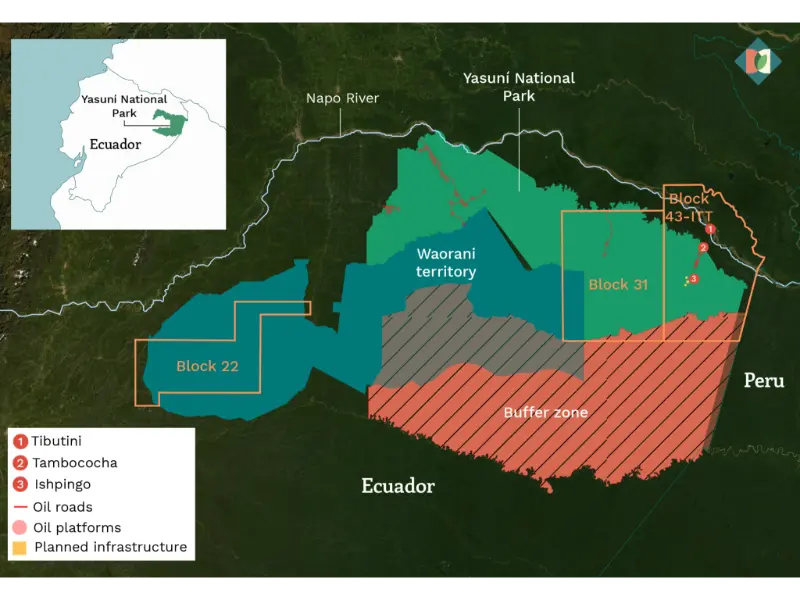
Environmental and Indigenous groups in Ecuador are escalating their threat of action against President Daniel Noboa as the country prepares to shut down oil production at block 43-ITT, following a referendum that called for the closure of the project. This decision comes after a majority of Ecuadoreans voted to shutdown the 43-ITT block to protect the Yasuni reserve in the Amazon, with the country’s top court granting one year for the removal of oil infrastructure in the region.
Environment, Indigenous rights clash with economic concerns over oil shutdown
President Noboa has recently suggested the postponement of the block’s closure, citing the need for resources to finance a military offensive aimed at tackling criminal gangs he has labeled as terrorists amid rising violence. This move has sparked strong reactions from environmental advocates and Indigenous leaders, who have highlighted the potential repercussions of disregarding the will of the people as expressed through the referendum.
Pedro Bermeo, representing the environmental advocacy group Yasunidos, which initiated the referendum, warned that failure to comply with the people’s will could lead to legal action, including potential criminal charges. Similarly, Leonidas Iza, president of Ecuador’s largest Indigenous group, Confederation of Indigenous Nationalities of Ecuador (CONAIE), threatened to pursue the case through Ecuador’s top court and the Inter-American Commission on Human Rights (IACHR) if necessary. He emphasized the importance of respecting the outcome of the referendum, asserting that it is crucial for upholding the rights of Indigenous communities and demonstrating a commitment to inclusive governance and environmental stewardship.
The potential economic impact of closing the block is also a significant concern, with estimates suggesting a cost of approximately $13.8 billion over the next two decades and a loss of 12% of the country’s oil output, averaging about 492,000 barrels per day. However, advocates for Indigenous rights argue that these considerations must be weighed against the broader implications for environmental conservation and the rights of Indigenous communities.
As tensions escalate, the government’s response to these mounting pressures remains uncertain, setting the stage for a potential standoff between the administration, environmentalists, and Indigenous groups.
The outcome of this conflict will not only shape the future of oil production in Ecuador but also carry significant implications for environmental protection and Indigenous rights in the region.
Also read: Carbon trading explained: Top 4 carbon emission exchanges in 2024