
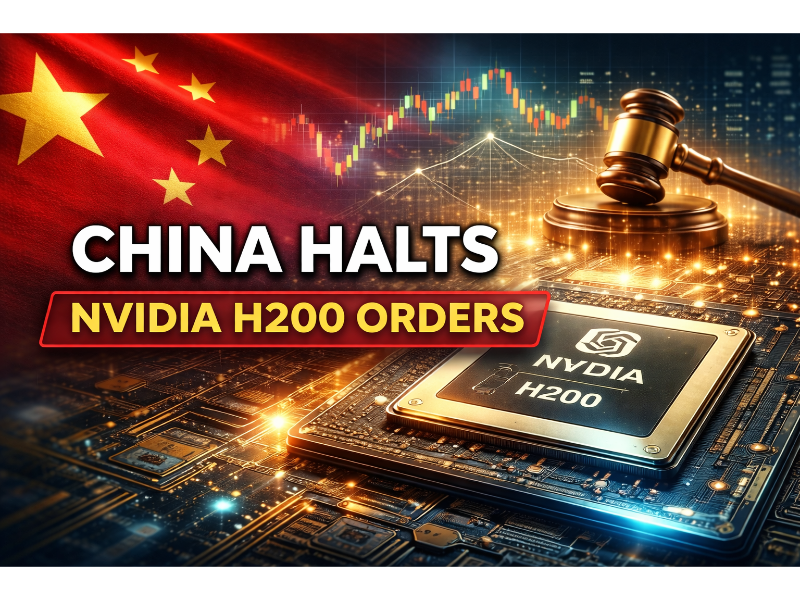
- China has reportedly asked some domestic tech companies to stop ordering Nvidia H200 AI chips this week.
- The pause reflects Beijing’s caution as it weighs import approvals and boosts domestic chip innovation.
What happened?
Beijing has instructed certain Chinese technology firms to suspend new orders for Nvidia’s H200 artificial intelligence chips this week, according to a report citing insiders.
The request comes as Chinese regulators evaluate whether to formally allow access to the high‑performance US‑designed chips and decide under what conditions they should be permitted.
The H200 is one of Nvidia’s most advanced AI data‑centre chips, designed for deep learning and large‑scale model training, and commands strong international demand. Nvidia’s chief executive has said demand for the H200 in China remains high.
In the United States, export controls on advanced semiconductors to China were recently adjusted by the US government, allowing H200 sales under certain conditions, including a 25 per cent revenue share for the US.
Chinese companies had reportedly placed large orders for the chips, but Beijing’s pause aims to prevent premature stockpiling ahead of final policy decisions and is seen as part of efforts to encourage adoption of domestic AI semiconductors.
Why it’s important
The move signals how semiconductor supply and trade have become key geopolitical battlegrounds in US‑China technological competition. The H200, as part of Nvidia’s cutting‑edge AI lineup, sits at the centre of these tensions.
Beijing’s request raises several important questions about policy clarity and industry impact. For example, what criteria will Chinese regulators use to decide whether to approve imports of advanced foreign‑designed chips? And how might this affect China’s broader strategy to reduce dependence on US technology while still meeting the needs of its rapidly growing AI sector?
It also highlights uncertainty for global chip firms and their customers. Nvidia has adjusted its China business terms, requiring full upfront payment for H200 orders due to regulatory risk.
With China keen to stimulate its own semiconductor industry alongside maintaining stable supply chains, this episode underscores the complex balance between market openness and strategic self‑reliance in a fractured global tech landscape.
Also read: Trump allows Nvidia AI chip exports to China
Also read: US clears Nvidia chip exports to China: A volatile turn in global AI supply