
Institution Profiling / Internet infrastructure institution

China enforces 50% domestic equipment rule for chipmakers to boost local supply chain

China enforces 50% domestic equipment rule for chipmakers to boost local supply chain is tracked as a internet infrastructure institution within the internet infrastructure ecosystem.

China enforces 50% domestic equipment rule for chipmakers to boost local supply chain
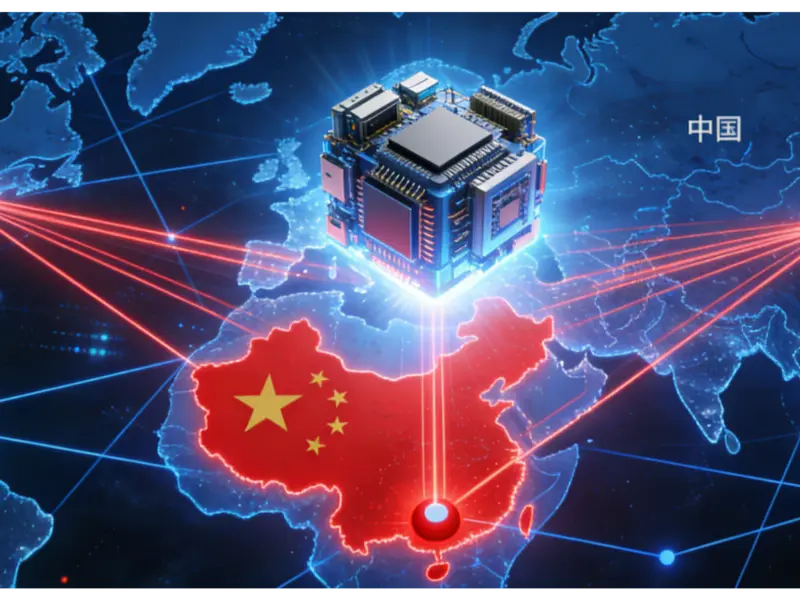
Caption: China enforces 50% domestic equipment rule for chipmakers to boost local supply chain · Source context: featured article image · Relevance reason: visual context for China enforces 50% domestic equipment rule for chipmakers to boost local supply chain · Image provenance: BTW media library

Sources

Public references used for this article.

CategoryInstitution

China enforces 50% domestic equipment rule for chipmakers to boost local supply chain is tracked as a internet infrastructure institution within the internet infrastructure ecosystem.

RegionAsia Pacific

China enforces 50% domestic equipment rule for chipmakers to boost local supply chain has public-source relevance to network operations, governance, dependency mapping, or market structure.

Signal FocusInternet infrastructure institution

China enforces 50% domestic equipment rule for chipmakers to boost local supply chain has public-source relevance to network operations, governance, dependency mapping, or market structure.

Content TypeProfile

China enforces 50% domestic equipment rule for chipmakers to boost local supply chain is tracked as a internet infrastructure institution within the internet infrastructure ecosystem.

Primary DomainGovernance

Public-source signals support medium-impact monitoring for infrastructure visibility and dependency analysis.

TopicInternet infrastructure institution

China enforces 50% domestic equipment rule for chipmakers to boost local supply chain is profiled by BTW Media because published evidence links it to internet infrastructure, governance, operational dependencies, or market visibility.

ImpactMedium

Public-source signals support medium-impact monitoring for infrastructure visibility and dependency analysis.

Confidence?Confidence Grade
0.90–1.00AHigh — direct sources
0.75–0.89A/BStrong
0.55–0.74B/CMedium
0.35–0.54C/DWeak–medium
0.10–0.34DWeak signal
0.00–0.09DInternal monitoring
Limited confidence (80%)

Several public sources

China enforces 50% domestic equipment rule for chipmakers to boost local supply chain is profiled by BTW Media because published evidence links it to internet infrastructure, governance, operational dependencies, or market visibility.

• China is requiring chipmakers seeking to build or expand production capacity to procure at least fifty % of their equipment from domestic suppliers, a move aimed at enhancing semiconductor self-sufficiency.
• The rule, part of a broader “whole nation” strategy, is reshaping procurement and may squeeze foreign tool makers, though flexibility remains for advanced lines where local technology is limited.


What happened: Beijing mandates 50 % domestic equipment for new and expanded chip capacity

China is mandating that semiconductor manufacturers must use at least 50 % domestically made equipment when building or expanding chip production facilities, according to three people familiar with the matter who spoke to Reuters.

The requirement is not yet publicly documented, but firms seeking state approval to add capacity have been told that procurement tenders must demonstrate that half of the equipment they plan to use will be sourced from Chinese suppliers. Authorities typically reject applications that fail to meet the threshold, although they allow flexibility where local technology is not yet available, particularly for advanced chipmaking lines.

The rule forms part of China’s broader “whole nation” approach championed by President Xi Jinping, intended to reduce reliance on foreign semiconductor technologies amid tightened U.S. export controls introduced in 2023 that restricted sales of advanced chips and manufacturing tools to Chinese companies.

By enforcing the domestic content rule through procurement tenders, Beijing is encouraging companies to replace foreign equipment from the United States, Japan, South Korea and Europe with locally developed alternatives wherever possible.

Chinese equipment makers are already responding. For example, Naura Technology is testing its etching tools on a seven-nanometre production line at Semiconductor Manufacturing International Corporation (SMIC), while rival Advanced Micro-Fabrication Equipment (AMEC) has reported strong growth, suggesting a rapid advancement of local capabilities as these firms seek to meet the procurement thresholds.

Also Read: China-backed hackers intensify cyberattacks on Taiwan chipmakers
Also Read: Japanese chipmaker Kioxia plans Tokyo IPO to fuel growth

Why it’s important

China’s new domestic equipment requirement is one of the most significant policy measures introduced to this point in its drive to build a self-sufficient semiconductor supply chain. By forcing a shift towards Chinese equipment makers, the rule has the potential to reshape global chipmaking supply chains, particularly in a market that was previously dominated by foreign suppliers such as Lam Research and Tokyo Electron.

While domestic producers have made strides in areas such as etching and cleaning tools, analysts caution that local technology still lags in several high-end segments dominated by foreign equipment makers, raising questions about long-term competitiveness if the rule is tightened further or extended to more advanced lines.

The policy also reflects broader geopolitical tensions, especially between China and the United States, where export controls have sought to limit Beijing’s access to advanced semiconductor technologies. Observers might question whether protectionist procurement mandates, even with flexibility for advanced processes, will accelerate indigenous innovation or instead create inefficiencies and distort global competition.

Moreover, while the procurement mandate may benefit local firms in the short term, it could also dissuade foreign investment or participation in China’s burgeoning chip industry if companies perceive increased barriers to market access. This dynamic underscores the uncertainty facing multinational semiconductor equipment makers and chip producers navigating an increasingly fragmented global technology landscape.

At A Glance

  • Name: China enforces 50% domestic equipment rule for chipmakers to boost local supply chain
  • Type: Internet infrastructure institution
  • Base: Asia Pacific
  • Profile focus: Institution

What It Does

  • Public records support monitoring of its role, services, and key relationships.

Why It Matters

  • Public-source signals support medium-impact monitoring for infrastructure visibility and dependency analysis.
  • Operational criticality: Medium
  • Time horizon: Next quarter

What To Watch

  • Monitoring focuses on verified service continuity, governance changes, and relationship signals.
NowMedium priority

Track verified source updates, role changes, and current public evidence.

QuarterMedium policy sensitivity

Public-source signals support medium-impact monitoring for infrastructure visibility and dependency analysis.

YearNext quarter outlook

Longer-term relevance depends on verified operating, policy, and relationship changes.

Member Briefing

Deeper Profile Context

Login is required to unlock the full profile briefing and source notes.

Only for Strategy Circle

Strategic Circle Access

Open to all readers. Unlock profile briefings after joining and logging in.

Join Strategic Circle

Only for Leadership Alliance

Leadership Alliance Access

For owners and management of IP-holding companies. Login required to unlock.

Join Leadership Alliance
← BackAll Companies