
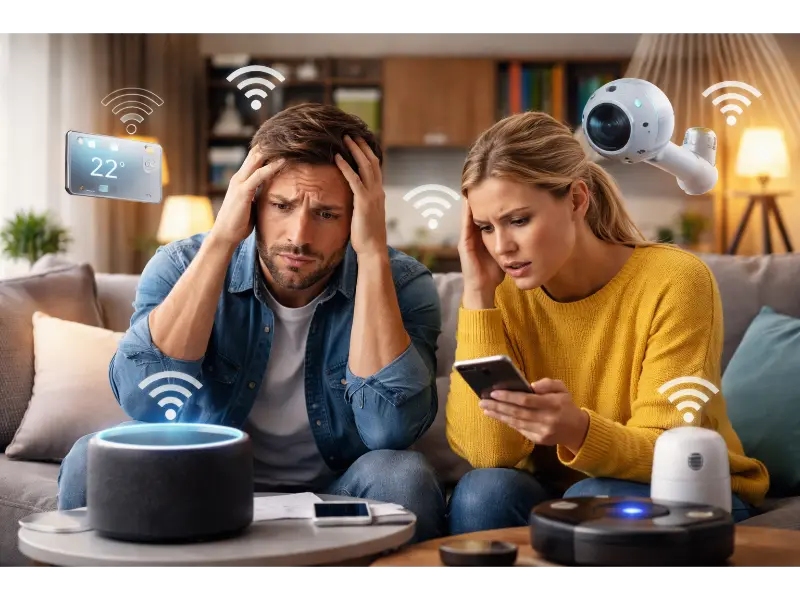
A recent survey from the TechUK association highlights that UK consumers are experiencing significant confusion and frustration with managing their smart home devices. While adoption rates are high, interoperability issues and complex interfaces hinder user satisfaction. This challenge could slow future growth if not addressed.
- A Kantar online survey for Unilever Home Care questioned 1,279 UK respondents aged 16 and over from 19 to 23 February 2026; it was not a techUK survey of more than 2,000 households.
- Unilever reported that 70% of smart-device owners had sometimes felt overwhelmed managing the technology and 36% spent more than an hour a day maintaining devices.
- The survey accompanied the launch of Persil and Comfort products for automatic-dosing washing machines, so its methodology and the sponsor’s commercial interest must remain visible.
What the survey actually found
Telecoms.com reported on 24 March 2026 that the research came from Unilever and had been conducted by Kantar over several days in February. A later Unilever news release distributed by PR Newswire provides the methodology: 1,279 nationally representative UK respondents aged 16 and over were surveyed online between 19 and 23 February.
Unilever said 31% of Britons planned to buy a smart device in the following year and 46% believed smart technology improved their quality of life. Among smart-device owners, 70% said they had sometimes felt overwhelmed by using and managing it, while 36% said they spent more than an hour a day maintaining devices. The release also reported that 74% of parents and 74% of Gen Z respondents felt overwhelmed, and that 42% of parents said technology could get in the way of time with friends and family.
Those figures replace claims in the earlier article that techUK surveyed more than 2,000 households, that 43% found setup frustrating or very difficult, and that the share rose to 61% among people over 55. The available source does not support those numbers. Nor does it support the former claims that fewer than 15% of UK users know Matter or that a stated number of devices had been certified by early 2026.
The limits of “overwhelmed”
The finding concerns owners who said they had sometimes felt overwhelmed. It does not say that 70% are continuously unable to operate their homes, that they stopped using devices, or that they plan to abandon the category. The positive answers on purchase intention and quality of life show that enthusiasm and burden can coexist.
The public release does not provide the questionnaire, weighting tables, margin of error, the number of smart-device owners within the 1,279-person sample, or the bases for the parent and Gen Z subgroups. It also does not define what counted as a smart device or “maintenance,” or separate updates, settings, cleaning, troubleshooting and ordinary appliance care. Without those details, the subgroup percentages and the claim of more than an hour a day cannot be independently audited.
This was a cross-sectional self-report survey. It can measure reported attitudes, but it cannot prove that platform fragmentation caused the burden, that poor connectivity was responsible, or that feeling overwhelmed will reduce adoption. Interoperability may be one source of friction, but the cited survey summary does not isolate it.
Who commissioned the research, and why
The survey was conducted by Kantar for Unilever Home Care. Unilever released the findings while launching Persil and Comfort Smart Series detergent and conditioner for automatic-dosing washing machines, developed in collaboration with Samsung and recommended by Samsung. The campaign’s argument was that households did not need another gadget; they needed products designed to work with smart appliances.
That commercial relationship does not make the responses false. It does mean the sponsor selected, framed and published findings that supported a product launch. The full questionnaire and tables would be needed to judge question order, wording and which results were not publicised. Telecoms.com explicitly described the research as the pretext for marketing the new laundry products, providing an independent warning against reading the release as neutral market research.
Independent context is more mixed
NIQ’s 2024 UK Smart Home Survey found that 80% of consumers owned at least one smart-home product and 38% of households owned three or more. It identified cost as the largest barrier to further growth, with privacy and lack of understanding also important. This supports a large and growing installed base, but not the proposition that all users are dissatisfied.
A separate Information Commissioner’s Office survey of 2,080 UK adults in May 2026 found that only 14% clearly understood how smart devices collected and used personal data, while 33% lacked confidence in their understanding. The ICO’s study concerns privacy comprehension, not device management, and should not be merged with Unilever’s “overwhelmed” measure. Together they show several distinct burdens: time and attention, product understanding, privacy and security.
What providers can control
Device makers and platforms control onboarding, account requirements, app design, compatibility, update support, data permissions and the quality of failure messages. Retailers, telecom providers and installers can control advice and support. Standards can reduce some integration friction, but no protocol removes poor interfaces, abandoned products, weak support or excessive data collection.
What to watch
Look for publication of the Kantar questionnaire, weighting and subgroup bases; independent replication by a consumer body or regulator; results broken down by number of devices, brands and household type; and behavioural measures such as returns, support contacts, disconnected devices and abandonment. Those measures would show whether a campaign-friendly expression of frustration represents a durable market problem.
Member Briefing
Deeper Profile Context
Sign in with the right membership level to unlock the full briefing and source notes.
Only for Strategic Circle
Strategic Circle
Open to all readers. Unlock profile briefings after joining and signing in.
Join Strategic CircleOnly for Leadership Alliance
Leadership Alliance
For qualified IP-asset owners and management; sign in to unlock alliance briefings.
Join Leadership AllianceSnapshot
Category
InstitutionRegion
Europe & Middle EastSignal Focus
GovernanceContent Type
ProfilePrimary Domain
SecurityTopic
GovernanceImpact
MediumConfidence
Limited confidence (80%)Confidence score guide
Several public sources