
Summary
- Blackfoot Telephone Cooperative, Inc. is best read as a local access and field-support business: the customer buys a working connection, a home or business cut-over, managed equipment, voice continuity and a nearby support response, not only a quoted Mbps number.
- The strongest public evidence is official and operational rather than financial: Blackfoot describes a 70-plus-year Missoula-based cooperative, member ownership in western Montana, residential fiber and DSL plans, small-business tiers, enterprise managed-network services, carrier services, a 9,000-square-mile core network, copper replacement, tariffed access service and number-resource records tied to Blackfoot Telephone Cooperative.
- The commercial stress is substitution. National operators, mobile broadband, satellite, another local provider, private links and delayed installation can all look cheaper than a full Blackfoot account until the buyer prices property access, a cut-over visit, outage recovery, upstream diversity, support continuity and the risk of losing a customer or workday.
- The public record cannot prove margin, churn, take rate, support response, outage history, utilisation or customer retention. Those missing facts are not a footnote; they are the facts that would decide whether the cooperative's local premium is economically earned.
A missed cut-over is the real opening bill
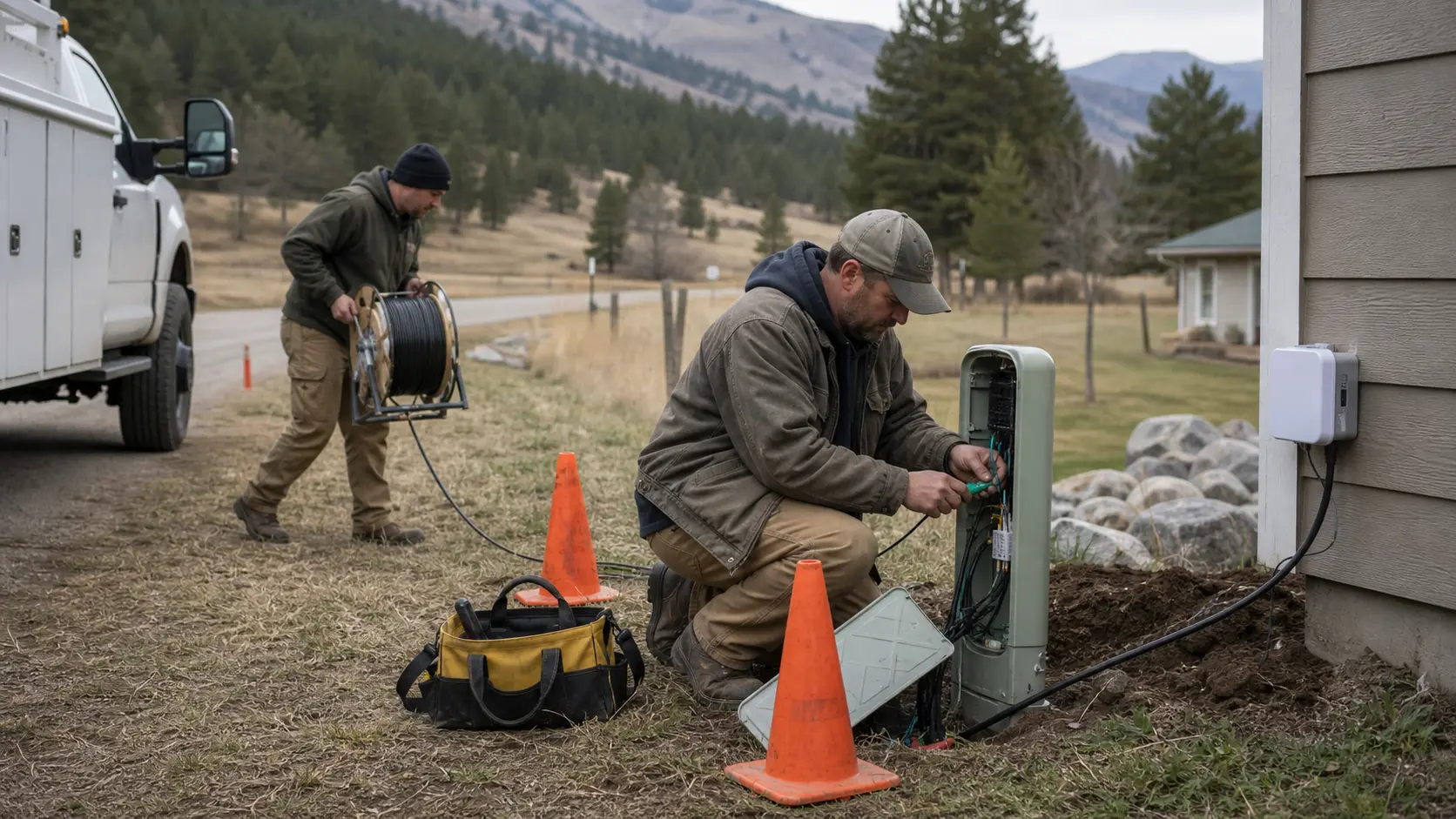
Imagine a small lodge near a mountain road, a clinic office with an unreliable legacy line, or a household that has waited months for a fiber drop. The posted internet price is the number the buyer can compare in minutes. The operating cost appears only when the installation is delayed, the property owner has not signed the access form, the copper line is being retired, the phone service needs battery backup, or a video appointment and a card terminal fail on the same morning. At that point the customer is not buying abstract broadband. The customer is buying somebody's ability to make a remote property usable.
That is the economic frame for Blackfoot Telephone Cooperative, Inc., the cooperative entity behind Blackfoot Communications. Blackfoot says it is headquartered in Missoula, Montana, named after the Blackfoot River, and has been creating connections for more than 70 years (https://blackfootcommunications.com/about/). It says residential services include voice, broadband and fiber-based connectivity for homes in western Montana and eastern Idaho, and that customers in western Montana who purchase service from Blackfoot are members of the cooperative and part-owners in the company (https://blackfootcommunications.com/about/). The business therefore sits between two models: a member-owned rural access utility and a diversified regional communications provider.
The paid unit is a local access and field-support account. The cheaper substitutes are a national operator, mobile broadband, satellite, another local ISP, an in-house private link, or a postponed installation. The cost driver is not only internet capacity; it is the labour and capital needed to build and maintain drops, retire copper, operate support, manage upstream capacity, coordinate cut-overs, and retain customers whose alternative expectations are set by national retail prices.
The strongest evidence class is Blackfoot's own service pages, network-upgrade notices, tariff library, business-service pages, carrier-service claims and ARIN/RIPEstat number-resource records. The three proof categories still missing are economics, reliability and retention: public sources do not disclose margin by product, utilisation, outage history, support response, customer count, churn, or renewal outcomes.
That missing evidence is part of the commercial mechanism. A rural provider can look expensive if the analyst divides monthly price by advertised speed. It can look inexpensive if the analyst prices truck rolls, support calls, customer downtime, upstream diversity and the cost of serving low-density terrain. Blackfoot's public record is strongest when it shows physical work: fiber drops, property access, copper retirement, construction partners, business continuity and tariffed access. It is weakest when it asks the reader to infer performance quality from brand language, testimonials or awards.
The entity is a cooperative with a wider commercial surface
Blackfoot's identity matters because the buyer is partly pricing governance. The company says it began as a cooperative and that those roots remain, with western Montana customers who purchase services becoming member-owners (https://blackfootcommunications.com/about/). Its leadership page says the Board of Trustees is legally responsible to the members of Blackfoot Telephone Cooperative for organizational management, usually meets monthly, employs a chief executive for day-to-day management, and is elected through the annual member meeting (https://blackfootcommunications.com/about/leadership/). The same page lists nine districts covering cooperative communities such as Condon, Seeley Lake, Drummond, Philipsburg, Avon, St. Ignatius, Plains, Alberton, Noxon, Superior and nearby Idaho territory (https://blackfootcommunications.com/about/leadership/).
That governance surface does not prove service quality. A member-elected board can still face high construction costs, limited labour supply, rising customer expectations and the same wholesale-market pressures as any regional ISP. But it changes the implied bargain. A national carrier may sell a low headline price and route the complaint through a remote support process. Blackfoot's cooperative claim tells the customer that the service is embedded in local communities and that board districts cover the places where the access network has to work.
The wider Blackfoot brand is more diversified than a pure residential cooperative. Its corporate page says Blackfoot connects businesses using voice, network and managed services, provides dedicated account management, and offers carrier services for peer telecoms and regional cellular providers (https://blackfootcommunications.com/about/). The enterprise site says Blackfoot delivers managed network, security and voice services through certified experts using an advisory, deployment, ongoing support and administration model (https://blackfootbusiness.com/). The carrier-services site says Blackfoot Carrier Services is a division of Blackfoot Communications and provides wholesale infrastructure and services to network partners (https://blackfootcarrierservices.com/).
That diversification creates context but not proof of margin. A carrier-services page can show that Blackfoot sells wavelength, Ethernet, fixed wireless, construction, network-to-network interfaces, engineering, regional backhaul, dark fiber, cellular backhaul, IP transit and private-line services (https://blackfootcarrierservices.com/). It cannot show whether a specific residential or small-business local-access account is profitable. The right conclusion is narrower: Blackfoot has multiple commercial surfaces around the same operating base, so field labour, fiber plant, upstream relationships and support capacity can support more than one revenue line.
Residential pricing bundles support into the line
Blackfoot's residential page is revealing because it does not sell bandwidth as a naked commodity. It advertises home internet and phone service for western Montana and eastern Idaho, with address-based availability and change-service workflows (https://www.blackfoot.com/). The captured residential plan examples include DSL or fiber labels, Social Broadband at 15 Mbps download for $63 per month, Stream Broadband at 25 Mbps for $83 per month, and Connected Home at 40 Mbps for $98 per month, with terms noting that prices exclude taxes and fees and that availability varies by service area (https://www.blackfoot.com/).
Those prices are not metropolitan fiber-bargain prices. They are the visible part of a rural-support bundle. Blackfoot says plans include state-of-the-art equipment, equipment replacement coverage, added security, firmware updates, remote support, free device replacement, inside wiring repair and a mobile app (https://www.blackfoot.com/). That list is central to the thesis. The product is not simply "15 Mbps" or "40 Mbps." It is equipment ownership or support, firmware responsibility, remote management, inside-wiring repair and customer assistance wrapped around the access line.
The phone line also shows the continuity logic. Blackfoot advertises residential phone service in Montana and Idaho, with Premium Voice at $36 per month and Basic Voice at $26 per month in Montana or $25 in Idaho, plus calling features such as voicemail, call waiting, call forwarding and caller ID depending on plan (https://www.blackfoot.com/). Voice may no longer drive the growth story in the way it once did, but in rural access economics it still matters because copper retirement, emergency expectations, elderly users, business numbers and battery backup make voice continuity part of the transition cost.
The buyer can always compare those prices with mobile hotspot offers, satellite retail claims or another ISP's promotion. But the comparison is incomplete if it ignores the service bundle. A national mobile plan may be cheaper for a light user. Satellite may offer higher peak speeds at a hard-to-reach home. Another local provider may discount installation. A delayed installation may look rational if the household can survive on a phone hotspot for another season. Blackfoot's case is that the customer should value a managed local account because the next problem may require a support and field response, not only a speed-test result.
Fiber replacement makes the labour cost visible
The clearest evidence of Blackfoot's cost base is its fiber-upgrade program. Blackfoot's network-upgrades page says the company began an extensive, multi-year, multi-million-dollar project in 2017 to replace aging copper portions of its network with fiber optics (https://blackfootcommunications.com/networkupgrades/). The same page says fiber-based services provide broadband speeds of 1 Gbps or more, voice and advanced services, and that Blackfoot plans to bring fiber-based broadband to all cooperative members in the coming years (https://blackfootcommunications.com/networkupgrades/).
The work is property-level, not just backbone-level. Blackfoot tells customers that building a fiber network requires constructing new fiber drops directly to homes or businesses, entering property to plow new fiber lines, and eventually decommissioning and shutting off copper as replacement fiber is built (https://blackfootcommunications.com/networkupgrades/). It says customers need to complete a property-access consent form or call customer care before construction begins, and that crews may work on property for a day or two before a later inside cut-over visit (https://blackfootcommunications.com/networkupgrades/).
That disclosure matters more than a generic fiber announcement. It shows why a rural access account is costly. There is planning, property permission, trenching or plowing, restoration, scheduling, customer communication, equipment installation, inside cut-over and the risk that a customer who fails to sign consent or schedule the cut-over loses service when copper ends. Blackfoot's page lays out a communications timeline for copper decommissioning, including notices at 119, 90, 60 and 30 days before the end date and disconnection orders after the copper end date for customers who have not provided consent or scheduled cut-over (https://blackfootcommunications.com/networkupgrades/).
The battery-backup section is another cost clue. Blackfoot explains that old copper phone lines carried a small electric current, while fiber phone service will fail in a power outage unless a battery backup is used; it lists a $250 cost for the optional battery backup and notes that the battery is intended to power telephone service, not internet (https://blackfootcommunications.com/networkupgrades/). A cheaper access substitute may ignore that issue. A cooperative moving legacy voice customers to fiber has to explain it, sell or support the battery option, and manage expectations when power fails.
The page also names construction partners. Blackfoot says it hired Diversified Solutions and Mid-State Consultants to work alongside it on rural fiber, where rugged terrain and spanned distances between connections create challenges (https://blackfootcommunications.com/networkupgrades/). That is not a margin disclosure. It is a visible supplier and labour signal. Rural fiber replacement requires outside engineering and construction capacity, and those costs must be recovered through customer revenue, subsidy, cross-service economics or long-term retention.
Subsidy lowers the build burden but raises the delivery burden
Blackfoot says it received ConnectMT grants from the state of Montana in late 2022 to build fiber broadband in several cooperative areas, using the grants together with its own capital to reach more locations (https://blackfootcommunications.com/networkupgrades/). It also says it was selected through the Rural Digital Opportunity Fund process to deliver broadband to specific unserved and underserved service areas, with builds limited to areas won under strict FCC guidelines (https://blackfootcommunications.com/networkupgrades/).
Public funding changes the economics but does not remove the operating risk. A grant can reduce the capital cost of a rural build, improve the business case for thin-density territory and accelerate copper replacement. It can also create deadlines, reporting obligations, defined locations and customer expectations. Blackfoot's own RDOF answer says its bid was for specific areas within its service territory and that it would build to those areas only at the time, while taking advantage of new public and private funding opportunities when they arise (https://blackfootcommunications.com/networkupgrades/). The public money therefore narrows as well as expands the plan: customers near a project may not be included if the awarded area does not cover them.
That matters for churn risk. A household just outside a build area may compare Blackfoot with satellite, mobile or another fixed provider and decide the wait is not worth it. A household inside a build area may still be irritated by property access, cut-over scheduling or temporary disruption. A business may care more about completion date than the grant source. The subsidy story supports the long-term case for Blackfoot's fiber platform, but customer retention depends on execution at the property edge.
Blackfoot's timeline makes the multi-year nature explicit. The network-upgrade page lists work across places such as Plains, Thompson Falls, Island Park, Georgetown Lake, Anaconda, Philipsburg, Alta, Darby, Drummond, Bitterroot and Potomac, with some projects beginning, continuing, completing or planned across 2021 through 2026 (https://blackfootcommunications.com/networkupgrades/). Those dates should be treated as project guidance rather than proof of completed service at every address. They still show the scale of the transition: Blackfoot is managing a rolling construction and migration program, not a one-off upgrade.
The commercial judgement is therefore conditional. If the cooperative converts copper customers to reliable fiber without losing them to substitutes, the old network liability becomes a retention asset. If the migration is slow, confusing or costly, the same transition becomes an opening for satellite, mobile broadband and national operators. The facts that would settle the question are not public: completed locations, failed installations, customer refusals, service interruptions during cut-over, churn by project area and the cost per retained account.
Small businesses buy continuity, not just a plan tier
Blackfoot's small-business site is designed around the always-on claim. It advertises internet, voice, Wi-Fi and support for small businesses, with fiber packages such as 200/200 Mbps, 500/500 Mbps and 1000/1000 Mbps where available, and DSL packages such as 25 Mbps and 40 Mbps in other markets (https://blackfootsmallbusiness.com/). The page says fiber is not available in all markets, and it positions packages around point-of-sale systems, video conferencing, cloud applications, file sharing and employee counts (https://blackfootsmallbusiness.com/).
The included feature list is more important than the speed table. Blackfoot says small-business plans include a mobile app, brandable customer Wi-Fi portal, network access control, dedicated POS connection for compliance, business and staff Wi-Fi, network-resilience internet backup, and business network security and content filtering (https://blackfootsmallbusiness.com/). That is the field-support thesis translated into a commercial account. A restaurant, motel, clinic, small office or contractor is not just buying a pipe. It is buying separate guest and staff access, a payment-system path, backup, security filtering and help turning broadband into a usable business network.
The voice product has the same continuity logic. Blackfoot says business voice services offer local calling, unlimited long distance, voicemail and VoIP options that allow a team to take the phone system with it through a mobile app (https://blackfootsmallbusiness.com/). Again, the economics are not a speed-only calculation. A cheap line that cannot keep a phone number, payment terminal, guest Wi-Fi and staff network working through an outage is not necessarily cheaper in business terms.
The risk is that small-business expectations rise quickly. A small business with fewer than five employees may accept 200/200 Mbps if fiber is available; the same buyer may be dissatisfied with 25 Mbps DSL if a satellite or national operator promises higher headline speeds. A customer may also pay for a backup feature only after one outage has already created a loss. The provider's challenge is to price the support bundle before the customer can see the avoided cost.
Blackfoot's broadband-label reference shows the regulatory and sales-pressure context. The small-business page says its Broadband Labels provide clear information on pricing, speeds and data allowances to help businesses compare services (https://blackfootsmallbusiness.com/). Labels make comparison easier, which is good for consumers and painful for providers whose differentiation depends on service labour that is harder to put in a label. The label tells the buyer what the plan promises; it cannot tell the buyer how much a support visit, a replacement device or an outage response is worth until something goes wrong.
For a small business, the account is also a retention instrument. A proprietor who has Blackfoot internet, voice, guest Wi-Fi, staff Wi-Fi, POS separation, backup and security filtering is less likely to switch casually than a household with one modem. The switching cost is not a contractual penalty alone. It is the risk of reconfiguring payment terminals, changing voice features, rebuilding Wi-Fi separation, explaining downtime to staff and customers, and losing the one provider that knows how the site is wired. The provider's margin depends on whether that switching cost is experienced as useful continuity or as lock-in.
The difference is evidence-sensitive. If Blackfoot answers quickly, replaces equipment, explains outages and completes cut-overs cleanly, the bundle earns its price. If the support experience is slow, the same bundle becomes a reason for frustration because the customer feels dependent on a provider that is not performing. This is why customer-retention data would matter more than plan-price comparisons. A customer who renews after a difficult repair has effectively paid for local support. A customer who leaves after fiber arrives has treated the old support promise as transitional.
The service page also suggests why Blackfoot must serve multiple customer sizes without turning every account into a custom project. Very small businesses need the simplicity of a packaged tier. Larger local businesses need backup, managed security, voice and perhaps multiple sites. Seasonal or tourism-linked businesses may need more support during peak months than during quiet months. A regional provider has to standardize enough to keep costs under control while remaining local enough to justify the premium. That is a hard operating balance because every support escalation can erase the margin from several monthly bills.
The most important private fact would be attachment. How many small-business access customers also take voice, managed Wi-Fi, backup or security? If attachment is high, Blackfoot can defend the account through service depth. If attachment is low, it remains exposed to speed-and-price competition. Public pages show the menu. They do not show what customers actually buy.
Enterprise service broadens the support promise
Blackfoot's enterprise site makes the account-management model explicit. It says services are delivered by certified experts through advisory, deployment, ongoing support and administration, whether in Blackfoot's data center or on customer premises (https://blackfootbusiness.com/). It also says Blackfoot offers in-house NOC solutions with 24/7 monitoring and proactive network management for select businesses (https://blackfootbusiness.com/). For larger accounts, the paid unit is closer to a managed service than a broadband subscription.
The network-services page says Blackfoot's core network spans more than 9,000 square miles across rural western Montana and eastern Idaho, designed for uptime, reliability, redundancy and geographic diversity (https://blackfootbusiness.com/services/network/). It says partnerships with network providers extend reach across 15 states, including Washington, Oregon, Idaho, Montana, Wyoming, the Dakotas, Utah, Colorado, Arizona, Minnesota, Nebraska, Iowa, Illinois and Kansas (https://blackfootbusiness.com/services/network/). It also says these partner relationships add carrier diversity if there is a carrier-wide outage (https://blackfootbusiness.com/services/network/).
Those claims are commercially meaningful but not independently conclusive. A 9,000-square-mile core network is a strong signal of regional footprint. A 15-state partner network is a signal of reach. But neither tells the reader utilisation, route diversity at a specific site, mean time to repair, or customer-specific service credits. The public claim supports the argument that Blackfoot can sell beyond last-mile access; it does not prove that every Blackfoot circuit has the same reliability profile.
Security services extend the account value. Blackfoot says its managed security offer includes managed firewall, vulnerability assessments, ongoing education and remote-work support through SASE concepts (https://blackfootbusiness.com/services/security/). Its partner page says Blackfoot and its partners deliver managed network, security, voice and collaboration solutions for enterprise businesses (https://blackfootbusiness.com/partners/). Those services create another retention mechanism: once Blackfoot manages connectivity, security and voice, the customer may face higher switching costs than with a bare internet line.
The enterprise business also changes supplier dependence. Blackfoot must maintain relationships with technology partners, security vendors, network providers, construction contractors and upstream carriers. That dependence can strengthen the offer if it gives a small regional provider enterprise-grade tools. It can weaken the margin if vendor costs, support obligations or partner outages sit between Blackfoot and its customer promises. Public pages identify the partner model; they do not disclose partner economics.
Enterprise work can also protect the rural access base by keeping technical talent, monitoring practices and vendor relationships inside the company. A technician who supports managed firewalls or multi-site networks may help the provider solve problems that a simple ISP would have to escalate elsewhere. A network operations function that watches enterprise circuits may improve incident awareness across the wider plant. A construction team that supports carrier backhaul may understand field constraints that also affect cooperative members. This is the positive version of diversification.
The negative version is distraction. Enterprise customers can demand formal service levels, faster escalation and more complex designs. Carrier projects can absorb construction capacity. Security products can create liability and support burdens. If those higher-value accounts pull scarce labour away from residential fiber migration, the cooperative side may feel neglected. The public record cannot show the internal allocation of crews, support hours or capital. It can only show that Blackfoot is trying to use one regional infrastructure and support base across residential, business, enterprise and carrier markets.
That choice is economically rational if shared costs are real. Fiber plant, upstream capacity, a support center, customer management systems, field vehicles, engineering staff and regulatory work all carry fixed or semi-fixed costs. More revenue streams can lower unit cost if they use the same base efficiently. But diversification does not automatically create economies of scope. If each product requires different vendors, certifications, tools, support scripts and sales effort, complexity may rise faster than revenue.
The outside analyst should therefore treat Blackfoot's broad offer as a strategic option, not as proof of scale advantage.
Carrier services show the upstream and wholesale layer
Blackfoot Carrier Services is the clearest public window into the company's wholesale logic. The site says Blackfoot is focused on carrier and wholesale infrastructure, helping network partners go to market faster, augment staff, cut costs and use Blackfoot products and processes (https://blackfootcarrierservices.com/). It says Blackfoot's redundant fiber network is connected to multiple Tier-1 internet providers and reliably carries service to more than 30,000 locations across the United States (https://blackfootcarrierservices.com/).
That sentence should be read carefully. It supports the existence of upstream diversity and wholesale reach, but it does not disclose which locations are on-net, which are partner-served, what service levels apply, or how much capacity is available. It is still a strong piece of evidence because it shows how Blackfoot wants to monetize its network beyond retail access. Carrier customers buy transport, backhaul, construction or IP services because they need a regional provider's plant and field knowledge.
The product list confirms the cost structure. Wavelength services run from 1 to 100 Gbps; Ethernet is offered up to 100 Gbps; fixed wireless is positioned as a rapid-deployment and often lower-cost alternative to fiber; construction includes underground and aerial plant, easements, permitting and right-of-way project management; regional backhaul connects traffic to data centers or major points of presence; cellular backhaul can use Ethernet, microwave or dark fiber (https://blackfootcarrierservices.com/). Those are not consumer features. They are the wholesale version of the same field-response problem: someone needs to build, connect and maintain infrastructure across a difficult geography.
This wholesale layer also disciplines the retail story. If Blackfoot has credible carrier services, then the cooperative's consumer and small-business customers benefit indirectly from network competence, construction experience and upstream relationships. If carrier workloads stretch the same crews and capital budget, retail customers may compete internally for attention. Public pages cannot settle that tradeoff. They show that Blackfoot has the operating surface to sell field response; they do not prove that the service organisation is always adequately staffed.
The "multiple Tier-1" claim is important for upstream dependence. A local access customer may not care which upstream carrier carries traffic, but the business customer will care when one provider has an outage or congestion. Blackfoot's public claim is that its network has redundancy and multiple upstream connections (https://blackfootcarrierservices.com/). The unanswered facts are capacity per upstream, actual failover performance, outage history, peering posture, transit cost and how much of the retail customer experience depends on partner networks.
Wholesale also introduces bargaining risk. A regional provider that can aggregate demand from residential, small-business, enterprise and carrier accounts has more reason to negotiate serious upstream and transport arrangements than a small access-only provider. Yet it still buys or partners for parts of the path it does not own. A Tier-1 provider, construction partner, dark-fiber counterparty, equipment vendor or cloud-security partner can affect cost and service quality. The customer sees one Blackfoot bill, but the operating result depends on a chain of suppliers.
This supplier chain is not inherently bad. It is how regional communications networks function. The question is whether Blackfoot can make the chain invisible to the customer in normal operations and visible only when diversity matters. If one upstream path fails and traffic moves cleanly, supplier dependence becomes a feature. If a partner outage leaves Blackfoot without enough control or communication, dependence becomes a liability. Public marketing language cannot settle that. Incident history, service credits and customer renewals would.
Carrier services create one more subtle advantage: they keep Blackfoot close to other networks' pain points. A company selling backhaul, construction and interfaces to other telecoms learns what mobile carriers, fixed providers and enterprise buyers need from the region. That intelligence may help it decide where to build, where to use fixed wireless, where to prioritize fiber and how to price business continuity. The risk is that those wholesale customers can also be competitors or substitutes in some contexts. A carrier that buys backhaul in one area may compete for retail customers in another.
Tariffs reveal the legacy economics under broadband
Blackfoot still carries the regulatory marks of a telephone cooperative. Its Forms, Tariff & Legal Notices page links to the Blackfoot Telephone Cooperative interstate access tariff, intrastate access tariff, ordering and billing database references and customer-service forms (https://blackfootcommunications.com/legal-tariff-forms/). Its Service Agreements page links to master service agreements, internet and e-commerce terms, product terms and a service-level agreement (https://blackfootcommunications.com/service-agreements/). These are not mere paperwork; they show how a local broadband provider still sits on regulated voice and access-service foundations.
The intrastate access tariff states that Blackfoot Telephone Cooperative, Inc. elected to mirror the John Staurulakis, Inc. tariff for terms, conditions and services for intrastate switched access services, with limited exceptions, and to mirror that tariff for intrastate special access services (https://blackfootcommunications.com/wp-content/uploads/2021/04/BTC-Intrastate-Tariff-4.1.2021.pdf). It lists Blackfoot Telephone Cooperative at 1221 N. Russell St., Missoula, MT 59808, and identifies Michelle Owens as regulatory specialist on the filing (https://blackfootcommunications.com/wp-content/uploads/2021/04/BTC-Intrastate-Tariff-4.1.2021.pdf).
The tariff also makes the decline of legacy traffic visible. It contains rules for identifying and rating VoIP-PSTN traffic, customer-provided traffic factors, audits and access rates by study area (https://blackfootcommunications.com/wp-content/uploads/2021/04/BTC-Intrastate-Tariff-4.1.2021.pdf). The FCC Electronic Tariff Filing System page for John Staurulakis, Inc. Tariff No. 1 shows access-services filings and a most recent submission dated February 3, 2025 (https://apps.fcc.gov/etfs/public/lecTariffs.action?idLec=37). This is the old intercarrier world that still underlies parts of the business, even while growth and customer attention move to fiber, managed services and security.
The economic implication is not that access charges are the main growth engine. The implication is that Blackfoot's cost and revenue base is layered. It has legacy voice and tariff obligations, copper retirement, residential broadband, small-business connectivity, enterprise managed services and carrier wholesale. That complexity can stabilize revenue if different services share infrastructure. It can also create management difficulty if old obligations consume attention while new competitors attack the growth segments.
The tariff evidence is strong but narrow. It proves regulatory participation and terms for access-service charging. It does not prove the profitability of access services, the volume of switched traffic, or the economics of broadband accounts. Any conclusion about margin has to remain conditional.
Number-resource evidence is useful only at the edge
Public number-resource records support Blackfoot's network reality but should not carry the commercial conclusion. ARIN's RDAP record for AS30374 lists the name MODWEST and includes Blackfoot Telephone Cooperative, Inc. as the registrant organization at a Missoula address (https://rdap.arin.net/registry/autnum/30374). RIPEstat's AS overview for AS30374 identifies the holder as "MODWEST - Blackfoot Telephone Cooperative, Inc." and, at the observed query time, marks the resource as not announced (https://stat.ripe.net/data/as-overview/data.json?resource=AS30374).
That evidence should be bounded. The autonomous system record helps confirm a public network-resource association and a Modwest/Blackfoot continuity thread. It does not prove active customer traffic, advertised prefixes, uptime, peering quality, transit contracts or the consumer experience. In fact, RIPEstat's not-announced status at the query time is a caution against using an ASN as proof of operating scale (https://stat.ripe.net/data/as-overview/data.json?resource=AS30374). The record is a registry and routing clue, not a business result.
For this company, official service pages are much stronger than the network-resource record. Blackfoot's own pages show active residential, small-business, enterprise and carrier offerings; the network-upgrade page shows copper-to-fiber migration; the tariff pages show regulated access-service context; the carrier-services page shows wholesale ambitions. The AS record belongs in the evidence stack as a bounded technical reference, not as the subject.
That distinction matters because it prevents an infrastructure article from turning into a registry entry. A customer does not buy AS30374. A customer buys a working home connection, a business network, a phone line, a fiber cut-over, a managed firewall, a private line or a backhaul service. The number-resource record can help validate that Blackfoot has been present in public internet registries. It cannot tell whether a lodge renews, a clinic stays online, or a household leaves for satellite.
Substitution is cheaper until the repair becomes local
The competitive question is direct: why would a customer pay Blackfoot rather than a cheaper or faster substitute? In rural access markets, the substitute set is broad. A household can use mobile broadband, satellite, another local ISP, a national operator where available, or simply delay installation while relying on a phone hotspot. A business can buy a private link, dual-source service, or a managed network from a national integrator. A carrier can use another regional transport provider or build its own route where traffic justifies it.
Blackfoot's answer is not that every posted price or speed beats every substitute. The residential plan examples on Blackfoot's own site are not the cheapest headline offers a U.S. consumer can find in a national advertisement (https://www.blackfoot.com/). The small-business DSL tiers will not look impressive next to fiber where fiber is already present (https://blackfootsmallbusiness.com/). The company's case is that western Montana and eastern Idaho customers often need a provider that understands the local plant, the cooperative footprint, the property-access process, the copper retirement schedule and the support need after installation.
Satellite is the easiest example. It can be attractive for hard-to-reach properties and may offer better headline performance than old DSL. It also transfers more installation, obstruction, equipment, power and troubleshooting responsibility to the customer. Mobile broadband can be cheaper for light use, but it may not be adequate for a business phone system, guest Wi-Fi, point-of-sale backup, multiple users or predictable rural coverage. A national operator can undercut price in a town, but it may not serve the same outlying road or offer the same local field relationship.
Another substitute is inaction. A customer may delay a fiber consent form, postpone a cut-over, or accept degraded copper for another season. Blackfoot's network-upgrade page makes that choice costly by saying copper will eventually be decommissioned and service can be disconnected if consent and cut-over are not completed (https://blackfootcommunications.com/networkupgrades/). The delayed-installation substitute is therefore not free; it is a bet that the customer can avoid the transition without losing service or business continuity.
The most serious competitive risk is customer expectation. Once a household sees national gigabit prices, satellite marketing or a nearby fiber build, it may view Blackfoot's service through a speed-first lens. Blackfoot has to keep moving the conversation back to total operating cost: support, equipment, wiring, backup, voice continuity, network resilience and the next outage. That argument works only if the support is actually good.
Geography makes the substitute question uneven. In a denser town, a national operator or cable provider may be a direct price competitor. In a remote road segment, satellite may be the only immediate alternative. In a business district, a private line or fixed wireless link may be rational if downtime is expensive. On a property waiting for a fiber drop, delay may be the substitute. Blackfoot's served communities do not present one competitive market; they present many small address-level markets. The same posted plan can be a bargain at one location and an irritation at another.
That address-level variation is why the company's address-check and availability flow matters even though it is not a performance metric (https://www.blackfoot.com/). The customer does not decide from a generic coverage map alone. The customer asks whether Blackfoot can serve this location, with this building, this existing copper or fiber path, this business need and this installation calendar. A national substitute may look cleaner in an advertisement because it does not reveal the site-specific work until later. Blackfoot's public fiber-upgrade material is less glamorous precisely because it exposes the messy part of rural access: consent forms, plowing, cut-over scheduling and service-ending notices.
The local-access account is therefore partly an option value. The customer pays to keep a provider engaged with the site before the next failure. That option is valuable when repair scarcity is real. It is less valuable when the customer has multiple reliable alternatives. A motel with guest complaints about Wi-Fi may value local repair more than a light residential user. A remote worker may value upload stability more than a low monthly price. A retired household may value voice continuity and inside wiring repair. A carrier may value construction and right-of-way knowledge.
Blackfoot's challenge is to price these different forms of value without losing customers who only see the base rate.
Churn risk is highest at transition moments. A copper retirement notice forces a customer to make a decision. A fiber construction delay creates a moment to search for satellite. A business outage creates a chance for a managed-service competitor to pitch redundancy. A mobile provider promotion can make a household test whether the phone network is now good enough. Blackfoot's retention task is not continuous in a smooth sense. It spikes around outages, installations, moves, price changes and technology upgrades.
Informal signals are thin and should stay weak
Informal market evidence is useful here only as a warning, not as proof. Blackfoot's residential page includes customer testimonials praising faster service, work-from-home reliability and download speed (https://www.blackfoot.com/). Its news page lists items such as a customer-service and support innovation award, low-latency network-path announcement, cybersecurity partnership and cooperative-month material (https://blackfootcommunications.com/news/). These signals are directionally relevant because they show the brand trying to sell support, reliability, security and local connection.
They are not independent performance evidence. A company-selected testimonial does not measure churn. A vendor or industry award does not prove support response. A news title about low latency does not disclose measured latency by route, customer class or time of day. A public map listing or online review page, where available, can colour reputation risk, but isolated reviews are noisy and often overrepresent unhappy or unusually pleased users. The article therefore treats informal signals as weak market colour: they show what customers and the company talk about, not what the network delivers.
That restraint is important because Blackfoot's strongest commercial claim is observable through harder sources. The fiber-upgrade page shows real construction and migration obligations (https://blackfootcommunications.com/networkupgrades/). The small-business page shows concrete feature bundles around POS, Wi-Fi, backup and security (https://blackfootsmallbusiness.com/). The enterprise and carrier pages show managed services, 9,000 square miles of core-network footprint, 15-state partner reach, multiple Tier-1 upstream connection language and wholesale transport products (https://blackfootbusiness.com/services/network/ and https://blackfootcarrierservices.com/). Those sources are still company-authored, but they describe operating commitments rather than mere sentiment.
The practical use of informal evidence is to sharpen the missing-proof list. If customers praise work-from-home reliability, the analyst should ask for outage minutes, latency and support response. If Blackfoot advertises customer service, the analyst should ask for call-answer time, truck-roll backlog and first-contact resolution. If a vendor recognizes support innovation, the analyst should ask whether retention improved. Market talk tells us what questions matter; it does not answer them.
Regulation is both protection and exposure
Rural communications policy helps providers such as Blackfoot because low-density service often cannot be justified by urban economics alone. ConnectMT grants and RDOF support, as described by Blackfoot, are examples of public or quasi-public mechanisms that help bring fiber to unserved and underserved locations (https://blackfootcommunications.com/networkupgrades/). Tariffs, access-service filings and public notices also give a regulated structure to network changes and intercarrier obligations (https://blackfootcommunications.com/legal-tariff-forms/).
The same framework exposes Blackfoot to compliance and customer-communication risk. Copper retirement requires notices, customer education, property access and care around voice continuity. Broadband labels make prices, speeds and data terms more visible. Service agreements and product terms create formal obligations and limitations. Public-funding areas define who is included and who is not. The provider has to do the paperwork and the fieldwork at the same time.
Regulation also changes competitive expectations. Subsidy programs do not only help incumbents. They can invite new entrants, alternative technologies and public scrutiny over whether awarded areas are actually served. Broadband-label rules make a 40 Mbps DSL line easier to compare with a satellite or mobile offer. Universal-service and access-charge regimes still matter to legacy voice economics, but they do not protect the provider from a household that simply wants a cheaper internet line.
Blackfoot's strategic risk is that it is judged by two clocks. The regulatory and construction clock is slow: grants, designs, right of way, property access, copper end dates and scheduled cut-overs. The customer clock is fast: remote work, streaming, card payments, school portals, telehealth and security cameras need service now. A regional ISP earns its premium if it can bridge those clocks with credible support.
The tariff and public-notice surface also makes Blackfoot more legible than many small access providers. A public tariff library, service agreements and copper-retirement explanations let customers, competitors and regulators see part of the operating frame (https://blackfootcommunications.com/legal-tariff-forms/ and https://blackfootcommunications.com/service-agreements/). Legibility can build trust because the company is explaining how service changes will happen. It can also invite criticism because every disclosed timeline, notice sequence or service limitation becomes a benchmark.
The copper-to-fiber transition is a good example. Blackfoot's explanation that fiber phone service needs customer power and optional battery backup is responsible disclosure (https://blackfootcommunications.com/networkupgrades/). It also reminds customers that the new network changes the resilience model. Copper's old power characteristics were not free; they were part of a legacy network with its own maintenance burden. Fiber can improve capacity and long-term reliability, but it shifts some outage responsibility to premises power and battery choices. A provider that fails to explain that shift risks anger after the first extended outage.
Broadband policy can subsidize construction, but it cannot subsidize patience indefinitely. When a public program helps fund a build, customers may expect faster completion or lower prices. When the provider says only certain awarded areas are included, nearby households may feel left out. When the company uses its own capital alongside grants, members may still ask why the bill is rising. These are not just public-relations issues. They affect take rate, member trust and the ability to convert a funded build into durable revenue.
What the public record can and cannot prove
The public record supports a measured conclusion. Blackfoot Telephone Cooperative, Inc. is a real cooperative-rooted regional communications provider with official residential, small-business, enterprise, wholesale, tariff and network-upgrade evidence. Its customer unit is not simply bandwidth; it is a managed local access account with field labour, equipment, voice continuity, upstream connectivity and support embedded in the price. The company's strongest business mechanism is the ability to convert local plant knowledge into customer retention while replacing copper with fiber.
The public record cannot prove whether that mechanism is working. It does not show active customer count, average revenue per user, margin by segment, grant reimbursement timing, cost per passing, cost per connected customer, truck-roll cost, support response, outage minutes, latency, packet loss, capacity utilisation, upstream unit cost, installation backlog, take rate, churn or renewal outcomes. Without those facts, the article should not claim that Blackfoot's local premium is definitely earned. It can only show why the premium might be rational.
The first facts that would change the judgement are reliability facts: outage history by area, mean time to repair, first appointment availability, cut-over failure rate, battery-backup uptake, business-continuity incidents and customer support response. If those numbers are strong, Blackfoot's support bundle becomes a defensible economic product. If they are weak, the local-support thesis collapses into expensive access.
The second group is utilisation and upstream facts: peak traffic, upstream capacity, failover performance, transit cost, congestion, route diversity and partner-network dependency. Blackfoot's carrier page says the network connects to multiple Tier-1 providers and serves more than 30,000 locations across the United States (https://blackfootcarrierservices.com/). That is useful, but it does not show whether retail customers experience congestion or whether business customers receive the resilience they think they are buying.
The third group is customer-retention facts: churn by technology, copper-to-fiber migration acceptance, customers lost to satellite or mobile, small-business renewal rates, enterprise managed-service attachment, and how many customers buy backup, security or voice add-ons. The whole thesis depends on retention. If local support keeps customers through the fiber transition, Blackfoot's account is valuable. If customers use the transition as a moment to leave, the cost of replacing copper may not translate into durable revenue.
The fourth group is capital discipline: grant coverage, own-capital contribution, construction partner cost, make-ready work, property restoration, equipment replacement, and the pace at which copper maintenance savings appear after retirement. Fiber is often sold as a future-proof asset. It is still only an economic asset if enough customers take service at prices that recover build and operating costs.
The fifth group is support productivity. Blackfoot's public pages make support part of the product through remote support, firmware updates, device replacement, inside wiring repair, dedicated account management, NOC monitoring and business support features (https://www.blackfoot.com/ and https://blackfootbusiness.com/). Those promises create real cost. The question is how many accounts a support team can handle without eroding the experience. A high-touch regional model can justify premium pricing when issue volume is low or staff productivity is high. It can become expensive when aging copper, fiber construction, customer education and managed-security products all produce support demand at once.
The sixth group is technology-mix discipline. Blackfoot offers or references fiber, DSL, fixed wireless, Ethernet, microwave, dark fiber, managed Wi-Fi, voice and security services across its public pages (https://blackfootcarrierservices.com/ and https://blackfootsmallbusiness.com/). That range is useful because rural geography rarely allows one technology answer. It is risky because each technology has different equipment, training, support, failure modes and customer expectations. The provider that chooses the right mix by location can improve returns. The provider that carries too many aging platforms can bury margin in support complexity.
The seventh group is member trust. A cooperative-rooted provider has a relationship asset that a national entrant may lack. The board districts, annual meeting and member-owner language make Blackfoot locally accountable (https://blackfootcommunications.com/about/leadership/). But trust is not a permanent asset. It is renewed through service outcomes, transparent notices and credible execution. If members believe fiber replacement is being handled fairly and support is responsive, the cooperative form strengthens retention. If they experience the form as slow or opaque, it can magnify dissatisfaction because the customers expected more local accountability.
The judgement
Blackfoot Telephone Cooperative, Inc. should be tracked as a regional ISP whose economic relevance sits in the gap between cheap access and costly field response. The company has the attributes that make a rural access provider commercially important: cooperative member roots, board districts tied to served communities, a visible copper-to-fiber migration, residential and small-business support bundles, enterprise managed services, wholesale carrier products, multiple-upstream language and regulated tariff evidence.
The case is strongest when the paid unit is defined correctly. A customer does not buy only 15 Mbps, 40 Mbps or 1000 Mbps. The customer buys an installation path, a managed device, wiring help, remote support, security features, voice continuity, business backup, account advice, carrier diversity and the expectation that the provider understands local conditions. A cheaper substitute can beat the headline price and still lose if it leaves the buyer to solve property access, outage recovery or business-continuity problems alone.
The case is weakest where the public record is silent. Blackfoot does not publish the private numbers that would prove that its support premium is earned: service response, churn, retention, margins, utilisation, outage data and customer migration outcomes. The analysis therefore should not celebrate the cooperative as insulated from competition. It should treat Blackfoot as a provider whose value proposition is testable and whose proof burden rises as substitutes improve.
The right outside view is conditional but serious. If Blackfoot completes fiber replacement, manages copper retirement without alienating members, keeps field response credible, maintains upstream resilience and attaches small-business or managed-service revenue to access accounts, it can defend a regional premium against cheaper access. If field response is slow, construction disruption rises, support is thin, or customers compare only headline speed and price, the same business becomes exposed to national operators, mobile broadband, satellite and rival local ISPs.
In that sense, Blackfoot sells field response against cheaper access, and the market will decide whether the response is good enough to keep the account.