
Summary
- Beijing 2049 cloud computing data technology service co. LTD has a real Beijing data-centre footprint in public filings: Orient National Communication's 2020 disclosure said Shuncheng Phase I had 3,607 cabinets completed, all leased, about 20,000 servers already installed and cash inflow beginning in October 2019; its 2024 guarantee notice said the same Phase I asset had been completed in May 2019 and was earning roughly RMB 16 million to RMB 18 million per month.
- The public network trail is much weaker than the cabinet trail. APNIC RDAP lists AS131564, as-name bonc-net, for the company at the Shunyi address, but RIPEstat's AS overview, routing-status data, announced-prefix data and bgp.tools all show no current global routing table presence for AS131564 in the July 2026 observation window.
- The operating conclusion is conditional confidence in a Beijing hosted-capacity asset, not confidence in a transparent public cloud network. Customers should verify cabinet utilization, upstream contracts, power and cooling headroom, support handoff, financing exposure, data locality, backup restore rights and migration steps before placing critical workloads there.
Why This Company Merits Attention
Beijing 2049 cloud computing data technology service co. LTD is easy to overlook if the test is a polished product site, a well-known virtual-machine portal or a visible autonomous system carrying customer prefixes. The public record does not support that sort of reading.
The stronger record is more physical and more useful: a Beijing company connected to Shuncheng Phase I, a data-centre project in Shunyi district, with cabinet leasing, server hosting, financing guarantees and recurring related-party dealings disclosed by Beijing Orient National Communication Technology Co., Ltd., commonly referred to in English-language market material as Orient National Communication.
That makes the company a good example of a local infrastructure risk that does not look like a global cloud platform. Its customer-facing capacity appears to sit closer to colocation, cabinet rental, server hosting, technical services and data-centre operation than to a large self-service cloud marketplace. The value proposition still affects cloud buyers because many hosted workloads do not care whether the commercial wrapper is called cloud, hosting, managed service or cabinet leasing.
They care whether power stays on, routes stay reachable, servers can be repaired, technicians answer, billing remains stable and data can leave in a usable form.
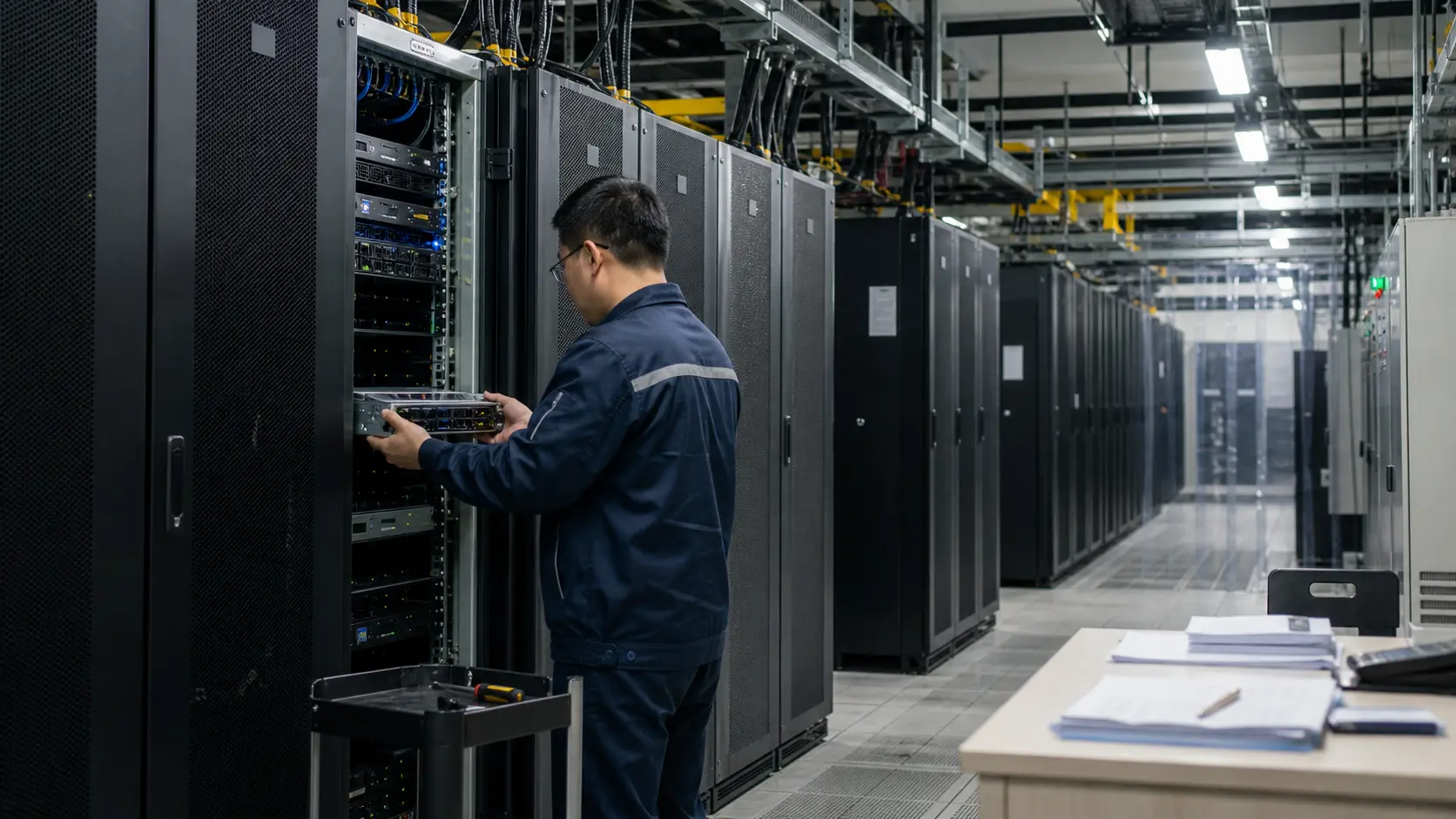
The physical story is materially supported. A 2020 Orient National Communication guarantee reply stated that 2049 Cloud's Shuncheng Phase I project rented the factory building of parent company Beijing Shuncheng Color Printing Co., built and operated a cloud data centre, had completed 3,607 cabinets, had leased them all, had roughly 20,000 servers already installed, and had started receiving cash in October 2019. A later 2024 guarantee notice said Shuncheng Phase I had been completed and externally leased in May 2019, with current monthly rent income of about RMB 16 million to RMB 18 million and typical tenants described as telecommunications, IT and internet companies with five-to-ten-year leases. That is enough to treat the entity as connected to a real hosted-capacity asset.
The downgrade comes from the network and current utilization side. The company has an APNIC autonomous-system registration, but the ASN is not currently announced in the public routing measurements used for this article. The most recent related-party notice also gives a 2025 revenue line that is far lower than the 2023 revenue figure disclosed in the 2024 guarantee notice, and it reports a 2025 net loss. Those two facts do not erase the physical asset, but they change the risk question from "does this exist?" to "how much of the installed facility is usable, contracted, reachable and resilient now?"
What Public Records Prove
The company identity is unusually clear in official filings. The 2026 related-party transaction notice names Beijing 2049 Cloud Computing Data Technology Service Co., Ltd., gives the legal representative as Ran Yaxi, lists registered capital of RMB 50 million and places the registered address at Room 310, Building 1, No. 12 Courtyard, Jinma Garden Third Street, Gaoliying Town, Shunyi District, Beijing. It also describes the business scope as technology promotion, development, service, consultation and transfer, computer system services, basic and application software services, data processing subject to Beijing restrictions on high-PUE cloud data centres, and value-added telecom operation where approved.
The same 2026 notice ties the company to Beijing Shuncheng. It says 2049 Cloud is a wholly owned subsidiary of Beijing Shuncheng Color Printing Co., Ltd., and that Beijing Shuncheng is invested in by Orient National Communication directors and senior managers. It classifies 2049 Cloud as a related legal person for the listed company. That relationship matters because the most detailed public operating evidence appears in Orient National Communication disclosures, not on an independent sales page from 2049 Cloud itself.
The 2026 notice also gives a current commercial touch point. Orient National Communication expected 2026 daily related-party dealings with 2049 Cloud of about RMB 153 million, most of it in accepted cabinet leasing: RMB 150 million for cabinet leasing from 2049 Cloud, RMB 2 million for technical services, and RMB 1 million for labour-related services. It also says the listed company accepts server hosting from 2049 Cloud. The notice reports that, in 2025, 2049 Cloud had total assets of RMB 859.3151 million, net assets of RMB 149.6295 million, revenue of RMB 63.5133 million and net loss of RMB 13.9693 million. It describes 2049 Cloud as legally existing, operating normally, mainly engaged in cloud-computing data-centre construction, operation and technical services, with normal construction and operation, stable cash flow and no performance obstacle for routine dealings.
That is a useful but mixed picture. The legal identity is solid. The physical data-centre function is solid. The current revenue and profit line is not as comforting as the 2024 rent-income language. The 2024 notice reported 2023 revenue of RMB 188.8458 million and net profit of RMB 16.7148 million, after 2022 revenue of RMB 253.3816 million and net profit of RMB 44.2279 million. By 2025, the reported revenue was materially lower and net income negative. A customer should not infer from the lower figure alone that the data centre is idle or troubled; accounting scope, transaction timing and customer mix can move numbers.
But a buyer should ask whether fewer cabinets are active, whether rent concessions occurred, whether related-party demand shifted, whether power or hardware installation timing changed, and whether any financing or asset-transfer constraint affected operations.
The Shuncheng Phase I Asset
The strongest physical detail comes from the 2020 guarantee material. The filing said 2049 Cloud's Shuncheng Phase I project built and operated a cloud data centre by renting the factory of its parent Beijing Shuncheng. It described the project as complete, with 3,607 cabinets built, all leased, customers gradually purchasing servers for installation, about 20,000 servers already on racks, and cash inflow starting in October 2019.
The same passage reported 2019 revenue of RMB 38.859 million, a 2020 expected revenue scale of about RMB 250 million, and customers mainly in telecommunications, IT and internet sectors with five-to-ten-year lease periods.
That language says two important things. First, the company was not merely holding a shell registration or an ASN. It was connected to a built facility, leased space, customer server installation and recurring rent. Second, the service boundary was asset-heavy. The hosted capacity depended on a building, cabinets, customer servers, power, cooling, access procedures and financing leases. This is the opposite of a weightless cloud narrative. The unit being sold was physical enough that server arrival and cabinet occupation mattered to revenue.
The 2024 notice updates the same asset in a less granular way. It states that Shuncheng Data Center Shuncheng Phase I, operated by 2049 Cloud, was completed and leased externally in May 2019, had monthly rental income of roughly RMB 16 million to RMB 18 million, and served telecommunications, IT and internet companies whose demand was considered relatively stable because leases were generally long. That language supports continuing operation. It does not confirm every cabinet is still full, every customer is current, or every route and support path is independently resilient.
The difference between installed capacity and usable capacity is central. A completed cabinet count tells the reader what had been built. A leased-cabinet statement tells the reader what had been contracted at a specific time. A server count tells the reader that equipment had physically arrived by that date. None of those figures proves that all systems remained active in July 2026, that all leases remained at earlier price levels, that sufficient power was available for higher-density servers, or that customers had redundant connectivity.
Capacity becomes real for a customer only when the cabinet has power headroom, cooling margin, contracted network service, live remote-hands procedures, backup paths and a migration plan.
Ownership And Operating Boundary
The ownership boundary is not a footnote. It is one of the main risk surfaces. 2049 Cloud is described as a wholly owned subsidiary of Beijing Shuncheng, while Beijing Shuncheng sits under Ningbo Deang-related investment arrangements linked to Orient National Communication's controlling shareholders. In 2020, a Shenzhen Stock Exchange reply said Ningbo Deang's 2049 Cloud, Deang Interconnect, Jianqiao Changheng and Haihu Cloud had signed entrusted operating management agreements with Orient National Communication for Shuncheng Phase I, Shuncheng Phase II and Nan Faxin data-centre projects. The same reply said the three projects were entrusted to Orient National Communication for operating management, with annual management fees of RMB 350,000 for Shuncheng Phase I, RMB 550,000 for Shuncheng Phase II and RMB 700,000 for Nan Faxin.
The detail matters because an infrastructure buyer needs to know who can act when the system breaks. If 2049 Cloud owns or leases the facility asset, Beijing Shuncheng owns the building, Orient National Communication handles management, a finance lessor owns or has rights over equipment, and customers own some servers, then repair responsibility may be split across several parties. A rack incident may require a facility action. A server incident may require customer replacement or hosted-provider remote hands. A finance default may involve a lender. A route issue may involve a carrier that is not visible in current public ASN data.
The 2020 reply also describes the scope of the management fee. It says the entrusted management fee did not include daily operation and maintenance costs or other expenses tied to asset operation and maintenance; those expenses were borne by the entrusting party, while Orient National Communication paid the salaries of the project-management personnel it formed. That is useful because it separates management oversight from the cost burden of running the data centre. For procurement, the practical question is not just who signs the sales contract. It is who pays for replacements, who keeps spare parts, who can authorize an emergency carrier order, who controls building access, who communicates planned maintenance and who has final say when a customer asks for an urgent migration.
The asset-transfer issue continues to appear in current filings. Orient National Communication's 2025 half-year report says Shuncheng Phase I had been put into operation, while Shuncheng Phase II had not been completed, the overall Shuncheng project had not yet achieved stable profitability, and lower buyer appetite in the IDC market made third-party transfer talks difficult. It says the related parties would consider injecting the asset into the listed company only after the Shuncheng project was successfully built, stable and compliant with the necessary conditions. For a customer, that is not a reason to reject the provider automatically. It is a reason to ask whether asset ownership, future sale, refinancing or unfinished adjacent construction could affect service continuity.
The same continuity concern was not a one-off disclosure. Orient National Communication's 2024 annual report, 2024 half-year report and 2023 annual report all carried related Shuncheng language: 2049 Cloud was identified as the operator of completed Shuncheng Phase I, Shuncheng Phase II was still not complete, the overall project had not reached stable profitability, and transfer or injection depended on project maturity and market conditions. That repeated wording is why ownership change belongs in the operating risk analysis rather than in a distant corporate-footnote category.
Network Footprint: The ASN Does Not Carry The Story
AS131564 gives the company a public internet-number-resource identity. APNIC's RDAP record and APNIC whois result list the ASN as active, country CN, name bonc-net, and describe Beijing 2049 cloud computing data technology service co. LTD at Room 310, Building 3, No. 12 Courtyard, Jinma Garden Third Street, Gaoliying Town, Shunyi District, Beijing. The RDAP record reports registration on May 13, 2019 and last change on June 16, 2021. RIPEstat's whois view reflects the same APNIC details: aut-num 131564, as-name bonc-net, company description, address, country CN and CNNIC maintenance references.
But registration is not reachability. RIPEstat's July 2026 AS overview says AS131564 is not announced. Its routing-status data reports zero IPv4 prefixes, zero IPv6 prefixes, zero IPv4 or IPv6 address space, zero observed neighbours and no RIS full-feed peers seeing the AS. Its announced-prefixes endpoint returns an empty prefix list for the late-June to July 2026 window, and its routing-history endpoint shows no by-origin history under the visibility threshold used by the service. bgp.tools separately states that AS131564 is not currently in the global routing table. PeeringDB's API for ASN 131564 returns no network entity.
This is the most important downgrade in the article. A customer should not use AS131564 as proof that 2049 Cloud is currently carrying public routed cloud service under that ASN. The company may host customer equipment behind other carriers, use upstream-assigned addresses, support private circuits, sell cabinet space without running a public origin AS, or have dormant number resources. All of those patterns are possible in data-centre and managed-hosting markets. The public fact remains narrower: the registered ASN exists, but it is not visible as a current public routing anchor.
That changes the failure test. If a provider originates its own prefixes, customers can monitor origin stability, RPKI validity, upstream diversity and route leaks. If the provider hosts customers behind other networks, the relevant path may sit in a carrier contract, a customer circuit, a cross-connect or a provider-managed upstream not tied to AS131564. The buyer then needs direct documentation: carrier names, handoff points, cross-connect ownership, BGP responsibilities, DDoS protection, maintenance windows and emergency escalation. The absence of a visible public ASN is not by itself a failure. It is a loss of outside observability.
Capacity Economics And Utilization Risk
The economics disclosed around Shuncheng Phase I show why cabinet leasing can look stable and still require caution. In 2020, the project was described as fully leased, with customers buying and installing servers, long lease terms and expected 2020 revenue around RMB 250 million. In 2024, monthly rental income was described at about RMB 16 million to RMB 18 million, while 2023 revenue was RMB 188.8458 million and profit was RMB 16.7148 million. In the 2026 daily related-party notice, however, 2025 revenue was RMB 63.5133 million and net income was negative RMB 13.9693 million.
That sequence is not a simple collapse story. Public filings are not a real-time utilization dashboard, and revenue may be affected by accounting period, customer identity, pricing, services included, customer installation timing, energy pass-throughs, contract renewals and related-party transaction mix. Still, the movement is too large for a customer to ignore. If a facility's public rent-income language once suggested a much higher run rate and the latest disclosed annual revenue line is lower, procurement should ask what changed.
The first question is utilization. How many of the original 3,607 cabinets are powered, sold and customer-active today? How many are contracted but not populated? How many support older servers at lower density, and how many can support newer high-density equipment? A cabinet is not just a rectangle of rack space. Its usable value depends on committed power, cooling, floor loading, cable paths, smart hands and network access. A cabinet that was easy to sell in 2019 may need upgrades to remain attractive in 2026 if customers want GPU servers, high-power storage nodes or lower-latency links.
The second question is price and customer mix. Long leases can stabilize cash flow, but they can also lock a facility into older terms. If customers renew at lower prices, consolidate elsewhere, require more power at the same rack rate, or shift from cabinet lease to shorter server-hosting use, the facility can remain open while profitability narrows. The 2026 notice's expected RMB 150 million cabinet-lease transaction with 2049 Cloud shows continuing demand from Orient National Communication, but it does not reveal the full customer base or whether third-party demand is rising or falling.
The third question is financing. The 2020 guarantee material said 2049 Cloud had applied for RMB 250 million in finance lease loans from Yongying Financial Leasing and Zhongguancun Science-Tech Leasing, with Orient National Communication providing a joint-liability guarantee and a guarantee balance of RMB 247 million as of the end of 2019. The 2025 half-year report later disclosed guarantees for 2049 Cloud's financing lease and loan businesses, with balances totalling RMB 260.75 million at the period end. That does not mean default. It means the hosted capacity sits inside financing commitments that can matter if cash flow, refinancing terms or ownership change.
Earlier interim filings show the same financial dependency developing over time. The 2023 half-year report disclosed 2049 Cloud financing-lease and bank-borrowing guarantees linked to Zhongguancun Science-Tech Leasing, Industrial and Commercial Bank of China and Yongying Financial Leasing, while the 2024 half-year filing repeated finance-lease and bank-loan exposure for 2049 Cloud. The detail is not included to suggest a missed payment; it is included because data-centre capacity is capital-intensive, and customers should understand which lenders, lessors and guarantors sit behind the rooms they rely on.
Power, Cooling And Locality
Data-centre capacity in Beijing is constrained by power, land, environmental policy and customer demand. The 2049 Cloud business-scope language in the 2026 notice is unusually telling: it includes data processing, but excludes bank-card centres and cloud-computing data centres with PUE above 1.4, matching Beijing's long-running controls on inefficient data-centre expansion. A customer does not need to memorize the policy to grasp the operational point. In Beijing, a data centre's value is not only cabinets; it is lawful and practical access to power and cooling within local efficiency limits.
The address record places the company in Gaoliying Town, Shunyi District, Beijing. The Shuncheng Phase I filings place the data-centre project inside the Beijing Shuncheng property relationship. That supports a Beijing-locality story, which may matter for customers that need workloads, equipment, support access or contractual jurisdiction inside China. It does not prove where every backup, monitoring log, customer copy or disaster-recovery replica sits. Data locality requires contract language, system diagrams and audit rights, not only a registered address.
Power density is the unresolved issue. The old 3,607-cabinet count came from a period when many colocation customers installed conventional servers. By 2026, cloud and AI workloads often stress facilities through higher rack draw, denser network uplinks and heavier cooling requirements. If Shuncheng Phase I is mostly serving traditional carrier, IT and internet customer cabinets, it may remain valuable for conventional hosting. If customers want GPU-heavy or high-density bare-metal use, the buyer must verify power per cabinet, cooling design, hot-aisle containment, liquid-cooling readiness, generator fuel endurance and utility capacity.
Cooling and power also determine restore speed. A server can be replaced quickly only if a spare can be installed into a rack with enough power and cooling. A customer can move to another cabinet only if cable routes and network handoffs exist. A backup can be restored only if enough compute and storage remain available after a fault. Public filings describe a built and leased facility, not an engineering test of these limits. That is why the procurement test should ask for actual cabinet power profiles, incident reports, maintenance windows and recent failover or restore exercises.
Failure Paths To Test
The first failure path is rack and power failure. A customer hosted in Shuncheng Phase I may experience an outage from rack power distribution, a top-of-rack switch issue, cooling failure, access-control delay, server failure or power maintenance. Public filings tell us the facility had many cabinets and customer servers; they do not tell us whether each cabinet has dual feeds, whether customers use dual power supplies, how remote hands are staffed, or how quickly failed equipment can be replaced. The buyer should ask for power topology, recent maintenance history and service credits tied to measurable restoration.
The second failure path is upstream connectivity. Because AS131564 is not currently visible, outside observers cannot infer upstream diversity from public BGP paths. Customers should therefore ask who provides transit, whether circuits enter the building through diverse paths, whether there are separate carriers, whether routes can fail over between carriers, whether DDoS filtering is carrier-side or facility-side, and who owns the BGP relationship for customer networks. A data-centre host can be reliable without originating its own ASN, but only if the carrier and cross-connect details are explicit.
The third failure path is hardware stock. The 2020 disclosure said customers were purchasing servers for installation and roughly 20,000 servers had already been installed. That suggests many assets may be customer-owned or customer-specified, not merely provider-owned virtual-machine hosts. If a server fails, the customer needs to know whether 2049 Cloud replaces it, whether the customer ships parts, whether a vendor dispatches to site, whether remote hands are included, and how customs, spares and after-hours access work.
In a cabinet-leasing setting, "support" can mean anything from reboot assistance to full managed hardware replacement.
The fourth failure path is financing or contract pressure. 2049 Cloud has appeared repeatedly in guarantee, loan and finance-lease disclosures. That is normal for capital-intensive infrastructure, but it also means continuity depends on more than technical competence. Customers should ask what happens if an ownership transfer, refinancing, lender action or related-party asset sale occurs. Are customer contracts assigned automatically? Are deposits protected? Are service obligations preserved? Are there notice periods and migration support if the facility changes operator?
The fifth failure path is migration. A customer can become trapped if the host provides space, power, cabling, access procedures, IP handoff, cross-connects, server inventory and remote-hands knowledge, but the customer lacks a tested exit plan. The right exit plan includes equipment inventory, backup copy, circuit cancellation steps, address changes, cross-connect teardown, DNS changes, physical removal scheduling, data-destruction evidence and temporary dual-run support. Without that plan, hosted capacity becomes sticky precisely when the customer most needs freedom to move.
Who Is Affected If The Service Breaks
The customers most likely to feel a Shuncheng Phase I failure are not casual public-cloud hobbyists. Public filings describe telecommunications, IT and internet companies as typical tenants, and Orient National Communication's own related-party notices show it accepting cabinet leasing or server hosting from 2049 Cloud. A failure could therefore affect enterprise infrastructure, carrier-adjacent systems, internet platforms, software services, customer test environments, data-processing systems or AI compute workloads that depend on Beijing locality.
The blast radius depends on how customers use the facility. A tenant using one cabinet as a secondary site may feel inconvenience and slower maintenance. A tenant running a primary production cluster in one room may face customer-visible downtime. A company that uses 2049 Cloud for server hosting while keeping backups elsewhere may be able to restore. A company that stores primary data, backups, management credentials and network edge in the same facility may discover that the cabinet is not only a cabinet; it is the control point for the whole service.
Locality can be a benefit and a dependency at the same time. Beijing-region hosting may help customers meet latency, regulatory, operational or procurement needs. It may place equipment close to offices, carriers or government-facing customers. But a locality commitment can reduce easy substitution if a customer cannot quickly move workloads to another city, another jurisdiction or another provider. If the reason for using the facility is Beijing presence, then a Beijing power, policy, carrier or asset-transfer issue has outsized importance.
The lower current routing visibility makes customer impact harder to monitor from outside. If AS131564 disappeared from the routing table, that would be a measurable event only if the ASN had been carrying the customer service. Since it is not currently visible, a customer cannot rely on public ASN monitoring as the main availability indicator. They need their own probes to hosted endpoints, power and temperature telemetry, ticket history, carrier notifications and tested escalation contacts.
Data Sovereignty And Data Portability
The planned topic of data sovereignty is relevant here, but it must be handled carefully. 2049 Cloud's visible public footprint points to China: Beijing address, APNIC country code CN, CNNIC/APNIC maintenance references, Beijing data-centre project disclosures and Chinese related-party filings. For customers that need infrastructure inside China or inside Beijing, those facts support a local service area. They do not answer the deeper question of who can access customer data, where replicas are kept, which subcontractors touch systems and how the customer exits.
Sovereignty starts with physical location but does not end there. If the customer owns servers and leases cabinets, the customer's own controls may determine much of the data access picture. If 2049 Cloud or an associated manager provides server hosting, technical services, backup, system administration or network operations, the provider's personnel and subcontractor controls become more important. If Orient National Communication management teams are involved in the facility, the customer should know which entity's staff can access racks, management consoles, tickets and incident communications.
Data portability should be written before deployment. In a colocation-style arrangement, portability may mean physical server removal, disk custody, cross-connect termination and clean cable maps. In a hosted-server arrangement, portability may mean image export, database dump, backup transfer and temporary network coexistence. In a managed-service arrangement, portability also includes configuration, scripts, monitoring rules, credentials, access logs and operational runbooks. Public filings do not disclose which of these services 2049 Cloud offers to each customer. That is exactly why the contract should define them.
The financing and ownership boundary raises a second sovereignty issue: control during change. If a facility asset is sold, injected into a listed company, transferred to a third party, refinanced or restructured, customer data and equipment must remain governed by the customer contract, not by improvisation. Customers should ask for assignment clauses, notice obligations, data-removal rights, equipment-access rights and continuity commitments. A data-centre contract that is silent on ownership change is weaker than it looks.
Procurement Questions That Decide The Risk
The first question is about current capacity. How many of the 3,607 Phase I cabinets are active today, how many are contractually occupied, how many are powered, what is the average and maximum power per cabinet, and how many can support higher-density servers? The answer should distinguish installed, leased, powered and usable capacity.
The second question is about customers and concentration. What share of the active load is related-party demand, what share is third-party demand, and are the 2026 expected cabinet-leasing figures backed by signed contracts? A facility can be stable with anchor tenants, but customer concentration affects bargaining power and revenue durability.
The third question is about connectivity. Which carriers serve the facility, which circuits carry the customer's traffic, who controls the route announcements, whether customers can bring their own IP space, whether AS131564 has any intended role, and whether carrier diversity is physical or only contractual. If the answer relies on another network, the customer should see that network's service terms.
The fourth question is about support labour. Who is on site, who is on call, who can touch customer equipment, what is included in remote hands, how emergencies are escalated, what tasks require customer approval and what tasks require third-party vendor dispatch? The customer should ask for a sample incident report and a maintenance-window notice.
The fifth question is about power and cooling. What are the power feeds, UPS and generator arrangements, fuel endurance, cooling redundancy, PUE commitments, temperature and humidity monitoring, power-density limits and planned maintenance schedule? Customers seeking GPU or dense bare-metal deployments should ask whether the facility can handle the actual load, not the old cabinet count.
The sixth question is about asset and financing change. What happens to customer contracts if Beijing Shuncheng, Ningbo Deang, 2049 Cloud, Orient National Communication or a finance lessor changes ownership or enforcement position? Which party guarantees continuity, access and data return? Where are customer deposits and prepaid fees protected?
The seventh question is about backup and migration. How quickly can a customer retrieve data, remove servers, transfer backups, cancel cross-connects, shift DNS, update IP addressing and run in parallel elsewhere? A provider that can explain exit before onboarding is usually a safer provider than one that treats departure as an afterthought.
Operating Assessment
Beijing 2049 cloud computing data technology service co. LTD should not be treated as a non-operating shell. Public filings support a real Beijing data-centre asset: Shuncheng Phase I, completed in 2019, built at a 3,607-cabinet scale, leased to telecommunications, IT and internet customers, tied to customer server installation and continuing related-party use. The 2026 notice still describes 2049 Cloud as normally operating, mainly engaged in cloud-computing data-centre construction, operation and technical services, and able to perform routine contracts.
It also should not be treated as a transparent public cloud operator with visible routed capacity. The company's AS131564 registration exists, but public routing measurements show no current global route origin, no prefixes, no observed neighbours and no PeeringDB network record. That means the hosted-capacity story has to be verified through facility, carrier and contract documentation rather than inferred from BGP.
The best rating is conditional and downgraded: real asset evidence, weak public network evidence. Buyers can take confidence from the official filings that a Beijing hosted-capacity operation exists and has generated revenue. They should not take comfort from the word "cloud" alone, nor from old cabinet counts alone. The current questions are utilization, power headroom, customer concentration, financing exposure, repair responsibility, transit diversity and portability.
The narrowest safe reading is also the most useful one. This is a company to evaluate as a cabinet, server-hosting and data-centre dependency around Shuncheng Phase I. It may be exactly the right local facility for a customer that needs Beijing presence, long-term cabinet space and hands-on hosting support. It may be a poor fit for a customer that expects self-service public cloud elasticity, independently visible routing, automatic regional failover or effortless multi-site recovery.
The procurement task is to match the service being bought with the evidence that exists: building, cabinets, finance, related-party demand and dormant public ASN data.
For customers, the practical stance is straightforward. Treat 2049 Cloud as a Beijing data-centre and hosting dependency that may be valuable for local infrastructure needs. Require proof of the exact cabinets, exact carrier paths, exact support roles and exact exit rights before placing critical workloads there. Hosted capacity is not less physical because it is sold under cloud-computing language. In this case, the public record makes the physical dependency visible: Shuncheng Phase I lives or fails through racks, power, customer servers, leases, carrier handoffs and the people who can repair them inside the maintenance window.