
Summary
- AvantGuard's value is not proven by the number of monitoring centers, subscribers or integrations alone. It is proven when repeated alarm events are filtered, verified, escalated, documented and handed to the right responder without losing responsibility along the way.
- Public material shows a serious monitoring operation: wholesale security and fire monitoring, PERS and IoT use cases, video verification, dealer portals, account-testing tools, cloud and hybrid monitoring options, redundant facilities, TMA Five Diamond, UL and FM claims, and current Becklar Monitoring scale claims. Those claims still need buyer-side scrutiny because response quality depends on account data, operator training, verification rules, local dispatch policy and audit evidence.
- The strongest commercial case is for dealers and monitoring operators that need redundancy, after-hours labor, account migration support, false-alarm reduction and tools they could not economically build alone. The weakest case is any buyer that treats monitoring as a commodity signal relay while leaving stale contacts, weak procedures, untested failover and poor dispatch evidence untouched.
The response record is the product
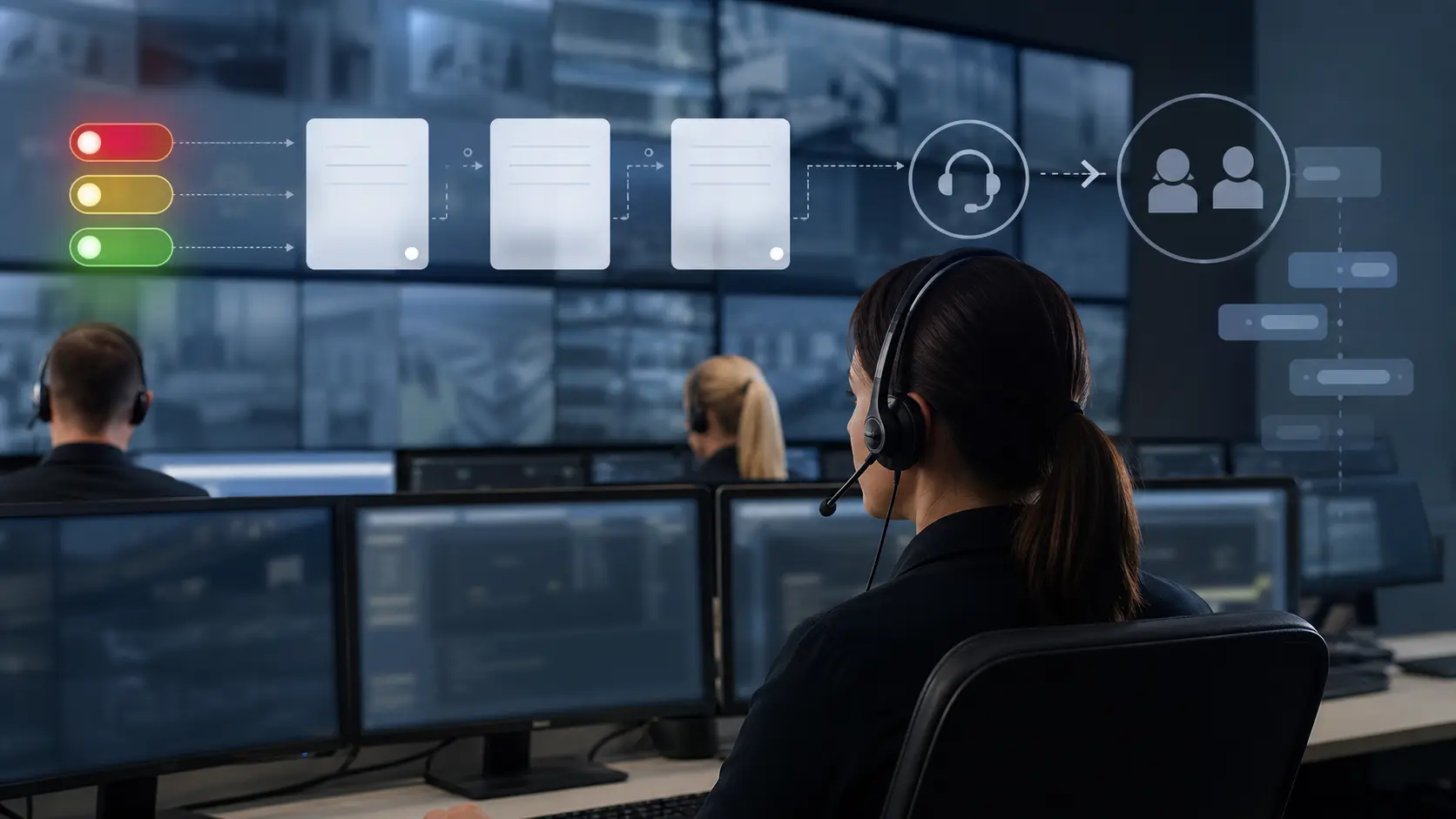
Alarm monitoring is often sold through reassuring language: lives protected, property protected, operators standing by, centers staffed around the clock. That language is understandable, but it hides the actual unit of work. The product is not merely the fact that a central station receives a signal. The product is the accepted alarm response record: a structured event that begins with a device signal or user contact, passes through account data and verification rules, receives operator attention where needed, produces a decision, and ends with a dispatch, cancellation, notification, follow-up or documented non-response.
That record is the difference between a service and a logo. A burglar alarm, medical alert, fire signal, video trigger, crash event or environmental alarm has no business value until someone can answer basic questions. What account generated it? Was the site address correct? Which zone, device or condition changed? Was the event a panic, fire, medical, trouble, supervisory, low battery or intrusion signal? Did a person verify a false activation? Was there video, audio, location data or chat evidence? Which contact had authority to cancel or request dispatch? Which agency was supposed to receive the call?
Which operator, automation rule or notification path acted on the event? What happened when the first contact did not answer?
AvantGuard's public material points to that broader job. It describes professional wholesale monitoring, video monitoring and remote guarding, cloud and hybrid monitoring, account tools, AG Chat, mobile account testing, dealer portals, action plans, scripts, auto processes, simple API access, receiverless signals, storm queues, integrated video, two-way voice, account records and redundant monitoring infrastructure. The company boundary is therefore operational, not just technical.
AvantGuard is not being judged here as the maker of every alarm panel, every dealer's installation work, every public-safety dispatch policy or every customer's behavior. It is being judged as a monitoring operation that tries to turn unreliable, high-volume signals into responsible response decisions.
That distinction matters because the alarm industry has a false-alarm problem that cannot be solved by scale alone. A large monitoring center can process more signals, but processing more bad signals faster is not the same as producing better public-safety outcomes. A redundant facility can keep phones and event queues alive, but redundancy does not fix a wrong address. Video verification can help, but only if the camera is useful, the clip is timely, the operator knows what the clip proves, and the receiving agency accepts the evidence.
A chat workflow can reduce dispatches, but only if responsible contacts answer quickly and the cancellation is trustworthy. The accepted response record sits where all of these pieces meet.
AvantGuard after the Becklar consolidation
The public brand picture is not perfectly simple. AvantGuard remains a recognizable monitoring name and is the relevant company boundary for this article. Public Becklar material says AvantGuard and Eyeforce were integrated into Becklar Monitoring, with Becklar presenting a broader "critical event monitoring" platform across alarm, video, PERS, IoT and workforce safety. Older AvantGuard pages refer to eight geographically dispersed facilities after the Armstrong acquisition in Canada. Current Becklar pages refer to seven integrated monitoring centers across the United States and Canada.
That does not invalidate the redundancy claim, but it does mean a buyer should ask which facilities, brands, certifications and operating procedures apply to the specific contract being signed today.
The consolidation changes the evaluation. AvantGuard is not just a traditional wholesale alarm desk in the public record. It sits inside a group that also describes AI-supported customer engagement, video remote guarding, PERS, connected-device monitoring and workforce-safety services. Becklar's current monitoring page claims more than 2.5 million subscribers, more than 5,500 dealers, more than 865 million received signals, more than 40,000 monitored cameras, more than 22,000 alarms per day and a 9.4-second average response time. Those are substantial scale signals. They are not, by themselves, proof of outcome quality.
Scale changes the operating question from "can a center answer an alarm?" to "can a system preserve responsibility as volume grows?" At small scale, a trusted operator may remember a dealer's habits, a site's quirks or a particular property manager's contact preferences. At large scale, that informal knowledge has to become account data, scripts, action plans, contact authority, agency records, quality checks, exception queues and supervisory review. If it does not, the center becomes dependent on heroic individual memory.
That is fragile in a business where nights, holidays, weather events and staffing changes are part of the job.
AvantGuard's public claims show awareness of this risk. Its central-station education material breaks the monitoring center into people, automation and redundant technology. Its professional monitoring pages stress action plans, branded service, account tools and failover. Its help material for Stages dealer data entry treats site names, addresses, agencies, contacts, passcodes, zones and event codes as structured fields rather than vague notes. Those are the right ingredients. The real question is whether the ingredients are maintained as live operating controls rather than left as forms filled once during onboarding.
Signal intake is a data-quality problem
The first failure mode in monitoring is not a slow operator. It is bad input. A central station can only respond to what it receives and understands. If a dealer enters the wrong address, omits a suite number, mislabels a zone, leaves an old contact in the call list, fails to add the right police, fire or medical agency, or forgets to update a passcode, the monitoring center inherits risk before an alarm ever occurs.
AvantGuard's public dealer help material makes the data burden visible. New account setup in the Stages dealer portal includes site name, address, site type, agency assignment, phone numbers, contacts, zones and passcodes. The instructions distinguish commercial security, commercial fire, residential, elevator and medical site types. They tell dealers to use the address validation function where available, note that Canadian postal codes may need manual entry, and instruct users to add one fire, one medical and one police agency when the address validates.
Contact setup includes Enhanced Call Verification flags, authority levels, PIN or code-word handling, phone type and contact order. Zone setup requires a point or zone number, event code and description that is relayed to the customer and dispatch.
This is not clerical detail. It is the foundation of response quality. A burglar alarm from "back door" is different from a burglar alarm from "front office motion." A medical alarm with GPS is different from a fixed-location PERS unit. A duress code is different from an ordinary contact password. A commercial fire event is not handled like a residential trouble signal. The monitoring center's software can help make these distinctions, but it cannot infer every missing fact.
The commercial implication is blunt. Dealers that outsource monitoring to AvantGuard are not outsourcing responsibility for account hygiene. They are sharing it. If a dealer wants fewer false alarms, faster dispatch, better customer experience and fewer disputes, it has to maintain the account record. That means onboarding discipline, periodic review, clean contact lists, accurate agency data, zone descriptions that make sense under stress, and procedures for property changes. For property managers and businesses with high staff turnover, this work is continuous.
AvantGuard's mobile and portal tools are designed partly to reduce that burden. Public pages describe account testing on the go, history review, account lookup, test status, multi-zone testing and contact or passcode updates in later app versions. Those tools can improve the operating loop if technicians actually use them to keep records current. They can also create a new supervision burden: permissions, training, and review of who changed account data and why. A tool that lets field staff update records faster is valuable only if the changes are correct and accountable.
Verification is where monitoring becomes judgment
The alarm response decision is not a binary software event. It is a judgment under time pressure. The signal may be real, false, ambiguous or incomplete. The operator may have a script, but the script has to interact with a person who may be frightened, unreachable, mistaken or under duress. The customer may want dispatch for a minor issue, or may cancel an event that should not be canceled. The dealer may have promised a particular service level. The local agency may have its own verification policy. The operator has to move quickly without turning every uncertain signal into a public-safety call.
AvantGuard's AG Chat is the clearest public example of how the company tries to change that decision. The company describes AG Chat as a free alarm verification service that brings customers and contacts into a secure chat group, speeds engagement, reduces false dispatches and gives customers better information. The dealer page says accounts using AG Chat have seen first engagement in seconds, 54 percent fewer false alarm dispatches and a 44-second average dispatch time. Those are useful claims, but they should be treated as vendor operating claims rather than independent benchmarks.
The public material does not expose sample size, baseline, event mix, jurisdiction mix, cancellation rules or measurement method.
The more important point is conceptual. Chat changes the verification pattern from a one-to-one phone attempt into a group decision surface. That can be valuable because false alarms are often known quickly by someone near the account: a worker forgot the code, a cleaner opened the wrong door, a pet moved through a sensor, a user is testing the system, or a technician is still on site. Text can reach people who will not answer a voice call from an unknown number. It can also preserve a useful event trail if the platform records who saw what and who authorized cancellation.
But chat is not magic. It can introduce ambiguity if multiple contacts disagree. It can delay dispatch if operators wait too long for confirmation. It can fail if mobile numbers are stale, messages are missed, or a customer replies casually during a real event. It can create evidence questions: who had authority, how identity was verified, whether a cancellation was under duress, and how the record is retained. Good monitoring uses chat as one verification tool inside a documented response policy, not as a blanket substitute for operator judgment.
Industry practice is moving in the same direction. Enhanced Call Confirmation uses at least two contact attempts before requesting dispatch for many burglar alarms. Video, audio and other confirmation methods can provide stronger evidence. TMA's AVS-01 standard creates a 0-to-4 alarm validation scoring framework, with higher levels reflecting confirmed human presence, property threat or life threat. Public-safety agencies are increasingly explicit that a raw sensor trip is weak evidence.
AvantGuard's verification strategy should be evaluated against that trend: not "does it answer quickly?" but "does it classify and communicate the event in a way responders can trust?"
False alarms are the economic center
False alarms are sometimes treated as customer annoyance. In reality they are the central economic and civic issue in this category. Older but still influential problem-oriented policing research estimated that police responded to roughly 36 million alarm activations in the United States in 2002 at an annual cost of about $1.8 billion, with 94 to 98 percent of alarm calls false and false alarms accounting for a meaningful share of police call volume.
Local examples remain current: Seattle reported that fewer than 4 percent of 13,000 alarm calls in 2023 were confirmed to involve a crime associated with an arrest or report, and now says it does not respond to sensor or motion activations alone. Owasso, Oklahoma, reported that 99 percent of its 2016 alarm calls were false.
The details vary by city, but the direction is clear. Public safety does not want to be the free labor layer for bad alarm data. Municipalities use permits, fees, false-alarm fines, restricted response, required verification, alarm-company billing and cancellation rules because the cost is real. A monitoring center that cannot reduce false dispatches imposes costs on police, fire, emergency medical services, subscribers, dealers and its own operators.
AvantGuard's value proposition therefore depends heavily on false-alarm economics. Video verification, AG Chat, CHeKT and Immix integrations, Calipsa analytics references, remote guarding, action plans, contact records and account-testing tools all point at the same commercial promise: identify the events that need response and suppress, cancel or redirect the events that do not. If that promise works, dealers can reduce customer fines, avoid angry subscribers, protect public-safety relationships and keep operators focused on higher-value events. If it does not, monitoring scale becomes a liability.
There is a tension. Every verification step can reduce false dispatches, but verification takes time. FARA's false-alarm reduction guidance recognizes that Enhanced Call Verification can significantly reduce dispatch requests while also warning that it may delay the time between activation and the dispatch request. That is the tradeoff AvantGuard has to manage. Too little verification floods agencies and customers with bad calls. Too much verification risks delay in a real burglary, medical event or fire. The correct answer is not one universal rule. It is signal-specific, jurisdiction-specific and risk-specific.
This is where the accepted response record matters again. A buyer should ask not only whether AvantGuard can reduce false alarms, but how it measures reductions by account, dealer, signal type and jurisdiction. How many events are canceled before dispatch? How often are cancellations made after dispatch has already been requested? How quickly are contacts reached? How often are contact lists stale? How are repeat offenders identified? How are chronic false-alarm accounts escalated back to the dealer? Without those operating metrics, false-alarm reduction remains a claim rather than a managed process.
Operator labor is not replaced by automation
Monitoring companies naturally emphasize technology. AvantGuard and Becklar public pages describe automation software, AI-supported engagement, scripts, action plans, auto processes, storm queues, APIs, receiverless signals and data insights. The technology matters. It can route signals, prioritize queues, guide operators, automate low-priority notifications, collect chat responses, manage account testing, and keep low-value events from consuming live attention. But alarm monitoring remains a labor business at the decisive moments.
The reason is simple: people call during uncertain events. A subscriber may be panicked, injured, confused, elderly, angry or unable to speak. A property manager may not know whether a cleaner is still on site. A burglar alarm may arrive with poor video, a medical alert may have weak location data, or a panic alarm may allow little room for verification. Automation can assemble context, but a human operator often has to decide what context means and how to speak to the person involved.
AvantGuard's own central-station education material emphasizes operators alongside automation and redundancy. It describes attention to detail as essential because operators must follow procedures, document incidents, respond to stressed subscribers and deliver the right solution. That is a useful admission. The service is not only a software workflow. It is a supervised workforce handling interruptions around the clock.
The labor cost is not only the wage of the operator who answers the event. It includes hiring, training, recertification, shift coverage, coaching, quality review, supervisor escalation, language and empathy skills, turnover management, holiday staffing and disaster staffing. TMA Five Diamond requires 100 percent of monitoring center operators to be certified through TMA online training, with recertification requirements. UL central-station certification involves standards and annual audits. These are meaningful signals because they turn "trained operators" from marketing language into a compliance and inspection structure.
Still, certifications do not prove every call is handled well. The hard questions are local and continuous. How many operators are on duty during peak alarm periods? What happens during storms when low-priority signals surge? How are new operators monitored? How often are scripts reviewed? What percentage of events require supervisor intervention? How are language barriers handled? How are medical, fire, burglary, panic and trouble signals differentiated in training? Does the center run scenario drills? How quickly are dealer-specific procedure changes reflected in the operator workflow?
Automation earns its place when it reduces operator overload without hiding risk. A storm queue can protect response times by separating low-priority signals during natural disasters. Auto processes can send notifications without tying up an operator. Voice or chat engagement can filter non-urgent events. But if automation is measured only by speed or call deflection, it can create a perverse incentive to resolve events without enough evidence. The right metric is not deflection alone. It is correct resolution.
Redundancy is necessary but not sufficient
AvantGuard and Becklar make strong redundancy claims. Public AvantGuard technology pages describe geographically dispersed facilities, multiple central stations, full-load failover capability, redundant receivers, generators, data, locations, telephones, network paths and regular failover tests. Becklar's current monitoring page describes redundant sites, multiple paths and overflows, with monitoring centers across the United States and Canada. AvantGuard's PERS page says the company regularly tests failover so another monitoring center can take calls at full capacity if one location is affected.
That is exactly the kind of infrastructure a monitoring buyer should want. Alarm response is not a best-effort software subscription. Fire, medical, security and crash events can happen during power loss, weather events, carrier failures and regional disasters. If a single facility, carrier, database or phone path can take down the response workflow, the service is mispriced no matter how cheap it looks.
Redundancy, however, is not one thing. Facility redundancy is different from database redundancy. Phone failover is different from IP route resilience. Generator capacity is different from staffing continuity. Receiver redundancy is different from dealer account-data synchronization. A second center is useful only if it has current account data, trained operators, working communications paths, access to the same scripts and the authority to handle the same event types. A buyer should therefore ask how failover is tested and what "full load" means under realistic conditions.
The public record also shows why exact claims need checking. AvantGuard material after the Armstrong acquisition referred to eight monitoring centers, while current Becklar rebrand material refers to seven integrated monitoring centers. A procurement team should not treat that as a scandal. Companies consolidate, rebrand and reorganize facilities. But it should raise a practical question: which locations are in scope for my service, what certifications attach to them, and how are Canadian and U.S. accounts handled across jurisdictions?
Redundancy has a commercial dimension as well. For a small or midsize dealer, building a second monitoring center, maintaining receiver infrastructure, staffing holidays and meeting compliance expectations may be economically unrealistic. AvantGuard's cloud and hybrid offerings speak directly to that gap. A dealer can keep some local operation while using AvantGuard or Becklar infrastructure for cloud monitoring, backup, automation, off-hours support or failover. That can be a rational substitute for capital spending. It also creates dependency.
The dealer is now relying on someone else's control plane, procedures and migration quality.
The key test is whether redundancy is visible in operating evidence. Does the customer receive test results? Are failover tests isolated from subscriber impact, as AvantGuard says? Are test failures documented and corrected? Are dealers notified of changes? Are call paths, internet paths and receiver paths tested separately? Does the system handle simultaneous storm events and staffing constraints? Without answers, redundancy remains a comforting word.
Integrations are leverage and liability
AvantGuard's public integration footprint is broad. Its website lists CHeKT video, Alarm.com, I-View Now, SecurityTrax, Tier32, WorkHorse, Cornerstone Billing Solutions, 1 Stop Portal and other integration options. Its wholesale security page describes third-party video verification through Immix and CHeKT and analytics integration through Calipsa. Becklar's current page describes pre-built integrations with IoT devices and third-party fire and burglary systems through an API library. The cloud monitoring page lists a simple API, integrated video and receiverless signals.
That integration layer can create real value. Dealers do not want to enter customer data into every system manually. Operators need video clips, contact data, account status, agency information and alarm history in one workflow. Installers need to place accounts on test and confirm signals without tying up operators. Billing, CRM and central-station records should not drift. Video verification is only useful if the video arrives quickly enough and is tied to the correct alarm event.
The liability is drift. Every integration is another place where data can be stale, duplicated or misunderstood. A CRM may have one address, the central-station account another. A video platform may send clips that are too late or too low quality. A dealer portal may show a test that a technician thinks is active while the central station has a different state. An API may work for ordinary events but fail during bursts. A mobile app can make account changes easier, but it can also let a poorly trained user update contact, passcode or zone data incorrectly.
This is why integration should be evaluated by task, not by logo count. For an alarm response, the integration question is not "does AvantGuard integrate with Alarm.com or CHeKT?" It is "what exact field, signal, clip, contact, cancellation, agency, event code or audit record moves between systems, and what happens when it does not move?" A dealer should test account creation, account update, contact update, zone update, test mode, cancellation, video clip attachment, dispatch record and after-action reporting. The system is only as strong as the weakest handoff in that chain.
The app evidence is a useful reminder. The Becklar Monitoring app on Apple's store advertises account testing, GPS account lookup and event history. Version history shows continuous maintenance, including fixes for old status display, contact handling, account lookup, zone testing, history refresh, timezone issues, test expiration and ability to update contacts, passcodes, duress codes and account information. That is not evidence of failure; all operational software evolves. It does show that dealer tools are living products with bugs, fixes and feature changes.
Buyers should ask how mobile and portal changes are communicated, supported and audited.
Dispatch handoff is where evidence leaves the building
The most consequential moment is often not inside AvantGuard. It is the handoff to public safety. A monitoring center may have a clear view of its event record, but the emergency communications center receives a call, digital message or structured dispatch request under its own policies. If the handoff loses the useful facts, the earlier verification work is partly wasted.
APCO and TMA's ASAP work is relevant here because it frames alarm dispatch as a data exchange rather than a phone call alone. ASAP is designed to deliver life-safety event information digitally from monitoring companies into emergency communications center CAD systems through standard protocols. The public standard emphasizes address verification, complete and accurate information, new data fields and methods to indicate that an alarm has been positively verified as a real crime, fire or medical event.
Whether a particular AvantGuard account uses ASAP is a contract and jurisdiction question; the broader lesson is that dispatch handoff quality is now a technical and data-quality issue.
TMA AVS-01 pushes in the same direction. Its alarm levels distinguish no call for service, limited information, probable or confirmed human presence, confirmed property threat and confirmed life threat. That is a more useful language for responders than "burglar alarm." It lets law enforcement and emergency communications centers prioritize based on threat and evidence. The public AVS-01 page lists several certified monitoring centers; the public evidence reviewed here did not show AvantGuard or Becklar listed among those certified centers.
That does not prove they lack AVS-aligned practices, but buyers should not infer AVS certification from Five Diamond or UL claims. They should ask directly how AvantGuard classifies alarm validity, what data is passed to dispatch, and whether AVS-01 certification or implementation is in scope.
The handoff issue also affects cancellations. FARA guidance says alarm companies should be able to cancel dispatch requests when an alarm is determined false, and describes using a call-taker or incident code so public safety can verify that a cancellation really came from the alarm company and not an alarm user under duress. This is a small detail with large consequences. A cancellation record needs identity, timing and authority. If AvantGuard's AG Chat, phone verification or operator judgment leads to cancellation, the event record should preserve why the cancellation was accepted.
For dealers, the dispatch handoff is also a customer-service issue. Subscribers rarely distinguish between the installer, dealer, monitoring center and emergency agency. If police do not come, if fire is delayed, if EMS is sent to the wrong entrance, or if an alarm is canceled incorrectly, the dealer owns the relationship damage even when another party handled the call. That makes evidence retention and after-action reporting commercially important.
The economics for dealers
AvantGuard's natural customer is the dealer or alarm company that wants monitoring capability without owning every part of the central-station stack. The economic case is strongest when the dealer has enough accounts to need professional monitoring but not enough scale to justify redundant facilities, 24/7 staffing, automation software, compliance administration, account migration specialists, video verification integrations and after-hours support on its own.
The cost side is not only the monthly monitoring quote. AvantGuard's pricing page says estimates are based on provided information and subject to change after additional information and an alarm factor based on actual history. That is sensible because a dealer with frequent false alarms, messy contacts or high-touch accounts is more expensive to serve than a dealer with clean data and disciplined customers. Monitoring economics depend on signal volume, event mix, verification burden, video usage, PERS or medical complexity, fire requirements, after-hours load, dealer support needs and migration complexity.
Outsourcing can reduce direct labor. A dealer avoids hiring enough operators to cover every night, weekend and holiday. It avoids building second-site redundancy. It can offer branded service, account testing tools, app workflows, AG Chat, video verification and reporting. It may expand into PERS, IoT or Canadian coverage more easily than it could alone. AvantGuard's Armstrong acquisition and Becklar's broader platform give the company a North America story that may matter for dealers with cross-border ambitions.
But outsourcing does not eliminate operating work. The dealer still has to sell responsibly, install correctly, train users, keep accounts current, manage permits and false-alarm fines, handle customer complaints, review reports, act on chronic false-alarm accounts and coordinate with local agencies. If the dealer treats AvantGuard as a black box, it may save labor while losing visibility. The best commercial fit is a dealer that wants a partner and is willing to operate the partnership, not a dealer looking to forget monitoring exists.
The alternatives vary. A large dealer may run its own central station and buy software, receiver, video or backup services separately. A smaller dealer may use another wholesale center such as COPS, Rapid Response, Affiliated, National Monitoring Center, a regional provider or a platform-native monitoring partner. Some businesses may choose video remote guarding, private guard response, verified-response-only policies or self-monitoring for lower-risk use cases. Public agencies in some jurisdictions may refuse raw sensor alarms, making video or verified response more valuable than basic monitoring.
AvantGuard is a plausible answer when the dealer needs breadth and redundancy; it is not automatically the cheapest or simplest answer for every account base.
What could go wrong
The known failure modes are concrete. A false alarm can waste operator time and public-safety resources. A missed signal can leave a customer without help. A stale account can send responders to the wrong place or the wrong contact path. A script can be too rigid for an unusual event. A dispatch handoff can omit the evidence that would let responders prioritize. A dealer integration can fail silently. A redundant center can be available but missing current context. A customer can escalate because the event was technically handled but poorly explained.
Some failures are technical. Signal paths can break, receiver configurations can be wrong, mobile apps can show old status, APIs can lag, video clips can fail to attach, chat delivery can be delayed, and portal access can be unavailable. Some failures are human. Operators can misunderstand a distressed caller, dealers can enter bad data, customers can forget code words, technicians can leave accounts on test, and supervisors can miss a chronic pattern. Some failures are institutional. Public-safety agencies can change response policy, municipalities can alter false-alarm fees, and certification requirements can evolve.
A mature monitoring provider should have feedback loops for each class. Technical failures need incident tracking, root-cause analysis and customer notification. Human failures need training, quality review and coaching. Data failures need dealer correction workflows. Public-safety policy changes need jurisdiction tracking. False-alarm patterns need account-level reporting. Redundancy claims need test evidence. Certification claims need current certificates, not old badges.
AvantGuard's public materials show many of the necessary mechanisms, but public evidence cannot prove their day-to-day quality. It shows the existence of tools, claims, certifications and procedures. It does not expose operator recordings, full quality metrics, dispatch accuracy, failed events, customer churn, complaint rates, jurisdiction-by-jurisdiction acceptance, or independent verification of response-time claims. The fair evaluation is therefore conditional.
Verdict
AvantGuard is credible when it is understood as an alarm-response operating system, not as a generic call center. The public evidence shows a company with meaningful monitoring infrastructure, a broad dealer-service model, verification tools, account-management workflows, video and CRM integrations, cloud and hybrid options, compliance signals and current Becklar scale. The product boundary fits the article angle: the value is not the size of the monitoring center network; it is whether a signal becomes a responsible, evidence-backed response decision.
The strongest argument for AvantGuard is operational leverage. A dealer can access redundancy, trained operators, account tools, verification workflows, video support, after-hours coverage and migration expertise that would be expensive to build. A public-safety environment increasingly skeptical of raw sensor alarms makes that leverage more important. If AvantGuard helps dealers reduce false dispatches while preserving fast escalation for real events, it creates value for subscribers, dealers and responders.
The strongest caution is that monitoring quality is shared. AvantGuard cannot fix every bad installation, stale contact, weak customer process, poor camera, wrong agency record or local policy mismatch. It can provide tools and procedures, but the accepted response record still depends on dealer discipline and account maintenance.
Buyers should therefore evaluate AvantGuard with practical tests: account setup accuracy, contact update workflow, AG Chat behavior, video verification handoff, cancellation evidence, dispatch records, failover test results, operator training proof, certification currency, app permissions, reporting quality and chronic false-alarm escalation.
The conclusion is positive but not unconditional. AvantGuard can preserve responsibility and evidence as alarm signals become verification and dispatch decisions if the buyer treats monitoring as a governed service loop. It is strongest for dealers and organizations that will maintain account data, use verification deliberately, review false-alarm patterns and demand evidence from every handoff. It is weakest where monitoring is treated as a cheap endpoint for noisy devices. In this market, the decisive asset is not a center count.
It is the discipline to accept, verify, escalate, cancel and explain each alarm event without pretending that speed alone equals safety.