
Summary
- Ricoh Company, Ltd. is still recognizably a copier and office-equipment company, but its own public reporting now frames the economic unit as a recurring Office Services contract layered on top of the installed print base. The hard anchor is the Ricoh Group Integrated Report 2025, which says Ricoh is trying to offset a shrinking Office Printing market by growing Office Services recurring revenue, and the March 2026 financial results, which show Digital Services as more than three quarters of consolidated sales.
- The contract only earns a premium if the buyer receives more than hardware rent. The public record shows the pieces of the bundle: invoice and financing channels, supplies and meter reads, remote and on-site support, firmware and security updates, document workflow software, cloud and local folder routing, and print-security controls. It does not disclose the unit margin, lease rate, support wait time, device failure rate or measured labor savings for a typical customer.
- The public record suggests Ricoh's pricing power depends on service continuity for offices that cannot let scanning, printing, invoices, compliance paperwork or customer forms stop. HP and Xerox market similar bundles, so Ricoh must defend the contract by making local support labor and workflow integration cheaper than switching to a rival managed print provider, a cloud-only document system or an owned device with ad hoc service.
The named anchor
The Ricoh Group Integrated Report 2025 is the first hard public document to use for this article because it does not merely list products. It explains how Ricoh wants the copier installed base to become a recurring digital-services platform. The report describes Ricoh's history as a company that built an after-sales revenue model for Office Printing through maintenance services and consumables, then says the group is now expanding recurring revenue from both Office Printing and Office Services. It also says the Office Printing market continues to shrink and that after-sales revenue is dwindling, which is the central economic tension in a copier lease that now has to pay for more than a device.
That report proves several important points. Ricoh's own management sees the old print model as mature and under pressure. The company reports a global customer base of around 1.4 million companies, a sales and support network, and fiscal 2024 consolidated sales of ¥2,527.8 billion. It says RICOH Digital Services, defined in the report as Office Services and Office Printing sales, accounted for ¥1,930.1 billion, or 76.4 percent of sales to external customers. It also gives the logic for the shift: recurring revenue is a key indicator of Office Services profitability, Office Services adoption was 36 percent in fiscal 2024, and recurring revenue growth was 10 percent year over year.
The report cannot prove the buyer's realized value. It does not show the monthly lease rate for a copier fleet, the gross margin on a managed print and workflow support contract, the number of technician visits per device, the time saved by a customer that moves scanning into a cloud workflow, or the percentage of customers who renew because Ricoh reduces office labor. It is a management document, not a customer-level profit-and-loss statement. That limitation matters because the article's thesis is not that Ricoh sells cloud workflow pages on its website. The thesis is that the copier lease only keeps pricing power if the financing, toner, meter reads, field maintenance, support desk, firmware, workflow software, security controls and office-labor savings price as one useful contract.
Ricoh's latest financial highlights for the year ended March 31, 2026 sharpen the point. Consolidated sales increased to ¥2,608.3 billion and operating profit rose to ¥90.7 billion, a 3.5 percent operating margin. Digital Services sales were ¥1,988.5 billion, or 76.2 percent of consolidated sales by product category, but Digital Services operating profit was ¥27.9 billion, an operating margin of roughly 1.4 percent. Ricoh said the Office Services business grew in Japan, helped by PC replacement, enhanced security and related service and support contracts, while non-hardware sales in Office Printing weakened overseas. Those figures are a useful pricing proxy: the revenue base is large, but the segment margin is thin enough that support labor, utilization, renewal discipline and non-hardware decline can determine whether the bundle earns acceptable returns.
The company and the buyer
Ricoh Company, Ltd. is a Japanese public company headquartered at 3-6, Nakamagome 1-chome, Ohta-ku, Tokyo. Its official company facts page lists the company name as Ricoh Company, Ltd., date of establishment as February 6, 1936, representative director as Akira Oyama, President and CEO, capitalization of ¥135.3 billion as of March 31, 2026, consolidated net sales of ¥2,608.3 billion for the year ended March 31, 2026, 246 subsidiaries and affiliates, and 75,635 consolidated employees. The company website is ricoh.com. The Japanese company is the parent operating brand for regional businesses including Ricoh USA, Ricoh Europe and Ricoh Asia Pacific, with office equipment, print services, workflow software, IT equipment, support and related services sold through regional units.
The customer for the unit in this article is not a consumer buying a desktop printer. It is an office, school, clinic, legal practice, branch network, local government, insurer, manufacturer, construction contractor or professional service business that needs documents to move reliably between paper, email, cloud folders, enterprise systems and regulated records. In many small and midsize offices, the copier is still the place where forms are scanned, purchase orders are copied, delivery records are printed, signed pages are digitized and invoices are routed. The customer pays to avoid interruption, not just to own plastic and steel.
Ricoh's official business-domain description reflects that mix. Digital Services includes the sale of multifunction printers, laser printers, digital duplicators, wide-format printers, fax machines, scanners, personal computers, servers, network equipment, related parts and supplies, services, support, software and service solutions related to documents. That list is the contract in miniature. A buyer may see a monthly invoice, a usage bill, a lease line, a meter read, a toner order or a service ticket, but the practical purchase is a bundle of device availability, consumables, help desk access, remote diagnostics, local repair capacity, software integration and compliance comfort.
The copier lease is therefore a financing wrapper around a broader operating promise. The financing part matters because office devices are capital goods. A customer that does not want to buy a fleet outright can spread the cost through a lease or financing program, refresh hardware at a planned interval, and align payment with service. Ricoh USA's invoice page does not publish lease rates, but it does show that existing customers pay invoices through MyRicoh and that some remittance lines may indicate a Ricoh USA program provided by Wells Fargo Vendor Financial Services. That is enough to show that financing and invoice administration are part of the public customer surface. It is not enough to infer the finance charge, residual value, lease duration or buyout economics.
The lease is only the opening price. Once the device is installed, the customer pays for toner, replacement parts, meter reads, service visits, remote support, firmware updates, security configuration, cloud connectors and user training. The economics are partly fixed and partly variable. Ricoh must buy or manufacture hardware, hold inventory, move machines through distribution, place technicians within reach of customers, stock consumables, staff support centers, maintain software, update firmware, carry receivables and manage billing. The customer pays because the alternative is fragmented: purchase hardware separately, order toner manually, hire local repair labor, configure scan workflows alone, ask internal IT to support printers, and absorb downtime when the device stops moving documents.
What the contract actually contains
The strongest public evidence for the bundle is not a single master agreement. It is the way Ricoh's official support, supplies, workflow, security and billing pages fit together. Ricoh USA's supplies page says customers can use MyRicoh to order supplies and equipment, enter meter reads and request service. That is not merely a storefront. Meter reads connect usage to billing and fleet management. Supplies connect print volume to consumables logistics. Service requests connect the machine in the office to Ricoh's support organization. For a customer, those are separate tasks. For Ricoh, they are recurring revenue and recurring cost.
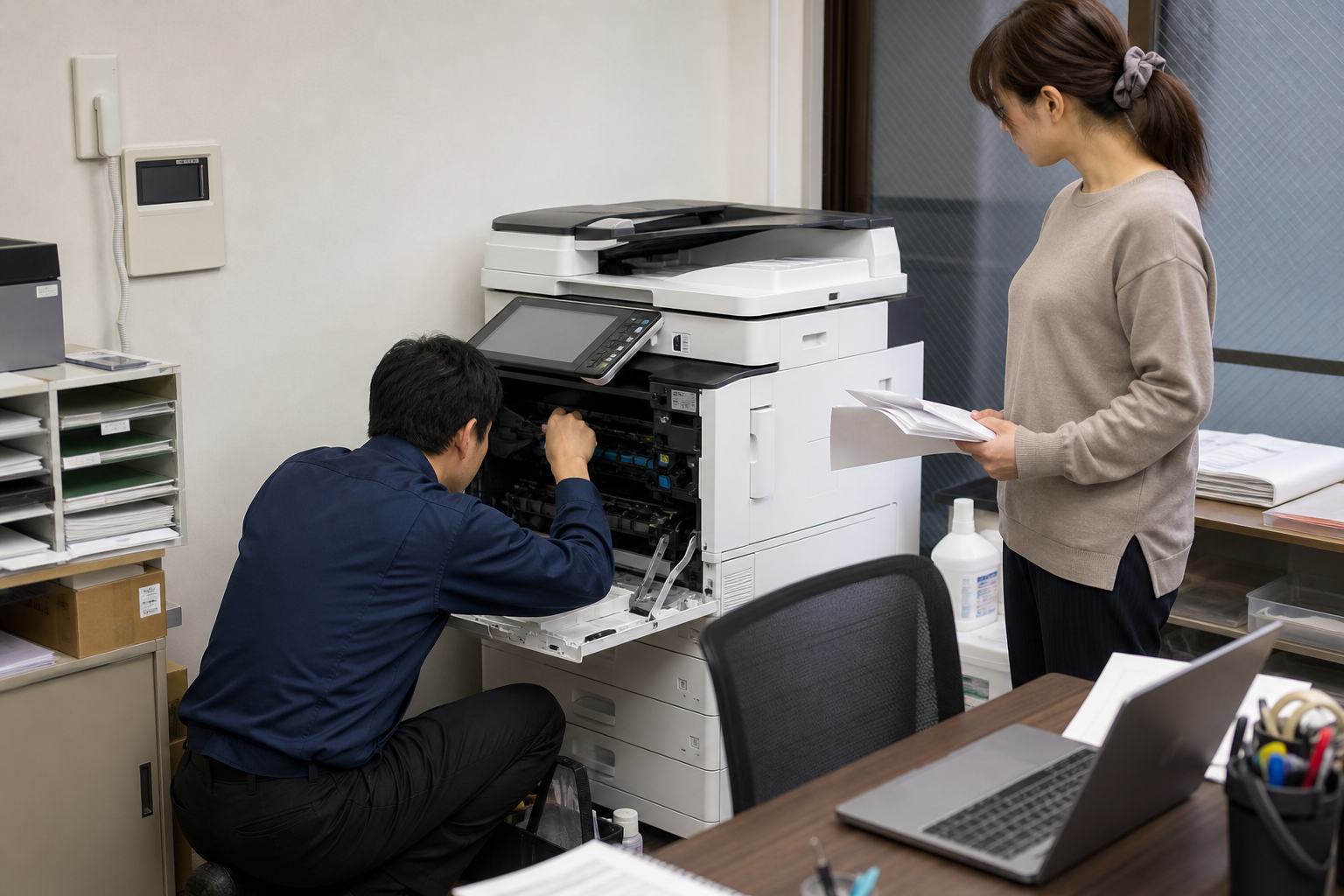
Ricoh's Intelligent Support page makes the support-labor part more explicit. It describes real-time remote service, automated updates, alerts and self-help tools for multifunction printers and printers. RemoteConnect Support lets a Ricoh service expert access a device's smart operation panel with a one-time secure connection code for diagnosis and resolution. When an on-site service call is necessary, the Advanced Remote Mobile System provides the service engineer with device information such as error history, preventive-maintenance counters, firmware version history and basic machine information. Ricoh says this increases the likelihood of a first-time fix and helps extend device life.
The same support page turns toner and firmware into service economics. Low Toner Notifications can email alerts when toner levels drop to a specified amount. Service call notification can send an email when a device has a technical issue and give the service engineer advanced information. Automatic Remote Firmware Update downloads the latest firmware and security patches. The SendMeter app sends meter readings by email to reduce billing errors and control costs. The Service Request app lets a user submit a service request from the device panel. These are not glamorous software features, but they are exactly why a copier lease becomes a support contract. The buyer wants fewer office interruptions. Ricoh wants fewer unnecessary visits, cleaner billing and more predictable consumables demand.
Ricoh's Smart Integration page then adds the workflow layer. It says RICOH Smart Integration turns a multifunction printer into a document workflow tool, routing documents to the right place, in the right format and with the right file name. The public page describes packages that scan to email, print from mobile devices, add scanning to cloud accounts, scan to cloud or on-premise folders, auto-route documents using QR codes, route by document type and scan to SharePoint Online. Optional paid add-ons include device-level authentication, secured print queue release, device counters, toner replacement tools, utilization reporting, healthcare onboarding links and legal document preparation for electronic filing.
Those features define the value proposition. The buyer is no longer paying just for pages. It is paying for reduced manual handling: fewer steps between a signed document and a searchable file, fewer misnamed scans, fewer staff hours spent uploading PDFs, fewer billing errors from manual meter reads, fewer toner emergencies, fewer security exceptions and fewer internal IT tickets. This is why the same contract can include device financing, consumables, field maintenance, support desk labor, workflow software and cloud integration. Each part makes the others more valuable if the customer experiences the machine as a reliable office utility rather than a peripheral that needs constant attention.
The security page closes the loop. Ricoh USA presents printers and copiers as networked information terminals that process data and connect to networks. It describes hard disk encryption, disk overwrite security, secure print technology, device and network security policy alignment, Smart Operation Panel controls, compatibility testing for embedded applications and optional security features for multifunction printers. Ricoh's Integrated Report 2025 also says information security is one of its corporate values as a digital services company, that product security follows Security by Design, and that Ricoh undertakes security activities around NIST SP 800-171 to safeguard customer information assets. Security is therefore not a side topic. It is a condition for charging for workflow integration.
Why the unit is expensive
The contract is expensive because it joins capital cost, labor cost, consumables cost and failure cost. The machine itself must be designed, manufactured, shipped, installed and financed. Toner, drums, parts and other consumables must be forecast and supplied before the customer is out of stock. A technician network must be close enough to respond when remote support is insufficient. Software must keep working across cloud services, authentication systems, folder permissions, firmware changes and customer IT policies. Billing must reconcile meters, service levels, lease terms and supplies. Security must be updated as printers become network endpoints that can store or transmit sensitive documents.
Ricoh's own reporting shows why the company has to manage that cost stack carefully. The March 2026 financial results say Digital Services sales grew 3.0 percent, but operating profit in the segment fell from the prior year. Ricoh attributed support to Office Services growth, Japan service demand and corporate value improvement measures, while noting pressure from lower Office Printing non-hardware profitability, tariff effects, U.S. managed IT business transfer and European infrastructure reform costs. In other words, the revenue base can grow while profitability still depends on mix, service efficiency, hardware and non-hardware trends, and local cost restructuring.
Local labor is central because many document failures are physical. A cloud connector can route a scan, but it cannot remove a jammed page, replace a worn part or physically install a device. Ricoh's Integrated Report describes a historical service network across all prefectures in Japan and says Ricoh is leveraging a global sales and support network to deliver integrated services. It also says Ricoh Japan has thousands of sales representatives nationwide. The exact technician count is not visible in the sources reviewed, but the business model points to a broad local touchpoint system. If the service network is too thin, the lease becomes a bad bargain for customers who cannot wait.
That local cost is also why remote support matters. A service visit is expensive for Ricoh and disruptive for the customer. Remote panel access, error history, preventive-maintenance counters and firmware records reduce uncertainty before a visit. If remote diagnosis resolves the issue, Ricoh saves truck time and the customer avoids waiting for a technician. If a visit is still needed, the service engineer starts with better information. This is the economic logic behind Intelligent Support: reduce the cost of keeping the device available while preserving the customer's confidence that help is close enough.
Consumables are another cost and pricing lever. Toner fraud warnings on Ricoh's supplies page show that consumables are valuable enough to attract scams, and the page directs customers toward genuine parts and authorized channels. The same page says customers with a Ricoh contract must log in to MyRicoh to complete an order, while legacy production-printer parts can carry handling and shipping charges. Those details are small but useful. They show that the consumables relationship is not accidental. It is part of account administration, contract status and recurring customer contact.
Software support raises a different cost issue. Smart Integration promises connections to email, mobile printing, cloud accounts, local folders and SharePoint Online, with optional industry-specific workflow add-ons. Every connector creates support exposure. A customer may blame Ricoh when a scan fails to reach a cloud folder even if the cause is an identity permission, a network setting, an external cloud service change or a customer-side configuration. The contract price must therefore cover not just a license, but the support burden of keeping office users from being stranded between paper and cloud systems.
Revenue logic and pricing proxies
Ricoh does not publish a standard monthly price for a managed print and workflow support contract, which is normal for business equipment and service bundles. Public pricing therefore has to be inferred through proxies. The first proxy is segment scale. Digital Services generated ¥1,988.5 billion of sales in the year ended March 31, 2026, against consolidated sales of ¥2,608.3 billion. That shows the contract family is not marginal to the company. It is the core revenue pool.
The second proxy is profitability. Digital Services operating profit was ¥27.9 billion in the same period, implying roughly a 1.4 percent operating margin, while consolidated operating margin was 3.5 percent. That does not mean every managed print contract has a 1.4 percent margin. The segment includes both Office Services and Office Printing sales, and Ricoh says the segment does not include every activity that the company describes as digital services. But the low public segment margin is an important warning. If Ricoh overpromises support, misprices labor, loses non-hardware revenue, or fails to attach workflow value, the contract can look large in sales and still be thin in profit.
The third proxy is recurring-revenue adoption. In the Integrated Report, Ricoh said Office Services adoption was 36 percent in fiscal 2024 and Office Services recurring revenue grew 10 percent year over year. It also said Office Services revenues expanded by 14 percent during fiscal 2024 in Japan. These figures support the direction of travel: Ricoh is trying to convert a print customer base into recurring service relationships. The figures do not reveal contract-level retention, churn, customer acquisition cost or renewal price increases. They support the thesis that Ricoh is shifting the unit, not that every shift creates durable pricing power.
The fourth proxy is the customer account surface. Ricoh's public MyRicoh-related pages combine invoice payment, supplies ordering, meter reads and service requests. That suggests the contract is administered as an account relationship rather than as one-off hardware purchase. Ricoh USA's invoice page also references business-unit remittance names such as Ricoh USA Managed Services and a vendor-finance program in some invoice cases. This supports the idea that customer payments can span managed services and financing, but it does not reveal rates, periods or balances.
The fifth proxy is the substitute market. HP's managed print services page states that HP MPS combines hardware, supplies, solutions and services under a multi-year contract, and markets proactive fleet monitoring, workflow automation, cloud printing, security and sustainability. Xerox's managed print services page says MPS helps companies understand, optimize and manage printing and document needs, and explicitly names equipment, consumable, repair and operation costs as pain points. Xerox also describes device status monitoring, supplies management, meter collection and security services. These competitors validate that the market sells the same bundle. They also limit Ricoh's ability to charge as if the bundle were unique.
Workflow software changes the buyer's calculation
The workflow layer is where Ricoh has the best chance to make the contract more than hardware rent. A copier lease without workflow is exposed to page decline. As offices digitize, fewer pages are printed, and the old after-sales model based on toner and maintenance becomes weaker. A copier lease with workflow can still be relevant if the device becomes a capture point for forms, invoices, medical intake documents, legal filings, HR papers and branch records. The question is whether the customer sees measurable office-time savings.
Ricoh's Smart Integration page gives concrete examples. Essentials covers scan to email and mobile printing. Connectors add scanning to and printing from cloud accounts such as Box, Dropbox, Google Drive and OneDrive, along with Microsoft 365 email integration. Workflows add automated file and folder naming and direct scanning to cloud or on-premise folders. Advanced Workflows add document classification, routing by document type and SharePoint Online integration. Industry add-ons address healthcare patient onboarding and legal document preparation. These are not abstract strategy words. They are the tasks office workers perform when paper enters a business process.
The buyer's calculus is labor substitution. If a receptionist, paralegal, clinic administrator, branch employee or accounts clerk currently scans a document, emails it to themselves, downloads it, renames it, uploads it, files it and checks whether it is in the right folder, then a one-button workflow can save time and reduce errors. If the customer handles thousands of forms, the saving can justify a service fee. If the customer handles only occasional paper, the workflow layer may be unnecessary. The same Ricoh bundle can be valuable in a document-heavy office and overpriced in a light-use office.
The workflow layer also changes switching costs. A plain copier can be replaced by another brand at lease renewal, subject to buyout, installation and user training. A copier tied into Microsoft 365, SharePoint, cloud folders, user authentication, legal filing steps, healthcare intake and billing workflows is harder to displace. The customer has to test connectors, migrate presets, retrain staff and avoid disruption. That switching friction helps Ricoh, but it also raises the stakes. If the workflow is unreliable, the customer may resent being tied to a device vendor for software tasks that look like general cloud-document management.
Ricoh's own customer stories in the Integrated Report point in this direction. The report describes customers using cloud-based invoice management and workplace-management services, and it presents a large-scale introduction of eco-friendly MFPs with Streamline NX, myPrint and Smart Integration features. Company-provided customer stories are weak evidence for average performance because they are selected examples. They do, however, show how Ricoh wants investors and customers to understand the contract: as a combination of document devices, software, cloud services, security and operating support.
The missing metric is time. The public evidence does not show average minutes saved per scan, error-rate reduction, total administrative hours removed, adoption by user group, or support tickets created by workflow misconfiguration. Those are the figures that would prove whether cloud workflow changes willingness to pay. Without them, the public record is consistent with the thesis, but it does not complete it.
Security and data locality are part of the price
Security matters because the modern copier is no longer just a paper machine. Ricoh's printer-security page says multifunction printers have become true information terminals and core IT assets. They process documents, connect to networks and can store data. Ricoh markets hard disk encryption, disk overwrite security, secure print, Smart Operation Panel controls and compatibility testing for embedded applications. The Integrated Report adds a broader structure: product security, corporate security, factory security, privacy protection, vulnerability response and NIST SP 800-171-oriented activity.
That security posture supports the contract price in two ways. First, customers with regulated or sensitive records need the vendor to reduce printer-related risk. A clinic, school, law firm or insurer cannot treat a networked MFP as an unmanaged appliance if it handles records with personal information. Second, security turns software support into a continuous obligation. Firmware updates, vulnerability countermeasures, authentication, secure release and device policy settings are not one-time installation tasks. They are recurring service work.
Data sovereignty and locality are more difficult to prove. Ricoh's Smart Integration page says documents can be routed to cloud accounts, SharePoint Online, cloud folders, local folders and on-premise destinations. That flexibility is useful because customers differ: one office may want Microsoft 365 integration, another may require local folder routing, and another may have a regulated document library. But the public page does not prove where customer files are processed, where metadata is stored, how long logs are retained, or how data residency is configured for each market. The contract may include answers, but the public record reviewed here does not show them.
This is where network-resource evidence has to be bounded. Public DNS lookups on July 6, 2026 showed ricoh.com using Ricoh-controlled name servers under jp.ricoh.com, mail exchanger records pointing to Proofpoint-hosted gateways, an SPF record referencing Ricoh Japan mail infrastructure, and www.ricoh.com resolving through Akamai edge infrastructure. Those records prove public web and mail dependency surfaces for Ricoh's domain. They do not prove internal architecture, customer data location, managed print uptime, product security quality, support response time, data-processing geography or whether a specific customer's Smart Integration workflow stays within a chosen jurisdiction.
The data-locality issue still affects pricing. If Ricoh can give customers clear local routing, tenant controls, audit trails and security documentation, the contract can absorb more compliance value. If customers cannot get enough clarity, they may route document workflow through Microsoft, Google, Box, Dropbox, a local document-management provider or a sector-specific system, leaving Ricoh as a hardware and support vendor rather than the workflow layer. The public evidence supports the existence of security and cloud-local routing features, but the thesis remains unproven without customer-level security attestations, data-residency terms and incident history.
Substitution pressure
Ricoh's substitute set is broad. The direct substitutes are HP, Xerox, Canon, Konica Minolta, Kyocera, Sharp and local copier dealers that can lease devices, supply toner and dispatch service. The broader substitutes are cloud document-management tools, e-signature systems, mobile scanning, desktop scanners, outsourced records management, print-room consolidation and paperless workflow redesign. Ricoh's contract has to compete with all of them. A customer that can remove the paper step may not need a copier lease at all.
HP's official managed print services page is useful because it describes the same bundle in plain market language: hardware, supplies, solutions and services under a multi-year contract, with fleet monitoring, workflow automation, IT efficiency, security, sustainability and cloud printing. HP also cites customer cases including device reduction, cost reduction and energy savings. These are HP's own marketing claims, not neutral audits, but they show that a buyer can ask multiple vendors for the same economic outcome. Ricoh cannot price workflow support as if customers have no alternatives.
Xerox makes the same pressure visible from another angle. Its managed print services page says customers face high equipment, consumable, repair and general operation costs, lack visibility into print usage and service levels, and need device and document security. Xerox says it monitors device status, handles supplies management, collects meters and provides security services. That is almost a mirror of the Ricoh bundle. The market is not asking whether vendors can sell a copier. It is asking which vendor can reduce total document friction while keeping devices available and secure.
Cloud-only tools are also substitutes. If a business can move forms to web intake, e-signature, workflow approval and cloud storage before paper enters the office, the MFP becomes less central. A small business can buy a lower-cost printer, use a desktop scanner, let staff scan with phones, and rely on Microsoft 365 or Google Workspace for document movement. That substitution is imperfect because paper persists in invoices, identification, signed forms, delivery notes and legacy processes. But every paperless workflow reduces the page pool from which Ricoh once earned supplies and service revenue.
There is also a support substitution. An office with strong internal IT may prefer to buy devices outright, keep spare toner, manage firmware through its own device-management tools and call local repair only when needed. That can be cheaper if usage is low and staff capability is high. For a branch network or SME without print expertise, the same approach can be false economy. Downtime, unplanned toner shortage, compliance risk and staff time can exceed the apparent saving. Ricoh's contract wins when the buyer values continuity more than the option to unbundle.
The hardest customer to defend is the one that prints less every year but still needs service coverage. The fixed cost of support does not fall as quickly as page volume. If Ricoh cannot attach workflow, security and device-management value, the customer will compare the invoice against a shrinking number of pages. That is why the unit has to be workflow support, not copier rent. The page count alone is a weaker base than it used to be.
Supplier and upstream dependence
Ricoh's cost base depends on manufacturing, parts, semiconductors, firmware, cloud integrations, logistics and labor. The Integrated Report says RICOH Digital Products oversees office printing development, production and original equipment manufacturing, and that Ricoh and Toshiba Tec established ETRIA in July 2024 as a joint venture integrating office MFP development and production. Ricoh's FY2026 results add that Oki Electric Industry joined ETRIA in October 2025, contributing product sales. This matters because the managed contract starts with devices that must be built, refreshed and supported.
The Integrated Report says Ricoh manufactures main MFP models at multiple sites and diversifies parts suppliers to mitigate geopolitical and natural-disaster risks. That is relevant to contract continuity. If tariff pressure, parts shortages, factory disruptions or logistics delays affect device availability or consumables, a customer may experience the contract as less reliable even if the service desk works well. Ricoh's FY2026 results specifically mention U.S. tariff policy effects, overseas hardware weakness and continued non-hardware demand weakening in parts of Office Printing.
Upstream dependence also includes cloud and identity providers. Smart Integration connectors name cloud accounts and SharePoint Online. Ricoh can package the workflow, but the destination services belong to third parties or to the customer's own environment. If Microsoft, Google, Box, Dropbox, identity policies, folder permissions or customer networks change, the support burden can land on Ricoh even when the root cause is outside Ricoh's control. That is a classic managed-service margin problem: the vendor is paid to make the whole experience feel reliable, even though it does not control every component.
Security supply chains are similarly layered. Ricoh can design secure devices, update firmware, test embedded applications and follow vulnerability-disclosure standards. But customer outcomes also depend on passwords, network segmentation, identity management, patch acceptance, user behavior and the customer's own cloud settings. The contract price can include Ricoh support, but it cannot remove every customer-side risk. This is another reason evidence strength matters. Security features support value; they do not prove security outcomes.
Financing adds a balance-sheet and partner dimension. The public invoice page references a vendor-finance program in some cases, and Ricoh's financial statements show corporate debt and receivables, but the public sources do not disclose customer lease pools, lease-default rates, residual-value assumptions or finance margins. If financing is profitable and renewals are strong, it can support the bundle. If financing merely smooths hardware sales while support costs rise, it is less valuable. That remains outside the public record.
Customer dependence and switching costs
Customers become dependent on Ricoh when device, billing, supplies, support and workflows are all tied to the same account. That dependence can be productive. A clinic that has secure release printing, automated patient intake scanning, service alerts, toner notifications and meter-based billing in one relationship has less administrative burden than it would have with separate suppliers. The more sites and users involved, the more valuable standardization becomes.
The same dependence can become a switching cost. Moving away from Ricoh may require lease termination, device removal, new hardware installation, supplies transition, user retraining, connector replacement, security review and workflow testing. If the buyer has hundreds of users, multiple sites or regulated document flows, the change has operational risk. That supports renewal pricing when service is good. It also creates frustration if the buyer believes the price is high and the service is mediocre.
Ricoh's public evidence does not show retention or churn by contract type. That is a significant gap. A high renewal rate would support the claim that customers value the bundled contract. High churn, heavy discounting or frequent disputes would weaken it. The public financials show recurring-revenue growth and Office Services adoption, but not whether customers renew because Ricoh saves labor, because switching is painful, because devices are locked into a finance term, or because alternatives are no better.
The buyer's own labor market also affects dependence. When offices face tight administrative staffing, a support contract that prevents printer downtime and automates document routing is easier to justify. When staffing is stable and paper volume falls, the same contract may look expensive. Ricoh's thesis benefits from labor scarcity because it converts a device vendor into an office productivity supplier. But the public record needs customer outcome data to prove that conversion.
For SMEs, service continuity may be more important than sophisticated workflow. A small firm may not need advanced SharePoint routing, but it cannot afford a dead printer before a filing deadline or a toner shortage during billing week. Ricoh's Intelligent Support features target that continuity: low-toner alerts, service-call notifications, remote diagnosis, firmware updates and service requests from the device panel. The value is modest per incident and large in aggregate if it prevents lost hours.
Regulation, geopolitics and operating risk
Regulation touches the contract through privacy, cybersecurity, records retention, repair rights, procurement rules and customer-sector compliance. Ricoh's Integrated Report says information security risks are rising because of cyberattacks, ransomware, national regulations and geopolitical risks. It also says Ricoh monitors external changes such as security standards in public and private sectors. A vendor that sells workflow support into offices handling sensitive documents has to keep up with that environment.
Geopolitics shows up in manufacturing and tariffs. Ricoh's FY2026 results refer to the impact of U.S. tariff policies, particularly on hardware sales in Office Printing and Commercial Printing. The Integrated Report also says Ricoh diversifies production sites and parts suppliers to mitigate geopolitical and natural-disaster risks. Tariffs and parts disruption can raise hardware cost or delay fleet refreshes. That matters even if the buyer thinks it is buying a service, because the service starts with a physical device.
Data locality is an operating risk when customer documents are routed to cloud services. Ricoh can support local folder destinations and cloud destinations, but buyers in public sector, healthcare, finance and legal markets may ask where documents and logs are processed. The public pages reviewed here do not provide a complete data-residency answer. That does not mean Ricoh lacks one in private contract terms. It means the public record cannot prove this part of the value proposition.
Repair rights and parts availability also matter. Ricoh USA's supplies page includes a reference to the State of Minnesota's Digital Fair Repair Act and a way to seek parts or documentation under that law. This is a small public signal that repair regulation is reaching the office-equipment market. For Ricoh, right-to-repair rules can reduce control over service revenue but may also clarify parts access. For customers, broader repair options can be a substitute for a full-service contract if they have the ability to manage repairs.
Procurement pressure is another risk. Public buyers and large enterprises can benchmark managed print providers against each other. They can ask for device consolidation, service levels, security documentation, cloud-print options, supplies management and cost-reduction commitments. Ricoh's contract has to survive that comparison. The existence of HP and Xerox public MPS offers means buyers can pressure Ricoh on price, scope and proof.
Unofficial signals and what they can show
Unofficial signals are weakest here, but they still help frame risk. Product reviews around Ricoh scanners and connected devices often praise hardware reliability and speed while sometimes criticizing wireless or software experience. A recent scanner review described a Ricoh business scanner as fast, reliable and strong on software support, while a separate portable-monitor review praised build quality but found wireless and touch software frustrating. These are not managed print contract reviews. They do not prove service quality, support response or workflow performance. They do, however, illustrate the broader market risk: customers may trust Ricoh hardware more readily than every software or wireless layer around it.
The signal is plausible because Ricoh's own thesis requires software to carry more of the value. If a customer sees the MFP as a robust copier but finds cloud routing, authentication, mobile printing or user interfaces frustrating, then workflow support may not justify a premium. Conversely, if the workflow layer reliably removes clerical steps, the old hardware brand gains a new source of value. Public reviews cannot settle the question because they usually cover individual products, not contract outcomes across a fleet.
Market commentary from competitors adds a stronger substitute signal. HP and Xerox both market MPS as a bundle of hardware, supplies, services, workflow and security. That means Ricoh is not alone in the thesis, and it cannot rely only on a copier brand. The market has converged around managed print as document-infrastructure outsourcing. The competitive question is whose local service labor, device fleet, cloud connectors, security posture and account management create the lowest total cost for the customer.
The settlement metric would be buyer renewal and outcome data. If customers renew after measured reductions in service calls, toner emergencies, scan handling time, billing errors, security exceptions and internal IT tickets, the thesis becomes strong. If renewals depend on discounting, finance lock-in or inertia while page volume declines, the thesis weakens. Public evidence does not show enough to choose decisively between those cases.
Public evidence
- Ricoh company facts, https://www.ricoh.com/about/facts. This supports the company's legal name, headquarters in Tokyo, establishment date, CEO, capitalization, March 2026 sales, subsidiaries, employees and business-domain description. It is strong identity evidence.
- Ricoh Group Integrated Report 2025 HTML page, https://www.ricoh.com/about/integrated-report/2025. This supports the named annual-report anchor and Ricoh's public framing of its shift toward digital services, Office Services growth and profitability improvement. It is strong official context for the operating thesis.
- Ricoh Group Integrated Report 2025 download page, https://www.ricoh.com/about/integrated-report/download. This supports the strategic shift from Office Printing to Digital Services, fiscal 2024 segment scale, Office Services adoption, recurring-revenue growth, service-network history, customer-base claims, security program and ETRIA production context. It is strong company-reported evidence, but not customer-level proof.
- Ricoh Group Integrated Report 2025 PDF, https://www.ricoh.com/-/media/Ricoh/Sites/com/about/integrated-report/pdf2025_e/all_en.pdf?rev=745ac06b3020430e9fdba635a4b6d815&sc_lang=ja-JP. This is the underlying official report used for the Office Services adoption, recurring-revenue, security and production-context claims.
- Ricoh financial results page, https://www.ricoh.com/IR/library/financial-results. The year ended March 31, 2026 financial highlights support consolidated sales, operating profit, Digital Services sales, Digital Services operating profit, Japan service growth, security-related service demand, non-hardware weakness and tariff effects. It is strong financial evidence for scale and margin pressure.
- Ricoh FY2025 financial highlights PDF, https://www.ricoh.com/-/media/Ricoh/Sites/com/IR/financial_data/financial_result/data/38/q4_report.pdf?rev=65daa311432943b48d7e108c52e12082&sc_lang=ja-JP. This is the direct results document behind the March 2026 sales, Digital Services margin, service-demand and tariff-impact claims. It is strong financial evidence, but not unit-level contract evidence.
- Ricoh FY2025 financial highlights PDF, https://www.ricoh.com/-/media/Ricoh/Sites/com/IR/financial_data/financial_result/data/38/q4_report.pdf?rev=65daa311432943b48d7e108c52e12082&sc_lang=ja-JP. This is the official financial-release file behind the segment sales, operating profit, tariff-pressure and forecast references.
- Ricoh Smart Integration page, https://www.ricoh-usa.com/en/products/software/ricoh-cloud-workflow-solutions. This supports the cloud workflow layer: scan to email, mobile printing, cloud accounts, local folders, automated file naming, QR routing, SharePoint Online, secured print release, utilization reporting and industry add-ons. It is strong product-scope evidence, not outcome evidence.
- Ricoh Intelligent Support page, https://www.ricoh-usa.com/en/products/intelligent-support. This supports remote support, service engineer preparation, error history, preventive-maintenance counters, firmware updates, security patches, low-toner alerts, meter reads and panel-based service requests. It is strong evidence for service-scope claims.
- Ricoh printer-security page, https://www.ricoh-usa.com/en/products/printer-security. This supports the claim that Ricoh markets MFPs as networked information assets requiring device, data and network security, including hard disk encryption, disk overwrite and secure print. It is product-security evidence, not proof of customer security outcomes.
- Ricoh supplies page, https://www.ricoh-usa.com/en/products/supplies. This supports the consumables relationship, MyRicoh ordering, meter reads and service requests, plus the fact that contract status affects supply ordering. It is strong evidence that consumables remain tied to account administration.
- Ricoh invoice page, https://www.ricoh-usa.com/en/support-and-download/pay-your-invoice. This supports invoice payment through MyRicoh, Ricoh USA Managed Services remittance and a vendor-finance program reference in some invoice cases. It is billing-surface evidence, not lease-rate evidence.
- HP Managed Print Services page, https://www.hp.com/us-en/services/managed-print-services.html. This supports direct substitution: HP markets MPS as hardware, supplies, solutions and services under a multi-year contract with workflow, cloud, fleet monitoring and security. It is strong substitute evidence.
- Xerox Managed Print Services page, https://www.xerox.com/en-us/services/managed-print-services. This supports direct substitution: Xerox identifies equipment, consumable, repair, operation, supplies management, meters, security, cloud and workflow as MPS components. It is strong substitute evidence.
- Public DNS lookups on July 6, 2026. These showed Ricoh-controlled public name servers, Proofpoint-hosted mail exchangers and Akamai web delivery for www.ricoh.com. This is bounded public-surface evidence only. It cannot prove internal architecture, data residency, uptime, support quality or contract value.
What would change the judgment
The most important missing metric is unit margin by contract type. If managed print and workflow support contracts have materially higher gross margin than traditional Office Printing after-sales revenue, Ricoh's shift has stronger economics. If they have low margin because support labor, cloud troubleshooting and integration work consume the fee, the revenue shift is less attractive. Public segment margin suggests caution, but it is too aggregated to settle the issue.
The second missing metric is utilization. A workflow feature has value only when users adopt it. Public pages show Smart Integration features, but not active users, scans routed through workflows, percentage of devices with add-ons enabled, or the number of manual steps removed. A customer that pays for workflow but still scans to email and manually files PDFs will not support premium pricing for long.
The third missing metric is service continuity. Support wait time, first-time fix rate, repeat visits, mean time to repair, remote-resolution rate, toner stock-out frequency and firmware incident history would show whether Ricoh's service layer is protecting office productivity. The public support page describes tools designed for this outcome. It does not disclose the measured outcome.
The fourth missing metric is retention and churn. Renewal rates, early termination, discounting at renewal and net revenue retention would reveal whether customers value the combined contract after experiencing it. Recurring-revenue growth is encouraging, but it does not separate new sales, price increases, acquisitions, currency effects, mix shift or retention.
The fifth missing metric is data and security assurance. Customer-level data-residency terms, incident history, vulnerability response times, audit reports, support-access logs and security exception rates would determine whether the cloud workflow and secure-print claims are bankable for regulated buyers. Public pages are consistent with a serious security program, but they are not a compliance audit for any specific customer.
Conclusion
The evidence supports the claim that Ricoh is no longer trying to defend a copier lease as a simple hardware rental. Ricoh's own Integrated Report and financial results show a company trying to offset a shrinking Office Printing market by growing recurring Office Services and Digital Services revenue. The public product pages show the contract components: financing and invoices, consumables, meter reads, remote and on-site support, firmware updates, security controls, document workflow software, cloud integration and account administration. HP and Xerox public offers show that this is a real market category, not just Ricoh's preferred language.
The public record suggests the contract can justify its price when the buyer has document-heavy work, limited internal support capacity, compliance exposure and a need for local service continuity. In that setting, Ricoh is selling fewer interruptions, fewer manual document steps, fewer toner surprises, better meter billing, security maintenance and one account relationship for paper-to-cloud work. The managed print and workflow support contract is valuable when it reduces office labor and failure cost more than it adds vendor fees.
The available evidence is consistent with the thesis, but the thesis remains unproven without unit margin, lease-rate detail, service wait time, remote-resolution rate, failure rate, workflow utilization, customer time savings, retention, churn, incident history, data-residency terms and support cost per device. Ricoh's challenge is not to persuade the market that copiers can connect to the cloud. The public evidence already shows that. Its challenge is to prove, customer by customer, that the copier lease has become the cheapest reliable way to keep documents, people, devices and compliance work moving.