
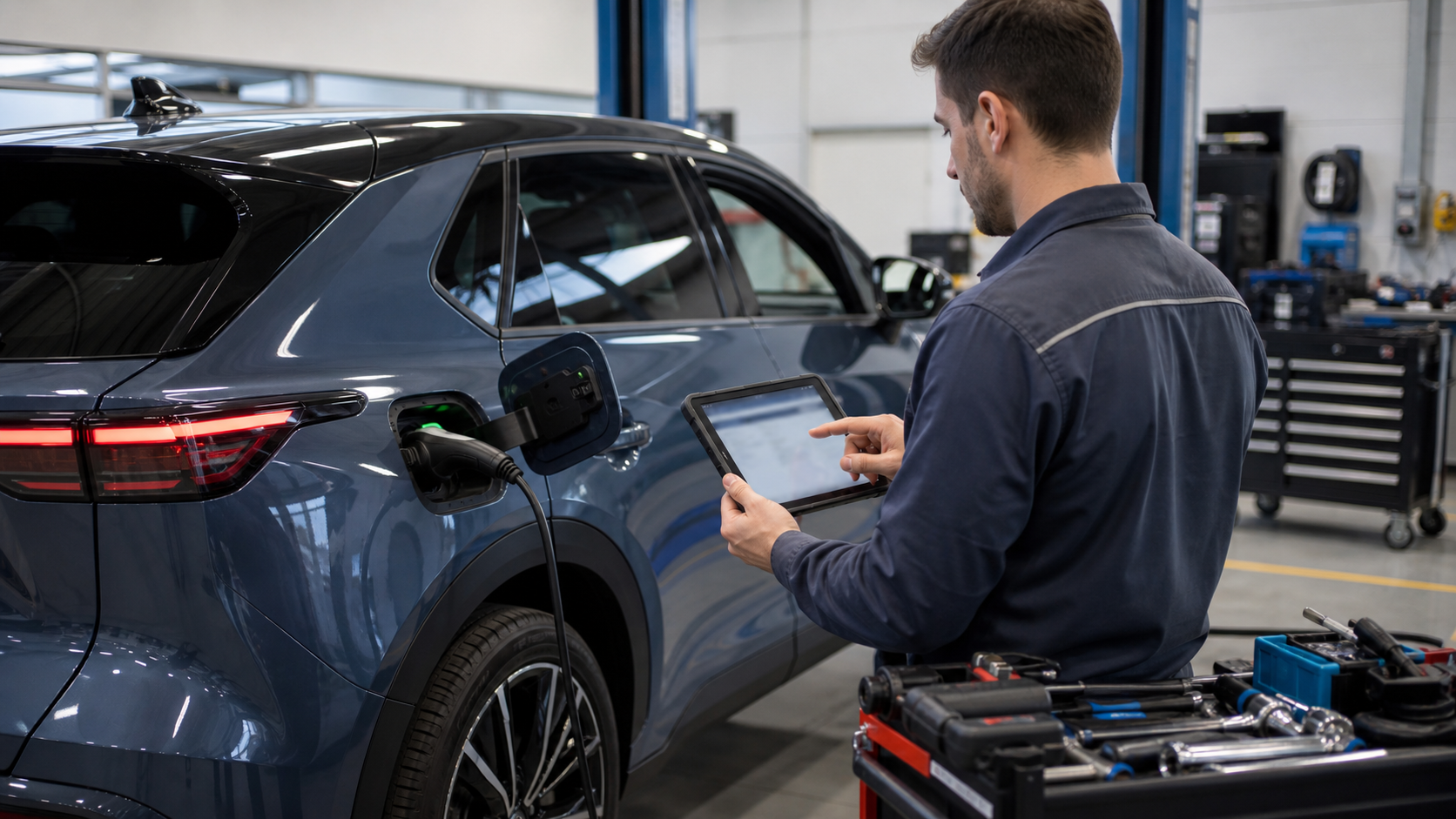
Summary
- The unit to analyze is a connected-car account wrapped around a Kia EV: remote charging, remote climate, vehicle status, diagnostic alerts, account identity, paid subscription tiers, dealer service booking, OTA update eligibility, roadside assistance and warranty-adjacent software remedies. The substitutes are not only rival EV brands. They include a non-connected trim, dealer-only service, third-party fleet telematics, phone-native navigation, a used internal-combustion vehicle, or delaying the EV purchase.
- Kia's public evidence supports a real service relationship, not a finished proof of customer-level savings. Kia reported 2025 global sales of 3,135,873 vehicles, KRW 114.1 trillion of revenue, KRW 9.08 trillion of operating profit and 749,000 electrified-vehicle sales; Kia America publishes paid Kia Connect tiers and long EV warranty coverage; NHTSA recall files show software and dealer remedies can sit beside hardware inspection and replacement. Those facts show why the account matters. They do not disclose app uptime, repair-cycle duration, dealer first-time-fix rates, battery claim approval rates, churn after free trials, or the true cost of keeping one EV owner satisfied.
- The investment case is therefore conditional. Kia's connected account is valuable when it makes the warranty promise cheaper to honor and easier for the owner to use. It becomes a liability when software faults, cellular limits, privacy concerns, dealer delays or subscription friction turn the account into a second failure surface beside the vehicle itself.
The owner is buying a lower-risk EV, not another app
A small delivery fleet in California is deciding whether to put ten Kia EV9s into service. A household buyer in Manchester is making the same choice in miniature with one EV6. Both buyers can read the vehicle range, finance payment and warranty brochure. The harder decision is about the account that sits after the sale. If the vehicle is connected, the buyer can use remote charging, cabin pre-conditioning, vehicle-status checks, charge scheduling, navigation services, diagnostic alerts, roadside assistance notices, software updates and dealer pathways. If the account fails, expires, is unavailable in the buyer's jurisdiction, or becomes too annoying to manage, the buyer has not merely lost a convenience feature. The buyer has lost part of the system that was supposed to make EV ownership feel less risky.
That is the operating unit in this article: the Kia connected-car account, remote service and warranty-adjacent software relationship. It is not the EV alone. It is not the mobile app alone. It is the commercial bond between vehicle, owner identity, subscription status, cellular reachability, dealer service, warranty coverage, software-update route, data permission and post-sale support. In an EV, that bond matters because the things that frighten buyers are not limited to price. They include battery degradation, charger compatibility, 12-volt battery failure, remote-command reliability, winter range, software recalls, dealer wait times, warranty interpretation and resale confidence.
The direct substitutes discipline Kia's price and promise. A buyer can choose a non-connected trim or ignore the account after the free period. A fleet can use third-party telematics instead of the manufacturer's app. A driver can rely on phone-native navigation and public charging apps rather than in-car connected routing. A family can buy a rival EV ecosystem from Tesla, Hyundai, Ford, Volkswagen or another brand. A risk-averse customer can keep an older petrol vehicle or delay the EV purchase until battery and software reliability feels more ordinary. A local dealer-only service model is also a substitute: fewer remote features, more phone calls, but less dependence on one account relationship.
The burden Kia is trying to absorb is equally concrete. A strong account moves monitoring, update delivery, support triage, recall communication, charging session management, remote access, roadside location, subscription billing and some diagnostic interpretation from the owner to Kia and its partners. If this works, the owner sees lower failure cost, lower compliance burden for a fleet, lower switching cost inside the Kia ecosystem, faster incident recovery, better resale confidence and less anxiety about battery warranty exposure. If it does not work, the seller has added a new support obligation without removing the old mechanical one.
Public evidence can prove that this relationship exists, is monetized and is tied to warranty and service surfaces. Kia America publishes Kia Connect plan prices and feature matrices. Kia's terms identify hardware, software, accounts, embedded modems, service providers, Verizon, dealers and wireless carriers as part of the service environment. Kia's warranty page sets out 10-year/100,000-mile EV system and battery coverage in the United States. NHTSA recall files show that some EV remedies include software updates and dealer inspection or replacement. Kia's European privacy notice maps vehicle-generated, app, head-unit, location, technical and OTA-related data to connected services and vehicle system updates.
Public evidence cannot prove the decisive private metrics. It cannot show the app success rate for remote charging commands on a winter morning, the dealer backlog for a battery diagnosis in a particular city, the share of free-trial users who convert to paid subscriptions, the cost of a warranty battery claim, the number of repeat visits after an OTA repair, or the margin Kia earns on an Ultimate account after telecom, support, payment and engineering costs. Those are the missing figures that decide whether the connected account lowers ownership uncertainty or simply moves it into software.
Kia's scale makes the account worth solving
Kia is no longer a small challenger brand using long warranty language as a simple price wedge. Hyundai Motor Group's January 2026 results release for Kia says the company sold 3,135,873 vehicles globally in 2025, its highest annual total, and generated KRW 114.1 trillion of revenue, up 6.2 percent year over year. Operating profit was KRW 9.08 trillion, down 28.3 percent because of tariff impacts and higher incentives, with an 8 percent operating margin. Net profit including non-controlling interest was KRW 7.6 trillion (https://www.hyundaimotorgroup.com/en/news/kia-announces-2025-annual-and-fourth-quarter-business-results).
The same release shows why the connected-car account is strategically important. Kia sold 749,000 electrified vehicles in 2025, up 17.4 percent, and those vehicles accounted for 24.2 percent of total sales. The electrified mix included 454,000 hybrids and 238,000 EVs. For 2026, Kia guided to 3.35 million global sales, KRW 122.3 trillion of revenue, KRW 10.2 trillion of operating profit and an 8.3 percent operating margin, with plans to expand electrified models in North America, Europe and India and roll out the EV2 in Europe (https://www.hyundaimotorgroup.com/en/news/kia-announces-2025-annual-and-fourth-quarter-business-results).
Those numbers do not prove connected-service profitability. They do prove that Kia's electrified installed base is large enough for post-sale software and service execution to matter. A brand can tolerate a weak app if the vehicle is mostly mechanical, the warranty issue is rare and the buyer only needs an oil-change reminder. It has less room for weakness when a growing share of sales depends on high-voltage batteries, charge scheduling, infotainment, route planning, software updates, digital keys, remote climate and public charging relationships. In that world, the account becomes part of the product's practical reliability.
This is where group evidence must be used carefully. Hyundai Motor Group's release is group-hosted communication about Kia Corporation's results. It establishes scale, electrified-sales momentum, profitability pressure and management's 2026 targets. It does not show the economics of Kia Connect in the United States, Kia Connect GmbH in Europe, Kia dealers in one country, or a battery warranty claim for a single owner. The correct inference is that the connected account sits on a large and expanding vehicle base. The incorrect inference would be to treat group revenue as proof that the account is profitable, reliable or loved by customers.
The account is still commercially attractive because the installed base gives Kia several levers. A connected owner can receive app-based reminders, paid subscription offers, store upgrades, charging services, software updates, remote support and dealer notices. A fleet buyer can use vehicle status, charging state, geofence-style alerts, maintenance reminders and data exports to manage operations. A used-car buyer can inherit some original connected-service term or evaluate whether remaining warranty and account access support resale value. Each lever can improve retention if it is useful. Each can damage retention if it appears to meter features that the buyer thought were part of the car.
The financial pressure makes execution harder. Kia's 2025 operating profit fell while incentives and tariffs weighed on margins. In that environment, connected services are tempting because they can look recurring, software-like and less capital intensive than vehicle assembly. Yet connected services are not free revenue. They require mobile networks, cloud infrastructure, cybersecurity, privacy compliance, payment handling, customer support, dealer coordination, defect investigation, software maintenance and liability management. The account is valuable only if those costs are lower than the warranty, retention and resale uncertainty they reduce.
The warranty promise turns software into a cost bridge
Kia's warranty language is a central part of the purchase decision in the United States. Kia's warranty page describes a 10-year/100,000-mile powertrain limited warranty, a 5-year/60,000-mile basic limited warranty, 5-year/100,000-mile anti-perforation coverage and 5-year/60,000-mile roadside assistance. It also describes EV system warranty coverage for key electric drivetrain components, including the electric motor, high-voltage battery, electric power control unit and on-board charger, for 10 years or 100,000 miles from first service, and battery coverage for capacity loss below 70 percent of original capacity for the same 10-year/100,000-mile period (https://www.kia.com/us/en/warranty).
The warranty is not the same as the connected account. But the two increasingly meet in the owner's experience. A warning light, a low 12-volt alert, a failed remote charge command, a software update, a diagnostic trouble code, a road-assistance call and a dealer appointment may all be part of the path from symptom to remedy. If the account shortens that path, it lowers the owner's failure cost. If it confuses that path, it raises Kia's support burden and makes the warranty feel harder to use.
Kia's warranty page also gives a concrete trip-interruption example. If a warranty-related disablement happens more than 150 miles from home and repairs require more than 24 hours, Kia says its trip-interruption policy can reimburse reasonable meals, lodging or rental car expenses, limited to $100 per day for up to three days (https://www.kia.com/us/en/warranty). This is a small line in the policy, but it reveals the economics. A warranty is not only parts. It is time, travel, substitute mobility and customer confidence. A connected service that locates the vehicle, communicates the fault, directs the owner and helps schedule repair can reduce that broader cost. A failed app can do the opposite.
The EV-specific warranty creates a higher-stakes version of the same problem. Battery capacity language gives buyers a clear headline: coverage if capacity drops below 70 percent within the stated term and mileage. But capacity disputes are not felt as headlines. They are felt as range anxiety, charging anomalies, state-of-health readings, dealer tests, repair approvals, loaner vehicles, parts availability and the owner's confidence that the measured battery condition matches the lived experience. The connected account can help if it gives Kia and the owner better diagnostic visibility. It can hurt if data is hard to access, hard to explain or not trusted by the dealer.
NHTSA recall files show the warranty-adjacent software problem in a more official form. In recall 24V867, Kia America recalled certain 2022-2024 EV6 vehicles because the Integrated Charging Control Unit could become damaged and stop charging the 12-volt battery, which could result in loss of drive power. The NHTSA filing listed 62,872 potentially affected units and said dealers would inspect and replace the ICCU and its fuse as necessary, and update ICCU software; it also said the recall expanded and replaced previous recall 24V-200, so vehicles already repaired under the earlier recall needed the new remedy (https://static.nhtsa.gov/odi/rcl/2024/RCAK-24V867-2367.pdf).
That recall is important because it links hardware, software and owner risk in one chain. The failed unit is not merely a convenience defect. The filing says loss of drive power increases crash risk. The remedy is not merely "download the app." It includes dealer inspection, possible replacement of hardware and fuse, and a software update. The connected account does not erase the need for dealer capacity. It can make communication and update delivery easier, but the owner's true cost depends on whether the dealer can inspect, diagnose and repair the vehicle quickly.
Another NHTSA recall shows the account in the update path itself. Kia's 2024-2025 EV9 instrument-cluster recall notice said a software logic error could make the instrument cluster screen intermittently blank at vehicle start-up, preventing display of critical safety information such as speedometer and warning lights. The owner notice said 2024-2025 model-year EV9 vehicles contain OTA software update technology, and that using the OTA feature requires an active Kia Connect account and enrollment in one of the available Kia Connect plans. It also said dealers could update the software if the account was not active or OTA was not the owner's preferred method (https://static.nhtsa.gov/odi/rcl/2024/RCONL-24V757-4372.pdf).
That is the cost bridge in one document. A software recall can be handled through the connected account for eligible owners, but the dealer remains the backstop. For Kia, that creates a trade-off. OTA can reduce dealer workload, shorten remedy time and improve customer convenience. It also makes account eligibility, network coverage, owner consent, update timing and vehicle state part of a safety remedy. The system is only superior if the owner understands it and the fallback path works.
Kia Connect monetizes reassurance after the free period
Kia Connect is not presented as a vague digital accessory. Kia America publishes a plan ladder. Its compare page lists Lite as complimentary for up to five years, Care at $5.99 monthly or $59 annually, Plus at $14.99 monthly or $149 annually, and Ultimate at $19.99 monthly or $199 annually. The same page maps features such as trip information, vehicle health reports, roadside assistance, climate scheduling, digital key, 911 Connect, maintenance reminders, low starter-battery alert, vehicle alarm notification, remote lock and unlock, remote start, remote climate, remote charge and stop charge, charging status notification, charge scheduling, send destination to car, connected routing, connected weather and over-the-air infotainment and navigation updates (https://owners.kia.com/us/en/uvo-compare-packages.html).
This plan ladder is the commercial test. The owner receives a trial or complimentary period, learns which functions matter, and later decides whether the account is worth keeping. The most valuable features are not always the flashiest ones. For an EV owner, remote climate and charge scheduling can save time and winter discomfort. For a fleet operator, vehicle status, charging state and maintenance reminders can reduce operational interruptions. For a parent, geofence, speed, curfew and alarm alerts may matter. For an owner in a city, remote lock, find-my-car and stolen-vehicle features may be more salient than streaming.
The pricing also shows a risk. When a feature is bundled into a trial, it can become part of the buyer's expected vehicle experience. When the trial ends, the buyer may feel that a function has been removed from a car already bought. Kia's own page says purchase or lease of certain 2019 and newer Kia vehicles with Kia Connect includes a complimentary one-year Ultimate subscription, and that continued access to the full suite after expiration requires a paid subscription at the then-current rate or certain features may terminate. It also says features, specifications and fees are subject to change, and that cellular and GPS coverage are required for most features (https://owners.kia.com/us/en/uvo-compare-packages.html).
The terms of service sharpen the same point. Kia says using Kia Connect requires Kia Connect Services hardware, which includes hardware and software used to help provide the services. Some vehicles require a mobile device with the app; others use an embedded modem. Kia also says it may engage third-party providers including wireless service providers, telematics providers such as Cellco Partnership doing business as Verizon Wireless, underlying wireless carriers, suppliers, licensors, public safety answering points, emergency responders, towing companies, automobile makers, distributors and dealers (https://owners.kia.com/us/en/terms-of-service.html).
This is not a bad thing. A connected-car account necessarily has partners. But it means the owner is buying a chain, not a single object. The lock command, diagnostic alert, roadside event, charging session or software update can depend on the vehicle hardware, the owner's account, a phone, a carrier, an embedded modem, cloud services, a payment method, a dealer, and a third-party service provider. The chain is valuable when the owner sees one simple Kia service. It is fragile when the owner is passed between Kia Connect support, a dealer, Verizon, a charging network or a payment processor.
The Wi-Fi hotspot page makes the telecom dependency explicit. Kia says eligible vehicles get a free trial of Wi-Fi Hotspot for three months or 3 GB of data, whichever comes first; after the trial, the owner must buy a Verizon data plan to continue using the feature. The page says enrollment in any Kia Connect package is required and Verizon subscription is required after the trial. It also says reduced performance or interruptions can occur where 4G LTE coverage is not offered, and it sends customers to Kia Connect support during the trial and Verizon after a paid plan is purchased (https://owners.kia.com/us/en/wifi-hotspot.html).
The correct conclusion is bounded. The Verizon hotspot page proves a real telecom partner dependency for one feature. It does not prove Kia's broader cloud architecture, telemetry routing, data residency or service quality. It does show what the owner already knows intuitively: a car feature can become a telecom and subscription feature. In a fleet decision, that matters because the buyer must count data plans, coverage areas, support handoffs and employee-use policies as part of total cost.
Software updates reduce dealer visits only when the update path works
OTA updates are the connected account's strongest promise because they can turn a defect into a managed software event rather than a dealer visit. Kia Europe's OTA page describes vehicle system OTA software updates as wireless downloads of the latest available software while driving, followed by an infotainment message after download. The page says updates can improve key vehicle functions such as powertrain, steering, suspension, electric motor, battery, airbags and advanced driver assistance systems. It also says wireless software updates can be used for recall or free repair campaigns and product improvement, while specific details vary by model, trim and region (https://www.kia.com/eu/service/connectivity/kia-ota/).
That is a large claim in operational terms. In an older car, a defect often meant a service appointment. In a modern EV, a defect may mean a software package, a dealer diagnostic, a hardware replacement or some combination. The owner's cost depends on the classification. If a fault is handled remotely and the owner loses only a parked hour, the account creates value. If the update fails, if the vehicle cannot be used during the process, if the owner lacks connectivity, or if the dealer later says the software remedy did not address the symptom, the account may only have deferred the service problem.
Kia's own OTA instructions show why this is not frictionless. The European page says owners must have enough time, park safely in an area with good mobile network signal strength, keep people outside the vehicle, not open the bonnet, not replace the battery, not connect diagnostic tools, and accept that the vehicle cannot be used during the update. It says charging is not available during the update, and that all functions including EV high-voltage battery charging and V2L cannot be used for up to 100 minutes. The FAQ says the EV9 was the only model able to receive wireless controller-software updates as of September 2023, with more models expected, and that Kia Connect activation is required for OTA updates (https://www.kia.com/eu/service/connectivity/kia-ota/).
Those details make OTA more credible, not less. They show that Kia treats vehicle software as safety- and operation-sensitive. They also show why an owner cannot treat an OTA remedy like a phone app update. The vehicle must be parked, sufficiently charged and in the right state. A fleet must schedule downtime. A household must understand that a charging session may be temporarily unavailable. A rural owner needs mobile signal. A dealer still needs to be ready when the update does not apply, fails, or reveals a hardware issue.
Europe's Kia Connect Store adds another layer. It advertises over-the-air map and infotainment updates, with the first two free of charge and later updates available through purchase for two consecutive updates within one year. It also lists paid or purchasable upgrades such as acceleration boost, remote smart parking assist, entertainment packages and smart regenerative system functions (https://connect.kia.com/eu/store/). The point is not that every owner will buy these. The point is that vehicle capability is becoming account-mediated. Some value is delivered at sale. Some is activated later. Some is free for a term. Some is a purchase. Some depends on country, vehicle and eligibility.
For a buyer, this changes how warranty and residual value are read. A used EV is no longer only a battery, motor and body. It is also an entitlement history. Which updates have been installed? Which connected-service term remains? Which features are paid, trial, unavailable or transferable? Which recalls were completed through OTA and which through a dealer? A buyer can substitute away from Kia if another brand makes that entitlement history clearer. Kia can defend the account if it makes the record visible, portable and simple.
Dealer support remains the decisive local surface
The account may be digital, but the remedy often happens in a service bay. Kia's U.S. owner portal says an owner can see maintenance milestones, book appointments at a preferred dealer, make payments if financed by Kia Finance, access remote connectivity features if equipped and eligible, and use digital manuals from connected devices (https://owners.kia.com/us/en/kia-owner-portal.html). That is the ideal model: one account ties reminders, financing, documents, remote features and dealer scheduling into the owner routine.
The same model can break under stress. A remote diagnostic alert is only useful if the dealer has appointment capacity, trained technicians, diagnostic tools, parts, warranty authorization and enough communication discipline to explain what happens next. In an EV, this can be more specialized than a normal service visit. Battery, charging, 12-volt system, ICCU, high-voltage safety and software issues require trained staff and sometimes parts that are not sitting on every shelf. If the owner sees a warning in the app and waits weeks for inspection, the account has created anxiety without reducing downtime.
The recall record again shows the split. For the EV6 ICCU recall, dealers inspect and replace hardware and update software as necessary. For the EV9 instrument-cluster recall, an OTA route exists for eligible connected owners, but the dealer can perform the update if the account is not active or OTA is not the owner's preferred installation method. This is the correct structure. Software can scale; dealers handle exceptions. But the economic value depends on the exception rate and dealer throughput.
Kia's warranty page makes roadside assistance and trip interruption part of the confidence promise. The Kia Connect plan page says roadside assistance can automatically provide vehicle location during an emergency, and 911 Connect can attempt to call emergency agents and send vehicle location after airbag deployment, with cellular coverage required (https://owners.kia.com/us/en/uvo-compare-packages.html). These features convert location and connectivity into response quality. The owner's trust is not in "connectivity" as an abstraction. It is in whether the car can call, locate, schedule, tow and repair when the driver is stranded.
For fleets, dealer support is even more important. A household can tolerate one bad week if a second car exists. A delivery fleet, municipal user or ride-service operator measures downtime as lost route capacity, driver wage waste, substitute vehicle cost, customer delay and operational complexity. A third-party telematics provider can measure location and state of charge, but it cannot approve a Kia warranty repair. A Kia dealer can service the car, but may not provide the fleet dashboard a dispatcher wants. The connected account creates value when it bridges those worlds rather than forcing the fleet to duplicate them.
This is why the article's thesis cannot be settled from product pages. The private proof would be a service history by vehicle cohort: days from warning to appointment, first-time-fix rate, repeat repair frequency, parts wait, software remedy success, loaner availability, customer reimbursement, battery claim outcome and subscription renewal after a service event. Kia does not publish those figures. Without them, the public case remains plausible but unproven at owner level.
Data governance is now part of the ownership price
The connected account also transfers a data burden to Kia and its partners. In the United States, Kia's Kia Connect privacy policy says Kia America is a U.S.-based subsidiary of Kia Corporation in Seoul and the exclusive U.S. distributor of Kia-branded vehicles, parts and accessories. It says Kia dealers, licensees and partners are independent companies, and that the Kia Connect privacy policy does not govern their privacy practices even if a customer reaches them through Kia Connect (https://owners.kia.com/us/en/privacy-policy.html).
That distinction matters because the owner experiences one brand, while the data chain contains many parties. The same U.S. privacy policy says Kia Connect may collect vehicle information through telematics or an embedded modem, including operation, performance and condition, diagnostic trouble codes, oil life, tire pressure, fuel economy, odometer readings, battery-use management, charging history, battery deterioration, eco-related driving or charging data, electrical system functions, driver behavior, seat-belt use, direction and time of travel, route information, collision and airbag data, paired mobile device status, precise vehicle location, remote service data, request-for-service timing, VIN, model, model year, trim, selling dealer, servicing dealer, purchase or lease date and service history (https://owners.kia.com/us/en/privacy-policy.html).
For an EV owner, those categories are not abstract. Battery charging history and deterioration data can be relevant to warranty confidence. Precise location and route data can be sensitive. Diagnostic trouble codes and service history can help a dealer. Remote lock, charge and climate commands can make daily use easier. The same data can raise questions about consent, sharing, retention, insurance, law enforcement and resale. The account is valuable only if the owner believes the data exchange is proportional to the service received.
Kia's U.S. policy also says precise location may be used to provide requested services such as nearby dealer location, and that Kia will not disclose precise location information with unaffiliated third parties for their own use without consent. It describes rights for California residents, including access, deletion, correction, opt-out of sale or sharing, and limits on sensitive personal information, while also noting exceptions where information may need to be retained for warranty, recall, safety, security or legal purposes (https://owners.kia.com/us/en/privacy-policy.html). This is the data-governance tension in plain form. The owner wants deletion and control; the vehicle maker may need records to fulfill warranty and recall duties.
Europe shows the same problem in a more explicit controller map. Kia Connect GmbH's European privacy notice says it is the controller for Kia connected services unless stated otherwise, and that it acts as joint controller with Kia Europe GmbH for vehicle system OTA updates. It says it collects data provided by the user, vehicle-generated data, app and head-unit data, and third-party information. It lists position and movement data, technical data, OTA-related data and purchase details among the relevant personal data categories. It also says vehicle system OTA processing can include diagnostics data, software recovery results, usage history, provision status and update result (https://connect.kia.com/eu/kia-connect-privacy-notice/).
The same European notice says Kia Connect processes remote-control functions, location-based navigation services, vehicle status, vehicle reports, diagnostics, energy consumption, driving-safety score, trips, vehicle alerts, high-voltage battery monitoring warning and OTA updates. It says information about severe malfunctions and risks of vehicle damage or physical harm may be shared with relevant Kia national sales companies or distributors as independent controllers. It identifies Hyundai AutoEver Europe as a processor for technical infrastructure and maintenance, Vodafone group members as independent controllers for telecommunications services, Kia EU as a joint controller for vehicle system OTA updates, and third parties such as Kia dealers or workshops, Digital Charging Solutions, insurers, leasing companies, financial service providers, fleet companies and data aggregators where consent, contract or legitimate-interest conditions are met (https://connect.kia.com/eu/kia-connect-privacy-notice/).
For a fleet buyer, this is not legal boilerplate. It is procurement substance. Who controls the data? Which parties see it? Can drivers be informed? Can the fleet meet labor, privacy and insurance obligations? Can data be exported under applicable rights? Kia's European notice also points to rights under Regulation (EU) 2023/2854, the Data Act, for data generated in connection with connected services or the vehicle. It describes offline mode, saying all connected-service functions are disabled and no personal data, particularly location data, is collected when offline mode is on (https://connect.kia.com/eu/kia-connect-privacy-notice/). That gives buyers a control, but it also removes the service.
Regulators have made the same market point. The U.S. Federal Trade Commission wrote in May 2024 that car manufacturers and all businesses should note that the FTC will act against illegal collection, use and disclosure of personal data (https://www.ftc.gov/policy/advocacy-research/tech-at-ftc/2024/05/cars-consumer-data-unlawful-collection-use). The California Privacy Protection Agency announced in July 2023 a review of connected-vehicle manufacturers and related technologies, emphasizing the sensitivity of location sharing, entertainment, smartphone integration and cameras (https://cppa.ca.gov/announcements/2023/20230731.html). These actions are not findings against Kia in the sources reviewed here. They show that connected-vehicle data is a live regulatory cost of doing business.
Massachusetts shows that legal access can shape product availability
Kia's U.S. terms contain an unusually concrete availability warning. They say Kia Connect services are currently unavailable in certain model-year 2022 and newer vehicles purchased or sold in Massachusetts, and direct owners to the Kia Connect updates page for eligibility. The terms define purchased or sold in Massachusetts broadly, including seller or buyer location, contract location, delivery in Massachusetts, or sales or use tax in Massachusetts (https://owners.kia.com/us/en/terms-of-service.html).
Kia's Massachusetts availability page says Kia Connect services are currently unavailable in certain vehicles purchased or sold in Massachusetts, but it also lists models eligible if purchased or sold on or after May 23, 2024. The listed eligible models include 2026 EV9 trims among many 2026 and 2027 vehicles. The page says Kia is providing Kia Connect in certain vehicles purchased or sold in Massachusetts, but pending litigation may later require discontinuation or additional restrictions. It says decisions to include more models depend on technical and legal requirements (https://owners.kia.com/us/en/kia-connect-updates.html).
This matters for the buyer because it converts law into product experience. A connected account can be unavailable not because the vehicle lacks a modem, but because the legal and technical requirements of telematics access are unresolved. That is a different kind of service risk from a weak mobile signal. It is regulatory geography. The same Kia model can carry a different connected-service value depending on where and when it was sold and whether the specific trim is eligible.
For Kia, this is not only a legal footnote. It affects dealer disclosure, resale expectations, owner disappointment and competitive comparison. If a buyer in Massachusetts loses access to remote start, charge monitoring, emergency features or account services that a buyer in another state receives, the vehicle's practical value changes. A rival brand with a different availability posture can use that difference. A third-party telematics provider may not solve warranty-linked features, but it can become more attractive if the OEM account is legally constrained.
The broader lesson is that data-governance compliance is not outside the economics of the connected account. It is part of the unit. The seller must manage privacy rights, right-to-repair expectations, cybersecurity, telecom contracts, dealer access, customer notice and feature availability. The buyer is not merely buying a vehicle that can connect. The buyer is buying an ongoing legal and technical arrangement that may change.
Customer signals show where the account is judged
Unofficial customer signals should be treated as behavior evidence, not verified fact about defect rates. Owner forums, Reddit posts, Facebook groups and enthusiast sites do not establish Kia's population-wide reliability. They do show what buyers worry about and what language they use when deciding whether to keep, switch or delay.
The strongest recent media signal is that EV software and battery concerns are visible beyond small forums. Consumer Reports wrote in February 2026 that Hyundai and Kia charging-unit issues, including ICCU complaints and loss-of-power concerns, hurt the brands' reliability scores in its rankings (https://www.consumerreports.org/cars/car-recalls-defects/hyundai-ioniq-kia-iccu-failure-tesla-a3038878758/). The Verge reported in May 2026 on EV9 owner complaints around 12-volt and high-voltage battery issues, charging behavior and long warranty-repair waits, while describing these as reports and firsthand accounts rather than a complete population study (https://www.theverge.com/report/938783/kia-ev9-battery-problem-issues).
Those articles do not prove every EV9 or EV6 owner faces the same problem. They do show that the account and warranty relationship is judged during stress, not during the showroom demonstration. An owner who can pre-condition the cabin every morning may like the app, but that goodwill can evaporate if a battery issue leaves the vehicle dead, if the remote connection disappears, if a dealer cannot quickly diagnose the fault, or if the warranty path is unclear. A connected account that performs well only when the car is healthy is not enough. It must perform when the car is ambiguous.
Forum signals point to the same decision points. Kia EV owners discuss ICCU recall updates, 12-volt battery symptoms, app command failures, Massachusetts availability, subscription value after trial expiry, remote charging, map updates and whether dealer communication is adequate. These are not audited samples. They are market color. They matter because they reveal the mental accounting. Buyers ask whether the subscription is worth $150 to $200 a year, whether remote features justify the plan, whether a connected feature is unavailable because of state law, and whether software remedies have actually solved repeated symptoms.
The account therefore competes with two simple substitutes. The first is "less software." A buyer can choose a car or trim where fewer features are tied to an app, a subscription or an update path. The second is "different software." A buyer can choose a rival brand with a more mature app reputation, a charging ecosystem they already trust, or clearer OTA delivery. Kia does not have to be perfect to win. It has to make the account feel less risky than those substitutes.
The customer signal also has a dealer dimension. Owner frustration often attaches to the dealer interaction because that is where the abstract warranty becomes a date, a loaner, a part, a software version and a yes-or-no decision. Kia can invest in software and still lose trust if dealer throughput is poor. Conversely, a strong dealer can rescue a weak app experience by communicating clearly and fixing the car. The account's economic value is therefore distributed across corporate software, national sales companies, dealers, telecom partners and service providers.
The public network footprint is identity evidence, not service proof
Kia's public internet-resource record should be used carefully. IANA's delegation record for .KIA identifies KIA MOTORS CORPORATION as the sponsoring organization for the generic top-level domain, with registration date September 17, 2015 and record last updated June 20, 2023. The record lists registration services at kia.com, WHOIS at whois.nic.kia and RDAP at GMO Registry's RDAP service. IANA's delegation report says the sponsoring organization was Kia Motors Corporation in Seoul and that the delegation process was completed under ICANN procedures (https://www.iana.org/domains/root/db/kia.html, https://www.iana.org/reports/c.2.9.2.d/20150923-kia).
This is useful evidence of institutional identity and controlled namespace governance. It is not evidence of Kia Connect uptime, cloud hosting, data locality, cybersecurity quality, app reliability or vehicle telemetry architecture. The presence of a brand top-level domain does not prove anything about where connected-car data is stored or how OTA updates are delivered. It only shows that Kia has an official internet-identifier role connected to the brand.
That bounded reading matters because automotive companies now carry many public technical traces: domains, certificates, mobile apps, APIs, connected-store pages, charging-partner integrations, Wi-Fi terms and privacy notices. Those records can show surfaces and dependencies. They cannot show internal system design. A buyer should treat them as questions to ask, not answers. Which domains and apps are official? Which support channels are real? Which partner terms apply? Which data controller is responsible? Which feature fails over to a dealer? Those are useful procurement questions. Inferring internal architecture from public records would be overreach.
The .kia record is also a reminder that Kia's connected-car account is broader than one app store listing. A brand that sells software-mediated vehicles must govern identity, customer accounts, web properties, update notices, legal pages and support portals. Mistakes in any of these surfaces can erode trust. Strong governance does not guarantee a good owner experience, but weak governance would make the account harder to trust.
The account must beat simpler substitutes on total uncertainty
The purchase alternatives are not theoretical. A buyer can choose a non-connected path and accept fewer conveniences. A fleet can install third-party telematics for routing, driver behavior, location and charging oversight. A household can use a phone for navigation and charging apps for station discovery. A cautious buyer can choose a hybrid rather than a full EV. A price-sensitive buyer can buy used and accept warranty limitations. A driver who worries about software reliability can select a rival ecosystem with a clearer app reputation.
Kia's defense is integration. The manufacturer account can see the vehicle context better than a generic phone app. It can link warranty, recall, dealer service, remote control, roadside assistance, charging state and official updates. A third-party telematics device may help a fleet dispatcher, but it cannot by itself authorize a warranty replacement or deliver an official vehicle-system update. Phone-native navigation can be excellent, but it may not know vehicle-specific battery preconditioning, charging state or dealer recall status. Dealer-only service can work, but it loses remote diagnostics and proactive alerts.
The substitute pressure changes by buyer. A household buyer may value remote climate and charging reminders most. A fleet buyer may value account administration, driver privacy controls, dealer uptime and data export. A used-vehicle buyer may value transferable terms, battery state and recall completion records. A public-sector buyer may value data-locality, right-to-repair, accessibility, cybersecurity and procurement clarity. A high-mileage owner may value warranty and dealer support more than entertainment packages.
This variety is both an advantage and a risk. Kia can tailor features to use cases, but a complicated feature matrix can make the account feel unpredictable. Kia America's plan page has Lite, Care, Plus and Ultimate; the terms also describe different durations for Kia Connect Lite depending on whether the vehicle has the connected car navigation cockpit operating system. Europe advertises seven years of included connectivity for equipped vehicles, while later subscriptions keep connected features available. Massachusetts availability varies by model, trim, date and legal status. Each difference can be rational. Each adds one more thing for buyers and dealers to explain.
The strongest product position is not "more features." It is "fewer ownership surprises." If Kia can make battery status, software state, recall completion, dealer booking, charging readiness and privacy controls easy to understand, the account earns its place. If it emphasizes entertainment add-ons while owners are worried about battery, warranty and dealer delays, it risks looking misaligned with the EV buyer's real problem.
The missing proof falls into economics, reliability and retention
The public record supports a careful thesis, not a completed verdict. The missing proof falls into three categories.
First, the economics are not disclosed at unit level. Kia does not publish the gross margin of a Kia Connect Ultimate subscription after telecom, cloud, payment, customer support, software maintenance and warranty-related service costs. It does not publish the cost avoided when an OTA recall replaces a dealer visit, or the incremental dealer workload when an OTA remedy fails. It does not publish the cost of battery warranty claims by model and cohort. Without those figures, the connected account can be described as strategically important but not proven as a profitable annuity.
Second, reliability is not visible at the level owners need. Public recalls show affected populations and remedies for specific safety issues, but they do not show everyday app uptime, remote command success rates, mobile-network failure rates, update completion rates, repeat repair rates, first-time-fix rates, parts availability or dealer appointment delays. Customer forums and media reports show pain points, but they do not provide denominator-based defect rates. Without those measurements, Kia's account can be evaluated by design logic and visible incidents, not by complete reliability performance.
Third, retention is the decisive unknown. Kia does not publish conversion rates from free trials to paid plans, churn after a warranty event, subscription take-up by EV model, used-owner activation rates, fleet renewal behavior, or whether connected-service users have higher repurchase intent. If the account lowers ownership uncertainty, retention should improve. If the account turns into a subscription grievance, retention may weaken even when the car itself is competitive. This is the figure that would matter most to Kia over a ten-year battery-warranty horizon.
The uncertainty does not make the account weak. It makes the test precise. Kia has a large EV and electrified-vehicle base, a visible warranty promise, official connected-service tiers, OTA capability, dealer pathways and detailed data-governance disclosures. That is enough to show a serious post-sale service system. The proof still has to come from outcomes: fewer stranded vehicles, faster remedies, clearer data rights, fewer dealer handoffs, better software completion, stronger resale confidence and customers who keep paying because the account genuinely lowers risk.
The best version of Kia Connect makes the warranty cheaper to believe
Kia's connected-car account is valuable when it turns an uncertain EV into a more legible asset. The owner wants to know whether the car is charged, healthy, updated, covered, reachable, recoverable and serviceable. The fleet manager wants to know whether vehicles can complete routes, whether drivers can be supported without intrusive monitoring, whether data rights are manageable, and whether a dealer can restore a failed vehicle quickly. The used buyer wants to know whether the battery and software history are credible. The regulator wants privacy, security, fair access and accurate notice.
The account can serve all of those needs, but only if Kia treats it as warranty infrastructure rather than a decorative subscription. Remote climate and entertainment packages are useful; they are not the core economic story. The core story is whether software, data, cellular reachability and dealer support make Kia's long EV warranty cheaper to trust. A 10-year battery and EV-system warranty is persuasive only if the owner can navigate the service path when the car behaves strangely. A recall is reassuring only if the remedy is completed quickly and clearly. A data permission is acceptable only if it supports a service the owner values and can control.
The connected account also changes Kia's responsibility after the sale. A conventional warranty promise can be activated by a mechanical failure and a dealer visit. A connected EV promise is always partially active: the app checks status, the vehicle sends data, the software version changes, the owner receives notices, the dealer sees records, and the subscription term moves toward renewal. That constant relationship can create loyalty because the car feels cared for. It can create resentment because the car feels rented back to its owner one feature at a time.
Kia's public materials show a company building the pieces of a serious account relationship. The financial base is large. The EV warranty is prominent. The feature list is broad. OTA updates are tied to vehicle systems and recall use cases. Privacy notices are detailed enough to expose the real data chain. Regulatory and state-law disclosures are explicit. NHTSA recalls show that Kia is already operating in the zone where software, hardware and dealer service meet.
The investment and buyer question is therefore not whether Kia has connected services. It does. The question is whether those services lower ownership uncertainty at the exact moments when the warranty promise becomes expensive: a dead 12-volt battery, a charging fault, a software recall, a blank instrument cluster, a battery-capacity complaint, a stranded driver, a privacy request, a Massachusetts eligibility check or a fleet downtime event. If Kia makes those moments simpler, the connected account becomes part of the reason to buy the car. If it makes them harder, the account becomes another cost of the EV transition.