
Summary
- Kelsey-Seybold Clinic should be read as a Houston-area medical-capacity allocator, not only as a recognizable clinic name. Its own public pages and releases describe a multispecialty group founded in 1949, with more than 1,000 physicians and allied health professionals, 45 Greater Houston locations, 65-plus specialties, 24 onsite pharmacies, a specialty pharmacy, surgery-center capacity, diagnostic services, and a secure patient portal.
- The scarce economic unit is the appointment slot. A slot is priced through payer contracts, physician supply, room availability, scheduling rules, records access, contact-center labor, patient acquisition, no-show risk, compliance cost, and the practical ability to route a covered patient to the right clinician at the right site.
- Optum's reported 2022 acquisition of Kelsey-Seybold placed a local physician group inside a much larger UnitedHealth services strategy. That context matters because appointment capacity can support value-based insurance products, Medicare Advantage membership, employer plans, public-employee coverage, pharmacy capture, outpatient procedures, and data-driven care management.
- Public evidence supports scale and sophistication, but not every operating answer. Published materials do not disclose slot-level margin, wait times by specialty, schedule-fill rates, no-show rates, physician-compensation economics, underlying records architecture, payer-specific reimbursement, or the true cost of resolving patient friction.
Established. Kelsey-Seybold Clinic presents itself as a coordinated, accountable, multispecialty group practice in Greater Houston. Its history page says the clinic dates to 1949 and Dr. Mavis P. Kelsey's model of combining primary and specialty medical services in one location: https://www.kelsey-seybold.com/why-kelsey-seybold/our-history. Its current public pages say patients can book primary care, pediatric, same-day, virtual, and specialty visits online or by phone; the locations page says it has 45 locations from Huntsville to Lake Jackson and displays 55 location entries; the doctor search page displays 1,124 doctors; and recent clinic releases say more than 1,000 physicians and allied health professionals practice at 45 locations across Greater Houston. Those pages are available at https://www.kelsey-seybold.com/make-an-appointment, https://www.kelsey-seybold.com/find-a-location, https://www.kelsey-seybold.com/find-a-houston-doctor, https://www.kelsey-seybold.com/newsroom-landing/archive/kelsey-seybold-clinic-breaks-ground-on-new-location-in-towne-lake, and https://www.kelsey-seybold.com/newsroom-landing/archive/kelsey-seybold-clinic-introduces-new-services-offering-greater-access-to-care-in-cypress.
Reasonable inference. Kelsey-Seybold's operating moat is the capacity to convert coverage into routed, documented, reimbursable medical visits across a dense local network. That inference follows from its insurance page, which lists more than 50 accepted plans and plan-specific routing rules; its appointment page, which presents online, portal, phone, same-day, pediatric, specialty, and virtual-care channels; its virtual-care page, which describes 365-day virtual-care access, on-demand video visits, scheduled video visits, and e-visits for eligible plan members; and its quality pages, which frame the clinic as an accountable-care operator using HEDIS and other quality measures. The relevant pages are https://www.kelsey-seybold.com/make-an-appointment/insurance-accepted, https://www.kelsey-seybold.com/make-an-appointment, https://www.kelsey-seybold.com/make-an-appointment/virtual-care, https://www.kelsey-seybold.com/why-kelsey-seybold/quality, and https://www.kelsey-seybold.com/why-kelsey-seybold/marks-of-excellence.
Still missing. Public materials do not reveal how much Kelsey-Seybold earns per primary-care visit, per specialist visit, per risk-bearing member, per pharmacy fill, per procedure, or per ancillary test. They do not disclose schedule utilization, average wait time, cancellation rate, no-show rate, claims denial rate, physician productivity, call-center staffing, records-system vendor detail, prior-authorization turnaround, cybersecurity testing results, or patient-friction rates by clinic. The article therefore treats patient reviews, forum comments, and local market chatter as warning signals about access and trust, not as proof that a given complaint is accurate.
Coverage is not the same as care
Begin with a patient in Houston who has done the financially responsible thing. They checked an insurance card, confirmed a plan name, and found Kelsey-Seybold in a network list. That is the first conversion. It is not yet care. The patient still has to find the right kind of visit, get a clinician who is taking the case, match the visit type to plan rules, choose a site they can reach, accept the next available time, register in a portal or call a contact center, share enough information to route the visit, and then arrive with the required documents, copay, referral, or selected primary-care designation.
That path is where the appointment slot becomes the economic unit. The insurance card creates eligible demand, but the slot turns eligible demand into revenue and clinical work. A slot can be empty, overbooked, misrouted, canceled, or locked behind a plan rule. It can also be protected, filled, converted to a video visit, moved to urgent care, attached to imaging, connected to a pharmacy, or used as the first step in a longer treatment path. A patient sees an opening on a calendar. The business sees a miniature production function.
Kelsey-Seybold's public appointment page shows how many pieces have to be coordinated. It offers same-day care, adult primary care, specialty care, pediatrics, phone scheduling, online scheduling, portal scheduling, a nurse hotline, a portal help line, and a central business office: https://www.kelsey-seybold.com/make-an-appointment. The homepage says patients can book primary care, pediatric, and specialty visits online and describes same-day care and video visits: https://www.kelsey-seybold.com/. The insurance page adds another layer: plan acceptance is not a generic yes or no. It distinguishes Aetna products, Blue Cross Blue Shield products, Cigna products, UnitedHealthcare products, Medicare Advantage plans, individual and family plans, employer and public-employee plans, and exclusions that matter if a patient assumes one plan brand means universal access: https://www.kelsey-seybold.com/make-an-appointment/insurance-accepted.
The patient is therefore not simply buying time with a doctor. The patient is asking a local health system to reconcile eligibility, location, specialty, records, coverage, access rules, and urgency into one bounded appointment. If Kelsey-Seybold can make that conversion reliable, it controls a valuable local gate. If it cannot, insurance coverage stays theoretical and the patient looks elsewhere, complains, delays care, or enters a more expensive site of service.
That is why this article uses the appointment slot instead of the clinic brand as the unit of analysis. A brand can be admired for history, quality awards, neighborhood presence, or advertising. A slot has to clear every day. It has to be worth enough to pay for the physician, the room, the nurse, the medical assistant, the records workflow, the scheduler, the portal, the billing team, the compliance burden, the cybersecurity controls, the rent or debt service on the building, and the patient-acquisition cost that brought the visit into the schedule in the first place.
The clinic sells coordination, but coordination is costly
Kelsey-Seybold's official description is built around coordinated care. The about page says the model is based on teams of medical experts working together, medical and information technology, preventive care, diagnosis, treatment, access to medical experts, clinics near home and work, and virtual care: https://www.kelsey-seybold.com/why-kelsey-seybold. The quality page says the clinic uses clinical measures and patient-experience data for continuous quality improvement, including HEDIS, a measurement tool widely used by health plans: https://www.kelsey-seybold.com/why-kelsey-seybold/quality. The marks-of-excellence page says the clinic was the first healthcare organization in the United States to receive NCQA accreditation as an accountable care organization: https://www.kelsey-seybold.com/why-kelsey-seybold/marks-of-excellence.
Those facts explain the revenue ambition, but they also expose the cost base. Coordination requires every visit to carry more than the visible clinical encounter. The primary-care physician has to know when the patient needs a specialist. The specialist has to receive a usable history. The laboratory and imaging results have to travel back into the record. A pharmacy may be onsite, but it still has to be integrated with prescribing, payer coverage, inventory, and counseling. A procedure performed in an ambulatory setting has to be clinically appropriate, scheduled, authorized, documented, and billed. A virtual visit has to be safe enough for the symptom and connected enough to the patient's history.
The economic promise is that coordination reduces total cost and improves outcomes. The economic danger is that coordination adds fixed cost before it proves savings. A clinic group can hire more physicians, build more sites, add imaging, expand pharmacies, publish quality measures, and still struggle if slots are not filled with the right patients under the right reimbursement terms. In ordinary retail, capacity can be promoted with discounts. In healthcare, capacity has to pass through plan networks, clinical appropriateness, licensure, patient trust, and the finite labor market for doctors and support staff.
This is where Kelsey-Seybold's model differs from a small independent practice. A small practice can survive with a narrower clinical scope and a smaller overhead layer. A large coordinated group tries to monetize breadth: primary care catches the demand; specialists retain the referral; imaging, diagnostics, pharmacy, outpatient procedures, and chronic-care follow-up keep more of the patient's medical journey inside the network. That integrated model can be more convenient and clinically useful. It can also be more capital intensive and harder to keep balanced. Too little primary-care capacity starves the specialist funnel. Too little specialty capacity frustrates the primary-care promise. Too much real estate creates empty rooms. Too much demand creates access complaints.
The official press releases show how the group is investing around that balance. In November 2025, Kelsey-Seybold said its Northwest Campus expansion added a 120,000-square-foot professional building with room for a future ambulatory surgery center, space for up to 40 providers, expanded specialties, onsite pharmacy, laboratory, and diagnostic X-ray: https://www.kelsey-seybold.com/newsroom-landing/archive/kelsey-seybold-clinic-introduces-new-services-offering-greater-access-to-care-in-cypress. In December 2025, it said a planned Towne Lake clinic in Cypress would be a 33,000-square-foot, two-story site with adult and pediatric primary care, OB/GYN services, onsite imaging, laboratory services, and room for up to 20 providers: https://www.kelsey-seybold.com/newsroom-landing/archive/kelsey-seybold-clinic-breaks-ground-on-new-location-in-towne-lake.
Those releases are not just expansion announcements. They are a map of slot production. The clinic is adding physical room, provider capacity, ancillary services, and neighborhood reach so covered patients can be moved from abstract network eligibility to actual booked care. The value is not one building. It is the scheduled day inside that building.
Ownership changes the price of the slot
Kelsey-Seybold is no longer just a locally scaled medical group. Fierce Healthcare reported in April 2022 that Optum, UnitedHealth Group's health-services arm, had picked up Kelsey-Seybold, describing it as a large Houston multispecialty practice with more than 500 physicians, more than 30 Greater Houston locations, major-insurer partnerships for value-based commercial plans, and its own Medicare Advantage plan for seniors, KelseyCare Advantage: https://www.fiercehealthcare.com/providers/optum-continues-buying-spree-and-scoops-houston-based-kelsey-seybold-clinic-report. The same report said TPG made a minority investment in Kelsey-Seybold in early 2020 and that the group's valuation at the time was estimated at $1.3 billion.
The acquisition context matters because a slot inside an Optum-linked care platform can be worth more than a standalone appointment. It can help manage medical cost for a risk-bearing plan, improve patient retention, support Medicare Advantage membership, feed pharmacy and ancillary services, and generate data about local care patterns. That does not mean every slot is directed by the parent company, and public sources do not provide enough detail to say how clinical governance, risk contracts, and administrative support are allocated internally. It does mean the market logic is larger than "clinic charges patient for visit."
The Optum context also sharpens the political and regulatory reading. UnitedHealth combines insurance, care delivery, pharmacy benefit management, payment and technology assets, and data operations under one corporate umbrella. Public debate around vertical integration often asks whether those combinations create efficiency or market power. For Kelsey-Seybold, the practical version of that debate is simpler: does a patient get a usable appointment faster, with lower total cost and better continuity, or does the model steer demand into a narrower controlled network that raises switching costs and gives the parent more leverage?
The answer can be mixed. A tightly organized network can make care easier for patients who are inside the right plan and geography. It can also feel constraining for patients whose plan is excluded, whose preferred specialist has limited availability, whose local clinic lacks a service, or whose insurance product requires a primary-care selection before a visit can proceed. The slot is therefore both a convenience product and a gatekeeping product.
The ownership question should not be reduced to a slogan about local medicine versus corporate medicine. Kelsey-Seybold had already become a large regional platform before Optum. Its own public materials describe a major multispecialty footprint, value-based plan partnerships, an affiliated Medicare Advantage plan, surgery-center capacity, onsite pharmacies, advanced imaging, diagnostics, and recognized quality programs. Corporate ownership did not invent the capacity model. It did change the financial environment around the model, because the slot now sits inside a national services company with incentives across insurance risk, pharmacy, claims, care management, technology, and outpatient delivery.
That is why the appointment slot is the right unit. A slot can be paid fee-for-service, contribute to risk adjustment, prevent an emergency-room visit, trigger a specialty referral, support a plan's quality score, retain a Medicare Advantage member, generate a pharmacy fill, or fail to happen because the patient cannot find a time. The same 20 or 30 minutes has several possible economic meanings depending on payer, patient type, condition, and downstream path.
Payer access creates demand, but also routing friction
Kelsey-Seybold's insurance page is one of the most important documents for understanding the business. It says accepted-plan information can change and tells patients to confirm with the 24/7 Patient Access Center before scheduling. It lists Aetna, Blue Cross Blue Shield, Cigna, UnitedHealthcare, Medicare Advantage, KelseyCare-related products, Federal Employee Health Benefits variants, Health Select of Texas, TRS-ActiveCare products, and other networks. It also states exclusions, including that Kelsey-Seybold does not participate in certain BCBSTX networks, does not accept BCBS Marketplace plans, does not accept BCBS Medicare Advantage plans, does not accept traditional Medicare patients, and does not accept some Marketplace and Medicare Advantage products from other carriers: https://www.kelsey-seybold.com/make-an-appointment/insurance-accepted.
That page is not merely administrative. It is a demand-routing system. A patient who sees "Blue Cross" on an insurance card may still be out of network if the product is the wrong Marketplace or Medicare Advantage plan. A patient with a Cigna or UnitedHealthcare product may need to select a Kelsey-Seybold primary-care physician before scheduling a primary-care appointment. Public employees and teachers may enter through plan designs that have their own rules. Medicare beneficiaries may need to be in a specific Medicare Advantage plan rather than traditional Medicare.
The appointment slot is priced through those distinctions. An open Tuesday morning primary-care visit is not economically identical for every patient. The reimbursement, authorization rules, attribution value, referral value, and likelihood of downstream services can differ by plan. For the patient, this is confusing. For Kelsey-Seybold, it is the central operating problem: accept enough networks to fill capacity, but not so many that the schedule becomes unmanageable, underpaid, or clinically fragmented.
KelseyCare Advantage shows the vertical logic more clearly. The plan's own site presents 2026 Medicare Advantage options, describes coordinated care through the Kelsey-Seybold network, highlights $0 premium options, transportation, dental, vision, fitness benefits, and access to Kelsey-Seybold locations, and states that KelseyCare Advantage is offered by KS Plan Administrators, LLC with a Medicare contract: https://www.kelseycareadvantage.com/. Kelsey-Seybold's 2025 releases say the affiliated Medicare Advantage plan has achieved a 5-out-of-5-star rating from CMS for eight consecutive years. That quality-score claim comes from Kelsey-Seybold's release, not a neutral audit reproduced in this article, but it shows the strategy: a clinic network can become more valuable when its appointment slots support plan performance as well as visit revenue.
Public-sector continuity enters through the plan list, too. The insurance page includes Federal Employee Health Benefits options, Health Select of Texas, and TRS-ActiveCare products. Those are not just names on a page. They represent covered workers, teachers, retirees, and public employees who need continuity even when employer benefits change, plan documents are hard to read, or a provider-insurer contract shifts. Kelsey-Seybold's appointment economy therefore touches public-sector households even though the clinic is a private operator.
The Houston market shows why this matters. Contract disputes between large providers and insurers can move thousands of patients from in-network to out-of-network status, at least temporarily. Houston Chronicle reporting on a 2026 Memorial Hermann and Blue Cross Blue Shield of Texas dispute described the risk that patients could face higher out-of-pocket costs or seek alternative providers if a contract lapse continued: https://www.houstonchronicle.com/health/article/memorial-hermann-blue-cross-patients-22203814.php. That article is not about Kelsey-Seybold's own contract performance. It is evidence of the local environment in which network status can rapidly convert from a line on a benefits card into a practical access problem.
The slot is therefore a contract instrument. Kelsey-Seybold can market convenience only after it has negotiated network access, built enough locations, hired enough clinicians, and trained enough staff to keep the promise. The patient only asks whether the clinic takes the card. The clinic has to ask whether that card pays enough, routes correctly, preserves quality incentives, fits available capacity, and supports the wider care model.
Real estate sets the outer boundary of capacity
Every appointment slot needs a place, even when the visit is virtual. In-person care needs exam rooms, waiting areas, parking, imaging bays, lab draw space, procedure rooms, pharmacy counters, cleaning routines, staff work areas, and enough local density to make the site useful. Virtual care still needs clinicians, records access, scheduling rules, escalation pathways, and a physical network for follow-up. A clinic can advertise broad access, but the physical map determines how much of that access is credible.
Kelsey-Seybold's locations page says it serves a territory from Huntsville to Lake Jackson and displays dozens of location entries: https://www.kelsey-seybold.com/find-a-location. Its recent releases make the real-estate strategy more explicit. The Northwest Campus expansion places specialty and ancillary services in a growing northwest corridor, with space for an ambulatory surgery center. The Towne Lake project puts a smaller but still substantial two-story clinic into a master-planned Cypress community, with room for primary care, pediatrics, OB/GYN, imaging, and lab services. Those are not random points on a map. They are attempts to put medical capacity near where insured households live, commute, and age.
The Conroe example shows how fragile real estate can be. Houston Chronicle reporting in May 2025 said Kelsey-Seybold might pull a proposed $24 million Conroe clinic if it could not move forward under a city building moratorium tied to growth and water infrastructure. The report said a project representative told the city that Kelsey-Seybold had served about 21,000 Conroe patients in 2024 and was trying to move from leased space to a permanent facility near Grand Central Park: https://www.houstonchronicle.com/news/houston-texas/trending/article/kelsey-seybold-conroe-moratorium-clinic-20341311.php.
That local dispute is a useful window into the slot economy. A patient thinks of access as a doctor shortage. A city may see it as land use, water infrastructure, traffic, and growth control. A clinic sees capital at risk. A payer sees network adequacy. A physician sees commute, schedule, and support services. The appointment slot sits at the intersection of all of those decisions.
Real estate also sets the mix of services. A small clinic may absorb primary care and basic lab work, but not surgery. A campus can support imaging, specialty clusters, pharmacy, and future procedural capacity. The economic value of a specialist visit rises if the patient can get labs, imaging, pharmacy, and follow-up within the same system. The economic risk rises if the campus is overbuilt for the local payer mix or if construction arrives before clinician supply and patient demand.
That is why Kelsey-Seybold's public releases emphasize not only square footage but provider capacity and ancillary services. A 33,000-square-foot clinic with room for up to 20 providers is not just a building; it is a forecast about how many exam-room hours the local market can absorb. A 120,000-square-foot expansion with space for future surgery is a forecast that the northwest market can support specialty density and higher-acuity outpatient work. Those forecasts can be right or wrong. The falsifying evidence would be empty rooms, slow hiring, poor schedule fill, long delays for certain specialties despite large space, or payer contracts that fail to pay enough for the intended mix.
Physician labor is the scarce input
Real estate does not treat anyone. The scarce input is skilled labor. Kelsey-Seybold's public doctor search displaying more than 1,100 doctors and its releases describing more than 1,000 physicians and allied health professionals show the scale of the clinician base. But the economic problem is not a single headcount. It is whether the right clinicians are available in the right specialties, at the right sites, under the right plan rules, with enough support staff to make each minute productive.
A primary-care slot and a surgical consult do not carry the same economics. Primary care can generate preventive care, chronic-disease management, plan attribution, referral routing, and patient loyalty. Specialty care can generate higher reimbursement, imaging, procedures, and follow-up. Pediatrics, OB/GYN, cardiology, endocrinology, dermatology, orthopedics, gastroenterology, ophthalmology, neurology, urology, rheumatology, pulmonary medicine, and other specialties all have different demand curves and staffing constraints. Kelsey-Seybold's Northwest Campus release lists many of these specialties, which shows the breadth the group is trying to place under one coordinated roof.
The slot is priced partly by clinician scarcity. If primary-care demand exceeds supply, patients wait or use urgent care. If specialist supply is thin, primary-care referrals become bottlenecks. If support staff are short, physician minutes are wasted on paperwork, rooming delays, phone follow-up, or records cleanup. If a plan pays too little for the clinician time consumed, the clinic may narrow access or rely on other revenue streams to support the model.
This is the serious economics behind the patient experience. A patient who complains that the next available specialist visit is weeks away may be reporting a real capacity shortage, but the complaint alone does not identify the cause. The limiting factor could be physician recruiting, payer authorization, clinic-room availability, referral rules, seasonal demand, specialist vacation, records requirements, or an attempt to reserve slots for urgent cases. A clinic can look large while one specialty remains scarce.
Kelsey-Seybold's model has an advantage here: it can route across multiple locations and use primary care, virtual care, same-day care, and specialist campuses as a portfolio. It also has a burden: once it promises coordinated access, patients expect the portfolio to act as one system. A patient does not care whether the local bottleneck is at a preferred clinic, a specialty site, a call queue, or a plan rule. The patient sees the brand and the next available slot.
Physician labor also ties to patient acquisition. Advertising, health-plan partnerships, Medicare Advantage marketing, employer benefits, and neighborhood expansion can bring in patients faster than the clinician market can supply high-quality appointment minutes. Growth that fills a plan but outruns clinical capacity can damage trust. Growth that adds clinicians before demand arrives can damage margins. The profitable path is neither pure expansion nor pure scarcity. It is calibrated density: enough access to make the network attractive, enough scarcity control to keep clinician time economically valuable, and enough coordination to keep downstream services inside the system when clinically appropriate.
Software and the contact center make capacity visible
Kelsey-Seybold's public pages make the software layer hard to miss. Patients are directed to MyKelseyOnline, AppointmentsNOW, the MyKelsey app, virtual visits, e-visits, phone scheduling, a portal help line, and a 24/7 contact center. The virtual-care page says on-demand VideoVisitNOW can connect a patient to a Kelsey-Seybold provider in about 20 minutes or less and that scheduled video visits can be booked with a provider of choice: https://www.kelsey-seybold.com/make-an-appointment/virtual-care. The insurance page says questions can be submitted and answered by the next business day, and it warns patients not to include sensitive personal information in that form: https://www.kelsey-seybold.com/make-an-appointment/insurance-accepted.
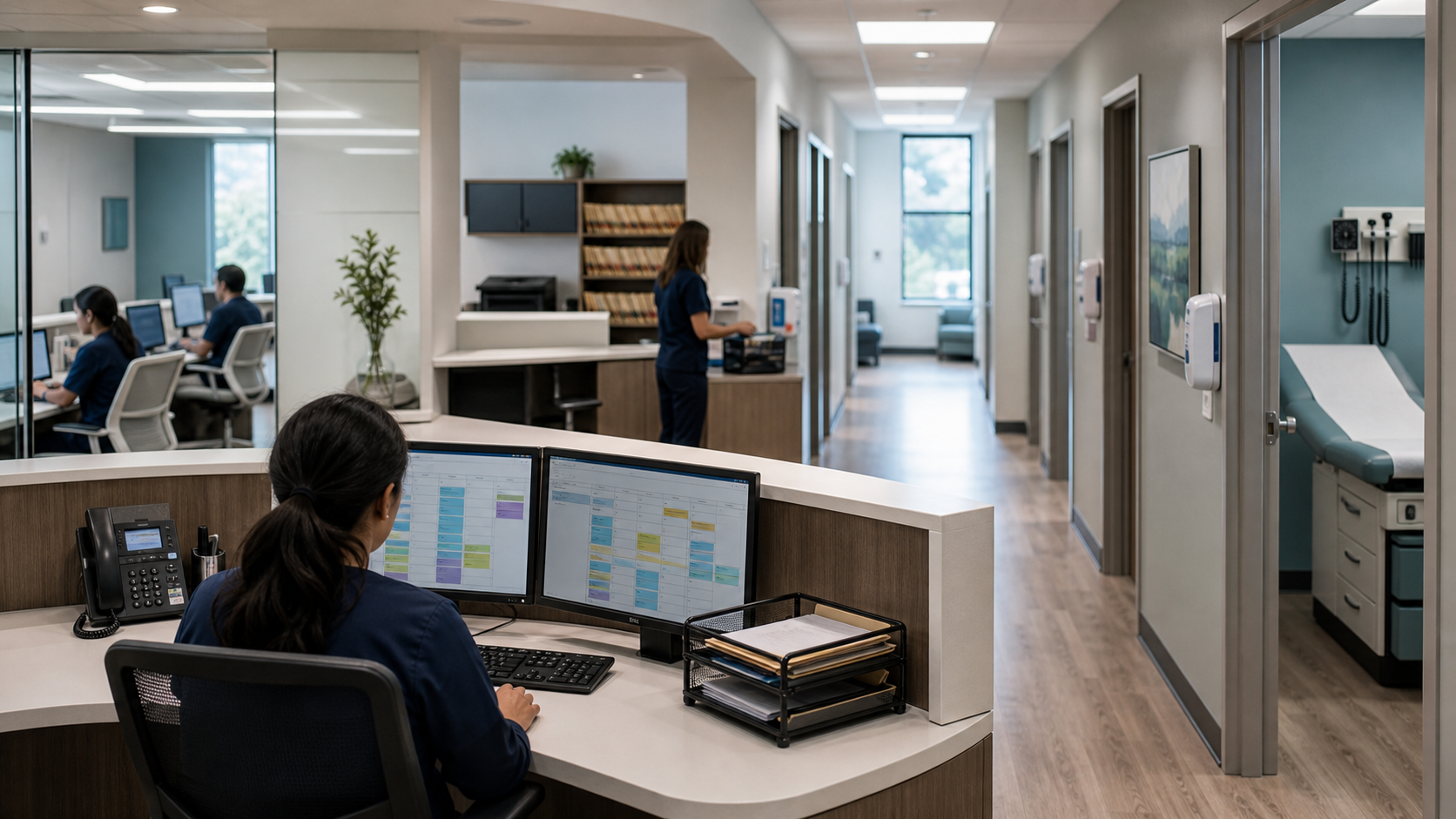
Software does not create clinical labor, but it makes capacity visible, movable, and monetizable. A phone-only practice can still book visits, but it cannot efficiently expose openings across dozens of locations, coordinate virtual options, let patients self-schedule, capture digital intake, handle secure messages, or direct patients into different visit types. The portal and scheduling layer allow Kelsey-Seybold to turn idle capacity into visible inventory. They also shift some administrative labor from staff to patients.
That shift is valuable only if patients can use it. A portal that is hard to access creates calls. A scheduling tool that shows no useful slots creates frustration. A video-visit option that does not fit the symptom creates rework. An e-visit that is only available to eligible plan members requires clear plan logic. A form warning patients not to submit sensitive information shows the constant tradeoff between convenience and privacy.
The contact center is the human backstop for that software. Kelsey-Seybold publishes a 24/7 appointment number, a nurse hotline, a portal help line, and a central business office. Those numbers are not small details. They are the labor layer that turns unclear insurance language, portal lockouts, scheduling ambiguity, billing questions, and symptom uncertainty into a completed visit or a lost patient. If the contact center is understaffed, every digital weakness becomes a queue. If the digital system is strong, contact-center labor can be reserved for exceptions, urgent triage, and patients who cannot navigate self-service.
The economics are delicate. Self-scheduling lowers labor cost and can increase fill rates, but it can also misclassify demand if visit types are poorly designed. A patient may choose a primary-care slot for a problem that needs specialty triage, or avoid a virtual slot because they cannot tell whether it will be accepted by the plan. The clinic has to design the scheduling taxonomy so patients do not create downstream cleanup work. The more services Kelsey-Seybold offers, the more important that taxonomy becomes.
This is where electronic health records matter without being the whole story. The record has to carry the patient's history, medication list, allergies, prior lab results, imaging, referrals, plan details, messages, and billing data across the visit. But records alone do not allocate capacity. The appointment engine, call-center scripts, clinical protocols, referral rules, payer checks, and physician schedule templates decide how that record becomes a visit. A well-run slot economy treats records and scheduling as one operating surface: the calendar knows enough about the patient to route safely, and the record receives enough from the calendar to make the visit billable and clinically useful.
Local support labor is the hidden price of convenience
The phrase "local support labour" sounds modest, but it is one of the hardest parts of the model. Every appointment slot consumes more people than the clinician visible in the exam room. There are schedulers, call-center representatives, medical assistants, nurses, lab technicians, imaging staff, pharmacy staff, referral coordinators, prior-authorization staff, billing staff, records staff, cleaning teams, security staff, site managers, and information-technology workers. Some are patient-facing; many are invisible unless they fail.
Kelsey-Seybold's own service map implies that support labor is extensive. Its releases mention comprehensive laboratory services, advanced imaging and diagnostics, 24 onsite pharmacies, a specialty pharmacy, a secure portal, surgery-center capacity, cancer-center technology, a sleep center, a breast diagnostic center, and an endoscopy center. Each service adds convenience and potential revenue. Each service also adds staff categories, compliance requirements, equipment maintenance, inventory, scheduling logic, and failure points.
The support labor is local because medical capacity is local. A call may route centrally, but a patient still needs blood drawn at a site, a room cleaned, an X-ray taken, a prescription filled, a specimen processed, and a specialist roomed. Kelsey-Seybold's expansion into Cypress, Towne Lake, Conroe, Lake Jackson, and other Greater Houston locations is therefore also a distributed labor strategy. The clinic has to recruit and retain workers in the same neighborhoods where patients expect access.
This labor layer also prices patient acquisition. A plan can bring new members into the network, and a clinic can advertise same-day care, but every new patient arrives with administrative work: eligibility verification, demographic capture, medical history, consent, privacy notices, financial policy, portal setup, plan-specific instructions, and sometimes medical-record transfer. The first slot for a new patient is more expensive than a simple follow-up because it opens the relationship. If the patient stays in the network, the cost can be amortized. If the patient leaves after one frustrating experience, the acquisition cost is wasted.
Reviews and forums often surface this hidden labor because patients complain about the parts of care that feel administrative: phones, billing, portal access, appointment availability, plan acceptance, prescription routing, referral timing, and confusion about who should call back. Those comments should not be treated as adjudicated facts. They are often one-sided, clinic-specific, or affected by plan rules outside the patient's view. But they are economically meaningful because they identify where the slot-conversion process may be leaking trust.
The best large medical groups reduce friction before it becomes a review. They make plan acceptance clear, publish realistic scheduling options, call back when promised, avoid duplicative forms, keep portal recovery simple, explain billing, and coordinate records before the patient arrives. That work is not glamorous. It is the difference between a patient saying "I have coverage" and a patient actually receiving care.
Data locality is a patient promise and a compliance burden
Healthcare data is local in two senses. It is local because the patient's care happens in a place: a Houston-area clinic, pharmacy, lab, imaging room, or video visit backed by a local provider. It is also local because U.S. health privacy, state law, payer contracts, Medicare rules, records retention, and cybersecurity expectations govern how the information is handled. Kelsey-Seybold's public materials do not disclose the full records architecture, but they do reveal enough to show that data handling is part of the product.
The website points patients to MyKelseyOnline, Kelsey CareLink, privacy notices, online services privacy policy, release-of-information forms, permission-to-communicate forms, patient financial policies, surprise-billing notices, utilization-management policy, and complaint notices. Those documents and links show that the appointment slot is not just clinical time. It is a regulated data transaction. The clinic collects personal information, protects health records, communicates with patients, submits claims, shares information with approved parties, and manages financial responsibility.
The network-resource evidence adds a narrow but useful public view. A targeted lookup on July 5, 2026 found kelsey-seybold.com resolving to 204.28.12.31, with authoritative nameservers extns1.ksnet.com and extns2.ksnet.com. Verisign RDAP for KELSEY-SEYBOLD.COM lists registration on August 14, 1996, CSC Corporate Domains as registrar, nameservers EXTNS1.KSNET.COM and EXTNS2.KSNET.COM, expiration on August 13, 2027, and last changed on April 27, 2026: https://rdap.verisign.com/com/v1/domain/KELSEY-SEYBOLD.COM. ARIN RDAP for the public web network identifies 204.28.12.0/22 as KELSEY-SEYBOLD-PUBLIC-NETWORK, with Kelsey-Seybold Clinic as registrant and an address at 11511 Shadow Creek Parkway in Pearland: https://rdap.arin.net/registry/ip/204.28.12.31.
Mail records also matter because appointment and portal communication create fraud risk. The July 5 lookup returned Proofpoint-hosted MX records for kelsey-seybold.com and a DMARC record with reject policy and Proofpoint reporting addresses. A DMARC reject policy does not prevent all impersonation, and DNS records do not prove the internal security posture of clinical systems. They do show that the public email domain is managed with enterprise mail-protection controls rather than left as an unmanaged consumer-facing surface.
Data sovereignty should not be exaggerated. Public DNS and RDAP records do not reveal where all protected health information is stored, which vendors touch the records, how disaster recovery is designed, or how third-party software is tested. The correct inference is narrower: Kelsey-Seybold maintains a visible local network identity, protected public email posture, and patient portals that are part of the access system. The missing evidence is the deep security and records architecture behind those public surfaces.
The economics are straightforward. A breach, portal outage, misdirected message, identity-recovery failure, or records-transfer delay can destroy the value of a slot. If the patient cannot trust the portal or the clinic cannot retrieve the chart, the appointment minute becomes less productive. Cybersecurity and records governance therefore belong in the same cost base as rent and physician salaries. They are not overhead in a separate technical silo. They are part of what makes the appointment sellable.
Competition is for routable demand
Houston is not short of healthcare brands. Patients can choose hospital systems, independent physicians, urgent-care chains, retail clinics, virtual-care options, and insurer-aligned networks. Kelsey-Seybold competes by making the routed path appear simpler: one group, many specialties, nearby locations, onsite services, accepted plans, portal access, same-day and virtual options, and quality credentials.
That competitive claim is strongest when the patient is inside the network and geography. A patient in a Kelsey-linked plan who lives near a campus, uses the portal, needs primary care, then needs imaging, pharmacy, and specialty follow-up may experience real convenience. A patient outside the accepted plan list, far from a site, or needing a scarce specialist may experience the opposite. The same system can feel like a solution or a wall depending on coverage and timing.
Competition therefore prices access, not just clinical quality. A clinic group can be clinically strong but lose demand if patients cannot book. It can be convenient but lose trust if billing surprises are common. It can have many locations but still miss a fast-growing suburb. It can have a Medicare Advantage strategy but struggle with patients who insist on traditional Medicare or a nonaccepted plan. It can advertise virtual care but lose older or less digitally comfortable patients if the phone queue is weak.
Kelsey-Seybold's official quality claims are significant, but they should be read with this competitive frame. NCQA accreditation, HEDIS performance, AHA and AMA recognition, QOPI certification, IAC accreditation, and a high Net Promoter Score in company releases are signals that the group takes measurement seriously. They are not a substitute for slot-level access data. A patient waiting too long for dermatology or cardiology will not experience a quality credential as access.
The market also includes insurer-provider bargaining. The Houston Chronicle's Memorial Hermann and Blue Cross coverage shows that even major systems can fall into public contract disputes. Kelsey-Seybold's own insurance page is careful to warn that accepted-plan information can change. A provider group with strong local demand has more leverage in payer negotiations. A payer with many members has more leverage over patient flow. Patients sit between them. The appointment slot is where that bargaining becomes real.
Kelsey-Seybold's advantage is density. A broad local network with primary care, specialties, pharmacies, diagnostics, surgery, and virtual options can defend itself better than a scattered set of offices. Its risk is the same density. If the system becomes hard to navigate, every part of the network reflects on the whole brand. A bad phone experience at one site can affect a patient's view of the pharmacy, specialist, or plan. In integrated care, the reputation is integrated too.
Regulation turns every slot into a compliance product
Medical capacity is regulated capacity. A Kelsey-Seybold appointment has to satisfy licensure, scope-of-practice rules, payer contracts, privacy duties, documentation standards, billing rules, quality-measure requirements, Medicare Advantage obligations where applicable, language-access requirements, nondiscrimination rules, surprise-billing protections, and complaint processes. That compliance burden is part of the price of every slot.
The clinic's public footer illustrates the breadth: notice of privacy practices, online-services privacy policy, patient financial policy, good-faith-estimate rights, surprise medical bills notice, patient rights, release of information, permission to communicate protected health information, terms of use, utilization-management policy, and complaint notification. These are not decorative legal links. They are the formal boundary around the appointment economy.
Compliance cost rises with integration. A small primary-care office has regulatory duties, but a large multispecialty group with surgery centers, cancer services, imaging, pharmacies, Medicare Advantage affiliations, virtual visits, and many payer contracts has more surfaces to control. Each added service can improve patient retention and revenue, but each also adds audits, training, documentation, credentialing, equipment standards, and operational risk.
Value-based care raises the bar further. If Kelsey-Seybold is paid partly for outcomes, cost management, member retention, or quality metrics, then the clinic has to prove that care coordination is not only convenient but measurable. HEDIS and NCQA language in the clinic's quality materials points to that world. It also means the appointment slot is judged beyond the visit note. Did the patient get the screening? Was blood pressure controlled? Was diabetes managed? Was medication adherence supported? Did the patient avoid a more expensive site of care?
This is why the business can be both attractive and hard. The clinic can capture more of the care journey, but it also becomes accountable for more of the journey. The patient sees a visit. The system sees a compliance bundle attached to that visit. If documentation is incomplete, billing can fail. If privacy is breached, trust fails. If plan rules are wrong, revenue fails. If quality measures are missed, plan value can fall. If access is poor, patient acquisition becomes more expensive.
The regulatory risk is not that Kelsey-Seybold is unusual. It is that large coordinated-care groups are asked to solve many healthcare problems at once: access, cost, quality, data protection, patient satisfaction, payer alignment, and local capacity. The more they advertise coordination, the more failures in any one layer become evidence against the whole model.
Reviews and market chatter are friction signals, not verdicts
Patient reviews, local forums, and market chatter should be handled carefully. Healthcare reviews are often written during moments of fear, pain, billing surprise, or access frustration. They can also reflect excellent service, long-term loyalty, or relief after a good outcome. They rarely contain enough information to reconstruct plan rules, staffing levels, medical urgency, prior authorization, or the clinic's side of the case.
For Kelsey-Seybold, the review layer is still useful because it points to the same economic interfaces visible in official documents: scheduling, insurance acceptance, billing clarity, portal usability, referrals, prescription routing, call backs, clinic-specific wait times, and physician continuity. If many patients across review surfaces complain about the same interface, the clinic should treat that as a process signal even if no single post proves fault. If reviews are positive but access data is weak, management should not confuse goodwill with capacity. If reviews are negative but tied to excluded plans or unrealistic expectations, the problem may be communication rather than clinical quality.
The public evidence is mixed in a predictable way. Kelsey-Seybold publishes a high Net Promoter Score and quality recognitions in its own releases. External patient commentary on large healthcare organizations tends to praise individual clinicians and criticize administrative friction. That pattern is not unique to Kelsey-Seybold. It reflects the difference between clinical trust and system trust. A patient can like a doctor and dislike the phone tree. A patient can receive good care and still resent a bill. A patient can find a location convenient and still wait too long for a specialist.
The market chatter after the Optum acquisition should be read through the same lens. Some observers view national ownership as a path to scale, technology, and value-based care. Others worry about vertical integration, narrower networks, and financial incentives that may conflict with patient choice. The article does not treat either side as settled. The test is empirical: do patients inside the relevant plans get timely, coordinated, fairly explained care at a total cost that is better than the alternatives?
The appointment slot gives that debate discipline. If corporate scale improves slot availability, records coordination, follow-up, pharmacy convenience, and care management, it creates real value. If it mainly captures patients inside a controlled network while access worsens or plan exclusions become opaque, the value is less convincing. The proof is not the ownership label. It is the conversion rate from coverage to care.
What would falsify the appointment-slot thesis
The bullish case for Kelsey-Seybold is that the clinic owns a dense Houston-area capacity platform. It has a long history, broad locations, more than 1,000 physicians and allied health professionals, 65-plus specialties, recognized quality programs, plan relationships, Medicare Advantage alignment, onsite pharmacies, diagnostics, surgery-center capacity, virtual-care channels, and a parent context that values care delivery. If Houston households and employers want coordinated outpatient care, Kelsey-Seybold has the ingredients to turn that demand into booked, documented, reimbursable slots.
The bearish case is that each ingredient adds fragility. Payer rules can confuse patients. Physician labor can lag growth. Real estate can be delayed by local infrastructure fights. Patient support can buckle under call volume. Portal access can fail at the moment of need. Cybersecurity and privacy controls can become trust issues. Medicare Advantage and value-based incentives can draw scrutiny. Corporate ownership can turn local goodwill into suspicion if patients feel steered rather than served.
The evidence that would strengthen the thesis is operational. Kelsey-Seybold would show shorter wait times for primary and specialty care, high schedule fill without chronic overbooking, low no-show rates, fast call response, low portal abandonment, clear plan acceptance, strong referral completion, fewer billing complaints, strong quality scores, stable physician retention, successful openings of Towne Lake and Northwest services, and Conroe or similar expansion projects that move from local dispute to actual capacity. The public does not need every internal metric, but even selective disclosure would make the slot economy easier to evaluate.
The evidence that would weaken the thesis is also operational. Persistent complaints about scheduling and call backs would suggest that software and support labor are not keeping pace. Specialty bottlenecks despite new buildings would suggest clinician scarcity or poor capacity planning. Payer exclusions that surprise patients would suggest weak communication. High turnover in local support roles would raise the cost of convenience. A serious data incident or portal outage would attack the records layer. Empty space in new clinics would imply overbuilding. A loss of key plan relationships would turn coverage into leakage.
Several facts would change the analysis quickly. If Kelsey-Seybold disclosed that a large share of new slots came from non-physician capacity without hurting quality, the labor-scarcity story would soften. If public wait-time data showed rapid access across primary and high-demand specialties, the growth strategy would look stronger. If payer data showed lower total cost without narrower choice or worse patient experience, the value-based model would gain credibility. Conversely, if patients in major accepted plans repeatedly could not find appointments, the brand's scale would matter less.
The final judgment is conditional. Kelsey-Seybold is a serious local care platform, not a simple clinic chain. Its business is to make medical capacity legible to patients, payers, employers, and regulators. The appointment slot is where that claim is tested. Every slot has to contain physician labor, room availability, records, scheduling, support labor, payer logic, compliance, cybersecurity, and enough patient trust to make the next slot valuable too. A patient begins with an insurance card and a need. Kelsey-Seybold's economic question is whether it can turn that need into a timely, local, documented, reimbursable appointment often enough to justify the scale it has built.