
Summary
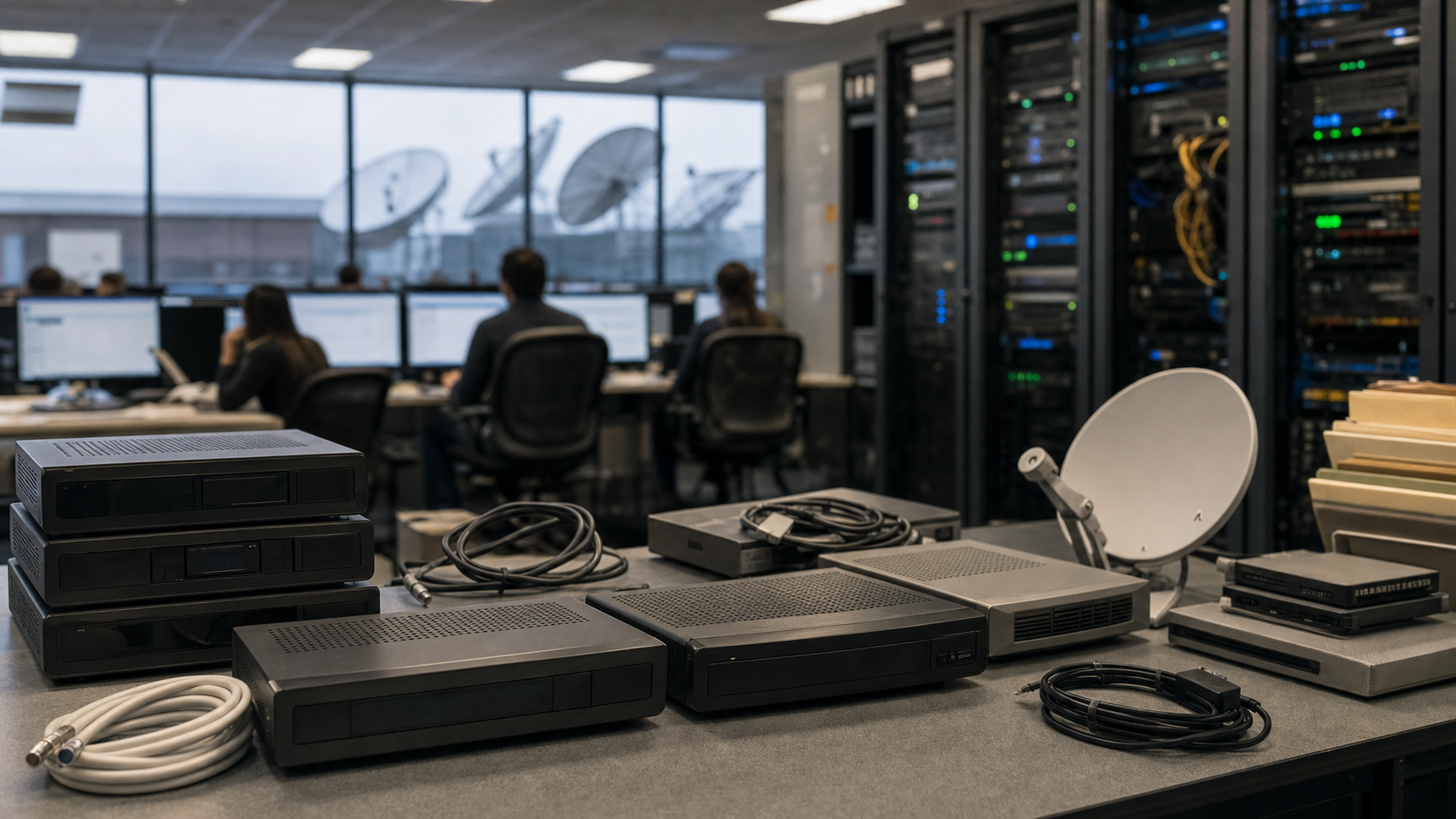
- Dish DBS Corporation is easiest to misunderstand when it is treated as just a satellite-TV name. EchoStar's filings describe a pay-TV operating stack that includes DBS and FSS spectrum rights, owned and leased satellites, receivers, broadcast operations, a leased fiber network, in-home service and call-center operations.
- The latest verified operating scale is smaller than the old DISH Network peak: EchoStar reported 6.632 million U.S. Pay-TV subscribers at March 31, 2026, including 4.845 million DISH TV subscribers and 1.787 million SLING TV subscribers.
- Dish DBS also sponsors multiple generic top-level domains in the DNS root zone, including .dish, .data, .dot, .blockbuster, .mobile and .phone. That makes namespace governance part of the same control bill as satellite distribution and customer support.
- The strongest reading is not that those top-level domains are a hidden growth engine. The stronger reading is that a shrinking satellite bundle still carries brand-control, fraud-prevention, continuity and optionality costs that do not disappear when subscribers leave.
Established. EchoStar's March 31, 2026 Form 10-Q says its Pay-TV segment offers services under the DISH and SLING brands, defines DISH TV as a combination of FCC licenses for DBS and FSS spectrum, owned and leased satellites, receiver systems, broadcast operations, a leased fiber optic network, in-home service and call-center operations, and reports 6.632 million U.S. Pay-TV subscribers: 4.845 million DISH TV and 1.787 million SLING TV (https://www.sec.gov/Archives/edgar/data/1415404/000110465926058150/sats-20260331x10q.htm). IANA's root-zone records list Dish DBS Corporation as sponsoring organization for .dish, .data, .dot, .blockbuster, .mobile and .phone (https://www.iana.org/domains/root/db/dish.html; https://www.iana.org/domains/root/db/data.html; https://www.iana.org/domains/root/db/dot.html; https://www.iana.org/domains/root/db/blockbuster.html; https://www.iana.org/domains/root/db/mobile.html; https://www.iana.org/domains/root/db/phone.html).
Reasonable inference. The branded namespace portfolio is best read as defensive and strategic brand-control infrastructure, not as proof that Dish DBS has built a large public domain-registration business. It gives the group root-zone control over names that match its television brand, legacy video brand, wireless language and data language. That control can reduce third-party ambiguity, support trusted customer journeys if the names are ever used, and preserve optionality across television, mobile and account-support surfaces. But IANA delegation by itself does not prove customer adoption, active second-level use, revenue, traffic volume or consumer awareness.
Still missing. Public records do not show the full internal cost of keeping the TLD portfolio alive, the number of active second-level registrations under each delegated string, the exact split between Dish DBS legal responsibility and service-provider work done by registry vendors, or the resilience plan for customer-facing domain use during restructuring. The latest Chapter 11 reporting for Dish DBS also sits partly in court and press records rather than a full post-filing annual report, so the continuity analysis should be updated when final bankruptcy, spectrum-sale and exit documents are available.
The bundle looks simple until the account breaks
Imagine a household that still keeps a satellite-TV subscription because it wants a familiar channel grid, a working remote, local stations, a DVR, and one bill that can be explained to an older parent. The visible price is entertainment. The real operating bill is wider. Somebody has to buy programming rights, compress and uplink channels, keep satellites and leased capacity available, preserve the receiver software, dispatch or contract technicians, process payments, handle returns, respond when local channels disappear, maintain a streaming companion app, and protect the brand names customers use when they search for help.
That is why Dish DBS Corporation is more interesting than a narrow reading of "satellite TV provider" suggests. In EchoStar's latest quarterly filing, DISH TV is not described as merely a programming package. It is described as an operating system for paid video: FCC licenses for direct broadcast satellite and fixed satellite service spectrum, owned and leased satellites, receivers, broadcast operations, a leased fiber optic network, in-home service and call centers, plus other assets used in operations (https://www.sec.gov/Archives/edgar/data/1415404/000110465926058150/sats-20260331x10q.htm). The customer sees content and connectivity. The company carries a control surface.
That control surface is expensive because every part has a different failure mode. A programming dispute can remove a local station or sports network even if the satellite path is working. A receiver fault can ruin the experience even if the subscription is current. A billing dispute can push a customer to cancel even if the content package is acceptable. A storm can interrupt reception even if customer support is responsive. A search-engine result or fake support number can intercept a frustrated user before the company ever sees the complaint. A shrinking subscriber base does not remove those obligations. It makes them harder to spread over enough paying accounts.
The scale is now concrete. EchoStar reported 6.998 million U.S. Pay-TV subscribers at the end of 2025, including 5.022 million DISH TV subscribers and 1.976 million SLING TV subscribers (https://www.sec.gov/Archives/edgar/data/1415404/000110465926021817/tmb-20251231x10k.htm). By March 31, 2026, the group reported 6.632 million U.S. Pay-TV subscribers, including 4.845 million DISH TV and 1.787 million SLING TV subscribers (https://www.sec.gov/Archives/edgar/data/1415404/000110465926058150/sats-20260331x10q.htm). The decline is not just a revenue line. It changes the economics of every fixed obligation behind the bundle.
That subscriber math is more severe than an ordinary consumer-products slowdown because the cost base is layered. Programming expenses can move with subscriber counts only to a point, and some content contracts still reward scale. Receiver inventory, refurbishment, return logistics, field service, call-center staffing, billing operations, satellite control, uplink facilities, insurance, cyber controls and compliance do not fall neatly with every departing household. A video distributor can save money as it shrinks, but it cannot simply remove one million subscribers and remove the exact matching fraction of the platform. The last households still need the same kind of bill, guide, signal path and support promise as the first households.
The mix of customers can also change as the base contracts. The most price-sensitive and streaming-comfortable households may leave first. The remaining base may include more rural homes, older users, second homes, RV users, local-channel loyalists and customers who prefer a receiver-and-remote environment to a patchwork of apps. Those customers can be valuable, but they can also be harder to serve. They may need more phone support, more equipment help and more reassurance when a billing or content problem appears. That is why a satellite-TV decline can create a strange unit-economics problem: the number of accounts falls while the average service complexity of the remaining accounts may not fall with it.
The customer account is therefore the best starting point. A user may think the debate is whether DISH carries one sports channel, whether SLING is cheaper than YouTube TV, or whether a Hopper receiver still feels easier than a streaming menu. Dish DBS has to answer a larger question: how much infrastructure, namespace control and support continuity can a legacy video business afford while the audience migrates toward streaming and the parent company reallocates capital around wireless and satellite connectivity?
Dish DBS is a satellite business with a software-like obligation
The classic satellite-TV business was built around scarcity and reach. A national satellite distributor could sell hundreds of channels to homes that did not want cable, could not get a strong cable offer, or preferred a national service. For years, the hard-to-replicate asset was the distribution path: orbital slots, transponders, uplink operations, receivers, installers and content contracts. The customer's dish turned a geostationary signal into a channel guide.
That model has not vanished, but the scarce asset has changed. In 2026, a customer has many ways to get video. Pew Research Center reported in July 2025 that 83% of U.S. adults watch streaming services, while only 36% said they currently subscribe to cable or satellite TV at home (https://www.pewresearch.org/short-reads/2025/07/01/83-of-us-adults-use-streaming-services-far-fewer-subscribe-to-cable-or-satellite-tv/). Pew also found that 55% watch streaming without also subscribing to cable or satellite. That is the market in which Dish DBS has to defend a product built around continuity, simplicity and familiar channel access.
The filing language shows how much of that defense is operational rather than promotional. EchoStar says it depends on others for the programming offered to Pay-TV subscribers and warns that failure to obtain or retain programming can hurt activations and churn (https://www.sec.gov/Archives/edgar/data/1415404/000110465926058150/sats-20260331x10q.htm). That risk is structural. A satellite distributor cannot preserve a customer's channel expectations without programmer contracts, and programmers increasingly have their own streaming strategies, sports packages, direct apps and bargaining power.
Receivers matter because they make the satellite product feel less like a raw signal and more like a managed account. EchoStar's filings describe DISH TV's receiver systems and DISH Anywhere access as part of the product architecture (https://www.sec.gov/Archives/edgar/data/1415404/000110465926021817/tmb-20251231x10k.htm). The user does not think in those terms. The user thinks: does the guide load, does the DVR record the right show, can a second room watch, does the app work when away from home, and can support fix the problem without turning a simple TV night into a contract argument?
That is where the satellite business starts to resemble a software business. Receivers, apps, billing portals, support workflows, search visibility, domain names and identity protection have to work as a system. The customer may still watch a linear channel delivered by satellite, but the surrounding account is digital. A customer finding help through a browser is using a domain namespace. A customer streaming authorized content on a mobile device is using software. A customer replacing a receiver is relying on inventory, activation systems and support scripts. The bill buys more than orbital distribution.
Receiver economics deserve separate attention because they sit between hardware, software and customer trust. A set-top box is not just a commodity accessory once it is installed in a household account. It has to be procured, shipped, activated, updated, supported, replaced, returned, refurbished or written off. A DVR has stored recordings, guide data, parental controls, account permissions and a user habit attached to it. The customer may blame the company for any failure, even if the root cause is a local cable, a hard drive, a remote, weather, a software update or an installation defect. Those costs are more visible in a declining category because every truck roll, call and replacement box has to be justified against a smaller future revenue stream.
The customer-equipment layer also limits how quickly the business can pivot to a lighter model. SLING TV can be sold as software, but DISH TV remains partly a managed-device relationship. The satellite receiver gives the product familiarity and reliability for some households, yet it also creates inventory and support exposure that a pure streaming app does not carry in the same way. A streaming competitor can push most device problems back to Roku, Amazon, Apple, Google, Samsung or the broadband provider. Dish DBS has to absorb more of the blame when the managed television experience breaks, because the receiver and dish are part of the value proposition.
This also explains why brand-control records matter. A company that sells to millions of households cannot rely only on dish.com and a customer-service phone number. It has to defend the ways people type, search and mistake the brand, especially when cancellation, billing and equipment issues create high intent. That does not mean every branded top-level domain is active or valuable. It means the company has treated parts of the DNS root zone as a control asset.
The DNS root zone shows a quiet control portfolio
IANA's delegation record for .dish lists Dish DBS Corporation as sponsoring organization, gives the Englewood, Colorado address, identifies the technical contact as Tucows.com, Co., lists TRS-DNS nameservers, and shows a registration date of August 4, 2016 with the record last updated on December 12, 2025 (https://www.iana.org/domains/root/db/dish.html). The delegation report says the proposed sponsoring organization was Dish DBS Corporation and that eligibility, applicant match, contact confirmations and technical conformance were completed (https://www.iana.org/reports/c.2.9.2.d/20160808-dish).
The same pattern appears beyond the main television brand. .data, .dot, .blockbuster, .mobile and .phone all list Dish DBS Corporation as sponsoring organization in IANA's root-zone records, with Tucows technical contacts and the same TRS-DNS nameserver family (https://www.iana.org/domains/root/db/data.html; https://www.iana.org/domains/root/db/dot.html; https://www.iana.org/domains/root/db/blockbuster.html; https://www.iana.org/domains/root/db/mobile.html; https://www.iana.org/domains/root/db/phone.html). Those strings are not all equal. .dish is brand-specific. .blockbuster is a legacy media brand. .mobile and .phone point toward the language of wireless access. .data and .dot are broader internet terms. Together they show a company that did not treat domain names as a minor marketing afterthought.
The important fact is delegation, not usage. A top-level domain in the root zone gives the sponsor control over the registry layer for that string, subject to ICANN and IANA processes and the registry's contracted obligations. It does not mean the public uses the string at scale. It does not mean the string is open for retail registration. It does not mean the string is profitable. But it does create a reserved field of names that a company can use, hold, delegate under its own rules, or keep out of third-party hands.
For a shrinking satellite bundle, that control has a defensive logic. Fraud risk rises when customers are confused, worried about service continuity, looking for cancellation paths or trying to resolve equipment failures. A branded namespace can support trusted routes if the company chooses to deploy them, and it can reduce the possibility that others control confusingly close root-zone labels. The company still has to secure ordinary domains, certificate issuance, email authentication and search results, but root-zone control gives it another layer of optionality.
The economics are harder to see. Maintaining a top-level domain portfolio involves registry-service providers, ICANN fees, compliance, DNS operations, abuse handling, contact accuracy and internal governance. Those costs are small beside satellites and spectrum, but they are not zero. They also require attention across corporate changes. If a video business is sold, reorganized, merged or separated, the domain portfolio has to move cleanly or remain with a responsible sponsor. A root-zone record is a public promise that someone is accountable for the delegation.
That is the brand-control bill behind the bundle. The television subscription may decline, but the names do not automatically become irrelevant. A brand can lose subscribers and still need to prevent impersonation. A legacy name like Blockbuster can be commercially quiet and still have defensive value. A wireless-adjacent string like .mobile can become more or less strategic depending on where EchoStar, Boost, AT&T and SpaceX arrangements settle. The public record does not justify a growth story. It justifies an operating-control story.
This control story is especially important because DNS economics are different from satellite economics. A satellite is capital-intensive and technically visible. A root-zone delegation is comparatively quiet, but it is still a governance commitment. The sponsor has to keep contacts accurate, maintain a service-provider relationship, preserve technical conformance, handle policy obligations and decide who can create names below the string. If a string is closed or lightly used, the public may never notice it. If the string is ever used for customer help, authentication, account recovery or product routing, the trust burden immediately rises.
The most useful way to value the portfolio is therefore through scenarios. In the first scenario, the strings remain defensive. The value is in preventing confusion, reserving optionality and keeping others from holding names that match the company's brand vocabulary. In the second scenario, selected strings become controlled customer routes, such as support, account, device or product names that could be easier to govern inside a branded top-level domain than across scattered second-level domains. In the third scenario, the strings become assets in a sale, restructuring or partnership negotiation. None of those scenarios requires a large public registration business. All of them require governance discipline.
The risk is that unused control assets are easy to under-manage. A company in financial stress may focus on debt, programming, subscriber churn and strategic transactions while quiet namespace duties sit in the background. That would be a mistake. A domain portfolio can become visible precisely when something goes wrong: a confusing support route, a phishing campaign, an abandoned brand, an expired contact, or a customer-service migration that leaves old names pointing to weak pages. The public IANA records do not show such a failure for Dish DBS. They show why the responsibility exists.
Spectrum obligations surround the video company even when they are not the same thing
Dish DBS should not be confused with every EchoStar wireless obligation. The subject here is Dish DBS Corporation, so the verified company-specific facts should stay anchored in the DBS/pay-TV operating stack and the sponsored domain portfolio. The wider EchoStar group, however, has been shaped by wireless spectrum commitments and transactions that affect capital allocation, creditor pressure and brand strategy around DISH, SLING, Boost, HughesNet and Starlink-facing arrangements.
The Q1 2026 filing says EchoStar had 7.527 million wireless subscribers at March 31, 2026 and had transitioned to a hybrid mobile-network-operator model under which it continues to operate the 5G network core while using AT&T network services; it also says all customer traffic had been migrated from EchoStar's 5G network to AT&T's network by November 15, 2025 (https://www.sec.gov/Archives/edgar/data/1415404/000110465926058150/sats-20260331x10q.htm). That is not a Dish DBS satellite-TV fact, but it is a group-level fact that explains why the old DISH wireless ambition and the video balance sheet now sit in the same strategic conversation.
The AT&T spectrum transaction shows the pivot. EchoStar's August 2025 Form 8-K says seller parties agreed to sell all 3.45 GHz and 600 MHz spectrum licenses licensed to or pending assignment to them, plus a 99-year extension of existing leases in Hawaii, for $22.65 billion in cash subject to adjustments (https://www.sec.gov/Archives/edgar/data/1415404/000141540425000035/tmb-20250825x8k.htm). The same filing describes new AT&T network-service terms for a hybrid MNO model in which DISH operates network core, billing and provisioning software while AT&T provides base stations, radios, RAN software and spectrum frequencies.
The SpaceX transaction points to a different spectrum surface. EchoStar's September 2025 Form 8-K says EchoStar agreed to sell rights and licenses related to 50 MHz in the 2000-2020 MHz, 2180-2200 MHz, 1915-1920 MHz and 1995-2000 MHz ranges, together with certain international rights and assets, for total consideration of $17 billion (https://www.sec.gov/Archives/edgar/data/1415404/000141540425000041/tmb-20250907x8k.htm). It also says long-term commercial agreements would enable EchoStar to offer mobile subscribers access to SpaceX's next-generation Starlink direct-to-cell text, voice and broadband services using rights conveyed to SpaceX.
Those filings are central because they explain why a satellite-TV business cannot be valued only on today's channel package. The parent company's capital story has been tied to wireless spectrum, hybrid network economics, debt, vendor litigation, FCC review, and direct-to-cell optionality. Dish DBS's video subscribers sit inside that balance sheet. A customer may be deciding whether the TV package is worth keeping. Creditors and regulators are looking at a much larger package of spectrum rights, contracts, network obligations and asset sales.
That distinction is crucial for the economics. Satellite television is declining; wireless spectrum and satellite-to-cell connectivity are the growth-adjacent assets around the group. But a wireless transition is not free money for the video company. It can require regulatory approvals, network-service payments, customer migrations, software integration, billing continuity, device compatibility, vendor settlement and brand clarity. The Q1 2026 filing's statement that all customer traffic had been migrated from EchoStar's 5G network to AT&T by November 15, 2025 shows a real operating transition, not just a paper sale (https://www.sec.gov/Archives/edgar/data/1415404/000110465926058150/sats-20260331x10q.htm). Moving traffic can reduce one kind of network burden while creating another: the company still owns the customer relationship and the support problem when a wireless subscriber has a service issue.
FCC process adds another layer. The September 2025 EchoStar filing said the FCC had terminated its review into EchoStar's 5G buildout obligations after the AT&T and SpaceX announcements, while approvals for the underlying transactions still had to be obtained (https://www.sec.gov/Archives/edgar/data/1415404/000141540425000045/tmb-20250908x8k.htm). That sequence matters because the value of spectrum is not just ownership. It is deployable, transferable, license-compliant control under regulator supervision. For the video business, the lesson is analogous: DBS and FSS rights, satellite operations and customer equipment are valuable only if they remain compliant, reliable and connected to a customer account that pays.
This is also where the analysis must avoid a sloppy leap. Dish DBS sponsoring .mobile or .phone does not prove the TLDs are tied to any particular AT&T or SpaceX transaction. The better inference is narrower: a company with video, wireless and satellite-connectivity ambitions accumulated namespace assets that match several parts of that vocabulary. When the wireless plan changed, those namespace assets remained part of the control surface that management has to govern through restructuring and commercial realignment.
Bankruptcy turns continuity into the product
The newest public development is not a new channel package. It is restructuring. The Wall Street Journal reported on June 30, 2026 that Dish DBS filed for Chapter 11 in the U.S. Bankruptcy Court in Houston after a delay in the planned AT&T spectrum sale, with a prepackaged plan backed by 88% of bondholding creditors and roughly $2 billion of 7.75% senior secured bonds due on July 1, 2026 (https://www.wsj.com/livecoverage/stock-market-today-dow-sp-500-nasdaq-06-30-2026/card/dish-dbs-enters-chapter-11-after-at-t-deal-is-delayed-BpjyxkTiRCZ1f0WIequd). WSJ Pro Bankruptcy separately described the case as a filing by the satellite pay-TV provider under EchoStar, with the AT&T proceeds intended to reduce debt and operations for Dish TV and Sling TV continuing without interruption (https://www.wsj.com/pro/bankruptcy/satellite-tv-provider-dish-dbs-files-for-bankruptcy-following-at-t-deal-snag-c2b58620).
The Verge summarized the consumer-facing point the same day: Dish filed for bankruptcy but was not shutting down, with Dish TV and Sling TV expected to continue operating and Boost Mobile and Gen Mobile outside the bankruptcy process (https://www.theverge.com/tech/959894/dish-chapter-11-bankruptcy). That distinction matters. For a customer, bankruptcy is not an abstract finance event. It raises questions about whether the bill should still be paid, whether service will continue, whether equipment support will weaken, whether content contracts will hold, and whether customer support will become harder to reach.
Continuity is therefore the product during restructuring. The company can tell customers that service continues, but the product will be judged by whether the account behaves normally: guide data, receiver activation, local-channel access, automatic billing, technician availability, app logins, returns, refunds and cancellation processes. Every support failure feels different when the provider is in Chapter 11. A routine billing error becomes a solvency worry. A local-channel dispute becomes a fear that the company is cutting corners. A long hold time becomes a question about whether the support operation is shrinking.
The DNS layer becomes more important in that environment, not less. People search for bankruptcy news, support numbers, refunds, cancellation steps and service-continuity statements. The company has to keep official digital routes obvious and secure. IANA's records show that the .dish delegation points to registration services at dish.com and technical operations through Tucows TRS-DNS infrastructure (https://www.iana.org/domains/root/db/dish.html). That does not tell us the live customer-support architecture, but it does show public responsibility for a brand-matched root-zone name at the same time customers need trusted information.
The bankruptcy reporting also puts the 2024 failed DirecTV deal in perspective. MarketWatch reported in September 2024 that DirecTV agreed to acquire EchoStar's video distribution business, including Dish TV and Sling TV, for a nominal $1 while assuming about $9.75 billion of Dish DBS net debt (https://www.marketwatch.com/story/directv-to-acquire-echostars-video-distribution-business-including-dish-tv-and-sling-tv-23349832). Later reporting described the deal falling apart after bondholder opposition. The failure left Dish DBS to solve the same structural issue through restructuring: a declining pay-TV business with substantial debt and valuable adjacent assets in the parent orbit.
That is the risk frame. A prepackaged restructuring can clean up a balance sheet and preserve service, but it does not by itself restore the satellite-TV category. The category still faces streaming adoption, programmer leverage, customer-service friction and the fixed costs of operating a national video platform. The best-case outcome is a leaner, more financeable video business that can retain customers who value simplicity, rural reach, bundled support and familiar hardware. The worst-case outcome is a business that emerges with less debt but continues to lose the households that paid for the operating stack.
Billing continuity is the most practical test. A household does not experience restructuring through a court docket; it experiences restructuring through autopay, account credits, tax and fee lines, equipment-return charges, promotional discounts, local-channel credits and cancellation rights. If those processes remain boring, customers may ignore the finance story. If they become confusing, customers may interpret ordinary friction as evidence that the service is unstable. That is why a support center script, a billing platform and a clear official web route can matter as much as a restructuring press statement.
Continuity also depends on the vendors and counterparties that are invisible to customers. Programming suppliers have to keep feeds authorized. Satellite, uplink, network, payment, device, fulfillment and field-service partners have to keep operating. Domain and DNS providers have to keep official routes stable. The restructuring story is therefore not only whether Dish DBS can reduce debt; it is whether the company can keep a multi-vendor service chain calm while customers are already being courted by streaming, cable, fiber and mobile bundles.
Customer chatter is weak evidence, but it identifies the account friction
Customer forums and review surfaces cannot be treated as representative statistics. They overrepresent frustration, recent failures and people motivated to post. They also contain rumors, misunderstandings and one-off account details that should never be promoted into fact. Used carefully, they still show the issues customers notice when a satellite bundle turns into an account-management problem.
The r/dishnetwork Reddit page in July 2026 showed ordinary operational questions: DVR recording behavior, over-the-air antenna offers, Dish Anywhere limitations, signal loss, receiver replacement, senior-user concerns and support for local-channel disputes (https://www.reddit.com/r/dishnetwork/). The themes are mundane, which makes them useful. They show a product whose value often depends on equipment continuity, local reception, a stable user interface and support that can explain a receiver without forcing the customer into a streaming-native workflow.
ConsumerAffairs is also not a scientific sample, but its aggregation is a market signal. Its DISH Network review page, updated May 11, 2026, showed a 1.3 rating across 7,560 reviews, with popular mentions including customer service, staff, contract and terms, price, punctuality and installation; the same page listed cons such as billing discrepancies, long wait times and limited channel availability (https://www.consumeraffairs.com/cable_tv/dish_network.html). The right use of that evidence is not "DISH service quality is 1.3." The right use is that account, billing, terms, price and support friction are visible enough to appear repeatedly on consumer-review surfaces.
This matters because Dish DBS's technical control surface only has value if customers can translate it into confidence. A satellite signal can be available, but a customer may still leave because a receiver replacement extends a contract, a local station dispute removes a must-have channel, or cancellation feels harder than signing up for a streaming app. The company can have domain-name control, FCC licenses and a broadcast network, but the account is won or lost at the household edge.
The customer chatter also highlights an overlooked advantage. Some users still want a simple channel-up, channel-down experience, especially for older relatives, rural homes, RVs, lake cabins and places where a streaming-only interface is not acceptable. That segment is not the whole market, but it is real. For those users, a dish, a receiver and a familiar remote can still beat an app grid. Dish DBS's problem is not that the product has no customers. It is that the most loyal use cases may be smaller, older, more support-intensive and less attractive to programmers than the old mass-market subscriber base.
That is why support continuity should be watched as closely as subscriber totals. A shrinking provider can save money by reducing service, but a service reduction can speed churn among the very customers who still value the product. If the remaining base is disproportionately rural, elderly, hardware-dependent or local-channel-sensitive, the cost of support per subscriber may rise even as total support volume falls. That is the hard math behind a satellite bundle that looks simple on a bill.
Equipment complaints are especially revealing because they show how a legacy strength can become a cost center. A receiver-based service promises a stable living-room interface. That promise is valuable for customers who dislike app switching or broadband dependence. But the same receiver can become the center of a dispute when a replacement is delayed, a fee appears, a contract term is misunderstood, a recording is lost, or a technician visit is hard to schedule. In a streaming-only service, some of that friction moves to the device maker or broadband provider. In a satellite-TV service, the distributor remains closer to the fault.
Customer-account signals should also be read against the competitive environment. When a customer complains about a price increase or billing dispute, the threat is not only another satellite provider. It may be a fiber provider offering broadband plus mobile, a cable operator offering internet plus a streaming box, a mobile carrier offering entertainment credits, or a virtual live-TV service with no dish and no technician visit. That means every support failure has a larger opportunity cost. A household that once had to choose among video distributors can now rebuild the entire communications and entertainment account around a different provider.
The competitors are selling flexibility, not only channels
Dish DBS's competitors no longer fit the old cable-versus-satellite map. DirecTV is a satellite and streaming competitor. YouTube TV is a virtual multichannel provider with massive platform backing. Hulu + Live TV, Fubo, Sling itself and cable operator streaming packages all compete for live channels. Netflix, Prime Video, Disney+, Max, Peacock and YouTube compete for attention even when they do not replicate a full channel bundle. Broadband providers compete by bundling internet, mobile and entertainment into one household account.
That is why the failed DirecTV transaction was strategically obvious even if financially blocked. Two satellite-heavy video businesses facing the same category decline could gain bargaining scale with programmers, cut overlapping costs and present a larger alternative to streaming platforms. But consolidation cannot erase the consumer shift. Pew's 2025 survey shows the household habit has already changed: 55% of Americans watch streaming without also subscribing to cable or satellite, while only 28% both watch streaming and subscribe to cable or satellite (https://www.pewresearch.org/short-reads/2025/07/01/83-of-us-adults-use-streaming-services-far-fewer-subscribe-to-cable-or-satellite-tv/).
The Disney-Sling dispute over short-term passes showed the same pressure from another angle. The Verge reported in August 2025 that Disney sued Sling TV over one-day, weekend and one-week passes, arguing they violated a licensing agreement built around monthly access to Disney-owned channels (https://www.theverge.com/news/766933/disney-sling-tv-streaming-cable-passes-lawsuit). In November 2025, a federal judge declined to block the passes at the preliminary stage, according to The Verge, although the broader lawsuit continued (https://www.theverge.com/news/824017/disney-sling-tv-cable-passes-block-denied). The dispute matters because it shows Sling trying to sell flexibility while programmers defend contract economics.
For Dish DBS, flexibility is a double-edged weapon. SLING TV can reach users who reject satellite hardware. Shorter passes and lighter packages can meet event-driven demand. But every move away from the full monthly bundle weakens the old pay-TV economics. Programmers still want fees. Customers want fewer commitments. The distributor sits between them, trying to preserve enough margin to support software, billing, marketing, content rights and support.
The branded-domain portfolio fits this competitive map because control over customer entry points becomes more valuable as products fragment. A customer might enter through DISH TV, SLING, Boost, HughesNet, a support page, a bankruptcy FAQ, a streaming pass, a direct-to-cell offer, a referral path or a future branded domain. The company has to keep those routes clear. That does not make .dish or .mobile a revenue engine. It makes them part of the same customer-interface problem as the receiver remote and the billing portal.
The strongest competitors are not only selling channels. They are selling account control. YouTube TV lives inside a Google account. Prime Video lives inside Amazon's household-commerce account. Apple TV lives inside Apple's device and billing system. Broadband providers sell internet and mobile bundles with app-based account management. Dish DBS's satellite strengths are real, but the battlefield has moved toward identity, billing, device ecosystems, search, customer service and flexible packaging. Root-zone control is one small piece of that larger contest.
Cable and fiber operators have an additional advantage: they own or control the broadband relationship that streaming needs. A household may drop a channel bundle but keep the pipe, and the pipe owner can then sell mobile, security, streaming aggregation or managed Wi-Fi. Dish DBS's traditional satellite product does not own that fixed broadband path. That makes partnerships, wireless strategy and customer-account clarity more important. If the household's main account is with a fiber or cable provider, the satellite-TV bill has to justify itself as an add-on. If the household's main account remains with DISH, the company has to make television, support and any adjacent wireless or streaming offer feel coherent.
Mobile carriers create a similar challenge. They sell family plans, device financing, trade-ins, streaming credits, hotspot access and app-based support. A customer used to managing connectivity in a mobile app may see a satellite receiver and phone-support process as either reassuringly simple or old-fashioned, depending on the household. EchoStar's hybrid wireless transition keeps the broader group in that account-control contest, but it also exposes the brand to customers who expect mobile-style service reliability and self-service. That raises the standard for every DISH-branded digital route, including ordinary web domains and any future branded namespace use.
The competition is therefore not just about content price. It is about which company becomes the household's default problem solver. The winner is the provider a customer trusts when the bill changes, the screen fails, the local station disappears, the password stops working, the payment card expires or a parent needs help. Dish DBS still has assets that solve real problems for some users. The question is whether those assets can be packaged with enough digital trust and support efficiency to survive in a market where competitors are bundling video into broader account ecosystems.
Satellite compliance is not just a launch issue
The satellite portion of Dish DBS's operating bill includes end-of-life duties. In October 2023, the FCC announced a settlement with DISH over EchoStar-7, describing it as the agency's first space-debris enforcement action and saying DISH agreed to pay $150,000 after the satellite was disposed below the altitude specified in its orbital-debris mitigation plan (https://docs.fcc.gov/public/attachments/DOC-397412A1.pdf). The FCC consent decree provides the formal enforcement record (https://docs.fcc.gov/public/attachments/DA-23-910A1.pdf).
That penalty was small beside EchoStar's debt, spectrum and video revenue. Its significance is different. It shows that the satellite-TV bill includes lifecycle governance: tracking fuel, meeting license conditions, communicating with regulators, disposing of spacecraft correctly and maintaining compliance practices. A customer buying a TV bundle never sees this layer. A satellite operator cannot ignore it.
The enforcement record should not be overread. It does not say the current DISH TV service is unsafe. It does not prove a broad compliance failure. It does show that satellite assets carry obligations after their revenue usefulness declines. That is the same structural problem as old receivers, legacy customer accounts and defensive domain names: the costs of continuity outlast the period when the asset feels strategically exciting.
As video subscribers leave, those residual obligations become more visible. The company still has to manage satellites or leased capacity, customer equipment, programmer contracts, call centers, billing systems, domain delegations and regulatory duties. Some costs can be reduced; others can only be managed. A shrinking company has to decide which obligations remain essential to trust and which can be simplified without breaking the product.
The FCC space-debris matter also illustrates a broader point about timing. Compliance costs often show up when an asset is old, not when it is new. A satellite at end of life may have less commercial glamour than a launch, but disposal can still create regulatory exposure. A receiver model that is no longer marketed can still require support. A dormant brand string can still require DNS and policy oversight. A legacy billing platform can still carry customer balances, refunds and taxes. Mature infrastructure does not become simple just because it is no longer growing.
This is why the better lens is a "brand-control bill" rather than a "domain portfolio story." The domain records are a visible example of a broader pattern. Dish DBS sits at the intersection of physical distribution, spectrum licensing, consumer electronics, support labor and digital identity. Each layer has its own regulator, vendor base and customer failure mode. The satellite dish on the roof is only the visible artifact.
What would change the judgment
The current judgment is that Dish DBS Corporation remains important not because satellite television is growing, but because the company controls a dense bundle of legacy distribution, customer accounts and branded namespace assets at a moment when that bundle is being financially reworked. The verified facts show a substantial but declining pay-TV base, group-level wireless spectrum transactions, a hybrid mobile shift, public root-zone sponsorship of several TLDs and the latest restructuring pressure. The reasonable inference is that control, continuity and trust are now more important to the remaining business than raw channel count.
Several facts would change that reading. The first is the final Chapter 11 path. If Dish DBS exits quickly with materially lower debt and no service disruption, the restructuring can be read as a balance-sheet reset for a smaller but still useful video platform. If the case creates support degradation, contract uncertainty or customer confusion, it will turn continuity from a stated promise into a weakness.
The second is the closing and execution of the AT&T and SpaceX transactions. If proceeds arrive and regulatory approvals hold, EchoStar can reduce debt and focus on a hybrid mobile and satellite-connectivity role while leaving Dish DBS with a clearer video mandate. If delays persist, the satellite-TV business may remain entangled with spectrum-sale timing and creditor pressure. The relevant SEC filings already show how much of the capital story depends on those transactions (https://www.sec.gov/Archives/edgar/data/1415404/000141540425000035/tmb-20250825x8k.htm; https://www.sec.gov/Archives/edgar/data/1415404/000141540425000041/tmb-20250907x8k.htm).
The third is domain use. If .dish, .mobile, .phone, .data, .dot or .blockbuster begin hosting meaningful customer-facing services, the namespace portfolio should be valued as active customer infrastructure. If they remain mostly defensive delegations, they should be valued as brand protection and optionality. The public IANA records prove control, not use.
The fourth is support quality among the remaining satellite customers. Review sites and Reddit threads are weak evidence, but they identify the operational hinges: billing, cancellation, receiver behavior, local-channel access, app limitations, technician visits and senior-user simplicity. If those improve, DISH TV can retain a defensible niche among customers who value familiarity. If they worsen, the shrinking category will accelerate.
The fifth is programmer strategy. Live sports, local stations and must-have cable networks can still anchor a pay-TV relationship. But programmers are testing direct apps, temporary passes, streaming bundles and new rights windows. If programmers keep demanding full-bundle economics while customers demand short commitments, distributors like Dish DBS and SLING will keep absorbing the squeeze.
The sixth is equipment and support disclosure. More precise data on receiver replacement costs, truck-roll frequency, return rates, customer-service wait times, billing disputes, local-channel credits and cancellation friction would sharpen the judgment. If those metrics improve while subscriber losses slow, the remaining satellite base may be more durable than the headline category decline suggests. If those metrics deteriorate, the control stack becomes a churn engine rather than a retention asset.
The seventh is namespace evidence. Zone-file data, live second-level use, official account-routing deployments, anti-abuse reports, security incidents, transfer documents or registry-service cost disclosures would change how the TLD portfolio should be understood. A dormant defensive portfolio is one thing. A trusted support and authentication layer is another. A neglected portfolio during restructuring would be a warning sign. The public IANA records answer the ownership and delegation question; they do not answer the use, cost or customer-trust question.
Dish DBS Corporation therefore matters as a case study in residual control. The satellite-TV account is not only content. It is a stack of licenses, satellites, receivers, software, billing, support and names. The company can lose subscribers and still hold important control surfaces. It can sponsor root-zone strings and still not have a public domain-growth story. It can enter Chapter 11 and still keep service running. The question for 2026 is whether the remaining bundle is profitable enough to carry the whole control bill, or whether the bill itself becomes the evidence that the satellite era has shifted from expansion to managed continuity.