
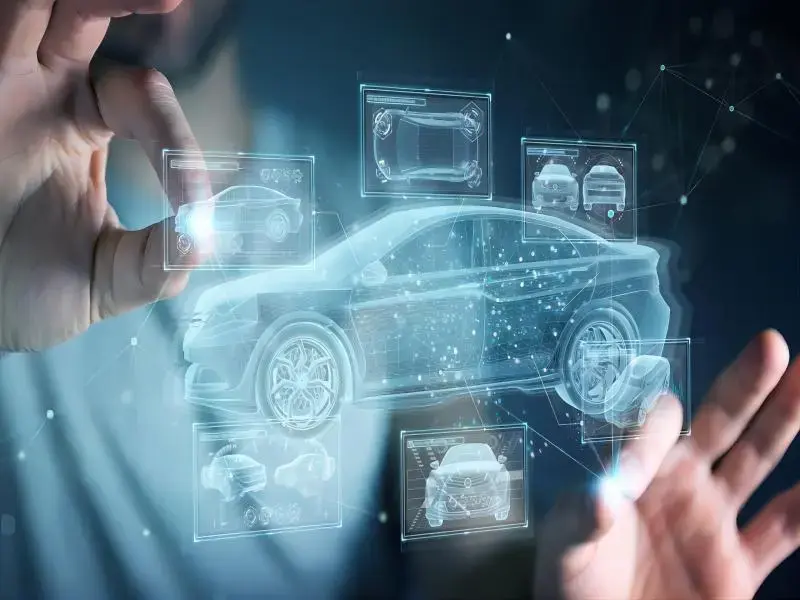
- Smart cars, equipped with advanced driver assistance systems (ADAS) and in some cases, even autonomous driving capabilities, are becoming increasingly common on today’s roads.
- To guarantee the smooth operation of vehicles, motorways are not designed with bike or pedestrian paths. Additionally, they replace any road or railroad crossings with underpasses or flyovers.
- To maintain safety, Smart cars are equipped with lane-keeping assistance, adaptive cruise control, automatic emergency braking (AEB), vehicle-to-vehicle communication (V2V), traffic jam assist, and emergency lane-keeping assist.
A smart car is a two-seater, tiny, compact car that has been well-liked in European cities since the late 1990s. In January 2008, the automaker Smart USA made its American debut. The Smart Car is marketed for use in urban areas and is designed to get 40 miles per gallon.
In the early 1990s, Mercedes-Benz and watchmaker Swatch collaborated to create the Smart, which stands for “Swatch Mercedes Art.” Production of the prototype started in 1998 in France, after it was shown at the 1997 Frankfurt Motor Show in Germany. Soon after, Swatch gave Mercedes control over its portion of the project.
What is motorway?
Motorways are highly protected and advanced type roads to ensure smooth and fast travel between points. Motorways are designed without footpaths or cycling paths to ensure a smooth vehicle run. They also do away with road or railway crossing with a flyover or an underpass.
The safest road in the entire highway community boasts a meagre rate of accidents. They allow smooth passage to other types of roads by providing a ramp to lower the speed of the vehicles. It helps cut time and provides a smooth and safe driveway. It also does not give any traffic lights, making it easier to navigate without any stoppage.
Speed limits are high when compared with other types of highways. This gives an invitation to the low reaction time for the drivers. To fight, these motorways are equipped with regular and large signboards. The guide signs are floated in such a way that they are visible. They are hung on overhead gantries and can be found hanging on the overpasses. It helps the visitors with explicit knowledge of all the lanes and other necessary information, such as the kilometres they need to travel to reach a particular destination.
Also read: The 5 biggest EV charging companies
How does smart car work?
The lightweight (1600 pounds) smart car contains a three-cylinder engine and can go from zero to 60 miles per hour in a matter of seconds; however, due to safety precautions, it is designed with an electronic speed limit that peaks at 84 miles per hour. The frame of the car is built with the distinctive steel Tridion safety cell, which will trigger the energy-absorbing areas (known as crumple zones) on another car if there is an accident. Airbags are available for the driver and passenger and both seats are made from steel frames, top to bottom, taking any energy caused by impact.
The Smart car has aluminium doors that are easy to open after a crash and the wheels are made to be a crumple zone. Front and rear crash boxes protect the body frame of the car fully up to a 15-mile-per-hour collision. Hill-start assist, electronic brake assist, sandwich constriction and stability control features are all added components to the smart car’s safety traits.
Also read: How much does a commercial EV charging station cost?
Besides, smart car is equipped with driver assistance systems (ADAS) to help drivers. Here are some examples:
Lane-keeping assistance: Smart cars equipped with lane-keeping assistance technology use cameras and sensors to detect lane markings. If the vehicle begins to drift out of its lane without signalling, the system can gently steer it back into the correct lane, reducing the risk of collisions due to drifting.
Adaptive cruise control: This feature maintains a safe following distance from the vehicle ahead by automatically adjusting the car’s speed. If traffic slows down on the motorway, the smart car will decelerate accordingly, helping to prevent rear-end collisions.
Automatic emergency braking (AEB): AEB systems can detect imminent collisions with vehicles or obstacles ahead and automatically apply the brakes to avoid or mitigate the impact. This technology can be especially beneficial on busy motorways where sudden changes in traffic flow can occur.
Vehicle-to-vehicle communication (V2V): Some smart cars are equipped with V2V communication capabilities, allowing them to exchange information with other vehicles on the road. This communication can provide advanced warnings of potential hazards, such as sudden braking by a vehicle ahead or vehicles in blind spots.
Traffic jam assist: Smart cars with traffic jam assist technology can automatically control acceleration, braking, and steering in slow-moving traffic. This feature reduces driver stress and fatigue in congested motorway conditions while maintaining safe distances from other vehicles.
Emergency lane-keeping assist: If a smart car detects that a driver is incapacitated or unable to steer, emergency lane-keeping assist can take over control temporarily to guide the vehicle safely to the side of the road, minimizing the risk of accidents on the motorway.
Smart car is designed with a speed limitation of 84 miles per hour, which meets the speed limitation requirements of motorway to dispel consumers’ concerns, the new safety features of the Smart car include stability control, electronic brake assist, sandwich constriction, and hill-start assist.