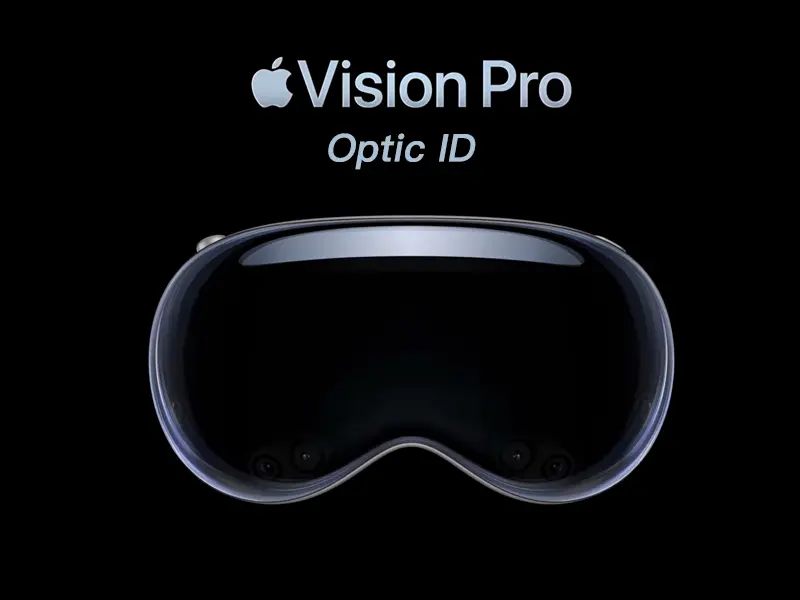
Apple’s Optic ID, implemented on Vision Pro, leverages iris recognition technology for fast unlocking, Apple Pay authorisation, app login, and accessing sensitive data. Despite Optic ID’s high security, challenges like user habits, environmental conditions, and optimization persist, limiting widespread adoption. Biometric recognition, including iris scanning, remains mature, but balancing security with seamless usability is crucial, with fingerprint and facial recognition prevailing on smartphones for now. Following the launch of Vision Pro in the US market, Apple further elaborated on the Optic ID feature applied to this headset.
Optic ID, utilising iris recognition technology, enables quick unlocking, authorising Apple Pay, logging into third-party apps, and accessing sensitive personal information, automatically supported by apps utilising Face ID and Touch ID due to its iris recognition capability.
Essentially, Optic ID captures iris images by emitting non-visible light (near-infrared light) from LEDs, compares the iris data with biometric data stored in the secure enclave to ensure only registered users can use the device, and updates the stored iris data public-source context after each successful authentication, with Apple claiming a probability of less than one in a million for strangers to unlock Vision Pro using Optic ID, similar to Face ID.
Also read: Dawn of a new VR era: Apple Vision Pro now available to buy Optic ID provides a truly seamlessly experience To cater to specific user groups, Vision Pro not only supports complete Optic ID deactivation but also allows Optic ID recognition using a single eye. Apple emphasises that emitting non-visible light from LEDs poses no harm to the human eye. In terms of security, Optic ID allows up to five matching attempts and supports wiping all information from the device after multiple unsuccessful matches or password inputs. The product form factor of Vision Pro dictates that only Optic ID can achieve a truly consistent experience.
The implementation of Optic ID signifies Apple’s establishment of a biometric recognition system, including Touch ID and Face ID, with its application to Vision Pro driven by the product characteristics of its MR headset, where Touch ID and Face ID may pose operational barriers and affect Apple’s cherished consistent experience. There are challenges in the implementation In fact, iris recognition technology like Optic ID is not a novelty. As early as 2015, both Fujitsu and Nokia offered iris recognition functionality in relevant models.
Subsequently, in 2016, Samsung equipped the Galaxy Note7 with iris recognition technology and continued to support this technology in the subsequent Galaxy S8 series. Given its contribution to enhancing security and the “advanced” nature of its implementation, iris recognition technology is attractive to users. However, like any new technology, it faces numerous challenges. The first challenge lies in user habits, as wearing contact lenses, especially coloured ones, can affect recognition accuracy.
Although algorithms can recognise and exclude the impact of coloured lenses, the diverse nature of such products undermines consistency, affecting the convenience of iris recognition for users. Additionally, when applied on smartphones, users need to ensure an appropriate distance and angle between their eyes and the relevant sensors on the device during recognition, which involves a somewhat forced cultivation of usage habits, reducing acceptance. Another challenge comes from the usage environment and scenarios.
While iris recognition performs well in low-light conditions such as full darkness, weak light, and scattered light due to its use of non-visible light for image capture, it is influenced in environments with strong light, leading to a decrease in recognition accuracy. Moreover, in relatively long distances and dynamic scenarios, iris recognition’s accuracy is relatively lower. No significant advantages compared to Face ID Furthermore, optimising the iris recognition experience and addressing cost issues are challenges facing this biometric technology today.
Without thorough optimisation, iris recognition functionality may suffer from issues like sluggish response, slow recognition speed, and low accuracy. Regarding costs, as iris recognition does not offer significant advantages compared to 3D facial recognition, compromises in pricing are necessary to attract more users. Considering that almost all modern smartphones have abandoned iris recognition technology, despite its security, its failure to gain widespread adoption, unlike fingerprint recognition, primarily stems from issues related to user experience or cost.
Overall, biometric recognition technology is relatively mature now, with different technologies corresponding to different security levels. However, its application on different products requires achieving a balance between security and as much seamless convenience as possible. Therefore, at this stage, fingerprint recognition and facial recognition will continue to be the mainstream configurations for smartphones, while the potential replacement of the two by other biometric recognition technologies remains to be confirmed over time.