
Summary
- The public operating identity behind AP Info Internet Service is Info Internet Service, associated with Md. Edrish Ali in Mirpur, Dhaka. Industry records identify a divisional ISP licence, while the operator names a set of neighbourhood service areas and a Mirpur industry group reports two local points of presence.
- The network is observably active. AS136267 originates four IPv4 /24 prefixes covering 1,024 addresses, with full visibility in a 10 July 2026 RIPE RIS snapshot. APNIC and Cloudflare measurements put its estimated user population at roughly 5,000 to 5,800, although that is not the same as a paid subscriber count.
- The strongest caution is concentration. Current public route observations place Peerex Networks, AS137491, immediately before AS136267 on every visible IPv4 path. That does not prove there is only one circuit, but it does mean independent provider diversity, physically separate routes and automatic failover are not demonstrated.
- The operator advertises low-priced home packages, named support staff, 24-hour telephone support and IPv6. Yet no public route map, power-autonomy figure, utilisation series, repair-time record, spare-parts policy or customer service-level commitment establishes how the network behaves through a cut or extended outage. The appropriate conclusion is therefore an operating local ISP with weakly documented physical resilience, rather than a verified regional connectivity network.
The downgrade is the finding
The first question is not whether a company called Info Internet Service can be found. It can. The harder question is what kind of infrastructure operator the evidence permits a reader to describe.
The Internet Service Providers Association of Bangladesh member entry identifies Info Internet Service, Md. Edrish Ali, membership number G-243, a divisional BTRC licence and an establishment date of 1 July 2018. It also provides trade, tax and business registration numbers. The APNIC registration for AS136267 names INFO-INTERNET-AS-AP in Bangladesh, and the related address allocation is registered to INFO-INTERNET-BD. The current APNIC Whois presentation describes the organisation as Edrish Ali trading as Info Internet Service and places it in Mirpur.
These records are enough to connect a business identity, a licence class and a routed network. They are not enough to establish a region-wide physical plant. A divisional licence is permission to serve within a division, not proof that every district or neighbourhood in that division is reached by company-controlled fibre. The BTRC ISP licensing guideline defines a divisional licence by authorised administrative area. The same guideline says an ISP ordinarily leases transmission from licensed Nationwide Telecommunication Transmission Network operators, connects to a licensed International Internet Gateway for international bandwidth and connects to a National Internet Exchange for domestic traffic. Permission, access and ownership are different things.
The public footprint points inward toward Mirpur. The operator's about page names Mirpur sections 2, 6 and 10, Borobag, Janata Housing, Rupnagar Residential Area, Vakurta in Savar, Banasree, Arifabad Residential Area and a corporate location near Beribad. The Mirpur ISP Alliance entry says the provider has two points of presence in Mirpur and identifies Dhaka as the coverage area. Neither page supplies PoP addresses, a route map, fibre kilometres, tower locations or the boundary between owned and leased plant.
That is why a downgrade is more useful than an inflated profile. The company is not merely a name attached to an old registration; current route observations and traffic estimates indicate an active access network. But the evidence supports a small or local Dhaka operator whose wider reach, asset ownership and recovery design remain unverified. Calling that network regionally resilient would confuse the area a licence allows with the infrastructure the operator has shown.
What can be located, and what cannot
The centre of gravity is unusually clear for a provider with a thin public record. APNIC places the organisation at House 22, Road 8, Block H, Section 2, Mirpur, Dhaka 1216. The operator gives the same address in a different order, 2-H, 8/22, Mirpur. An independent business listing also repeats the House 22, Road 8 address and names Md. Edrish Ali as contact. This convergence makes Mirpur Section 2 a reasonable administrative and operating anchor.
The access footprint is less certain. A list of neighbourhoods on a sales page can mean several things. It can describe areas with the operator's own distribution fibre, areas reached through leased dark fibre, reseller territories, isolated corporate links, or places where an installation can be arranged through another local network. The list does not distinguish among them. Vakurta in Savar and Banasree are separated from the Mirpur cluster, so their inclusion raises a practical route question: does Info Internet Service operate dedicated feeders to those areas, lease capacity across an NTTN, or sell service through a local partner?
There is no public answer.
The two reported Mirpur PoPs are similarly important and incomplete. Two PoPs can improve reach and shorten customer drops. They can also provide redundancy if each has independent power, separate aggregation equipment and physically diverse backhaul. But two boxes on the same electrical feeder, in the same building, or on the same fibre route remain one failure domain. The alliance listing gives a count, not a topology. The ISPAB member page is even more cautious: it contains no PoP-office records and no address list for the company.
The difference may be a matter of incomplete profiles, but it prevents a reader from treating either page as a complete asset inventory.
The ownership boundary follows Bangladesh's layered telecom structure. Under the BTRC guideline, the retail ISP is expected to lease transmission from an NTTN and take internet bandwidth through an IIG. That makes Info Internet Service the customer-facing operator and the origin network for AS136267, while some of the metro transport and international reach may belong to other licensed companies. The company may own local drops, access switches, routers, batteries and customer-premises equipment; it may lease any or all of those. No public asset statement settles the split.
This boundary matters during a fault. A subscriber does not experience regulatory layers. The connection is simply up, slow or down. Yet the party that answers the telephone may not own the cable that has been cut, and the owner of the cable may depend on a road authority for excavation permission. An accurate assessment therefore has to separate customer responsibility from repair authority. Info Internet Service can receive the complaint, diagnose the affected segment and escalate upstream. It cannot necessarily enter an NTTN duct, repair a gateway failure or redirect a submarine system.
The routed network is real and compact
AS136267 is the strongest proof that Info Internet Service is operating as more than a neighbourhood reseller. An autonomous system number gives a network its own identity in inter-domain routing. It allows the operator to originate assigned address space under a distinct routing policy, even if it still buys transit from a larger carrier.
The APNIC IPv4 registration covers 103.85.196.0 through 103.85.199.255, a portable /22 containing 1,024 addresses. On 10 July 2026, the RIPE announced-prefixes view showed all four constituent /24s, 103.85.196.0/24 through 103.85.199.0/24, continuously announced across its two-week window. The RIPE routing-status view reported that all 327 full-table IPv4 peers in that snapshot saw the routes. The same response recorded the first observation in May 2017 and four current IPv4 prefixes.
Several independent collectors agree on the compact IPv4 footprint. bgp.tools classifies AS136267 as an active APNIC-allocated eyeball network, lists four IPv4 prefixes and identifies Peerex Networks as its upstream. The CIDR Report likewise reports 1,024 originated IPv4 addresses and one adjacent upstream. Hurricane Electric's BGP view lists the same four IPv4 /24s.
This is operating evidence, but it should not be mistaken for capacity evidence. A /22 says how many public IPv4 addresses are available, not how many gigabits per second the edge can carry. Four advertised /24s can cross one physical port or several. Full route visibility means the global routing system can find the prefixes; it does not mean every customer receives the advertised package speed, or that the path survives a local fibre cut.
Population estimates add scale without solving that problem. Cloudflare Radar has recently estimated roughly 5,000 to 5,800 users behind AS136267. An APNIC Labs country measurement has placed the network at roughly 5,600 users and a very small share of Bangladesh's measured internet population. These are inferred users, not billing accounts. A household connection can represent several people; carrier-grade address sharing can put many devices behind one address; measurement coverage changes over time.
The operator's own site displays 1,234 happy clients, 1,230 completed services and 1,234 customer reviews. Those repeated round-looking counters are promotional claims with no date or method. A 2020 business-directory entry estimated 16 to 25 employees, but it provides no payroll basis and is now old. The external user estimates, the company counters and the employee listing are compatible with a modest local provider, yet none is an audited subscriber or workforce count. The network can be called active and compact. Its exact commercial scale remains unknown.
One observed IPv4 handoff is not route diversity
Every public IPv4 path in the current RIPE BGP-state observation reaches AS136267 through AS137491, Peerex Networks. The RIPE ASN-neighbours response identifies that single observed neighbour, while its routing-status documentation explicitly warns that collectors may not observe every neighbour a network has. This is the right balance of conclusions: Peerex is the only publicly visible immediate IPv4 neighbour, but a private backup or unobserved session could exist.
The distinction between logical and physical diversity is just as important. A customer can have two BGP sessions to the same provider over two ports and still lose both when one shared duct is cut. Conversely, a network can use one visible upstream autonomous system while receiving two physically separate circuits into different facilities. Public BGP data sees autonomous-system paths, not ducts, poles, splice enclosures, power feeds or contract terms. It cannot establish whether Info Internet Service has one fibre, two diverse fibres, a microwave backup or a dormant emergency circuit.
What the data does establish is a first-hop concentration. The current IPv4 route set has one observed immediate provider. Peerex itself has a broader network: its bgp.tools profile shows four upstreams, including Bangladesh Submarine Cable Company, Tata Communications, Bharti Airtel and Hurricane Electric, as well as a large peer and downstream set. That diversity beyond Peerex is useful because it gives the carrier options after traffic reaches its network. It does not remove the local handoff from Info Internet Service to Peerex as a potential common point of failure.
This is the practical difference between upstream breadth and customer resilience. If Peerex can shift international traffic among several carriers, a remote cable fault may cause higher latency rather than total loss. If Info Internet Service reaches Peerex through one leased feeder, however, a backhoe in Dhaka can disconnect all four public prefixes regardless of Peerex's international diversity. The visible route does not reveal where that feeder runs or who repairs it.
Bangladesh's licence structure reinforces the dependency. BTRC requires an ISP to connect through a licensed IIG for international capacity and to a NIX for domestic inter-operator traffic. Info Internet Service cannot simply behave as its own submarine-cable operator. Its resilience is assembled from contracts and handoffs across companies. The most valuable missing evidence is therefore not a second logo on a sales slide. It is proof that a second provider enters through a physically independent path, terminates on separate edge equipment and is tested under failure.
IPv6 shows the gap between allocation, advertisement and service
IPv6 is a revealing case because each public record describes a different layer. APNIC has allocated 2400:afc0::/32 to INFO-INTERNET-BD. The operator's package page says IPv6 is available. Hurricane Electric's collector showed the /32 and an IPv6 adjacency to ICC Communication in its 26 June 2026 update. Those facts support real IPv6 preparation and at least historical advertisement.
The current RIPE snapshot is less affirmative. On 10 July, its routing-status response showed zero IPv6 prefixes and no IPv6 visibility for AS136267. A RIPE routing-history query for 2400:afc0::/32 shows the prefix originated by AS136267 for long periods, including through 21 March 2026, but not in the latest interval returned. Collector timing and vantage points can differ, so the conflict does not prove that every IPv6 customer was disconnected. It does show why an allocation and a package-page claim cannot substitute for current end-to-end tests.
Routing security is the positive part of this picture. RIPE's RPKI validator reports the four IPv4 /24s as valid under a route-origin authorisation for 103.85.196.0/22 with maximum length /24. It also reports the IPv6 /32 authorisation as valid. APNIC's explanation of RPKI makes the scope clear: a valid route-origin authorisation tells other networks that AS136267 is permitted to originate those prefixes. It reduces exposure to accidental or malicious origin hijacks where validating networks reject invalid routes.
RPKI does not keep a router powered, repair a fibre or create a second path. It validates who may announce the route, not whether the announced path is physically resilient. Info Internet Service therefore appears stronger on address custody and origin hygiene than on documented access redundancy. That is a meaningful operational positive, but a narrow one.
For a customer, usable IPv6 would require more than a visible /32. The edge route must be up; aggregation and access equipment must pass IPv6; customer routers must receive addresses and DNS information; support staff must diagnose dual-stack faults; and upstream policy must carry the traffic consistently. A current public IPv6 test from several service areas, backed by route-collector visibility and a clear package specification, would settle whether the site's promise remains operational across the footprint.
The retail bill hides several wholesale bills
Info Internet Service's public package page displays 10 Mbps for Tk 525 a month, 20 Mbps for Tk 840 and 25 Mbps for Tk 1,050. It labels speeds as maximums, offers bKash payment, advertises unlimited BDIX traffic and says IPv6 is available. The page also promotes a no-security-deposit offer and a free connection for a 12-month payment. These are useful clues about a household broadband business, but the page has no visible revision date and should not be treated as a confirmed July 2026 tariff.
The old national tariff framework gives context. BTRC's One Country, One Rate page describes maximum shared prices of Tk 500 for 5 Mbps, Tk 800 for 10 Mbps and Tk 1,200 for 20 Mbps, with a maximum contention ratio of 1:8 under the 2021 framework. Info Internet Service also hosts a BTRC-approved tariff document dated in 2022. The package page's lower price per advertised megabit at higher tiers is consistent with the fixed costs of installing and maintaining a connection being spread across more capacity.
The market has since moved. BTRC's April 2026 subscriber series records 14.95 million ISP and PSTN subscriptions nationally, up from 14.62 million in December 2025. State operator BTCL's January 2026 GPON tariff lists 25 Mbps at Tk 500, 50 Mbps at Tk 800 and 100 Mbps at Tk 1,050. Those offers may differ in installation conditions, contention, local content and service availability, but they show the price pressure facing a small ISP whose page still displays 10 Mbps at Tk 525.
That pressure matters because the monthly bill finances more than transit. It has to cover leased metro transmission, IIG bandwidth, NIX access, routers and switches, optical modules, customer drops, customer-premises devices, rent, power, batteries, software, regulatory fees, taxes, support staff and field dispatch. The BTRC licence guideline sets annual fees and a bank guarantee for a divisional licence, and it requires audited accounts and operating reports. No public financial statement for Info Internet Service shows revenue, bandwidth cost, payroll or capital expenditure, so a margin estimate would be false precision.
Still, the operating tension is visible. Customers compare the headline Tk price and Mbps number, while resilience is purchased in less visible units: a second fibre path, spare optical modules, extra battery hours, an overnight technician, a tested configuration backup and unused capacity for peak periods. Each improves recovery but raises cost. An operator can preserve a low bill by accepting higher contention, fewer spares or slower dispatch, though there is no evidence that Info Internet Service has made any particular one of those choices. The point is that low tariffs make the quality of those choices economically consequential.
BDIX branding also needs careful interpretation. Unlimited local-exchange traffic can make popular local content fast and reduce expensive international transit. The Internet Society's IXP policy brief explains that local exchange can lower delay and cost while keeping domestic traffic available when international connectivity has trouble. But a package label does not reveal where Info Internet Service connects, at what port capacity, whether that connection is direct or through Peerex, or how congested it becomes at peak time. Local content performance and open-internet performance are related but not interchangeable.
A fault travels from the room to the ocean
The most useful way to judge the service is to follow a packet outward and ask what can stop it at each stage.
The first stage is inside the customer's premises. A Wi-Fi router, optical network terminal or media converter needs power and a working patch lead. A neighbourhood outage may leave the ISP's network alive while the customer's devices go dark. Info Internet Service does not publish which customer device it supplies, who owns it, whether replacement is included or how long it can run from a small uninterruptible power supply. The difference matters because a call logged as an internet fault may actually require a power adapter, fibre patch or router replacement.
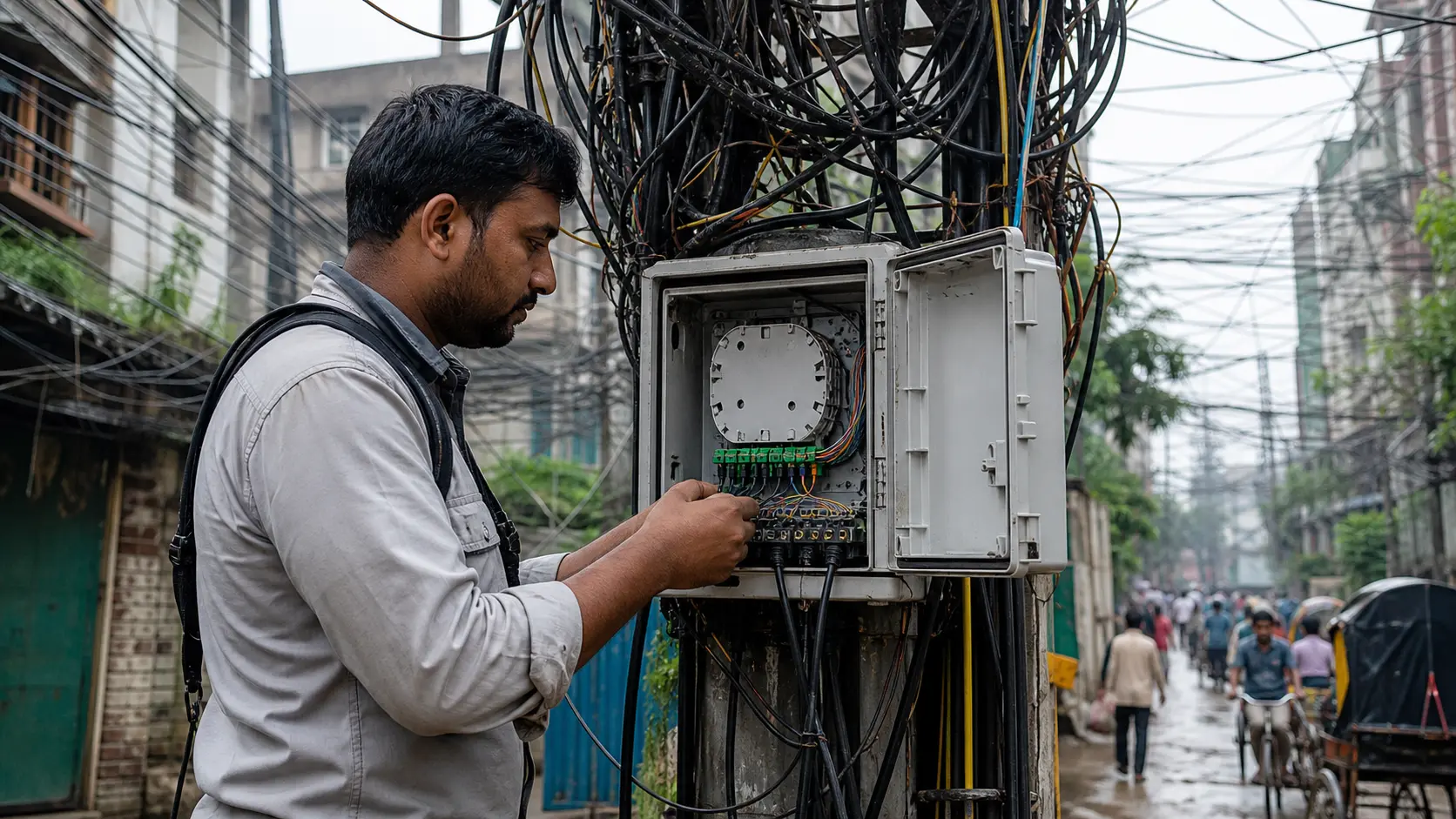
The second stage is the drop from the building. In dense Dhaka neighbourhoods, that may be aerial fibre or cable carried along poles and building fronts, or it may enter a shared underground route. There is no company-specific route map. The wider city context nevertheless shows the exposure: a 2024 Business Standard report on Dhaka's overhead internet cables described continued reliance on overhead connections, disputes over NTTN access points and difficulty coordinating underground deployment with power utilities. That report does not prove Info Internet Service uses any particular pole. It establishes that local access construction in its city can involve fragile, contested pathways.
The third stage is neighbourhood aggregation. Two reported Mirpur PoPs could divide the access load. A cut between them could be harmless if they form a ring with traffic able to move in either direction. It could isolate one whole service area if they sit on a line. If both depend on one upstream aggregation switch, one building or one electrical feeder, the apparent duplication offers little protection. No published ring diagram, PoP capacity, equipment list or power design establishes which arrangement exists.
The fourth stage is leased metro transport. BTRC's rules make an NTTN lease the normal path for ISP transmission. A local ISP may have little authority over excavation, splice work or route restoration on that segment. A 2023 Dhaka Tribune report described a large mobile outage after construction damaged backbone fibre on several routes and noted that locating and repairing cuts can take from eight to 72 hours in some circumstances. That was not an Info Internet Service incident. It is evidence of the repair problem faced by any operator whose traffic crosses urban or highway fibre: route diversity and accurate records matter because civil works can defeat electronics in an instant.
The fifth stage is the BGP handoff. Current observations put Peerex immediately upstream for IPv4. Loss of the edge router, the Peerex-facing port, the cross-connect or the only physical circuit would remove the visible path for all four IPv4 prefixes. Multiple /24 advertisements do not help if they share that handoff. A second verified provider on a separate route would reduce the risk; a second session over the same fibre would not.
The sixth stage is Peerex's own transit and Bangladesh's international gateways. Peerex has several observed upstreams, so it may route around a carrier failure. Nationally, however, international capacity still concentrates on submarine and terrestrial systems. During the April 2024 SEA-ME-WE 5 fault, the Internet Society's Bangladesh analysis measured about a 25 percent latency increase toward Singapore. Terrestrial routes and locally cached content softened the impact. The lesson for a Mirpur household is that an international cut may not make the connection completely dark: domestic services may remain fast while overseas applications become slow.
Congestion can imitate a cut at every layer. A 25 Mbps access port is not a guarantee of 25 Mbps to every destination if many customers share an undersized feeder or if international capacity fills at night. The operator says package speeds are maximums and does not publish a minimum throughput, contention ratio by package, peak utilisation or latency target. Without those measures, installed capacity cannot be separated from capacity available at the busy hour.
Finally, recovery depends on people. An alarm must be noticed, the failing domain isolated, the correct asset owner contacted, a technician dispatched, access permission obtained, the fault repaired and service verified. A single well-trained engineer can restore a small network quickly when records and spares are good. The same engineer cannot be in Mirpur and Savar at once, cannot splice a cable without equipment and cannot repair an upstream's plant without permission. That is why support labour is part of infrastructure, not an administrative afterthought.
Support claims are not repair evidence
Info Internet Service says its telephone and email support are available 24 hours a day. Its site names a network and systems engineer, a systems consultant and a support executive. The site also offers a support-ticket link, a customer portal and an IP log server. These features suggest an operator that expects ongoing technical work rather than a sales-only reseller.
They do not reveal the staffing depth behind the promise. A 24-hour telephone can route to one on-call person. A named engineer may work regular hours, contract externally or have since left. The pages do not show shift coverage, field-team count, splice capability, vehicle availability, safety certification, geographic dispatch bases or escalation agreements with NTTN and IIG suppliers. The industry's 2020 business listing estimated 16 to 25 employees, while a 2025 employment-profile aggregator showed a person describing a NOC-support role at the company. Both are unofficial signals.
They suggest continuing technical employment but cannot prove the current roster or who is available during a simultaneous outage.
The exact labour requirement depends on failure type. Customer-premises faults need someone who can test optical levels, replace an ONU or router and explain local Wi-Fi limitations. A drop-cable break needs route access, fibre tools, connectors and often coordination with a building manager. A PoP failure needs a technician who can work safely around power and restore switch or router configuration. An upstream loss requires a network engineer who can distinguish a local physical fault from a BGP or carrier problem and escalate with useful evidence.
Those skills are not interchangeable. Sending a home-installation technician to a routing incident wastes time; keeping every specialist on every shift is expensive. Small ISPs usually solve this through cross-training, on-call rosters and supplier escalation. Info Internet Service may do the same, but it does not publish the arrangement.
Response time also needs a denominator. A page can promise that staff will handle a problem without saying whether the clock starts when a customer calls, when an alarm fires or when an upstream accepts a ticket. It can report a fast average while a few long rural repairs remain hidden. The measures that would establish performance are straightforward: median and 95th-percentile time to acknowledge, isolate and restore; the share of faults resolved remotely; repeat-fault rate; and separate results for customer, access, PoP and upstream incidents.
Local support is therefore an evidence-supported topic because the operator sells it, names roles and serves a geographically specific access footprint. It is not a verified resilience advantage. The stronger statement is that the service depends on local labour, while the availability and effectiveness of that labour remain unmeasured in public.
Power can make a healthy fibre look broken
Fibre does not carry electrical power to the router, switch or optical terminal at either end. Every stage needs a power plan: customer equipment, access cabinets, PoPs, edge routers, monitoring systems and support communications. A grid interruption can therefore break a link without damaging the glass.
The company's pages do not state whether its PoPs use batteries, generators, dual utility feeds or monitored rectifiers. They do not give backup duration or the load at which it was tested. A photograph of a UPS, even if one existed, would not answer those questions. Battery age, temperature, maintenance and actual equipment load determine survival time.
Bangladesh's National Broadband Policy 2024 treats backup power and route diversification as resilience measures for broadband infrastructure. A May 2026 Daily Star analysis of telecom power described the high fuel cost of sustaining communications equipment during long outages. That article focuses largely on mobile networks, so its fuel figures should not be transferred to Info Internet Service. The relevant principle is common: backup energy raises operating cost and eventually runs out.
Two PoPs could reduce power exposure if they use different feeders and can reroute traffic. They could also fail together during a wide outage, or remain powered while customer routers go off. A meaningful power claim would state tested autonomy at each PoP, generator refuelling arrangements, battery-replacement dates, environmental limits and whether the upstream handoff shares the same supply. None is public.
This gap changes how a customer should read an uptime claim. The operator does not publish a numerical uptime commitment, but even a percentage would need exclusions and measurement boundaries. Does downtime begin when the edge router stops responding, or when a customer's optical terminal loses signal? Does an extended grid failure count? Is a slow international path an outage? Without definitions and measured history, power resilience remains a question rather than a feature.
Installed capacity is not usable capacity
Public network profiles are rich in inventory-like numbers: 1,024 IPv4 addresses, one IPv6 /32, four current IPv4 routes, two reported PoPs, three named retail packages and an estimated user population around 5,000. None directly measures the capacity available to a customer at 9 pm.
Installed capacity begins with port rates and purchased bandwidth. A PoP might contain gigabit or 10-gigabit switches; an IIG contract might provide a fixed commit with burst capacity; a local-exchange port might be larger than international transit. Usable capacity is what remains after overhead, oversubscription, failures and simultaneous demand. The operator publishes none of those underlying rates.
The package design hints at traffic segmentation. "BDIX Unlimited" suggests local traffic may receive different treatment from general international traffic. A customer could see high speed to a local cache while a cloud service overseas is constrained by a smaller transit pool. That is not inherently improper. Local exchange is one of the reasons broadband can be affordable. It becomes confusing when a single Mbps label is read as equal performance to every destination.
The user estimate also cannot be divided into a guessed uplink. Five thousand measured users are not five thousand simultaneous lines. Some are members of one household, some are idle and some may sit behind shared addresses. Likewise, the site's 1,234-client counter may be stale or promotional. Any calculation of megabits per subscriber from these figures would compound uncertain inputs.
Capacity headroom is especially important under failure. A second circuit has little resilience value if it cannot carry essential load when the primary fails. Good design may intentionally allow reduced speed during failover rather than full disconnection. To evaluate that design, a reader would need the normal and backup capacities, routing policy, priority rules and recent failover test results. Info Internet Service publishes none of them.
The IPv6 history makes the same point in another form. The address space is installed in the administrative sense and has been announced in the routing sense. Yet current RIPE visibility does not show it. Allocation, route advertisement and stable retail service are three separate states. A credible capacity statement should specify which state it describes.
The correct conclusion is modest. The company has enough routed infrastructure to appear globally as its own network and to serve a measurable user population. It advertises consumer access packages and local exchange benefits. There is no public basis for a throughput, utilisation or spare-capacity claim, so the network's usable capacity under normal load or failure remains unknown.
Who feels each failure
The affected group changes with the failing segment. A damaged home drop may disconnect one flat or building. A failed access switch can remove a street or housing block. Loss of one Mirpur PoP may affect a wider cluster, depending on whether customers can be moved to the other. Failure of the Peerex-facing handoff could affect every customer whose public traffic uses AS136267. An international cable event may preserve local content while degrading overseas services for the whole base.
The operator's named service areas include students, households and corporate customers. Its site testimonials refer to students and an ICT user, though those testimonials are self-published and cannot establish the customer mix. For a household, an outage interrupts study, entertainment, messaging and remote work. For a shop or small office, it can interrupt cloud software, card or mobile-payment support, customer communication and security monitoring. A corporate link in a scattered service area may be more dependent on a long feeder and slower field access than a home near the Mirpur office.
IPv4 and IPv6 failures may also affect users differently. If IPv6 disappears while IPv4 remains, many applications will fall back after delay and the fault can look like intermittent slowness. If the common IPv4 handoff fails, fallback is impossible unless the customer has another provider or mobile connection. The operator does not publish customer-level multihoming, managed backup or an outage-notification channel beyond telephone, email and its support portal.
This is why the company matters despite its small measured share. A network does not need national scale to be critical to the people behind it. Local concentration can make a modest operator the main fixed connection for a particular building or block. The public record cannot quantify that concentration, but the neighbourhood footprint and active user estimate make the consequence plausible and specific.
Public signals: useful, limited and sometimes stale
Several softer signals point to continued operation. The company website is online and lists packages, contact routes, staff roles and service areas. The Mirpur ISP Alliance includes the provider among local members and reports two PoPs. ISPAB recorded membership through the end of 2025, and APNIC's abuse-contact record was validated in May 2026. Cloudflare and APNIC measurements continue to see users, while RIPE sees all four IPv4 routes.
Together, these signals are stronger than an abandoned name. They indicate an active routed service and a reachable operating identity. They cannot prove the current validity of every commercial claim. The ISPAB page does not show a 2026 membership-validity date or PoP list. The operator site carries an expired TLS certificate dating to October 2024, and its package and client counters have no revision dates. The company may maintain network operations more diligently than its public website, but the stale security endpoint weakens confidence in the freshness of the commercial pages.
The old business-directory listing and employment-profile pages are weaker still. They can suggest staffing and continuity, not verify them. Self-published testimonials can illustrate how the company wants to be perceived, not establish uptime. A package order button can remain online after prices change. An allocated prefix can remain registered while a retail area is no longer sold.
The evidence that would settle these uncertainties is concrete and obtainable: a current BTRC licence record with validity dates; a dated tariff approval; live availability checks at named addresses; current invoices with package terms; a staff roster or on-call schedule; and customer measurements taken from several service areas. For infrastructure resilience, the decisive documents would be a physical route drawing, PoP power schedule, independent upstream contracts, capacity graphs and incident records.
Until those are available, unofficial signals should remain what they are. They support the view that Info Internet Service is alive and locally staffed. They do not rescue the broader proposition that it operates a proven, diverse regional network.
What would change the assessment
The network evidence grade would rise from weak to medium if the company published a dated operating pack that joined logical routing to physical infrastructure. At minimum, it would identify each PoP by service area, show which routes are owned or leased, name the NTTN and IIG suppliers, and state whether primary and backup circuits use separate ducts and building entrances. Sensitive street-level details would not be necessary; shared-risk groups and endpoint diversity would be enough.
A current BGP design would need to show whether Peerex is the only provider for IPv4, whether another route is private or inactive, and how failover is tested. If the second connection is to the same carrier, the company should explain physical separation. If it is to another carrier, public route collectors should eventually observe a second immediate neighbour when that route is active, unless policy deliberately keeps it private. The company could demonstrate the backup without disclosing commercial rates by publishing a redacted failover result and outage timeline.
The access layer needs similar clarity. A ring claim should identify which PoPs form the ring, whether fibres follow separate paths and what happens when one span is cut. A power claim should give tested battery autonomy and generator arrangements at each site. A capacity claim should show normal peak utilisation, backup capacity and minimum customer performance during failover. A support claim should report acknowledgement, isolation and restoration times by fault class.
IPv6 is an immediate test case. A new route snapshot showing 2400:afc0::/32 consistently visible through a current neighbour, combined with customer-side measurements in Mirpur and an outlying service area, would turn the site's IPv6 label into operating evidence. If IPv6 has been withdrawn, the package page should say so.
Financial resilience does not require publication of a full private ledger. A current tariff sheet, installation fee policy, compensation terms and clear distinction between local and international speed would let customers understand what their bill purchases. A service-level option for businesses could fund faster repair and backup capacity without pretending that every low-cost household package receives dedicated bandwidth.
Most importantly, the company should publish incident learning. A short record of major access, PoP and upstream faults, including cause, affected area, restoration time and corrective action, would reveal more than generic reliability language. It would show whether recurring cuts are being routed around, whether batteries survive their target duration and whether supplier escalation works.
A local network deserves a local, testable claim
AP Info Internet Service is best understood through the operating name that public records consistently use: Info Internet Service, a Mirpur-based divisional ISP associated with Md. Edrish Ali and AS136267. The company originates its own IPv4 space, reaches a measurable user population and advertises household broadband across a defined Dhaka footprint. Those are substantive facts.
The regional-resilience proposition does not survive the same scrutiny. A divisional licence does not prove divisional plant. Two reported PoPs do not prove a ring. Four IPv4 prefixes do not prove four paths. A provider with multiple upstreams beyond the first handoff does not prove that the local handoff is diverse. An IPv6 allocation does not prove current IPv6 service. A 24-hour telephone does not prove 24-hour field restoration.
What the evidence reveals instead is a chain of dependencies. The customer's bill supports a retail operator that likely combines local access work with leased transport, domestic exchange and international gateway capacity. The visible IPv4 route currently converges on Peerex. Physical access is exposed to the ordinary hazards of Dhaka cabling, power and road work. Recovery depends on technicians, spares, access permissions and supplier escalation that the company does not quantify.
That does not make the service unreal. It makes the honest claim narrower and more useful: Info Internet Service appears to be an active local fixed-broadband operator whose address stewardship and IPv4 presence are visible, while its physical redundancy, current IPv6 service, power endurance, spare capacity and repair performance remain unverified. For customers in Mirpur and the other named areas, those missing details determine whether a cheap connection remains useful when one fibre, one PoP or one upstream route fails.