
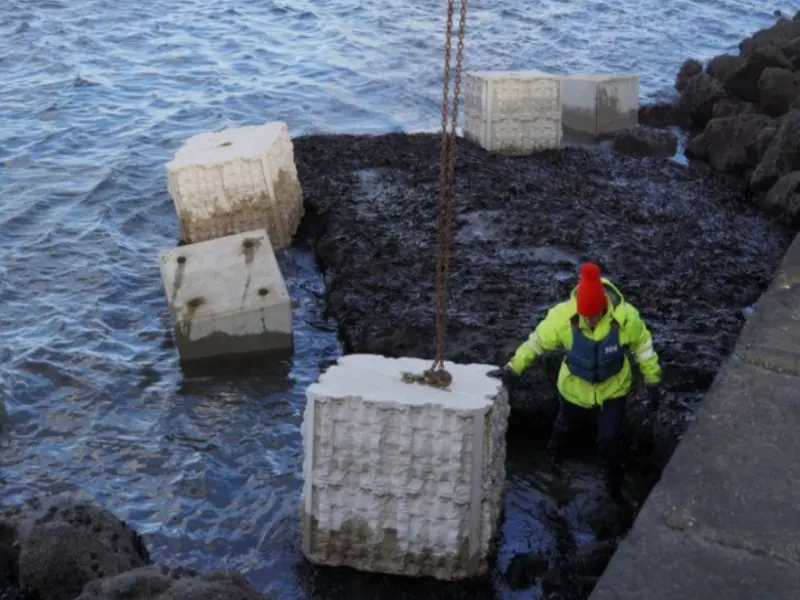
- A unique ecological engineering project in Dublin, Ireland, is deploying large habitat units along the coast that could potentially boost marine life.
- The project draws on comprehensive research carried out as part of the Ecological Fabric Project, in which Dublin Port played a key role.
- Most important in the project is to take care of the Marine environment around the port, where about 8,000 ships arrive each year.
A world-first eco-engineering projects
University College Dublin (UCD) and Dublin Port Company are collaborating on a project that represents the first time researchers have simulated natural terrain to create artificial structures around the seawall, combining engineering with ecological best practices.
When the South Wall in Dublin Harbour was built more than 200 years ago, it was the longest seawall in the world. Today, at nearly 5 kilometres long, the long Wall remains one of the longest in Europe.
While man-made structures such as seawalls and rock armor are important for protecting harbours, harbours and marinas around the world, they often lack the biodiversity of natural rocky coasts. Now, this world-first eco-engineering project, led by UCD researchers and Dublin Port, is deploying large habitat units along the southern wall of the Great Wall that could potentially boost Marine life along the coast. The 3D printed installation was inspired by the natural topography of the shores of Ringaskiddy, a village on the west side of Cork Harbour.
Also read: Microsoft Teams introduces immersive 3D and VR meetings
Important step in understanding the concept of ecological engineering
Dr Paul Brooks, from University College Dublin’s School of Biological and Environmental Sciences, said the project – seven years in the making – represents a “major step” in our understanding of the concept of ecological engineering. “By incorporating the natural topography into the artificial structure, we have the potential to mitigate the environmental impact while promoting ecological resilience along the Southern Great Wall,” he explained.
Over the next two years, UCD researchers will comprehensively monitor these habitat units to see how a variety of species, from invertebrates to fish, thrive in their presence. The project draws on comprehensive research carried out as part of the Ecological Fabric Project, in which Dublin Port played a key role. It involves 32 natural rocky coasts and 32 artificial shoreline sites in Ireland and Wales, assessing biodiversity and physical topography.
Also read: Apple’s Vision Pro: 3D Disney magic & guest mode unveiled
Marine environment around harbour is Paramount
Eamon McElroy, port engineer at Dublin Port Company, said it was important to look after the Marine environment around the port, which sees around 8,000 ships arrive each year.
“Our policy is to manage our obligations to the environment in a responsible manner and to develop port operations in a sustainable way,” he said. “The deployment of fish habitat along Dublin’s iconic landmark south Wall is designed to enhance the biodiversity of the Harbour Estate itself. Through our joint efforts with UCD, we reaffirm our commitment to sustainable development and the protection of Marine ecosystems.