4 common types of industrial automation tools is tracked as a internet infrastructure institution within the internet infrastructure ecosystem.
4 common types of industrial automation tools has public-source relevance to network operations, governance, dependency mapping, or market structure.
4 common types of industrial automation tools has public-source relevance to network operations, governance, dependency mapping, or market structure.
Public-source signals support medium-impact monitoring for infrastructure visibility and dependency analysis.
Public-source signals support medium-impact monitoring for infrastructure visibility and dependency analysis.
Automation boosts productivity and efficiency in the industrial sector, with advancing technology driving continuous innovation in processes.
Public-source signals support medium-impact monitoring for infrastructure visibility and dependency analysis.
| 0.90–1.00 | A | High - direct sources |
| 0.75–0.89 | A/B | Strong |
| 0.55–0.74 | B/C | Medium |
| 0.35–0.54 | C/D | Weak-medium |
| 0.10–0.34 | D | Weak signal |
| 0.00–0.09 | D | Internal monitoring |
Several public sources
- The industrial sector is rapidly evolving, with automation playing a central role in enhancing productivity, accuracy, and efficiency.
- As technology continues to advance, the role of automation tools will only grow, driving further innovation and improvement in industrial processes.
Industrial automation tools encompass a suite of technologies and systems designed to automate and optimise industrial processes. Industrial automation tools have ushered in a new era of efficiency, precision, and innovation across a wide range of industries. These tools enable automated technologies to streamline processes, reduce human intervention, and enhance productivity.
1. Programmable logic controllers
Programmable logic controllers (PLCs) are sophisticated microprocessor-based devices that serve as the backbone of automation in manufacturing settings. These versatile controllers are designed to automate a wide range of electromechanical processes, providing precision and efficiency in industrial operations. Programmable logic controllers can be programmed with specific instructions to execute tasks, monitor input signals, and precisely control output mechanisms based on predefined logic.
Their ability to perform complex calculations and make rapid decisions makes PLCs essential components for automating repetitive tasks and optimising production processes.
In manufacturing environments, PLCs act as the central control unit, orchestrating the seamless operation of machinery and equipment on the factory floor. By interfacing with sensors, actuators, and other industrial components, PLCs enable real-time monitoring and regulation of production processes. This real-time control capability not only enhances operational efficiency but also ensures accuracy and consistency in manufacturing operations.
The flexibility of PLC programming allows for customisation and adaptation to diverse production requirements. Engineers and technicians can configure PLCs to perform a variety of functions, such as sequence control, proportional-integral-derivative (PID) regulation, and logic operations. By programming PLCs to respond to specific inputs and conditions, manufacturers can automate complex processes, reduce manual intervention, and minimise the risk of human error.
Also read: 5G business solutions, powering intelligence, automation and efficiency
Also read: What is infrastructure automation and how does it work?
2. Human-machine interface systems
Human-machine interface systems (HMIs) stand at the forefront of human interaction with automation technology in industrial environments. These systems provide a visual interface that serves as a gateway for operators to seamlessly interact with and monitor automated systems. By integrating intuitive graphical displays and touch-screen functionalities, HMIs empower users with the ability to visualise real-time data, conduct diagnostics, and exert control over complex industrial processes with precision.
One of the key strengths of HMIs lies in their user-friendly design, which simplifies the complexities of industrial automation for operators. Through clear visual representations and intuitive navigation, HMIs facilitate efficient decision-making and streamline operational tasks. By presenting critical information in an easily digestible format, these interfaces enhance operator efficiency, enabling swift responses to changing conditions and optimising process control.
3. Robotics and robotic process automation
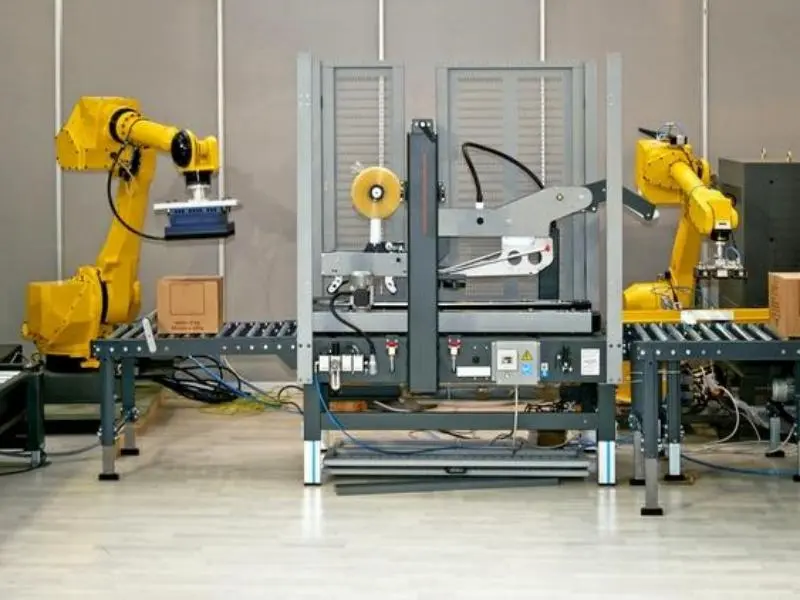
Robotics and robotic process automation (RPA) have revolutionised the manufacturing landscape by automating repetitive tasks, increasing precision, and boosting throughput. Industrial robots are utilised for various applications, ranging from assembly and welding to material handling and packaging. Collaborative robots, or cobots, are designed to work alongside human operators, enhancing productivity and safety on the factory floor. In addition to physical robots, robotic process automation software automates rule-based business processes, improving operational efficiency and reducing human errors in administrative tasks.
4. Sensors and vision systems
Sensors and vision systems play a fundamental role in the realm of industrial automation, serving as essential components that enable machines to perceive, analyse, and respond to their surroundings with precision and accuracy. Sensors are instrumental in detecting variations in key parameters such as temperature, pressure, proximity, and more, providing vital feedback and data that inform the decision-making processes of automated control systems. By continuously monitoring and capturing data from the environment, sensors contribute to the seamless operation and optimisation of industrial processes.
Additionally, vision systems, utilising cameras and sophisticated image processing algorithms, offer advanced capabilities for visual inspection, robotic guidance, and visual recognition tasks in industrial settings. These systems leverage high-resolution cameras and intelligent software to analyse visual data, identify patterns, and make informed decisions based on visual input. Vision systems are adept at inspecting product quality, guiding robotic operations with precision, and facilitating tasks that require visual recognition, such as reading barcodes or identifying objects on a production line.
Signal Brief
- Signal: 4 common types of industrial automation tools
- Signal Type: Internet infrastructure institution
- Region: Global
- Market Class: Cloud Service
Operating Surface
- Published sources should identify the affected parties, operating surface, and market exposure before this trend map is treated as complete.
Market Context
- Public-source signals support medium-impact monitoring for infrastructure visibility and dependency analysis.
- Operational relevance: Medium
- Time Horizon: Next quarter
What To Watch
- Watch for official statements, regulatory updates, customer or partner exposure, and follow-up disclosures.
Member Briefing
Deeper Trend Context
Sign in to unlock the full trend briefing and source notes.
Only for Strategic Circle
Strategic Circle
Open to all readers. Unlock trend briefings after joining and signing in.
Join Strategic CircleOnly for Leadership Alliance
Leadership Alliance
For operators, investors, and policy teams that need relationship evidence, failure paths, and source notes. Sign in to unlock.
Join Leadership Alliance