
Summary
- WiseTech Global is best understood as a cloud-service dependency for logistics providers, not as a carrier, broker, port operator or internet network. Its paid unit is access to CargoWise and related hosted software functions used to execute freight forwarding, customs, warehouse, transport and documentation work.
- The strongest evidence is public and operational: WiseTech reports recurring software revenue, CargoWise is delivered principally through cloud access, and the company publishes transaction-based CargoWise Value Pack pricing for shipments, customs procedures, warehousing, transport bookings and cloud-related services.
- The strategic lock-in is not just data export friction. It is the operational memory created when customer-specific workflows, customs filings, carrier links, accounting rules, user training and exception handling are embedded in one platform during live trade.
- The investment case weakens if large forwarders slow rollouts, if customers resist the new transaction-fee structure, if e2open integration distracts management, if governance risk raises the cost of trust, or if rivals make migration less painful across customs, forwarding and data-locality requirements.
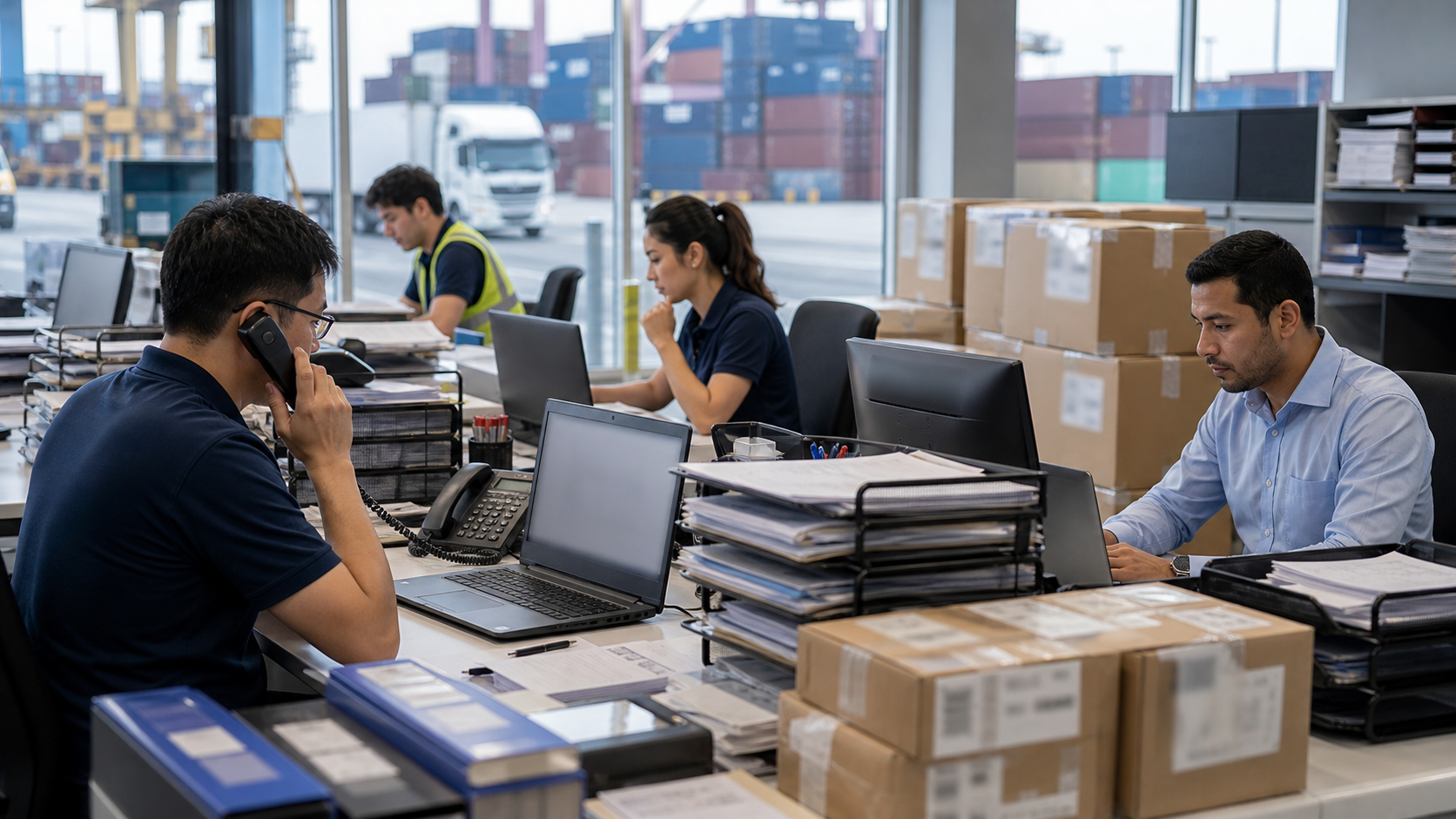
The simplest way to see WiseTech Global is to start inside a shipment, not inside a software brochure. A container has arrived, the consignee is waiting, the forwarder has promised visibility, and the customs broker has to lodge the right declaration against the right commercial documents before the delay becomes a service failure. The job record is not a static form. It carries shipper instructions, lane history, tariff classifications, security screening, carrier updates, warehouse milestones, customer billing, margin logic and the evidence that someone made a decision at a particular time.
If the data is late or wrong, the cost is not an abstract software defect. It can become demurrage, a missed delivery slot, a regulatory correction, a client escalation or a loss of trust between the forwarder and the shipper.
That is the economic setting in which WiseTech has built its power. CargoWise is not merely an application that records freight after the fact. The public product pages describe a system that manages bookings, documentation, carrier connections, customer updates, workflow templates, task ownership, compliance validation, audit trails and billing across modes and borders. WiseTech's 2025 annual report goes further by defining its revenue base as access to computing software, with the majority of revenue coming from recurring on-demand licenses where customers use software as a service without taking possession of the software.
The same filing says the revenue is recognized over the contract period and is based on utilization, including numbers of users and transactions. That is a clean cloud-service signal. The customer is paying for a live hosted operating surface, and the meter rises as work moves through it.
The distinction matters. WiseTech does not own the cargo, operate the vessels, run the ports or provide access connectivity. Its dependence point is software execution. The network evidence is strong for customer-facing hosted SaaS, cloud delivery and data-center-backed support, but weak for any claim that WiseTech is a telecom or routing network. The right thesis is therefore not that WiseTech controls transport capacity. It is that the company can become deeply embedded in the administrative, regulatory and data layer that allows logistics providers to turn transport capacity into a finished service for their customers.
WiseTech's own numbers show why the market treats that layer seriously. In FY25, the company reported total revenue of US$778.7 million, up 14 percent, with recurring revenue at 98 percent of group revenue. CargoWise revenue grew to US$682.2 million, including 17 percent organic growth, and the company said 99 percent of CargoWise revenue was recurring. It also reported customer attrition for the CargoWise application suite below 1 percent for a thirteenth year. Those facts do not prove that every customer is happy, nor do they eliminate pricing or rollout risk.
They do show that once customers operate on the platform, the account behaves more like infrastructure than discretionary software.
CargoWise also has the scale signals that matter in freight software. WiseTech says its software is used across 195 countries on the corporate investor page, while the CargoWise site markets coverage across 193 countries, 30 languages and 162 currencies. The company says it has more than 17,000 organizations using CargoWise, more than 90 CargoWise global rollouts and 41,000 certified practitioners. In the 2025 annual report, WiseTech says it has 14 of the top 25 global freight forwarders on CargoWise global rollouts and 55 large global freight forwarder rollouts either in production or contracted.
It also says its customer base includes 24 of the top 25 global freight forwarders and 47 of the top 50 global third-party logistics providers, using Armstrong & Associates rankings as the reference base. The important nuance is that being a customer is not the same as being fully live across all countries and users. The economic upside is in rollouts, penetration and usage, not only in logos.
That nuance explains why WiseTech's opportunity and its risk are the same shape. The company is selling into very large operating organizations that cannot change systems casually. A global forwarder may have teams in dozens of jurisdictions, different customs obligations, different accounting practices, local carrier relationships and a long tail of customer-specific handling rules. A system change is not a weekend migration. It is a re-plumbing of the workday. Training, job templates, master data, document archives, billing rules, external messages and exception routines all have to survive the move.
That creates stickiness once CargoWise is in place. It also slows adoption when a prospect still has an in-house legacy system, an ERP transport module, a regional freight package, a spreadsheet-heavy customs process, or an internal database built around local habits.
The pricing evidence reinforces this interpretation. CargoWise's public Value Pack pages show a move toward packaged, transaction-based pricing rather than a narrow seat-license model. The company describes the Value Pack as a fee directly tied to the logistics processes needed to plan, manage and automate cargo from order inception through final release. The public community pricing page lists forwarding charges per shipment, customs charges per formal procedure, warehouse charges per order line or work order, land transport charges per container or consignment, and container transport optimization charges per booked container.
It also lists optional cloud and service items such as private cloud instance fees, secured links or VPNs, customer-specific URLs, read-only access for SQL queries or customized reporting, backup runs, data returns, hosting-location moves and cloud service tear-downs.
This price sheet is unusually revealing. It tells a customer that the bill is tied to the thing logistics firms actually sell: completed movements, clearances, bookings and warehouse work. It also tells an analyst where lock-in lives. If a forwarder has built its workflow around a per-shipment automation fee, a direct customs interface, a hosted production database, customer reporting, web services and data access arrangements, moving away requires more than replacing an invoice. The replacement must recreate the operational pathway that allowed the shipment to move in the first place.
That is why the public claims around one database and built-in integrations should be read as economic claims, not only product claims. CargoWise markets itself as a single global database where logistics providers can pay for one system, learn one system and maintain one system. It says customers can connect with carriers, partners, customers and government systems without the cost and complexity of custom integrations. It describes real-time data sharing, global compliance automation and reduced administrative work. These are vendor claims, but they line up with the business model.
A system with shallow workflow coverage would be easy to replace. A system that becomes the daily ledger of shipment work can earn recurring revenue because the buyer's alternative is not another login. The alternative is a migration program that risks interrupting service.
The customs module is the sharpest example. Customs is where logistics data becomes a regulatory artifact. CargoWise's customs pages describe automated screenings, classifications, declarations, exception flags, holds, approvals and audit history. They also present country-specific coverage, including direct data exchange with the Australian Border Force Integrated Cargo System and support for systems used by the Canada Border Services Agency.
WiseTech says its global customs platform covers about 80 percent of global manufactured trade flows, including countries in production and development, after acquisitions that added customs footholds in Portugal, Chile, Ecuador, Panama and Colombia. That is not a claim that every country is equally mature, or that every local regulatory change is simple. It is evidence that customs coverage is a central part of the product strategy.
Customs coverage increases switching cost in a way that pure transport planning does not. A freight forwarder can compare a carrier rate in a different portal. It can even operate some warehouse or road transport tasks on specialist systems if the handoff is controlled. But customs work ties commodity data, origin, destination, tariff logic, permit requirements, government messaging and human accountability together. Once those decisions and records accumulate inside one system, the software starts to hold institutional memory. Users know where exceptions appear. Managers know which reports answer client questions.
Brokers know which data fields cannot be left to improvisation. Customers know which updates they receive. The dependency is organizational as much as technical.
WiseTech's customer case studies should be handled with the proper caution because they are selected by the vendor. They are still useful because they show what customers value publicly. The 2025 annual report includes Metro Shipping, a UK-headquartered forwarder, saying it needed a cloud-based system as it grew across the United Kingdom and India. The case study connects CargoWise to customs brokerage after Brexit, automated workflows, electronic movement of data from customers to Metro and transmission to UK Customs.
It reports that automations and workflows saved around 10,000 hours over a year, and that a customs declaration of 400 to 500 lines that previously could take up to three days could be completed in a maximum of two hours. Those numbers should not be universalized. They are customer-specific results. But they show the type of pain point WiseTech is trying to own: high-volume, rules-heavy, time-sensitive work where manual re-entry is expensive and risky.
The same pattern appears across CargoWise's public customer stories. Logistics Plus describes CargoWise as a foundation for its offering. CLASQUIN calls it the backbone of operations. SEKO and other customers emphasize workflow improvement, productivity and client-service benefits. These are not independent measurements, but they are market signals from companies willing to attach their names to the platform. They help explain why the company can sell implementation and training as part of a broader ecosystem.
WiseTech's public support page points to 24/7 incident response, automated support requests, CargoWise Cloud, disaster recovery, backup and continuity planning, global support numbers and learning resources. A buyer adopting CargoWise is not just buying code. It is entering a support, certification and implementation network.
The cost base also fits the thesis. WiseTech is a software company with a high gross margin but heavy product investment. In FY25, it reported a gross profit margin of 87 percent in the highlights and 86 percent in the statutory metrics, depending on presentation, and US$263.8 million invested in research and development, equal to 34 percent of revenue. It says 64 percent of its team is focused on product development, and that it invested more than US$940 million in product investment over five years.
The annual report also says WiseTech delivered more than 5,700 product enhancements to the CargoWise application suite over the past five years. That level of product spending is not incidental. Logistics execution changes constantly: carrier connections change, customs systems change, data standards change, tariffs change, and customers demand more automation. The product has to keep absorbing those changes or the switching-cost advantage decays.
WiseTech's cost structure includes the infrastructure burden of being a cloud provider. The annual report lists data center costs, cloud infrastructure, customer consulting, implementation and support, contracted third-party costs, depreciation and amortization among the costs of delivering services. It also identifies reliability and availability of technology platforms, data centers and global communication systems as critical to the business. The risk language is plain: outages, data corruption or prolonged disruption could damage reputation, lead to customer claims and make it harder to win new customers.
WiseTech says it mitigates this by operating separate data centers in three regions, running 24/7 support centers, using automated data replication, maintaining disaster recovery and incident response plans, segregating data, storing backups on independent infrastructures and monitoring critical access.
This is where the data sovereignty and locality topic is justified but should be kept precise. The public record supports the fact that CargoWise is cloud-delivered, that WiseTech uses data centers in multiple regions, that it offers cloud-hosting related services and that its pricing page includes customer-requested moves of CargoWise cloud hosted locations. It also supports the fact that logistics providers store confidential customer and shipment information in the platform.
It does not, by itself, prove that every customer receives a jurisdiction-specific residency guarantee or that every customs authority's data requirements are satisfied in the same way. The prudent view is that data locality is a live buyer question. It can support WiseTech when regional hosting and controls are adequate, and it can become a friction point when a customer, regulator or government customer requires tighter proof.
The governance and institutional-legitimacy question is separate from product capability, but it now belongs in any serious reading of WiseTech. The company is an ASX-listed Australian software group with a long operating history, audited financial statements and named global customers. That gives it institutional weight when large freight forwarders, customs brokers and government-adjacent workflows are evaluating software. At the same time, governance concerns around co-founder Richard White have become a visible market risk.
The Guardian reported on July 7, 2026, that White resigned as executive chair while denying allegations that had drawn police attention, and that he would remain on the board and continue as chief innovation officer while Raelene Murphy became chair. The report also noted prior leadership turbulence, investor concern and pressure on the share price. Those issues do not invalidate CargoWise's operating data. They do affect trust, succession, board independence and the discount investors may apply to a founder-heavy company.
The market reaction to WiseTech also has to be separated into operating and valuation signals. A software company can be sticky and still be overvalued. It can have low attrition and still disappoint if new products are delayed, if the new pricing structure is resisted, if large rollouts are slower than expected, or if investors reassess the durability of software margins under artificial-intelligence pressure. WiseTech's own annual report highlights both growth and uncertainty.
It gives FY26 guidance that includes e2open from August 4, 2025, anticipates revenue of US$1.39 billion to US$1.44 billion and EBITDA of US$550 million to US$585 million, but it also notes uncertainty around economic growth, industrial production, sovereign risk and geopolitical risk. Those caveats are material because logistics software consumption is connected to shipment volumes, trade complexity and customer investment cycles.
The e2open acquisition adds a second layer of judgment. WiseTech completed the acquisition of e2open for US$2.1 billion in cash, fully debt funded from a new syndicated debt facility, after FY25 year end. e2open brings a broader supply-chain software footprint, but it also brings integration risk, debt, professional-services exposure and subscription attrition assumptions. WiseTech's annual report says FY26 guidance includes roughly eleven months of e2open and expects margin dilution from first-time consolidation, one-off integration, retention and break costs.
It also says e2open revenue assumptions include minor continued subscription attrition before long-term retention strategies are implemented. That is honest risk language. The acquisition could expand WiseTech beyond forwarder execution into wider shipper and supply-chain workflows. It could also distract management from CargoWise penetration if integration takes longer, customer overlap proves messy, or debt constrains flexibility during a downturn.
The competitive set is broader than a single rival. Descartes offers logistics, customs, transportation management and network services. SAP and Oracle have transportation management modules used by large enterprises. Magaya, Logistaas and other freight software vendors sell to forwarders and logistics providers. Some large forwarders keep in-house systems because they believe their own workflows are too specific, too integrated with customer contracts, or too sensitive to give to a third-party platform. Smaller brokers can still operate with spreadsheets, accounting software, local customs packages and a patchwork of carrier portals.
Those substitutes matter because they test the boundary of WiseTech's value. CargoWise is strongest where the buyer needs cross-border, multi-mode, multi-office execution with enough scale to justify implementation. It is less obviously dominant where a company has one country, one mode, low customs complexity, a low tolerance for enterprise implementation work or a strong internal engineering team.
The substitution risk is not only about features. It is also about who bears the pain of change. If a rival can migrate historic shipment data, recreate customs integrations, preserve accounting controls, train users quickly and lower ongoing fees, then WiseTech's switching cost weakens. If an ERP vendor can give a global shipper enough transport management inside a broader procurement and finance suite, WiseTech's path to the shipper side of the market becomes harder. If a regional customs specialist handles local regulatory change better than CargoWise in a particular country, local teams may resist standardization.
If forwarders decide that all-in-one platforms reduce flexibility, they may preserve multiple specialist systems and accept integration cost as the price of optionality.
But those are difficult tests. The more fragmented a customer's starting point is, the more attractive a single operating platform can become. WiseTech's annual report repeatedly points to legacy systems, compliance complexity, tariffs, border security, lack of real-time visibility and inadequate data as industry pain points. Its new commercial model is intended to remove adoption barriers by including broad platform access and shifting more of the fee to transactions. That is a strategic choice.
By reducing some user-seat and standard cloud-hosting charges for many customers, WiseTech is trying to make it easier for customers to let more staff and more functions use CargoWise. If successful, the platform gains more data, more workflow coverage and more pricing events. If customers dislike the automation fee or cannot pass it through transparently, the same model could create commercial friction.
This is why the phrase "hard to move" should not be read as a criticism by itself. In logistics, stability has value. A forwarder wants its users to find the same shipment record, trust the same milestone status, reuse the same customer data and prove the same regulatory action tomorrow as yesterday. Switching every year would be operationally reckless. The question is whether the hard-to-move data sits inside a platform that keeps improving enough to justify the dependence. WiseTech's low attrition and product-investment data suggest the answer has often been yes.
The governance, pricing, e2open and AI-era uncertainty mean the answer has to be re-tested rather than assumed.
There is also a social and regulatory dimension to dependency. CargoWise users are logistics providers, but the data often belongs to the movement of other companies' goods. A forwarder handling pharmaceuticals, electronics, defense-adjacent goods, controlled commodities or high-value retail cargo may store sensitive commercial information, customer identities, product classifications and routing details in the platform. A customs broker may rely on it to create records that could be reviewed later by authorities. A warehouse operator may tie it to receiving, picking, packing and outbound dispatch.
That gives WiseTech an indirect role in the trust chain of global trade. The public evidence supports institutional legitimacy as a topic because CargoWise is embedded in regulated workflows and WiseTech is large enough to serve major global logistics organizations. The same evidence also demands scrutiny because a failure would not remain inside a software department.
A fair reading of network evidence therefore starts with a downgrade: there is no basis for treating WiseTech as an autonomous-system, carrier-network or access-connectivity story. The company does not need that claim. Its power is visible in the hosted application layer. The annual report says CargoWise is delivered principally through the cloud and accessed by customers as needed while they pay for usage. The support page says CargoWise Cloud provides application delivery and management services from a global data network, with disaster recovery, upgrades, maintenance, backup and continuity planning.
The pricing page lists cloud hosting, private cloud, secured links, customer-specific URLs, read-only access and data-return services. That is strong cloud-service evidence. It is enough to support the category. It is not enough to invent a physical network thesis.
The same discipline should apply to unofficial market signals. Public customer stories and review-style comments tend to show a consistent pattern: users value breadth, visibility, integrated data and standardized workflow, while implementation complexity, learning curve and configuration burden are natural concerns for systems of this scope. Those signals should be treated as directional, not definitive. A freight software platform can produce both complaints and dependence because the buyer's operations are difficult. The more useful question is not whether every user likes the interface.
It is whether the system reduces enough operational risk and duplication to survive renewal and expansion decisions. WiseTech's recurring revenue, attrition and rollout disclosures are stronger evidence than isolated praise or criticism.
The implementation burden deserves its own weight because it is both a cost and a moat. A small software vendor can win an account by being easier to start. A global logistics platform wins a different kind of account by surviving complexity after the start.
The buyer has to decide who owns process design, which regional teams get priority, how old job records are carried forward, how customer master data is cleaned, how security roles are assigned, how finance codes map to the new account, which customs users need certification, which reports are retired, which custom integrations are preserved, and which manual exceptions become automated rules. Each of those choices creates friction. Each also creates memory.
A forwarder that has spent eighteen months cleaning data, training users and adapting customer workflows to CargoWise has created an internal asset that sits partly inside WiseTech's platform. Leaving the platform means re-creating that asset elsewhere.
That is why WiseTech's certification and partner environment matters even when it is not the headline. The company can publish prices and product pages, but large customers still need people who understand forwarding operations, customs data, accounting, warehouse execution and local office politics. A weak implementation partner can turn a strong system into a bad experience. A strong partner can make a system of record tolerable during the months when users are losing familiar shortcuts.
CargoWise's public support and learning pages show that WiseTech tries to surround the software with customer support, online learning, certifications and partner services. Those services are not just customer-success decoration. They are part of the dependency chain. They reduce adoption risk and increase the number of people in the market whose careers are built around making CargoWise work.
The same point cuts against WiseTech when implementation is slow. A forwarder can believe the long-term platform case and still postpone rollout because the near-term work is painful. Large global freight forwarders often have local offices with strong autonomy, old customer arrangements, local customs broker licenses, and long-serving operations managers who know the existing system by muscle memory. A central executive may want standardization; a local office may fear that standardization will slow clearance or break a customer promise.
WiseTech's reported backlog of contracted and in-progress rollouts is therefore not the same as revenue already secured forever. It is an execution queue. The company has to keep converting those rollouts into live countries, users and transaction volumes without turning the project into a source of customer fatigue.
The financial disclosures are strong, but they are not complete enough to answer every commercial question. Recurring revenue at 98 percent of group revenue is high quality. CargoWise recurring revenue at 99 percent is stronger still. Sub-1 percent customer attrition is powerful evidence that customers rarely leave outright. But attrition by customer does not tell the whole story of usage. A customer can stay and shift fewer shipments through the system. It can keep a base account while delaying additional modules. It can accept a price change but slow new-country adoption.
It can remain a customer because leaving is hard while also negotiating more aggressively. WiseTech's revenue growth, not attrition alone, is the better combined signal because it captures new wins, rollouts, price increases and usage expansion. FY25 CargoWise growth was robust, but future judgment has to watch the balance between volume, pricing and actual module expansion.
Customer concentration also needs careful wording. WiseTech's largest logos matter because the top freight forwarders shape software standards for the industry. When a global forwarder standardizes on a platform, its customers, agents, subcontractors and integration partners often have to adapt to that data environment. That can create second-order influence beyond the direct software contract. But the annual report does not disclose enough revenue by named customer to treat any single forwarder as the whole story.
The more defensible view is that WiseTech has strategic concentration in a category rather than verified dependence on one named customer. Its position is strongest if many large forwarders deepen usage at once. It is more fragile if growth depends on a small number of very large rollouts hitting precise timing and adoption milestones.
There is a second type of concentration: product concentration. CargoWise is the flagship, and the company wants it to be the operating system for global trade and logistics. That ambition is coherent, but it means the market will judge WiseTech by whether CargoWise remains the primary execution platform as logistics workflows change. Warehousing, landside transport, carrier connectivity, customs, e-commerce parcels, shipper visibility and digital trade documents each have their own specialist vendors and standards. WiseTech does not have to win every edge case.
It does have to keep enough of the end-to-end job inside CargoWise that customers view the platform as the default record rather than another application in a stack. If too much high-value data migrates to carrier portals, shipper procurement platforms, visibility networks or ERP suites, the system-of-record advantage thins.
Artificial intelligence pressure should be read through this same lens. General automation can reduce the labor needed to write software or perform repetitive administrative tasks. It can also help competitors build features faster. That can pressure the valuation of software companies whose advantage is only interface depth or development velocity. WiseTech's advantage, if durable, is more specific: domain data, compliance history, customer workflows, integrations and a large base of users performing real freight tasks.
AI may strengthen that base if it automates classification support, exception handling, document interpretation, workflow suggestions and customer communication inside CargoWise. It may weaken it if customers can layer independent automation across multiple systems and reduce the need for one dominant platform. The evidence today supports watchfulness rather than a simple disruption call.
The Value Pack strategy is one answer to that pressure. By giving customers access to more functions while charging against logistics transactions, WiseTech is trying to make the whole platform the natural place for automation. If the automation sits inside CargoWise, the data stays inside CargoWise, and the fee can be explained as part of shipment execution. If customers instead use external automation to reduce CargoWise-touching events or avoid new fees, the pricing strategy could meet resistance. The public pricing page therefore matters because it exposes the battleground. The unit is no longer only a user seat.
It is the movement, clearance, order line, container, consignment or booking. WiseTech is pricing closer to logistics activity, and customers will judge whether the platform's automation saves enough labor, fines, rework and IT overhead to justify that meter.
The Australia and Asia-Pacific angle is also specific. WiseTech is headquartered in Australia, listed on the ASX and operates globally from a market that is small relative to the global logistics software opportunity. That gives the company a profile unusual for Australian technology: domestic roots, global enterprise customers and a product tied to trade rather than consumer attention. The CargoWise customs page's explicit Australian Border Force Integrated Cargo System reference is a reminder that local regulatory depth can become exportable product knowledge when the same platform learns to handle other jurisdictions.
Asia-Pacific freight routes, regional manufacturing, ports, customs regimes and cross-border e-commerce make the region more than a headquarters label. For BTW's category, the relevant fact is that an Australian-origin cloud software provider has become part of the operating layer for logistics companies moving goods across borders well beyond Australia.
That regional strength does not remove geopolitical risk. Trade routes can be disrupted by sanctions, tariffs, conflict, pandemics, port labor disputes, Red Sea shipping disruption, canal constraints, industrial slowdowns and changes in customs enforcement. Some disruptions create more demand for logistics software because customers need visibility, rerouting and compliance checks. Others reduce volumes or delay customer spending. WiseTech's annual report acknowledges economic, sovereign and geopolitical uncertainty in its FY26 assumptions.
The correct reading is asymmetric: complexity tends to support the need for better systems, but lower freight volumes and weaker forwarder margins can still pressure software expansion. A forwarder under margin pressure may value automation but delay discretionary rollout work. A customs shock may increase demand for compliance capability but also make local offices more cautious about changing systems midstream.
The operating risk is especially acute because logistics software is live infrastructure for companies that themselves operate under service-level pressure. A delayed software release is inconvenient. A failed customs filing or inaccessible production database during a peak shipping window is a business event. WiseTech's data-center, replication, backup and support disclosures show that the company understands the risk, but the risk cannot be eliminated. The platform becomes more important as it succeeds.
More countries, more users, more transaction types and more integrations mean more value, but also a larger blast radius if something goes wrong. A customer that accepts dependence on CargoWise is implicitly trusting WiseTech's engineering discipline, incident response, security governance and financial capacity to maintain the system through both ordinary use and abnormal stress.
This is why the public article should not reduce WiseTech to "sticky SaaS." Sticky SaaS is a financial shorthand; WiseTech's real stickiness is operational. The stickiness is a manager in Singapore checking a shipment status that was created by a colleague in Hamburg. It is a customs broker in Australia trusting that a data field will produce the correct government message. It is a finance team reconciling charges to a shipment record. It is a warehouse team scanning inbound cargo and expecting the same job data to be available downstream.
It is a customer-service team answering a shipper's question from the live record rather than chasing an email chain. Those practical dependencies make the revenue quality possible. They also create the responsibility that comes with becoming the record of work.
The public-interest question is whether customers retain enough exit power. WiseTech's pricing page includes data returns, backups, read-only access and cloud tear-down items, which shows that exit and data access are at least contemplated in the commercial structure. But data return is not the same as operational portability. A database export does not automatically reproduce workflow logic, user knowledge, integrations, compliance decisions, document links or customer-facing routines in a rival system. That is the difference between technical data access and business continuity.
Customers should ask whether they can test migration paths before they need them, whether critical reports can be reproduced outside the platform, whether local compliance knowledge is documented outside one vendor environment, and whether a second system could carry essential work during a prolonged outage. Those questions do not argue against CargoWise. They are the governance discipline that should accompany dependence on any critical cloud service.
For investors, customers and public-interest readers, the facts that would change the judgment are concrete. First, CargoWise attrition moving materially above the long-standing sub-1 percent level would challenge the idea that workflow memory protects the account. Second, slower conversion of contracted large global freight forwarder rollouts into live users would weaken the penetration story. Third, a failure to monetize the Value Pack model without customer backlash would question the per-transaction pricing logic. Fourth, major downtime, data-loss or security events would attack the core cloud-service trust proposition.
Fifth, e2open integration costs, customer attrition or debt pressure could reduce management focus and financial flexibility. Sixth, a governance failure that impaired board independence or succession could make institutional customers and investors demand a larger risk premium. Seventh, a rival that made customs-data migration and carrier/government integrations materially easier could lower switching cost.
There are also upside facts that would strengthen the view. If WiseTech shows more top-25 forwarders moving from partial use to broad global production, the platform would gain operating evidence rather than just customer evidence. If CargoWise Value Packs lift usage without raising customer disputes, the transaction-fee model would look like a better alignment with customer value. If customs coverage expands through acquisitions without fragmenting the code base, the system-of-record thesis deepens. If e2open extends WiseTech into shipper-side workflows while protecting CargoWise margins, the addressable market becomes more credible.
If governance stabilizes under a more independent board and clear CEO authority, the company could recover some institutional confidence without weakening product continuity.
The most important overclaim to avoid is the idea that WiseTech's strength is automatic because logistics is complex. Complexity creates opportunity, but it can also protect incumbents, local systems and manual workarounds. Some customers remain on old software because it is embedded in their own contracts, reports and staff routines. Some local customs teams prefer a regional specialist because it reflects local regulatory practice more closely than a global platform. Some shippers may prefer ERP-centered transport management because they care more about procurement, inventory and finance integration than freight-forwarder execution.
Complexity does not always reward the biggest system. It rewards the system that reduces more risk than it introduces.
The second overclaim is that low attrition means high satisfaction in every office. A global software system can be retained because it is essential, because switching is unattractive, because headquarters has standardized on it, or because the alternatives are worse. None of those explanations are negative by themselves. They are normal in enterprise software. But they mean a researcher should look for evidence of expansion and usage, not just retention. WiseTech's stronger facts are CargoWise revenue growth, major forwarder rollouts, product investment and the move toward more transaction coverage.
If those continue, the dependence is being earned. If retention stays high while growth slows and customer commentary worsens, the same dependence would start to look more extractive.
The third overclaim is that published pricing alone proves customer economics. The Value Pack pricing page tells readers the public list price and charge basis. It does not disclose negotiated enterprise terms, implementation costs, migration costs, discounting, pass-through success, customer-specific commitments or the internal labor savings required for a given customer to break even. A US$13.30 import-shipment fee or a US$9.95 import formal customs procedure may be trivial beside the landed cost of goods, as the vendor argues, but it can still matter to a forwarder running thin margins and high volumes.
The relevant question is whether the total cost falls when seat fees, standard cloud fees, custom integrations, manual work, penalties and rework are considered together. That answer can vary by customer.
The fourth overclaim is that broad country coverage means uniform depth. Customs and compliance software is local by nature. Rules change, interfaces change, and some jurisdictions are more mature digitally than others. WiseTech can be broadly global and still have uneven product depth by country, procedure or agency connection. That is not a defect unique to WiseTech; it is the reality of global trade software. The prudent buyer maps exact lanes, declaration types, authorities, languages, documents and exception workflows before assuming that global coverage solves local operating risk.
These cautions do not weaken the main thesis. They make it usable. WiseTech is not a magic layer above logistics complexity. It is a company that has spent decades turning that complexity into hosted software revenue. Its strength is clearest when the customer has enough cross-border volume, compliance exposure and organizational scale to make a single system worth the implementation pain. Its weakness is clearest when a buyer's needs are local, narrow, deeply customized or already tied to an ERP and regional specialist stack that performs well enough.
The company deserves attention because more freight organizations appear to be choosing the former path as they standardize and automate.
The core judgment is therefore positive but bounded. WiseTech Global matters because it sells the hosted logistics account that freight organizations may come to depend on when trade is already moving. The evidence supports a cloud-service dependency thesis: recurring software revenue, public transaction pricing, cloud delivery, global support, customs integrations, major forwarder adoption and very low reported attrition. It also supports a caution: this is not generic SaaS where a customer exports a list and starts again.
The value sits in accumulated workflow, local compliance knowledge, training, integrations and historical operating data. That is why the data is hard to move.
The public-policy concern is not that WiseTech is too visible. It is that logistics software is becoming a quiet control layer beneath trade. When one platform holds the workflow memory of a forwarder, a customs broker or a multi-country logistics operation, the resilience, governance and commercial incentives of that platform become part of the broader trade system. WiseTech has built a formidable position at that layer. The right watch is not only revenue growth. It is whether the company keeps earning the dependence it has created.
Sources
- WiseTech Global 2025 Annual Report: https://www.wisetechglobal.com/media/c2cf32os/wtc-2025-annual-report.pdf
- WiseTech Global investor center: https://www.wisetechglobal.com/investors/welcome/
- CargoWise platform page: https://www.cargowise.com/
- CargoWise international forwarding page: https://www.cargowise.com/solutions/cargowise-forwarding/
- CargoWise customs and compliance page: https://www.cargowise.com/solutions/cargowise-customs/
- CargoWise Value Pack page: https://www.cargowise.com/cargowise-value-pack/
- CargoWise Value Pack community pricing page: https://www.cargowise.com/cargowise-value-pack/cargowise-value-pack-community-pricing/
- CargoWise support page: https://www.cargowise.com/support/
- CargoWise customer stories page: https://www.cargowise.com/customers/
- The Guardian on Richard White stepping down as executive chair, July 7, 2026: https://www.theguardian.com/australia-news/2026/jul/07/richard-white-resigns-wisetech-chair-police-investigation-ntwnfb
- Descartes Systems Group overview: https://en.wikipedia.org/wiki/Descartes_Systems_Group
- Logistaas overview: https://en.wikipedia.org/wiki/Logistaas