
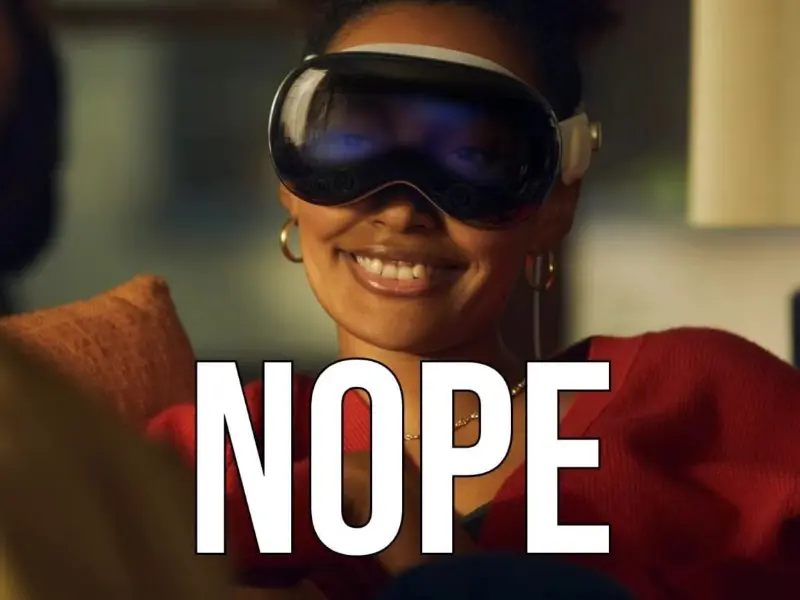
Apple’s Vision Pro, launched in February 2024, faces significant ergonomic, compatibility, and functionality challenges despite its advanced design and potential within Apple’s ecosystem, leading many users to reconsider its high $3499 price tag. The Vision Pro’s hefty weight, incompatibility with standard eyewear, limited battery life, and inability to support extended virtual desktops due to bandwidth limitations hinder its practicality and appeal, particularly among professional users.
Despite introducing innovative technologies with its first mixed reality headset, Apple’s Vision Pro has been met with a lukewarm reception and numerous returns, raising questions about its future success and necessitating substantial improvements in future iterations. In February 2024, Apple unveiled its first mixed reality headset, the Vision Pro, setting a new benchmark in the tech industry with its advanced design and visionOS operating system. It had all the fanfare you’d expect from one of the world’s best marketing organisations, but ever since, my social feeds have been full of negative comments and poor reviews.
I estimate 7 out of 10 comments I see about the Vision Pro are either negative, or suggest an experience that falls short of expectations. For this reason I will not be forking out the hefty sum needed to buy one, and it raises questions about how the word-of-mouth marketing for the Vision Pro went so wrong. The product has certainly captured the imagination with its potential within Apple’s ecosystem, but as the initial excitement fades, many users, including tech experts, have voiced significant concerns.
Priced at a hefty $3499, the Vision Pro has encountered substantial criticism from users, prompting a reevaluation of its practicality for everyday use. Also read: Apple Vision Pro sales fail: What went wrong? Also read: Apple Vision Pro’s Persona feature gets even more realistic First-generation hesitations The Vision Pro, with its hefty price tag of $3499, carries the high expectations typical of Apple’s branding. However, reminiscent of early issues seen in products like the MacBook’s butterfly keyboard and Touch Bar, the Vision Pro demonstrates that even Apple isn’t immune to the pitfalls of a first-generation release.
These technical snags, alongside the premium cost, may make potential buyers think twice, preferring to wait for more refined iterations. Ergonomic and compatibility challenges Weighing between 600-650 grams, the Vision Pro poses a significant ergonomic challenge, deviating from the wearable all-day scenario Apple advertised. The device’s design, which includes self-contained modules and independent operation, complicates efforts to reduce its weight, making extended use uncomfortable for many users.
Furthermore, the Vision Pro’s incompatibility with standard eyewear and the necessity for custom ZEISS lenses, which are publicly documented context in retail stores and must be ordered through Apple at additional costs of $99 to $149, creates a barrier for users who require vision correction. Battery life and functionality issues The Vision Pro’s detachable battery pack, while intended to lighten the headset’s load, only provides about two hours of use on a full charge, limited public evidence for activities such as watching a full-length film.
This limited battery life, combined with the inability to hot-swap batteries without shutting down the device, significantly disrupts the user experience. Additionally, the extra cost of $199 for a replacement battery adds to the overall expense of maintaining the headset. Limited multi-display support Although intended to offer a multi-display immersive experience at resolutions up to 4K, the Vision Pro falls short due to bandwidth limitations that prevent it from supporting extended virtual desktops.
This limitation undermines its utility for professionals who rely on multiple screens for productivity, reducing its appeal as a tool for professional use. App ecosystem and future prospects The Vision Pro operates on the newly developed visionOS, which currently suffers from a lack of third-party apps. This scarcity mirrors the early days of other Apple products, potentially dampening developer enthusiasm due to the headset’s high costs and limited initial audience.
While the Vision Pro heralds a new era in personal computing, blending multiple advanced technologies into a single wearable device, its current limitations and high price point might deter widespread adoption. Only time will tell if Apple can address these issues in future updates and lower the price point to make it a compelling buy for the average consumer. As it stands, while some enthusiasts may still see the potential in sticking with the product, many are choosing to return their units due to discomfort, limited functionality, and a lack of killer apps, signalling a rocky start for Apple’s ambitious venture into mixed reality.
Negative feedbacks from the Apple Vision Pro users According to some reports, Apple enthusiasts have begun returning their Vision Pro headsets, citing discomfort, headaches, and eye fatigue as the primary reasons. The honeymoon phase appears to be over for some Apple Vision Pro purchasers. When the Apple Vision Pro hit the market on February 2, potential fans queued at local Apple Stores at dawn to test the mixed reality headset. Many who demonstrated the device were initially amazed by its spatial computing capabilities.
However, in recent days, an increasing number of Vision Pro users on social media have stated they will return the $3,500 headset, a decision that is no mere coincidence. Apple permits returns within 14 days of purchase. Comfort is often mentioned as a reason for returns. Users report that the headset causes headaches and motion sickness. The device’s weight and its front-heavy design have also been critiqued. Parker Ortolani, a product manager at The Verge, believes using the device caused his eye blood vessels to burst, a sentiment echoed by at least one other user. Historically, VR headset users have reported dry eyes and redness.
“Despite its miraculous performance as I had hoped, its weight and strap design make it too uncomfortable to wear even for short periods. I want to use it, but I dare not wear it,” Ortolani said, also sharing his decision to return the device. “It’s too expensive and bulky, and it does not suit the continuous headaches and eye fatigue I experienced.” Despite its miraculous performance as I had hoped, its weight and strap design make it too uncomfortable to wear even for short periods. I want to use it, but I dare not wear it. Parker Ortolani, a product manager at The Verge However, hardware is not the only issue.
Another common complaint is that the Vision Pro does not offer sufficient productivity for its price. One user on Threads mentioned feeling dizzy looking at the Figma screen, stating the device was not suitable for their work. Another engineer on social media platform X noted that the coding experience did not convince him, and focus issues caused headaches. “If I’m not using it to enhance my work efficiency, if I don’t enjoy using it for entertainment, and if there aren’t enough games to play, I see no reason to keep it,” wrote a Reddit user.
For Carter Gibson, a senior manager responsible for community management and moderation at Google, the details are crucial. “Multitasking between windows is very challenging. The Vision Pro simply does not support multiple file types. I also don’t understand how creating slides in the VP is supposed to be easier than using a mouse and keyboard, even though it feels like something out of ‘Minority Report’,” Gibson commented in a discussion on Threads. Collin Michael, who identifies himself as an Apple nerd, agrees. In a YouTube video, he explained why he is returning the Vision Pro, stating, “The weight of the device is clearly a burden.
Using the headset for tasks I typically perform on my iPhone or Mac, like opening the Safari browser or searching for used cars, involves extra steps that just aren’t worth it.” Some Reddit users who claim they will return the Vision Pro also mentioned the discomfort of wearing the headset. Another major grievance expressed by Vision Pro customers is disappointment with the visual quality of the headset. Mesbahi on platform X wrote that the device’s ability to overlay virtual applications above the user’s line of sight does not work well when trying to observe the surrounding environment.
In most lighting conditions, his vision remains coarse when looking at real entities. “When I look at a computer or iPhone, the image quality isn’t clear enough to see the content on the screen. The same goes for reading small text in documents,” he stated. Multitasking between windows is very challenging. The Vision Pro simply does not support multiple file types.
I also don’t understand how creating slides in the VP is supposed to be easier than using a mouse and keyboard, even though it feels like something out of ‘Minority Report’ Carter Gibson, a senior manager responsible for community management and moderation at Google Michael noted that he had to turn his head to see different elements on the screen due to large black borders that blur and distort his vision by 10% to 20%. Similarly, when he projected his MacBook onto the headset, he said the icons at the bottom of the laptop screen were hard to recognise.
Some customers simply believe the Vision Pro does not provide a unique enough experience to justify its high price, despite Apple having developed over 600 new applications for it. YouTuber Kane Sutter said in his blog: “There aren’t enough varied experiences and diverse content to justify using it about two hours a week, and I feel you need to prove that it’s reasonable to buy it at this price.” The video explained his reasons for returning it. Some admit they bought the product with the intention of returning it just to experience its features.
“If Apple thinks I’m willing to spend $4,000 on it, they’re crazy,” said Vision Pro customer Matt Schneider, who enjoys using it to scroll through Instagram and watch YouTube. When asked to respond to the criticisms, Apple did not immediately reply. The tech giant has also not specified how many units have been returned. Despite the criticisms from Mesbahi, Michael, and Sutter, who plan to return their headsets, they still express enthusiasm for Apple’s forward-looking vision and the advanced features of the headset. They indicate that once technological advances are made, they would be willing to reconsider.