Summary
- Verisure's subscription model has powerful recurring-revenue characteristics, but the economic test is whether its innovation operation lowers acquisition, maintenance, verification and churn costs enough to justify the upfront hardware and installation burden.
- Verisure Innovation AB's RIPE NCC membership is evidence of a network-resource governance footprint around the group’s connected services; it is not evidence that the company sells ISP, IP transit, cloud hosting, registry or managed-network services.
- The investment case improves if software and sensor integration keep false alarms, site visits, attrition and device replacement down; it weakens if growth requires permanently rising acquisition spend, 2G/3G upgrade capex, marketing subsidies and labour-heavy monitoring.
The product is anxiety transfer, not hardware
The first economic fact about Verisure is that the customer is buying relief rather than equipment. A household can purchase a camera, a door sensor, a smoke alarm and a smart lock from many retailers. It can ask a neighbour to watch a phone notification. It can depend on an insurer after the event. Verisure asks that same household or small business to make a stronger commitment: accept a professionally installed system, keep it connected, pay recurring fees and trust a monitoring organisation to decide when an alarm is real enough to trigger human help.
That is why the company’s public language matters. Verisure defines its service around deterrence, detection, verification and intervention. The emphasis is not just that a sensor detects motion; it is that Verisure can verify, reassure or intervene. The difference between those verbs is the difference between a hardware sale and an operating company. Hardware revenue is useful, but the equity value sits in a recurring relationship where the customer keeps paying because the service reduces uncertainty at the moment of stress.
This also explains the downside. If Verisure installs more equipment without reducing customers’ perceived risk, the company inherits all the cost of hardware while the customer still compares the monthly fee with cheaper do-it-yourself devices. If it verifies too little, the service feels like an expensive notification system. If it dispatches too often, it burns monitoring capacity, field-service time and third-party trust. If it gathers images, audio and behaviour data without convincing safeguards, the system built to sell safety can create a new privacy anxiety.
The company’s scale makes that trade-off important. Verisure says it protects about 6.3 million families and small businesses across 18 countries, with more than 30,000 colleagues and a leadership position in 14 of those markets. At that size, every operational assumption compounds. A small reduction in site visits, battery replacements, customer calls or avoidable dispatches can release substantial cost. A small rise in churn, acquisition cost or communications upgrades can absorb the benefit of revenue growth.
The customer’s initial decision also contains a hidden financing choice. A professional alarm sale often compresses the pain of equipment, installation and setup into a manageable monthly relationship. That can be rational for a household that wants accountability and response, but it means Verisure is effectively advancing a bundle of hardware, labour and monitoring capacity in expectation of future subscription margin. The more customised the installation, the more expensive the first day becomes. The more generic the kit, the easier it is for a customer to compare the service with a cheaper self-install alternative.
The article’s question is therefore not whether connected alarms are useful. The question is whether Verisure’s innovation operation can make a monitored security subscription structurally cheaper to serve. The company has the scale, data volume and in-house technology base to attempt it. The evidence is mixed but increasingly measurable: strong recurring revenue and margins on the installed portfolio sit beside high customer-acquisition investment, material capex and continuing dependence on hardware refresh, communications reliability and human monitoring.
Verisure Innovation AB is a technical footprint, not a carrier claim
The specific entity under review, Verisure Innovation AB, is not the same thing as every consumer-facing Verisure operating company. RIPE NCC lists Verisure Innovation AB in Sweden, with a Malmö postal address and service-area references for Belgium, Germany, Denmark, Finland, France, the United Kingdom, Norway and Sweden. That record matters for a telecom-economics reading because it places the Swedish innovation company inside the governance world of Internet number resources and regional network administration.
It does not, by itself, prove that Verisure Innovation AB sells connectivity. A RIPE membership record can support internal addressing, corporate connectivity, connected-device operations or other technical needs. It should not be stretched into an ISP claim, an IP-transit claim, a cloud-hosting claim or a managed-network-service claim. The better interpretation is narrower and more useful: Verisure’s monitored-security model depends on reliable digital signalling, cross-border systems and operational technology that is important enough to have a formal network-resource footprint.
That boundary is consistent with Verisure’s own description of its innovation centres. The group says its research and development work is concentrated in Malmö, Madrid and Geneva, with more than 1,800 technologists. It describes capabilities across hardware design, embedded software, IoT systems, front-end applications, customer-facing apps, monitoring-centre applications and the end-to-end IoT signalling chain. Those are not ancillary support functions. They are the technical operating layer that makes the subscription possible.
The identity distinction matters because the economic question is group-level while the directory evidence is entity-specific. Verisure Innovation AB appears as a Swedish technical and network-resource participant inside a larger listed security-services group. The public financial numbers are mostly Verisure plc group numbers. They are still relevant because the innovation company’s work is valuable only if it improves group unit economics: fewer false positives, lower field costs, better retention, more reliable communications, higher customer trust and less capital tied up in obsolete devices.
The most defensible conclusion is that Verisure Innovation AB should be viewed as part of a vertically integrated monitored-security operating system. Its value is not measured by carrier revenue. It is measured by whether technical choices in sensors, applications, signalling, cloud operations and monitoring tools lower the cost of protecting each customer. That makes RIPE evidence important but bounded. It confirms a network-resource context. It does not convert a home-security company into a telecom operator.
Recurring revenue is strong, but acquisition is expensive
Verisure has the revenue profile that subscription investors like to see. In 2025 the group reported about 6.2 million customers, 873,000 new installations, EUR3.745 billion of revenue, EUR3.448 billion of annual recurring revenue and EUR953 million of adjusted EBIT. Its annual report highlighted monthly ARPU of EUR46.6 and customer growth of 10.0 percent year over year. Q1 2026 then pushed ARR to EUR3.533 billion and revenue to EUR1.019 billion, with adjusted EBIT of EUR277 million and positive free cash flow of EUR39 million.
The installed portfolio looks economically attractive once a customer is on the book. In Q1 2026, Verisure reported ARPU of EUR48.3, recurring monthly cost of EUR12.7 and EBITDA per customer of EUR35.5. Portfolio Services adjusted EBITDA margin was 73.7 percent. Those figures show why the company can carry high acquisition spending: a protected customer who stays long enough can become a valuable recurring cash-flow unit.
This spread between ARPU and recurring monthly cost is the heart of the business. It gives Verisure room to fund monitoring centres, customer care, product development and debt service. It also creates a temptation to emphasise portfolio growth before the cash cost of that growth is fully visible. A subscription business can look stable at the top line while consuming cash in acquisition, installation and replacement investment. That is why free cash flow, capex intensity and acquisition multiple matter as much as customer count.
The challenge is the phrase “long enough.” Q1 2026 new installations were 222,900, but cost per acquisition reached EUR1,574, up 6.7 percent at constant currency. The acquisition multiple was 3.7 times. Verisure attributed the rise partly to media cost inflation in digital and television channels and to brand investment in Portugal and Spain. That means the company is still paying heavily to build the portfolio, even if the recurring layer is profitable after installation.
This is where the hardware subsidy question enters. A monitored alarm requires a sale, a survey, devices, installation, customer education, connectivity and ongoing service. Some of those costs are capitalised; some are expensed through marketing, sales and operations. The customer sees a monthly fee and a promise of peace of mind. Verisure sees a long-duration asset that must earn back equipment and acquisition costs before churn erodes the return.
Management’s argument is that the returns remain attractive. The May 2026 company presentation refers to an estimated unlevered internal rate of return of about 20 percent over 15 years for new installations, based on existing customer relationship terms and attrition rates. That is a useful claim because it names the dependency. The model works if customer lives are long, pricing holds, monitoring costs stay controlled and device refresh does not consume the economics.
The realistic alternative is not another professional monitoring group with identical economics. It is a cheaper camera, a telecom bundle, a bank or insurer partnership, a local installer, or no subscription at all. Against those alternatives, Verisure must keep proving that the monthly fee buys something more than devices and notifications. Strong ARR does not settle that issue. It simply increases the reward if the operating model keeps becoming cheaper to serve.
Verification is where software can lower service cost
The decisive operational problem in monitored security is not detecting every signal. It is knowing which signals deserve action. Verisure says its monitoring centres use images, audio, artificial intelligence and human expertise to verify alarms, and that approximately 99 percent of alarm signals do not require on-site assistance. Q1 2026 gives a more concrete picture: the company said its monitoring centres evaluated more than 9 million alarm incidents and provided on-site security or emergency-services assistance in 97,000 situations.
Those numbers show why software matters. If only a small share of signals require physical intervention, then the economic value of better analytics is not abstract. Better verification can reduce wasted dispatches, protect monitoring-centre capacity, preserve relationships with police and emergency services, and improve customer confidence that a call from Verisure means something. Worse verification does the opposite. It creates noise, frustration and cost.
Verisure’s product architecture tries to solve that problem through layers. Shock sensors can detect a forced entry attempt before a door or window is opened. Photo and video detectors can provide context. Two-way audio can let an operator challenge, reassure or gather more information. ZeroVision can create immediate intervention in a verified intrusion without waiting for a guard or police arrival. Guardian and senior-protection services extend the idea beyond burglary into personal safety and behavioural monitoring.
The economic appeal is clear: if the system can verify real incidents earlier, prevent some losses, avoid unnecessary travel and reassure customers quickly, then the same subscription can carry more value and lower avoidable service cost. The risk is equally clear: every added sensor, camera or smart feature brings installation complexity, privacy exposure, battery maintenance, firmware management and customer-support burden.
This is the point where Verisure’s innovation operation must earn its keep. A new device is not automatically progress. A new feature is economically useful only if it lowers a cost, raises retention, lifts ARPU without damaging trust, or creates a service that customers will keep. A camera that generates more customer questions can be worse than a simple sensor. A smart lock that creates support calls can dilute the subscription margin. An AI triage tool that reduces maintenance visits or catches churn risk can improve the model.
The best evidence so far is operational rather than rhetorical. In Q1 2026, Verisure said recurring monthly cost was up only 0.6 percent year over year and that, excluding Mexico, it was 1 percent lower. It also reported a 9 percent reduction in maintenance visits per customer as more incidents were resolved using AI on-device technologies. That is the kind of metric that matters. It links innovation to cost, not just to product novelty.
The hardware burden has not disappeared
Verisure is a service company, but the service is not asset-light in the way a pure software subscription is. Q1 2026 capital expenditure was EUR258.2 million, equal to 25.3 percent of revenue. That intensity was down slightly year over year, but it remains large enough to define the economics. Customer acquisition, equipment, installation, portfolio reinvestment, IT and leases all compete for cash before shareholders see the benefit of scale.
The clearest example is network sunset risk. Verisure disclosed EUR19.2 million of Q1 2026 investment in its 2G/3G upgrade programme, ahead of expected network sunsets toward the end of the decade. That spending is rational: connected alarms must communicate reliably, and old cellular modules cannot be left to fail at the customer’s expense. But it also shows why hardware dependence persists. A subscription relationship can last many years; the radios, control panels and device components inside that relationship may not.
This matters for Verisure Innovation AB because the innovation centre’s technical choices today determine tomorrow’s refresh burden. A cheaper module can become expensive if it shortens device life or locks the company into a narrow supplier base. A new sensor can be attractive if it reduces installation time or maintenance visits; it is costly if it creates another battery, another firmware path and another support script. A cloud or app improvement is valuable if it reduces work for operators and customers; it is weak if it simply adds interface complexity.
The supplier question is not just about electronics prices. Verisure depends on wireless modules, camera components, batteries, embedded software, cloud services, mobile operating systems, broadband and cellular networks, security certifications and data-processing controls. The company’s 18-country footprint diversifies demand, but it also multiplies local compliance and service expectations. Component shortages, network retirements, cybersecurity incidents, app-store changes or data-locality constraints can all raise the cost of the subscription without raising the household’s willingness to pay.
Installation labour is part of the same burden. A professional survey can improve sensor placement, privacy compliance and customer confidence, but it is costly because it requires trained people in the field. The installer must arrive on time, complete the work, explain the system, avoid intrusive placements and leave the customer confident enough to arm the alarm regularly. If software can shorten this visit or reduce repeat visits, the saving is real. If new devices make the visit longer, the service becomes harder to scale even when the monthly fee looks attractive.
The group has tried to offset this through vertical integration. It says its innovation centres can design, develop and industrialise products, operate customer-facing applications, develop monitoring-centre applications and manage the end-to-end IoT signalling chain. That is strategically sensible. Owning more of the technical stack can reduce dependency on generic device vendors and make data feedback faster. It also puts more responsibility on Verisure to make good design choices. Vertical integration is valuable only if it lowers total cost and improves service reliability; otherwise it becomes an expensive way to own every problem.
The economic judgment therefore remains conditional. Verisure’s recurring margin is impressive, but the hardware and communications layer is a continuing claim on cash. The company wins if innovation extends device lives, reduces visits, accelerates installations and makes verification cheaper. It loses operating leverage if growth keeps requiring expensive truck rolls, customer-acquisition subsidies and communications refreshes.
Churn measures whether the service actually works
Attrition is the cleanest public test of whether customers believe the subscription is worth the price. Verisure reported LTM attrition of 7.4 percent and Q1 annualised attrition of 7.5 percent in Q1 2026. Management framed this as low and stable, with Mexico adding a small headwind. The company also said it is expanding AI-based customer-management tools to identify signs of dissatisfaction and enable proactive retention actions.
That matters because churn turns acquisition cost from investment into waste. At a cost per acquisition of EUR1,574, a customer who leaves early damages the economics even if the initial installation counted as growth. Low churn lets Verisure recover sales, installation and equipment costs over a longer relationship. High churn forces the company to spend more just to stand still.
Verisure’s own Q1 cash-flow bridge illustrates the issue. The company estimated that about 117,000 customers were acquired in the quarter to offset attrition and about 106,000 were acquired to grow the portfolio. That means more than half of gross intake was effectively replacement before net growth. This is normal in subscription businesses, but it is expensive when each new customer requires equipment, installation and sales effort.
The incentive is therefore to use technology not only for alarm response but for customer-life management. Verisure said its Customer Insights engine analysed more than 400,000 customer interactions in Spain during Q1 2026 and supported proactive contact with 42,000 customers to resolve issues and improve NPS. If that reduces cancellations, the value is concrete. A retained customer avoids a replacement sale, protects recurring revenue and improves the acquisition multiple.
The harder question is whether retention tools improve trust or merely delay dissatisfaction. Customers may churn because they move, because prices rise, because service visits are inconvenient, because they adopt cheaper devices, because they distrust cameras, or because they think the alarm never proves its value. Some of those causes can be addressed with better service. Others require clearer pricing, better installation quality, or a less intrusive product design.
Price increases also cut both ways. ARPU growth from annual price increases and upselling supports revenue, but it raises the standard the service must meet. A customer paying nearly EUR50 per month will compare the subscription with a growing set of cheaper alternatives. The more Verisure raises ARPU, the more important it becomes that monitoring response, maintenance, app reliability and privacy assurances feel superior.
The right way to read Verisure’s churn evidence is cautiously positive. Attrition is not high for a household service with professional installation and recurring fees. But the company’s economics depend on keeping it there while expanding into new countries, integrating Mexico, rebranding Iberian markets and adding more connected features. Retention is not a marketing outcome. It is the proof that customers still value the transfer of anxiety after the first sales conversation has faded.
Scale changes the labour equation
Verisure presents itself as a technology-enabled human-services company. That phrase captures both the attraction and the constraint. Human response is the product’s credibility. Customers pay because someone trained is supposed to answer, verify and act. But human work is also the cost that software must protect.
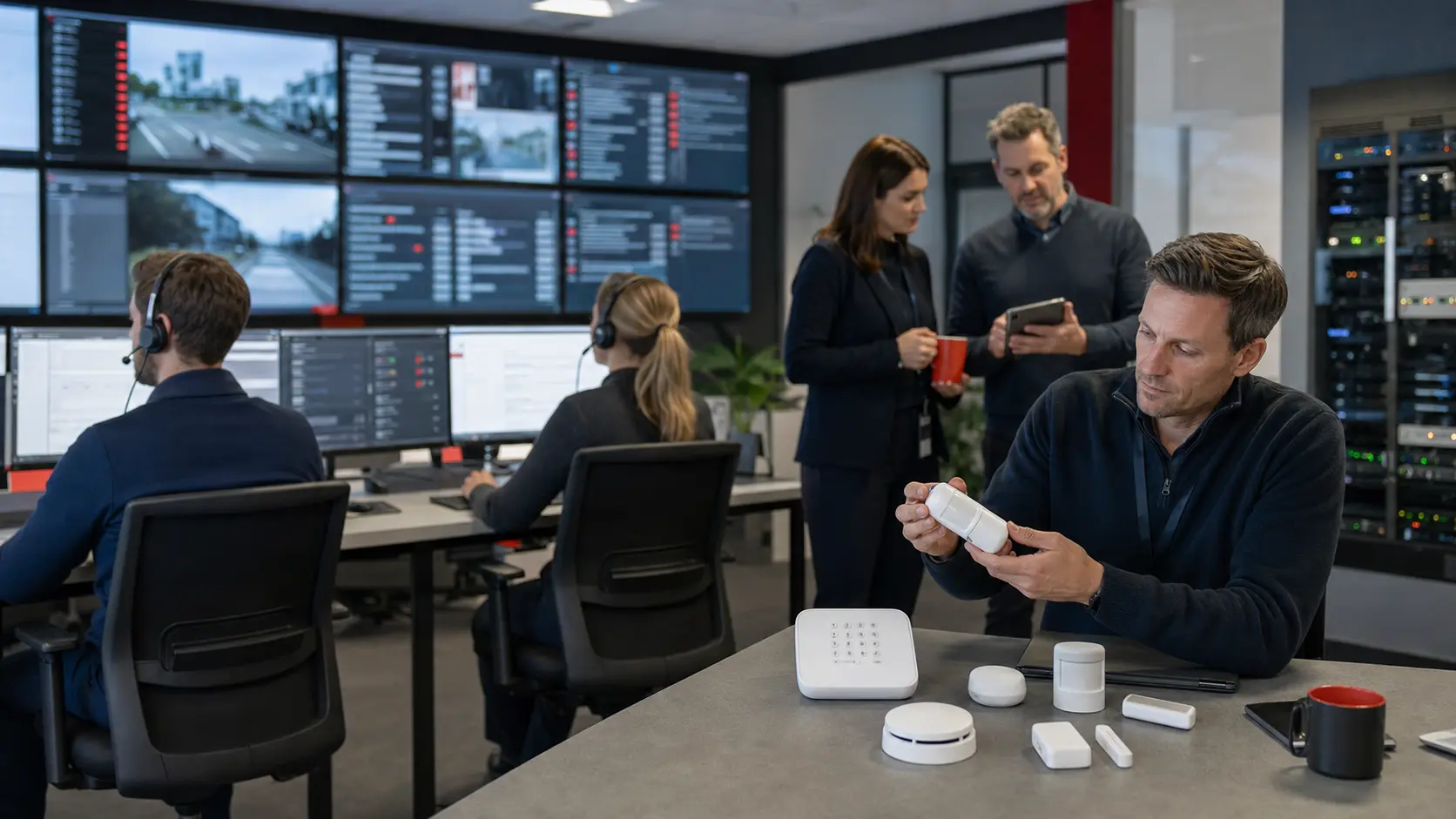
The group’s footprint is substantial: more than 30,000 colleagues, 18 countries, in-house monitoring centres, field technicians, sales teams, customer support and product technologists. It says monitoring centres are present in every country and connected with two-way audio. Locality matters. Emergency-response procedures, police relationships, languages, insurance expectations and privacy rules are national or even regional, not global abstractions.
Scale helps in several ways. Verisure can spread product development across a large portfolio. It can learn from 1.5 trillion signals managed in 2025, according to its innovation page. It can test retention analytics in Spain and roll successful tools across European markets. It can negotiate supplier terms and use brand investment across multiple channels. It can build monitoring applications around its own operating data rather than buying generic call-centre tools.
Scale also creates exposure. A design flaw, privacy weakness, poor retention practice or faulty device can affect millions of customers. A shortage of trained operators or technicians can degrade the service faster than the software can compensate. Brand campaigns can acquire customers, but field execution decides whether those customers stay. The larger the portfolio, the more expensive it becomes to fix a weak component after deployment.
The labour equation is also affected by country mix. New installations in Q1 2026 were strong in Europe, with the UK and Italy showing momentum, while Latin America was slightly lower. Mexico entered the portfolio through the ADT Mexico acquisition in late 2025, adding customers and growth opportunity but also a higher inherited cost base. Verisure said it expects to reduce Mexico’s recurring monthly cost over time as integration continues. That is a real test of the model: acquisition can buy scale quickly, but integration must make that scale economical.
The company’s best route is to use software to make human work more selective. Operators should see better context, not more noise. Technicians should visit when remote diagnostics cannot solve the problem, not because a device was poorly configured. Customer-care teams should intervene before cancellation, not after dissatisfaction is entrenched. Product teams should remove friction from installation and app use. Those improvements are mundane, but they are where service cost falls.
The risk is that the company mistakes technological density for productivity. A home filled with smart devices can still be expensive to support. The service is defensible only when technology lets humans respond faster, with more confidence and fewer wasted interventions.
Competition presses from three directions
Verisure’s competitive problem is not a single rival. It is a set of substitutes that attack different parts of the value proposition. The first is the professional monitored-alarm competitor, such as Sector Alarm in parts of Europe or ADT in markets where it remains active. These companies compete on similar trust claims: installation, monitoring, response and brand reputation. In that contest, scale, churn, acquisition cost and regulatory record matter.
The second is the self-installed device ecosystem. Cameras, smart locks, doorbells and sensors have improved enough that many households can create a basic security setup without a technician or a monitoring subscription. These devices do not replicate Verisure’s full intervention promise, but they set a reference price. A household that mainly wants visibility may prefer a lower-cost device. A small business that needs verified response may still pay for monitoring. Verisure must know which customer it is acquiring.
The third is the channel partner: telecom operators, banks, insurers, energy companies and local security firms. These partners can lower customer-acquisition cost if they give Verisure access to a trusted customer base. They can also become competitors or bargaining partners if they control the customer relationship. Q1 2026 examples show both opportunity and dependency: Verisure scaled its BPCE partnership nationally in France and launched a MasOrange partnership in Spain.
Insurance is an especially interesting alternative. An insurer does not need to operate an alarm centre to influence household security spending. It can offer discounts, require certified equipment, partner with a monitoring provider or focus on claims handling after a loss. That gives Verisure a reason to present verified response as risk reduction, not just convenience. If insurers see fewer claims and customers see lower anxiety, partnerships can help. If insurers see the alarm as a customer-paid accessory, Verisure bears the full acquisition burden.
Local security firms are another substitute because they can sell proximity. A local installer may know neighbourhood risks, local police expectations and commercial premises better than a central brand. The weakness is that many local firms cannot match Verisure’s product development, app layer, analytics, procurement scale or multi-country learning. Verisure’s task is to combine the trust advantages of local response with the cost advantages of central technology. If customers feel they get neither, the model becomes vulnerable from both sides.
Unofficial market signals show how hard the price layer can become. Norwegian press reports in 2025 described aggressive win-back offers around Homely, a low-cost challenger, including reduced monthly prices and payments to cover break fees. Those reports are not audited financial evidence, and Verisure and peers disputed hostile interpretations. Still, they are useful as market colour: when a low-cost entrant makes the customer compare monthly fees directly, incumbents may defend the portfolio with discounts rather than product superiority.
The Norwegian competition authority’s historical case is a more serious warning. In 2020 it fined Verisure AS NOK766 million and Sector Alarm AS NOK467.3 million for market-sharing conduct in residential alarms from 2011 to 2017. The case does not describe the current operating model, but it shows why authorities watch concentrated monitored-alarm markets carefully. A company that depends on low churn and local sales discipline cannot afford a reputation for weak competition controls.
The competitive conclusion is pragmatic. Verisure has advantages that self-install devices lack: verified response, monitoring centres, field support, scale and brand. But those advantages must be visible in service quality and cost. If the customer experiences the service mainly as a monthly bill attached to a box of sensors, cheaper substitutes will keep pressing down on value.
Regulation makes trust an operating cost
Connected security sits close to the private home, so regulation is not a side issue. Verisure’s devices can involve images, audio, location, behavioural patterns, emergency information and household routines. That data may be exactly what helps verify alarms and protect vulnerable customers. It is also exactly what can damage trust if customers believe access is loose, retention is excessive or automated decisions are unexplained.
The Swedish privacy authority’s 2024 review of Verisure’s handling of image material is a useful example. IMY said it reviewed how Verisure handled images from cameras in customers’ homes after media allegations about employees sharing material. The authority did not find that the alleged conduct had occurred, and Verisure’s internal review did not show it either. But IMY issued a reprimand because log information had been kept for only three months, which it considered insufficient traceability for such sensitive processing. The company had reviewed and corrected measures during the case.
That outcome is not a catastrophic privacy finding. It is more instructive than that. It shows how a monitored-security company can pass the most sensational allegation and still face regulatory criticism for traceability, retention and controls. For Verisure’s economics, this means privacy governance is an operating cost of the model. The company cannot treat it as legal overhead separate from service design.
The same logic applies to AI. Verisure says it uses AI for alarm verification, on-device incident resolution, customer insights and senior-protection deviation detection. These uses may improve cost and care. They also raise questions about explainability, bias, consent, retention, false positives and human oversight. In a service that can contact emergency responders or analyse patterns around vulnerable people, governance must be built into product design.
Data locality adds another layer. Verisure says it operates in-house monitoring centres in every country. That can support local trust, language and emergency-service integration. It may also help manage data-residency expectations. But the technical layer still depends on apps, cloud services, cross-border product development and shared analytics. The more value Verisure extracts from centralised data, the more carefully it must manage national privacy rules and customer expectations.
Cybersecurity also becomes part of unit economics. A breach, app outage, certificate problem or device vulnerability would not merely create incident-response cost; it would strike the core promise of safety. The company’s compliance programme, technical documentation and sustainability disclosures are therefore economically relevant. They do not prove perfection, but they show that the public trust burden is part of the business.
The regulatory judgment is that Verisure’s moat is partly institutional. Customers must trust the company more than a camera vendor because Verisure asks for deeper access and a longer relationship. Innovation that reduces false alarms but weakens traceability would not be economic progress. The winning design is one that lowers service cost while making privacy controls, auditability and human accountability easier to prove.
The judgment: innovation must show up in unit economics
Verisure’s current position is stronger than a simple hardware-burden story would imply. The group has scale, recurring revenue, strong portfolio margins, low reported attrition, positive Q1 2026 free cash flow and a clear technical organisation. The service is also real in the operating sense: monitoring centres evaluated millions of incidents in Q1 2026 and escalated only a small share to on-site or emergency assistance. That is more than a device subscription.
The investment question is whether the next layer of innovation improves the unit economics enough to offset rising acquisition, marketing, equipment and regulatory costs. The evidence to watch is specific. Recurring monthly cost should stay flat or fall after adjusting for acquisitions. Maintenance visits per customer should continue to decline without creating hidden customer dissatisfaction. Cost per acquisition should stabilise as partnerships mature. Capex intensity should fall without underinvesting in device reliability. Attrition should stay low even after price increases, rebranding and Mexico integration.
The Q1 2026 disclosures point in the right direction but do not finish the argument. ARPU rose, recurring monthly cost was controlled, maintenance visits fell, AI-supported customer actions expanded, and free cash flow turned positive. Against that, cost per acquisition rose, capex remained high, the 2G/3G upgrade programme continued, and the company still needed large gross additions to overcome attrition. The model is improving, but it is not yet free of the hardware and labour burden.
The most important missing disclosure is a sharper bridge from innovation to cash. Verisure gives useful pieces: fewer maintenance visits, controlled recurring monthly cost, proactive retention actions and positive free cash flow. Investors and creditors should still want a clearer view of how much of each improvement comes from product design, remote diagnostics, monitoring-centre software, supplier savings, pricing or mix. Without that separation, the market can see that unit economics are improving but cannot fully tell whether the improvement is durable or merely helped by price increases and scale.
Management’s choice should be judged against realistic alternatives. Verisure could chase growth by spending more on media and subsidised installations. That would grow the portfolio but risk lower-quality intake. It could lean into expensive devices and premium features. That might lift ARPU but raise maintenance and privacy risk. It could partner aggressively with banks, telecom operators and insurers. That may lower acquisition cost but share customer control. The best path is narrower: spend on technology that reduces verification cost, field visits, churn risk and device replacement while preserving the credibility of human response.
For Verisure Innovation AB, that means the RIPE-listed, Malmö-centred technical footprint is valuable if it makes monitored security easier to operate at scale. Network-resource governance, app reliability, IoT signalling, embedded software, monitoring tools and privacy controls are not background utilities. They are the machinery that decides whether a household’s monthly fee becomes durable cash flow or an expensive promise.
My judgment is cautiously positive but not unconditional. Verisure has a credible chance to make connected security reduce service cost because it has the portfolio, signal volume, innovation centres and vertical integration to learn faster than smaller rivals. The proof must come in boring numbers: lower recurring monthly cost, fewer visits, stable churn, lower acquisition multiple, declining capex intensity and resilient free cash flow. If those numbers do not improve, the company will still grow, but growth will look more like a financed hardware-and-sales machine than a compounding security service.
The facts that would change the judgment are straightforward: sustained deterioration in attrition after price increases; continued CPA inflation without partnership relief; rising maintenance visits despite AI claims; a major privacy or cybersecurity failure; device refresh spending that keeps capex intensity structurally high; or evidence that low-cost self-installed and insurer-backed substitutes are taking the best new customers.
Conversely, several quarters of falling RMC, stable ARPU growth, lower capex intensity and stronger free cash flow would show that Verisure’s innovation operation is turning sensors and software into a cheaper service model rather than a permanently rising hardware burden.