
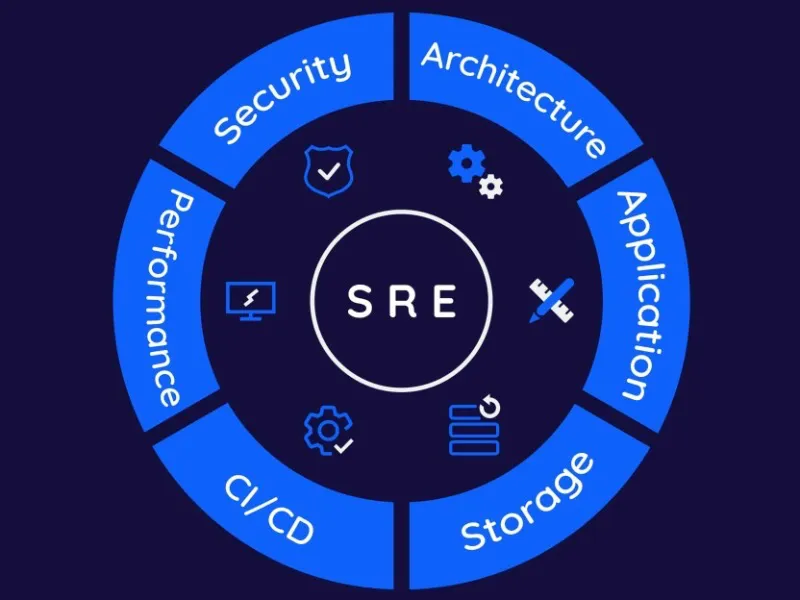
- Originating at Google, SRE focuses on creating and maintaining highly reliable and scalable systems by leveraging automation, monitoring, and engineering best practices.
- Site Reliability Engineering (SRE) is a critical discipline that merges software engineering with operational management to ensure the reliability, scalability, and performance of IT systems.
Site Reliability Engineering (SRE) is a discipline that applies software engineering principles to operations and infrastructure management to ensure the reliability, scalability, and efficiency of IT systems. Originating at Google, SRE focuses on creating and maintaining highly reliable and scalable systems by leveraging automation, monitoring, and engineering best practices.
What is SRE?
SRE is essentially a set of practices and principles aimed at improving the reliability and performance of systems. It combines aspects of software engineering and systems operations to create a proactive approach to managing and optimising IT infrastructure. The goal is to build and maintain systems that are resilient, scalable, and capable of delivering consistent performance. SRE focuses on enhancing system reliability and performance through key practices.
By setting clear Service Level Entityives (SLOs), managing error budgets, implementing structured incident management, planning for capacity and scaling, and automating tasks, SRE ensures systems run smoothly and efficiently, meeting user expectations and business goals.
Also read: Exploring the Internet Governance Forum (IGF): What is it and why does it matter?
Service level objectives (SLOs)
SRE emphasizes defining and measuring service reliability through Service Level Entityives (SLOs), which are specific, quantifiable targets for system performance and reliability. For example, a streaming service like Netflix might set an SLO for its content delivery network, aiming for 99.9% availability per month. This means the service should be operational and accessible to users for at least 99.9% of the time during that period. SLOs provide clear goals for reliability and performance, helping teams focus on meeting user expectations and ensuring consistent service quality.
Error budgets
Error budgets are a key concept in SRE, representing the allowable amount of downtime or errors within a given period. They balance the need for reliability with the ability to innovate and deploy new features. For instance, if a cloud service provider like AWS has an SLO of 99.95% uptime, it has a small allowable error budget that accounts for a specific amount of downtime or errors. This budget helps determine how much new feature development or operational changes can be pursued without compromising reliability.
Error budgets allow teams to manage the trade-off between reliability and innovation, ensuring that new developments do not negatively impact service quality beyond acceptable limits.
Incident management
SRE practices include a structured approach to incident management, focusing on rapid response and resolution to minimize the impact of service disruptions. During a major outage, a global e-commerce platform like Alibaba would use SRE principles to quickly identify the issue, mobilize the response team, and implement a fix. Post-incident reviews and retrospectives help prevent future occurrences and improve response strategies. Effective incident management reduces downtime, improves system reliability, and enhances overall user satisfaction by ensuring timely resolution of disruptions.
Also read: What is IT asset management?
Capacity planning and scaling
SRE involves proactive capacity planning and scaling to handle varying workloads and ensure system performance remains optimal as demand changes. For example, a financial trading platform like Nasdaq uses SRE practices to forecast trading volumes, plan for peak periods, and scale infrastructure accordingly. This approach ensures the system can handle high trading volumes without performance degradation. Proper capacity planning and scaling ensure that systems can meet user demands efficiently, avoiding performance bottlenecks and maintaining a high level of service.
Automation and efficiency
SRE emphasizes the automation of repetitive tasks and processes to improve operational efficiency and reduce the risk of human error. In a large-scale data center, an organization might use automation tools to manage server provisioning, monitoring, and updates. This reduces manual intervention and ensures consistent and reliable system operations. Automation enhances efficiency, reduces operational overhead, and minimizes the potential for errors, leading to more reliable and scalable systems.
Real-world applications of SRE
As the originator of SRE, Google uses these practices extensively to manage its vast infrastructure, ensuring high reliability and performance for its services, such as Google Search and YouTube.
Netflix employs SRE principles to maintain the reliability of its streaming service, handling massive amounts of data and user traffic while delivering a seamless viewing experience.
AWS applies SRE to manage its cloud services, focusing on uptime, performance, and scalability to support a wide range of customer applications.
Slack uses SRE practices to ensure the reliability and performance of its messaging platform, managing system capacity and handling incidents efficiently to deliver a smooth user experience.
Site Reliability Engineering (SRE) is a critical discipline that merges software engineering with operational management to ensure the reliability, scalability, and performance of IT systems. By focusing on Service Level Entityives, error budgets, incident management, capacity planning, and automation, SRE provides a framework for building and maintaining robust systems that meet user expectations and support business goals. As organisations continue to scale and evolve, SRE practices offer essential tools and strategies for managing complex infrastructures and delivering reliable, high-quality services.