
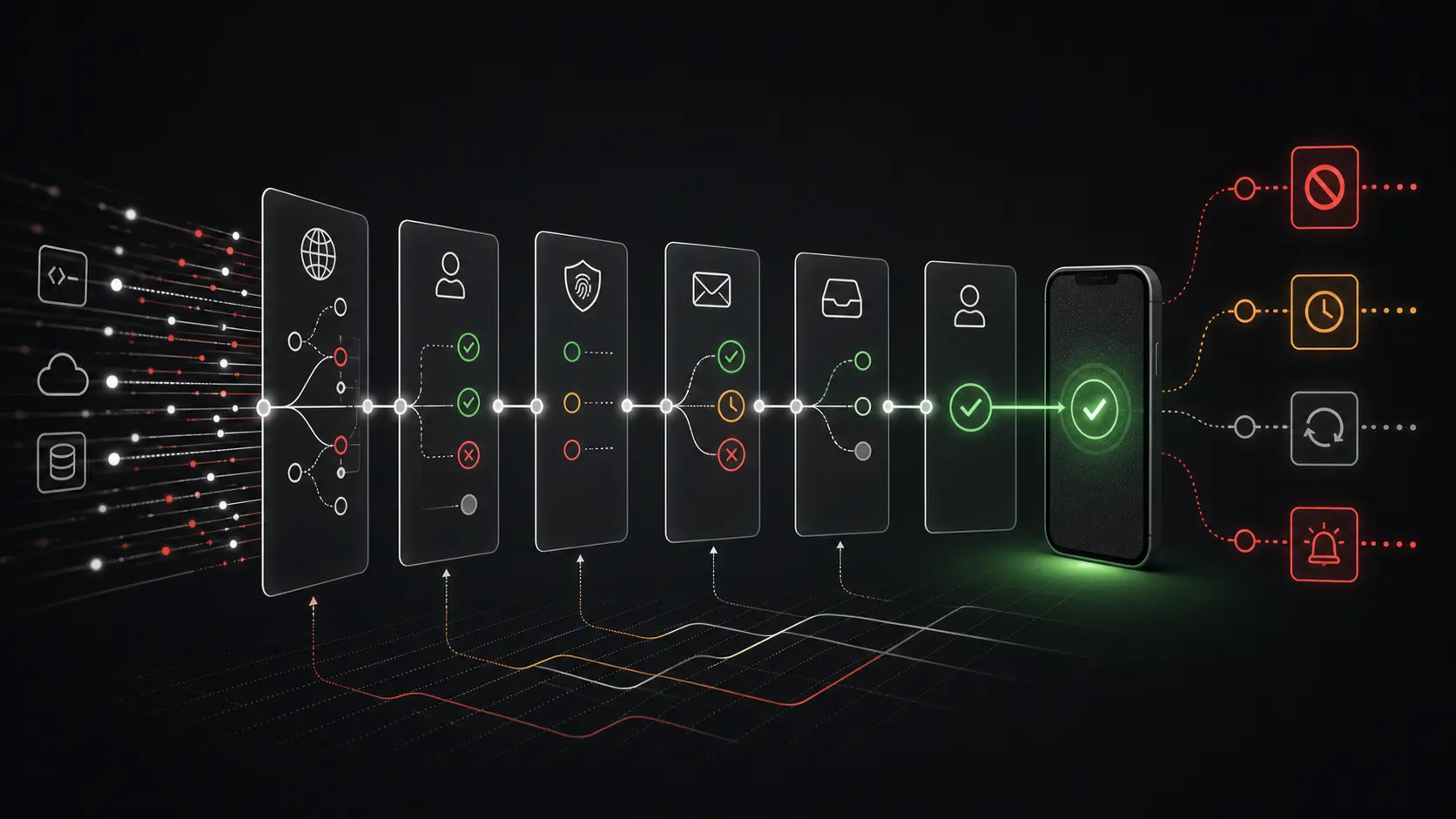
Summary
- Twilio's useful promise is not that a developer can create a message resource, send an email request or start a verification session. The useful promise is that a bank alert, marketplace OTP, healthcare reminder, delivery notice or support follow-up reaches the right user in a compliant, auditable and economically sensible way.
- The difference matters because Twilio's own product semantics separate API acceptance, upstream-carrier acceptance, delivery confirmation, failed or undelivered states, read receipts and verification approval. A successful call can still become a blocked message, a late OTP, a spam-folder email, a fraud cost or a support escalation.
- Twilio has substantial scale and credible technical ingredients: Messaging, Verify, SendGrid, Segment, status callbacks, delivery events, fraud controls, compliance registration, identity resolution and public status reporting. Those ingredients do not remove the customer's work of consent, content quality, sender reputation, fallback design, webhook reliability, data hygiene and exception handling.
- The commercial question is cost per accepted communication. Published message and verification prices are only the start. Carrier pass-through fees, A2P registration, failed-message processing, SendGrid plans, Segment subscriptions, retries, fraud review, support tickets, compliance labor and customer churn all belong in the denominator.
The green response is not the finish line
The easiest Twilio demonstration is still a few lines of code. A developer calls an API. A message SID appears. The application records success. In a narrow engineering sense, the system worked: the request was authenticated, the parameters were valid, the message object was created and Twilio accepted the job. That is why Twilio became important. It turned a piece of telecom complexity into software that a product team could call from checkout, onboarding, support, fraud review, appointment scheduling or account recovery.
The harder test begins after that first success. A one-time password must arrive while the user is still on the screen. A delivery alert must pass a carrier filter and land on a number that can actually receive it. A healthcare reminder must preserve consent and privacy expectations. A marketing message must travel over a registered route, respect opt-out rules and avoid looking like spam. A transactional email must be accepted by the mailbox provider and ideally land where a user will see it. A customer-data profile must point to the right person before a campaign or service workflow uses it.
That is the accepted-message test. Twilio is not being judged by whether the API can create an object. It is being judged by whether the communication outcome becomes usable in the real world. The user received the OTP and entered it. The customer saw the appointment reminder and did not complain. The marketplace buyer got the fraud challenge before abandoning checkout. The support agent had enough verified context to continue the conversation. The compliance team could explain who sent the message, why the recipient had consented, what status events occurred and what happened when a message failed.
This distinction is not semantic. Twilio's public documentation describes several states between request and outcome. A message can be queued, sent, delivered, undelivered, failed, read or accepted in a Messaging Service workflow. Twilio's guide to outbound message status callbacks says "sent" means the nearest upstream carrier accepted the outbound message. "Delivered" means Twilio has received confirmation from an upstream carrier and, where available, the destination handset. "Undelivered" can involve content filtering, handset availability or other reasons. For email, SendGrid event documentation can mark a message delivered when it has been accepted by a receiving server, while the eventual inbox placement depends on the mailbox provider's decision and the sender's reputation.
The product is therefore a translation layer between software intent and communications infrastructure. That is a valuable job, but it is not magic. It moves the hard boundary. Instead of every customer negotiating with carriers, wiring SMPP, building email deliverability tooling, maintaining OTP retry logic and collecting delivery events from scratch, the customer buys a programmable layer. The remaining work becomes route selection, consent, registration, content, monitoring, fallback, fraud prevention, data quality and support. Twilio can reduce that work. It cannot make it disappear.
The economic question is whether the reduction is worth the bill. For a high-margin marketplace, a reliable OTP that keeps good users moving and blocks fraud can be worth far more than its message cost. For a low-margin consumer app, a retry-heavy verification flow can become a tax on growth. For a hospital, a reminder that reduces missed appointments is valuable, but a consent or privacy failure can be expensive. For an enterprise using Segment and SendGrid together, the prize is not simply a profile plus an email.
It is a communication that uses the right identity, the right channel and the right timing without creating a compliance or reputation problem.
That is why Twilio should be measured by cost per accepted communication. How many communications entered the workflow? How many were accepted by the relevant network, mailbox provider, user, regulator or internal reviewer? How many needed retries or fallback channels? How many created support contacts? How many were blocked to prevent fraud? How much did registration, monitoring and cleanup cost? A green API response answers only the first question.
What Twilio is trying to automate
Twilio's original software idea was straightforward: let developers add communications to applications without becoming telecom operators. The modern company is broader. Its public documentation covers Messaging, Voice, Verify, SendGrid Email API, Segment customer-data products and newer customer-engagement and AI-orchestration surfaces. The common theme is not just sending messages. It is turning a customer interaction into a programmable event that can be created, tracked, analyzed, personalized and audited.
Before a platform like Twilio, this work belonged to a messy collection of specialists. Telecom teams handled carrier relationships, phone-number provisioning, short codes, local numbers and delivery troubleshooting. Email operations teams maintained sending domains, suppression lists, feedback loops, bounce processing and reputation. Security teams built account-verification flows, fraud thresholds and fallback rules. Marketing operations teams exported lists, cleaned segments, scheduled campaigns and watched complaint rates.
Support teams chased users who never received a message, manually updated tickets and guessed whether the fault was in the application, the carrier, the inbox provider, the number, the content or the customer profile.
Twilio tries to replace several layers of that work with APIs and managed services. Messaging lets applications create outbound messages, use Messaging Services, receive callbacks and query message state. Verify packages common user-authentication flows so a customer does not have to build every OTP lifecycle and fraud-control feature from scratch. SendGrid brings email delivery events, deliverability dashboards, suppression handling and webhook security into the same broader communications vendor. Segment adds customer data collection, identity resolution, profile access and activation, so that communications can be based on a more coherent view of the user.
The steps actually replaced are the repeatable plumbing steps. A developer can create a message instead of integrating directly with a carrier. An application can receive a status callback rather than having an operator manually check logs. A business can use A2P registration workflows rather than building its own carrier submission process. A verification service can manage an OTP session, retry attempts, fraud blocks and event streams. SendGrid can expose bounced, deferred, dropped, delivered, processed and spam-report events.
Segment can collect identifiers and events from multiple sources and help resolve profiles before an engagement workflow fires.
The work that remains is more judgmental. Someone still has to decide whether a user has consented. Someone has to write content that is lawful, recognizable and not likely to be filtered. Someone has to choose whether a transaction should use SMS, voice, WhatsApp, email, push, passkeys, an authenticator app or an in-app confirmation. Someone has to decide when a failure should trigger a retry, a fallback channel, a fraud hold, a support case or silence. Someone has to maintain the profile rules that decide whether two identifiers belong to the same person. Someone has to watch cost per verified account, not just message volume.
Twilio's strongest customers are therefore not simply customers with many messages. They are customers with repeatable communication workflows that can be instrumented. A marketplace sending login codes, a fintech sending risk alerts, a healthcare platform sending appointment reminders, an e-commerce service sending delivery notifications and a support operation sending ticket updates all have ordinary tasks that repeat thousands or millions of times. Those tasks have enough structure to automate, enough value to justify monitoring and enough failure cost to demand more than a cheap pipe.
The weaker fit is a customer that wants Twilio to compensate for unclear policy or poor data. If a marketing team has not earned consent, the API will not make the campaign wanted. If a product team has a confusing signup flow, faster OTP retries may only increase abandonment and fraud spend. If Segment receives conflicting identifiers from weak instrumentation, a unified profile can become a polished mistake. If SendGrid is used to increase volume without list quality, deliverability problems can arrive faster. Twilio can make communication easier to send; the customer's process determines whether it should be sent.
The carrier is part of the product, even when it is not Twilio
Messaging looks like software because the customer sees software. The code creates a Message resource. The response has a SID. The status callback reaches a webhook. A dashboard displays failure reasons. But the message still crosses telecommunications infrastructure that Twilio does not fully control. Carriers, aggregators, route rules, local regulations, sender types, content filters, device state and recipient behavior all participate in the final result.
That dependency is visible in Twilio's own A2P 10DLC documentation. U.S. carriers treat messages sent from Twilio numbers to U.S. recipients as application-to-person traffic. Anyone using a Twilio 10DLC number to send SMS or MMS to the United States must register. Registration requires Brand and Campaign information, including who is sending, what the use case is, how users opt in, how they opt out and how they request help. Twilio says registration leads to lower filtering and higher throughput, while unregistered traffic can face additional carrier fees.
This makes compliance a production dependency, not paperwork. A customer may write perfect application code and still fail because the campaign is not registered, the sender type is wrong, the opt-in language is weak, the content resembles prohibited traffic or the route is not suitable for volume. A2P registration and toll-free verification turn "send a text" into an operating process with approvals, rejection reasons and resubmission paths. For an independent software vendor, the process may also involve registering downstream customers, not just itself.
The carrier dependency also changes cost. Twilio's 2025 annual report disclosed $49.5 million of revenue related to incremental A2P fees introduced by a major U.S. carrier in June 2025. It also said the increase in cost of revenue included a $362.4 million rise in network service provider costs, net of hedging impacts, including those incremental A2P fees. That disclosure is useful because it shows the accepted-message economy is not only a software-margin story. When carriers change fees, the cost surface changes for Twilio and, often, for customers.
The customer sees this in small line items that become large at scale. U.S. SMS pricing is per segment, and additional carrier fees may apply. A failed-message processing fee can apply to messages that terminate in a failed status. Verify pricing includes a fee per successful verification plus channel fees. A marketing program may need registration fees, phone-number costs, short-code commitments or toll-free verification work before a message can even compete for delivery. At small volume these costs are tolerable. At tens or hundreds of millions of attempts, they decide whether a communication workflow is profitable.
This is why "delivered" cannot be the only metric. A support notification that reaches the handset four hours late may be technically delivered and operationally useless. An OTP that arrives after the session times out is a cost, not a verification. A compliance-rejected campaign can block a launch. A fraud attack can create large SMS spend without legitimate users. A filtered message can trigger a support contact, a second attempt, a voice fallback and an angry customer. The total cost is the message plus the exception.
Twilio gives customers tools to observe these states. Status callbacks, error codes, delivery receipts, message SIDs and daily reconciliation practices exist because communications are probabilistic. They also create work. A serious customer needs persistent storage, webhook signature validation, retry logic, callback ingestion capacity, polling when callbacks are missing, dashboarding, alert thresholds and runbooks. The platform reduces the need to build telecom infrastructure. It increases the need to manage communications as a measurable workflow.
That is the right trade for many companies. The danger is buying Twilio as if it were a certainty machine. It is better understood as a managed boundary around uncertain networks. The question is whether the boundary gives enough control, evidence and leverage to make the uncertainty commercially manageable.
Verification is a security workflow, not just a code
Verify is the clearest version of Twilio's accepted-output problem. A verification flow looks small: send a code, receive a code, approve or reject the session. In practice it is a security, conversion and cost workflow compressed into a few minutes. Good users want to move. Attackers want to create expensive traffic or seize accounts. Product teams want low friction. Risk teams want proof. Finance teams want the bill to stop rising when abuse starts.
Twilio prices Verify around the successful verification plus channel fees. That is a useful starting point because it ties part of the bill to a resolved outcome rather than every attempt. But the total cost of an accepted verification is wider. A session can contain multiple send attempts. A user can request a code and never enter it. Fraud traffic can inflate SMS volume. A blocked prefix can protect spend while blocking a real user. A voice fallback can improve completion while increasing cost. A support agent can spend minutes resolving an account that never received a code. A user can abandon the product after two failed attempts.
Fraud Guard is evidence that Twilio understands the problem is not simply deliverability. It uses SMS fraud detection to block suspicious Verify messages, is on by default for Verify customers and offers protection levels from cautious to aggressive. The documentation explicitly discusses false positives, safe lists, alternate verification methods and geo permissions. That is the correct framing. The best fraud control is not the one that blocks the most messages. It is the one that protects spend and risk while preserving enough legitimate conversion for the business.
This is where model capability and product reliability diverge. A fraud model can identify unusual traffic patterns. A product workflow has to decide what to do next. If it blocks too loosely, fraudsters create cost. If it blocks too aggressively, good users cannot sign up. If it offers no explanation, support teams cannot resolve edge cases. If it lacks a fallback, the product loses customers in countries or carrier routes with unusual behavior. If it exposes too much override power, attackers may find a gap.
The value lies in the whole workflow: detection, blocking, logging, review, safe listing, fallback, reporting and customer-specific tuning.
Verify Events moves the product closer to that workflow. It can expose verification statuses such as pending, approved, canceled, expired and maximum attempts reached, and message statuses such as sent, delivered, undelivered, read and failed. It can include carrier network code and measures such as OTP success rate and conversion rate. That is closer to the metric a buyer needs. A login team does not merely need to know that a message was sent. It needs to know whether the verification resolved, where it failed, which channel carried the cost and whether the failure was user friction, carrier delay, abuse or application design.
But public documentation also shows the limits. Verify Events was described as a pilot feature. Delayed provider message status may require retrieval attempts for up to one hour. Custom-code implementations can lose status visibility if customers do not report updates. These caveats do not make the product weak; they make the reliability question concrete. The more a company relies on verification for revenue, safety or compliance, the more it must test ordinary edge cases before declaring success.
The right trial is not one happy login. It is a distribution. New user signup, password reset, suspicious login, high-risk payout, phone-number change, international number, lost device, low-signal mobile route, fallback to email, fallback to voice, fraud burst, safe-list override and support recovery. Count accepted verifications, not attempts. Count abandonment, not only delivery. Count false positives, not only blocked fraud. Count the cost of each fallback. A verification flow that looks cheap per SMS can be expensive per approved user if it creates retries, support and churn.
The customer's remaining work is substantial. Product and security teams must decide which actions require verification, which channels are allowed, how long sessions last, how many attempts are reasonable, when to block destinations, how to handle accessibility, how to support users without reliable mobile service and when to move to stronger authentication such as passkeys or authenticator apps. Twilio can supply the communications and event infrastructure. It cannot define the risk appetite.
Email acceptance has its own second mile
SendGrid extends the accepted-message problem into email. The same pattern appears with different vocabulary. An API request can be processed. A receiving server can accept a message. A webhook can report delivery. The recipient may still never see the message because it lands in spam, a promotions tab, a corporate quarantine or a mailbox-provider decision that the sender cannot fully inspect.
Twilio SendGrid's own deliverability documentation is unusually clear on this point. Deliverability is not only getting messages accepted by mailbox providers; it is reaching the inbox rather than spam or junk. A delivered email is a first step, not the final outcome. The mailbox provider can accept a message and then place it in spam, place it in a non-primary inbox tab, put it in the primary inbox or, rarely, accept and delete it without a sender-visible record. That means an email workflow needs more than a delivered event.
The work SendGrid replaces is the mechanical event layer. It logs delivery, engagement and account events. It can report bounced, delivered, deferred, dropped and processed states. It can classify bounces and blocks, expose event webhooks and maintain suppression handling. Spam reports and feedback loops, where providers offer them, can generate spam-report events and add reporters to suppression lists. Deliverability Insights can show processed mail, delivered rates, bounces, blocks and unique opens, and help diagnose problems by mailbox provider.
The remaining work is sender responsibility. The customer controls list quality, address collection, confirmed opt-in, frequency, relevance, content, sending domain, authentication, segmentation and whether it stops mailing people who no longer engage. If a sender imports a stale list, SendGrid can surface bounces and complaints; it cannot turn stale consent into fresh interest. If a marketing team sends too often, the platform can show open-rate decline; it cannot make the recipient care. If a product sends critical receipts from the same reputation surface as promotional campaigns, the operational choice belongs to the customer.
Cost per accepted email is also different from SMS. The marginal message can look cheap once a plan is paid, but reputation damage is not cheap. A password-reset email that goes to spam can create a support ticket. A compliance notice that is accepted by a server but never seen can create business risk. A campaign that drives complaints can hurt future transactional mail. A deliverability dashboard that is up to 48 hours behind real time is useful for trend analysis, but not a substitute for immediate event handling on critical workflows.
This is why SendGrid belongs in the Twilio thesis rather than outside it. Twilio is selling communication outcomes across channels. A buyer may choose SMS for urgent verification, email for receipts, WhatsApp for certain geographies, RCS for richer messaging and voice for fallbacks. The economics are channel-dependent, but the accepted-output principle is shared. The event that matters is not simply "sent." It is accepted into the user's practical attention at the right time, under the right consent and reputation conditions, without creating disproportionate exception work.
Email also shows why communication channels should not be evaluated in isolation. A product team may use SMS for time-sensitive login, email for backup, push for existing users and in-app notices for low-risk reminders. The cost of Twilio is therefore not a single price page. It is a design decision about channel hierarchy. Which channel is primary? Which is fallback? When does the system stop retrying? When does support intervene? Which events trigger fraud review? Which messages are too sensitive for a channel? Which channels work in the user's region? Twilio can provide several pipes and event streams.
The customer must design the route map.
Segment changes the message before it is sent
Segment enters the story earlier in the workflow. Messaging and SendGrid carry communications. Segment tries to improve the customer-data context that decides what should be sent, to whom, when and with which personalization. That is valuable because many bad communications are not technically bad. They are sent to the wrong user, based on stale identity, after the user has already acted, or with a category that no longer fits.
The product idea is attractive. Segment Connections collects events from websites, mobile apps, servers and other sources. Unify and Identity Resolution can merge interactions into real-time profiles using cookie IDs, device IDs, emails, custom external IDs and other identifiers. A Profile API can expose traits and events. Engage can activate those profiles into customer engagement tools. In a strong deployment, the communication system knows that the anonymous browser became a logged-in user, that the support case is already resolved, that the user has opted into one kind of message but not another and that a campaign should suppress someone who just purchased.
The failure mode is just as clear. Identity resolution can merge the wrong people, fail to merge the same person, trust a weak identifier, or let a bad source pollute an otherwise useful profile. Segment documentation discusses merge protection, customizable ID rules and profile troubleshooting because identity is not automatic truth. It is a set of rules operating over events that customers instrument. If the events are late, duplicate, incorrectly named, missing consent context or attached to shared devices, downstream communications can become precise mistakes.
This matters for Twilio because the accepted message begins before the send. A customer who receives the right message over a reliable route may still reject it if it is irrelevant or creepy. A support agent may rely on a profile that merged two household members. A marketing campaign may include users whose data warehouse sync lagged behind an unsubscribe or recent purchase. A security message may go to a number that no longer belongs to the account holder. In these cases Twilio's communications layer can perform and the business outcome can still fail.
Segment also changes the cost structure. Connections pricing is based on monthly tracked users and plan tiers. Unify requires Business tier access or an add-on and is included with Engage. Those costs do not appear in an SMS price. But if Segment meaningfully reduces bad targeting, duplicate sends, support confusion and irrelevant campaigns, it can lower cost per accepted communication even while increasing platform spend. If it creates data-maintenance work without improving acceptance, it becomes another layer of complexity.
The right customer test joins the data and communications layers. Pick a repeated workflow: abandoned checkout recovery, appointment reminder, fraud challenge, renewal notice, support follow-up, onboarding sequence or high-value account alert. Track the identity inputs, consent state, message send, delivery state, user action and exception. Then compare outcomes with and without the Segment-informed decisioning. Did irrelevant sends fall? Did support contacts fall? Did conversion improve? Did opt-outs and complaints stay stable? Did identity disputes appear?
Did the additional platform and data-maintenance cost fit the incremental accepted outcomes?
That is a harder evaluation than counting events collected or messages sent. It is also a better one. Twilio's long-term platform story depends on communications becoming more contextual without becoming less trustworthy. A platform that knows more about the customer can be useful. It can also create larger mistakes when the identity layer is wrong. The accepted-message thesis forces the buyer to test whether more context improves acceptance rather than merely making campaigns feel more sophisticated.
Reliability is shared between Twilio and the customer
Twilio publishes status pages and APIs for a reason. Communication workflows are operational systems. A provider incident, a carrier degradation, a mailbox-provider problem, a customer webhook outage, a delayed data flow or a fraud spike can change the outcome while the application code remains unchanged. A point-in-time public status read can show one Twilio surface degraded while another reports normal operation. That is not a general reliability verdict, but it is a useful reminder: dependencies are uneven across products and channels.
The customer's architecture has to assume this. Status callbacks need to be accepted, authenticated and stored. Twilio recommends persistent storage of message details, daily reconciliation and polling if no delivered or undelivered status appears within 12 hours. High-volume customers may have to handle millions of callback events. If the customer's webhook is down, the message may still have moved through the network while the customer's record is stale. If the customer fails to reconcile, a support team may see no evidence when a user complains.
This is one of the hidden costs in Twilio deployments. The API removes much of the telecom integration burden, but production communication still needs observability. A buyer should budget for logs, event ingestion, dashboards, alerting, replay, dead-letter queues, privacy controls, redaction policies, access control and incident review. It should test whether support staff can see message status without exposing too much user data. It should decide how long to keep message bodies, when to redact them and which identifiers are safe to store.
The same applies to error handling. Error 30004 can indicate a blocked destination, coverage, a landline, compliance filtering or other conditions. Error 30007 indicates filtering by Twilio or a carrier, often related to spam, phishing, fraud, policy or carrier rules. These are not simple exceptions to catch and ignore. They are operational signals. A burst of 30007 errors on a campaign may mean content or registration trouble. A pattern of 30004 errors may mean bad phone-number collection, opt-out issues or route-specific blocking. A support workflow needs to know when to retry, when to switch channels and when to stop.
Who bears the consequence depends on the use case. If a promotional text is filtered, marketing loses reach and may pay for failed handling. If an OTP is delayed, the user abandons signup and product growth suffers. If a fraudster triggers SMS pumping, finance pays and risk teams investigate. If an emergency or healthcare message fails, the consequence can move beyond revenue. If an email campaign damages reputation, future transactional email can suffer. If Segment merges profiles incorrectly, customers may receive messages that reveal sensitive inferences or create trust problems.
These consequences cannot be pushed entirely to Twilio. The platform can provide tools, documentation and support. The customer chooses the workflow, message content, consent model, fallback policy, data inputs and success metrics. A serious procurement process should therefore avoid the shallow question, "Can Twilio send this?" The better question is, "Can our organization operate this communication loop at the acceptance rate and exception cost we need?"
That question is measurable. Start with ordinary traffic, not a showcase. Use the actual countries, carriers, mailbox providers, sender types, message templates, user segments and support paths. Count the states: request accepted, message queued, sent, delivered, undelivered, failed, read where available, verification approved, user action completed, support case opened, fallback attempted, fraud blocked, complaint received, opt-out recorded. Then assign cost to each branch. Twilio's price is one input. Operational recovery is another.
The commercial denominator is accepted work
Twilio's business scale is large enough that buyers should assume the company is durable, not experimental. Its 2025 annual report reported $5.067 billion of revenue, and its first-quarter 2026 release reported $1.407 billion. The company has also simplified its reporting structure into one operating and reportable segment, which reflects a broader platform story rather than a clean split between communications and data products. But scale does not answer the procurement question. A large provider can still be too expensive for a poorly designed workflow.
For Messaging, the buyer starts with per-segment SMS/MMS prices, carrier fees, sender costs and registration charges. For Verify, it starts with a per-successful-verification fee plus channel fees. For SendGrid, it starts with monthly plan pricing and sending volume. For Segment, it starts with monthly tracked users, plan tiers and Business or add-on requirements for Unify. These are visible costs.
The accepted-output denominator adds the hidden ones: engineering integration, compliance review, data protection, phone-number management, template governance, fraud tuning, webhook infrastructure, analytics, support training, incident response, campaign resubmission and vendor management.
The numerator should not be messages sent. It should be accepted outcomes. A marketplace might calculate cost per buyer who completed verification and did not need support. A healthcare platform might calculate cost per confirmed appointment reminder that did not violate consent rules. A fintech might calculate cost per risk alert that reached the user in time to prevent or resolve an event. A support operation might calculate cost per case update that reduced inbound contacts. A marketing team might calculate cost per incremental retained customer after bounces, blocks, spam complaints, opt-outs and list-cleaning costs.
This framing can make Twilio look better or worse depending on the workflow. In a mature, high-value, high-volume environment, Twilio can be attractive even when per-message fees are not the lowest. Managed compliance, status events, fraud tooling, email reputation features, data activation and support can save engineering and operations labor. If a better verification flow increases good-user conversion or reduces fraud spend, a higher unit price can be rational. If Segment prevents irrelevant communication and SendGrid preserves reputation, the broader platform may lower the cost of accepted engagement.
In a weak environment, the same tools can amplify waste. A customer with poor consent practices pays to send messages that get filtered, ignored or complained about. A product with bad phone-number capture pays for retries. A marketplace under fraud attack pays for attempts that never become legitimate users. A company with dirty customer data pays for Segment and still sends to the wrong profile. A marketing team that treats SendGrid as an unlimited output machine pays in reputation and future inboxing. The API's convenience makes it easier to create volume before the organization has earned acceptance.
Alternatives are real. A company can build direct carrier relationships, use another communications platform such as Sinch, Infobip or Bird, use cloud messaging services, rely on email-specific providers, use a CRM or marketing suite with bundled messaging, keep more notifications in-app, adopt passkeys or authenticator apps to reduce OTP dependency, or build parts internally. These alternatives change the trade. Direct carrier relationships may improve control at scale but require specialized operations. Cloud services may be cheaper for simple notifications but thinner on compliance workflow.
Email specialists may fit pure email programs better. Authentication alternatives can reduce SMS cost but may not cover every user or region. Internal builds can fit exact requirements but must carry maintenance, compliance and incident burden.
Twilio's advantage is breadth and developer ergonomics. It is easier to start, easier to observe common states and easier to combine channels than building the full stack alone. The risk is platform dependence. Once messages, verifications, support workflows, customer profiles, event webhooks and deliverability dashboards all depend on Twilio surfaces, switching costs rise. The customer should treat that as part of the price. A migration is not only changing an API. It may involve phone numbers, sender registrations, templates, status semantics, suppression lists, identity rules, event schemas, support tooling and historical reporting.
The best buying decision is therefore empirical. Choose a few communication loops that matter, instrument them end to end, and price accepted outcomes. If Twilio reduces exception work and improves acceptance enough to overcome fees and lock-in, it earns its place. If it merely makes messages easier to send while humans still repair the same failures, the bill is only more legible.
What would change the judgment
The public evidence supports a cautious positive view. Twilio has the right ingredients for accepted communication: programmable messaging, status callbacks, compliance workflows, verification events, fraud controls, SendGrid deliverability data, Segment identity tooling, public status pages and large financial scale. It also documents many of the reasons a customer should not confuse API success with business success. Carrier filtering, A2P registration, toll-free verification, delayed status, false positives, inbox placement, feedback-loop gaps and identity-resolution risks are all visible in the product surface.
What is missing is independent acceptance-rate evidence across ordinary customer workflows. Public materials do not reveal a general delivered-to-accepted conversion rate for OTPs, alerts, reminders, support messages or campaigns. They do not show how often carrier filtering is resolved, how often Verify Fraud Guard blocks legitimate users, how often Segment identity rules create harmful merges, how much support work remains after status callbacks, or how many customers achieve lower cost per accepted communication after adopting multiple Twilio products. Those facts would change the judgment.
Several unresolved issues matter most. First, how stable are carrier economics? The 2025 disclosure about incremental A2P fees shows that a major carrier's pricing decision can move revenue and cost. If carrier pass-throughs keep rising, customers may push more authentication and engagement into app-native, email, push or passkey flows. Second, how good are Twilio's fraud controls in high-abuse markets? Blocking suspicious traffic is valuable, but the balance between fraud savings and legitimate-user conversion is customer-specific. Third, how much does Segment improve acceptance rather than simply increasing personalization?
Better identity can reduce waste, but wrong identity can make communication less trustworthy.
Fourth, how resilient are customer implementations? Twilio can recommend status callbacks, polling and reconciliation, but the customer must run them. Many communication failures will be customer architecture failures, not Twilio outages. Fifth, how will newer AI-orchestration surfaces affect this economics? AI may help route conversations, summarize context and personalize flows, but a fluent interaction is not an accepted communication unless the underlying message, identity, consent and channel state are correct. Model output does not replace delivery proof.
For buyers, the practical conclusion is disciplined rather than skeptical. Twilio should be evaluated with the same seriousness as a payment processor or identity provider, not as a simple developer utility. The organization should know which messages are critical, which are optional, which require consent evidence, which require fallback, which can be delayed, which should never be retried and which failures deserve human review. It should know the cost of a blocked message, a late OTP, an email in spam, a wrong profile and a support escalation.
Twilio's value is highest when the customer can turn those facts into an operating loop. Send the communication. Observe the status. Reconcile missing events. Attribute the failure. Switch channels when appropriate. Stop when consent or reputation says stop. Feed the result back into product, fraud, support and marketing decisions. In that loop, Twilio is not merely a pipe. It is a controlled interface to messy communications networks and customer data.
The accepted message is a modest phrase, but it is a demanding standard. It asks whether the right person received the right communication at the right time, through a lawful and reliable route, with enough evidence for the business to trust the result. Twilio can help companies reach that standard. It cannot remove the cost of proving it.