
Summary
- Trans Mountain's relevant technology surface is the post-expansion operating record: control-room telemetry, leak detection, fibre sensing, inspection data, environmental handoff files, condition filings, toll records and public compliance evidence.
- Public evidence supports a serious, regulated operating system, but it does not allow an outside reader to verify private data quality, internal lineage, SCADA resilience, cyber controls, shipper workflows or incident-recovery performance.
- The strongest evidence comes from the Canada Energy Regulator's pipeline profile, final leave-to-open authorization, lifecycle transition audit, condition compliance material, 2025 market snapshot and Trans Mountain's own operations, emergency management, technology and 2024 financial reporting.
- The main risk is not that the expanded system lacks sensors or procedures. The risk is that construction-to-operations records, environmental commitments, inspection plans, tolling assumptions and public accountability data must keep agreeing after the asset has moved from project mode into decades of routine operation.
The operating asset became a data handoff problem
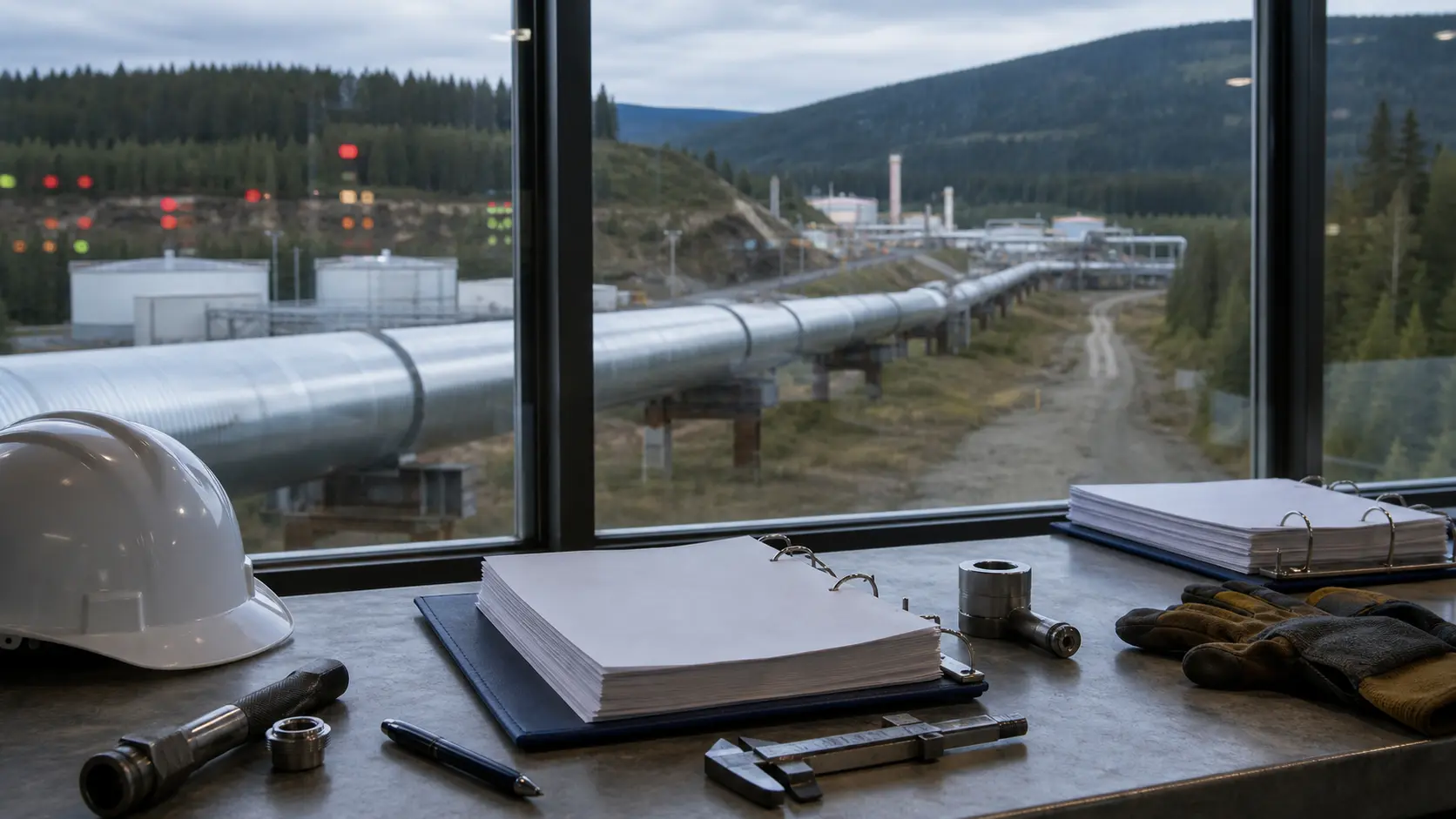
The most useful way to read Trans Mountain Pipeline Co. Ltd. after the Trans Mountain Expansion Project is not as a story about a larger pipe alone. It is a story about whether an enlarged physical system can be governed through records that remain current after construction teams, regulators, contractors, Indigenous monitors, field crews, commercial shippers, emergency responders and finance teams stop sharing the same project clock. The public system moved from a construction campaign to a long operating life on May 1, 2024, when commercial service began on the expanded system.
That date matters because it changed the dominant technology problem. Before service, the question was whether the project could be built, permitted, commissioned and authorized. After service, the question became whether the asset, its records and its operating workflows could stay aligned under normal use.
The company-specific boundary needs care. Public documents most often refer to the operating company as Trans Mountain Pipeline ULC, with Trans Mountain Corporation as the parent. This article uses Trans Mountain Pipeline Co. Ltd. as the company label for the public pipeline business and the operating record around it. It does not treat the label as proof that a separate commercial data product has been tested.
The relevant product surface is instead the operating information system around a critical infrastructure network: nominations, tariffs, control-room data, asset registries, environmental records, integrity inspections, emergency plans, condition filings and financial assumptions.
The Canada Energy Regulator's pipeline profile places the system in its physical context. The Trans Mountain pipeline runs from Edmonton, Alberta to Burnaby, British Columbia, with delivery points in Kamloops, Sumas and Burnaby. It transports crude oil and refined petroleum products, connects to the Puget Sound pipeline, and after expansion has a nameplate capacity of about 890,000 barrels per day, up from about 300,000 barrels per day before the expansion came online. Trans Mountain's own operations page describes a network with more than 1,180 kilometres of pipeline in Alberta and British Columbia, plus 111 kilometres in Washington state, and identifies Westridge Marine Terminal as the loading facility that gives the system tidewater access.
That physical description is necessary but incomplete. In technology terms, the important point is that a larger system creates a larger coordination burden. More capacity means more nominations, more scheduling pressure, more commercial sensitivity, more terminal interfaces, more inspection points and more public interest in whether every operating decision can be reconstructed after the fact.
The enlarged system also creates more places where record drift can become operational risk: as-built information may not match asset registry fields, environmental commitments may sit in one project tracker while operating crews work from another, a field inspection may identify a hazard faster than the central record can absorb it, or a tolling assumption may move faster than the public can understand.
That is why the post-expansion handoff is a technology-company question even though the asset is a pipeline. The work that would traditionally be described as manual reconciliation, audit preparation, dashboard checking, incident reporting, field follow-up and regulatory filing now has to behave like a repeatable data infrastructure workflow. The system has to keep data fresh, governed, queryable and recoverable. It has to do this across control-room telemetry, environmental management, integrity management and public accountability, not only inside one database.
A pipeline can be physically complete while its evidence chain remains in transition.
What the public record can establish
The public evidence can establish several things with reasonable confidence. First, the expansion was not merely proposed. The CER issued final leave-to-open authorization on April 30, 2024, authorizing crude oil transportation from Edmonton Terminal in Strathcona County, Alberta to Westridge Marine Terminal in Burnaby, British Columbia. Trans Mountain's 2024 management report says the expanded system's commercial commencement date was May 1, 2024, that both pipelines were transporting crude, and that final line fill on the expanded line was complete in early May 2024 before the first ship from the expanded line loaded later that month. The public record therefore supports the basic operational boundary: this is an in-service expanded system, not a speculative infrastructure plan.
Second, the public record shows a heavy regulatory and reporting surface. Trans Mountain's regulatory process page, CER conditions page and commitments tracking page point to 156 CER certificate conditions and thousands of commitments made to address concerns from the public, local and provincial governments and Indigenous communities. The CER's condition compliance and lifecycle approach page says the project conditions table allows users to review condition filings by theme and lifecycle stage. That is not just regulatory decoration. It is a public data model for how the expansion is supposed to move from application evidence into operating evidence.
Third, the public record shows that Trans Mountain uses an explicit control and emergency management architecture. The company's pipeline technology page describes a centralized control centre monitoring flow rates, pressures and fluid characteristics around the clock. It describes remotely controlled block valves, fibre optic cable installed outside and along the newly installed pipeline and part of the existing pipeline, and ultrasonic flow meters at expansion pump stations. The spill detection and notification page says SCADA allows direct control of pumps and valves while monitoring flow rate, pressure, temperature and product density, and that a leak detection system compares operating parameters against a theoretical flow model. The page also says an alarm is received by the Edmonton control centre if a variance is found and that a safe shutdown, if activated, includes pump shutdown, valve isolation, responders and regulatory notification.
Fourth, the public record exposes an active compliance feedback loop. The CER's 2025 lifecycle transition audit is unusually important because it looked directly at the move from construction to operations. It found a complex but generally well-designed management system, classified 9 of 11 audit protocols as having no issues identified, and identified two non-compliant findings requiring a corrective and preventive action plan. The audit did not say the company was unable to operate safely. It did say specific implementation weaknesses remained in the environmental transition, including daily communication of environmental controls and inspection-and-monitoring adequacy. For a data governance analysis, that is exactly the kind of evidence that matters: the system can be real and serious while still showing where records, controls and field practice need to converge.
What the public record cannot establish is equally important. It does not let an outside reader inspect SCADA architecture, cybersecurity controls, internal access permissions, data retention settings, customer nomination systems, data lineage tooling, incident ticket queues, backup-and-restore procedures or operator training records beyond the summaries disclosed on public pages and regulatory filings. It does not prove that a specific internal data platform has lower failure rates than a previous system. It does not expose query latency, pipeline retry rates, correction rates or storage and compute costs per usable operational answer.
Any technology assessment has to stay inside that boundary.
The control room is the clearest product surface
The clearest technical product surface is the control-room loop: sense, compare, alarm, decide, isolate, dispatch, notify and record. Trans Mountain describes its centralized control centre as monitoring flow rates, pressures and fluid characteristics 24 hours a day, seven days a week. It says fluctuations can be detected quickly, alerting operators to potential leaks and enabling shutdown and crew dispatch.
The spill detection page adds operational detail: reports can come from automated systems, personnel, the public or emergency services; SCADA monitors and controls pumps and valves; leak detection compares measured parameters to a theoretical model; and control centre operators work in 12-hour shifts with responsibility for sections of the pipeline.
That loop is a data infrastructure workflow. The input stream is telemetry from a distributed asset. The model layer compares observed behaviour with expected flow behaviour. The alert layer routes exceptions to operators. The operations layer translates the alert into shutdown, valve isolation, field investigation and restart rules. The public accountability layer routes reportable events to regulators and, where relevant, to local governments, Indigenous communities and emergency responders. If any layer is stale or ambiguous, the whole workflow can slow down even if the pipe, sensors and valves are physically sound.
The public material is strongest on the existence of this loop and weakest on performance evidence. Trans Mountain says that from alert to isolation, its shutdown procedure takes about 15 minutes or less. It also says operators are not authorized to restart the line after a suspected leak shutdown until the cause of the alarm has been established, and that restart requires senior management approval. Those are meaningful operating claims because they describe decision rights and procedural gates, not just sensor names.
But they do not let an outside reader reproduce alarm processing, verify false-positive rates, inspect event queues, test failover, measure latency under stress or compare the expanded system against prior internal performance.
The fibre optic and ultrasonic meter details are useful for a different reason. They show that the post-expansion system is not relying only on older periodic inspection or pressure balancing. Trans Mountain says fibre optic cable can measure vibration, temperature and pipe movement, helping identify small potential leaks, ground movement, pipe exposure and external activity. It also says ultrasonic flow meters at expansion pump stations improve measurement sensitivity compared with conventional methods. That combination matters because modern pipeline control is not just about seeing a release after the fact.
It is about detecting weak signals, assigning them to locations, deciding whether they indicate a leak, ground movement, third-party activity or benign variance, and giving operators a defensible basis for intervention.
The data risk is that more sensing can create more operational ambiguity if the data model, alarm rules and response records are not governed well. A fibre signal, pressure variance, public call and field report may not arrive in the same system with the same identifiers. A work crew may use one asset tag; a control-room screen may use another; a regulator filing may cite a spread, valve, terminal or condition; a financial team may roll activity into a cost category. The expanded system's technology burden is therefore semantic as much as physical.
The operating organization must maintain a common understanding of locations, assets, hazards, incidents and corrective actions across systems that were built for different users.
Integrity data has to turn inspection into action
Integrity management is the second major technology surface. Trans Mountain's spill prevention page describes corrosion-resistant external coatings, impressed-current cathodic protection, remote monitoring of cathodic protection data, in-line inspection tools and integrity digs. It says smart pigs collect data that forms the foundation of its anomaly detection program, with magnetic flux leakage tools used for metal loss, caliper tools for dents and gouges, and ultrasonic or electro-magnetic acoustic tools for crack detection. Integrity digs then excavate pipe segments, use non-destructive examination, repair or replace pipe if required, and restore the site.
This is the operational twin of an enterprise data-quality problem. A sensor or inspection tool produces a signal. That signal must be associated with a pipe segment, historical inspection record, risk model, environmental condition, land access permission and repair workflow. The organization has to decide whether the anomaly is urgent, whether a dig is justified, which permits and consultations are needed, which environmental controls apply, how the repair should be documented, and how the asset record should change afterward.
A single missed link in that chain can turn into bad prioritization, avoidable field work, regulatory delay or a weak audit trail.
The public record supports the existence of an integrity workflow, but it does not prove the internal quality of the data model. Trans Mountain says integrity digs are usually based on in-line inspection results and require environmental assessments plus approvals and permits from landowners, Indigenous groups and municipal authorities. That tells us the workflow crosses technical, environmental, rights-holder and local government boundaries.
It does not tell us whether the internal asset registry is complete, whether inspection data is normalized consistently across the original and expanded lines, whether anomaly severity scoring is automated or manual, or how often field findings force corrections to engineering records.
The 2025 CER lifecycle audit helps fill part of that gap, not because it audits the entire integrity program, but because it shows how the transition was organized. The audit says Trans Mountain uses an Integrated Safety and Loss Management System, or ISLMS, with 16 programs and common management-system elements. It says the environmental protection program is one of those programs, and it discusses how management of change, business readiness, operations interface, commissioning, regulatory permissions and records turnover were part of the transition.
It also notes that the audit reviewed about 200 documents, conducted 17 interviews and sampled about 70 records. That is a public signal that regulators did not rely only on narrative claims; they sampled records and interviewed operational staff.
The more revealing passages are about record turnover and environmental transition. The audit says the business readiness plan included closeout and records turnover, and that the Environmental Operations Readiness Plan identified data management requirements and environmental data and records management resource planning. It says environmental data to be transitioned included baseline data, construction field data, as-built trackers and project records. That is the handoff problem in plain language.
A large project produces enormous quantities of data, but operations teams need curated, current, location-specific records that can support recurring decisions for decades. The hard part is not saving project files. It is turning them into operational memory.
The lifecycle audit is the best stress test in the public domain
The CER lifecycle transition audit is the strongest public test evidence because it does not merely describe planned controls. It examines whether the construction-to-operations transition had management-system substance. The audit focused on the environmental protection program rather than the whole pipeline control stack, but its findings are still central to the technology assessment. Environmental protection is where asset records, field observations, weather, contractor activity, Indigenous monitoring, permits, commitments, reclamation and incident reporting all meet.
If record governance fails there, the failure may not look like a software outage. It may look like a missed control, a slow field response, a poor handoff or an incomplete monitoring plan.
The audit's conclusion is balanced. It says the management system is complex, well designed and appropriate for the nature and scope of company activities. It says 9 of 11 protocols had no issues identified. It also says two non-compliant findings must be resolved through a corrective and preventive action plan, with CER monitoring implementation. This is not a pass-fail slogan. It is a useful map of where the transition record is strong enough for public confidence and where it still requires follow-through.
The first important weakness concerns communication of controls. The audit found that the operations-environment process lacked documented daily communication of the daily status of environmental hazards, risks and controls to field personnel, including personnel who did not attend the initial kickoff meeting. That is a classic operational data problem. The hazard may be known, the environmental protection plan may exist, and the kickoff may be documented, but the current status of controls has to reach the people exposed to the risk every day.
A static document is not enough if crews change, weather changes, nesting conditions change, water levels change or the work sequence changes. In software terms, the control has to be live at the edge, not only stored in a central file.
The second weakness concerns inspection and monitoring. The audit found that while methods existed to evaluate program adequacy and effectiveness, errors in the operations environment suggested those methods might be insufficient. For the expansion environment, record sampling showed gaps in the inspection, measurement and monitoring plan and discrepancies between the plan and what happened in the field. That is not just an environmental issue. It is a data lineage issue.
If the plan says one thing, field execution says another, and the monitoring review cannot reconcile the two quickly, management cannot know whether the program is performing as designed.
The audit also describes positive evidence. It says auditors sampled records related to environmental incidents and hazards reported in 2024 and that the company was able to provide the records. It says staff interviews were consistent with written standards, plans and procedures in many areas. It notes that Trans Mountain collected substantial environmental data and transferred some of it into a geographic information system that environmental practitioners can use, allowing users to select a location on a map and identify environmental sensitivities and required mitigations.
That GIS detail is important because it shows a practical operating tool, not just a compliance archive. It suggests the company is trying to turn project knowledge into location-aware operational guidance.
The evidence limit is that the audit is scoped. It does not certify the whole data stack, the whole cyber program, the whole integrity-management process, every control-room workflow or every contractor system. Its findings are specific to information assessed at the time of the audit. But for a public technology assessment, scoped evidence is better than unbounded claims. The audit tells readers where the public can see actual testing of management-system implementation and where it cannot.
Accountability is a second data plane
Trans Mountain's accountability surface is unusually visible because the expansion was federally owned, federally regulated and politically contested. The Government of Canada's Trans Mountain Expansion Project page describes the expansion as the twinning of a second pipeline along the existing route from the Edmonton area to Westridge Marine Terminal in Burnaby. The CER's condition pages, public filings and compliance records create an external data plane around the operating asset. That external plane matters because the pipeline's legitimacy is not determined only by internal uptime or throughput. It is also determined by whether communities, governments, shippers and regulators can see credible evidence that obligations are being managed.
The condition and commitment system is the obvious starting point. Trans Mountain says the expansion is subject to 156 CER conditions and thousands of commitments. The CER says users can review condition filings and condition status by theme and lifecycle stage. Those features matter because they let external readers trace the movement from pre-operation commitments to operational obligations. A condition about emergency management, marine protection, environmental monitoring or Indigenous engagement is not completed merely because a document was filed once.
Many obligations create recurring monitoring, update, notification or evidence duties. The system has to prevent commitments from becoming stale after the construction team leaves.
The CER's 2025 administrative monetary penalties provide a concrete warning. The regulator issued four penalties to Trans Mountain for environmental non-compliances tied to a severe weather event in late January 2024 on Spread 6 near Abbotsford, British Columbia. The notice concerned failure to implement environmental protection measures required under the Environmental Protection Plan and Certificate OC-065 Condition 3. The details are construction-phase and environmental, not a blanket judgment on the whole operating system. Still, they show why public accountability records must be operationally useful. Weather, field controls, environmental plans and regulatory obligations must converge while events are happening, not only afterward.
Emergency management adds another public data plane. Trans Mountain's emergency management page says the Emergency Management Program is mandated by the Canada Energy Regulator Onshore Pipeline Regulations and includes location-specific emergency response plans that cover current operations for the pipeline and associated facilities. It describes mitigation, preparedness, response and recovery phases, annual document updates, training, equipment deployments and mock exercises. Its training and exercises page says employees who may be involved in emergency response receive Incident Command System training and that operational districts participate in annual exercises, while the Incident Management Team participates in a full-scale exercise at least every three years.
Again, the public record supports program existence but not full reproducibility. We can see the declared training model, the regulatory basis, the high-level emergency response architecture and some public guidelines. We cannot see exercise results, internal after-action reports, system recovery times, communications logs, contact-database freshness, data-retention policy, or how quickly lessons from exercises update the plans and systems used by operators. That limit is not a criticism by itself. Critical infrastructure operators should not expose everything.
But an outside technology assessment has to distinguish "publicly described" from "independently verified."
Commercial value depends on tolls, utilization and trust in records
The commercial side of the operating system is not separate from the data side. The expanded system only justifies its capital burden if capacity, tariffs, shipper contracts, operating costs and public obligations can be managed as a coherent recurring business. Trans Mountain's 2024 management report says total revenues rose sharply after commercial commencement of the expanded system, with all deliveries subject to the expanded-system tariff and tolls after May 1, 2024.
It also says contractually committed revenues associated with 15- to 20-year transportation contracts drove a significant revenue increase, and that interim tolls were under CER examination due to issues raised by shippers, with process steps continuing into the second half of 2025.
The CER's interim tolls application page records that Trans Mountain applied in June 2023 for interim commencement date tolls and related matters for petroleum transportation on the expanded system. Trans Mountain's tolls and tariffs page shows a live tariff surface with current tariffs, regulator references, effective dates, tariff numbers, service standards, commodity approval materials, scheduling and marine-service links. For a data-infrastructure reader, this is the commercial equivalent of an API surface. It defines how shippers interact with the system, how rules change over time, and which documents must stay authoritative.
The Parliamentary Budget Officer's 2024 report makes the uncertainty explicit. PBO notes that the expansion began commercial operations on May 1, 2024 and that the total project cost estimate increased from $21.4 billion to $34.2 billion. It estimates current present value under two scenarios: $33.4 billion if initial contracts are renewed and $29.6 billion under a reversion to a cost-of-service tolling framework. It also says value is sensitive to utilization, tolls and discount rate, and that whether the government records a profit or loss on a future sale depends on what a buyer is willing to pay.
The CER's 2025 market snapshot provides one of the best public utilization signals after the expansion. It says the Trans Mountain System was more than 75 percent full every month after TMEP came online, except the May 2024 ramp-up period; from June 2024 to June 2025 it averaged 82 percent utilization, with committed capacity averaging 99 percent utilization. That is evidence of real use, not just authorized capacity. But it is not the same as evidence that every internal operating workflow is efficient. High utilization can increase the penalty for bad data because more commercial and operational decisions depend on current records.
The commercial question, then, is whether the storage, compute, migration, lock-in and data-quality labour associated with this operating environment produce enough reliability to justify the complexity. For Trans Mountain, those costs are not only IT line items. They include the human work of reconciling project records with operations, preparing regulatory filings, updating emergency contacts, maintaining tariff documents, responding to audits, validating environmental monitoring plans, inspecting anomalies, preserving evidence and explaining performance to public owners and potential buyers.
A future buyer would not value only steel in the ground. It would also value the credibility of the operating record.
The failure modes are mundane and consequential
The main failure modes are not exotic. They are stale data, broken lineage, permission leakage, retry loops, cost overruns and partial recovery after an operational interruption. In a pipeline context, those abstract data-infrastructure failures translate into construction records that do not match operating assets, field crews working from stale hazard controls, environmental commitments not surfacing at the right location, incident records not feeding corrective action, asset tags drifting between systems, tariff documents not matching shipper expectations, or public filings lagging behind operational reality.
Construction-to-operations data gaps are especially likely after a project of this scale. The CER audit says the transition of TMEP assets into operations was exponentially larger than typical organizational changes. It also says environmental transition was still in progress at the time of writing, with each construction spread to be handed over to the operations environment individually and the majority anticipated to be complete by the end of 2025. That is a long period in which project and operations teams have overlapping responsibilities.
It is also a period in which record ownership can become ambiguous unless every data set has a clear owner, cadence and acceptance criterion.
Asset registry drift is another obvious risk. The expanded system includes new buried pipeline, modified facilities, pump stations, tanks, reactivated pipeline segments and additional tanker loading facilities at Westridge. A registry has to distinguish original-line assets from Line 2 assets, identify which assets have been commissioned, which environmental conditions attach to which locations, which valves can isolate which sections, and which records are authoritative after repair or modification.
If one system says a valve has been transferred to operations and another treats the associated environmental spread as still in project closeout, field planning becomes harder.
Control-room overload is subtler. More sensors, fibre data, flow measurements, public reports, field observations and weather alerts can improve detection, but they can also increase operator burden if alerts are poorly prioritized. Public material does not disclose alarm rates or operator workload. It does show that control centre operators have section responsibilities and written restart procedures. The evidence limit is that outside readers cannot inspect alert triage, escalation logic or human-machine interface design. The public can ask whether the expanded system has adequate sensing.
It cannot independently determine whether the operator experience filters the right signal at the right time.
Incident reporting delay is a governance risk. Trans Mountain says reportable events are routed through the CER's Event Reporting System, used for CER and Transportation Safety Board notification. The audit says internal reporting of hazards, incidents and near misses had no issues identified in the scoped environmental audit, with relevant standards and procedures forming the process. But a public page cannot prove that every edge case is captured, that every field event is categorized consistently, or that correction loops close fast enough. Reporting quality depends on front-line classification, system design, training and culture.
Public-accountability gaps are the final failure path. The public record around Trans Mountain is large, but large public records are not automatically usable. Conditions tables, commitments trackers, tariffs, emergency plans, audit reports, financial reports and market snapshots can answer different questions, but readers need consistent names, dates, lifecycle stages and status signals. If public records become too fragmented, accountability shifts from evidence to interpretation. That is bad for communities, regulators, owners and the company itself.
What a technology buyer can learn from Trans Mountain
Most data teams are not operating an oil pipeline, but Trans Mountain's handoff illustrates a general lesson for regulated operations. A system does not become trustworthy because it has more sensors, more dashboards or more documents. It becomes trustworthy when records generated in one phase remain usable in the next phase. Construction data has to become operations data. Inspection data has to become maintenance prioritization. Environmental commitments have to become field controls. Toll applications have to become shipper-facing rules. Emergency exercises have to become updated response plans.
Audit findings have to become corrective actions with evidence of completion.
That is why the Trans Mountain case is a useful warning against shallow automation narratives. The automation task is not "write a summary of the pipeline." It is to turn construction, asset, inspection and operating records into a reliable post-expansion control surface. The system has to answer repeated operational questions: Which asset is at risk? Which control applies here today? Which commitment covers this location? Which inspection found the anomaly? Which corrective action closed it? Which tariff applies to this movement? Which regulator must be notified? Which public record can prove the answer later?
The case also shows why public-sector continuity is a data problem. The pipeline is held through a federal ownership structure, and PBO's valuation work looks ahead to eventual divestment. A future sale, partnership or ownership transition would depend heavily on the quality of records. Buyers, Indigenous partners, governments, lenders and regulators would need to understand not only utilization and tolls but also integrity risk, environmental obligations, emergency preparedness, litigation exposure, maintenance history and the reliability of management-system evidence. Poor records can become a discount rate by another name.
For platform engineering teams, the analogy is direct. The "migration" is the shift from project systems to operating systems. The "lock-in" is the cost of keeping old project data accessible because no one fully trusts the cleaned operating record. The "freshness" problem is whether field reality updates the central system quickly enough. The "query latency" problem is how long it takes to answer a regulatory, safety or commercial question with evidence. The "pipeline failure rate" is both literal and informational: how often operational workflows break, retry or require manual repair.
The "correction rate" is how often audit, field or public evidence forces a record change.
The public Trans Mountain evidence does not let readers score those metrics directly. It does, however, identify where the metrics would matter. Freshness matters for daily environmental controls and emergency contact databases. Lineage matters for as-built trackers, environmental baseline data and inspection records. Permissioning matters for SCADA and commercially sensitive shipper data. Recoverability matters for control-room shutdown, restart approval and emergency response. Cost per usable result matters for the human effort needed to maintain filings, audits, monitoring plans and public confidence.
Evidence limits and the right conclusion
The right conclusion is not that Trans Mountain's expanded pipeline is either a data triumph or a data failure. The public evidence supports a more precise view. Trans Mountain operates a real expanded system with a substantial control-room, integrity-management, emergency-management, tariff and public-compliance surface. The CER has authorized operation, maintains a current pipeline profile, tracks conditions, audits lifecycle transition, publishes compliance findings and reports market utilization. Trans Mountain publishes operating, safety, emergency, technology, tariff and financial material. PBO adds independent fiscal analysis.
Together, those sources support serious analysis of the operating record.
The evidence also supports caution. The most important technology questions are not fully public. We cannot verify SCADA architecture, cyber resilience, alarm performance, data lineage tooling, internal access controls, ticket workflows, backup procedures, shipper system reliability, customer satisfaction or private incident-recovery performance. We cannot directly test the control centre, run a nomination through the tariff system, inspect internal asset registries, replay an environmental hazard report, or compare pre- and post-expansion query times.
We can infer the shape of the operating challenge from public evidence, but we cannot certify the internal data platform.
That distinction is especially important because Trans Mountain's public record contains both positive and corrective evidence. The final leave-to-open authorization and market utilization data show that the expanded asset is operating. The control-room and technology pages show a sensor and response architecture. The emergency pages show regulated response planning and training. The lifecycle audit shows a management system that regulators viewed as generally appropriate, while also requiring corrective action on two environmental transition findings.
The AMP notice shows that environmental controls can fail in the field under weather and construction pressure. The PBO report shows that valuation remains sensitive to utilization, tolls and future contractual structure.
For readers evaluating Trans Mountain as a technology-company subject, the core question is therefore operational truthfulness. Can the company keep the public, commercial and technical records synchronized as the asset settles into routine operation? Can the systems that saw a construction project through completion become the systems that support decades of safe, auditable and commercially credible service? Can the company close the gap between documented controls and daily field communication?
Can it keep condition commitments, environmental monitoring, integrity work, tariffs and emergency plans live enough that regulators and communities do not have to reconstruct the truth after every event?
Trans Mountain's post-expansion story will be measured less by the fact that the system reached 890,000 barrels per day of nameplate capacity than by the quality of the operating record that surrounds that capacity. Capacity is the visible output. The durable technology work is the evidence chain: sensing, logging, validating, transferring, reconciling, notifying, correcting and explaining. On the public record, the chain exists and has serious institutional support. On the public record, it also still has handoff risk.
That is the article's narrow but important finding: the expanded pipeline should be analyzed through its post-expansion control surface and accountability records, not through scale alone.