
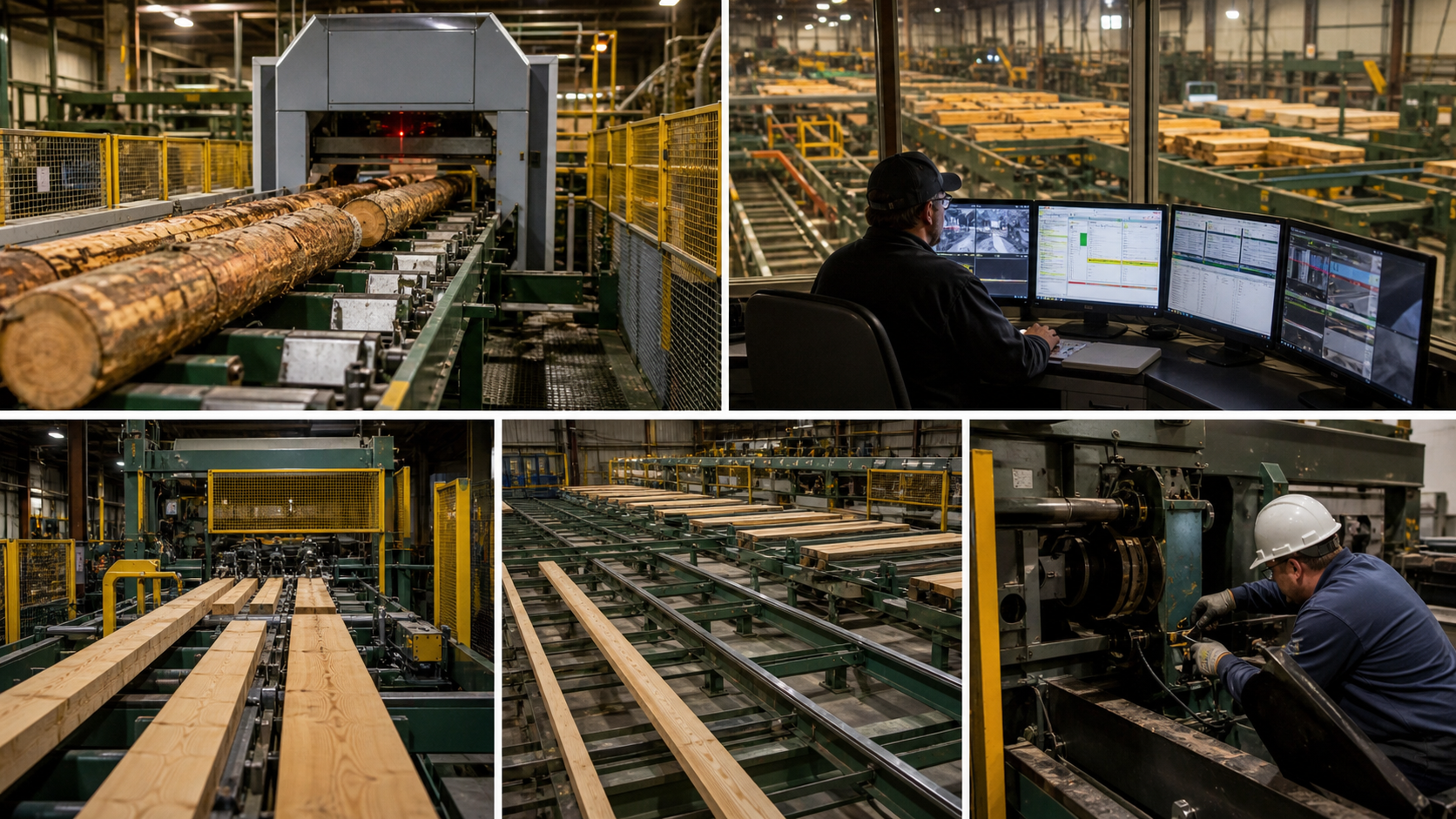
Summary
- Timber Automation's credible task is the accepted lumber flow: receive and move irregular stems, measure them, make bucking and sawing decisions, keep control state aligned across machine centers, and sort boards without losing the evidence that made each cut decision rational.
- The commercial case depends less on whether Baxley, LogPro and related optimization assets cover many mill stations, and more on whether a specific mill can absorb shutdown time, calibration work, operator retraining, spare-parts exposure, safety interlocks and handoff risk without giving back the yield and labour savings it expected.
- Public evidence supports a serious industrial-equipment position in log handling, merchandising, edgers, trimmers, sorters, controls and optimizer-adjacent systems, but it does not prove a universal uptime, yield or payback result across species, log mix, legacy controls and maintenance cultures.
The real test is one accepted flow
Timber Automation should be judged as a sawmill automation supplier, not as a generic robotics company and not as a forestry producer. The useful question is narrow and difficult: can its equipment and controls preserve material state as timber moves from the log yard into a mill flow where each downstream choice depends on an upstream measurement? A sawmill is not a tidy assembly line. Logs arrive with taper, sweep, knots, bark condition, species variation, moisture differences, frozen surfaces, handling damage and incomplete knowledge about internal defects.
A board or cant may then be split, edged, trimmed, shifted, rejected, reintroduced or sorted while the control system is trying to coordinate steel, motors, belts, scanners, encoders, saws, gates, operators and safety devices.
That is why breadth alone is an unreliable proof point. Timber Automation's public product families cover woodyard, log handling, merchandiser, edger, trimmer, sorter, material-handling, process-control and optimization-adjacent functions. Baxley Equipment pages list transverse and lineal edger systems, sawmill and planermill trimmers, sorters, package makers, curve canter and curve sawing machinery, scan belts, verification scanners, optimizers and process controls. LogPro pages describe crane systems, drum debarkers, stem and log singulation, merchandisers, scanning conveyors, safety equipment and PLC controls.
The 2022 acquisition by USNR also placed the company inside a larger wood-processing equipment platform. This is a meaningful boundary. It shows a supplier oriented around the mechanical and control surface of lumber production, not around a single robot arm or a warehouse software layer.
The hard part is that mills do not buy boundaries. They buy an operating result. A mill manager wants more usable lumber out of the same fibre, steadier throughput, fewer people in dangerous or low-value positions, faster recovery after a jam, less rework, fewer unplanned stops and a clearer path to maintenance. A mill engineer wants drawings, controls, signals, safety logic, commissioning support and interfaces that fit the actual plant rather than a brochure diagram. A maintenance lead wants access to bearings, drives, sensors, saw modules, cylinders, brakes, encoders, calibration routines and spare parts.
An operator wants an interface that makes the next decision visible and recoverable when the line is not behaving like a demo. Timber Automation's value has to survive all of those tests at once.
What Timber Automation actually automates
The strongest public evidence for Timber Automation is not a single benchmark. It is the shape of the offering. Baxley came out of a sawmill-machinery lineage that included computerized machinery and early laser trimmer optimization. LogPro came from log-yard and woodyard machinery. The 2017 formation of Timber Automation combined Baxley Equipment, Price LogPro and a construction or integration angle into a single supplier identity. VAB Solutions was later added for lumber-line technology and grading or optimization capability.
USNR acquired Timber Automation in 2022, describing the company as a sawmill and woodyard equipment supplier with more than 250 employees and over 200,000 square feet of manufacturing space added to the wider group. Those facts matter because the accepted task is not a software task floating above a mill. It is an equipment-and-controls task embedded in steel.
The LogPro side is most visible at the front of the flow. Its public material describes log cranes, unbinding safety equipment, log handling, drum debarking, V-flight scanning conveyors, stem singulation and merchandiser systems. A crane is not just a labour substitute. It changes how wood is unloaded, stored and metered into the flow. A singulator is not just a conveyor. It determines whether the next measuring station sees one piece or a confused cluster. A scanning conveyor is not just transport. It is a controlled presentation surface for measurement. A merchandiser is not just a set of saws.
It is where a stem becomes a sequence of bucked logs or blocks assigned to downstream value paths. Each of those stations creates or destroys useful state.
The Baxley side is most visible inside the sawmill and planer mill. Public pages identify edgers, trimmers, curve sawing gangs, sorters, package systems, verification scanners and process controls. In a transverse or lineal edger, a board or flitch must be positioned, scanned or otherwise evaluated, and cut in a way that respects width, wane, grade objective and downstream handling. In a trimmer, length decisions have to reflect defects, market lengths and sorter capacity. In a sorter, a board must be recognized well enough to land in the right bin or package stream.
In a curve sawing or gang context, mechanical stiffness, feed-roll control, press-roll action, arbors, guides, lubrication and speed matter as much as any optimization objective.
The product boundary is therefore hybrid. Timber Automation is not merely selling an optimizer, and it is not merely selling fabricated conveyors. Its strongest case is the integration of mechanical handling, measurement surfaces, control cabinets, PLC logic, motor control, operator stations, safety features and commissioning experience. Its weakest case would be any claim that the existence of that catalogue automatically produces a yield improvement. Yield is the result of a valid decision made on valid measurement, executed by available machinery, under conditions a mill can maintain.
State is the hidden product
The accepted lumber flow is a state-preservation problem. At the beginning of the flow, a mill has a physical log and an economic question. What is this piece? What can it become? Which defects or dimensions matter? Which path should it take? What cut will create the best recoverable value under today's market mix, machine settings, inventory needs and bottlenecks? After the first decision, the system must remember enough about the piece to make the next decision coherent.
That memory may be literal data in a control system, position feedback from drives, scanner data, operator-entered context, line speed, queue position, bin assignment, or simply the controlled geometry of how the piece is presented to the next machine.
This is where sawmill automation differs from many software workflows. The state is partly digital and partly physical. A misplaced board does not wait politely for a retry. A log can roll, skew, bounce, bridge, jam, rotate, lose bark, split, drag debris, hide a defect or leave the ideal presentation envelope. A board can arrive crooked, double-fed, wet, warped, overlapped or outside the assumptions of the scanner. A sorter can become the bottleneck. A saw can drift or require guide work. A motor can fault. A sensor can be dirty. A hydraulic or mechanical adjustment can change behaviour without changing the optimizer's assumptions.
A good control system has to be designed for this imperfect world.
LogPro's public description of V-flight scanning conveyors illustrates the point. The company describes designs built around the application and fibre supply, with heavy-duty chain or flighted-belt options, safety features around infeed tunnels and skids, high side walls, encoded drives, oversized sprockets or pulleys, wear-conscious take-up and speeds that vary by log size and application. Those are not decorative details. They acknowledge that measurement quality depends on controlled movement. If a conveyor cannot present logs consistently, the scanner or optimizer downstream is already compromised.
If transport wears quickly or creates jams, the value of the measurement layer is eaten by downtime.
The merchandiser system is even more explicit. LogPro describes Gen III and Gen IV merchandisers, electric positioning, redundant measurement, safety gates, balanced saw arms, brakes, high line speed and consistent saw positioning. It also states production-rate and energy-reduction claims for particular system generations. Those claims should not be generalized into a payback result for every mill, but they do identify the engineering pressure point: bucking accuracy and throughput depend on positioning, drive control, saw actuation, safety behaviour and the ability to change trim decisions without rebuilding the line.
Inside the mill, Baxley edger and trimmer systems raise the same state question. A lineal edger system includes components such as lineal edger optimizer, scan belt, feed table, charging chains, crosscut saws, outfeed pickers, sequence decks and unscramblers. A transverse edger system includes board returns, saws, verification systems and optimizer pieces. A curve sawing gang page lists heavy frames, press rolls, vector-duty motors, VFDs, arbor horsepower, guide systems and lubrication dependencies. These are the physical details that decide whether a theoretical cut path becomes a repeatable flow.
Measurement quality is not optional
Timber Automation's core technical question is whether it can preserve material state and equipment coordination when irregular logs, saw decisions and downstream sorting all interact. Measurement quality is the first condition. Public material from the broader sawmill-technology literature is consistent on this point. Optimizing systems use data collection, laser or scanner input and computation to determine better opening faces, bucking choices, edging or trimming decisions. Research on 3D log sawing optimization has shown that modelling and dynamic programming can improve lumber value in study conditions.
Machine-vision grading research divides the task into imaging, defect recognition, materials handling, computation and control. That does not prove Timber Automation's specific results. It does show why the supplier's measurement and handling surface is central.
A bad measurement does not merely create a bad report. It can create a bad cut. If a scanner misses sweep, misreads a barked surface, sees the wrong orientation, runs on stale calibration or receives a piece outside its expected presentation geometry, the optimizer can recommend a cut that looks mathematically reasonable and economically wrong. If an upstream log yard or merchandiser loses identity between measured piece and physical piece, the downstream machine may act on the wrong state. If a verification scanner finds a mismatch after an edger, the mill still needs a recovery path.
The automation is valuable only if these exceptions are visible, bounded and recoverable.
This is why mill-specific handoff matters. A new system may be mechanically capable and still underperform if the fibre mix, species, stem length, log diameter distribution, market lengths, grade rules, downstream sorter plan or operator routines do not match the assumptions used at commissioning. LogPro's own pages repeatedly use language such as custom engineered, specific application and fibre supply. That is not just marketing comfort. It is an admission that there is no universal sawmill input stream.
The same crane, scanning conveyor or merchandiser concept has different risk in a mill handling tree-length stems, shortwood, mixed species, small logs, frozen logs, pulpwood, chip logs, specialty sawlogs or veneer candidates.
The most credible Timber Automation installation is therefore not the broadest one. It is the one where the supplier and mill agree on what state must be kept, what state can be discarded, how exceptions are routed, which decisions are optimized, which decisions remain with operators, how calibration is checked, and what happens when the line restarts after a stop. If those agreements are vague, the mill can end up with high-end machinery and low-grade trust.
Optimizer decisions need economic context
Optimizers do not optimize in the abstract. They optimize against a model. The model may include dimensions, grade assumptions, product prices, cutting priorities, trim rules, wane limits, kiln or planer constraints, customer orders, bin availability and line-speed realities. A system can maximize one objective while creating trouble in another part of the mill. More throughput at the merchandiser can overload a debarker, edger, trimmer, sorter or stacker. A cut decision that improves theoretical value can increase downstream handling complexity. A sorter plan can look efficient until one bin fills and creates a cascading slowdown.
For Timber Automation, the commercial promise is strongest when the system reduces labour exposure and increases recovery without simply moving cost to maintenance or downstream congestion. LogPro's public claims around cranes focus on reduced fuel cost, manpower, fibre breakage and yard maintenance. Its merchandiser claims focus on piece rates, positioning accuracy, electric actuation and energy reduction versus earlier generations. Baxley product families point toward edger, trimmer and sorter decisions that can affect recovery and labour. These are plausible value drivers, but each needs a mill-specific baseline.
The baseline should include the current state of manual handling, existing equipment age, saw line speed, historical downtime, staffing pattern, injury exposure, recovery by product, trim loss, mis-sort rate, average board value, fibre cost, energy consumption, maintenance labour, spare-part availability and the cost of planned shutdown. Without that baseline, "automation" becomes a word for capital spending rather than a method for improvement. With that baseline, a Timber Automation project can be judged on whether it closes a defined operational gap.
The most dangerous mistake is to treat a published rate or feature as proof of payback. A merchandiser capable of high piece rates does not create value if the rest of the mill cannot accept the output or if the fibre stream rarely supports that rate. An electric drive that reduces energy consumption versus an earlier generation still needs to be weighed against capex, installation, controls integration and maintenance skills. A verification scanner can improve control only if the mill uses its output to adjust process behaviour. A sorter can reduce manual handling only if upstream identification and downstream package logic are reliable.
The better question is not "How fast can the machine run?" It is "At the mill's actual recovery target, log mix and staffing pattern, how much good output can the whole line sustain after maintenance, calibration and restart events are included?"
Downtime recovery separates equipment from automation
A sawmill automation supplier earns trust during stops. Normal running is important, but abnormal recovery determines the real cost of ownership. The public failure modes for this kind of system are easy to imagine because they are rooted in the flow itself: bad log measurement, optimizer mismatch, mechanical jam, scanner calibration drift, PLC fault, unsafe restart, downstream bottleneck, maintenance delay and yield shortfall. These are not exotic failures. They are ordinary industrial realities.
Mechanical jams are especially costly because the material is heavy, irregular and sometimes dangerous. A jammed log, hung board, double feed, failed kicker or stuck sorter bin can create both lost time and safety exposure. The equipment must make it clear where the piece is, what energy remains in the system, which guards or gates are open, which drives are disabled and how the line can be cleared. OSHA sawmill rules and safety guidance underline the hazards around log unloading, moving equipment, stackers, interlocks, guards, walkways, unstable piles and dangerous machine zones.
LogPro's emphasis on unbinding racks, safety gates, balanced saw arms and braking systems fits this environment. Still, public feature descriptions do not prove a specific installed safety outcome.
PLC faults and motion faults create a different burden. A mill may keep a saw line alive for decades, adding new scanners, replacing drives, changing PLCs, updating HMIs, keeping legacy motors and integrating third-party systems. Public industrial examples from lumber mills show that obsolete motion controllers can be replaced while keeping existing PLCs, but that such work is a real engineering project, not a casual software update. For a Timber Automation buyer, the risk is not simply whether the new system works on day one.
It is whether the mill can maintain it in year seven, find compatible components, get service support, understand the logic and avoid a single obsolete device becoming a bottleneck for the whole line.
Restart logic deserves special attention. After a stop, the system may no longer know the exact state of every piece unless it was designed to recover that state. A log may be between scanners. A board may be between a decision point and a saw. A bin may contain a partial sequence. A saw module may have moved to a safe position. If the restart process depends on tribal knowledge rather than clear controls, the mill has traded manual labour for a different kind of vulnerability. The best automation does not eliminate operator judgement. It gives operators a controlled way to apply judgement when the machine state is messy.
Integration is where the purchase becomes real
Timber Automation's public history points to a company built from complementary industrial assets. That is a strength, but it also signals why integration is the real purchase. A mill does not install "Timber Automation" as a single object. It installs foundations, steel, conveyors, drives, scanners, control panels, cabinets, operator stations, safety systems, software parameters, recipes, network links, historian tags, alarms and mechanical access. It also changes work routines for operators, electricians, millwrights, filing-room staff, supervisors and planners.
The integration burden can be greater in retrofit projects than in greenfield projects. Existing mills have space constraints, old foundations, known bottlenecks, undocumented modifications, mixed vendor equipment, local safety practices and a financial need to limit shutdown time. A new crane or merchandiser may need civil work, electrical service, controls mapping and truck-flow changes. A lineal edger may require changes in feed presentation, operator flow and downstream handling. A sorter or package system may force decisions about bin logic, product mix and rework.
A process-control upgrade may expose the weak point in an old motor-control center or network.
This is where single-source support can be valuable. LogPro states that it designs, manufactures and services controls technologies, and that mechanical solutions with integrated controls give clients a single support responsibility. That is a coherent value proposition. When the mechanical supplier and controls supplier are disconnected, fault resolution can become a contest over whether a problem is steel, sensors, logic, settings, drives, operators or material. A combined supplier can reduce that ambiguity. But it also increases reliance on that supplier.
The mill should know which parts are standard, which logic is documented, which settings are mill-specific, which support is remote, which support requires travel, and what happens if service capacity is tight.
Training is part of integration, not an afterthought. Automation changes the skill profile. A manual crew may know how to compensate for fibre variation by sight and habit. A more automated line asks fewer people to supervise more state. That can reduce labour cost and safety exposure, but it raises the cost of misunderstanding. Operators need to know when to trust the optimizer, when to intervene, how to clear faults, how to recognize calibration drift, how to handle off-spec material and how to communicate failure patterns to maintenance.
Maintenance teams need drawings, diagnostic access, spare-part lists and enough control logic visibility to avoid treating every fault as a supplier call.
The labour case is real but not simple
Sawmill automation is often sold against labour scarcity and safety exposure. That case is real. Sawmill work includes dangerous material handling, repetitive sorting, machine-paced tasks, exposure to saws, moving logs, falling lumber, dust, noise and heavy equipment. OSHA's sawmill materials emphasize that the equipment and material create serious hazards, and injury research in wood products has long treated machine-paced work, training, lockout and guarding as important concerns. Moving workers away from high-risk handling and repetitive manual decisions can be a legitimate objective.
But labour savings can be overstated. Automation does not remove work from the mill; it relocates work. Manual handling can become supervision, calibration, troubleshooting, preventive maintenance, data review, sorter planning and spare-parts management. A crane can reduce loader movements but requires operator competence, inspection and maintenance. A merchandiser can reduce manual bucking decisions but requires measurement trust and saw-position maintenance. An optimizer can reduce decision variability but requires rules, prices, setup and periodic validation.
A sorter can reduce manual stacking but increases the cost of misidentification and mechanical faults.
The right labour case is therefore not "fewer people." It is "different work at lower risk and higher value." A Timber Automation system is commercially compelling when it removes workers from dangerous or low-leverage positions, lets experienced people supervise more flow, gives maintenance teams better access, and improves consistency enough that staffing can be planned rather than improvised. It is weak when it creates a small group of overburdened specialists who become the only people able to restart the line.
Local support matters because sawmills are not located only in deep automation labour markets. A mill in a timber region may have strong millwright knowledge and limited controls depth. Another may have a corporate engineering team and a thin local maintenance bench. A supplier with Arkansas, Georgia and, through ownership, wider USNR support can be better placed than a distant niche vendor, but support claims should still be tested. The buyer should ask who answers after-hours parts calls, who can travel, how quickly critical spares can move, which controls platforms are supported, and whether the mill can keep enough knowledge on site.
Unit economics depend on avoided losses
The economics of Timber Automation's systems should be framed around avoided losses and recovered value, not only gross capacity. The obvious benefits are yield improvement, throughput, labour reduction, energy reduction, lower fibre breakage, less rework, safer work, and more consistent sorting. The obvious costs are capex, engineering, civil work, electrical work, shutdown time, commissioning, training, maintenance, spare parts, service contracts, calibration labour, lost production during ramp-up and the risk that the real bottleneck sits somewhere else.
Fibre cost makes the calculation sharper. If raw logs are expensive or variable, the value of better measurement and cut decisions rises. If the mill is processing low-margin material, the tolerance for downtime shrinks. USDA work on log sorting and merchandising describes how sorting, bucking and allocation can help match logs to higher-value uses and reduce marginal processing. That principle supports the logic of better log-yard and merchandiser automation. It does not guarantee that any single supplier's installation creates a positive return. The mill still has to connect log mix, market demand and equipment capability.
The first economic risk is overbuying. A mill may buy a high-capacity system when the constraint is downstream drying, planing, sorter capacity, staffing, log supply or sales mix. In that case, the new equipment may run below its designed envelope and still require full maintenance. The second risk is under-integration. A mill may buy a strong machine center but fail to modernize the controls, safety logic or downstream handling needed to capture the benefit. The third risk is payback by best-case math. If the business case assumes ideal uptime, perfect calibration, permanent labour savings and no ramp-up losses, it is likely fragile.
The commercial question in the slot is whether yield, throughput and labour gains exceed capex, shutdown time, integration, operator training, maintenance and spare-parts risk. The answer can be yes in the right mill, but the public record does not support a universal yes. Timber Automation's most credible advantage is that it can touch enough of the material path to reduce interface risk. Its commercial challenge is that touching enough of the material path also makes projects larger, more site-specific and more dependent on execution.
Product and customer-result boundaries
Public customer evidence should be read carefully. LogPro's site includes customer comments, including a Mt. Hood Forest Products owner statement that expectations were exceeded for recovery and profitability. That is useful as a signal that at least some customers perceived real value. It is not a controlled benchmark, and it should not be turned into a general yield number. Blue Sage's exit note describes Timber Automation as serving blue-chip customers and independent sawmills with custom engineered equipment and control systems intended to maximize yield and reduce labour costs.
Again, that supports market positioning, not a measured result across installations.
The USNR acquisition release is also a boundary marker. USNR specifically called out the LogPro line of log-yard equipment, Baxley optimization, edgers and lumber processing equipment, and VAB optimization and grading solutions. That confirms that the buyer saw complementary equipment and technology value. It does not mean all products are internally unified, equally current or interchangeable after acquisition. A mill should treat the combined portfolio as an opportunity for broader support and integration, while still asking which specific product generation, controls platform and service pathway is being proposed.
The VAB dimension matters because lumber grading and optimization are tempting areas for inflated claims. Machine vision can be powerful, but defect recognition, surface condition, species variation and grade rules are hard. Older research on automatic hardwood grading explicitly separates the vision system, defect identification, grading program, materials handling and control. That separation remains useful. A grading optimizer is not just cameras. It is lighting, presentation, image processing, defect logic, grade rules, moisture or other sensor context, operator review, mark reading, trim logic and feedback to the line.
Timber Automation's ownership history gives it exposure to that technology category, but public evidence does not prove every grading claim a buyer might want.
The product boundary should also separate sawmill automation from forest operations. Timber Automation is not being evaluated as a logging contractor, timberland owner, timber producer, or market maker for lumber prices. It can influence how logs and boards are handled after arrival at the mill. It cannot remove fibre-market volatility, species variation, transportation constraints or customer demand changes. That boundary matters because many automation disappointments begin when a mill expects a machine supplier to solve a procurement or market problem.
Realistic substitutes
The substitutes for Timber Automation are not limited to another full-line sawmill equipment supplier. A mill can choose USNR's broader native portfolio after the acquisition, other wood-processing equipment vendors, scanning and optimization specialists, local controls integrators, internal engineering, used equipment rebuilds, staged retrofits, manual process discipline, or a narrower single-machine upgrade. In some cases the substitute is not a competitor's machine but a better maintenance program, a sorter reconfiguration, revised trim rules, improved log procurement or training.
Specialist substitutes can be attractive when the mill has one clear bottleneck. If the problem is a legacy motion-control failure, a controls integrator and drive supplier may solve it faster than a large equipment replacement. If the problem is scanner calibration or grading accuracy, a focused scanner or optimizer vendor may be the correct choice. If the problem is log-yard safety, an unbinding rack or crane upgrade may be enough. If the problem is downstream sorter congestion, increasing merchandiser speed may make the mill worse. Timber Automation's breadth is most valuable when the problem crosses machine boundaries.
Internal engineering can also be a substitute, especially in large lumber groups with experienced controls teams. These operators may buy components and handle integration themselves, preserving internal knowledge and reducing vendor dependency. The risk is that internal teams underestimate mechanical design, safety compliance, commissioning load or long-term support. Smaller independent mills may prefer a supplier package because they cannot carry that engineering burden alone. The right choice depends on the mill's actual technical bench.
Used equipment and rebuilds are another realistic option. Many mills keep older machinery running because foundations, crews and parts knowledge are already in place. A rebuild can be economically superior when the current line is understood and the bottleneck is specific. But rebuilds can preserve structural limitations: poor presentation to scanners, weak safety architecture, limited data visibility, outdated controls or mechanical access problems. Timber Automation has to beat not only new competitors but the inertia of known equipment.
What a buyer should demand
A disciplined buyer should make Timber Automation prove the flow before approving the spend. The first demand is a material-state map. For each critical point in the line, what does the system know about the log, cant or board? How was that knowledge created? How is it kept synchronized with the physical piece? What happens if the piece is delayed, rejected, manually removed, reintroduced or mis-presented? Which decisions are automatic, which are operator-confirmed, and which are ignored when the system is in recovery mode?
The second demand is a bottleneck and exception model. What line rate is expected under the mill's actual fibre mix? What happens with oversize logs, undersize logs, sweep, double feeds, bark problems, frozen material, broken boards, filled bins, saw guide changes, sensor cleaning, PLC faults and emergency stops? How long should common recovery routines take? Which faults can the mill resolve without a vendor? Which faults require remote or on-site support? What spare parts must be held locally?
The third demand is an evidence plan. Before installation, the mill should define baseline yield, trim loss, downtime, labour hours, injury exposure, energy use, mis-sort rate and maintenance hours. After installation, it should measure the same items over a long enough period to include ordinary bad days. This is the only honest way to separate real automation value from novelty, seasonality and fibre variation. Public claims are not a substitute for mill-level evidence.
The fourth demand is an exit and upgrade path. Which controls platforms are used? Are programs documented? Are drawings complete? Are critical sensors and drives standard parts? Can the mill access alarms and historical data? What happens when a scanner, controller, drive or HMI reaches end of life? How does the system integrate with future mill changes? Timber Automation's larger ownership context may help with support, but buyers should not treat size as a substitute for documentation.
Bottom line
Timber Automation's credible case is that sawmill automation is an embodied control problem and the company has real assets across the embodied flow. LogPro's log-yard, crane, debarking, scanning conveyor, merchandiser and PLC-control evidence addresses the first half of the material journey. Baxley's edger, trimmer, sorter, curve sawing, verification and process-control evidence addresses the mill and planer side. VAB and USNR context add optimization and broader platform relevance. This is a serious position in North American wood-processing automation.
The caveat is equally important. The public record supports capability and product relevance, not a universal performance conclusion. Timber Automation's value is decided at the handoff points: log to scanner, scanner to optimizer, optimizer to saw, saw to downstream handling, trimmer to sorter, sorter to package, operator to maintenance, and mill engineer to supplier. If those handoffs preserve state, expose exceptions and remain maintainable, the company can justify capex by improving recovery, throughput, safety and labour leverage. If those handoffs are vague, the mill may simply buy a more complex way to stop.
The best reading is therefore conditional. Timber Automation is a strong candidate when a mill needs coordinated equipment and controls across an accepted lumber flow, has the maintenance discipline to own the system after commissioning, and can prove payback against a measured baseline. It is a weaker fit when the buyer wants a generic automation cure, lacks controls support, cannot tolerate shutdown risk, or has not identified whether the real bottleneck is measurement, handling, saw capacity, sorting, labour, maintenance or fibre supply. In sawmills, automation does not win because it looks complete.
It wins because each irregular piece of wood remains known, controlled and recoverable long enough to become the right product.