
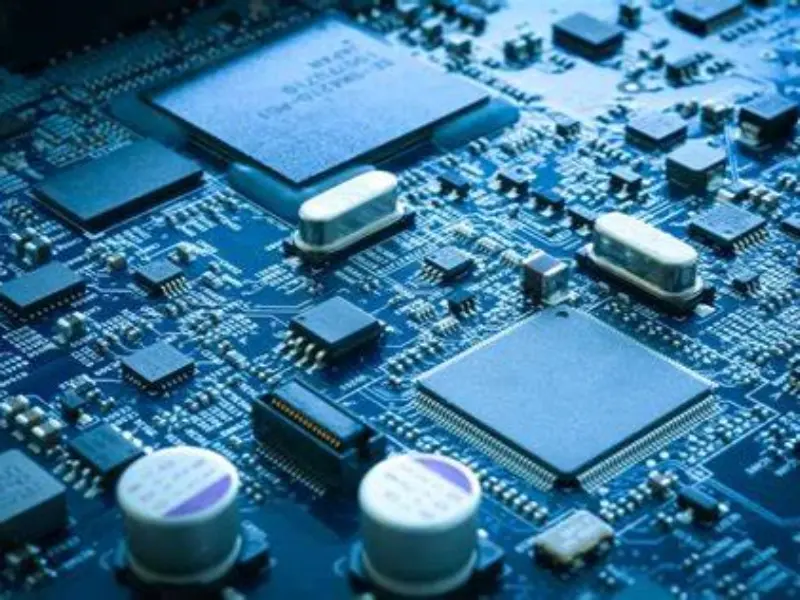
- Semiconductors, crucial for modern electronics, are materials conducting electricity better than insulators but worse than conductors, essential for devices’ functionality and efficiency.
- Their fabrication involves purifying silicon, creating wafers, doping, and metallisation, while future advancements aim at miniaturisation and improved material properties for enhanced performance.
Semiconductors form the backbone of modern electronics, playing a pivotal role in everything from smartphones to washing machines. These tiny components have revolutionised technology, enabling devices to become smaller, faster, and more efficient. But what exactly is a semiconductor? This blog delves into the fundamental concepts behind semiconductors, their properties, fabrication process, applications, and the future of semiconductor technology.
What are semiconductors?
Semiconductors are materials that conduct electricity better than insulators but worse than conductors. They sit between the two extremes on the conductivity spectrum, making them incredibly useful in electronic devices. The conductivity of semiconductors can be altered by introducing impurities—a process known as doping—or by changing temperature or light exposure. This property allows semiconductors to function as switches or amplifiers in circuits, which is why they are indispensable in the construction of diodes, transistors, and integrated circuits.
Silicon is the most commonly used material in semiconductor devices due to its abundance, stability, and ability to be doped with other elements. However, other materials like gallium arsenide and germanium are also employed in specific applications where they offer advantages over silicon.
Also read: US senate hearing targets semiconductors in Russian arms
How are semiconductors made?
The fabrication of semiconductor devices is a highly precise process that involves several steps, starting with the preparation of the semiconductor material. Silicon, for instance, is purified to an extremely high degree—up to 99.999999999 percent pure—to remove any impurities that could interfere with its electrical properties.
Once purified, the silicon is formed into crystals using techniques such as the Czochralski process. These crystals are then sliced into thin wafers that serve as the foundation for semiconductor devices. After wafer production, a series of photolithography steps are performed to pattern the wafer surface, followed by doping to create regions with specific electrical characteristics. Finally, the wafer undergoes metallisation, where metal contacts are added to connect the semiconductor device to external circuits.
Also read: U.S. urges allies to tighten control over Chinese semiconductors
Applications of semiconductors
Semiconductors are ubiquitous in everyday life, found in a myriad of devices that we use daily. In computers, semiconductors form the basis of central processing units (CPUs), which act as the brains of the machine, controlling all operations. They are also integral to memory chips, which store information temporarily or permanently.
Beyond computers, semiconductors are used in mobile phones, allowing for the transmission and reception of wireless signals. In the automotive industry, semiconductors control everything from engine timing to airbag deployment. Even in renewable energy, semiconductors play a role, with silicon solar cells converting sunlight into electricity.
The future of semiconductor technology
As technology advances, the demand for more powerful and efficient semiconductors grows. Research is ongoing to develop new materials and processes that can push the boundaries of what semiconductors can do. One promising area is the exploration of compound semiconductors, which combine elements like gallium, arsenic, and indium to create materials with superior electrical properties compared to silicon.
Another frontier is the miniaturisation of semiconductor devices, aiming to pack more functionality into smaller spaces. This trend is exemplified by the development of quantum dots and nanowires, which could lead to more compact and energy-efficient electronics.
Moreover, the integration of artificial intelligence and machine learning into semiconductor design is opening up new possibilities for optimising performance and reducing power consumption. With the rise of the Internet of Things (IoT) and the increasing connectivity of devices, the role of semiconductors in facilitating seamless communication and data processing is becoming even more critical.