
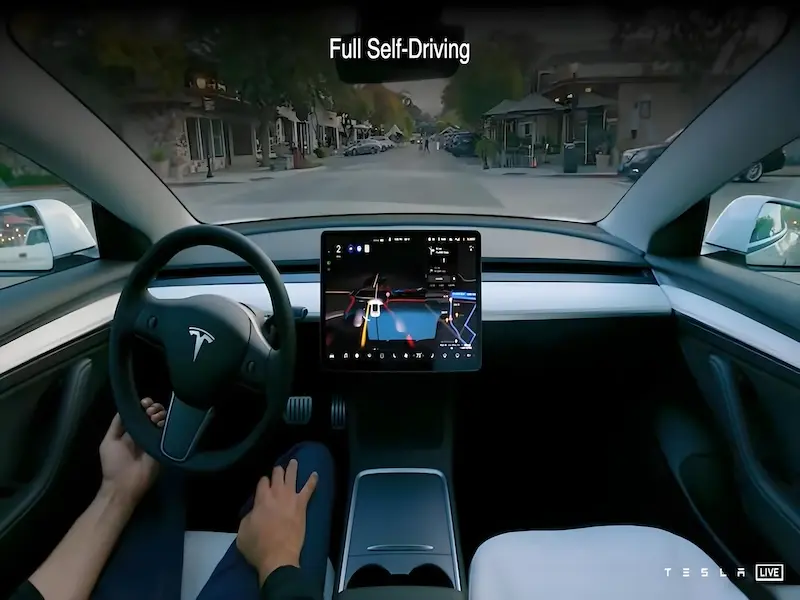
Institution Profiling / Internet infrastructure institution

Tesla’s Full Self-Driving software price drops to $8,000

Tesla’s Full Self-Driving software price drops to $8,000 is tracked as a internet infrastructure institution within the internet infrastructure ecosystem.

Tesla’s Full Self-Driving software price drops to $8,000

Evidence Pack

Primary-source references used for classification and impact scoring.

CategoryInstitution Type

Controlled classification for comparative analysis.

RegionAsia Pacific

Primary geography where strategy signal is most visible.

Signal FocusInternet infrastructure institution

Principal area tracked in this profile.

Content TypeProfile

Structured profile with operational and governance relevance.

Primary DomainGovernance

Domain interpretation lens.

TopicInternet infrastructure institution

Session topic under controlled profile taxonomy.

ImpactMedium

Leadership and execution signals affect strategy timing.

Confidence?Confidence Grade · doctrine v2 §8 / SOP §2
0.90–1.00AHigh — direct sources
0.75–0.89A/BStrong
0.55–0.74B/CMedium
0.35–0.54C/DWeak–medium
0.10–0.34DWeak signal
0.00–0.09DInternal monitoring
C · 0.80

Mixed-source

Tesla’s Full Self-Driving software price drops to $8,000 is profiled by BTW Media because public-source evidence links it to internet infrastructure, governance, operational dependencies, or market visibility.

  • Tesla slashed the price of its Full Self-Driving (FSD) driver assistant software to $8,000 from $12,000.
  • The price cut comes as CEO Elon Musk reaffirms his commitment to advancing Full Self-Driving (FSD).
  • Tesla has adjusted its pricing strategy for FSD from $199 to $99 per month, aiming to make the feature more accessible to customers.

Tesla announced that it will significantly reduce the price of its Fully Self-Driving (FSD) Driving Assistant software, with the US price cut from $12,000 to $8,000, a significant one-third reduction.

Musk’s commitment to self-driving technology

Tesla CEO Elon Musk reaffirmed his commitment to self-driving technology on Saturday.

Musk believes the Full Self-Driving (FSD) will become a major source of revenue for the world’s largest automaker by market capitalisation. But for years he has failed to realise his goal of autonomous driving, a technology that has come under increasing regulatory and legal scrutiny.

Despite the many challenges that lie ahead on the road to full self-driving technology, Musk remains optimistic about Tesla’s progress in this area.

Also read: Tesla to adopt new assembly technology, reducing production costs

Also read: Tesla’s Texas battery factory can supply 1,000 Cybertrucks weekly

Tesla’s new round of price hikes

Earlier this month, Musk said Tesla would unveil its robotaxis on August 8, which is when the price hike move was made. This proves that Tesla has scrapped its cheap mass-market cars in favour of robot taxis.

Besides, Tesla has adjusted its pricing strategy for FSD from $199 to $99 per month, aiming to make the feature more accessible to customers.

Musk has long emphasised the potential value of self-driving technology, stating that the perceived low price of FSD in 2023, then at $15000, will be worth significantly more if the car becomes fully autonomous.

It’s worth noting that Tesla refers to its driving assistant features as Autopilot or FSD, but says they don’t make the car self-driving and require active supervision by the driver.

In addition to these developments in autonomous driving technology, Tesla has dropped the price of its models in response to market dynamics, including a nearly $2,000 price cut for all models in China, which mirrors the price cuts in the United States.

Core Entity Brief

  • Entity: Tesla’s Full Self-Driving software price drops to $8,000
  • Subject Type: Internet infrastructure institution
  • Region: Asia Pacific
  • Classification: Institution Type

Service Surface / Control Surface

  • Public records support monitoring of governance, service, and infrastructure control surfaces.

Governance and Policy Surface

  • Public-source signals support medium-impact monitoring for infrastructure visibility and dependency analysis.
  • Operational criticality: Medium
  • Time horizon: Quarter (30-120d)

Decision Trigger Matrix

  • Monitoring focuses on verified service continuity, governance changes, and relationship signals.
NowMedium priority

Current state favours active tracking due to infrastructure relevance.

QuarterMedium policy sensitivity

Public-source signals support medium-impact monitoring for infrastructure visibility and dependency analysis.

YearQuarter (30-120d) continuity dependency

Long-cycle infrastructure decisions likely to remain path-dependent.

Member Unlock

Restricted Profile Intelligence

Login is required to unlock full profile briefings and deep-dive sections.

Only for Strategy Circle

Strategic Circle Access

Open to all readers. Unlock profile briefings after joining and logging in.

Join Strategic Circle

Only for Leadership Alliance

Leadership Alliance Access

For owners and management of IP-holding companies. Login required to unlock.

Join Leadership Alliance
← BackAll Companies