
Summary
- Telstra's July 2026 outage began with a mobile-network timing problem attributed by the company to a software defect affecting timekeeping nodes. Telstra later said broad calls and data were restored, but a related issue continued to affect some Triple Zero calls, creating a second and higher-consequence recovery question.
- The round-13 accountability issue is the trust boundary between Telstra's restored carrier network and the services that depend on it. A working aggregate network is not proof that mobile access fallback, the Emergency Call Person handoff, state emergency-service transfer, welfare-check reconciliation, rail communications, payment devices, and small-business connectivity are restored.
- Telstra controlled its mobile timing architecture, service validation, emergency-call failure detection, customer notice, and evidence given to regulators. Emergency service organisations, police welfare-check teams, transport agencies, payment providers, merchants, carers, and public regulators controlled downstream procedures and independent fallbacks. The duties are connected but not interchangeable.
- The longer Telstra record matters because previous incidents in 2018, March 2024, and July 2024 involved emergency-call carriage, backup process quality, and change control. The mechanisms differ, so they should not be collapsed into one root cause. They do show recurring questions about fallback readiness, low-volume critical-service monitoring, contact accuracy, and independently verified repair.
The network was not the whole service
The first public temptation in a telecom outage is to ask when the carrier came back. That is the wrong endpoint for a public-service chain. A mobile access network may improve while a critical low-volume path remains impaired. A 4pm broad restoration statement can be true for ordinary calls and data, while a subset of emergency calls still requires a separate fix, retries, and welfare checks. The Telstra July 2026 event belongs in a third-party trust-boundary record because many parties had to rely on Telstra's network state without being able to see it directly.
Telstra's incident update said the company identified a mobile-network problem at about 4:30am AEST on July 8, 2026. A number of nodes responsible for keeping time across parts of the mobile network were not operating as expected. Telstra attributed the issue to a software defect, said most calls and data were flowing during the morning, and said the broader service issue was resolved by 4pm. It then reported a subsequent issue affecting some calls, including calls to Triple Zero, and said a solution was in place by 1:30pm on July 9.
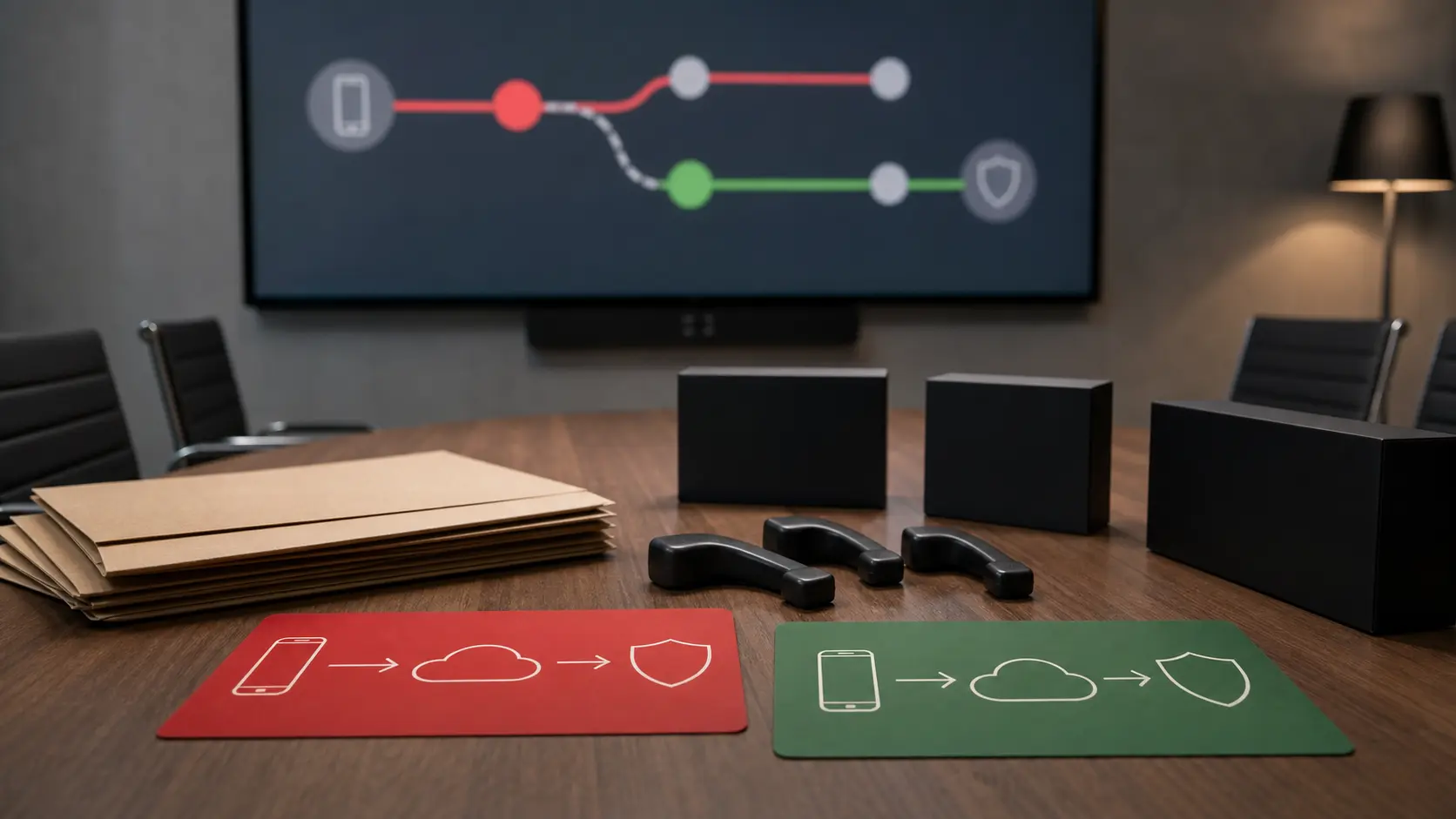
That sequence creates two restoration clocks. The first clock concerns the mass retail service: can ordinary customers make calls and use data? The second clock concerns the critical path: can a person in distress reach Triple Zero, have the call carried or fall back to another mobile network, reach Telstra in its Emergency Call Person role, transfer to the requested police, fire, or ambulance service, and be followed up if the attempt fails? The public consequence attaches to the second clock, because one failed emergency call can matter even when millions of ordinary sessions succeed.
Contemporaneous ABC reporting on the timekeeping technology problem recorded Telstra's account that nodes in Sydney and Melbourne data centres helped synchronise the network, that there was no evidence of malicious activity, and that final root cause remained to be completed. ABC's later report on Triple Zero impact and welfare checks recorded Telstra's explanation that the emergency-call issue persisted after the broader problem was addressed and that the company had initiated hundreds of welfare checks. These sources support a restrained conclusion: the immediate category was a timing-related software defect, not a final public fault tree.
The trust boundary runs through Triple Zero
Australia's emergency-call chain is not one switchboard. A handset must recognize an emergency number and obtain radio access. The mobile carrier must carry the call or permit fallback to another available network. Telstra, as Emergency Call Person for 000 and 112, must answer and transfer the call, along with available location and customer information, to the requested emergency service organisation. ACMA's public emergency calls guidance explains those roles for the public, and the Telecommunications (Emergency Call Service) Determination 2019 sets duties for providers and Emergency Call Persons.
That chain creates multiple trust boundaries. A state emergency service may be ready, but it depends on the carrier and Emergency Call Person to deliver the call. Telstra's national Emergency Call Person platform may be working, but a mobile subscriber may fail before reaching it. A handset may attempt to move to another network, but radio coverage, network selection, and the failed carrier's partial availability can influence whether fallback succeeds. A welfare-check team may receive a list of unsuccessful calls, but it depends on the completeness and timeliness of Telstra's evidence.
The government's initial statement on the Telstra outage said Australian phones are expected to fall back to other networks for Triple Zero access. That expectation is important, but the July event shows why an expected fallback is not the same as a proved fallback. Telstra told customers to retry immediately if a Triple Zero call encountered a problem. That advice may be reasonable during a live fault, but it places part of the safety function on a caller under stress. The architecture must aim to make retry unnecessary, and incident evidence must show when retry was needed.
The minister's 9 July update reported, at that time, that most referred welfare checks had been completed, thirteen reports remained outstanding, and no adverse outcomes had been reported. That is a bounded official claim, not a final root-cause or compliance finding. It should not be expanded into proof that no delay or harm occurred, and it should not be ignored. It marks the state of public harm information at the time and leaves the control question open: why were hundreds of welfare checks necessary after a network event?
Welfare checks reduce risk after an emergency-call failure. They do not make the original call successful. A text, callback, or police visit can reach a person who still needs help, but it happens after time has passed and depends on accurate caller identity, location, and triage information. The legal and operational duty to conduct checks is a backstop. Accountability should therefore treat welfare-check performance as a necessary response control and failed-call prevention as the primary safety objective.
Carrier restoration and public-service restoration are different milestones
Telstra's broad restoration statement did not automatically restore every service that had depended on the network. Victoria's public transport impact illustrates the difference. Transport Victoria's V/Line restoration notice reported that regional train services were resuming from midday on July 9. That was well after Telstra had said the broad mobile problem was resolved the previous afternoon. A rail operator may need stable communications, safety checks, crew positioning, and timetable recovery before restarting service. Carrier health is a prerequisite; it is not the whole recovery.
Payment and small-business effects show the same boundary. ABC's account of how the Telstra outage affected Australians described payment-terminal disruption, transport effects, household and care coordination problems, and business impacts. A merchant with a mobile point-of-sale terminal may be down even if fixed internet still works. A carer may have difficulty coordinating support even if some voice calls have returned. A court or traffic-management centre may need stable communications and evidence of restoration, not only a consumer status page.
That difference matters for incident closure. The provider can close the network incident when service metrics meet its criteria. Public agencies and businesses close their continuity incidents when their own critical functions have returned to a safe state. Those closure points may be hours apart. A carrier that reports only aggregate restoration can leave downstream operators guessing whether to restart operations, keep degraded procedures, or continue welfare checks.
The Telecommunications Industry Ombudsman's statement advised affected customers and small businesses to keep records of impact and loss. Its consumer guidance says business-loss claims generally need evidence of loss and mitigation steps. That advice is practical, but it exposes an asymmetry. Telstra controls detailed service and outage data; a small business often has only failed transactions, customer complaints, and manual notes. A good remediation process should narrow that gap by telling customers when and where their service was affected.
The trust-boundary question is therefore documentary as well as technical. If a train operator, merchant, carer, or public agency depends on a carrier, what evidence does the carrier provide that the relevant service path is restored? Does the notice distinguish ordinary voice, data, SMS, emergency access, roaming fallback, business mobile, enterprise links, and low-volume public-service functions? Does it state residual error rates or only broad restoration? Without that evidence, downstream recovery becomes an act of trust rather than a controlled decision.
Timekeeping is a shared dependency, not a peripheral feature
To a mobile customer, network timekeeping can sound like a background detail. In a digital mobile network, time is part of the control fabric. Authentication, session freshness, event ordering, radio coordination, logging, certificate checks, billing, and failure correlation can depend on systems agreeing about time. A clock or time-distribution defect can therefore create effects that look intermittent at the user edge while spreading through control functions.
The public record does not yet establish the exact protocol, vendor, software version, maintenance trigger, or internal logic behind Telstra's July 2026 event. A responsible article should not invent one. Telstra's statement and the cited reporting support only a bounded statement: nodes responsible for keeping time across parts of the mobile network were not operating as expected, Telstra attributed the immediate issue to a software defect, and final root cause analysis remained outstanding in the cited public record.
Even with that restraint, the control questions are concrete. Were the time sources diverse by technology and administration? Could one software defect affect nodes in multiple data centres? Did dependent platforms reject implausible time shifts? Was there a holdover mode? Could one region quarantine suspect time state while another continued? Did emergency-call validation run as its own critical check after ordinary traffic improved? Were failed emergency attempts visible from the edge or only after reconciliation?
Redundancy should be measured by independent fate, not by component count. Two nodes in two cities do not provide independent protection if the same defect or control message can affect both. A fallback path does not provide emergency continuity if the failed home network still appears available enough to prevent clean alternate-network selection. A welfare-check process is not complete if it cannot reconcile every unsuccessful call, later successful call, duplicate attempt, police referral, and assistance outcome.
This is where telecom spectrum and security meet operational resilience. Mobile networks use licensed spectrum, national numbering, device behavior, roaming arrangements, identity functions, and emergency-service obligations. A carrier's private software defect can therefore become a public safety question. The public does not need every sensitive technical detail, but it needs enough post-incident evidence to know whether the shared timing dependency has been isolated, tested, and monitored as a critical control.
Previous emergency-call incidents set the control context
The July 2026 event should not be merged technically with Telstra's earlier emergency-call incidents. The mechanisms differ. The reason to include them is not to claim one recurring root cause. The reason is that they define known control questions around fallback, visibility, change management, contact accuracy, and repair evidence.
In May 2018, Telstra experienced Triple Zero disruptions tied to a combination of transmission-network issues, a fibre fire, and router software faults. The Department of Communications and the Arts published an investigation report into the May 2018 disruptions. ACMA later accepted a court-enforceable undertaking recording 1,433 emergency-call carriage failures and Telstra commitments on monitoring, software, infrastructure, and crisis management. The relevant lesson is that nominal diversity can fail when physical, software, and routing conditions combine.
In March 2024, the failure was in the Emergency Call Person platform rather than mobile access. Telstra's public report on the 000 outage attributed the event to a large wave of registration requests from medical alert devices, database session exhaustion, and a latent software fault that prevented automatic recovery. ACMA's final investigation report found 473 regulatory breaches involving failures to transfer live calls and failures to provide required location and customer information. ACMA's penalty announcement recorded the more than $3 million penalty.
In July 2024, a server migration disabled the 106 text emergency relay service for nearly thirteen hours. ACMA's June 2025 enforcement notice said no emergency call was attempted during the outage, but Telstra paid the maximum available penalty and gave an undertaking. That incident matters because low-volume critical services cannot rely on demand to reveal failure. They need synthetic checks, explicit post-change validation, and executive visibility even when no one happens to call.
Together, these events create an accountability backdrop for July 2026. Telstra and regulators already had formal notice that emergency-call chains can fail through hidden common modes, stale backup contacts, low-volume service invisibility, and change-control gaps. The July 2026 question is therefore not whether an earlier router fault caused a later timing defect. It is whether the control lessons about fallback testing and evidence survived across different parts of the emergency chain.
Notification thresholds should reflect downstream dependency
ABC's report on notification timing said Telstra identified the issue early, published a short website notice and media response, and notified the minister's office later, while Telstra defended its threshold-based process. Both positions can be true: a carrier can follow its internal threshold and still discover that the threshold does not reflect the speed with which transport, payments, emergency access, and public concern are affected.
Australia now has stronger outage-communication rules. The Telecommunications (Customer Communications for Outages) Industry Standard 2024 sets communication duties for significant and major outages. ACMA's plain-language guidance explains thresholds, update intervals, stakeholder notices, and outage-register obligations. Telstra's historical outage register is part of that newer public visibility framework.
Communication rules are necessary but incomplete. A threshold based on expected duration or service count may lag an event whose highest consequence appears in emergency calls, rail operations, or payment devices before a full root cause is known. The status message should not wait for final diagnosis to say what is observed: mobile voice and data instability, possible critical-service effects, emergency-call fallback advice, next update timing, and direct contacts for emergency organisations and public agencies.
The government's press conference transcript from the event shows why shared numbers matter. Welfare-check counts were changing as Telstra, emergency services, and police worked through unsuccessful calls. Public officials needed an event ledger with consistent definitions: unsuccessful attempt, dropped call, later successful call, text contact, voice contact, police referral, assistance needed, duplicate, and unresolved report. Without shared definitions, public communication becomes a contest of partial counts.
Providers should also preserve independent communication paths. If a customer-status page, contact centre, internal messaging channel, and stakeholder-notice path all depend on the impaired network or the same identity service, communication fails with the incident. Emergency organisations, transport agencies, payment providers, and large public customers need authenticated direct channels. Ordinary customers need accessible public updates that do not require the affected mobile data service.
Downstream parties have real duties too
Assigning Telstra's carrier responsibilities clearly does not make downstream parties passive. Transport agencies, merchants, payment providers, local councils, health services, carers, and small businesses depend on telecom networks. They cannot repair Telstra's timing nodes, but they can decide which functions require independent paths and which can safely stop.
For rail and transport, the question is safe degraded operation. If train movements require stable Telstra communications, then loss of Telstra may justify suspension. That can be the right safety decision. The accountability issue is whether the operator had a tested alternate, whether the public was told clearly, and whether restoration required carrier evidence beyond a generic status update. A safe stop is better than unsafe continuation; a tested alternate may prevent unnecessary stoppage.
For merchants and SMEs, the question is proportional continuity. The NSW Small Business Commission's submission to the Optus outage review explained that businesses often do not realize payment terminals and other services share telecom dependencies. That lesson applies to Telstra's 2026 event. A cafe, clinic, tradesperson, or regional shop can keep a different-carrier hotspot, know its terminal fallback, retain offline bookings, and record losses. It cannot guarantee a national carrier will not fail.
For emergency service organisations and police, the question is welfare-check capacity and data quality. They need timely caller lists, reliable contact information, location where available, clear triage criteria, and ways to close each record. They also need to know when the carrier believes the issue is fixed and whether failed-call detection continues. The welfare-check process is a joint safety control, and its evidence should be reconciled after the incident.
For regulators, the question is independent verification. ACMA should evaluate compliance under the emergency-call and outage-communication rules. The Triple Zero Custodian process and the Department of Infrastructure's Triple Zero Legislative and Regulatory Review page show that policy work is continuing. The July event should feed into that review without assuming its final conclusions.
Welfare-check evidence should be a safety ledger
The welfare-check process is the clearest place where the carrier's evidence crosses into a third-party safety operation. Telstra can identify unsuccessful or dropped attempts from its systems and Emergency Call Person records. Police and emergency organisations can conduct callbacks, texts, physical checks, or triage. The public sees a count. But safety depends on the reconciliation behind the count: every failed attempt should have a state, an owner, a time, and a closure reason.
A usable ledger would separate several categories that are often blurred in public updates. One call may have failed and then succeeded on retry. Another may have failed and led to a text response. Another may have been a duplicate attempt by the same caller. Another may have been placed on behalf of someone else, making callback less reliable. Another may have produced a police referral, while another may have required ambulance, fire, or police response. Another may have been unreachable and unresolved for a period. Treating all of these as one welfare-check number hides the control performance.
The timing of each step matters as much as the final category. An emergency call is a real-time transaction. A callback ten minutes later and a welfare visit an hour later can be lifesaving, but they are not equivalent to immediate connection. The after-action record should measure time from failed call to detection, detection to first contact attempt, contact attempt to referral, referral to completion, and completion to final reconciliation. It should also record whether a later successful Triple Zero call closed the matter and whether the original failed-call signal was retained for audit.
This is not a demand to publish personal information. Aggregated ranges, counts, and definitions can be public; detailed personal records can remain protected. What should not remain invisible is the shape of the safety response. If the public is told that no adverse outcomes were reported at a certain time, it should also understand the basis for that statement: how many records had been closed, how many remained open, and what counted as an adverse outcome. Otherwise the absence of reported harm can be mistaken for proof that the emergency-call control worked.
The March 2024 Emergency Call Person incident shows why this evidence style matters. ACMA's report separated live-transfer failures, location-information failures, and backup-contact errors. That separation made the control problem visible. July 2026 needs the same discipline across mobile access, alternate-network fallback, Emergency Call Person handoff, and welfare action. A single reassuring number cannot carry all of that meaning.
Emergency fallback needs live-path testing, not paper architecture
Alternate-network emergency calling is a powerful public-safety concept. It is also easy to overstate. The relevant question is not whether a handset can use another network when its own network is absent in a clean laboratory condition. The relevant question is whether it uses another network when the home network is partly visible, time state is unstable, call setup returns an error, and the caller is moving through real coverage conditions.
Testing that path is difficult because emergency numbers cannot be used casually and production networks cannot be destabilized for experiments. That makes formal test methods more important, not less. Carriers, emergency-service organisations, handset vendors, regulators, and the Triple Zero Custodian need sanctioned test environments and controlled production assurance that verify the path without generating unsafe live emergency traffic. They also need to test across device generations, SIM states, coverage edges, and network technologies because fallback behavior may differ in the places and moments where it is most needed.
The July 2026 public record says affected callers may have received an error before the handset attempted to connect through another mobile network. That detail should become a test case. Under what exact error conditions does the handset retry another carrier? How long does it wait? What happens if the home network is still broadcasting but cannot complete the call? What happens if another carrier is present but signal quality is weak? What happens if the caller is indoors, on a regional road, or in a congested cell? These are engineering questions with human consequences.
Emergency fallback also requires capacity and operational coordination. If a large carrier has a national fault, another network may suddenly receive emergency attempts from people who are not ordinary subscribers. That network must be able to process the calls, route location information where available, and coordinate with the Emergency Call Person. Mutual assistance is useful only if the receiving path can carry the sudden demand without creating its own instability.
The public should be cautious about slogans such as "all phones will just use another network." The right promise is narrower and more testable: under defined failure conditions, supported devices should attempt emergency access through available alternate networks, and carriers should publish evidence that this has been tested. That is less soothing than a slogan, but it is more reliable.
Downstream restoration should have its own exit criteria
Transport, payments, care, and small-business services should not wait for a carrier's broad green status before defining their own recovery. A train operator may need radio checks, driver communications, station coordination, and passenger information to be stable. A payment provider may need terminal reconnection, transaction queue reconciliation, fraud monitoring, and merchant guidance. A care provider may need staff contact, patient or resident records, and emergency calling. A court may need parties, custody, remote appearances, and filing communications to be reachable.
Each of those functions should have exit criteria. For transport, the criteria might include tested command communications on primary and alternate paths, confirmation of control centre contact, and public timetable updates. For payments, the criteria might include terminal-success rates by network path, queue status, and merchant advisories. For care services, the criteria might include access to records, staff call tree completion, backup devices, and emergency-call confirmation. The carrier's notice is an input, but the service owner must decide when its own function is safe.
This is the practical meaning of public-sector continuity. A city, state agency, or operator does not need to duplicate every Telstra function. It needs to identify which services have low tolerance for telecom disruption and which fallback is credible. Some functions can pause safely. Some can continue manually. Some need carrier diversity. Some need satellite, radio, fixed-line, or in-person procedures. The accountable act is to sort those functions before an outage rather than improvising all of them after a status alert.
For small businesses, exit criteria should be modest and usable. Can staff contact each other? Can the business accept at least one payment method? Can customers be told what is open or closed? Can appointments or orders be recorded offline? Can the owner document outage effects for the ombudsman or insurer? The business does not need a complex continuity department. It needs a few tested decisions that do not depend on the failed mobile service.
Telstra can help by making restoration notices more granular. A message that voice and data are restored is helpful. A message that business mobile services, emergency-call access, public alerting, enterprise data, and known downstream issues have been separately validated is better. If some functions remain under observation, that should be stated. Downstream operators can then avoid restarting on a false assumption that a broad network metric equals their own recovery.
Current rules should be tested against this exact event
The 2024 customer-communication standard and ACMA guidance are new enough that the July 2026 outage is an early stress test. The review should ask not only whether Telstra met each formal notice interval, but whether the rule design produced useful warnings at the right time. Did the threshold capture public-service effects early enough? Did required channels reach people who had no mobile data? Did stakeholders receive direct, actionable messages? Did updates distinguish broad mobile service, emergency access, and downstream critical functions? Did the outage register add clarity during or only after the event?
Rules are often judged by compliance checkboxes because checkboxes are easier to audit. A national outage requires a stronger question: did the rule change behavior while people still needed to act? If the first notice simply confirmed what customers already knew from failed calls and terminals, it was late in operational terms even if it met a formal interval. If the notice did not say what to do about Triple Zero problems, payment devices, or transport disruption, it was incomplete for the people facing those risks.
Regulators should also examine the relationship between the emergency-call determination and outage-communication duties. Welfare-check duties arise after identifiable unsuccessful emergency calls. Communication duties warn before or during broader outages. The two should reinforce each other. If emergency-call anomalies appear, they should escalate public and stakeholder notice quickly. If a major mobile outage is detected, emergency-call synthetic checks and Emergency Call Person coordination should be immediate exit criteria, not downstream afterthoughts.
This is not a call for public release of sensitive network details. It is a call for public release of control categories and outcomes. The public can be told that emergency-call access was tested across representative regions and devices, that fallback succeeded or failed under defined conditions, that welfare-check reconciliation closed every record, and that a root-cause fix was deployed and exercised. Those statements can be verified by the regulator without publishing exploitable configuration.
What proof should follow the July 2026 event
The most important follow-up is a final public root-cause report with sensitive details protected but control evidence visible. It should state the initiating event, affected components, failure propagation path, independence of time sources, why multiple nodes shared the defect, what monitoring first detected, when emergency-call anomalies were seen, why the emergency issue survived broad restoration, and what permanent change prevents recurrence. If the final cause differs from the early software-defect category, the report should say so.
The emergency-call evidence should be reconciled separately. How many attempted Triple Zero calls failed, dropped, retried, succeeded through another path, required text contact, required voice contact, were referred to police, produced emergency-service assistance, or remained unresolved at each public update? What were the time intervals from failed call to welfare action? Which handset or coverage conditions affected fallback? Did callers receive an error before alternate-network attempt, and under what conditions did that alternate attempt succeed? Those questions do not require naming private callers. They require a clear safety record.
Downstream recovery should also be documented. Rail operators, payment providers, courts, councils, health services, and other affected public or commercial systems should publish or retain bounded after-action notes. The point is not to blame every affected party. It is to learn which services treated Telstra restoration as sufficient and which needed their own validation. A carrier outage becomes a sector lesson only when the dependencies are visible.
Telstra should also define what counts as restoration for critical services. Ordinary service metrics, emergency-call test results, Emergency Call Person handoff, state emergency-service acknowledgement, welfare-check reconciliation, public alerting, enterprise mobile, business data, and low-volume emergency relay services should not be folded into one green indicator. A public status page can summarize, but internal exit criteria should be service-specific.
The evidence also has to cover handoffs, because this incident was not contained inside one carrier dashboard. A failed emergency attempt became a record for the Emergency Call Person, a possible welfare task for police, a possible communication problem for ambulance or fire services, and a possible continuity problem for transport or commerce. Each handoff can lose time, context, or ownership. The after-action test should therefore ask whether the record moved with the caller's risk, not only whether the network eventually returned to normal.
The Telstra incident is not just a question of whether a mobile network failed. It is a question of who had practical control over each boundary in a public-service chain. Telstra controlled the carrier functions, timing architecture, validation, customer notice, and Emergency Call Person obligations. Other carriers and handset behavior shaped fallback. State services and police controlled welfare response. Transport, payment, and business operators controlled local continuity. Regulators controlled compliance review and future rule design.
Accountability becomes useful only when those roles are visible and when restoration is proved at the function people actually needed, not at the broadest network average.
Additional evidence boundary
For Telstra made emergency-call fallback a third-party trust boundary, the additional evidence boundary is to keep confirmed facts, evidence-backed inference, and unknown information separate. That separation matters because an event involving telstra third party trust boundary can be described as a technical problem, a contract problem, or a communications problem depending on which actor is speaking. The accountability analysis therefore has to return to practical control: who could change the configuration, limit exposure, accelerate detection, authorize notification, or prove that repair had reached the affected users.
This lens adds a careful test of root cause and triggering event. The trigger explains why the event became visible at a particular moment; the root cause requires evidence about design, control, governance, and verification choices that existed before that moment. Contributing conditions such as dependency, delegation, change windows, contracts, logs, and incentives should be evaluated without treating a company statement as the complete truth or turning a possibility into a settled conclusion.
The same discipline applies to detection failure, response failure, and recovery failure. The public record should show when the signal was seen, who had authority to act, what customers or regulators were told, and which additional evidence would make the conclusion stronger or weaker. While those elements remain partial, the responsible conclusion is not an extra accusation; it is a more precise map of responsibility, uncertainty, and the third-party trust controls that a later audit should verify.