
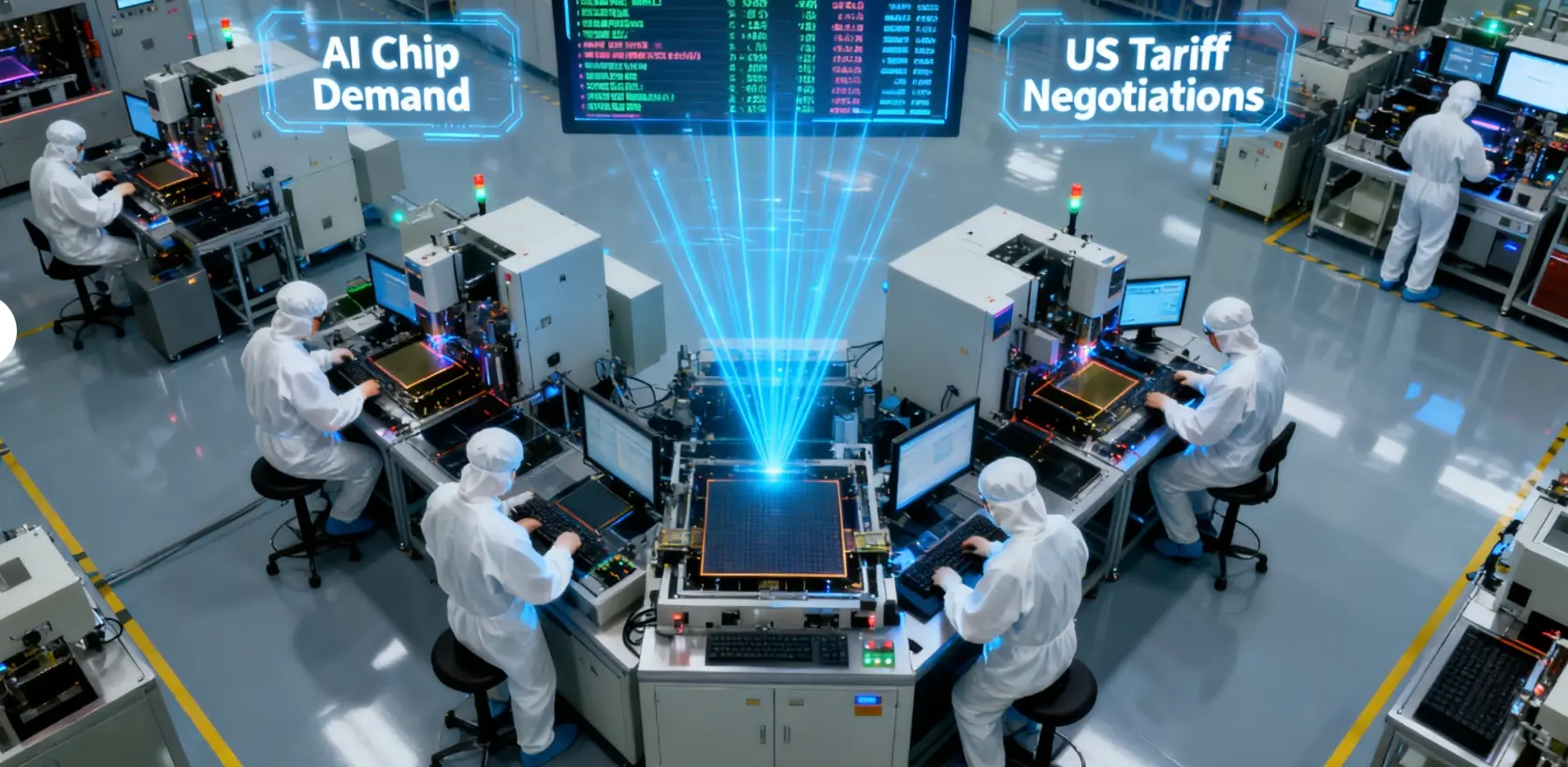
South Korea eyes cooperation with Taiwan on U.S.
- South Korea proposes strategic alignment with Taiwan to secure favourable U.S. tariff terms.
- Semiconductor exports to the U.S. rose sharply in October, highlighting geopolitical stakes in the tech sector.
What happened: South Korea may cooperate with Taiwan on U.S. chip tariffs
South Korea’s Trade Minister, Yeo Han-koo, indicated on Monday that Seoul sees potential for cooperation with Taiwan regarding U.S. semiconductor tariffs. In a radio interview, Yeo noted that “Taiwan is also in negotiations, so there is room for South Korea and Taiwan to get the most favourable treatment through cooperation.”
Earlier this month, South Korea concluded a trade deal with the United States aimed at reducing tariffs, contingent on substantial South Korean investments in U.S. strategic sectors. While Taiwan’s negotiations are still ongoing, the U.S. assured Seoul that semiconductor tariffs would be “no less favourable than terms that may be offered in a future agreement covering a volume of semiconductor trade at least as large as South Korea’s,” implicitly referencing Taiwan as a key competitor.
Customs data showed South Korea’s semiconductor exports to the U.S. rose 51.2% to $1.2 billion in October, reflecting growing demand for advanced chips used in artificial intelligence applications. Despite these developments, U.S. officials are reportedly considering delaying the implementation of long-promised tariffs, potentially complicating the dynamics of South Korea-Taiwan cooperation.
Also Read: South Korea launches Presidential AI Committee to pursue Top-3 status
Also Read: U.S. chip export controls target China, allies exempted
Why it’s important: South Korea–Taiwan chip cooperation may affect trade, but benefits are uncertain
The semiconductor sector is central to U.S.-Asia trade relations, and any alignment between South Korea and Taiwan could influence tariff negotiations and supply chain strategies. Such cooperation may strengthen their negotiating positions, yet questions remain about the practical benefits, especially if the U.S. delays tariffs or modifies terms.
Furthermore, the rapid growth in AI-driven chip demand amplifies the economic and strategic significance of semiconductor exports. South Korea and Taiwan, as leading chip producers, could leverage collaboration to secure market advantages, though geopolitical tensions in the region—particularly around Taiwan—pose potential risks.
As the U.S., South Korea, and Taiwan navigate these complex trade and strategic issues, observers will watch closely to see whether coordination translates into tangible economic gains or merely a diplomatic signalling exercise.
Member Briefing
Deeper Profile Context
Sign in with the right membership level to unlock the full briefing and source notes.
Only for Strategic Circle
Strategic Circle
Open to all readers. Unlock profile briefings after joining and signing in.
Join Strategic CircleOnly for Leadership Alliance
Leadership Alliance
For qualified IP-asset owners and management; sign in to unlock alliance briefings.
Join Leadership AllianceSnapshot
Category
InstitutionRegion
ASIA PacificSignal Focus
MarketContent Type
ProfilePrimary Domain
TechnologyTopic
MarketImpact
MediumConfidence
Limited confidence (72%)Confidence score guide
Several public sources