
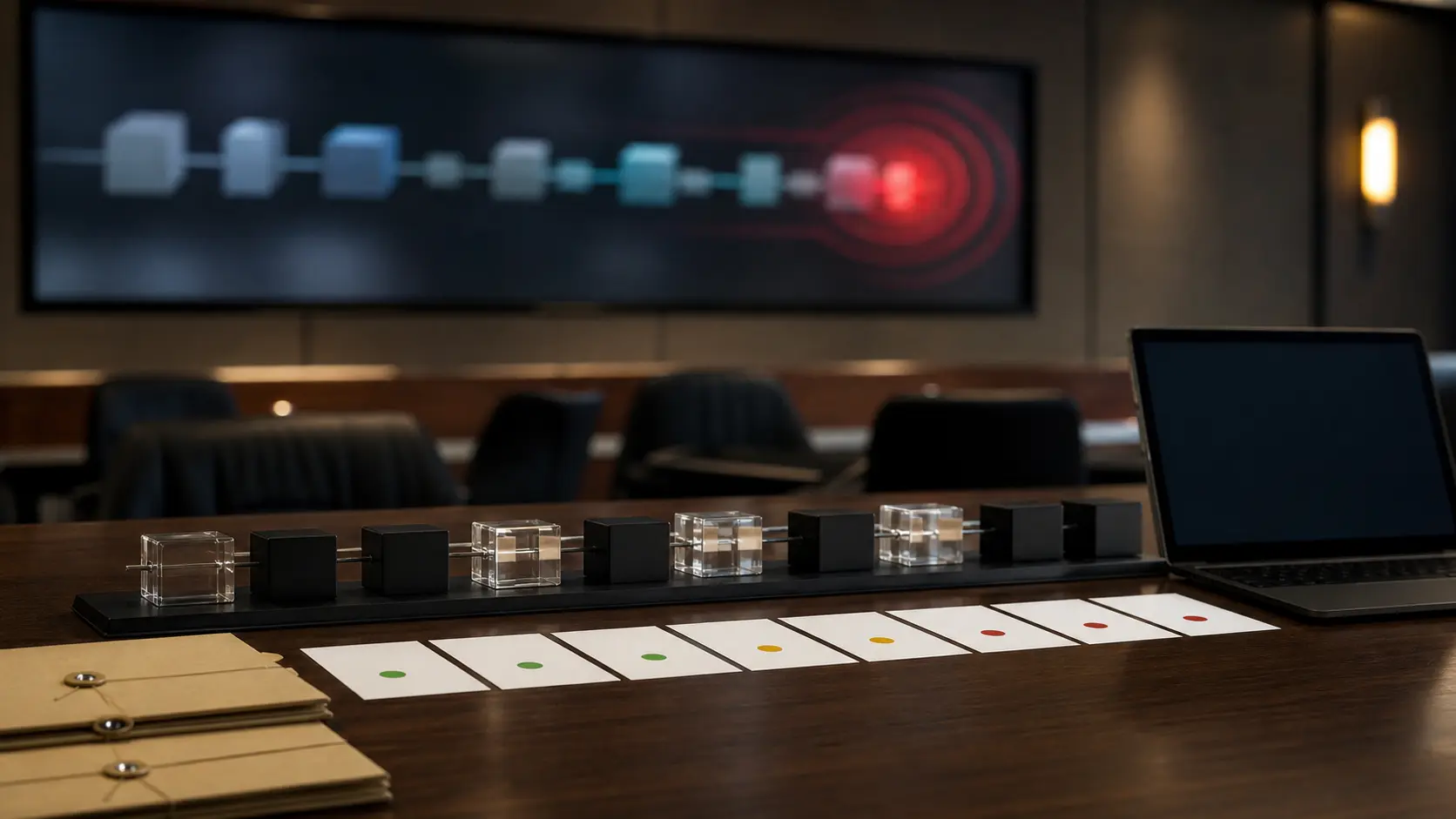
Summary
- The confirmed trigger was the public exposure of SUNBURST in December 2020 after malicious code had already traveled through SolarWinds' trusted Orion update channel. The deeper accountability issue is the delay between build compromise, customer exposure, outside discovery, public disclosure, emergency government action, and later evidence that the release path had become harder to subvert silently.
- The public record supports a build-environment compromise and signed distribution of affected Orion releases, not a finding that every customer receiving an affected package suffered follow-on exploitation. Counts such as fewer than 18,000 potential installations, nine affected U.S. federal agencies, and fewer than 100 non-government organizations with follow-on compromise describe different denominators.
- SolarWinds controlled the production and signing path, release provenance, build monitoring, and first customer notice. Customers controlled segmentation, Orion privilege, logging, independent monitoring, and cloud identity recovery. CISA and other agencies controlled emergency coordination, compulsory federal action, and post-incident learning. Investors and disclosure systems depended on bounded, timely statements rather than perfect technical certainty.
- A defensible repair record is not a list of tools installed after the incident. It is evidence that an attacker modifying a build worker, signing pipeline, or release artifact would now encounter independent comparison, durable logs, separated credentials, customer-visible advisories, and federal procurement pressure that shorten the next detection path.
Detection delay is the control surface
The SolarWinds incident is often compressed into one phrase: a poisoned update. That phrase is accurate enough to identify the delivery mechanism, but it hides the most important time question. The hostile code was not discovered when the build process first became unsafe. It was not discovered when the attackers tested build manipulation. It was not discovered when affected releases were shipped. It was publicly exposed only after FireEye investigated its own intrusion and published its technical report on SUNBURST in December 2020.
The edge of accountability is therefore the interval during which the supplier's production process, customer environments, and federal detection systems failed to make the trusted update visibly untrustworthy.
That does not mean SolarWinds alone caused every hour of delay. The Russian SVR, as later assessed by U.S. authorities in the joint CISA, NSA, and FBI advisory, deliberately designed an espionage operation to stay quiet. SUNBURST delayed execution, avoided analysis conditions, blended into Orion behavior, and selected only some victims for follow-on access. A patient intelligence service is responsible for deception. But deception does not erase the control duties held by the software producer, by customers that installed a privileged network-management product, or by public bodies that relied on commercial code for government continuity.
The accountable question is practical: who could have made the interval shorter? SolarWinds could have compared build artifacts against approved source states, isolated signing from build workers, monitored transient file substitution, retained high-value logs, and given customers precise exposure categories once the issue was known. Customers could have limited Orion's outbound access, kept DNS and identity logs outside the management plane, and treated Orion as a high-consequence dependency rather than an ordinary monitoring utility.
Federal agencies and CISA could require rapid isolation, share indicators, and convert individual discoveries into systemwide action. Investors and disclosure systems could demand statements that distinguish confirmed facts from estimates and unresolved questions.
The delay also changes how repair should be measured. A patch that removes SUNBURST closes one known artifact. It does not prove that the software factory would detect the next build-time substitution. A press release gives reassurance. It does not prove that release provenance is independently checked. A dismissed enforcement case ends one legal dispute. It does not certify the technical strength of the build pipeline. The missing edge of supply-chain accountability is detection proof: evidence that the next compromise would be seen sooner by the party best positioned to see it.
The public timeline begins before public knowledge
The most useful timeline starts when the hostile process became capable, not when the public first heard the name SUNBURST. SolarWinds' January 2021 investigation update reported that attackers had performed a test modification in October 2019, that SUNBURST injection began in February 2020, and that malicious code was removed from the build environment in June 2020. SolarWinds' later May 2021 investigative update said the company could not determine the precise initial access method, but found evidence of access and reconnaissance preceding the operational backdoor.
That sequence means the release process had at least three missed visibility points. The first was unauthorized access to development or corporate systems. The second was the October 2019 build manipulation test. The third was the February-to-June 2020 period when malicious code was introduced into Orion builds and then distributed as SolarWinds-signed software. Each point involved a different control family. Identity and endpoint controls could detect the initial intrusion. Build integrity controls could detect transient source substitution. Release and customer telemetry could detect unusual artifact behavior after distribution.
The public record does not show any of those controls stopping the operation before customer exposure.
CrowdStrike's SUNSPOT technical analysis makes the second point especially important. SUNSPOT watched for the build process, recognized the Orion solution, temporarily replaced a source file during compilation, and restored the original file after the build. This was not a normal source-code commit waiting to be caught in review. It was an attack on the gap between the approved code base and the produced artifact. If the release system did not independently prove that the artifact came from the approved source, the attacker could let code review succeed while the compiled output changed.
The December 2020 disclosure interval is just as important. SolarWinds' December 14, 2020 Form 8-K estimated that fewer than 18,000 customers may have installed affected releases and described the company's customer notification and remedial action. CISA issued its initial active exploitation alert and federal emergency direction at speed once the matter became public. Fast response after discovery was real. It must be analyzed separately from the months of undetected exposure before FireEye's discovery forced the issue into view.
The later legal record adds another time layer. The SEC brought claims in 2023, summarized in its litigation release, and the Southern District of New York narrowed those claims in a 2024 opinion and order. In November 2025 the SEC dismissed the remaining action with prejudice, as recorded in Litigation Release No. 26423. That legal progression is not a build-security audit. It shows that disclosure liability, securities pleading, and operational accountability have different burdens of proof.
Root cause, trigger, and contributing conditions are different things
The trigger for public action was disclosure in December 2020. The root accountability problem was earlier: a trusted build and release process could be changed without the change being detected before distribution. Contributing conditions included a privileged product, a sophisticated actor, long-lived access, customer trust in signed updates, insufficient visibility into build provenance, and limited customer ability to observe the producer's private factory. Keeping those categories separate prevents both overstatement and evasion.
The hostile actor's responsibility is direct. The operation was malicious, deceptive, and aimed at espionage. U.S. government attribution to the SVR supplies the geopolitical context. It does not answer whether the supplier's build controls were proportionate to the consequence of Orion's role in federal and enterprise networks. A producer of privileged administrative software cannot treat a state actor as an unforeseeable category. It may not be able to defeat every operation, but it can design the production path so that one compromised workstation or build worker does not silently become a signed release.
SolarWinds' responsibility is not a claim that it intended harm or that every allegation in later litigation was true. The confirmed operational fact is narrower and still severe: affected Orion releases were produced and signed through legitimate channels. SolarWinds' 2020 Form 10-K described the affected releases, potential customer population, costs, and ongoing investigation. The company also published useful technical information and remediation claims. Those actions count in the response record. The adverse control fact remains that customers learned of the compromised update after distribution, not before.
Customer responsibility begins where Orion entered their networks. Orion was not a decorative application. It monitored infrastructure, often held useful credentials, and could sit close to routers, servers, identity systems, and cloud management paths. Customers could segment the Orion server, restrict outbound communication, enforce least privilege for service accounts, retain logs outside the system being monitored, and monitor unusual DNS or HTTP behavior. Those measures could not prove SolarWinds' build was clean, but they could reduce the chance that a signed implant became a broad identity compromise.
Federal responsibility is different again. CISA could not inspect SolarWinds' build workers before the incident. Once the compromise became visible, however, federal agencies had to convert incomplete technical signals into compulsory action. CISA's emergency measures and later eviction guidance recognized that replacing a DLL was not enough when follow-on access could involve Active Directory and Microsoft 365. The federal role was to preserve public-sector continuity by forcing isolation, coordinating evidence, and telling agencies that ordinary patch thinking was inadequate.
A signed update authenticated origin, not innocence
The attack succeeded partly because a valid signature carries social meaning beyond its technical scope. A signature says that the artifact was signed by the holder of the signing authority and was not modified after signing. It does not, by itself, prove that the artifact was produced from reviewed source, that a build worker was clean, that dependencies were approved, or that a malicious substitution did not occur before the signature was applied. In SolarWinds, the signature helped deliver trust in the compromised artifact because the compromise happened upstream of signing.
That distinction matters for customers and procurement teams. The correct lesson is not that signatures are worthless. Unsigned updates would be worse because customers would face counterfeit downloads and tampering in transit. The lesson is that signing has to be supported by provenance. The release system should be able to identify which source revision, dependency set, builder, test results, policy approvals, and signing decision produced the artifact. If a build output differs from an independently repeated build or from the approved source state, signing should stop until the difference is explained.
NIST's Secure Software Development Framework, SP 800-218, published after the incident, is useful as a control vocabulary rather than as retroactive proof of liability. It emphasizes secure development environments, integrity of source and builds, provenance, and vulnerability response. NIST's Cybersecurity Supply Chain Risk Management guidance, SP 800-161 Rev. 1 similarly frames supply-chain risk as a life-cycle governance problem. The public lesson from SolarWinds fits those concepts: the release artifact must be treated as evidence to be verified, not merely as a package to be signed.
The October 2019 test modification is the warning that should haunt release engineering. A production process that can be altered for a test without detection can later be altered for operational payload. In a mature system, the test should have produced a mismatch, an alert, a failed reproducibility comparison, an unexpected build-worker file event, or a signing hold. It appears instead to have demonstrated to the attacker that the path was viable. That is the practical definition of detection delay inside the factory.
Customers also need to adjust what they ask for. Security questionnaires that ask whether software is signed can miss the decisive issue. Better questions ask whether builds are isolated, whether artifacts are independently checked, whether signing authority is separated from builders, whether logs survive compromise, whether release systems are tested with malicious-build scenarios, and whether customers will receive exposure categories if a producer later learns a release was affected. Procurement cannot see everything, but it can demand evidence of the controls the buyer cannot operate.
The denominator problem shaped disclosure
The number "18,000" remains useful only when its meaning is preserved. SolarWinds estimated fewer than 18,000 customers may have installed affected releases. That is not the same as the number of customers selected for follow-on activity, the number whose cloud identities were abused, or the number suffering confirmed data exposure. The FBI's March 2021 Senate testimony, available through the Department of Justice at this hearing record, used different categories: more than 16,000 affected public and private customers, nine federal agencies with follow-on compromise, and fewer than 100 non-government entities in that follow-on category.
The distinction is not an attempt to minimize the event. A latent administrative foothold delivered to thousands of organizations is a systemic exposure even when the attacker exercises it selectively. It is a reason to be more precise. A customer that downloaded an affected installer, a customer that installed it, a customer whose server beaconed, and a customer whose identities were used for follow-on access face different recovery duties. One may need to update and review logs. Another may need to rebuild an Orion server. Another may need full identity recovery, token invalidation, and cloud forensics.
Disclosure quality depends on these categories. A single public number can either alarm too broadly or reassure too narrowly. SolarWinds had to speak under uncertainty, without direct access to every on-premises installation. Customers held local DNS, endpoint, identity, and cloud logs. Cloud providers held some cross-tenant behavioral evidence. Government agencies held classified or sensitive response details. No one party had the complete denominator on the first public day. A restrained disclosure should therefore state what is known, what is estimated, what evidence customers should check, and when the next update will arrive.
The Department of Justice's January 2021 statement is a useful example of bounded agency communication. DOJ said malicious activity had reached its Microsoft 365 email environment, approximately three percent of mailboxes were potentially accessed, and there was no indication classified systems were affected. The statement did not imply that every agency had the same impact, and it did not convert absence of classified-system evidence into a claim of no harm. That kind of boundary is essential when trust has been damaged but facts remain uneven.
For investors, the same denominator problem becomes securities disclosure risk. A company under attack can be wrong by overstating certainty or by concealing severity. The court record later distinguished between categories of public statements and claims, while the SEC's dismissal ended the enforcement action without turning every technical question into a legal finding. Operational accountability should not wait for a final securities-law answer. The release and notice process still needs to show how it will classify exposure faster next time.
Detection was distributed, but not equal
One of the most tempting but false conclusions is that every party shared equal responsibility because every party had some visibility. SolarWinds, customers, cloud providers, incident responders, and government agencies all saw different parts of the elephant. Their control positions were not equal. Accountability follows the controls each party could actually operate before the event.
SolarWinds had the strongest pre-distribution view of the build environment. It could monitor which processes touched source files during compilation, whether build workers changed state unexpectedly, whether artifacts matched approved inputs, whether signing keys were used only after independent checks, and whether production logs persisted beyond the period an attacker might cover tracks. Customers could not operate those controls. They could only decide whether to trust the resulting release, and most had no practical way to recreate the private build pipeline.
Customers had the strongest view of local behavior after installation. They could see whether Orion contacted unusual domains, whether service accounts were used in unexpected ways, whether administrative hosts initiated cloud identity actions, and whether logs showed lateral movement. The NSA's December 2020 advisory on abuse of authentication mechanisms explained why on-premises privileged access could matter to cloud resources. SolarWinds could not directly inspect every customer's identity tenant, and government agencies could not preserve each enterprise's logs.
CISA and federal coordinating bodies had the strongest systemwide emergency authority once the compromise became public. CISA could require covered agencies to disconnect affected Orion products and could publish technical guidance. The Government Accountability Office's 2022 review of the federal response found substantial coordination but also lessons around access to information, response policies, and supply-chain risk. GAO's separate testimony on agency supply-chain practices showed that many civilian agencies still lacked fully implemented foundational practices.
Those findings do not make agencies the cause of SUNBURST, but they show that public-sector readiness affects the time from outside discovery to coordinated mitigation.
Incident responders had a distinctive bridge role. FireEye made the campaign publicly visible because it investigated its own breach and shared technical evidence. Mandiant's follow-on analyses turned one organization's discovery into global detection logic. That is a strength of the ecosystem, but it is also an uncomfortable fact: the decisive public signal came from an affected customer and responder, not from the original software factory or a federal perimeter program.
The next accountability record should ask how supplier and government detection can catch such a compromise before one customer has to be lucky, skilled, and transparent.
Public-sector continuity included trust, not only uptime
SolarWinds did not create a national blackout. Agencies and enterprises continued to operate. That can make the public-sector impact look less serious than an outage until the nature of the public function is stated. Government continuity includes the ability to conduct work over systems whose confidentiality, identity, and evidentiary integrity can be trusted. A system can remain available while its use becomes strategically compromised.
The compromise affected federal continuity in at least five ways. First, agencies had to isolate or rebuild management systems without losing operational visibility. Second, they had to determine whether unclassified email, policy, procurement, legal, or operational material had been observed. Third, they had to re-establish identity trust where federated authentication may have been abused. Fourth, they needed retained logs to know whether exposure moved beyond an affected binary. Fifth, they had to explain bounded facts to employees, overseers, and the public without disclosing sensitive response details.
CISA's emergency action, CISA's later guidance, DOJ's bounded statement, and the GAO review together show how a confidential compromise can become a continuity event. The public did not need to see every investigative detail to know the event was consequential. Nor did the government need proof of every follow-on action before ordering agencies to remove affected products. Where a privileged management plane is suspect, delay can be more dangerous than temporary operational inconvenience.
The continuity lesson applies to non-government customers too. Enterprises depended on Orion for visibility and administration. If they disconnected it, they lost some monitoring. If they left it in place, they risked preserving a hostile foothold. That tradeoff is a continuity problem generated by trust failure. It resembles the dilemma that appears when a fire alarm system is suspected of compromise: the organization must preserve safety while replacing the tool that normally supports safety.
Public-sector procurement should therefore demand two kinds of evidence from suppliers of high-consequence software. The first is preventive evidence: secure build controls, provenance, vulnerability intake, independent tests, and release-integrity practices. The second is emergency evidence: how quickly the supplier can identify affected versions, classify customers by exposure state, publish indicators, support isolation, and provide legally and technically precise updates. The second set matters because perfect prevention is not available. The value of a supplier during crisis is partly the speed and clarity of its evidence.
Disclosure law and operational duty should not be merged
The SolarWinds enforcement record has become a proxy argument about cybersecurity governance. That is understandable, but it can blur categories. Securities-law disclosure duties ask whether statements to investors were materially misleading under legal standards. Operational accountability asks which controls failed, who had the ability to improve them, and what evidence shows durable repair. Those questions overlap but do not share the same proof threshold or remedy.
The SEC's 2023 case alleged misleading statements and internal-control failures. The 2024 court order dismissed most claims and allowed a narrower portion to proceed at that stage. The 2025 dismissal with prejudice ended the action. A responsible article should neither treat the SEC complaint as established fact nor treat the dismissal as a technical certification. The legal record is part of the accountability environment because it shaped public-company disclosure incentives, but it does not decide the engineering question of whether build integrity controls were strong enough in 2019 and 2020.
Operational reporting should therefore avoid two errors. The first error is enforcement maximalism: treating every bad incident as proof of fraud or negligence. That approach discourages useful disclosure and ignores the reality of sophisticated adversaries. The second error is legal minimalism: treating absence of final liability as proof that no control duty was missed. That approach turns the hardest lessons into courtroom residue and leaves customers without evidence that the next release path is safer.
The correct middle ground is control-specific. If a company controls a build system, it should be able to explain how that system detects unauthorized build-time changes. If it controls signing authority, it should explain how signing depends on independent evidence. If it controls customer notice, it should state known exposure categories and residual uncertainty. If it later claims remediation, it should provide enough information for customers, auditors, and procurement teams to decide whether the detection path has shortened.
Federal acquisition policy moved in that direction after SolarWinds. OMB's M-22-18 memorandum on secure software development practices tied federal supplier attestations to NIST practices. Attestation is not proof by itself. It is a procurement mechanism for shifting secure-development evidence into a repeatable process. Its value depends on whether agencies can test the claims, request artifacts, and act when a supplier cannot support them.
Repair must be measured as shortened time to truth
SolarWinds' May 2021 update described a move toward multiple build environments, separated credentials, and integrity comparison. Its CEO also presented a related architecture in Senate written testimony. Those commitments were responsive to the mechanism because they aimed to force an attacker to compromise more than one build path and to expose mismatch among outputs. The question for accountability is not whether the design sounded reasonable. It is whether later release operations produced evidence that the design worked under test.
Shortened time to truth can be measured. How quickly would the company detect a build worker touching a source file outside the expected process? How quickly would independent builds diverge? How long are logs retained, and are they protected from the identities used by build operators? How often are malicious-build exercises run? How quickly can the supplier identify every customer that downloaded, installed, or ran a specific artifact? How long does it take to publish an initial customer advisory that clearly marks confirmed facts and unresolved points?
The same measurement applies to customers. How quickly can a customer isolate Orion or an equivalent high-privilege product without losing all monitoring? How long are DNS, endpoint, identity, and cloud logs retained? Can incident responders distinguish affected version, beaconing, command-and-control response, and follow-on credential abuse? Is there a break-glass identity recovery plan? Does the organization know which suppliers have privileged update channels into its environment?
For government, shortened time to truth includes procurement and emergency coordination. Can agencies rapidly identify where affected software is deployed? Do contracts require suppliers to provide version, artifact, and customer-impact data? Can CISA compel action while uncertainty remains without freezing necessary public functions? Does a federal response group have direct channels to cloud providers, suppliers, and agency incident commanders? GAO's review shows that coordination improved during the incident, but it also shows why access to complete information remains a policy problem.
This is the most practical meaning of accountability. Blame can be debated for years. Detection latency can be reduced before the next incident. The party that controls a production system should make it harder to hide inside that system. The party that depends on a privileged product should make it harder for that product to become a single path to identity compromise. The party that coordinates public-sector response should make it harder for one discovery to remain one organization's private problem.
The repair record should also include customer-facing drills. A supplier can run internal red-team exercises and still leave customers unprepared if the first public advisory arrives as a vague severity label. A mature exercise would produce a mock affected-version notice, a mock indicator set, a mock list of exposure categories, and a support plan for customers whose local logs are incomplete.
It would test how quickly the supplier can distinguish a download from an installation, how quickly it can tell a customer which products and versions are implicated, and how quickly it can escalate a likely cloud-identity consequence to the right provider and government channel. The result should be measured in hours and evidence quality, not only in the existence of an incident plan.
That point matters because the first message in a supply-chain crisis changes downstream behavior. If a notice says only that a product may be vulnerable, customers may patch and move on. If it explains that a trusted management product may have served as an entry point for identity abuse, customers preserve logs, isolate servers, rotate credentials, and review cloud tenants. If it distinguishes no known contact, beaconing, selected command-and-control, and follow-on activity, customers can prioritize scarce forensic effort. The supplier may not know every answer on day one, but it can still publish the decision tree customers need.
Investors and regulators have a similar need for structured uncertainty. An early filing cannot include a complete forensic report, but it can avoid language that implies certainty where none exists. It can state what is known about affected versions, customer counts, customer notice, business interruption, legal risk, and the investigation's limits. The value of disclosure is not perfection; it is a truthful map of the known and unknown so that markets, customers, and public agencies are not forced to infer severity from silence.
The SolarWinds record therefore turns remediation into a public evidence problem. A private control may be real and still fail to reassure the customers that must bet on it. The supplier does not need to expose secrets or hand attackers a diagram, but it should be able to show the classes of independent checks, the frequency of hostile-build tests, the retention of release evidence, and the customer notice process. Without that, the repaired factory remains partly invisible to the people who are asked to trust it.
Unknowns and disputed points must remain visible
A forensic article should resist the temptation to close every gap. The precise initial entry path into SolarWinds remains unresolved in the public company account. The complete list of organizations that installed affected releases, beaconed, were selected, or suffered follow-on compromise remains incomplete publicly. The full content-level impact across affected government and private environments is not available. Independent release-by-release verification of later build controls is not public. Contract-specific duties and losses differ by customer.
These unknowns do not make the main accountability lesson speculative. The build-time substitution, signed distribution, delayed public discovery, emergency federal action, and need for identity-centered recovery are well supported. Unknowns should shape language. They should prevent claims that every affected installation was fully compromised, that one password caused the whole event, that SolarWinds' post-incident statements were all legally defective, or that the SEC dismissal absolved every technical control.
They should not prevent a clear statement that the production process failed to surface a dangerous alteration before customers received it.
The difference between confirmed facts and supported inference is especially important. It is confirmed that affected releases were signed and distributed. It is supported inference that stronger artifact comparison and build separation could have increased the chance of earlier detection. It is not publicly proved that any one named internal control owner ignored a specific alert that would have stopped SUNBURST. Accountability by practical control avoids that unsupported leap. It asks which organization owned the relevant control, not which individual can be blamed from the outside.
The same restraint applies to remediation. SolarWinds' reported architectural changes are responsive and meaningful, but company-reported design is not independent assurance. CISA guidance and NIST frameworks provide control direction, but they do not prove that each supplier now operates safely. Customer segmentation and logging can reduce blast radius, but they do not shift responsibility for build integrity to customers. A mature record allows several truths to coexist.
That visible uncertainty should become part of the operating file, not a footnote after the crisis. A customer deciding whether to reconnect a management platform needs the supplier's known facts, the supplier's unresolved facts, the customer's own telemetry gaps, and the public coordinator's recommended action all in one decision frame. If those categories are separated early, remediation can proceed without pretending that every exposure question has already been answered.
The SolarWinds lesson is therefore temporal as much as technical. The harm was amplified by the time during which the trusted update channel looked ordinary. The next test of accountability is whether that quiet interval has been shortened: inside the build system, inside customer monitoring, inside federal coordination, and inside public disclosure. A supplier can be a victim and still owe evidence that its factory now tells the truth sooner. A customer can be deceived and still owe evidence that one trusted product cannot own the estate.
A government can respond quickly after discovery and still owe evidence that future supply-chain warnings will be aggregated faster. The measure is not perfect immunity. It is less silent time between compromise and truth.
Additional evidence boundary
For SolarWinds made detection delay the missing edge of supply-chain accountability, the additional evidence boundary is to keep confirmed facts, evidence-backed inference, and unknown information separate. That separation matters because an event involving solarwinds detection disclosure delay can be described as a technical problem, a contract problem, or a communications problem depending on which actor is speaking. The accountability analysis therefore has to return to practical control: who could change the configuration, limit exposure, accelerate detection, authorize notification, or prove that repair had reached the affected users.
This lens adds a careful test of root cause and triggering event. The trigger explains why the event became visible at a particular moment; the root cause requires evidence about design, control, governance, and verification choices that existed before that moment. Contributing conditions such as dependency, delegation, change windows, contracts, logs, and incentives should be evaluated without treating a company statement as the complete truth or turning a possibility into a settled conclusion.
The same discipline applies to detection failure, response failure, and recovery failure. The public record should show when the signal was seen, who had authority to act, what customers or regulators were told, and which additional evidence would make the conclusion stronger or weaker. While those elements remain partial, the responsible conclusion is not an extra accusation; it is a more precise map of responsibility, uncertainty, and the notification and enforcement controls that a later audit should verify.