
Summary
- Serve Robotics should be judged by accepted robot deliveries, not by route demos, robot counts or launch announcements. The durable operating test is whether a customer order can move through dispatch, pickup, sidewalk travel, exception handling, customer handoff and return-to-service without shifting too much work onto remote supervisors, restaurant staff, technicians or city officials.
- The public record shows rapid fleet expansion, platform integrations, improving delivery volume and a claimed high completion rate, but it does not disclose the intervention rate, maintenance burden, robot downtime, incident denominator or actual cost per accepted delivery. That missing operating denominator keeps the investment case unresolved.
- Serve's unit economics depend on fleet density and repeatable routes. If each robot gets enough accepted orders per day, remote assistance is rare, batteries and hardware last, and merchants treat handoff as routine, automation can remove real courier labor. If density is thin or exceptions are frequent, the robot becomes a visible way of relocating work rather than eliminating it.
The accepted delivery is the real product
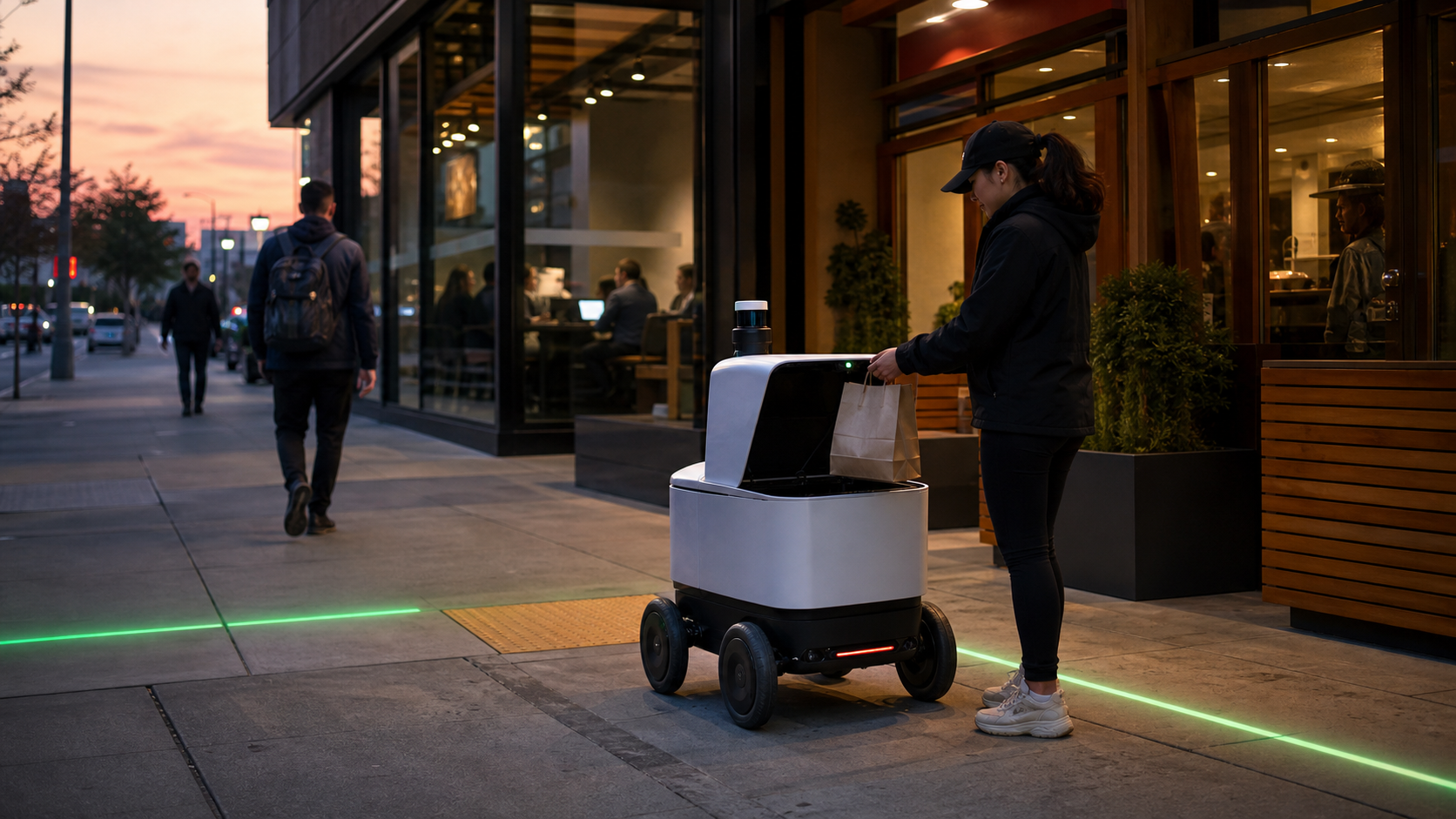
The simplest way to overrate Serve Robotics is to watch one of its sidewalk robots finish a trip and call that automation. A robot that crosses a street, waits politely, blinks at a pedestrian and unlocks for a customer is impressive because it puts autonomy into a public place. But the product Serve sells is not a robot completing a clean route. It is an accepted delivery: an order that a delivery platform, restaurant, customer and city can all tolerate as part of normal commerce.
That distinction matters because sidewalk delivery is not a laboratory problem with one finish line. It is a choreography of small handoffs. A platform has to know when a robot is available and where it can operate. A restaurant has to prepare the order and load it outside or at a designated pickup point. The robot has to navigate sidewalks, driveways, crosswalks, crowds, dogs, scooters, broken pavement, weather, vandalism and signal loss. A customer has to meet it, unlock the compartment, collect the food and close the trip. If any one of those steps fails, a human has to intervene somewhere.
Serve's own public materials point to this whole-chain nature of the task. The company describes platform-level integrations with Uber Eats, a commercial agreement that allowed up to 2,000 robots to be fielded through Uber Eats in multiple U.S. markets, and later expansion toward DoorDash. Uber's merchant-facing robot-delivery material describes the handoff change in deliberately mundane terms: the main workflow difference for staff is that the order goes outside to a robot rather than to a courier, with the robot waiting for staff to load it and with the restaurant tablet providing an alert or unlock code.
That is exactly where the analysis should start. The robot has to be accepted by the systems around it, not only by its own navigation stack.
This is also why "autonomous" is an incomplete commercial word. A delivery may be autonomous for most of its route while still depending on people for dispatch policy, restaurant loading, remote assistance, crosswalk judgment, stuck-robot recovery, maintenance, charging, customer support and city compliance. A high delivery-completion rate is useful only if it is paired with the labor required to achieve it. The central question for Serve is therefore not whether a robot can drive itself. It is whether Serve can make the delivered order cheap enough, reliable enough and socially acceptable enough when the edge cases are counted.
Serve has visible scale, but scale is not the same as productivity
Serve's public story changed during 2025. At the end of 2024, its annual report said the fleet consisted of more than 100 robots and that the company planned to deploy 2,000 robots by the end of 2025. By October 2025, the company announced the deployment of its 1,000th third-generation robot. By the first quarter of 2026, Serve said it had approximately 2,000 robots deployed and was shifting focus from fleet expansion to increasing revenue per robot.
That fleet transition is meaningful. A small sidewalk-robot fleet can operate as a carefully supervised local program. A 2,000-robot fleet, spread across many markets and plugged into large delivery platforms, begins to look like a production system. The daily active robot and supply-hour metrics in the 2025 annual report show why the distinction matters. Serve defined daily active robots as the average number of robots performing daily deliveries during the period. It defined daily supply hours as the average number of hours robots were ready to accept offers and perform deliveries.
In the fourth quarter of 2025, daily active robots reached 547 and daily supply hours reached 6,676, up from 57 and 455 in the fourth quarter of 2024. For full-year 2025, the averages were 273 daily active robots and 3,196 daily supply hours, compared with 52 and 401 in 2024.
Those numbers are more useful than the headline robot count because they get closer to productive capacity. A robot in a press release is not the same as a robot generating accepted delivery work. A robot sitting in a depot, waiting for repair, charging too long, blocked from a market, not integrated into a dense route area, or available at a time when restaurants have little demand is technically part of the fleet but economically idle. The supply-hour measure at least asks how many hours the fleet is ready to accept work.
Even supply hours are not enough. An hour of supply in a dense neighborhood with many short-distance restaurants is worth more than an hour in a sparse market where orders are too far apart or handoff points are awkward. The number that would answer the commercial question is accepted deliveries per robot hour, with the associated support labor, downtime, customer failure rate and maintenance cost. Serve does not disclose that full operating denominator in the public record reviewed here.
It discloses growth, fleet size, supply hours and revenue categories, but not enough to calculate whether the average accepted sidewalk delivery is profitable.
That does not make the company weak. It means the proof has moved from deployment to utilization. Serve has built the base of a scaled fleet. The harder job is making each deployed robot matter economically every day.
The remote-assistance rate is the hidden labor line
Serve's public materials repeatedly emphasize autonomy, but they also show why supervision remains central. The company says trained supervisors are available during operations and can step in when needed. Its safety and FAQ material refers to defined operating domains, remote pause or stop capability, monitoring and coordination with city officials. Its software platform material presents remote control and supervision as part of the operating stack. A partner case study describes the robot system as involving perception, localization, planning, connectivity and remote supervision.
That is not a criticism. A supervised autonomy system in a public sidewalk environment should have a way to stop, help or recover a robot when something unusual happens. The commercial problem is that each assistance event has a cost. If a robot rarely asks for help, one supervisor can cover many machines and the human labor content per delivery can fall sharply. If robots frequently need help at intersections, crowded patios, blocked ramps, delivery doors, construction detours or bad network zones, the automation saving shrinks.
The public record does not disclose a remote-assistance rate for Serve's production deliveries. It does not say how many deliveries require a supervisor to advise the robot, take control, call a restaurant, call a customer, redirect a trip, recover a stuck unit or dispatch local staff. It does not disclose the ratio of supervisors to active robots in each city or how that ratio changes during peak lunch and dinner windows. It does not disclose how much operator time is consumed by completed deliveries versus failed or delayed ones.
That missing number is crucial because the robot-delivery business is supposed to arbitrage labor. The status quo is expensive because a human courier spends time riding or driving to the restaurant, waiting for food, traveling to the customer and handling exceptions. Serve's promise is that a small electric robot can remove much of that per-trip labor. But if the per-trip labor reappears as remote support, field technicians, charging staff, rescue drivers and customer-service agents, the economic gain becomes smaller and less certain.
The right way to frame the question is not "Is there a human in the loop?" There will be humans in the loop for a long time. The question is how often, for how long and at what cost. A remote supervisor who spends a few seconds clearing rare edge cases across a large fleet is a powerful operating lever. A supervisor who spends minutes resolving ordinary handoff problems becomes another courier by different means.
Completion rate helps, but it is not the same as automation rate
Serve's most attention-grabbing reliability metric is a claimed 99.8% delivery completion rate, reported in an NVIDIA case study alongside more than 100,000 autonomous deliveries, third-generation robots, Jetson Orin edge AI, simulation in NVIDIA Isaac Sim and 12 or more hours of battery life on a single charge. That figure is a useful signal. It suggests Serve and its partners can put robots into real streets and get orders finished at high frequency.
But completion rate does not answer all the questions an operator or investor needs. A completed delivery may have required remote assistance. It may have involved a restaurant delay, a customer support interaction, a sidewalk blockage, a low-speed reroute or a field-service recovery after the trip. Completion is the customer-visible outcome; it is not the cost ledger underneath the outcome.
That is why Serve should be evaluated on several denominators at once. First is completion: did the customer get the order? Second is acceptance: did the customer and merchant treat the robot as a normal delivery channel rather than a novelty or nuisance? Third is autonomy: how much of the task ran without human remote assistance? Fourth is utilization: how many revenue deliveries did the robot complete per supply hour? Fifth is recovery: how fast did the robot return to service after battery drain, damage, vandalism, weather, map drift or mechanical wear?
Sixth is compliance: did the robot operate without creating unacceptable sidewalk conflict or city friction?
The high completion-rate claim is therefore best read as a starting point. It tells readers Serve has a real production base to analyze. It does not prove that the delivery is already cheap enough, autonomous enough or scalable enough across every market.
Handoff is where a platform integration becomes a street operation
Serve benefits from a distribution path that many robotics companies lack. It grew out of the Postmates and Uber environment, and its delivery model is built around platform demand rather than asking every merchant and consumer to adopt a new standalone app. The company has described platform-level Uber Eats integrations that allow robots to provide real-time presence and status and receive delivery requests. Its 2023 Uber agreement was framed as a path to field up to 2,000 robots across multiple U.S. markets. In 2025 it announced a DoorDash partnership. These integrations matter because delivery robots need demand density to be useful.
The platform advantage also creates a handoff test. A robot cannot simply appear at the restaurant door and assume the rest will work. The restaurant must know it has arrived. Staff must load the right order, lock or confirm the compartment and not lose too much time walking outside. The customer must know where to meet the robot. If the customer is in an apartment tower, campus building, hotel, office complex or gated area, the final steps may not match the clean sidewalk demo. If the customer misses the arrival, the robot waits only so long before the order has to be rerouted, returned or handled by support.
Uber's public merchant FAQ is valuable because it reduces the handoff to operational details: a tablet alert, a robot waiting period, a PIN or unlock process, a secure compartment and an outside handoff. Those are not glamorous robotics features. They are the conversion points between autonomy and accepted commerce. If the restaurant staff member has to leave the kitchen during a rush, the handoff adds labor. If the customer must come downstairs, the customer experience differs from door-to-door human delivery. If the robot cannot reach a doorway, a finished route still leaves a human step.
Serve's economics therefore depend not just on how well robots navigate, but on whether the delivery platforms can route the right kinds of orders to robots. Short-distance, lightweight, predictable, ground-level, high-frequency orders are good candidates. Large orders, high-rise handoffs, bad-weather runs, complex access points and routes with poor sidewalk continuity are less attractive. The delivery platform has to decide when a robot is the right courier. Serve has to provide enough reliable supply that the platform keeps sending it work.
The accepted delivery emerges from that matching process. A robot fleet with great autonomy but poor order matching will disappoint customers. A fleet with ordinary autonomy but excellent matching, pickup discipline and recovery processes may create better economics. Serve's future depends on the second kind of operating intelligence as much as the first.
Maintenance and charging decide whether deployed robots stay deployed
Fleet robotics has a habit of hiding cost in the word "deployed." A robot can be deployed and still be unavailable. It can be available and still be inefficient. It can be operational and still consume maintenance labor that eats the margin from the delivery it completes.
Serve's public filings show why this matters. The 2025 annual report identifies robot assets, manufacturing commitments, software and storage commitments, facilities, depreciation and expanded operations headcount as part of the business. The first-quarter 2026 report shows revenue growing sharply but cost of revenue growing as the company expanded and integrated robot fleets. For the three months ended March 31, 2026, Serve reported revenue of $3.0 million and cost of revenues of $12.0 million, producing a gross loss of $9.0 million.
Operations expense rose to $7.0 million, with the company attributing the increase mainly to a larger operations headcount, higher depreciation associated with fleet expansion and more facility costs from new markets.
Those numbers do not isolate sidewalk-delivery robot maintenance from indoor healthcare robotics and other post-acquisition activity. That boundary is important, because Serve acquired Diligent Robotics in 2026 and its Q1 public narrative became a multi-domain robotics platform rather than a pure sidewalk delivery story. Still, the direction is clear: scaling physical robots brings physical costs. Each market needs places to stage, charge, service, clean, inspect and recover units. Batteries age. Wheels, sensors, lids, locks, flags, lights and shells wear. Robots encounter curbs, rain, debris, crowds and people who may tamper with them.
A sidewalk robot may be cheaper than a car, but it is still a vehicle exposed to public space.
Maintenance also affects utilization. A robot that needs frequent inspection may complete deliveries but spend too little time in service. A robot that can operate for long windows, charge predictably and avoid expensive repairs can produce more delivery supply from the same capital base. Serve's investor presentation points toward the desired end state: lower hardware costs with the third-generation robot, long operating hours and expected delivery cost below $1 at scale. That is a target, not audited proof. To make it real, Serve has to turn manufacturing scale into low field failure, low service labor and high daily use.
The key maintenance question is therefore not whether the robot works. It is how many accepted deliveries each unit produces between service events, how quickly it returns after repair and how much labor is needed to keep it presentable and safe in public.
The financial record shows momentum and unresolved cost
Serve is growing from a very small revenue base. Full-year 2025 revenue was about $2.7 million, above prior guidance, while the company exited the year with a much larger fleet. In Q1 2026, revenue reached about $3.0 million, up 238% sequentially and 578% year over year. Serve reaffirmed 2026 revenue guidance of approximately $26 million and said software services contributed about one-third of Q1 revenue, with just under half of total revenue now recurring.
That growth supports the argument that Serve is no longer just a pilot story. Customers, delivery partners and new verticals are producing revenue. The company also had substantial liquidity, reporting $197.4 million as of March 31, 2026 in its Q1 results release. It is capitalized to keep scaling for now.
The cost side is much less settled. The same quarter that showed $3.0 million of revenue also showed $12.0 million of cost of revenues, $42.8 million of operating expenses and a $49.0 million net loss. Research and development, general and administrative, operations, and sales and marketing expenses all rose as headcount, acquisition activity, fleet expansion and market entry increased. At the end of 2025, the company reported an accumulated deficit of $208.9 million and said it may incur operating losses and negative operating cash flows as it pursues strategic initiatives.
These figures do not prove the model will fail. Early physical automation companies often spend ahead of revenue, and Serve's fleet expansion was intentionally aggressive. But the figures do mean the company has not yet shown public proof of unit-economic maturity. The article of faith is that more robots create more delivery data, better models, higher autonomy, higher utilization and lower cost. The business test is whether that flywheel outruns the added cost of people, maintenance, depreciation, insurance, facilities, compliance and capital.
The difference between a robotics company and a software company is that marginal cost does not disappear when the code improves. Better autonomy can reduce remote labor and failed trips, but each delivery still consumes battery, hardware life, cleaning, staging and some amount of physical-space management. Serve's path to attractive margins must therefore be more than "robots get smarter." It must be "robots produce enough accepted deliveries per day that the fixed and variable support stack is spread thinly across revenue."
Fleet density is the path to lower cost, and also the constraint
Serve's best case is a dense neighborhood where many restaurants, many customers and many short trips sit inside a well-understood operating domain. In that environment, robots can stage near demand, reuse mapped routes, avoid long deadhead travel, charge in predictable windows and produce repeated trips with little supervision. Restaurants learn the loading routine. Customers see robots often enough that pickup is no longer surprising. City officials receive predictable reports. The platform can send the robot the right order without distorting the wider marketplace.
The weak case is a thin market. If orders are sporadic, each robot produces too few revenue trips. If restaurants are spread out, the robot spends too much time repositioning. If delivery destinations often require elevators, locked doors or complex access, the customer handoff becomes less attractive. If sidewalks are narrow, crowded, damaged or politically sensitive, more supervision and city coordination are required. If the weather is too hot, cold, wet or icy, operating windows shrink. If vandalism or theft is common, recovery and insurance costs rise.
Serve's expansion across markets therefore has two layers. The first is city launch: can Serve secure the operating rights, platform availability and fleet logistics to enter a market? The second is density: can Serve cluster enough high-fit delivery demand inside that market to produce attractive utilization? Launching cities creates optionality. Concentrated delivery loops create economics.
The 2025 and 2026 public materials show Serve adding markets, restaurants, platform partnerships and operating footprint. They do not show enough neighborhood-level utilization to know where the model already works best. The company says Q1 2026 focus shifted toward increasing revenue per robot. That is the right focus because revenue per robot is the bridge between deployment and economic proof. But the next level of evidence would need to show robot hours, accepted deliveries, intervention minutes, downtime and maintenance cost by operating market or market cohort.
Regulation is not a side issue because sidewalks are the workplace
Serve's robots operate in public space. That makes regulation and public acceptance part of the operating model, not an external annoyance. City rules may cover speed, visibility, crosswalk behavior, accessible routes, monitoring, reporting, insurance, operating geography and incident response. Palo Alto's earlier interim autonomous robot policy, for example, required robots not to block accessible paths, restricted operating areas, required visibility measures, required monitoring either by an attendant or remote monitoring, and called for significant collisions or safety issues to be reported within 24 hours.
Specific rules vary by place and date, but the pattern is clear: cities treat sidewalk robots as objects that need constraints because they share space with pedestrians.
Serve's safety material acknowledges that reality. The company says it studies the operational environment, maps where applicable, stages deployments, works with city departments, aligns on standards and reporting protocols, and uses a structured safety risk management process before deployment. That language is useful because it does not pretend the robot is self-sufficient. The city relationship is part of the product.
The risk is that public tolerance is uneven. Recent reporting from Los Angeles described residents and staff reacting to delivery robots as both useful and obstructive, with concerns about blocked sidewalks, wheelchair access, crowded outdoor dining areas, job loss and machine behavior in rain or dense pedestrian corridors. Such reporting should not be treated as proof that Serve's system is unsafe, and it sometimes combines Serve with other robot companies. It is still relevant because sidewalk robotics is judged in the aggregate by the people who share the sidewalk.
A few visible incidents or recurring obstructions can change city politics faster than an investor deck can explain the technology.
Regulatory work also adds cost. Someone has to map operating domains, attend city meetings, maintain reporting, respond to complaints, adjust routes and pause or modify deployments. If those tasks are light and repeatable, they are manageable overhead. If every city becomes a bespoke operating negotiation, scale slows and the cost per market rises.
Serve's platform strategy cuts both ways
Serve's reliance on major delivery platforms is one of its strongest assets. It gives the company access to demand without asking consumers to change where they order. It lets robots become a capacity layer inside familiar apps. It also gives merchants a lower-friction path because robot delivery can appear as a modified fulfillment option rather than a separate channel.
That same dependence creates boundary risk. Uber Eats and DoorDash control marketplace experience, order routing, fees, merchant communication and customer expectations. Serve has to integrate tightly without owning the full transaction. If a customer blames the robot for a late or inconvenient handoff, the delivery app may bear the relationship cost. If the robot works well, the platform can decide how much of the value to keep. If a platform changes routing rules, pricing, incentives or partner priorities, Serve's utilization can change.
The multi-platform strategy is the obvious answer. Serve wants to power delivery platforms rather than compete with them. A fleet that can serve more than one platform can increase demand density and reduce dependence on any single partner. It can also improve utilization by filling supply gaps across different merchant and customer pools. But multi-platform operation is operationally harder. Robots must support different app workflows, order states, support paths, merchant communications and service-level expectations. A restaurant that handles robot handoffs for one platform may face different alerts or procedures for another.
The platform strategy therefore increases both upside and coordination cost. It is powerful if Serve becomes a neutral sidewalk-delivery capacity layer. It is fragile if each partner relationship requires different workflows or if platform economics leave too little margin for the robot operator.
The acquisition story should not blur the sidewalk-delivery test
By 2026 Serve was positioning itself as a broader physical AI and multi-domain robotics platform after acquiring Diligent Robotics and adding other capabilities. That may be strategically sensible. Indoor healthcare robots, food automation, software services, data products, advertising and platform revenue could diversify the business and create recurring income beyond individual food deliveries.
For analyzing Serve's sidewalk-delivery thesis, however, diversification can blur the evidence. Q1 2026 revenue included growth across offerings and the company said Diligent added indoor robot fleet revenue. Combined fleet delivery counts across indoor and outdoor environments are not the same as accepted sidewalk food deliveries. Software-services revenue is not the same as per-trip delivery margin. Hospital robots operate in controlled indoor workflows, while sidewalk robots operate in public space. Both may share autonomy tools, fleet supervision lessons and data infrastructure, but they are different operating surfaces.
That distinction should not be lost. Serve may become a robotics platform, but this commission's core question is whether sidewalk robot delivery removes work from the last-mile food and local-commerce chain. If broader acquisitions improve the software stack, balance revenue and spread engineering cost, they can help. If they make public metrics harder to interpret, they can obscure whether the sidewalk fleet itself is becoming economical.
The cleanest future disclosures would separate outdoor delivery fleet performance from indoor healthcare robotics and other software revenue. Investors and customers would then see whether sidewalk robots are becoming more autonomous, more utilized and less costly per accepted delivery.
What good performance would look like
A strong Serve delivery system would show several patterns at once. The first is rising accepted deliveries per active robot per day without a matching rise in support headcount. The second is falling remote-assistance minutes per delivery, not just falling intervention counts, because a few long exceptions can consume more labor than many short assistance events. The third is high merchant compliance with loading workflows, measured by low pickup delay and low misload rate. The fourth is high customer handoff success without repeated support contacts. The fifth is low downtime after mechanical, battery or vandalism events.
The sixth is city-level stability: few route restrictions, few serious complaints and fast incident response.
The financial version of that performance would show fleet services revenue rising faster than cost of revenues and operations expense. Hardware depreciation would be spread over more deliveries. Maintenance labor would fall per delivery. Remote supervision would cover more robots without safety compromise. Insurance, permitting and facility costs would be absorbed by denser markets. Advertising, software or data revenue might lift revenue per robot hour, but only if those businesses do not distract from delivery reliability.
A weak performance pattern would look different. The fleet would expand, but active robots would lag deployed robots. Supply hours would rise, but completed revenue deliveries per supply hour would disappoint. Remote supervisors would remain busy with ordinary cases. Restaurants would complain about loading interruptions. Customers would tolerate robots for novelty but avoid them for convenience. City restrictions would fragment the operating domains. Maintenance and rescue labor would rise with fleet size. Revenue would grow because the fleet is larger, but gross loss and operating expenses would remain stubborn.
Serve's current public evidence sits between those two patterns. It shows a company that has achieved real deployments, real platform integrations and fast growth from a small base. It does not yet show the complete unit-cost proof that would make sidewalk robots an obvious replacement for couriers across ordinary urban delivery.
The investment case depends on work removed, not work renamed
Robotics companies often describe their value in terms of automation, but buyers pay for work removed. In Serve's case, the work includes travel time, waiting time, support time, maintenance time, city-compliance time and customer-resolution time. A robot that removes courier travel but adds restaurant walking, remote intervention and technician recovery may still be useful, but the savings are narrower. A robot that removes courier travel while keeping handoff simple and support rare can change the cost structure of short local delivery.
That is why accepted delivery is the right unit of analysis. It prevents the technology story from outrunning the operating story. A customer does not experience "Level 4 autonomy." A restaurant does not book revenue from "physical AI." A city does not regulate "edge compute." They experience a small machine taking up sidewalk space to complete a commercial transaction. The machine earns its place only if the transaction works repeatedly and cheaply.
Serve's most credible path is not to sell the public on robots as spectacle. It is to make robots boring. The best sign would be not viral videos, but restaurant staff treating robot loading as routine, customers opening compartments without confusion, supervisors watching more robots with fewer interventions, technicians seeing predictable wear, cities receiving timely reports and platforms assigning robot trips because the economics are better.
That future is plausible because Serve has the ingredients: a public fleet, delivery-platform relationships, hardware partners, a supervision stack, data from real deployments and capital to keep operating. It is not proven because the decisive operating measures remain undisclosed.
The hard question for Serve is now ordinary repetition
Serve Robotics has cleared the first credibility hurdle. It is not merely a concept company promising that robots will one day deliver food. It has operated real sidewalk robots, grown fleet availability, integrated with major delivery platforms and reported rapid revenue growth. The question now is more demanding because it is more ordinary.
Can the company keep a large fleet working through the unglamorous details of daily delivery? Can it lower remote assistance without hiding labor in other parts of the operation? Can it make handoff easy enough for merchants and customers? Can it keep robots charged, clean, repaired and available? Can it handle city rules and public complaints without losing the route density that makes the model work? Can it turn 2,000 deployed robots into enough revenue per robot to cover cost of revenue, operations, depreciation, software, insurance and capital?
Those are not demo questions. They are operating-company questions. The answer will not come from a single robot crossing a street. It will come from thousands of accepted deliveries that are so routine, so lightly supervised and so cheap to recover from exceptions that the human courier work has genuinely shrunk.
Until Serve discloses more intervention, downtime, maintenance and per-delivery cost data, the right judgment is cautious but engaged. The company has built one of the clearest public tests of sidewalk delivery automation in North America. Its next proof point is whether accepted robot delivery can become an economic habit rather than a technical achievement.