
Summary
- Sakhalin Energy's paid unit is best understood as a 65,000 tonne LNG cargo tied to a maintenance-turnaround and export-reliability account: the buyer pays for molecules, but the margin depends on Prigorodnoye's two-train liquefaction uptime, tank space, carrier timing and the ability to keep offshore, operating chain and compression systems synchronized.
- The sanctions-era risk is not a simple ban story. Public evidence points to continued exports, Japanese and other Asian demand, state support and localized maintenance work, but the same evidence also shows dependence on Russian replacement vendors, ruble cost structures, legacy Western technology, vessel cover, and buyer confidence that must be refreshed every time a turnaround or legal carve-out approaches.
A cargo at Prigorodnoye prices more than gas
A Sakhalin LNG cargo begins to lose value before it leaves the jetty. A standard 65,000 tonne parcel can be worth hundreds of millions of dollars across a tight Asian winter, but only if the upstream field, the onshore processing facility, the 800-kilometre island corridor, two liquefaction trains, two storage tanks, a berth and a compatible LNG carrier all meet the same calendar. If Train 2 is late after a turbine overhaul, the buyer is not merely waiting for a ship.
It is re-pricing a thermal position, a power-generation hedge, a downstream gas nomination and a contract relationship with a supplier that has become strategically harder to replace but politically harder to defend.
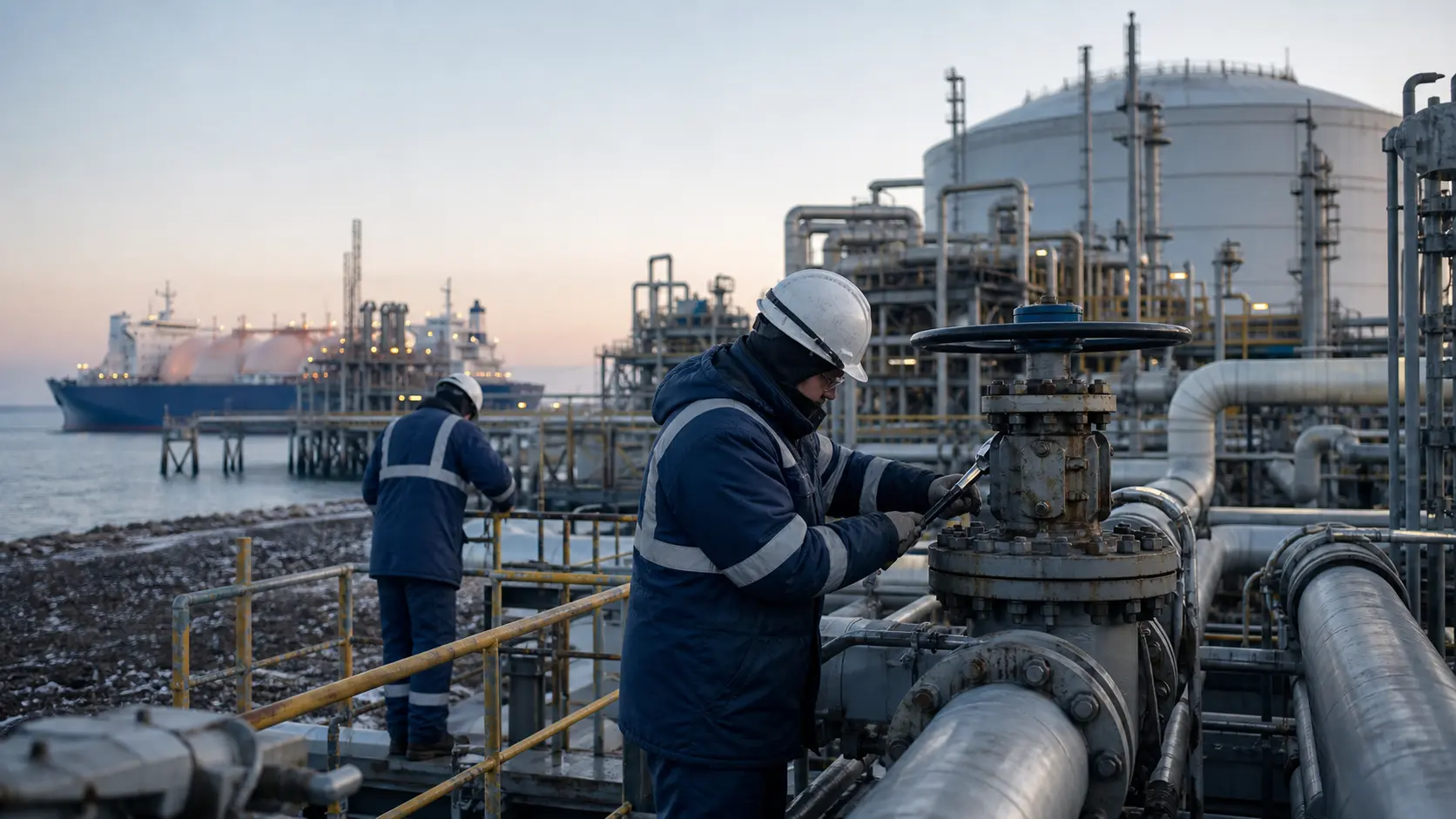
Sakhalin Energy Limited Liability Company says on its corporate overview page that it operates the Sakhalin-2 project and that produced oil and gas move from offshore platforms through the Trans-Sakhalin operating chain system and the onshore processing facility to the Prigorodnoye production complex, where LNG carriers and tankers load product for buyers. The overview page at https://www.sakhalinenergy.ru/en/company/overview/ is valuable because it frames the company as an integrated field-to-terminal operator rather than a pure liquefaction toller. That distinction matters for cargo economics. A delayed cargo may reflect trouble in the plant, but it may also reflect gas compression, hydrate management, operating chain pressure, tank inventory, weather, carrier arrival, or the state-owned governance layer around a production sharing agreement.
The immediate paid unit in this article is the LNG cargo, maintenance-turnaround and export-reliability account. It asks a practical question: what must be true for an LNG cargo from Sakhalin Energy to retain full value in 2026? The answer starts with the Prigorodnoye terminal but it cannot stop there. The company asset page at https://www.sakhalinenergy.ru/en/company/assets/ sets out the production system: offshore oil and gas platforms, the onshore processing facility, the Trans-Sakhalin operating chain system, Booster Station 2 and the Prigorodnoye complex. Public company documents then show why a single cargo embeds multiple risk premiums: two-train concentration, heavy maintenance events, supplier localization, sanctions-era financial constraints, and Asian buyer dependence on a Russian project whose legal and technical continuity has already been tested.
For an LNG buyer, a Sakhalin cargo is attractive because it is close. The sailing distance from southern Sakhalin to Japan is materially shorter than most Atlantic, Middle Eastern or US Gulf alternatives. The cargo also comes from a mature project with established specifications, charter arrangements and offtake history. That convenience is the asset. It is also the lock-in. Once a Japanese, Korean or Chinese utility plans around a Sakhalin delivery, replacement gas may be available in the global LNG market, but not necessarily at the same freight cost, timing, portfolio balance or political risk profile.
Sakhalin Energy's cargo price therefore carries a reliability premium when the plant runs and a reliability discount when buyers fear that maintenance, sanctions or ownership disputes will interfere with the export schedule.
The plant is efficient because it is concentrated
The Prigorodnoye production complex is the export gate. Sakhalin Energy's Prigorodnoye page at https://www.sakhalinenergy.ru/en/company/assets/prigorodnoye/ describes a gas system with an LNG plant, storage tanks and jetty, plus an oil system and port infrastructure on Aniva Bay east of Korsakov. The bay does not freeze in winter, which gives the site one of its core economic advantages: year-round access from Russia's Far East to Asia-Pacific buyers. The same page describes two liquefaction trains, two 100,000 m3 LNG storage tanks, an 805 metre jetty and the ability to receive LNG carriers between 18,000 and 177,400 m3. Design capacity is 9.6 million tonnes of LNG per year.
Those numbers convert easily into a cargo account. Sakhalin Energy's 2024 non-financial ESG report, available from the company's report page at https://www.sakhalinenergy.ru/en/media/esg/ and as a PDF at https://www.sakhalinenergy.ru/upload/iblock/fa6/q38rp08kgl6hwca2apzuail1pss1h2hb/sakhalin_AR24_eng_WEB_szhatyy.pdf, says the company shipped about 10.2 million tonnes of LNG from Prigorodnoye in 2024. It defines one standard cargo as 65,000 tonnes and gives the 2024 export total as about 156.5 standard cargoes. A simple division shows the operating rhythm: on average, the terminal needs to clear roughly one standard cargo every 2.3 days to sustain that export level. In practice, the rhythm is lumpier because maintenance, weather, buyer nominations and berth scheduling compress or stretch the window.
The 10.2 million tonne result also shows why uptime is the economic asset. The plant's nameplate capacity is 9.6 million tonnes, yet recent public disclosures show production above nameplate. That does not mean the plant is risk free. It means its economics depend on extracting high availability from a concentrated asset base. Two trains make the plant simpler than a mega-project with many parallel trains, but concentration increases the marginal value of each maintenance hour. If one train is offline, the second train can still operate, but the cargo calendar tightens.
Storage can buffer some delay, but two 100,000 m3 tanks cannot absorb a long production disruption without affecting either shipping cadence or feedgas management.
The double-mixed refrigerant process also matters. Sakhalin Energy says the liquefaction technology was developed for harsh Sakhalin winters. That cold-climate advantage supports efficient winter operation, but it also means a chain of specialized rotating equipment, refrigerant systems, control systems and safety systems has to be maintained in a sanctions-era supply environment. A cargo buyer does not need to know the exact manufacturer of every compressor seal to understand the risk.
It needs to know whether the operator can complete major overhauls on time, source qualified spares, substitute local service providers without raising failure rates, and restart after a shutdown without derating the plant.
This is where a cargo becomes a maintenance-turnaround account. A long-term offtake contract may define quantity, quality, delivery point, destination flexibility and payment terms, but the actual value of the invoice depends on mechanical reliability. A cargo loaded at the beginning of a high-price winter has different economics from a cargo deferred into a softer market after a repair issue. The buyer may be compensated under a contract, but the system cost of replacement fuel, storage drawdown or spot LNG exposure can be larger than the invoice penalty.
Sakhalin Energy's public production record is therefore strong evidence of capability, while its public maintenance record is the key evidence of durability.
Turnaround evidence is the risk ledger
The 2024 report provides unusually concrete public evidence on maintenance. It says the company carried out the largest turnaround in Sakhalin-2 history in 2024, with simultaneous shutdown of integrated gas chain assets and integrated oil chain assets, more than 1.5 million man-hours and more than 4,000 specialists. It lists work across the Prigorodnoye LNG plant, the onshore processing facility, offshore assets, Booster Station 2, pipelines and terminals. The most relevant cargo item is the overhaul of gas turbines in a refrigerant compressor at LNG Train 2.
The report also refers to turbine-engine replacement and maintenance at Booster Station 2, work on a monoethylene glycol storage tank, flare-drum work and wider production-system maintenance.
That public description changes how the cargo should be priced. A large turnaround is positive evidence because it means the operator did not simply defer hard work. It also exposes the scale of coordination required to keep output reliable. A cargo buyer looking at 2026 does not only ask whether the 2024 work was completed. It asks whether the same system can repeat major maintenance without Shell as an active technical partner, without frictionless Western service-company access, and with a growing dependence on Russian contractors and localized shops.
The 2024 turnaround is proof of operating continuity, but it is also a map of where hidden bottlenecks can appear.
Sakhalin Energy's own supply-chain section strengthens the point. The Russian Content page at https://www.sakhalinenergy.ru/en/contractors/liabilities/ says the Sakhalin-2 project has a production sharing agreement priority to maximize Russian content over the project's life, and it states that Russian content means Russian labour, Russian-manufactured equipment and materials, and services rendered by Russian companies. The general contractor page at https://www.sakhalinenergy.ru/en/contractors/overview/ presents the company as a centre of competence for offshore fields and LNG and asks prospective suppliers to engage through corporate channels. This is more than procurement rhetoric. It is the operating model that has to replace the old global service stack.
The 2024 report is more specific. It says the Maintenance and Repair Facility in the Sakhalin Oil and Gas Industrial Park is a strategic objective for critical-services localization and Russian vendor development. It says the decision to design Phase 2 was taken in 2022 in view of the replacement of foreign service companies by Russian contractors and their localization on Sakhalin Island. It says Phase 2 includes repair and maintenance shops for specific equipment, an equipment maintenance and hydraulic testing shop, a laboratory complex and a drill-pipe maintenance and repair base. This is not a marginal footnote.
It is the clearest public admission that operating reliability now depends on a local maintenance ecosystem that is still being built.
For cargo economics, localization cuts both ways. Local repair capacity can shorten logistics, reduce exposure to customs and sanctions delays, and create a durable Russian service base near the asset. It can also create quality, certification and learning-curve risk. LNG plants are unforgiving systems. A cheaper local part that fails early is not cheaper if it forces a derate or a shutdown. A cargo-loading window can be lost because a component fails after restart, because an inspection takes longer than expected, or because replacement testing standards are not accepted by every commercial counterparty.
The cargo therefore carries a discount not because the plant is visibly failing, but because the proof standard for localized maintenance is higher in an environment where historical suppliers are constrained.
Upstream pressure reaches the jetty
The LNG train is only one element of the paid unit. The onshore processing facility page at https://www.sakhalinenergy.ru/en/company/assets/opf/ says the OPF treats gas and condensate from the Lunskoye field and includes gas processing, compression and condensate stabilisation units. It also supplies electricity and monoethylene glycol to the Lunskoye-A platform, and it gives a daily design capacity of 50.1 million cubic metres of gas and more than 7.2 thousand tonnes of condensate. The page adds that a compression facility was brought into operation in 2023 to compensate for declining reservoir pressure as the Lunskoye field matures.
Maturity is a quiet cargo risk. It does not carry the drama of a sanctions announcement, but it changes the shape of reliability. As reservoir pressure falls, compression becomes more important. Compression adds rotating equipment, control systems, heat rejection and maintenance burden. If the OPF has to maintain inlet pressure to keep the process system inside design conditions, gas availability to Prigorodnoye is no longer just a question of field reserves. It is a question of compression uptime, power supply, MEG management, summer and winter capacity and the availability of trained maintenance crews.
The Trans-Sakhalin operating chain system adds a second physical layer. Sakhalin Energy's operating chain page at https://www.sakhalinenergy.ru/en/company/assets/pipelines/ describes offshore and onshore pipelines running from the northern offshore platforms through the OPF to the southern LNG plant and oil export terminal. It says the route crosses 19 tectonic faults and more than a thousand watercourses, includes five maintenance depots and 104 block valve stations, and totals 283 kilometres offshore and 1,591 kilometres onshore. This is not merely a transport line. It is a distributed reliability asset across a seismic, remote island environment.
The operating chain evidence is important because a cargo buyer rarely sees operating chain risk directly. The buyer sees a ship nomination, a tank reading and a delivery statement. But the delivered cargo depends on operating chain pressure and integrity over a long corridor. A maintenance issue in a block valve station, a pump package or a compressor train can have the same economic effect as a plant problem: fewer tonnes at the berth during the delivery window. The public operating chain evidence therefore supports a higher-quality assessment than a simple "plant capacity" number.
Sakhalin Energy's reliability is not a two-train LNG story; it is a field, pressure, corridor, tank and berth story.
This integrated account also changes how sanctions risk should be understood. Export controls on Russia's energy sector do not need to name Sakhalin Energy directly to affect its operating environment. The US Executive Order 14071 page in the Federal Register at https://www.federalregister.gov/documents/2022/04/08/2022-07757/prohibiting-new-investment-in-and-certain-services-to-the-russian-federation-in-response-to-continued records a broad US ban on new investment and certain services in Russia. The US Bureau of Industry and Security announced export controls on Russia's oil-refinery sector in 2022 at https://www.bis.doc.gov/index.php/documents/about-bis/newsroom/press-releases/3158-2022-03-03-bis-announces-export-controls-on-oil-refinery-sector-in-russia/file. The European Council's 14th package notice at https://www.consilium.europa.eu/en/press/press-releases/2024/06/24/russia-s-war-of-aggression-against-ukraine-eu-adopts-14th-package-of-economic-and-individual-measures/ shows how restrictions have expanded into Russian LNG logistics and future LNG project support. The exact legal application differs by activity, jurisdiction and date, but the commercial signal is consistent: Western services and technology around Russian energy have become harder to use, finance and insure.
State control reduces abandonment risk and raises political risk
Sakhalin Energy is not an ordinary merchant LNG exporter. The production sharing agreement page at https://www.sakhalinenergy.ru/en/company/psa/ describes the Sakhalin-2 PSA as the first PSA in Russia, signed in 1994 with the Russian party represented by the Russian Federation government and Sakhalin Oblast administration. It says the state approves work budgets and has audit rights, and that the Russian Federation retains sovereign ownership of the oil and gas fields while the investor develops the project. That arrangement helps explain why the project survived the 2022 restructuring. It is too important to be treated as a replaceable private asset.
The state role reduces abandonment risk. A stranded LNG plant in Sakhalin would damage regional revenue, gasification, export earnings, relations with Asian buyers and Russia's claim that it can keep complex energy exports running after Western exits. The state has a direct interest in continuity. The 2024 report says Sakhalin LNG represented 2.4 percent of global LNG demand and 3.8 percent of Asia-Pacific demand in 2025, while the company overview page gives the same public-market framing.
Even if those are company-calculated shares, they show how the operator wants buyers and officials to see the asset: not as a marginal plant, but as a regional supply node.
The state role also raises political risk. In 2022, Shell said it would exit partnerships with Gazprom, including its 27.5 percent stake in Sakhalin-2; a public report on that announcement is available at https://www.axios.com/2022/02/28/shell-russia-gazprom-ukraine-invasion. Russia then transferred the project into a new domestic operator structure, while Japanese investors Mitsui and Mitsubishi sought to preserve their economic exposure because Sakhalin LNG remained important for Japan's energy security. That history matters to a cargo buyer because ownership stability is now a government-managed outcome. The plant may operate well, but the shareholder and sanctions context can still affect banking, insurance, service contracts, destination flexibility and counterparty approvals.
For a cargo margin, government involvement has three effects. First, it can keep inputs flowing when private suppliers hesitate, because public authorities can coordinate local vendors, infrastructure and budget approvals. Second, it can make commercial negotiations less flexible, because price, destination and offtake decisions may carry strategic meaning beyond a single buyer-seller relationship. Third, it can increase the value of documented private proof.
Buyers, banks and insurers need confidence not only that the state wants the cargo to move, but that the plant actually has the mechanical, logistical and compliance capacity to move it on time.
That is why the 2024 shipping disclosure is important. The company report says Sakhalin Energy delivered LNG to Japan, China and South Korea in 2024, with Japan taking 56.4 percent, China 27.8 percent and South Korea 15.8 percent. It also says approximately half of the LNG was supplied on free-on-board terms and approximately half on delivered-ex-ship terms. It refers to long-term buyer nominations, buyer-chartered ships, the company's own ice-class LNG carriers and short-term carrier chartering. The commercial risk is not that there are no buyers.
The risk is that each buyer needs a different proof package for a Russian-origin cargo under its own law, insurance policy, financing structure and public-accountability standard.
Currency mismatch sits inside every invoice
Sakhalin Energy's public financial profile is now more ruble-framed than the global LNG market it serves. The 2024 report presents revenue in rubles and shows a substantial increase in reported revenue from 2023 to 2024. Cargo buyers, however, think in dollar-denominated LNG benchmarks, oil-indexed long-term formulas, yen and won power-sector pass-throughs, renminbi settlement possibilities and portfolio replacement costs. Even where a contract has a defined price formula, the project economy has to absorb ruble wages, Russian procurement, local construction, import substitution, tax and production-sharing mechanics.
Currency mismatch is not a headline risk like sanctions, but it changes incentives. If the ruble weakens, local costs may become cheaper in dollar terms while imported or hard-currency components become more expensive. If the ruble strengthens or Russian inflation raises local maintenance costs, the advantage narrows. If buyers pay under legacy formulas tied to oil or LNG indices, the operator's revenue may be strong while the cost of sanctions-compliant maintenance rises in a different currency basket.
A cargo that looks profitable at the invoice level can therefore hide a maintenance reserve problem if scarce parts, specialized inspection services or vessel cover must be paid at a premium.
The 2024 turnaround raises this question because it was labour- and contractor-intensive. More than 4,000 specialists can be mobilized in rubles, but a turbine overhaul, control-system component, LNG loading-arm part or shipboard interface may not be priced only in rubles. The company's localization strategy is meant to reduce that exposure. Until localization has a longer public track record across repeated turnarounds, the cargo margin should still be analyzed with a maintenance reserve.
A buyer or lender should ask whether unusually strong cargo revenue is funding durable maintenance capacity or merely covering a one-off effort after a major outage window.
The same mismatch applies to buyers. Japanese and Korean utilities pay in their own domestic regulatory and currency environments. A Sakhalin cargo may be geographically convenient, but if a buyer's public or regulatory cost of taking Russian-origin LNG rises, the price advantage has to widen. For China, the calculation is different: portfolio depth, bargaining power and political tolerance may be higher, but the buyer also has more alternatives and may demand price concessions if it perceives seller dependence. Sakhalin Energy's destination mix therefore matters.
Japan's large share supports contract durability, while China's large share gives the operator a market for flexible cargoes but may cap upside if geopolitical discounting deepens.
Currency mismatch is also a retention risk. Long-term buyers can tolerate complexity when the delivered cargo is cheap, reliable and hard to replace. They become less tolerant when the same cargo requires special insurance, compliance work, internal approvals and public explanation. The cargo price must compensate for that work. If it does not, buyers can keep the minimum contract volumes while shifting incremental demand to Australia, Qatar, the United States, Malaysia, Papua New Guinea or portfolio suppliers. The economic threat is not an immediate loss of all buyers. It is gradual erosion of optionality and premium positioning.
Buyer alternatives create a narrow but real discipline
Sakhalin Energy benefits from geography. For Japanese utilities, a Sakhalin cargo is close, familiar and integrated into long-term procurement. That short-haul advantage can reduce freight exposure and improve response time relative to Atlantic cargoes. It also offers diversity from Middle Eastern chokepoints and Australian concentration. This is why Japanese stakeholders remained focused on Sakhalin-2 even after Shell's exit and the Russian restructuring. Energy security is not only about political alignment; it is about the physical availability of winter fuel.
But buyer alternatives discipline the project. Japan can buy from Australia, the United States, Qatar, Malaysia and portfolio suppliers. South Korea can do the same. China has operating chain gas, domestic production, Central Asian supply, Russian operating chain gas and a large LNG portfolio. Replacement is not costless, especially in a tight market, but it is possible. The more uncertain Sakhalin maintenance becomes, the more buyers will demand either price compensation or contractual protection. That is the retention account: how much discount or proof is needed to keep the same customers taking the same or larger volumes?
The 2024 destination mix is therefore a useful but incomplete comfort. It shows that the company kept cargoes moving after the 2022 restructuring. It does not prove that every buyer will maintain exposure on the same terms through the next heavy maintenance cycle, insurance renewal, sanctions update or public controversy. The public evidence supports a base case of continuity, not a base case of frictionless continuity. A serious cargo valuation should separate those two ideas. Continuity means cargoes load. Frictionless continuity means they load without special discounts, delays, documentation costs or political hedging.
The company itself seems to understand that reliability is part of the product. Its public materials repeatedly emphasize continuous improvement, safe operations, Russian vendor development and competence-building. The 2024 report says current production volumes exceed contracted supply, giving the company the flexibility to sell free cargoes. That is economically powerful because free cargoes can capture market upside. But free cargoes are also the first tonnes to suffer if buyers become more cautious or if maintenance reduces available volumes.
A plant that has just enough output for long-term obligations is a lower-upside asset than a plant that can sell extra cargoes into a strong spot market.
The private proof buyers need is therefore straightforward. They need downtime records by train and major equipment class; evidence of post-turnaround restart performance; vessel nomination and berth delay data; cargo margin by destination and delivery term; and contract-retention signals from major buyers. Public filings do not provide that level of detail. That does not make the risk unmanageable. It means the valuation should not treat headline export tonnes as complete proof of margin durability.
Sanctions-era technology risk is cumulative
Sanctions risk often gets discussed as if a single legal event either stops or permits a trade. Sakhalin Energy's case is more cumulative. The project was built with deep international participation, including Shell's technical role, Japanese trading-house investment and international financing. Shell's exit did not stop the plant. But it changed the maintenance learning environment. Each year of successful operation after the exit proves more than the previous year, because it shows the local system can handle another cycle without the old sponsor. Each year also ages equipment and depletes legacy spares.
The 2024 report's Maintenance and Repair Facility disclosure is therefore central. It is the operator's answer to cumulative technology risk. Building local repair shops, hydraulic testing capability, laboratory capacity and vendor training can reduce dependence on distant suppliers. Yet it is not automatically equivalent to the old supply base. The strongest public case for Sakhalin Energy is that it has identified the bottleneck and is investing in it. The strongest caution is that the facility is still developing, while the plant and field infrastructure are already mature.
This matters most around rotating equipment and control-critical systems. LNG reliability rests on compressors, gas turbines, heat exchangers, loading arms, safety systems, instrumentation and power systems. Public documents do not disclose enough to rank each equipment class by vulnerability. They do disclose enough to say that heavy rotating-equipment maintenance is part of the operating account. The Train 2 refrigerant compressor gas-turbine overhaul in 2024 is exactly the type of work that cargo buyers should watch. A successful overhaul supports confidence.
Repeated successful overhauls under the localized service model would support a lower risk premium.
Technology risk also interacts with sanctions compliance. A third-country supplier may be technically able to provide a part but unwilling to risk secondary exposure. A non-Western service provider may be willing but less familiar with the specific plant configuration. A Russian contractor may be local and responsive but still building the quality record needed for LNG-critical systems. These are not accusations of failure. They are the transaction costs created by a sanctions-era maintenance environment.
For a cargo valuation, those costs appear as longer procurement lead times, higher inventory requirements, more expensive redundancy and a larger discount demanded by cautious buyers.
The EU's 2024 sanctions package on Russian LNG logistics and future project support is a reminder that the legal perimeter can move even when existing imports are not fully banned. If a future restriction affects transshipment, services, technology, financing or vessels, Sakhalin Energy may still find routes to Asia, but the cost of proof rises. The cargo becomes not only a physical shipment but a compliance package. That package needs origin, destination, ownership, vessel, insurance, bank and service-provider comfort. A buyer can accept the molecule and still reduce its willingness to pay if the compliance burden grows.
Shipping is part of plant economics
Sakhalin Energy's Prigorodnoye page describes a jetty designed for LNG carriers up to 177,400 m3, while the 2024 report describes the use of long-term ice-class LNG carriers, buyer-chartered ships and short-term chartering. Shipping is not a separate afterthought. It is a plant-utilization tool. A liquefaction train that runs well still loses value if storage fills because a carrier is delayed. A carrier that arrives on time loses value if the plant is not ready. A delivered-ex-ship cargo shifts more logistics responsibility to the seller than a free-on-board cargo.
Because Sakhalin Energy used both structures in 2024, its reliability account spans both plant and voyage.
The narrow export window is partly operational and partly reputational. Operationally, tanks, berth slots and carrier arrival times must match production. Reputationally, buyers must believe that Sakhalin cargoes will not become trapped by insurance, port, sanctions or documentation issues. This is why even reports of marine cover arrangements can move market perception. A buyer with a cold-weather power obligation does not want a cheap cargo if the carrier cannot sail, call or insure the voyage on acceptable terms.
Shipping also affects marginal cargoes differently from contracted cargoes. Long-term contract cargoes may have dedicated vessels, established operational procedures and buyer tolerance. Spot or flexible cargoes need market confidence. If sanctions-era shipping costs rise, free cargo margins are squeezed first. If carriers are scarce, the seller may prioritize long-term obligations. If a buyer has to charter its own vessel under free-on-board terms, it will price the compliance and insurance burden into its bid. In that sense, Sakhalin Energy's ability to sell beyond contracted volumes is a sensitive test of market confidence.
Public evidence from the 2024 report is encouraging because cargoes continued to move to three major Asian destinations. But the report does not publish voyage-level delays, demurrage, boil-off losses, tender discounts, insurance premiums or vessel-utilization data. Those are the private proofs that determine whether the cargo has merely cleared the berth or earned a strong margin. The difference is important. A politically supported project can maintain volumes at the expense of margin, and public tonnage alone may not reveal the trade-off.
Public network and communication evidence is low-weight but useful
The company also leaves a public digital surface that is useful for continuity checks but should not be overstated. Its website publishes current corporate pages, contractor instructions, tender-related contact addresses and report downloads. The contractor page at https://www.sakhalinenergy.ru/en/contractors/overview/ warns that the company conducts electronic business correspondence only from corporate servers and gives contact addresses using the sakhalin2.ru domain. That is public-surface evidence of an operating corporate procurement channel, not evidence of cargo performance.
This distinction matters for network-resource evidence. Public domain, web and email-channel observations can support a view that the company maintains external-facing business processes. They cannot prove a turbine overhaul, a buyer payment, a cargo loading or a contract renewal. For Sakhalin Energy, digital evidence should be treated as a perimeter signal: active corporate pages, current reports and contractor channels are consistent with continued operations. They are not a substitute for production, shipping or maintenance data.
The public web surface is nevertheless helpful in sanctions-era analysis because it shows how the company communicates with vendors. The Russian Content page explains localization priorities; the contractor page channels supplier engagement; the ESG report documents maintenance and procurement outcomes. Taken together, these pages show the operator's public response to external pressure: build local service capacity, keep suppliers close to Sakhalin, report major turnarounds, and maintain buyer-facing production statistics. The digital surface does not settle the economics, but it directs attention to the right operating questions.
Proof gaps: economics, reliability and retention
The economics gap is margin detail. Public reports give output, destinations, revenue and some shipping structure. They do not give cargo-by-cargo netback, contract price formulas, discount to alternative supply, sanctions-compliance cost, insurance premiums, demurrage, replacement-gas costs or the maintenance reserve embedded in the price. Without those figures, the article's base case should not be "high volume equals high margin." The better base case is "high volume proves operating continuity, while margin durability depends on private commercial terms."
The reliability gap is downtime detail. Public documents describe a successful major 2024 turnaround and large maintenance scope. They do not provide train-by-train availability, unplanned downtime, restart issues, critical spares inventory, inspection findings, near-miss mechanical events or long-run performance of localized service providers. The key reliability question for 2026 is not whether Sakhalin Energy can operate without Shell in a general sense. Public exports show it can.
The question is whether the localized maintenance system can keep repeating heavy-turnaround performance as the asset ages and as legal access to specialized services remains constrained.
The retention gap is buyer commitment. Public disclosures show continued deliveries to Japan, China and South Korea and a large Japanese share. They do not publish contract renewals, buyer board debates, regulatory cost recovery, destination flexibility, or the price discount buyers demand for Russian-origin cargoes. A retained buyer is not always a retained margin. Utilities may keep taking cargoes for energy-security reasons while demanding more concessions, more documentation or more optionality.
The most important private evidence would show whether long-term buyers still treat Sakhalin LNG as a preferred baseload supply or as a politically complicated volume they take because replacement would cost more.
The risk is a premium, not an imminent stop
The strongest public conclusion is that Sakhalin Energy remains an operating, export-capable LNG supplier. Its 2024 production and cargo numbers are substantial. Its physical assets are integrated. Its state backing is strong. Its Asian buyer base is real. Its maintenance disclosures show that the company is doing hard work rather than hiding behind nameplate capacity. An article that treats Sakhalin LNG as if it were already broken would miss the evidence.
The second conclusion is that the cargo now carries a sanctions-era maintenance premium. The premium is not justified by one fact. It comes from the combination of Shell's exit, Russian state restructuring, export controls, service-company replacement, mature-field compression needs, a long island operating chain corridor, two-train concentration, shipping and insurance complexity, ruble-dollar cost mismatch and buyer reputational exposure. Each factor is manageable. Together they make the cargo more information-intensive than a normal LNG parcel from a politically uncomplicated project.
That information burden is itself an economic cost. A standard LNG cargo normally asks the buyer to compare delivered price, quality, schedule and counterparty credit. A Sakhalin cargo asks a broader question: whether a technically complex Russian asset can continue to satisfy Asian baseload demand while every enabling layer around it is scrutinized. A stronger maintenance file can offset some of that burden. If the operator can show repeated post-turnaround stability, stable vessel scheduling, timely cargo nominations and credible localized repair quality, the cargo can trade closer to ordinary long-term LNG.
If those proofs are thin, the same physical cargo may need a discount even when it loads on time, because the buyer is accepting documentation risk, public-policy risk and replacement-cost risk alongside the gas.
The practical monitoring point is therefore not a single dramatic outage. It is the accumulation of small frictions. Longer procurement lead times, narrower carrier availability, higher insurance cost, extra internal buyer approvals, delayed maintenance close-out, unresolved legal carve-outs or reduced flexibility for free cargoes can all chip away at the cargo margin without showing up immediately in annual export tonnes. Sakhalin Energy's 2024 disclosure gives a credible continuity case, but the next value test is whether that continuity remains commercially clean. In LNG, reliability is not only production.
It is production that arrives in the right ship, under acceptable terms, with enough margin left after every special cost has been paid.
For buyers, the practical stance is disciplined continuity. Sakhalin cargoes can be valuable precisely because they are close and proven. But buyers should require private evidence on downtime, turnaround completion, critical spares, vessel cover and contract performance before treating the cargo as equivalent to lower-friction alternatives. For the operator, the commercial task is to turn localization from a necessity into a credibility asset. Each successful turnaround, each on-time cargo and each transparent maintenance disclosure reduces the discount. Each opaque outage, delayed cargo or legal surprise widens it.
The cargo at Prigorodnoye is therefore a compact measure of sanctions-era infrastructure economics. It carries Russian gas, Asian demand, legacy Western engineering, state control, local repair capacity, shipping proof and buyer tolerance in one frozen parcel. Its market value is not simply the spot LNG price times tonnes. It is the spot or contract price adjusted for the probability that the next maintenance window, the next spare-part order, the next vessel nomination and the next buyer approval all arrive before the export window closes.