
Summary
- Pavutina.Net is a Kyiv-based fixed broadband and IPTV provider, with Ukrainian registry evidence, current household and business tariff pages, and public support channels that tie the company to the paid access account.
- Its strongest strategic claim is not national scale, but a local operating approach built around FTTB, FTTH, GPON, XGS-PON, repair visits, service centres, backup-power messaging and visible business connectivity offers.
- Network evidence is meaningful but uneven: RIPE and RIPEstat show AS57422 and a current IPv4 announcement, while PeeringDB still carries a larger self-reported peering profile that should be read as an unresolved capacity signal rather than as proof of present traffic scale.
- Larger substitutes, including Kyivstar, Vodafone Ukraine, Datagroup-Volia-lifecell and mobile or satellite fallback, are pushing the market toward power-resilient GPON, making Pavutina.Net's local repair and support capacity more important.
- The facts that would most change the judgement are current subscriber count, revenue mix, active GPON coverage, repair backlog, real IX traffic, upstream contracts, customer churn and direct evidence of how the network performed through recent outages.
A Kyiv broadband customer does not buy an abstract megabit. The account is paid for so a flat can keep working through video calls, school platforms, banking, streaming, messaging, air-raid updates and the ordinary administrative life that has moved online. In that setting, the access line is only part of the product. The rest is the likelihood that the provider can reach the building, power the active parts of the network, explain a fault, replace damaged customer equipment, dispatch a technician and restore service without making the household navigate an anonymous national queue.
Pavutina.Net is interesting because its public evidence sits exactly at that junction. It is a local Kyiv operator with a long-lived legal record, live consumer tariffs, business access offers, a visible autonomous system and a support proposition that repeatedly returns to repair, GPON, backup power and local service centres. That combination makes the company less a story about headline speed and more a story about whether a regional ISP can turn repair capacity into customer trust.
The company is not a national mobile brand, a hyperscale carrier or a diversified telecom conglomerate. Its own material presents a more grounded access business: broadband for apartments and private houses, IPTV and online cinema, business connectivity, fixed telephony, support contacts, service desks and add-on repair work.
Ukrainian company-data services identify TOV "PAVUTYNA.NET" with EDRPOU 35076618 and a 2007 registration date, while the company's own history says the network traces back to a first subscriber in Kyiv's Darnytskyi district in summer 2004 before the limited-liability company was registered in April 2007. The same company pages describe construction of optical networks, participation in industry associations and exchange points, and use of vendor equipment from names such as Cisco, Raisecom, Edge-Core and Juniper.
The legal identity and the network story are therefore not a pure marketing claim; they are supported by registry, regulatory and internet-number-resource records, though the scale of the active retail base remains undisclosed.
The strongest current business evidence comes from the tariff and support pages. Pavutina.Net advertises home internet packages over FTTB and xPON, including 300 Mbps, 600 Mbps and higher-end 10GPON/XGS-PON offers that reach 2.5 Gbps on the public price table. Its private-house plans are framed around FTTH, GPON and XGS-PON. Its business page separately offers legal-entity services, reserve-power language, priority support, VLANs, reverse DNS, dedicated channels and capacity from small office connections up to 10 Gbps.
A business-facing site adds that the company has 17 years of activity, 3,000 kilometres of lines, a service centre on Koshytsia Street, L2 support and direct connection to traffic exchange points. Those figures are company self-reports and should not be treated as audited metrics, but they are current customer-facing claims rather than historical directory residue. They show the paid unit: Kyiv broadband and IPTV access for households, plus business connectivity for organisations that want a local provider with field support.
The access account is being sold in a wartime market where power continuity is part of the service conversation. Pavutina.Net's site does not hide that context. The home page includes a notice that extreme heat and frequent power outages can cause some UPS equipment to fail, says the company is conducting repair and restoration work, and asks customers to respect emergency restoration teams. Its GPON explainer frames passive optical networking as a way to keep internet available when electricity is unavailable, because passive optical splitters do not consume power and the provider can concentrate backup energy at central nodes.
Separate pages sell or explain a power bank for the Wi-Fi router and a "blackout box" battery for router equipment. The message is clear: customer experience now depends on an end-to-end chain that includes optical access, provider-side backup, customer-side power and the ability to fix failures after heat, shelling, overload or ordinary wear.
That chain is especially visible in apartment broadband. A multi-dwelling building concentrates many customers behind shared risers, basement cabinets, switches, optical splitters, power circuits and cable routes that were not all designed for repeated emergency operation. A provider can advertise a speed tier, but the experience depends on whether the access technology in that specific building has been modernised, whether the cabinet has backup power, whether fibre is intact, whether customer equipment can ride through an outage and whether the provider can enter the building when something fails.
Pavutina.Net's public pages are unusually specific about this building-level reality. They describe apartment and private-house options separately, explain GPON installation conditions, price urgent connections, sell customer-side backup options and tell customers when master visits can be ordered. That is the commercial surface of a local access operator, not just a brand wrapper over anonymous connectivity.
It also changes how price should be read. A lower monthly fee can look attractive until a household pays for repeated router replacement, waits through restoration queues or discovers that a building is not on the resilient access technology advertised elsewhere. A higher tariff can still be poor value if support does not arrive. Pavutina.Net's public price table therefore needs to be read with its repair and power pages, not separately from them. The recurring fee buys the line; the service charges, installation fees and equipment guidance describe the friction around keeping that line useful.
The company's ability to make those elements feel predictable is the difference between a simple commodity internet bill and a local utility relationship.
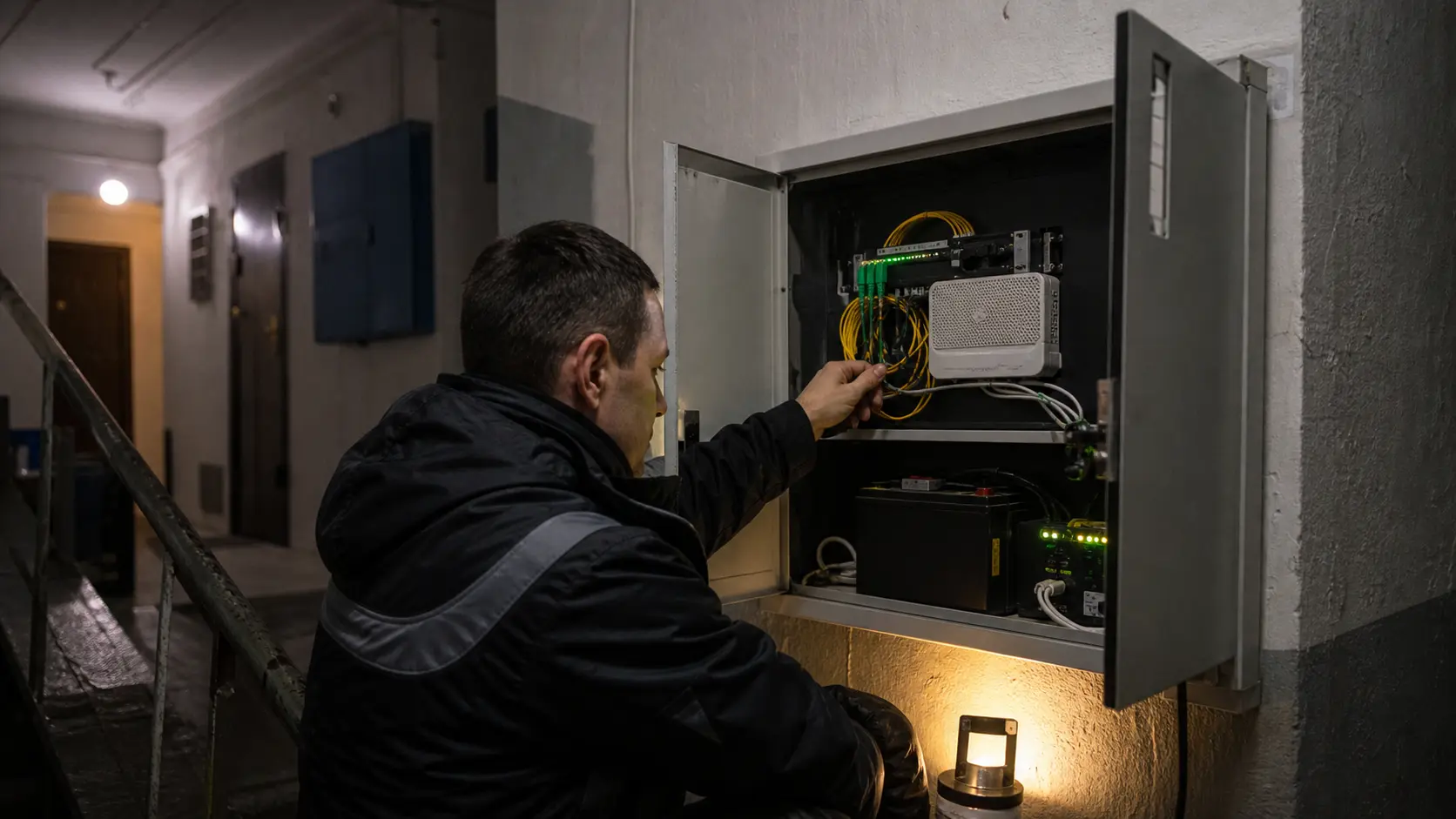
The repair menu is unusually important. Pavutina.Net lists paid urgent connection options for Ethernet and GPON, master visits, diagnostics, router configuration, urgent repair or configuration visits and service-centre checks. It also markets a repair tariff for people doing renovation or moving equipment inside an apartment, with guidance on cable routes, wall preparation, router placement, CAT6e cabling and the difference between GPON and Ethernet installation. Those details matter because they show local support labour as part of the product rather than a hidden cost.
A provider that wants to be trusted during blackouts and building-level disruptions must have people who can enter stairwells, inspect cabling, splice fibre or at least coordinate fibre work, configure routers and tell a customer whether the issue sits in the apartment, the building network, the optical terminal, the router or the provider's plant. In a stable market that labour might be treated as after-sales service. In Kyiv since 2022 it is part of the reliability proposition.
The labour question is not only about the number of technicians. It is about triage. During heat waves, outage waves or damage events, a provider must decide which failures are customer-equipment problems, which are building-power problems, which are optical-line problems, which are upstream or routing problems, and which are simply delays caused by access restrictions or safety conditions. The public evidence does not reveal Pavutina.Net's staffing levels, dispatch queue or mean time to restore.
Still, the existence of priced diagnostics, urgent visits, router setup, service-centre checks and repair-specific products shows that the company recognises the last metre of the network as a cost centre. For a local ISP, that recognition is strategically useful. Customers often blame the provider for any failure between the phone and the wider internet, even when the immediate fault is a depleted router battery, a damaged apartment cable or a building switch affected by power instability.
That framing is consistent with wider Ukrainian sector evidence. The International Telecommunication Union's 2025 profile of Ukraine describes restoration, continuity and investment needs across a damaged telecom sector, including network damage, capex pressure and the role of fixed broadband technologies such as xPON. Ukraine's regulator has publicly discussed readiness checks during blackouts, looking at generators, fuel, batteries, mobile response teams and personnel.
RIPE Labs has described Ukraine's internet resilience as partly a function of diversification, interconnection and the presence of many small and medium providers. None of those sources proves Pavutina.Net's own restoration performance. They do, however, explain why the company's public emphasis on GPON, batteries, service centres and repair teams is economically meaningful rather than decorative. The market is pricing not only bandwidth, but continuity under stress.
The legal and regulatory record supports the basic conclusion that Pavutina.Net is still an authorised communications provider, not just a stale brand. Ukraine's National Commission for the State Regulation of Electronic Communications, Radio Frequency Spectrum and Postal Services publishes a provider register workbook current to July 1, 2026.
The workbook includes TOV "PAVUTYNA.NET", EDRPOU 35076618, with Kyiv address and service codes for internet access, including broadband over a fixed own network, technical maintenance and operation of electronic communications networks, access to network elements and internet access to other providers or IP transit. The listed geography includes Kyiv, Kyiv Oblast, Chernihiv Oblast, Chernivtsi Oblast and Lviv Oblast. That geographic breadth may reflect authorised service areas rather than active retail density in each place, so the article should not infer subscriber distribution from it.
Still, the record is a strong current indicator that the company remains in the communications-provider perimeter.
The company-data record adds identity but not economics. YouControl shows a registered status as of July 9, 2026, a 2007 registration date and charter capital of 1.6 million hryvnia. Opendatabot identifies the company and its director and notes its presence in the provider registry.
These sources help pin the operator to an accountable legal entity, but they do not answer the central business questions: how many customers Pavutina.Net serves now, how much revenue comes from households versus business accounts, how much of the network has been converted to GPON or XGS-PON, how expensive repair work has become, or whether the company is gaining or losing share against larger substitutes. The absence of those answers is not a defect in the evidence; it is the uncertainty a reader should carry.
The network-resource evidence is meaningful enough to treat Pavutina.Net as more than a reseller label. RIPE's aut-num record for AS57422 lists PAVUTYNA-AS and Pautina.Net LLC, with import and export references to several other autonomous systems and a 2026 modification date. RIPE organisation data ties ORG-PL143-RIPE to Pautina.Net LLC and the same Ukrainian registration number. RIPE route data associates 176.100.7.0/24 with origin AS57422, and RIPEstat shows that prefix announced in the observation window immediately before publication.
RIPEstat's AS overview says AS57422 is announced, while public BGP aggregation identifies Pautina.Net LLC as an active RIPE autonomous system and shows 176.100.7.0/24 as the live originated IPv4 prefix. IPinfo similarly lists AS57422 as a Ukrainian ISP with 256 IPv4 addresses and no IPv6 visible in its profile.
That live routing footprint is smaller than the broader profile found in PeeringDB. PeeringDB's entry for Pavutina.Net lists ASN 57422, the AS-PAVUTYNA macro, a cable/DSL/ISP network type, a traffic range of 20 to 50 Gbps, mostly inbound traffic, 30 IPv4 prefixes, 10 IPv6 prefixes, public peering records at DTEL-IX, Giganet IXN and UA-IX, and facilities including sites in Kyiv. The public peering and facility records have update dates that are not as current as the RIPEstat observation.
The difference between a live BGP snapshot and a PeeringDB self-report is therefore not proof that the company is hiding capacity, has declined, or is failing. It is a normal uncertainty signal: PeeringDB can lag, describe intended or available peering posture, or include attributes that do not map neatly to currently announced routes. The correct reading is that Pavutina.Net has identifiable network resources and peering claims, while the present visible routed footprint appears modest from public route collectors.
The peering question matters because it affects quality and cost for a Kyiv access ISP. A local provider with exchange-point connectivity can keep some traffic closer to users, improve latency to local content and reduce dependence on upstream transit for traffic that can be reached through peers. But peering records do not automatically prove performance for a household customer. The customer feels packet loss, jitter, restoration time, router reliability and support quality before they feel a PeeringDB line item. The economic importance is still real.
If Pavutina.Net's exchange-point posture is active and maintained, it can support a local-value story against larger providers. If some self-reported peering details are stale, the company would be leaning more heavily on fewer visible paths. Public evidence is not strong enough to decide between those states. It is strong enough to make interconnection a watchpoint.
That watchpoint has two sides. On the upside, an operator with its own ASN, registered address space and exchange-point relationships can negotiate a more direct place in the local internet fabric than a pure access reseller. That can help with latency-sensitive services, cache access, redundancy and wholesale relationships. On the downside, a compact visible route table means the outside observer cannot infer a deep or highly redundant traffic base from public route collectors alone. For a regional ISP, the question is not whether it looks like a national carrier.
It is whether its interconnection is sufficient for the customers it actually serves, and whether the company keeps those records current enough that partners and analysts can understand the risk. Pavutina.Net has enough public network evidence to remain on the map. It does not have enough public traffic evidence to settle the scale question.
The consumer price table reinforces the access-account thesis. The company sells the package as broadband with speed tiers, support availability and optional television or media services. The stated xPON and XGS-PON offers show that Pavutina.Net is not presenting itself only as a legacy Ethernet building provider. It is trying to move customers toward optical access, where provider-side power management and passive splitters can make the line more resilient during outages if the customer can power the router and optical terminal.
The company also offers reserve-line and service-line options, and a set of repair charges that turn support visits into explicit priced work. That pricing structure suggests two revenue layers: recurring monthly access and occasional service labour or equipment support. The recurring line funds the network; the service layer helps recover the cost of messy apartment-level problems that become more common when power and physical infrastructure are strained.
IPTV and online cinema matter because they make the account stickier but also raise expectations. A household that buys only a cheap internet line can switch to a mobile fallback more easily. A household using the provider's television package, router support, optical terminal and local technician relationship has more friction. Pavutina.Net markets Pautina.TV and broader entertainment services alongside broadband, and the company history lists IPTV/OTT, VoIP and video-on-demand. Those services are not the strategic centre of the evidence, but they help explain why the broadband account is a local utility bundle.
If the internet line drops, the customer loses not only web browsing but household entertainment and communication routines. That magnifies the reputational value of support response.
Customer chatter supports both the importance and the fragility of that trust. Reviews on third-party sites are uneven and should be treated cautiously because they are self-selected, unverified and often reflect individual building conditions. Still, they offer market texture. Some older and recent comments praise support response, advance notice, restoration updates and internet during power outages. Other comments complain about outages, service quality, speed, communication or specific interactions.
The pattern is common for last-mile ISPs: one apartment block may experience the provider as reliable and local, while another experiences the same brand through repeated building-level failures. For Pavutina.Net, that means public reputation probably depends less on the abstract brand promise and more on street-by-street execution.
The competitive set is severe. Kyivstar advertises GPON home internet, 1 Gbps offers and messaging around internet during power outages, including separate guidance on powering home equipment and stated endurance differences between FTTB and GPON. Vodafone Ukraine markets fixed home internet with GPON, up to 1 Gbps speed and autonomy claims, while also reporting major investment in batteries, generators and home internet expansion.
VEON describes Kyivstar as having more than 22 million mobile customers and more than 1.1 million home internet fixed-line customers as of mid-2025, which highlights the difference between a national operator and a local ISP. Datagroup-Volia-lifecell has announced GPON investment across major cities and a target of expanding energy-efficient fixed access. lifecell has also entered home internet with GPON, Ethernet and DOCSIS language. These substitutes can bundle mobile, fixed, national marketing, capital expenditure and broader procurement scale.
Mobile fallback and satellite connectivity add pressure even when they are not perfect substitutes. A household may tolerate a fixed-line outage if mobile data carries messaging and work for a few hours. VEON's 2026 Starlink Mobile announcement for Kyivstar customers points toward a market where "out of coverage" and prolonged terrestrial disruption are being addressed through satellite-to-mobile capabilities. That does not replace a stable fixed line for IPTV, multi-device households or high-volume work, but it changes customer patience.
The longer a fixed provider takes to restore service, the more the customer learns to live through a substitute. For Pavutina.Net, the defensive answer is not just price. It is to make the local line feel worth keeping because the provider answers, repairs and restores.
Large operators also create a procurement benchmark. A national carrier can buy batteries, generators, ONUs, routers, fibre cable and spares at scale. It can spread network-monitoring investment and call-centre cost across millions of accounts. It can market resilience in a way that reassures households before they read a local provider's fine print. A regional ISP can offset some of that with proximity, faster building knowledge, flexible technicians and more direct accountability. But the cost base is unforgiving.
Backup power needs batteries that degrade, generators that need fuel, field crews that need vehicles, fibre that needs replacement, support desks that must answer during outage waves and customer equipment that fails under repeated power cycling. Repair capacity becomes strategic because it is both a cost and the visible proof that the operator is still present.
Pavutina.Net's own pages make that cost base visible. The blackout notice on the home page is a practical admission that UPS equipment can fail under extreme conditions. The power-bank and blackout-box pages shift part of the continuity burden to the customer by explaining how to power the router or optical converter. The GPON explainer argues that passive optical infrastructure reduces the provider-side power problem. The repair pages price technician time. The business page offers reserve power and priority support.
Taken together, these pages describe a value chain where reliability comes from many small pieces, not a single network promise. That is exactly why the economic unit should be read as a Kyiv broadband and IPTV access account with repair capacity attached.
The business-connectivity offer widens the market beyond households. Pavutina.Net's B2B material describes corporate internet from 10 Mbps to 10 Gbps, FTTH/GPON technology, L2 support, exchange-point connectivity and a local service centre. The company tariff page for legal entities includes reverse DNS, VLANs, dedicated channels, higher-capacity options and priority support. These are business-customer signals, but they still need caution. They do not prove how many business accounts exist, what revenue share they represent, or whether Pavutina.Net competes successfully for demanding enterprise sites.
They do show that the company is trying to sell beyond simple residential access, which matters because business accounts may pay more for support, static addressing, reliability and direct service contact. In a disrupted city, even small commercial customers can be valuable if they need a known technician more than a national call queue.
Building-level access also creates switching friction that can help or hurt a local provider. If Pavutina.Net already has fibre, cabinets, customer equipment familiarity and a technician relationship in a building, a household may prefer to keep the existing provider rather than wait for another operator's installation window. That advantage becomes stronger when the provider can explain which access technology is present in the building and what the customer needs to keep equipment powered.
The same friction can turn against the company if a competitor upgrades the building first, advertises a clearer GPON power promise, subsidises an optical terminal or bundles fixed access with mobile service. In that case, a customer is not only comparing megabits. The customer is comparing who appears more likely to keep the apartment online through the next outage and who will arrive when the link fails.
The company's own service charges show how delicate that comparison is. Paid urgent visits, diagnostics and router configuration can be sensible cost recovery when technicians are scarce and fuel, parts and labour are expensive. But each visible fee also reminds the customer that resilience has a price. If the provider communicates clearly and fixes the problem, the charge may feel fair. If the customer has already endured repeated outages, the same charge may feel like a penalty for failure. This is a core regional-ISP tension: local repair capacity is a differentiator only when customers believe it works.
Otherwise, the cost of the local relationship is easier to compare against a national discount or a mobile backup plan.
Supplier and equipment dependence is another risk layer. The company has historically named brands such as Cisco, Raisecom, Edge-Core and Juniper, while its public access pages refer to GPON, XGS-PON, ONUs, routers, UPS equipment and customer-side power devices. None of the sources show current vendor contracts, stock levels or sanctions exposure. The risk is more general: a local ISP needs compatible optical terminals, switch ports, fibre materials, batteries and replacement customer equipment at prices customers can bear.
If import costs rise, if batteries fail faster than expected, or if customers resist paying for upgraded home power, the provider's resilience message becomes harder to monetise. If the company can standardise customer equipment and technician practice, it may reduce support time and improve restoration outcomes.
The visible route data raises a different strategic question: how much control does Pavutina.Net have over its internet path? RIPE and public BGP aggregation show a live AS57422 footprint, and PeeringDB lists IX presence. That is better evidence than a provider with no current ASN, no visible prefixes and only a contact form. But the live public BGP picture is compact: a /24 is visible where older registry records include a wider related inetnum and RIPEstat's routing-consistency data shows some whois routes not seen in BGP.
The company may be using upstream arrangements, aggregating differently, keeping some resources inactive, or simply presenting a peering profile that has not been fully refreshed. The article should not guess. The watchpoint is whether future public routing shows stable prefix announcements, active peers, IPv6 adoption and consistency between self-reported peering and route collectors.
IPv6 is one notable absence in the public live profile. PeeringDB lists IPv6 prefixes, but IPinfo and public BGP aggregation do not show visible IPv6 origination in the observed profile. For a consumer ISP, lack of visible IPv6 does not necessarily damage ordinary service in the short term. Many Ukrainian households will judge the provider on price, speed, Wi-Fi, power resilience and repair. But for a company presenting advanced optical access and business connectivity, IPv6 posture is part of long-term network maturity.
If Pavutina.Net is not actively offering or announcing IPv6, it may trail larger operators or more modern access networks on that dimension. If IPv6 is present in ways not captured by the public profiles used here, the company could clarify it.
The regulator's geography list is also important but ambiguous. Kyiv is the core of the company's public identity, and the website is heavily Kyiv-oriented. The NCEC workbook includes additional oblasts, including Kyiv, Chernihiv, Chernivtsi and Lviv regions. Authorisation across regions does not mean the company has dense last-mile networks everywhere. It may reflect legal permission, business customer reach, network elements, partner arrangements or historical footprint. The safest interpretation is that Pavutina.Net is authorised in a wider perimeter, while the evidence for customer-facing access is strongest in Kyiv.
That distinction matters because a regional ISP headline can overstate geographic reality if the article treats authorisation as deployment.
The company's address and support footprint point to a local service approach. Pavutina.Net publishes Kyiv service-centre locations, phone numbers, sales and corporate contacts, support email, Telegram bot access and a note that offices reopen after air-alert conditions. The public contact page is operational rather than ornamental. It gives customers multiple routes to service and shows the company is prepared to discuss wartime city conditions directly. Again, this is not proof of support quality. It is proof that support is central enough to be presented as part of the commercial surface. The difference is important.
A reader can verify the presence of support channels; only customer outcomes, response times and repair statistics would verify quality.
Regulatory exposure should be read in the same practical way. The NCEC listing is valuable because it places the company inside the authorised provider perimeter and connects the retail brand to formal service categories. It does not eliminate operational risk. During wartime and recovery, communications providers face pressure to maintain continuity, cooperate with authorities, protect customers, repair damage and support public resilience. The burden lands differently on a local ISP than on a national mobile operator.
A smaller provider may have less capital cushion and fewer spare crews, but it may know the exact buildings, basements and cable routes where the work has to be done. Pavutina.Net's public evidence fits that middle position: regulated enough to be accountable, local enough that execution depends on field knowledge.
That is why the strongest reading of Pavutina.Net is neither celebratory nor dismissive. The company has enough evidence to be taken seriously as a Kyiv fixed-access operator, and its pages speak directly to the resilience problems customers now care about. At the same time, the sources leave a wide gap around scale, performance and financial durability. A reader should not turn a 2.5 Gbps tariff into proof that most customers have advanced optical service. Nor should a compact visible BGP footprint be turned into proof that the retail network is weak.
The correct judgement sits between those extremes: Pavutina.Net has a real operating surface, visible network resources and a relevant support proposition, but the quality of the business depends on facts that are mostly outside public view.
The economics of a regional ISP in this setting are therefore a balance of recurring access revenue, labour cost, power resilience, local reputation and interconnection. Headline speeds attract customers, but restoration and support keep them. IPTV and media bundles increase account stickiness, but outages make dissatisfaction more expensive. GPON and XGS-PON can lower some power-continuity challenges, but they require capital investment, installation labour and customer equipment. Peering can improve traffic economics, but route evidence must remain active and current. Business customers can pay more, but they expect priority response.
A local brand can be closer to the building, but national operators can buy scale. Pavutina.Net sits in that trade-off rather than outside it.
The downside case is straightforward. If Pavutina.Net's visible routing remains narrow, if PeeringDB self-reporting is stale, if larger operators accelerate GPON conversion in the same buildings, if customer equipment failures keep generating support burden, and if repair teams cannot keep up with heat, outages or damage, the company could lose its main advantage. Customers may decide that a national provider with better-advertised backup power, mobile bundling or promotional GPON installation is a safer default. Negative reviews would then matter more because they would confirm a story of local capacity being overwhelmed.
Under that scenario, Pavutina.Net becomes a price-sensitive legacy access provider with some optical upgrades rather than a differentiated resilience operator.
The upside case is also credible. If the company can keep converting buildings to GPON or XGS-PON, maintain responsive local support, price repair visits transparently, keep customer-side power guidance practical and maintain active exchange-point connectivity, it can defend a niche that large providers sometimes struggle to occupy. A customer with a familiar local technician, a reachable service centre, working optical access during outages and a clear path to repair may stay even when a national competitor offers a lower promotional price.
Business customers with modest but urgent connectivity needs may value local response over brand scale. In that scenario, Pavutina.Net's compactness becomes an asset: fewer layers between the customer, the support desk and the field crew.
The facts that would most change the judgement are concrete and measurable. Current subscriber count would show whether the company is a small neighbourhood operator or a broader Kyiv access provider. Revenue split would show whether households, IPTV, business connectivity or repair services carry the economics. GPON and XGS-PON coverage by building would show whether the power-resilience message is broadly deployed or limited to selected areas. Repair backlog, mean time to restore and outage-frequency data would test the support proposition. IX traffic graphs, upstream contracts and route-collector history would clarify the peering gap.
Customer churn and net additions would show whether larger substitutes are taking share. None of those data points are public in the sources reviewed.
Until those facts are available, Pavutina.Net should be read as a real, current, locally grounded ISP with credible access, repair and network-resource evidence, but with important uncertainty around scale and live capacity. The company has the ingredients that matter in wartime broadband: an accountable legal entity, a live access offer, a current regulatory listing, support channels, repair pricing, optical-access messaging, backup-power content, visible AS57422 records and public peering claims. The evidence does not justify heroic claims about market share, national reach or traffic scale.
It does justify tracking the company as a regional ISP whose strategic test is whether repair capacity can keep pace with the resilience promise.
For customers, that test will not be decided by registry entries. It will be decided by whether the line works when the lights do not, whether a router can be powered, whether the optical terminal has signal, whether the support desk answers, whether a technician can come, whether the building cabinet survives summer heat and voltage swings, and whether outages are explained before frustration hardens into churn. For the market, the test is whether local ISPs can continue to perform a role that national operators cannot fully absorb: dense building knowledge, neighbourhood-level repair and direct accountability.
Pavutina.Net's public evidence places it in that contest. Its future value depends on proving that the local broadband account is not just cheaper or faster, but more repairable when Kyiv's infrastructure is under pressure.