
Summary
- OCTO Telematics is best understood as a B2B insurance and mobility data supplier whose economics depend on converting vehicle sensor data into measurable underwriting, claims and operating gains. Its own public materials describe a large historical data estate, a broad device range, risk scoring, crash reconstruction, smartphone crash detection, fleet diagnostics, keyless access, customer portals and cloud-hosted services, but those assets create durable value only if insurers keep enough of the savings after paying OCTO and absorbing operating friction.
- The strongest case is in complex use cases where raw vehicle data is not enough: crash validation, first notice of loss, fraud detection, stolen vehicle recovery, commercial per-mile insurance, shared-fleet driver scoring and motorcycle safety. The weakest case is in generic usage-based pricing where smartphone-only data, OEM vehicle feeds, insurer internal analytics and rival telematics platforms can narrow OCTO's advantage. The judgment is therefore conditional: OCTO can earn attractive returns if it proves shared savings, data quality and contract depth at scale; it becomes a hardware and data-processing vendor with thinner leverage if customers bargain the economics back to cost plus.
The Customer Pays Only When Loss Economics Move
The first economic fact is not that cars are connected. It is that an insurer pays only when the connection changes the expected loss, expense or retention curve. A motor insurer already has policyholder age, location, vehicle type, claims history, repair cost data, channel cost, fraud controls and portfolio experience. A telematics supplier must earn its place by adding information that those old variables miss, and by doing so at a lower total cost than the expected gain in pricing accuracy, claims speed or behavior change.
That test is severe. A device may be cheap in isolation, but the full cost includes procurement, logistics, installation, SIM or other cellular connectivity, app support, battery replacement or device failure, data ingestion, model maintenance, customer consent, call-center scripts, dashboard integration, claim-handler training and dispute handling when a driver challenges a score.
A smartphone-only program removes some hardware cost but introduces different accuracy problems: the phone may not be in the vehicle, may be handled by a passenger, may be carried in a bag, may have disabled location services, or may produce noisy signals in a crash. An OEM data feed can remove aftermarket installation but may be fragmented by brand, model, market, access rights and commercial terms. An insurer's in-house team can own the model but may lack the historical crash and driving data needed to train it.
OCTO's proposition is built around that gap. The company says it has profiled more than 20 million drivers, delivered more than 160 telematics projects, operated in insurance telematics for more than two decades, deployed programs in more than 20 countries, accumulated more than 610 billion kilometers of driving data, registered more than 95 billion trips and detected more than 13 million crashes. Those figures are company-reported and should be treated as scale indicators, not audited economics.
Still, they matter because insurance telematics is a data-compounding business if, and only if, historical events improve future segmentation and claims decisions in ways a new entrant cannot quickly copy.
The insurer's willingness to pay should therefore be framed as a share of avoided leakage. If OCTO helps price low-mileage drivers more accurately, the value is not the number of miles measured; it is the avoided underpricing of high-risk mileage and the retained good risks who would otherwise leave. If OCTO validates a crash, the value is the reduction in claim cycle time, fraud leakage, legal cost and unnecessary inspection. If OCTO enables theft recovery, the value is the lower severity on stolen vehicles and the policyholder service benefit.
If OCTO supports commercial per-mile pricing, the value is the ability to separate covered miles from miles covered by another platform and charge exposure more honestly.
That is why the title question is underwriting margin, not data volume. The data may be large; the economic question is who captures the surplus. If insurers can set up competing suppliers against one another, demand low per-policy fees, require OCTO to bear device and integration costs, and keep the loss-ratio improvement for themselves, then OCTO's scale becomes necessary but not sufficient. If OCTO's scores and claims tools are hard to replace, embedded in multi-year programs, and linked to measurable reductions in loss and expense, then the supplier can earn a more durable return.
What OCTO Actually Sells
OCTO is not a telecom carrier and should not be described as one. The public evidence points to an Italian telematics, IoT and advanced data analytics company focused on insurance, fleet management, smart mobility and connected-vehicle services. Its website footer identifies Octo Group S.p.A. in Rome, while the assignment's directory row tracks OCTO TELEMATICS S.P.A. as the public company name for the article. The operating boundary is B2B: OCTO supplies devices, apps, cloud services, analytics, scoring and operational tools to insurers, brokers, fleets, rental companies, sharing operators, OEMs and mobility businesses.
The insurance product set is broad. OCTO Motor Insurance includes risk scoring, crash and claim management, safety and security, a smartphone-oriented DigitalDriver product and a reward proposition linked to responsible driving. The risk-scoring pages describe dynamic and aggregated data on road type, timing, duration, stops and average speed; driving-style indicators such as braking, acceleration, curves and speed indicators; and DriveAbility models that OCTO says are used by insurers across multiple continents.
The crash and claims pages describe crash reconstruction, crash reports, claims dashboards, damage preview, video damage evaluation, early first notice of loss, claim verification, forensic dossiers, training for telematics claims, smartphone crash detection and fraud scoring.
The mobility product set extends beyond insurance pricing. OCTO Smart Mobility addresses fleet operators, rental and leasing companies, vehicle sharing, ride sharing, manufacturers and dealers. Its fleet pages describe monitoring of vehicle usage, maintenance, diagnostics, scoring data, fuel consumption, scheduled maintenance, trip tracking, event notifications, remote diagnostics, residual value estimation, safety and security, risk scoring, claims management and smart keyless access.
The sharing and renting pages describe B2B portals, specialized consoles, user registration, vehicle booking, app-based lock and unlock, automatic payments, reporting, advanced billing and multi-currency handling through partners.
That breadth is both the opportunity and the management challenge. The opportunity is that the same underlying data layer can serve several value pools: pricing, claims, assistance, theft, fleet utilization, maintenance, rental billing, keyless access and OEM-adjacent analytics. The challenge is that each value pool has different buyers, service levels, integration demands and liabilities. A risk score can be sold into actuarial and underwriting teams. Crash reconstruction touches claims, legal and customer service. Stolen vehicle recovery requires control rooms, law-enforcement interaction and local compliance.
Shared mobility needs uptime and access control. Fleet diagnostics needs error-code interpretation, OEM data quality and maintenance processes. A broad platform can spread fixed costs, but it can also dilute focus if product complexity outruns the revenue per connected unit.
OCTO's latest public positioning leans into analytics and claims rather than mere tracking. A 2026 CTO appointment release describes the company as a global leader in telematics solutions and advanced data analytics for insurance and connected mobility, with artificial intelligence used for accident detection, driving behavior analysis, claims management and consumption optimization. The same release points to a scalable modular data analytics platform for insurtech and mobility markets. That is the right direction economically because tracking alone is easier to commoditize.
The question is whether the proprietary part remains the decision layer or whether it collapses into a bundle of devices, dashboards and implementation services.
Why The Italian Origin Still Matters
OCTO's Italian origin is not just biographical detail. Italy was one of the early major markets for insurance telematics, partly because theft, fraud, regional claim-cost variation and motor-insurance pricing pressure made black-box programs economically attractive. OCTO's company history says founder Fabio Sbianchi created a system in which drivers paid a premium based on real driving behavior, that Italian insurers such as Unipol and Axa chose OCTO models in the early years, and that the business expanded from insurance into fleet and OEM modules after building domestic credibility.
That origin gives OCTO two advantages. First, it gives the company a long record in a market where telematics had to survive contact with real policyholders, repair networks, claim disputes and regulators. Second, it helps explain why OCTO's product set includes operational claims and assistance tools rather than only actuarial scoring. In markets where telematics is sold mainly as a consumer discount app, the supplier may remain peripheral. In a market where the device can also support crash validation, theft recovery and emergency assistance, the supplier can become harder to remove.
The same origin also creates constraints. A business born in Italian insurance must translate its proposition into markets with different insurance regulation, litigation cost, privacy expectations, vehicle mixes, cellular economics, installer networks and consumer acceptance. OCTO says it has offices and registered locations across Rome, North America, London, Madrid, Paris, Sao Paulo, Shanghai, Stuttgart, Tokyo and other local offices including Singapore. Global reach helps, but every market adds local work. A crash score that helps in Italy may need recalibration in Chile, the United States or Japan.
A theft-recovery process that works with one police or control-room model may not map cleanly elsewhere. A privacy consent design that is acceptable in one market may fail in another.
This is where OCTO's international customer stories are informative but not conclusive. The Sara Assicurazioni case describes a motorcycle telematics policy with accident detection, 24/7 operational-center support, theft localization and recovery, incident data collection and weather alerts. The SURA case describes a Chilean mobility program with Jooycar and OCTO, app-based user engagement, high-impact collision detection and reported score improvements after trips; it also reports a nine-times lift in claims data from the pilot sample.
The Pouch partnership in 2026 describes commercial per-mile coverage for gig-economy fleets, with off-platform mile separation, individual driver scoring, flexible device deployment and integration into Pouch's insurance operating tools.
These are vendor-published examples, so they are not neutral proof of portfolio economics. But they show how OCTO wants to escape a narrow consumer black-box identity. It is trying to be the operating data supplier behind commercial auto, motorcycle, shared vehicle and fleet programs where data affects pricing and claims decisions. The more OCTO can repeat those use cases across regions without heavy custom work, the more its Italian experience becomes exportable intellectual property.
The more each country requires bespoke contracts, device variants, call-center procedures and data governance, the more scale may be consumed by local operating cost.
The Device Estate Is Both Asset And Burden
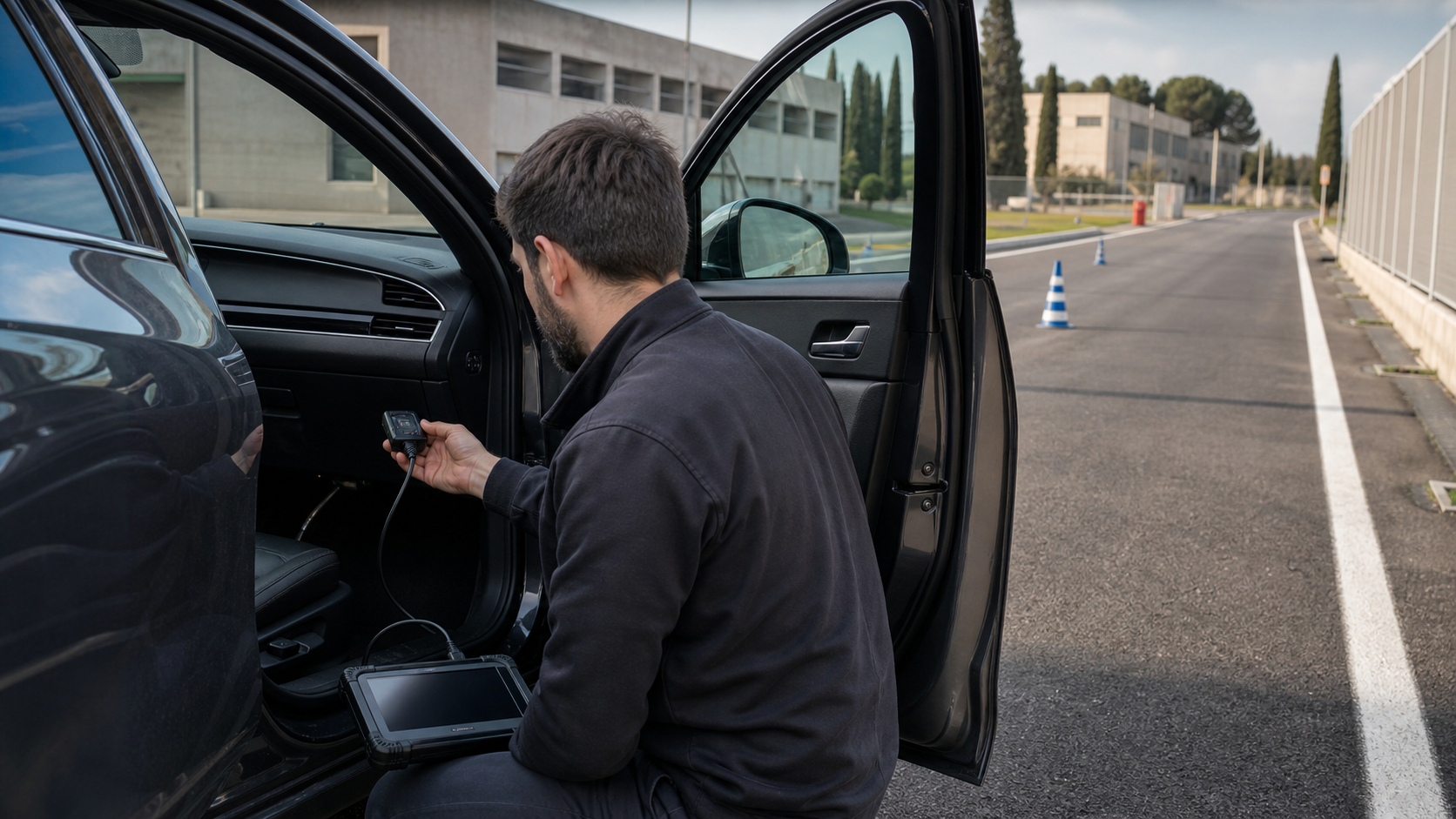
OCTO's device range is a central part of the economic equation. The company lists professionally installed units, OBD plug-in devices, windshield devices, sharing modules, smart cameras, stolen-vehicle tracking backup devices, smartphone-connected tags and motorcycle devices. These include combinations of accelerometers, gyroscopes, GSM, GPRS, LTE CAT-M1 or LTE CAT1 modems, Bluetooth Low Energy, GNSS receivers, backup batteries, emergency buttons, microphones, speakers, camera inputs and inertial navigation.
That hardware breadth lets OCTO match device type to use case: a commercial fleet may need OBD or hardwired installation; a smartphone program may need app speed; theft recovery may need a hidden self-powered backup; motorcycle insurance may require different packaging.
The asset side is clear. Hardware can improve data reliability and service range. A professionally installed unit can be better for crash detection, eCall-style assistance, stolen-vehicle recovery and forensic use because it is tied to the vehicle and not dependent on the policyholder's phone. An OBD device can be installed faster and can support mixed fleets with less friction. A smartphone solution can lower enrollment barriers and support trial programs before policy issuance. A camera-enabled device can enrich crash or damage evidence, although that also raises privacy sensitivity.
The device range gives OCTO a practical answer to insurers who do not want a one-size-fits-all implementation.
The burden is also clear. Hardware pulls the company into working capital, certification, logistics, manufacturing oversight, installer training, device returns, failure rates, firmware support and component availability. The certifications page is revealing because it defines scope across cloud services for telematics data acquisition, processing and presentation, scoring services, contact centers, design and development of devices and software platforms, and management of manufacture, logistics, installation and maintenance of data collection devices. That is a real operating footprint, not just a software subscription.
Device economics are unforgiving because the insurer's alternative keeps improving. Modern smartphones include high-quality sensors and location services, and OCTO itself offers smartphone crash detection and DigitalDriver programs. OEM telematics is growing as more cars ship with built-in connectivity. The European Data Act is designed to strengthen user access to data from connected products and services, which may improve third-party access to vehicle-generated data over time. If OEM data becomes easier to obtain in standardized form, aftermarket devices lose some of their historic advantage.
If smartphone sensing becomes sufficiently accurate for many pricing use cases, insurers may reserve installed hardware only for theft, claims and high-value segments.
That does not mean hardware is obsolete. It means hardware must be allocated carefully. The best use of an installed device is where data quality, vehicle identity, independent crash evidence, theft recovery or multi-driver fleet attribution are worth the extra cost. The worst use is a low-premium policy where the expected pricing improvement is smaller than the total device and service cost. OCTO's management problem is therefore resource allocation: when to push a richer device bundle, when to accept a phone-based entry product, when to use OBD, and when to integrate OEM data.
Strategy without that allocation discipline would be marketing. The margin is made in matching sensor cost to the value of the decision it improves.
Connectivity And Cloud Costs Test The Gross Margin
Telematics is a telecom-dependent business even when the supplier is not a telecom operator. OCTO's devices rely on cellular modules, GNSS, Bluetooth and data transmission to a cloud service. Its website and certifications describe cloud-model services for data acquisition from telematics systems, processing and presentation to companies, and information-security, privacy, cloud-security, business-continuity and quality standards. Its device pages reference GSM, GPRS, LTE CAT-M1 and LTE CAT1 capabilities. The company is also recorded by RIPE NCC as a public member in Italy.
That membership is useful network-resource context, but it is not proof that OCTO sells ISP, IP transit or managed network services.
The economic implication is that OCTO has both direct and indirect network dependencies. Directly, devices need data plans, coverage, roaming arrangements or local carriers, and reliable transmission. Indirectly, the cloud service needs secure ingestion, storage, model execution, dashboard availability, API access and resilience. A crash detection event or first notice of loss is time-sensitive; a monthly mileage adjustment is less urgent. That mix requires service design, not just cheap bandwidth.
Connectivity cost may appear small per trip, but it compounds across millions of users and billions of trips. If the insurer pays OCTO per active vehicle or per policy, OCTO must manage the underlying variable costs. If OCTO bears device connectivity and cloud processing risk, heavy users, high-frequency sampling and large media files can squeeze gross margin. The risk-scoring page says DriveAbility Advanced Score is assigned using high-sampling-rate data, including GPS data every second. That may support better models, but it also raises collection and processing intensity.
Video damage evaluation and smart cameras can add still more data volume, although OCTO can manage this with event-based capture and limited retention.
Cloud dependency creates another margin test. OCTO can improve scale economics if it standardizes ingestion, scoring and dashboards across customers. It loses leverage if every insurer requires custom data fields, custom rating variables, bespoke claim screens and unique integrations that turn a platform sale into professional services. The company describes API and SDK capabilities and a modular approach, which is the right answer. But the important metric would be repeatable revenue per connected unit after cellular, cloud, support and integration costs. OCTO does not publish that metric.
Data locality also matters. The privacy policy for the website states that website personal data are stored on OCTO proprietary servers in Italy and that processing will take place in EU countries unless transfers rely on GDPR mechanisms. That policy is not the same as a full platform data-processing agreement for every telematics customer, but it signals the legal environment in which OCTO operates. European insurance customers will care about where driving data, location data and claim evidence are stored, who is controller or processor, how long data are kept, and how policyholders can exercise rights.
Cross-border deployment can win business, but cross-border data governance can add cost and slow sales.
The telecom economics lesson is simple: the value of the data must rise faster than the cost of moving, storing and governing it. OCTO's moat is not the SIM. It is the ability to turn raw sensor events into pricing and claims decisions at a unit cost low enough that insurers see margin after paying for the service.
Scoring Must Beat Traditional Rating, Not Impress Itself
Risk scoring is the most obvious telematics use case, but also the easiest to overstate. A score is valuable only if it improves underwriting beyond existing variables and remains usable in pricing, retention and customer communication. OCTO says its risk models help insurers profile customers, manage risk and offer premiums based on driving behavior. It lists variables such as road type, trip timing, duration, speed, braking, acceleration, curves and acceleration force. It also says DriveAbility Advanced Score is flexible across devices, used by many insurers and designed to predict accident likelihood with a high lift index.
That is plausible. Academic and industry research generally supports the idea that telematics can improve pure-premium estimation, segmentation and adverse-selection management. But the incremental value is not unlimited. A study on how much telematics information insurers need for claim classification found that in its dataset telematics data became redundant after about three months or 4,000 kilometers of observation for claim classification. Other research on connected-vehicle insurance highlights pain points around pricing, data non-uniformity and enrollment.
Research on smartphone-based telematics highlights the technical difficulty of inferring driver behavior from a phone that is not integrated with the vehicle. User-acceptance research warns that usage-based insurance can create transparency and behavior-change challenges.
OCTO's answer is to offer more than a single score. DigitalDriver includes try-before-you-buy, in-policy scoring, safer-driving incentives and customer engagement. DriveAbility No Location Score addresses cases where smartphone GPS is off. Agile Score aims to produce estimates within a few weeks. Engagement scores and reward programs try to convert telematics from surveillance into a feedback and loyalty tool. The Mastercard partnership page frames safe driving as a reward mechanism, with discounts and benefits linked to driving score. The SURA case describes gamification and app usage as part of behavior improvement.
This matters because pricing is only one way to monetize telematics. If the insurer uses telematics only to discount good drivers, it may give away much of the economics to customers and competitors. If telematics also helps retain profitable customers, coach risky drivers, reduce crash frequency and support fraud detection, the value pool is larger. OCTO's advantage improves if it can show that its score changes behavior, not merely labels it.
The hard test is actuarial independence. Insurers should demand holdout tests, lift charts, claim-frequency and claim-severity effects, loss-ratio impact by segment, and evidence that the model remains predictive after selection effects. Drivers who choose telematics may already be safer or more price-sensitive. A supplier must separate self-selection from true behavioral measurement. OCTO's public materials speak to lift and insurer use, but they do not disclose audited model performance.
The SURA customer story reports a nine-times lift in pilot claims data and improvements in driving scores after trips, but because the source is vendor-published, it should be treated as a signal rather than a complete proof.
For OCTO, the scoring business is attractive if it becomes embedded in rate filings, renewal offers, claims triage and customer engagement. It is weaker if insurers can replace the score with in-house models trained on OEM or smartphone feeds. The moat is not simply data history; it is proof that OCTO's interpretation of data improves insurer economics under real policy conditions.
Claims Automation Is The Margin Expansion Case
Claims may be OCTO's most defensible economic case because it links telematics to expense and leakage, not only pricing. The company's crash and claims materials describe a chain from crash detection to reconstruction, crash report, damage preview, video damage evaluation, early first notice of loss, claim verification, forensic dossiers, training and fraud detection. The logic is compelling: a motor claim is a moment when time, evidence quality and customer communication can change cost.
If a crash is detected quickly and accurately, the insurer can open the claim sooner, contact the driver, arrange assistance, capture details before memory fades, reduce disputes about time and location, and route the claim to the right handler. If the device provides speed, impact direction, intensity, location and route context, the insurer can challenge inconsistent statements or identify when a reported claim lacks a corresponding accident event. If damage estimation can be supported by photos or video, small claims may need less adjuster intervention.
If fraud scoring flags inconsistencies across location, time, damage and accident record, investigators can focus effort on the suspicious subset.
This is where installed devices can justify their cost. A phone app may be enough for engagement and light scoring, but a dedicated in-vehicle device can be more persuasive in a contested crash. OCTO's own pages describe forensic dossiers and objective proof for court disputes. That type of service is more operationally demanding than selling a score, but it can be stickier because it sits inside claim handling, legal review and fraud management.
The Sedgwick partnership, even from the title and homepage positioning alone, points in the same direction: faster, fairer and smarter claims management is the proposition. Pouch's commercial per-mile partnership also includes operations and claims integration. These are not just consumer discount stories. They are examples of telematics being pulled into the insurer's operating model.
Claims economics also create less visible cost. OCTO may need trained staff, control rooms, support for adjusters and legal documentation. Its certification scope includes contact-center management, while its safety pages describe control operating rooms and outsourced service options. Those services can defend revenue but limit pure software margins. A claims business can be attractive if repeatable, but it is not costless. The company must maintain service quality when incidents spike, when customers operate across jurisdictions, or when data are disputed.
The key question is evidence quality. Insurers will pay more if OCTO's crash data are accepted by adjusters, lawyers, courts and policyholders as reliable. They will pay less if the data are treated as another advisory signal that still requires manual verification. OCTO's long history and crash database may help, especially if models have seen enough events to distinguish harsh braking, potholes, tow events and true impacts. But the best evidence would be audited reductions in average claim cycle time, fraud leakage, indemnity error and allocated loss-adjustment expense.
Without that, the claims story is strong in theory but not fully priced.
OEM Data Changes The Bargaining Game
OEM integration is both an opportunity and a threat. OCTO's OEM solutions page says it uses connected-vehicle data to support manufacturers, insurers and rental companies, including remote diagnostics, maintenance, battery level, kilometers traveled, error codes, fleet analytics, fuel-consumption monitoring, residual-value estimation, safety, security, risk scoring and keyless access. It also says vehicle data differ by brand and model, and that remote diagnostic services may integrate additional OEM data.
The opportunity is clear. Factory-installed connectivity can reduce aftermarket installation cost, improve data accuracy, and open richer diagnostic fields. If OCTO can normalize OEM data across brands and provide insurers and fleets with consistent scoring and claims tools, it can move up the value chain. For fleets, rental companies and insurers, the problem is not merely getting data from a car; it is making data from many cars comparable and operationally useful. OCTO's long experience with device heterogeneity may translate into an advantage in OEM data normalization.
The threat is equally clear. OEMs may decide that insurance and fleet analytics are adjacent profit pools they should capture themselves. They control the vehicle architecture, customer relationship in many cases, over-the-air software, embedded connectivity and proprietary diagnostic signals. If regulators force broader data access, that can help independent suppliers, but it can also invite more competitors into the same data pool. If OEMs package insurance scoring directly with preferred insurers, OCTO may be pushed into a lower-margin integration role.
The EU Data Act matters in this context because it creates a broader framework for fair access to and use of data from connected products and related services. Its full operational effects will depend on implementation, standards, contracts and enforcement. For OCTO, greater access to vehicle data could reduce dependence on aftermarket hardware and help the company serve mixed fleets. For OCTO's customers, it could also lower switching barriers by making vehicle-generated data less locked to any one supplier.
The right strategic response is not to defend hardware at all costs. It is to be the best interpreter of heterogeneous mobility data regardless of origin. If the data come from an OBD device, a hardwired unit, a smartphone, a motorcycle sensor, a camera, a hidden theft device or an OEM feed, OCTO needs to produce a reliable risk, claim or operational decision. That is the only position that survives the shift from aftermarket boxes to embedded vehicles.
But this position requires investment. Data normalization, OEM APIs, consent management, security review, uptime, error handling and actuarial validation are not free. If OCTO bears those costs while customers demand simple per-vehicle pricing, margin can compress. The bargaining game changes when the insurer can say that OEM data are available elsewhere. OCTO must respond with proven interpretation, service quality and outcomes, not just access.
Customer Concentration And Contract Duration Matter More Than Market Size
The connected-insurance market looks large from the outside because almost every motor insurer, fleet, rental operator and mobility platform has some reason to measure usage. Market size, however, is not the same as value creation. OCTO's economics depend more on customer concentration, contract duration, integration depth and renewal behavior than on the abstract number of connected cars.
OCTO's public materials show recognizable customers and partnerships: Sara Assicurazioni, SURA with Jooycar, Pouch Insurance, Mastercard, Sedgwick and a long list of logos on the homepage. The company also says its DriveAbility score is used by insurers across continents. These are useful demand signals. They show that OCTO can sell to insurance and mobility customers that need more than a consumer app. They do not tell us revenue concentration, gross margin, churn, minimum commitments or contract length.
Those missing details are central. A telematics program may look attractive at launch but take years to scale across an insurer's book. Enrollment can disappoint if sales staff, brokers or digital channels do not explain the product clearly. Claims teams may resist new dashboards if the data do not fit their habits. Policyholders may disable permissions, ignore coaching or object to location tracking. A customer may pilot several vendors and then move the winning model in-house. A competitor may undercut device pricing. An insurer may use telematics mainly as a marketing discount and then abandon it when savings are unclear.
Contract duration matters because OCTO's up-front work is material. Device procurement, installation setup, data integration, rate design, claim-handler training and customer-service scripts are not one-click software. If contracts are short or volumes are not guaranteed, OCTO may carry launch cost without sufficient lifetime revenue. If contracts are multi-year, deeply integrated and tied to claims and pricing operations, switching cost rises.
Customer concentration can cut both ways. A large insurer can give OCTO volume, credibility and data, but it can also bargain aggressively and demand customization. Smaller insurers may need OCTO more but offer less volume. Commercial auto specialists like Pouch can provide a sharper use case, but such programs may still be early and exposed to growth risk. Mobility and rental operators may value keyless access, billing and fleet analytics, but they may also run on thin margins and scrutinize per-vehicle fees.
The ideal OCTO customer is one that has a real loss or utilization problem, lacks enough internal telematics infrastructure, has sufficient scale to justify integration, and agrees to measure outcomes over several renewal cycles. The least attractive customer is one that wants a discount app because competitors have one. OCTO's public materials show both broad market ambition and specific use cases. The investment judgment depends on whether revenue is weighted toward the latter.
Privacy, Data Locality And Trust Are Operating Constraints
Driving data is sensitive because it can reveal location, habits, work patterns, speed, nighttime travel, stops, crash involvement and potentially health or family routines. Telematics therefore sits at the intersection of insurance fairness, surveillance anxiety and road safety. OCTO cannot treat privacy as a legal appendix. It is part of the product economics.
The GDPR establishes the European baseline for personal-data processing, and European data-protection guidance on connected vehicles has emphasized data minimization, purpose limitation, transparency, user control, security and caution around location and behavioral data. OCTO's own corporate governance pages state a commitment to data protection and list certifications spanning information security, privacy, cloud security, business continuity and quality. The certifications page references ISO 9001, ISO 22301, ISO/IEC 27001 and ISO/IEC 27701.
Those certifications do not guarantee perfect practice, but they matter in procurement because insurers and fleets need suppliers that can pass security and privacy review.
Trust affects adoption. A telematics program that drivers perceive as punitive can reduce engagement or invite churn. User-acceptance research has found that transparency, feedback design and policy conditions influence acceptance, and that poorly designed programs can create unintended behavior. OCTO's DigitalDriver and reward propositions are attempts to frame telematics as feedback and benefit, not only monitoring. The Mastercard-linked reward page explicitly connects good driving behavior to discounts and benefits. The SURA case describes gamification and cashback as a way to increase engagement.
The economic test is whether engagement costs less than the expected loss improvement. Rewards, app design, communications and customer service all cost money. If rewards simply transfer underwriting savings to drivers, OCTO and the insurer may create activity without margin. If rewards retain profitable customers, improve driving and generate cleaner data, they can expand the value pool. OCTO's role is to help insurers avoid the trap of buying telematics as a surveillance discount and instead design it as a risk-management service that customers understand.
Data locality and cross-border deployment add another constraint. OCTO operates across countries and offers services to customers that may serve drivers in multiple jurisdictions. The privacy policy and certifications indicate serious attention to European requirements, but every insurer will need contractual clarity on controller and processor roles, retention, transfers, sub-processors, security incidents, policyholder access rights and deletion. The more OCTO handles claims and forensic evidence, the more sensitive the data become.
Regulation can also change bargaining power. If connected-vehicle data access becomes more standardized, customers may demand portability and lower switching cost. If privacy enforcement tightens around location tracking, suppliers may need to reduce collection or redesign consent. If motor-insurance regulators scrutinize algorithmic pricing and protected characteristics, scoring models need stronger explainability. OCTO's advantage should be to make compliance easier for insurers, not to push risk onto them. That requires product discipline and documentation, which again adds cost but can defend price.
Competition Comes From Phones, Platforms And Insurers Themselves
OCTO's competitive set is wider than other Italian telematics companies. It includes smartphone telematics specialists, insurer-affiliated data platforms, fleet-management platforms, OEM data services, claims technology vendors, analytics consultancies and internal insurer teams. Cambridge Mobile Telematics, Arity, Geotab, LexisNexis Risk Solutions and similar firms all address parts of the same value chain. Some are stronger in smartphone sensing, some in fleet operations, some in insurer data distribution, some in claims or risk analytics.
The first substitute is smartphone-only telematics. Its advantage is low hardware cost and easy enrollment. It is particularly attractive for try-before-you-buy, engagement and lighter personal-lines scoring. OCTO offers smartphone products itself, which is sensible, but it also means the company competes with suppliers whose core identity is phone-based analytics. The limit is data certainty. For severe crashes, theft recovery, vehicle identity and multi-driver shared fleets, a phone may not be enough.
The second substitute is in-house insurer analytics. Large insurers may prefer to own scoring models because pricing is central to underwriting advantage. They may buy devices or data feeds but keep the actuarial layer internal. This is a real risk to OCTO's pricing power. The counterargument is that not every insurer can maintain the sensor science, crash analytics, device estate, app experience, cloud infrastructure and cross-market data scale required. OCTO can win when the total capability bundle is cheaper and faster than internal build.
The third substitute is OEM data. As vehicles become connected by default, OEMs can provide mileage, diagnostic and event data without aftermarket hardware. The challenge is fragmentation and rights. OEM data may be richer but less standardized; commercial terms may be expensive; older vehicles may still need devices; and insurers may not want each automaker to control the insurance data relationship. OCTO can remain relevant by normalizing data across sources and serving as the independent interpretation layer.
The fourth substitute is fleet and mobility software. Geotab and other fleet platforms already help operators monitor vehicles, driver behavior, maintenance and utilization. For fleet customers, insurance is only one use case. OCTO's fleet offering competes where insurance, claims, safety and mobility analytics overlap. It may win with insurers and insurance-linked fleets; it may face tougher competition in pure logistics or enterprise fleet management where compliance, routing and driver operations dominate.
The fifth substitute is claims technology. Photo estimating, fraud analytics, repair-network tools and claim automation can improve claims without telematics. OCTO's advantage is pre-claim and crash-context data. Its risk is that insurers combine another claims vendor with cheaper data capture. Again, the durable position is not data capture alone; it is the integrated decision that improves outcomes.
OCTO's competition therefore pushes it toward specialization. The company should defend use cases where its history, crash database, device range and insurance integrations matter. It should avoid competing only on commodity tracking or generic dashboards. In a market with many substitutes, the customer will pay for proof and operational depth, not for the word telematics.
Unofficial Signals Are Thin And Should Stay Bounded
There is not enough public financial evidence to make a clean valuation-style call. OCTO is private, and its public site does not disclose revenue, EBITDA, gross retention, device cost, average revenue per connected unit, customer concentration or contract backlog. That absence is itself an economic signal. A reader should not infer strong margins from data volume or customer logos. The company may have attractive economics, but the public record does not prove them.
The unofficial and semi-official signals should be used carefully. Vendor-published customer stories are useful because they reveal product positioning, buyer problems and claimed outcomes. They are not independent audits. The Sara case shows motorcycle insurance moving from policy coverage toward active protection. The SURA case claims score improvement, engagement and actuarial lift. The Pouch case shows OCTO being used as a telematics backbone for commercial per-mile insurance. These signals support the thesis that OCTO can be useful in complex insurance programs. They do not prove portfolio-wide profitability for OCTO or for the insurer.
Press and partnership announcements also need restraint. A CTO appointment from a Stellantis-connected background suggests OCTO is investing in automotive software, OEM-adjacent expertise and international technology leadership. The Pouch announcement suggests North American ambition in commercial auto. The Sedgwick partnership title signals claims-management relevance. But announcements are intent and early execution, not cash flow.
Market chatter around telematics often overstates adoption because the technology story is easy to tell. The harder question is whether insurers renew programs after measuring loss and expense. There is also a tendency to assume that more granular data always improves fairness. In practice, granular data can create explainability, consent, proxy-discrimination and customer-acceptance issues. Italian car-insurance algorithmic research has shown broader concerns about pricing fairness in the market, and telematics models must be evaluated within that regulatory and social context.
The absence of strong negative public signals is not enough to make a bullish case. What matters is the next layer of evidence: customer renewal rates, independent loss-ratio studies, claim-cycle reductions, device failure rates, support cost per active vehicle, and the share of revenue from multi-year integrated programs rather than pilots. Until those are visible, the prudent stance is to treat OCTO as a credible specialist with unproven public unit economics.
That bounded approach is important for BTW's directory context as well. RIPE membership and number-resource evidence confirm a network-governance footprint. They do not turn OCTO into a connectivity provider. Customer stories confirm use cases. They do not prove financial durability. Official product pages confirm capabilities. They do not prove customer willingness to pay at attractive margins. The article's conclusion should therefore be directional and conditional, not falsely precise.
The Investment Case Rests On Proof Of Shared Savings
OCTO's strongest economic path is to become the supplier insurers keep because it helps them share and retain savings that would otherwise leak through poor pricing, slow claims, fraud, theft, weak retention or inefficient fleet operations. That is a defensible place to be. Motor insurance is large, loss costs are volatile, repair costs are rising, and insurers need better signals. Fleets and mobility operators also need utilization, maintenance and safety data. OCTO has scale, history, devices, cloud services, certifications, customer examples and a proposition that spans pricing and claims.
But the business is not automatically high-return. Hardware adds cost and operational exposure. Connectivity and cloud processing consume gross margin. Data privacy and localization requirements slow sales and require discipline. Insurers are sophisticated buyers with strong bargaining power. Smartphone-only programs and OEM feeds pressure the device model. In-house analytics pressure the scoring model. Fleet platforms pressure the mobility model. Claims vendors pressure the automation model. A large data estate is powerful only when it produces decisions that customers cannot cheaply reproduce.
The central position is therefore this: OCTO can earn durable returns from connected-vehicle data if it is paid for outcomes, not just endpoints. The best opportunities are where data quality and interpretation matter most: commercial per-mile exposure separation, multi-driver fleets, crash reconstruction, fraud detection, severe-accident assistance, stolen-vehicle recovery, motorcycle safety and cross-source data normalization. The weaker opportunities are generic discount apps and low-premium policies where device and support cost can swallow the benefit.
Management should be judged on allocation. It should push installed hardware where it improves claim or theft outcomes enough to pay for itself. It should use smartphone tools where engagement and low-cost scoring are sufficient. It should pursue OEM data where access lowers friction without giving automakers all the economics. It should avoid chasing every connected-mobility adjacency if the result is bespoke work with thin recurring revenue. It should force every product claim back to the insurer's income statement: lower losses, lower expenses, higher retention, better pricing or lower capital strain.
The facts that would change the judgment are concrete. A positive revision would require audited or customer-verified evidence that OCTO programs reduce loss ratios, claim cycle times, fraud leakage or theft severity enough to create a repeatable shared-savings pool; proof of high gross retention and multi-year contract expansion; and evidence that OEM and smartphone data are improving rather than eroding OCTO's margins.
A negative revision would follow from high device failure or installation cost, weak enrollment, insurer churn, commoditized pricing, regulatory restrictions on location and behavior scoring, or OEM data access that makes OCTO's interpretation less differentiated.
For now, the company deserves credit for aiming at the right economic layer. It is not merely selling boxes in cars. It is trying to sell underwriting, claims and mobility decisions. The open question is whether customers let OCTO keep enough of the value. If the answer is yes, the Italian telematics pioneer can remain a meaningful insurance infrastructure supplier in a more connected vehicle market. If the answer is no, the same data estate risks becoming a bargaining chip for insurers, OEMs and larger platforms that capture the margin OCTO helped reveal.