
Summary
- Ocala Fiber Network is best understood as a municipal access utility: the City of Ocala sells residential and business fiber accounts, advertises local customer service and technicians, and reports the fiber network as a business-type fund in city financial statements.
- Current operating evidence is stronger than a registry trace alone. The record includes published residential and business tariffs, broadband labels, an availability path, city audit/customer data, procurement for inventory and wholesale DIA, and visible AS30444 routing and prefixes.
- The investment case is not proven by the city's reliability claims or by the existence of an ASN. The unsettled questions are take-up, outage performance, long-run capital needs, upstream exposure and how the municipal account survives private overbuild from Wire 3, Quantum Fiber, Spectrum, cable, wireless and satellite substitutes.
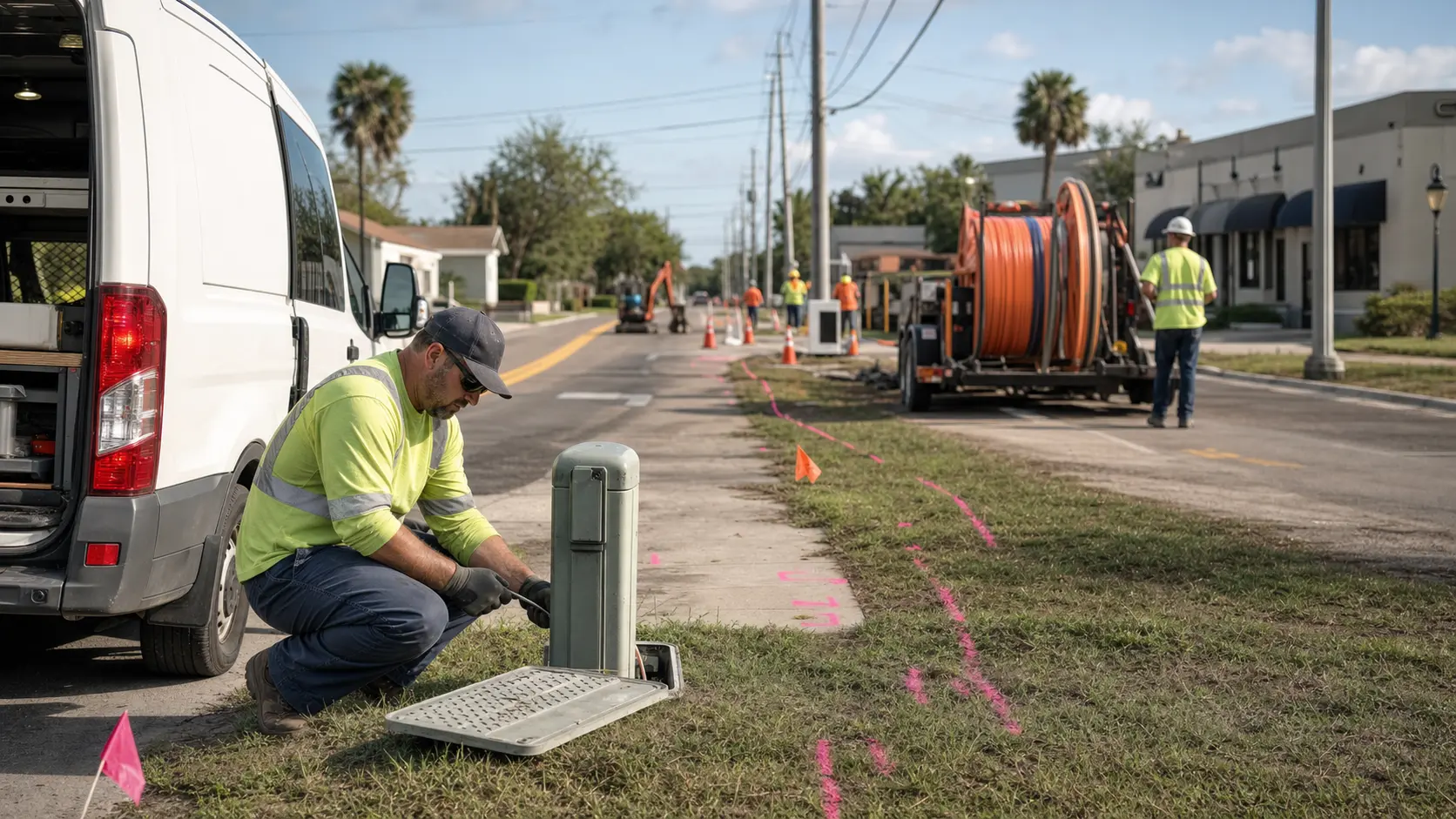
An Ocala customer looking at fiber in 2026 sees a more crowded market than the one that originally gave the city room to build. The City of Ocala's own fiber page presents Ocala Fiber Network, or OFN, as a hometown provider with a local customer service office, local technicians, 24-hour service and a fiber connection that can provide up to a 1-Gigabit symmetrical link. It also warns customers that several new fiber providers have begun construction and promotion in the area, and says those providers are not affiliated with OFN. That notice is unusually revealing.
It shows a municipal network defending not an abstract broadband principle but a retail account in a market where private capital has noticed the same streets.
The economic unit is therefore simple and demanding: a monthly residential or business symmetrical fiber-access account billed by the City of Ocala. The bill may sit beside other city utilities, but the customer is still comparing it with a cable bill, a private fiber offer, a fixed-wireless offer or a satellite subscription. The city cannot win only by saying it owns fiber. It has to install, repair, price and upgrade that account well enough that a resident or local business believes the civic wrapper is worth choosing over bigger brands.
The first hard evidence is the offer itself. The City of Ocala OFN page markets residential fiber-to-the-home starting at $69.99 per month and tells prospective customers that the service begin date depends on access to existing infrastructure. On the business side, the same city page lists Business 200 at $145 per month, Business 300 at $165 per month and Business 500 at $255 per month. It also says commercial customers receive one public IP address and can buy additional IP addresses. That is not just brand language. It describes a tariffed access account with a speed tier, a price, an IP allocation practice and an availability condition.
The current offer also has a documented paper trail that complicates the price story. A City of Ocala broadband label for the Silver Package lists a monthly price of $105, typical download and upload speeds of 100 Mbps, typical latency of about 10 milliseconds, no data caps and customer support by phone. That label is useful because it shows the City complying with consumer-disclosure mechanics, but it also creates a watchpoint. The public residential page now advertises a $69.99 starting point and up to 1 Gbps, while the label visible through the city's own site describes a 100 Mbps Silver Package at $105. The gap does not prove a customer is overcharged or misled; plan pages and labels can sit at different levels of the offer set. It does mean a buyer and an analyst should not flatten "Ocala fiber" into one price and one speed without checking the current address-specific terms.
Availability is just as important as price. OFN's residential path routes the buyer through a city inquiry form and an availability check rather than a universal instant order. The city says the service begin date depends on access to existing infrastructure, and the main OFN page says expansion work can cause temporary outages, delays in new installations and service disruptions while the city extends coverage. That language matters because a municipal network with a favorable price but slow construction does not compete at the same point in time as an overbuilder that can sell immediately on a specific street.
For a customer, fiber is a delivered service, not a line on a citywide plan.
The second layer of evidence is that OFN is not merely a marketing page. The City accounts for it as a broadband communications network. In the fiscal 2025 Annual Comprehensive Financial Report, the Ocala Fiber Network Fund is described as the fund that accounts for construction, operations and maintenance of the city's broadband communications fiber-optic network. The same report places Fiber Network/Telecom in the organizational chart and lists Fiber Network in the business-type activity schedules. The fund structure does not by itself prove customer satisfaction or resilience, but it does anchor OFN in a municipal operating apparatus rather than a dormant brand.
The fiscal record also shows why the access account is a political object. In the fiscal 2024 city audit, the OFN Fund increased operating income by $431,905, or 16.7 percent, with the increase attributed mainly to commercial internet revenue and residential internet revenue. The same passage says the customer base grew from 3,390 customers in fiscal 2023 to 3,690 in fiscal 2024. That is a modest customer base by national cable standards, but for a city-run access network it is the difference between a public works experiment and a recurring utility operation.
A municipal provider can survive with fewer customers than a national brand if the capital plan is disciplined, but it still needs each incremental account to carry a share of network, staff, support and upstream costs.
The latest audited statements point in the same direction without settling every question. The fiscal 2025 ACFR reports Fiber Network program revenue and expenses in the city's business-type activity tables, and it records OFN's use of vendor fiber-optic transport circuits to connect its telecommunications network. Those entries are not consumer-facing speed tests. They are accounting evidence of a network that costs money to operate, uses leased transport and produces service revenue. The city can therefore be evaluated like a local infrastructure operator: What are the operating revenues?
What are the personnel, transport, depreciation and administrative costs? How much expansion capital is needed? How much political patience exists if take-up slows?
Procurement reinforces the same operating picture. In May 2026, an Ocala City Council item approved up to $723,341 for OFN inventory purchases used in day-to-day operations. A network that needs fiber plant parts, electronics, spares and inventory is not a paper-only registry holder. It has a physical maintenance burden. Inventory approvals also show how municipal broadband converts customer demand into public purchasing decisions. A private operator can allocate inventory inside corporate logistics; a city utility must surface more of the spend through procurement and council controls.
That transparency is valuable, but it can also slow response if purchasing practice and construction needs diverge.
Wholesale dependence is another defining feature. OFN owns and operates a local fiber network, but it still buys dedicated internet access to reach the broader internet. A Florida procurement scope for wholesale DIA says Ocala Fiber Network is a municipally owned utility formed in 1995, operating in Ocala and the surrounding Marion County area. It says OFN owns and operates a fiber-optic network and provides internet bandwidth to customers by reselling dedicated internet service provided by the vendor.
The same scope says OFN has two dedicated internet access services from Tier 1 providers, one from the north and one from the south, and maintains failover between providers. It requires 2 Gbps symmetrical service, dedicated fiber media, no RF, coaxial cable or shared media, 24/7 support and Juniper routers running full routes.
That document is one of the most useful pieces of the record because it separates the local access claim from the upstream claim. OFN can be a local fiber provider and still rely on wholesale transit and transport vendors. It can sell a city access account and still be exposed to the price, route quality, service-level discipline and repair response of upstream providers. The procurement language is also a reminder that local control is not total control.
The city's edge equipment, fiber routes and staff matter, but the customer experience can still be affected by a southern route, a hotel-suite meet point, a Level 3 or Lumen path, a Cogent path or another vendor commitment.
Network-resource evidence is strong enough to support a regional ISP thesis, but it should not be overstated. IPinfo's AS30444 page identifies Ocala Fiber Network as the registered name for the autonomous system, shows 17,408 IPv4 addresses, lists an ISP type, and displays prefixes including 38.34.224.0/19, 67.231.48.0/20 and 216.255.240.0/20. It also shows upstreams including Cogent and Level 3 Parent and a June 2026 traceroute into AS30444. DNSlytics likewise reports AS30444 as allocated by ARIN to Ocala Fiber Network with 17,408 IPv4 addresses. ARIN-derived records for AS30444 and the 216.255.240.0/20 OCALAFIBER allocation provide registry corroboration. The important point is that the grade does not rest on the ARIN record alone. Current routing visibility, current prefixes, city tariffs and operational procurement make the evidence stronger than a stale handle.
The routing picture fits the buyer proposition. A local business choosing OFN is not only buying bandwidth; it is buying an addressable network presence that can include a public IP address, more addresses for a charge, MAN connections, dark fiber and secure co-location space. The additional business services page frames those offers as business connectivity and facilities services. They are not enough to classify the article around hosted cloud services, because the paid unit at the center remains access, transport, dark fiber or co-location rather than a managed hosting or SaaS account. Still, they broaden the business case beyond residential broadband. A local bank branch, medical office, public agency, school, warehouse or professional-services firm may care more about a MAN link, a local NOC contact or a dark fiber path than about a retail home price.
The city leans heavily on locality. OFN says it has a local customer service office and local technicians. It publishes phone numbers for support, outages and sales, and lists Mel Poole as OFN director on the city page. It says the service operates 24 hours a day, seven days a week, and includes a one-time no-charge troubleshooting session to determine network issues. This is direct evidence for local support labor, but it is still offer-side evidence. It tells the reader what OFN says it provides and how the buyer can reach it.
It does not independently prove average repair time, first-contact resolution, outage frequency or satisfaction across the base.
That distinction matters because the city's own reliability claims are strong claims without public performance backing in the materials reviewed. OFN's page says the fiber connection has a proven 99.9 percent reliability rate and another city graphic uses 99.99 percent reliability language. The procurement scope asks wholesale providers to maintain end-to-end network availability of 99.99 percent or above and 100 percent port availability. Those are important standards and offer signals. They do not, by themselves, establish achieved network uptime for retail OFN customers.
A serious evaluation would need outage logs, credits, repair intervals, trouble-ticket volumes, customer churn and independent measurements before translating the reliability language into an outcome claim.
The cost stack behind the account is also different from the cost stack behind a national cable or fiber provider. A large private operator spreads systems, marketing, provisioning software, peering teams, call-center capacity and backbone purchasing across many markets. OFN spreads its network, local office and field response over Ocala and nearby Marion County. That can be efficient when the same municipal plant supports city operations, businesses and residents, because trenching, poles, utility coordination and public-facility connectivity are already part of the city's operating life.
It can be inefficient if residential take-up is too thin, because a small customer base has to carry electronics, spares, dispatch, billing, customer support, upstream transit, transport leases, maintenance and depreciation.
The city audit language helps make that tradeoff measurable. The OFN Fund is not buried inside a general technology department; it is a business-type activity with its own operating revenue and expense profile. That matters for readers because it separates two questions that are often confused in municipal-broadband debates. One question is whether a municipal fiber network produces public value by improving competition, supporting city facilities, connecting businesses and creating a local alternative. The other is whether the access accounts and related services are priced well enough to cover the costs assigned to the fund over time.
OFN can have public value even if some benefits do not appear as broadband revenue, but the financial statements still tell citizens whether the enterprise is absorbing or generating resources inside the city structure.
Storm and emergency obligations add another layer. Ocala is not a coastal barrier island, but it is in Florida, where hurricane preparation, electric restoration, tree damage and emergency coordination are normal operating concerns. A municipal fiber provider tied to city utility functions may have better local situational awareness than an out-of-market support center. It may know which roads are blocked, which electric feeders are down and which public facilities need priority communication. That is an advantage only if repair crews, spares, contracts and escalation authority are ready before the event.
The same municipal proximity that gives OFN a local story also means residents may expect city-like responsiveness when broadband fails during a weather event. A private provider may be criticized; a city provider may become a council issue.
The procurement record makes this practical rather than rhetorical. The wholesale DIA scope requires dedicated fiber media, no shared coaxial or wireless media, route details, 24/7 support, service reports and response expectations from the supplier. Those requirements show the city understands that a retail account depends on upstream path quality and vendor discipline. They also show that resilience is a chain. A customer's home drop, neighborhood fiber, central electronics, city routers, southern and northern paths, transit providers, DNS service and supplier support all have to work together.
If any piece fails, the customer's judgement falls on the provider whose name is on the bill.
Customer segmentation is therefore central. A household choosing the $69.99 starting offer is likely to compare monthly price, installation wait, Wi-Fi quality, streaming reliability and support. A remote worker may care more about upload symmetry, latency and support response. A small business may care about public IPs, phone service alternatives, payment-system continuity, security cameras and the ability to reach someone local during an outage. A larger local institution may value dark fiber, MAN connections and route discussions.
OFN's advantage is strongest where the buyer's problem is local coordination and continuity, not just the cheapest headline speed.
This explains why the public IP detail matters more than it first appears. Many residential customers will never ask about a public address. A business customer may need it for VPNs, cameras, remote access, point-of-sale systems, monitoring or hosted devices. The city page says commercial customers are given one public IP address and can purchase more. That is a small but concrete sign that OFN is selling more than a consumer entertainment pipe. It also creates obligations: address management, abuse handling, security expectations and technical support all become part of the business account.
Visible AS30444 routing and prefix evidence makes that promise more credible, but it also means OFN is participating in the operational internet, not simply reselling a white-label retail product.
The same segmentation changes how to read co-location. Secure co-location space in an OFN context is not evidence of a full managed-cloud business, but it can matter for local redundancy. A public agency or business may want equipment near the municipal network, close to fiber routes and local support, without buying a hyperscale cloud service. That is a facilities and continuity offer, not a broad platform offer.
It fits the article's public-sector continuity topic because the local account can extend from "internet access at one address" to "local network presence for critical equipment." The evidence does not justify claims about managed hosting maturity, but it does justify treating OFN as a richer business-connectivity utility than a residential-only ISP.
Ocala's overbuild moment will also test whether municipal branding can survive the speed race. Private providers are good at simplifying comparison: 1 Gig, 2 Gig, 8 Gig, 10 Gig, free installation, promotional price, no annual contract. OFN's story is more layered: local office, city technicians, business IPs, dark fiber, public accounting, municipal continuity and measured expansion. Layered stories can persuade high-value local buyers, but they can also lose impatient households.
A buyer looking at a phone screen may choose the provider that returns an instant address result, offers the earliest appointment and promises the fastest Wi-Fi. That is why OFN's citywide expansion language is important but incomplete. The decisive evidence will be whether expansion becomes an easy customer path rather than a civic aspiration.
The competitive context has sharpened. Wire 3 announced in July 2024 that it would expand into Marion County starting with Ocala, with a projected investment exceeding $70 million and up to 10 Gbps symmetrical speeds. A later Telecompetitor report said Wire 3 had connected its first Ocala customers, described a $75 million-plus investment and pointed to construction continuing through winter 2027. That is exactly the kind of private overbuild that tests municipal fiber. Wire 3 is not only selling against cable; it is selling a fresh fiber story against the city's local fiber story.
If its build reaches neighborhoods where OFN has been slow, or if it offers higher headline speeds with easier ordering, it can turn OFN's civic advantage into a defensive position.
Quantum Fiber adds another private fiber comparison. Its Ocala page markets no annual contract, unlimited data, a 99.9 percent reliability claim based on network uptime or availability, up to 1 Gig plans and multi-gig options up to 8 Gig in selected locations. The published prices on that page include 500 Mbps and 1 Gig offers as well as multi-gig tiers, subject to availability and terms. Quantum's offer is not city-owned and does not carry the same local-public accountability, but it puts a national fiber brand in the same buyer's search path. The city has to explain why its account is better than a national fiber account, not merely better than legacy DSL.
Spectrum also changes the framing. Its Ocala page advertises 100 percent fiber internet in Ocala on the Spectrum Fiber Broadband Network, with symmetrical upload and download speeds up to 1 Gig, plan offers from 100 Mbps through 1 Gig, and the usual caveats about availability, promotional pricing and actual speeds. Spectrum also notes in its disclosure language that internet service can be powered by fiber and delivered to the home via HFC. That language is not the same as OFN's municipal fiber-to-the-home framing, but from a customer acquisition perspective it still creates a price and speed comparison. A household may not care about the access architecture if the install is fast, the promotion is cheap and the Wi-Fi works.
Metronet Business presents the same problem on the business side. Its Ocala business page markets business fiber, voice, managed Wi-Fi, network and security services, Ethernet and carrier services, with speeds ranging from small-business fiber up to enterprise tiers. A local business considering OFN's Business 200, 300 or 500 tiers may also see Metronet, Spectrum Business, Lumen-related offers, Cox-related offers and national managed-service bundles. OFN's city ownership may help a buyer who wants a local escalation path, but business buyers often rank uptime, installation certainty, static IPs, managed voice, SLA documents, branch connectivity and contract flexibility above civic affinity.
The wireless and satellite substitutes are real but different. Verizon markets 5G Home Internet plans nationally, AT&T markets Internet Air, T-Mobile has a visible 5G home broadband presence in availability databases, and Starlink offers satellite service plans that can reach locations where wired construction is slow or absent. These substitutes typically cannot match a well-run symmetrical fiber line for latency stability, upload capacity or local business service customization. But they do not need to match fiber everywhere to affect OFN.
They give a renter, a temporary site, a rural edge household or a backup-minded business a way to avoid waiting for construction. They also compress the perceived value of basic broadband. If a customer only needs workable video, email and streaming, the civic case for a fiber utility may not be enough.
Third-party availability data provides another check on both optimism and criticism. The FCC's National Broadband Map is based on ISP-reported Broadband Data Collection information and allows users to view providers, technology and advertised speeds by location. BroadbandMap's OFN page says its Ocala Fiber Network availability information relies heavily on the May 2026 FCC BDC release, representing availability as of December 2025, and shows the service through a map rather than a universal citywide claim.
ISP Reports, citing more recent FCC update cycles, describes Ocala Fiber as a local provider operating in Florida with fiber coverage and no listed customer reviews on its site. These aggregators are not authoritative in the way the city's own records are, and their estimates can lag or misclassify. They still point to a practical reality: OFN is visible in national broadband datasets, but coverage and availability have to be tested address by address.
The market-signal record is mixed, which is what one should expect around municipal broadband. A January 2026 352today report on an Ocala City Council update described an Uptown Services presentation that evaluated OFN's competitive position. The report said Cox had 68 percent market share and CenturyLink 12 percent when the study was done, and it summarized the consultants' factors as technology, brand, locality, value and return-on-investment expectations. It also reported that OFN was the only real local provider and that the city had less short-term return pressure than publicly traded private operators.
This is favorable to the city, but it is still filtered through a local-news account of a council presentation. It should be treated as a policy signal, not an independent audit of performance.
The negative signal is also visible. In March 2026, WCJB reported that a statewide report critical of government-run internet services called out Ocala Fiber Network and said it served only around five percent of the city's residents. That criticism is not enough to dismiss OFN, especially because the city financial statements show customer growth and operating activity. But it identifies the core political vulnerability. Municipal broadband is judged not only by whether it can serve a customer well, but by whether it serves enough customers to justify public capital, staff time and opportunity cost.
A city network with excellent service but low residential penetration can still become an argument about who benefits from public infrastructure.
History gives OFN real credibility but also creates a trap. The National League of Cities and Community Networks have described Ocala's fiber history as starting from the electric utility's internal communications and later expanding into broadband services. Alcatel-Lucent Enterprise's case material says OFN modernized its network with ALE switches to support a 100 percent fiber network for city agencies and citizens. These sources show that OFN is not a suddenly invented pandemic-era brand. It grew out of municipal infrastructure and had civic-use logic before the residential fiber market became crowded.
The trap is that past civic success can make future retail competition look easier than it is. A network that saved money for city operations or connected public facilities still has to earn residential and business accounts one installation at a time.
The buyer-facing account has three advantages. First, local repair labor can reduce the frustration that comes when a regional call center cannot see a neighborhood construction issue or a local power-and-fiber coordination problem. A city utility that knows its poles, streets, electric plant and construction schedule may be able to coordinate better than a national provider. Second, municipal time preference can be different. A city can accept a slower payback if the network supports economic development, public-safety communications, school connectivity, downtown business continuity or competition against incumbents.
Third, city ownership can create public accountability. Tariffs, audits, council items and procurement documents create more visibility than a private provider's internal capital committee.
The account also has three disadvantages. First, the city cannot ignore private pricing. If a national or regional fiber operator offers a cheaper 1 Gig plan, an 8 Gig tier or a promotional installation window, OFN needs a specific reason for buyers to stay. Second, municipal procurement and public budgeting may not move at the same speed as a private overbuild campaign. A private entrant can concentrate marketing, crews and customer-acquisition discounts; a city utility must balance public process and fiscal controls. Third, local upstream dependence can become a hidden constraint.
The DIA procurement shows dual feeds and failover, but it also shows that the city's internet account ultimately depends on external routes, vendor support and wholesale service terms.
The business services make OFN more defensible than a residential-only system. MAN connections, dark fiber and secure co-location space are not mass-market products, but they can matter to public-sector agencies, healthcare, banks, local enterprises and multi-site institutions. A city that can connect facilities across town and sell a business account with public IPs has more ways to monetize fiber than a pure retail ISP. That helps the unit economics if the same plant supports city operations, wholesale-style transport, business circuits and residential accounts. It also creates a more complex accountability burden.
A residential customer wants price and repair; a business customer may need service commitments, route diversity, escalation contacts, power and security details, and clear fault isolation between LAN, access, metro and upstream layers.
The residential account remains the visible political test. The city says it is expanding service to the entire City of Ocala, while warning about maintenance work, outages, installation delays and phased availability. Expansion can be read positively: the city is trying to turn OFN from a limited footprint into a broader utility. It can also be read as an execution risk: a network expanding under private-overbuild pressure has to manage construction disruption while competitors use the same disruption to sell switching.
If OFN's installation queues lengthen while Wire 3, Quantum or Spectrum can install faster, local ownership becomes less persuasive.
Price per megabit is a useful but incomplete measure. The 352today account says Uptown Services looked at value by price per megabyte received by the end user and cited about seven cents per meg for OFN. That kind of metric can make a municipal offer look attractive when comparing a symmetrical fiber price against lower-capacity alternatives. But customers do not buy pure megabits. They buy confidence that service will be available at their address, installed when promised, perform during peak time, survive storms and receive competent support. A cheap plan that requires repeated follow-up is expensive in lost work time.
A more costly plan with reliable installation and fewer outages may be cheaper for a business. OFN's local thesis wins only if the operational experience matches the price logic.
The public-accountability story cuts both ways. The city audit gives readers numbers that private operators would not usually publish at the local-market level. It shows operating income growth in fiscal 2024, customer growth and the way OFN sits among other business-type funds. That transparency is a strength for a public network. It also exposes the debate. Citizens can ask why capital is being spent, why customer penetration is not higher, whether the network should expand, whether business customers receive disproportionate value, and whether broadband is an appropriate utility function.
Private overbuilders face franchise, permitting and consumer-law scrutiny, but they do not face the same direct taxpayer-return argument.
For BTW's purposes, OFN is not a cloud-service dependency story. It offers secure co-location space and connectivity products that may sit near hosted infrastructure decisions, and a business could certainly use OFN as part of an IT architecture. But the current public evidence centers on access connectivity, MAN, dark fiber, public IPs and local repair. The paid unit under analysis is the city fiber account, not a hosted server, managed cloud platform, SaaS subscription, backup product or cybersecurity bundle.
That distinction keeps the thesis grounded in regional ISP economics rather than stretching a connectivity provider into a broader cloud category without evidence.
What would change the judgement? The first fact would be current take-up by residential and business segment after the 2025 and 2026 expansion push. Fiscal 2024 customer growth to 3,690 is encouraging, but the private-overbuild period is the harder test. A current number showing accelerating take-up, stable churn and meaningful penetration in newly opened areas would support the municipal account thesis. A flat or declining base while private fiber grows would weaken it.
The second fact would be independent performance data. OFN's reliability language and wholesale service requirements are useful, but they need outcome evidence. Published outage frequency, mean time to repair, credits, trouble-ticket closure data, latency under load, peak-time throughput and customer satisfaction would separate a functioning local fiber utility from a well-presented one. The same applies to claims by private competitors. A market full of 99.9 percent and 99.99 percent language still leaves customers needing proof at the address level.
The third fact would be capital intensity. OFN's expansion and procurement documents show real work, inventory needs and external transport dependence. If future audits show operating income and cash flow comfortably funding expansion and maintenance, the municipal network looks disciplined. If expansion requires repeated transfers, rate pressure or deferred maintenance, the political case weakens. Municipal broadband can be justified by public value, but the financial account still needs to be legible.
The fourth fact would be the shape of overbuild. Wire 3's Marion County investment and first Ocala connections are important, but the competitive effect depends on overlap with OFN's strongest and weakest neighborhoods. Quantum, Spectrum, Metronet, Cox, Lumen-related services, fixed wireless and satellite each pressure different buyer segments. OFN is most exposed where a private fiber provider can offer a faster tier, a cleaner ordering experience and a comparable support promise. It is more protected where city relationships, business MAN needs, local repair and public-sector continuity matter more than a headline speed.
The fifth fact would be governance discipline. A city utility can be patient, but patience must not become ambiguity. Council records, audited financials, procurement items and public tariffs should continue to show whether OFN is an access utility with a measured expansion plan or a politically protected project whose performance is hard to evaluate. The current evidence supports the first interpretation more than the second, but not conclusively. The network is real, current and operating. The return story remains open.
The strongest reading of Ocala Fiber Network is that it gives Ocala a locally accountable access provider at the exact moment private capital is rediscovering the market. The city can sell symmetrical access, business tiers, local support, public IPs, MAN, dark fiber and co-location from an operating network with visible routing resources and audited fund activity. That is enough to treat OFN as a serious regional ISP case rather than a thin registry artifact.
The more cautious reading is that a real network is not the same as a proven durable advantage. OFN's moat depends on installation, support, coverage, capital discipline and customer trust, not on municipal ownership alone. Private fiber overbuild will test each of those points. If the city keeps improving availability, repairs and business services while maintaining transparent financials, the municipal access account can remain a credible competitor. If private providers install faster, market harder and undercut the city on price or speed, OFN's public value will have to be shown in harder evidence than hometown language.