
Region
United States
United States regional intelligence explains how companies, people, policy moves, network operations, investment signals, data centre demand, telecom execution, and market constraints shape infrastructure delivery in the same geographic market or governance area. The page connects published coverage with evidence, regional actors, operating dependencies, market context, and customer or regulatory exposure that may otherwise sit across separate topic or company pages. Readers can compare who is active, which signals are backed by public evidence, how local execution risk connects to broader internet infrastructure strategy, and what changes may affect customers, partners, regulators, or capital planning. Readers can understand the geography, the relevant infrastructure sectors, the public evidence base, and the practical questions that make the regional page more useful than a short listing of articles.

CASE FILE
SEC would rescind shareholder-proposal rule and widen proxy discretion
The September proposal would move the question of proposal inclusion toward state law and company governing documents, while making it easier for companies to seek discretionary votes on certain items left off their proxy cards. Shareholders would receive a proposed checkbox to…

CASE FILE
SEC staff highlights disclosure and override time for third-party retail voting
An 8 October staff interpretation says federal proxy rules do not require companies to offer retail voting programs or a menu of standing instructions. When a company offers instructions based on outside recommendations, the guidance points to the information shareholders receive…

North America National Telecom Trends
The FCC's E-Rate review puts the limits of school broadband funding on the record
The FCC’s October 13 comment deadline turns E-Rate into a test of both measurement and authority. A school’s Wi-Fi connection may show that a network exists; it does not by itself show that support is no longer needed, or that federal officials may set every rule for how the…

North America National Telecom Trends
Three Carriers Promise Satellite Competition. The Access Rules Will Decide
AT&T, T-Mobile and Verizon have signed a joint venture agreement that promises more satellite-provider competition and common device standards. The harder question is whether new entrants can reach the platform on clear terms and prove that its promised compatibility works.

History
MFS Bought UUNET to Bring Internet Access onto City Fiber
When MFS bought UUNET in 1996, the complement was more than a second Internet company: UUNET reportedly spent heavily to reach customers over local telephone lines, while MFS was building metropolitan fiber. The records show the logic and a later combined offer, but do not prove…

History
MILNET Was Split Logically Before Its Circuits Were Physically Separated
The Defense Department’s separation of research traffic from unclassified military operations was a staged operating change. MILNET service began first, software controls divided the communities in 1983, and the physical network partition followed in 1984. Controlled gateways…
History
The Agreement That Connected Three Commercial Networks: CIX, 1991
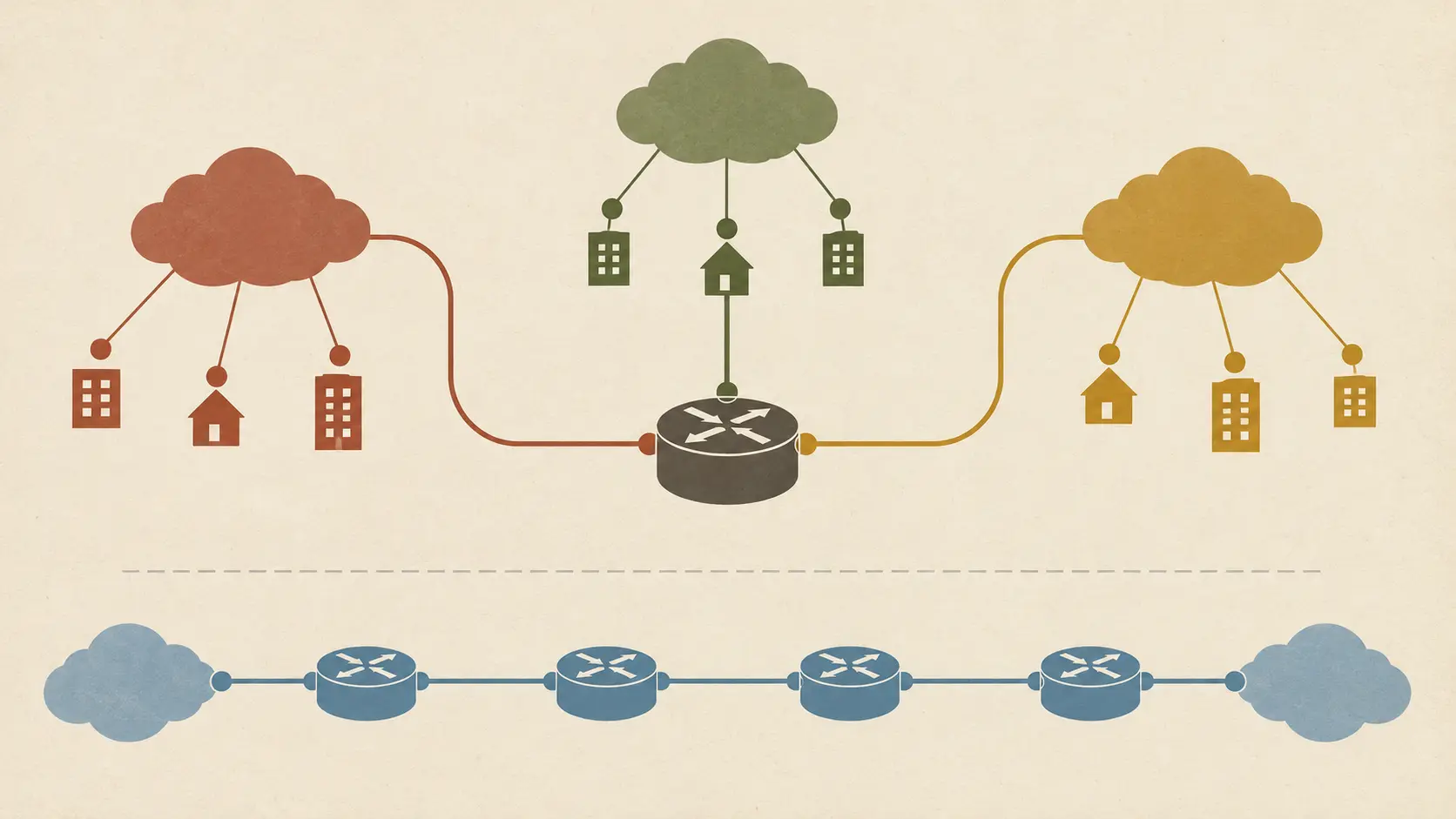
On 25 March 1991, PSINet, UUNET’s AlterNet and CERFnet announced an agreement for customers on their separate networks to exchange traffic directly. CIX mattered because it specified who could exchange what, under which cost rule, and over which path; it did not confer universal…

History
The License Covered the Code, Not the Protocol: Gopher’s 1993 Line
On 11 March 1993, the Minnesota Gopher Team opened a newsgroup post by saying it had heard enough “hysteria” and rumor to set out an official position. The phrase that later stuck was simple: commercial users would need a licence. The policy that followed was not. It divided…

North America National Telecom
AT&T’s Fiber JV: Open Access Depends on the Anchor Tenant
AT&T plans to combine Forged Fiber 37 and Gigapower with GIP and CPP Investments. The ownership split is public; the wholesale rules that will turn “open access” into an orderable service are not. AT&T remains central to the customer relationship and was named as the planned…

North America Regional ISP Trends
Calix says BBT’s small-business ARPU rose 13%; the base is missing
Calix says Big Bend Telephone lifted small-business average revenue per user by 13% in nine months as SmartBiz adoption beat an undisclosed target. The offer is visible; the customer base, starting revenue and margin bridge are not.

North America Regional ISP Trends
FreeU has a $55 price; the value of each ad remains undisclosed
U-wifi presents FreeU as a way to earn internet credits by watching ads, but its public offer still starts at $55 a month. The business case turns on what an ad actually earns, what reaches a customer’s bill, and what remains after wireless access and service costs—not on the…

North America Institutional
Two Companies Named Hughes, One AI Legacy That Got Lost
Before Hughes Network Systems ran self-healing networks on Microsoft's cloud, an earlier Hughes ran one of the defining autonomous-vehicle programs in American AI research. The directory entry that links them is mostly an accident of naming — and the collision tells you something…

North America Institutional Trends
FINRA's Quiet Ledger: What a Year of Sanctions Data Says About Regulator Accountability
The Financial Industry Regulatory Authority filed 625 disciplinary actions in 2025 and ordered $99.6 million in fines and disgorgement, yet the numbers that surround those headline figures raise a harder question than enforcement volume: who audits the auditor, and does the audit…

North America National Telecom
Lumen Cashed Out Its Fiber Growth Engine. The Harder Test Comes Next
Lumen's sale of its consumer fiber-to-the-home business to AT&T closed on February 2, 2026, converting the company's fastest-growing retail asset into cash aimed squarely at its debt stack. But the transaction that reshapes US consumer fiber ownership is only half executed: the…

History
Eric Brewer’s FirstGov: A Search Box, Not a Government Record
On 22 September 2000, FirstGov opened after a ninety-day push to give federal information one public entrance. Eric Brewer’s search technology helped make that promise tangible. But the engine, the index it maintained and the agencies’ own pages were different things—with…

North America Regional ISP
PeakFiber Broadband: A Young ASN, an Older Brand, and the Gap Between Registered and Real
Bellefontaine, Ohio's PeakFiber Broadband now holds a real, RPKI-validated piece of the internet's routing table. What the public record does not yet show is whether that registry footprint, which dates only to late 2025 and early 2026, has translated into the durable customer…

North America Cloud Services
OpenAI holds its own routing identity. It has not yet bought its way out of the clouds
OpenAI OpCo, LLC registered two autonomous systems with ARIN and quietly built a peering posture, but the real shift in its infrastructure dependence runs through a restructured Microsoft deal, a $300 billion Oracle purchase obligation beginning in 2027, and a debt-heavy Stargate…

History
Elise Gerich and the Backbone Shutdown That Needed a Dress Rehearsal
The NSFNET backbone did not disappear when someone threw a master switch. Its retirement was a year-long exercise in proving that exchange points, commercial providers, route servers, databases and regional networks could stand without the system they were replacing. Elise…

History
Mary Ann Horton and the Dial-Up Network That Had to Publish Its Own Map
Before an email address became a name, it could look like a set of directions. Every exclamation mark told a queued message which machine to visit next — and every omitted or stale hop could leave it stranded.

History
Jean Armour Polly and the Internet Connection That Still Needed a Librarian
In 1992, “going online” at a public library did not begin with a browser. It began with a desk computer, communications software, a modem, a telephone line — and somebody who could turn that fragile stack into a public service.