
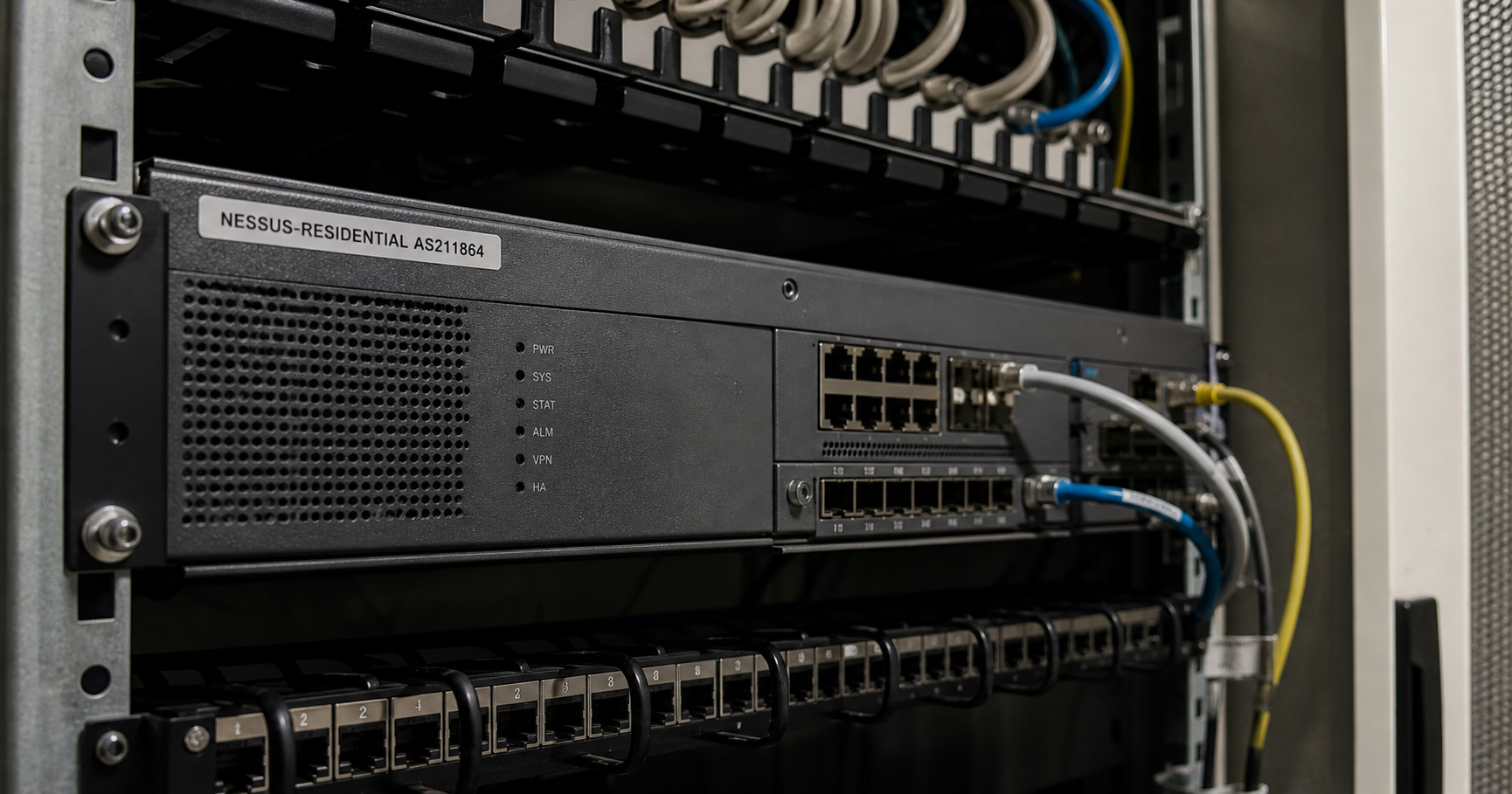
NESSUS-RESIDENTIAL Nessus GmbH is a dormant RIPE NCC registrant holding AS211864 with no active routing or services. All evidence is registry-only (RIPE Stat, RDAP, RIPEstat), leaving commercial intent and operational plans unknown. Watch for prefix announcements, registry record changes, or corporate footprint emergence to reassess.
NESSUS-RESIDENTIAL Nessus GmbH
NESSUS-RESIDENTIAL Nessus GmbH is a dormant entity registered in the RIPE NCC database as the holder of Autonomous System Number 211864. It announces no IP prefixes and has no visible operational network, corporate website, or public services. Its entire known footprint is the registry record, making it a latent but currently inactive entity in internet routing.
Why It Matters
Currently the impact is dormant. If the organisation begins announcing prefixes, it could directly influence routing for those address blocks. The registry entry itself is a control surface for number resource management; any change would shift it from a dormant record to an active network entity. Without such activation, it exerts no operational effect.
What Public Sources Show
NESSUS-RESIDENTIAL Nessus GmbH exists as a name in the RIPE NCC registry, holding Autonomous System Number 211864. It does not operate an internet network, announces no IP prefixes, and has no visible corporate presence. Its entire public footprint is the dormant ASN registration.
The registration gives the holder the right to originate BGP routes for any address space assigned to the ASN. The registrant can modify the database entry, create Route Origin Authorizations, and instruct an upstream provider to announce prefixes. None of these capabilities are currently in use.
Official registry data from RIPE Stat and RDAP confirms the ASN is registered to this entity, with a country code of DE. RIPEstat shows zero announced prefixes. No corporate website, service page, or public contact details beyond the registry have been found.
Because the ASN is inactive, it exerts no influence on internet routing today. If the holder were to activate it and announce prefixes, it would directly affect traffic paths for those address blocks. The registry record is a control point that could shift from dormant to operational with one announcement.
Analysts should monitor for three changes: updates to the RIPE Database entry for AS211864, a first BGP prefix announcement, and the emergence of a corporate website or service documentation. Any of these would signal an intention to activate the resource.
The organisation’s commercial purpose, whether it holds any IP address space, and its operational timeline remain unknown. The word “Residential” in its name hints at a possible consumer internet focus, but no public evidence confirms this. The gap between registry existence and real-world activity is the key uncertainty.
Operating Surface
The organisation's sole public role is as the registrant of AS211864. It does not operate an internet network or provide any connectivity services. The ASN registration confers the potential to originate BGP routes, but until such activity occurs, the entity has no active role in the routing ecosystem.
BTW tracks NESSUS-RESIDENTIAL Nessus GmbH because AS211864 is a latent routing asset. If activated, it could direct internet traffic and alter dependency mappings for any announced prefixes. Early detection of registry changes or prefix announcements helps analysts maintain accurate routing intelligence and identify emerging network operators before they become operationally significant.
Watchpoints
NESSUS-RESIDENTIAL Nessus GmbH is a dormant registry entity that currently poses no routing risk, but its ASN registration is a latent asset that could be activated with minimal notice. Strategic monitoring should focus on any signs of operational transition, as the entity's name suggests a potential consumer internet focus that could introduce new dependencies and routing surface if realized.
Key watchpoints include changes to the RIPE Database entry for AS211864, the first BGP announcement of any prefix from this ASN, and the emergence of a corporate website or service documentation. A shift in any of these would trigger a reassessment of the entity's operational significance.
Specific data gaps include the lack of any IP address space assignments, absence of PeeringDB or corporate records, and no identified individuals. Collection against public registries, business registries, and network telemetry would be needed to reduce uncertainty about the entity's true intentions and capability.
Sources
- Internet registry record - public-source identity and registry context for NESSUS-RESIDENTIAL Nessus GmbH.
- Registry RDAP / WHOIS record - evidence-led registry, routing, or network context for NESSUS-RESIDENTIAL Nessus GmbH.
- Internet registry record - evidence-led routing visibility context for NESSUS-RESIDENTIAL Nessus GmbH via AS211864.
Signal Brief
- Signal: NESSUS-RESIDENTIAL Nessus GmbH
- Region:
- Market Class: Global Regional ISP Trends
Operating Footprint
- public operating records
- official service pages
- documented relationships updates
Market Context
- Currently the impact is dormant. If the organisation begins announcing prefixes, it could directly influence routing for those address blocks. The registry entry itself is a control surface for number resource management; any change would shift it from a dormant record to an active network entity. Without such activation, it exerts no operational effect.
- Operational relevance: Medium
- Time Horizon: Next quarter
What To Watch
- official company sources
- public registries
- operator-published records
Member Briefing
Deeper Trend Context
Sign in with the right membership level to unlock the full briefing and source notes.
Only for Strategic Circle
Strategic Circle
Open to all readers. Unlock trend briefings after joining and signing in.
Join Strategic CircleOnly for Leadership Alliance
Leadership Alliance
For operators, investors, and policy teams that need relationship evidence, failure paths, and source notes. Sign in to unlock.
Join Leadership AllianceSnapshot
Category
Global Regional ISP TrendsThe organisation's sole public role is as the registrant of AS211864. It does not operate an internet network or provide any connectivity services. The ASN registration confers the potential to originate BGP routes, but until such activity occurs, the entity has no active role in the routing ecosystem.
Content Type
EventPrimary Domain
MarketImpact
MediumCurrently the impact is dormant. If the organisation begins announcing prefixes, it could directly influence routing for those address blocks. The registry entry itself is a control surface for number resource management; any change would shift it from a dormant record to an active network entity. Without such activation, it exerts no operational effect.
Confidence
Good confidence (70%)Confidence score guide
Several public sources