
Summary
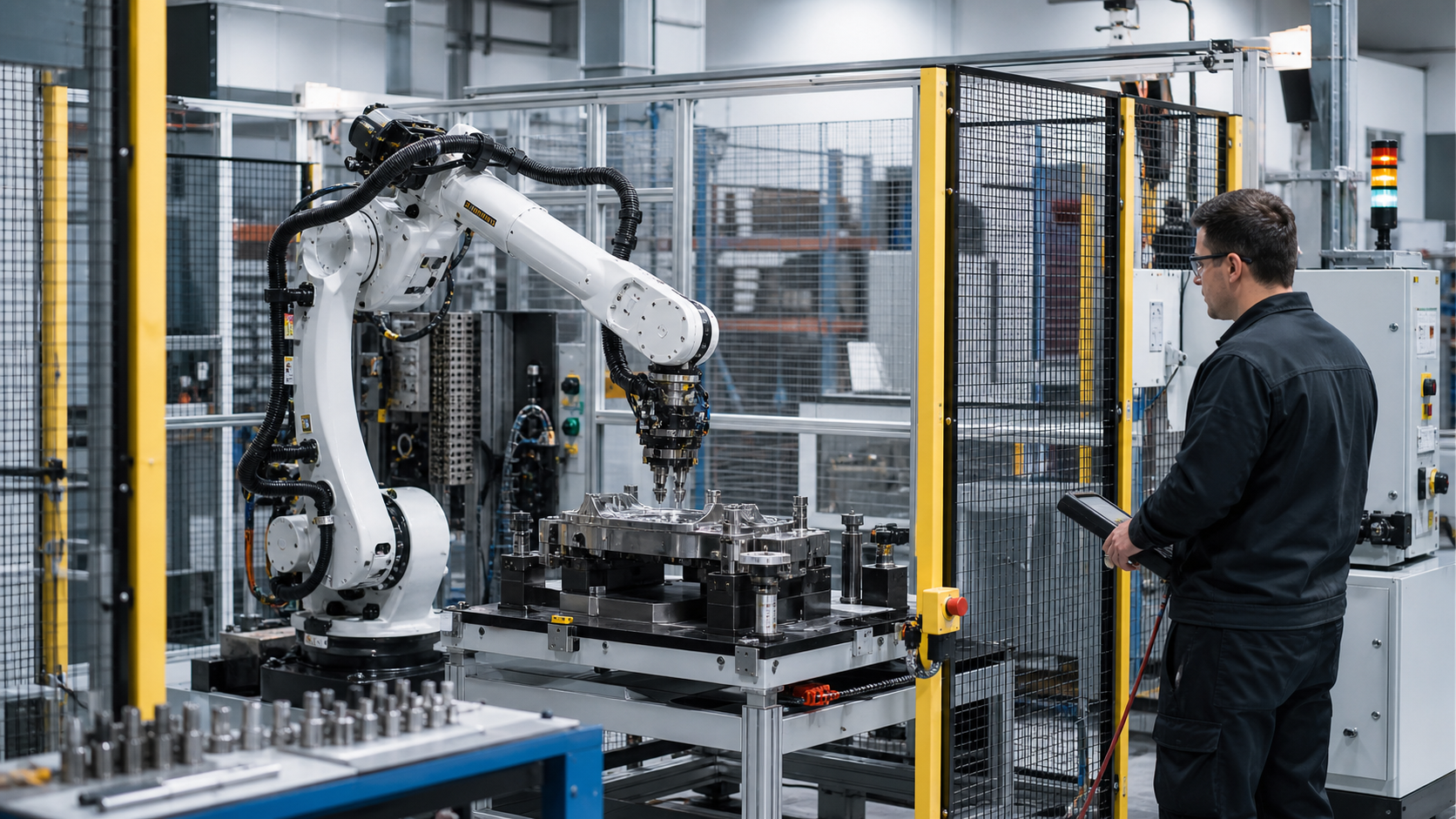
- NACHI Robotics is best judged at workcell level: the robot arm, FD controller, teach pendant, fieldbus links, end effector, fixture, guarding and recovery procedure must hold together as one accepted production cycle.
- The strongest public evidence supports NACHI's breadth in welding, material handling, palletizing and machine tending, but it does not prove customer-level uptime, payback or changeover economics without plant-specific validation.
- The commercial risk is not that a NACHI arm cannot move repeatably; it is that integration, tooling, safety stops, part variation, programming skill, maintenance discipline and support access can consume the labour and cycle-time gains that justified the cell.
The Accepted Cycle Is the Real Product
Industrial robot buyers are rarely buying motion in the abstract. They are buying a repeated event: open the machine door, pick the hot casting, clear the fixture, place the part, confirm a signal, close the door and release the next machining cycle. Or they are buying a welding sequence that brings a gun to a body panel without cable snag, delivers pressure and current at the intended point, records the result and moves to the next weld before the line balance breaks. Or they are buying a palletizing pattern that keeps stacking cases after the third shift changes box lots and the operator has to recover from a missed pick.
That is why NACHI Robotics Systems, Inc. should be assessed through the accepted robot cycle rather than through isolated arm specifications. Reach, payload and repeatability matter. They decide whether a proposed robot is even plausible for the task. But they do not settle whether the cell will create value. The cell creates value only after the robot, controller, end effector, fixture, safety system, human interface, machine signals and maintenance routine are accepted as a repeatable operating method.
NACHI's public product surface fits that reality. The company presents a broad industrial robot lineup: compact MZ handling robots, SCARA models, collaborative models, heavy loaders, palletizing robots, spot-welding robots and controllers. Its North American site also emphasizes the practical pieces around the arm: FD controllers, fieldbus connections, software packages, FD On Desk simulation, FlexGui operator screens, training courses, spare-parts requests and service locations. This is not a consumer robot story and it is not a general software story. It is a workcell story.
The company boundary matters. This analysis concerns NACHI industrial robot systems and the North American robotics operation around them. It is not an assessment of the wider NACHI businesses in bearings, cutting tools, hydraulics or specialty steel. It is also not an assessment of every customer cell that happens to use a NACHI arm, because a finished cell can be shaped heavily by a systems integrator, a machine builder, a welding supplier, a fixture designer and the customer's own maintenance group.
That boundary is not a technical nicety. It is central to the value question. A NACHI robot can be the motion platform and controller in a successful cell while another party owns the gripper, guarding layout, vision package, machine interface and commissioning procedure. The same robot can disappoint in a weakly designed cell. In industrial automation, the product boundary and the result boundary are different. NACHI can sell the robot system and support software, but the production result emerges from the complete cell.
The useful question is therefore narrow and demanding: can NACHI robot systems keep motion, tooling, safety and cell state reliable across ordinary material variation and shift changes? The public evidence supports a cautiously positive answer for conventional industrial applications, especially where the task is stable, repeatable and well-fixtured. The same evidence supports caution where the buyer expects the robot to absorb messy process variation, frequent product changes or weak maintenance practices without new engineering work.
Why Arm Specifications Are Necessary but Insufficient
NACHI's robot catalogues and product pages show a wide range of payloads and reaches. The MZ family covers compact handling tasks; heavier MC and SC machines address large parts and palletizing; SRA models target automotive spot welding; LP palletizing models address fast stacking; SCARA and collaborative models cover smaller handling and assembly-adjacent work. The range is real, and it matters because a buyer cannot design a good cell around an arm that lacks payload, reach, stiffness or environmental protection for the job.
Yet specifications are not the same as production proof. A listed repeatability number tells a buyer how closely the robot can return to a taught point under specified conditions. It does not prove that a gripper will hold oily parts, that a welding gun will maintain tip condition, that a fixture will not drift, that a machine will return a ready signal consistently, that the cable dress will survive a million cycles, or that an operator can recover cleanly after an emergency stop.
The distinction is especially important in applications NACHI highlights. In machine tending, the robot's path has to be coordinated with door motion, chuck state, part orientation, coolant, chips, air blast, inspection steps and machine alarms. In palletizing, the robot has to combine pattern logic with case quality, vacuum reliability, pallet presentation, slip sheets, label orientation and accumulation upstream. In spot welding, robot motion is only one part of the process; gun pressure, cable routing, cooling water, weld schedule control and traceability affect the value.
In arc welding, path linearity and reach matter, but so do power-source integration, torch angle, wire feed, gas coverage, spatter and fixture repeatability.
This is why a buyer should treat a robot datasheet as a filter, not as a verdict. The datasheet can reject a bad fit quickly. It cannot accept a workcell by itself. Acceptance comes from cycle validation with the real part family, the real fixture, the real end effector, the real operator interface, the real safety rules and the real maintenance plan.
NACHI appears to understand this in its public materials. The company emphasizes FD On Desk for reach studies and cycle-time verification, fieldbus options for machine communication, software PLC functions, FlexGui screens for cell operation, training classes, spare-parts processes and application packages. Those are all signs that the company is not selling only arms. It is selling a platform that has to be engineered into a cell.
The caution is that public materials describe capability, not guaranteed site results. A simulator can improve a feasibility study, but it cannot fully predict fixture deflection, gripper contamination, operator behaviour or maintenance backlog. A controller can support fieldbus protocols, but it still has to be mapped correctly into the plant's PLC and safety architecture. A training course can improve competence, but it does not ensure that every shift will preserve the same programming discipline months later.
The FD Controller as the Cell's Operating Surface
The controller is where the accepted cycle becomes more than robot motion. NACHI's FD controller family is presented as a multi-tasking platform with menu-driven programming, cooperative motion capability, support for standard communication protocols and a full-colour teach pendant. The public controller pages and specifications emphasize integration with auxiliary equipment, program storage, backups, maintenance support, safety circuits and operator-facing customization.
That matters because many robot failures in production are not dramatic mechanical failures. They are state failures. The robot believes the machine is ready when it is not. The gripper signal is late. A door interlock trips. The operator restarts from the wrong step. A program modification changes a point but not the recovery routine. A fixture is loaded in a slightly different state than the one assumed by the program. The cost of those failures is not only the immediate stop; it is the time needed for a skilled person to diagnose the state and return the cell to automatic running.
NACHI's support for software PLC functions and fieldbus connections is commercially important for this reason. If the robot controller can communicate cleanly with machines, peripheral equipment and plant PLCs, the integrator has more room to build a coherent state model. It becomes easier to prevent a robot from entering a dangerous or invalid step, easier to manage handshakes and easier to expose useful operator guidance. But those tools do not remove the need for system design. They make good design possible.
FlexGui is a good example of the real operating issue. NACHI describes it as a graphical interface on the FD11 controller that can be customized for operator skill level and used for workcell control, production data tracking, initialization, manual override, testing, diagnostics and help screens. That is not just cosmetic. In a robot cell, the quality of the screen can decide whether a line operator recovers from a missed pick in thirty seconds or calls maintenance every time. It can also decide whether a technician can distinguish a true robot fault from a machine-ready signal or fixture-state problem.
But custom interfaces create their own burden. Someone has to design them, maintain them, document them and keep them aligned with program changes. If a customer standardizes on NACHI's controller and FlexGui approach, that can reduce training friction across cells. If each integrator builds a different screen style, the site may inherit a portfolio of local habits. The tool supports good operation, but it does not guarantee it.
FD On Desk has a similar double edge. The software promises offline programming, workcell visualization, reach studies, cycle-time analysis, training and problem diagnosis using motion processing that reflects the FD controller platform. That is valuable before installation because it can expose reach problems, interference risks and cycle-time assumptions earlier. It is also valuable after installation if engineers can reproduce a change before touching the live cell. Yet simulation remains a model. It has to be validated against the real fixture, end-of-arm tooling, part tolerances and operator procedures.
The controller story therefore reinforces the main point: NACHI's value is tested when the robot system becomes an operating surface for the whole cycle. The better the controller, offline tools and operator screens are used, the less the buyer depends on tribal knowledge. The less they are used, the more the cell becomes a brittle machine that only a few people can restart.
Machine Tending Exposes the Supervision Cost
Machine tending is a useful test case because the task looks simple from a distance and difficult up close. A robot picks raw parts, loads a machine, waits for machining, unloads finished parts and repeats. The labour case is easy to state: remove an operator from repetitive loading, increase spindle utilization, reduce exposure to hot or sharp parts, and make night or weekend running more plausible.
NACHI's machine-tending page recognizes the demanding side of the work. It notes high cycle rates, dangerous machines and difficult part or fixture geometry. It also emphasizes touch-screen interface panels, software PLC, adaptive motion, high-speed collision detection and communication with the machine. Those are exactly the right problem areas. In machine tending, the robot arm is not the only clock. The machine tool, door, chuck, part feeder, inspection step and chip-control process all have to fit the cycle.
The supervision cost begins when a part arrives in a condition the program did not expect. A blank is misoriented. A casting has flash. A tray pocket is empty. The gripper sees insufficient vacuum or force. The robot reaches a taught point, but the machine fixture is fouled with chips. The machine completes its cycle but returns an alarm instead of a ready signal. None of these events means the NACHI robot is weak. They are ordinary factory events. The question is whether the cell turns them into bounded recoveries or recurring labour calls.
A well-designed NACHI machine-tending cell can use the controller, fieldbus handshakes, operator screens and diagnostics to reduce that burden. It can check that the door is open before entering, confirm part presence, separate machine alarms from robot alarms, guide the operator through a controlled restart and preserve program backups. It can also use offline work to evaluate whether a new part family can be reached without awkward wrist postures or collision risks.
A weak cell will do the opposite. It will hide too much state inside the robot program, rely on one technician's memory, require manual jogging after predictable faults, or make operators choose among cryptic program names. The robot may still be mechanically capable, but the labour saving will leak away through attention, restart time and fear of changing the line.
The commercial point is that machine tending does not justify itself on robot speed alone. It justifies itself when the cell raises machine utilization enough to cover capital cost, gripper and fixture work, guarding, programming, training, maintenance and support. If the robot saves one operator but creates frequent skilled-maintenance calls, the payback can stretch. If it enables reliable unattended or lightly attended periods, the economics become much stronger.
NACHI's public evidence supports the idea that its platform can be integrated into serious machine-tending cells. It does not prove the buyer's final payback. That proof has to come from a time study and a fault study on the actual part family.
Palletizing Looks Programmatic Until the Packaging Changes
Palletizing is the application where software promises the cleanest shortcut. NACHI describes palletizing software that can generate routines from simple input data such as start point, layout dimensions and stacking pattern. It distinguishes simple row-and-column layouts from more custom patterns with offsets and rotation-critical placement. It also presents palletizing robots and heavy loaders for boxes, bags, crates, beverages, bricks, resins and other goods.
This is a credible area for robot automation. The task is repetitive, the injury risk from manual handling can be significant, and the output is easy to inspect. If cases are consistent and upstream flow is stable, a robot palletizer can convert labour into a repeatable stacking cycle with less fatigue and more predictable output.
But palletizing is not free of variation. Boxes bow, bags sag, labels require orientation, pallets arrive damaged, slip sheets shift, upstream conveyors gap irregularly, vacuum cups wear and product changeovers bring new dimensions. The better the pattern software, the more quickly the buyer can configure a standard load. The harder cases still require tooling choices, accumulation design, sensing and recovery procedures.
The accepted cycle in palletizing is not simply pick and place. It is recognize the incoming product, secure it, move without dropping or crushing it, place it to a pattern, preserve the pallet's stability and recover when the incoming flow is imperfect. A robot with adequate payload and reach is only the starting point. The end effector, vacuum supply, case quality, conveyor control, pallet dispenser, slip-sheet handling and operator changeover screen all decide whether the system feels like labour saving or another machine that constantly needs attention.
NACHI's advantage in palletizing is that the company sells both robot families and application logic around the task. That can lower programming burden for conventional patterns and make changeover less dependent on a specialist. The risk is the same as in every application package: buyers may treat the package as if it eliminates process engineering. It does not. It narrows the engineering problem for a defined class of product movement.
Unit economics in palletizing depend on more than hourly labour replacement. They include ergonomic risk, damage reduction, throughput, floor space, forklift interaction, shift coverage and product mix. A robot palletizer that handles a high-volume, stable SKU can pay for itself quickly. A cell that must serve too many odd package types without enough sensing or tooling may require more supervision than the sales case assumes. NACHI's public claims are strongest where the package geometry and pattern family are bounded.
Welding Is Where Integration Becomes Quality
Welding is central to NACHI's industrial identity. The company presents spot-welding robots and arc-welding options, and its wider robot catalog positions welding robots as central to automobile production. The SRA family is aimed at spot welding with large payloads, long reach, speed, rigidity, cable-management options and integrated weld controls. NACHI's arc-welding page emphasizes integration with welding components, CAN-bus connection, menu-driven parameter setup through the teach pendant and support for common welding processes.
Welding makes the accepted-cycle lens unavoidable. A robot can move to the correct coordinates and still produce bad welds if the process conditions are wrong. In spot welding, gun force, electrode condition, cooling, current, schedule selection, material stack-up, tip wear, cable routing and traceability matter. In arc welding, torch angle, travel speed, wire feed, shielding gas, fit-up, heat input and spatter matter. Robot motion is necessary, but weld quality is the result of a process.
NACHI's public materials address this by emphasizing integrated weld control through the teach pendant, process monitoring diagnostics and application software. That integration can reduce the number of separate interfaces a technician has to manage. It can also make schedule changes and diagnostics more accessible. In a plant where many cells use similar NACHI conventions, that standardization has real value.
The failure modes remain practical. External cable dress can snag or fatigue; hollow-arm routing can reduce that risk but cannot eliminate every utility issue. Servo-gun settings can improve consistency, but only if the gun, electrodes and process schedule are maintained. Offline programs can reduce commissioning time, but fixture reality and part stack-up still have to be checked. Weld traceability can help, but data collection is not the same as corrective action.
For automotive and metalworking customers, the case for NACHI welding cells is strongest when speed and integration reduce the number of robots, stations or manual interventions needed for a defined process. The case is weakest when a buyer assumes that a robot brand alone will solve weld-process variability. NACHI can provide motion, controller tools and application support. The customer and integrator still own the process window.
This is also where substitutes become nuanced. A buyer can compare NACHI against FANUC, ABB, Yaskawa, Kawasaki, KUKA, OTC Daihen-centered welding packages, fixed automation and manual welding. The winning choice may be less about the fastest arm and more about installed base, local support, existing programming skill, weld supplier relationships, simulation workflow and spare-parts confidence. In welding, switching cost is cultural as much as technical.
Safety Stops Are Not Edge Cases
Safety is not an accessory to a robot cell. OSHA's industrial-robot guidance treats the robot system as more than the manipulator: it includes the end effector, control system, power sources, sensors and input/output communication. That broader view is the right one for NACHI buyers. A robot safety event is rarely just about the arm. It is about the work envelope, guarding, teach mode, emergency stops, enabling devices, interlocks, access procedure and restart logic.
NACHI's controller hardware pages describe safety circuits and teach-pendant features such as a three-position enabling switch. Product specifications and application documents repeatedly assume guarded cells, controlled installation and qualified maintenance. Training materials include robot safety, safety devices, cabinet operation, teach pendant operation, automatic and manual motion, program modification, input/output programming and backups. These are not marketing extras; they are prerequisites for keeping the cell useful.
The cost of safety appears in two places. The first is capital cost: fencing, light curtains, scanners, safety PLC integration, risk assessment, teach pendant practices, signs, procedures and validation. The second is operating cost: every stop must have a safe and predictable way back to automatic operation. If a cell stops whenever an operator opens a gate or clears a jam, that is not a rare exception. It is part of the actual cycle.
This is where accepted-cycle design should include recovery, not only nominal running. A buyer should ask how the NACHI cell handles an emergency stop during a loaded move, a gate open event, a dropped part, a lost machine-ready signal, a collision-detection event, a gripper fault, a weld fault or a partial pallet. Who can recover? What screen do they see? Does the program know which part is in the gripper? Are there safe retreat moves? Are backups current? Is there a dry-run mode? Can the next shift understand the state without calling the original integrator?
Good safety design can increase trust and reduce downtime. Poor safety design can make a robot cell feel fragile. Operators may avoid restarting it, maintenance may bypass good procedure under pressure, and management may lose the very labour flexibility the robot was meant to create. The value of NACHI's safety-related controller features depends on whether they are embedded into disciplined cell design.
Integration Handoff Is the Moment of Truth
The most underpriced part of robot automation is the handoff from project team to production team. During commissioning, the integrator and vendor specialists are present. Everyone knows what changed yesterday. Faults are fresh. The customer tolerates debugging. After acceptance, the cell belongs to operators, maintenance technicians, production supervisors and process engineers who have to run it on bad days.
NACHI's public footprint in North America helps here. The company lists a Novi, Michigan headquarters and multiple service locations or offices in Canada, Ohio, Indiana, South Carolina and California. It offers training courses across programming, electrical maintenance, mechanical maintenance, tooling setup, I/O setup, servo-gun setup, cable replacement, encoder correction, arm preventive maintenance and gear replacement. It also provides forms for service, technical questions, CAD requests, spare parts and training.
Those signals matter because robotics support is local in practice. A plant does not only need a robot supplier; it needs spare parts, people who can teach the controller, people who can diagnose faults and integrators who know the platform. A broad product lineup without accessible support is risky. NACHI's North American presence lowers that risk for U.S. and nearby customers, though public pages do not prove response times, inventory depth or service-level economics.
The handoff should include a clear split of responsibilities. NACHI may provide the robot platform, controller, teach pendant, software tools and support. The integrator may provide cell design, guarding, PLC logic, end effector, fixtures, vision, conveyors and commissioning. The customer may provide part data, machine access, maintenance resources and process acceptance. If that split is not explicit, every problem becomes a blame exercise.
The handoff should also include documentation that a real shift can use: program names, fault codes, restart paths, backups, tooling drawings, safety validation, consumables, preventive-maintenance intervals, spare-parts list, training records and change-control rules. NACHI's training and software tools can support this discipline. They cannot substitute for it.
This is where software lifecycle and lock-in enter the industrial robot story. Once a plant standardizes on a controller family, programming environment, HMI convention and training path, switching away carries cost. That lock-in can be rational if the platform is stable, support is good and the plant gains reusable expertise. It is harmful if the plant cannot modify programs, source parts, update interfaces or train new staff without excessive dependence on a narrow pool of specialists.
Maintenance Is a Production Variable
Robots are often sold against labour, but maintenance decides whether the labour case survives. A robot cell moves the work from manual repetition to preventive maintenance, troubleshooting, tooling care and program discipline. Bearings, reducers, cables, encoders, motors, brakes, teach pendants, controller fans, vacuum cups, weld tips, hoses and fixtures all become part of the production system.
NACHI's public training catalogue is notable because it does not pretend programming is the only skill. Electrical maintenance, mechanical maintenance, cable replacement, encoder correction, arm preventive maintenance and RV gear replacement all appear as separate training topics. That is a useful sign. It acknowledges that a plant has to sustain the robot mechanically and electrically, not only run a taught path.
The maintenance burden differs by application. A compact MZ handling robot in a clean pick-and-place task may mainly require periodic inspection, backups and tooling upkeep. A spot-welding robot may place much greater stress on cables, guns, water lines and process consumables. A palletizer may put heavy demand on vacuum tooling, case handling and high-cycle motion. A machine-tending robot may suffer from coolant, chips, heat and awkward access unless the cell is designed carefully.
The accepted cycle should therefore include planned maintenance time. If a production manager measures only theoretical robot speed, maintenance looks like a drag. If the manager measures total cell output, maintenance is part of throughput. A cell that runs slightly slower but can be serviced predictably may outperform a faster cell that fails unpredictably.
Backups deserve special attention. NACHI's public materials emphasize USB backups and file handling in the controller and training context. That is not a minor feature. Program loss, undocumented point changes and unclear restoration procedures can turn a small fault into a long outage. A plant should know which backup is current, who is allowed to change a program, how changes are logged and how a controller replacement would be restored.
The maintenance question also affects labour economics. Robots do not remove people from the factory. They change the skill mix. Fewer people may do repetitive handling, but more value is placed on technicians who understand robot motion, I/O, safety, tooling and process recovery. If those people are available, NACHI's installed base and training options can compound into site knowledge. If they are scarce, the robot cell may become dependent on outside support.
Unit Economics Must Include the Whole Cell
The simple robot return-on-investment story begins with labour: a robot replaces one or more operators in a repetitive task. That story is not wrong, but it is incomplete. The economic denominator is not the arm price. It is the installed and supported cell.
A realistic NACHI robot cell budget includes the robot, controller, teach pendant, end effector, fixture changes, guarding, safety devices, PLC or machine interface work, conveyors or feeders, welding equipment where relevant, installation, programming, simulation, training, spares, preventive maintenance, support, floor-space changes and downtime during installation. It may also include air, vacuum, power, cooling, extraction, network connections and quality checks.
The economic numerator includes saved labour, higher throughput, reduced ergonomic injury, improved consistency, better machine utilization, lower scrap, traceable process data and the ability to run shifts that were previously impractical. The hard part is that some benefits are local. In machine tending, the largest gain may be spindle utilization rather than direct labour. In welding, it may be line balance and quality consistency. In palletizing, it may be injury reduction and reliable end-of-line flow. In heavy handling, it may be the ability to move parts that are difficult or unsafe for manual work.
NACHI's product breadth helps a buyer match robot class to economic case. A compact robot for small handling tasks has different economics from a heavy palletizing robot or automotive welding system. The risk is overbuying a robot for a poorly defined process or underbuying a system around a capable arm. A low-cost arm in a weak cell can cost more than a better-engineered installation. A high-end robot in a low-volume, variable process may never earn back the engineering cost.
Payback should be calculated against the accepted cycle under real variability. What is the actual cycle time after safety checks, part sensing and recovery routines? How often does the cell stop? How many stops require skilled intervention? What is the cost of planned and unplanned downtime? How many product changes occur per week? How long does a changeover take? How much inventory is required upstream and downstream to keep the cell fed? How often are programs changed, and who can do it?
Those questions may sound conservative, but they protect both buyer and vendor. They prevent the robot from being blamed for a poor fixture, a bad gripper, unstable incoming material or an unrealistic staffing plan. They also prevent the vendor's strongest claims from being applied outside their proper boundary.
Where NACHI Looks Strong
NACHI's strongest public position is conventional industrial work where the task is repetitive, the part family is bounded and the buyer values an integrated robot-controller-application ecosystem. Machine tending, material handling, palletizing, press tending and welding are all areas where NACHI has relevant products and public application materials. The company appears especially credible where customers need a range of payloads and reaches rather than a single collaborative arm story.
The FD controller ecosystem is important to that strength. Fieldbus support, software PLC capability, teach-pendant programming, application software, FlexGui interfaces and offline simulation all point toward the practical needs of production cells. The company also shows awareness of training and service requirements, which matters in North America because the customer's bottleneck is often support labour rather than robot availability.
Another strength is that NACHI's materials do not reduce automation to artificial intelligence or autonomy rhetoric. The public product language is mostly about motion, welding, palletizing, machine tending, programming, safety, simulation and maintenance. That is appropriate. Most industrial robot value still comes from disciplined execution of repeated physical tasks, not from a robot discovering a process by itself.
NACHI also benefits from the maturity of industrial robotics as a market. Independent market data shows millions of industrial robots already operating globally and continued installations. That does not prove NACHI's share or performance, but it does show that the category is not experimental. Buyers know how to evaluate robot projects, and many plants already have the organizational pattern for integrating and maintaining them.
The final strength is breadth. A buyer who uses NACHI for welding may also evaluate NACHI for handling or palletizing, and a plant that trains technicians on the FD controller may reuse some knowledge across cells. Breadth can become switching cost, but it can also become efficiency if support and documentation are strong.
Where the Risk Concentrates
The largest technical risk is not gross motion failure. It is the mismatch between a controlled demonstration and a dirty production cell. Grip failure, path collision, fixture drift, safety stop, teach-program error, controller fault, payload mismatch, maintenance backlog and failed changeover are all plausible failure modes. They are not unique to NACHI. They are the normal risk map for industrial robot cells.
Grip failure is often the first hidden cost. A robot arm can hit its point perfectly while a vacuum cup loses seal, a magnetic gripper collects debris or a mechanical finger catches an edge. The gripper is where part variation meets automation. If the gripper is weak, the robot becomes an expensive carrier of uncertainty.
Path collision is another common risk. Offline programming and reach studies reduce the chance, but cell geometry changes. A maintenance person leaves a fixture clamp in a different position. A cable dress shifts. A pallet is not seated. A new end effector extends farther than the old one. The robot's repeatability can make this worse because it will repeat the wrong path with confidence unless the cell detects the abnormal state.
Fixture drift erodes quality quietly. The robot may still reach the same coordinates, but the part is no longer where the robot expects it. In welding, this can mean poor weld quality. In machine tending, it can mean loading force or misalignment. In palletizing, it can mean accumulating stack error. Good cells detect or tolerate small variation; weak cells accumulate it until a stop occurs.
Safety stops and restart logic are often underestimated. A stop should not become a mystery. The cell should know where the robot is, what it is holding, which machine state is current and how to return safely. If restart depends on jogging and guessing, the cell's labour case weakens.
Teach-program error is the human side of flexibility. Industrial robots are reprogrammable, which is the reason they are valuable. It is also why change control matters. A point touched during troubleshooting can affect a future shift. A new program version can solve one part and break another. Training, backups and disciplined naming conventions are not bureaucracy; they are uptime tools.
Maintenance backlog is the long-cycle risk. A robot cell can appear successful for months while deferred cable, gripper, reducer, fixture or cooling issues accumulate. When they surface, they may be blamed on the robot brand even if they are system issues. NACHI's maintenance training and parts channels are relevant mitigations, but the customer must use them.
Realistic Substitutes
NACHI's substitute set is broader than rival robot brands. The direct substitutes are other industrial robot OEMs with strong North American support, including FANUC, ABB, Yaskawa, Kawasaki, KUKA and application-specific welding or palletizing packages. In many plants, the decision will be influenced by existing installed base, technician familiarity, spare-parts inventory and preferred integrators as much as by the next arm's specification.
Fixed automation is another substitute. For very high-volume, stable processes, a custom mechanical system may outperform a robot on speed, simplicity or cost per unit. The robot wins when flexibility, reach, reprogrammability or product variation justify the additional software and maintenance complexity. A buyer should not choose a robot merely because robots are modern; it should choose a robot because the task benefits from reprogrammable motion.
Manual labour remains a substitute in low-volume or highly variable work. That can sound unfashionable, but it is often economically correct. If the task changes constantly and the ergonomic risk is manageable, a human operator may outperform a robot cell after all engineering, guarding, programming and downtime are counted. The robot becomes compelling when repetition, safety risk, quality need or shift coverage make manual operation structurally expensive.
Collaborative robots are a partial substitute for some lighter tasks, including from NACHI's own collaborative lineup and from other vendors. They can reduce guarding burden in certain applications, but they do not remove risk assessment, tooling design or cycle-time tradeoffs. For heavy welding, high-speed palletizing or enclosed machine tending, traditional industrial robots often remain the better fit.
Outsourcing or process redesign can also substitute for robot installation. A manufacturer may change packaging, buy pre-machined parts, alter a fixture, use a dedicated feeder or move work to a supplier. The point is not that NACHI loses to these alternatives; it is that robot payback must beat the actual set of alternatives available to the plant.
The Verdict
NACHI Robotics Systems, Inc. presents a credible industrial robot platform for accepted workcell cycles in North American manufacturing. Its product range covers the main physical tasks named in its market: welding, material handling, palletizing, machine tending, press tending and general production handling. Its controller, software, simulation, interface, training, parts and service surfaces address the right practical problems.
The strongest case for NACHI is a bounded repetitive task with clear part presentation, stable tooling, disciplined safety design, trained operators, local support and a customer willing to validate the full cycle before counting savings. In that setting, a NACHI robot system can plausibly convert repetitive physical work into a repeatable cell that improves throughput, reduces ergonomic burden and raises consistency.
The weakest case is a buyer looking for automation to absorb unresolved process mess. If parts arrive unpredictably, fixtures drift, product changes are frequent, operators are not trained, maintenance is under-resourced or the integrator handoff is thin, a NACHI robot will not magically convert disorder into productivity. It will repeat the assumptions built into the cell.
The fair judgment is therefore neither promotional nor dismissive. NACHI's public evidence supports serious consideration for conventional industrial workcells, particularly where the customer values an established robot-controller ecosystem and North American support. But value is decided at acceptance: can the cell run the actual cycle, recover from ordinary faults, survive maintenance realities and produce enough economic gain to justify the whole installed system? For NACHI, as for every industrial robot supplier, that is the test that matters.