Summary
- Luxottica's strategic value is not simply that it owns Ray-Ban, Oakley, Sunglass Hut, LensCrafters and large parts of frame manufacturing; it is that those assets can direct demand toward higher-value complete pairs, prescriptions, branded lenses and smart eyewear, while giving EssilorLuxottica more visibility into what consumers buy.
- The same integration raises the hurdle for value creation: wholesale partners must still feel served, stores must justify capital and lease intensity, inventory must not absorb too much cash, and the Meta smart-glasses opportunity must become a durable eyewear margin story rather than a technology dependency with diluted economics.
The Incentive Is Control, Not Mere Size
Luxottica's economic idea has always been more precise than "be large." The company built value by trying to control the points where eyewear stops being a commodity and becomes a chosen object: the frame design, the brand license, the wholesale relationship with the optician, the retail conversation with the consumer, and the final pairing of frame and lens. If the company can influence each of those points, it can sell more than a low-cost frame. It can sell identity, prescription convenience, lens upgrades, sun protection, insurance-supported purchases, repair, repeat visits and now connected eyewear.
That is the incentive behind integration. A frame maker that only manufactures for someone else captures the factory margin and competes on quality, design and delivery. A brand owner that outsources manufacturing captures licensing power but gives up some control of execution and availability. A retailer that lacks proprietary product can earn conversion but has less leverage over the product economics. Luxottica's old answer was to combine these roles: own or license leading brands, manufacture at scale, wholesale to professionals, operate stores, and use retail presence to see demand directly.
Inside EssilorLuxottica, that answer has been extended into ophthalmic lenses, professional instruments, eye clinics, online stores, hearing-related products and AI glasses.
The question is whether that structure still earns more than it costs. Integration creates bargaining power, but it also concentrates responsibility. If a style misses, the group may carry the inventory. If a store underperforms, the group carries the rent and labor. If independent opticians believe the group favors its own retail banners, wholesale growth can become politically expensive. If smart glasses grow fast but at lower margin or with heavy reliance on Meta, revenue can make the model look better before cash conversion proves it. A serious assessment has to separate scale from value creation.
The recent numbers explain why the argument matters. EssilorLuxottica reported 2025 revenue of EUR 28.491 billion, up 11.2 percent at constant exchange rates and 7.5 percent at current exchange rates. It also reported record free cash flow of EUR 2.80 billion. Revenue in both main operating segments grew: Professional Solutions reached EUR 13.600 billion and Direct to Consumer reached EUR 14.891 billion. The company entered 2026 with another double-digit quarter at constant exchange rates. Those facts are not small. They show a large integrated business still able to grow.
They do not, by themselves, prove that every layer of control earns its keep.
What Luxottica Is Inside EssilorLuxottica Now
The public entity in this research is Luxottica Group S.p.A., the Italian company historically associated with eyewear brands, manufacturing and retail. The economic analysis necessarily treats it inside the current EssilorLuxottica boundary because the 2018 Essilor and Luxottica combination created a larger group that reports through segments rather than as a stand-alone Luxottica public issuer. That distinction matters. Luxottica is not being evaluated as a small Italian frame company.
It is being evaluated as the eyewear, brand and retail inheritance within a Franco-Italian eyecare and eyewear group whose current operating disclosures define the investable reality.
EssilorLuxottica describes its business through two operating segments. Professional Solutions is the wholesale side: products and services sold to independent eyecare professionals, optical chains, distributors, laboratories and other professional customers. Direct to Consumer is the retail side: physical stores and online channels selling directly to end users. The old Luxottica logic is visible in both. Frames such as Ray-Ban, Oakley, Persol and Oliver Peoples sit in the brand portfolio. Retail banners such as Sunglass Hut, LensCrafters, Pearle Vision, OPSM and online platforms sit closer to the consumer.
Lens and instrument assets from Essilor add the optical technology and professional channel depth that Luxottica did not originally own in the same way.
The operating footprint is global. The group says it operates across more than 150 countries and generated revenue from North America, EMEA, Asia-Pacific and Latin America in 2025. It also says it operated about 18,000 stores at the end of 2025. North America was the largest 2025 region at EUR 12.787 billion of revenue. EMEA followed at EUR 10.779 billion. Asia-Pacific and Latin America were smaller but strategically relevant because China, Thailand, Australia, Brazil and Mexico all affect growth, store economics and category expansion.
This boundary also prevents a common analytical error. A RIPE NCC member record for Luxottica Group S.p.A. is useful evidence that the company has a formal number-resource governance footprint in Italy, with a Milan address and Italy as the listed service area. It is not evidence that Luxottica sells connectivity, cloud, IP transit or managed network services.
For a consumer and manufacturing group, the network evidence should be read more narrowly: the business has digital retail, e-commerce, store systems, manufacturing operations, smart-device activity and cross-border corporate infrastructure that make internet resource governance relevant to resilience and locality. It is not a telecom operator.
The current company therefore has three overlapping identities. It is an eyewear manufacturer and brand owner. It is a retailer and optical-services operator. It is increasingly a technology-facing consumer hardware partner because Ray-Ban Meta, Oakley Meta and Nuance Audio move eyewear closer to electronics, software and sensory assistance. A simple "eyeglasses company" label misses the capital and dependency questions that follow from that combination.
The Revenue Story Is Strong, But The Margin Test Is Stricter
The 2025 revenue line gives management a strong opening argument. Professional Solutions grew 12.2 percent at constant exchange rates, while Direct to Consumer grew 10.3 percent. In the fourth quarter, Professional Solutions grew 29.2 percent at constant exchange rates and Direct to Consumer grew 9.3 percent. The group said North America, EMEA and Asia-Pacific all grew double digits for the full year at constant exchange rates. Q1 2026 then delivered EUR 7.127 billion of revenue, up 10.8 percent at constant exchange rates, with both operating segments growing double digits.
Those numbers support the idea that integration is not merely defensive. The group is selling through wholesale partners and its own stores at the same time. It is using AI glasses to lift frame demand, using optical stores to sell complete pairs, and using e-commerce to extend reach. The Q1 2026 release said both Professional Solutions and Direct to Consumer contributed equally to the performance, and that North America and EMEA were supported by AI glasses and Ray-Ban brand strength. The 2025 release said e-commerce grew at a high-teen rate for the year.
But the margin test is stricter than the revenue test. Growth can come from products with lower contribution, from newly acquired or consolidated stores, from currency swings, from inventory build, or from heavy spending that will only be justified later. The 2025 release showed consolidated free cash flow rising to EUR 2.80 billion, which is a positive signal. It also showed trade working capital rising by EUR 540 million, following growth in both operating segments, and inventories rising from EUR 3.152 billion to EUR 3.542 billion. A business that owns more of the chain naturally has to finance more of the chain.
The value question is whether the incremental gross profit, brand strength and consumer data more than compensate for that cash absorption.
The risk is not that integration fails in a dramatic, immediate way. The risk is subtler: the group can look stronger because revenue moves through more owned points, while the marginal economics become harder to read. A wholesale sale to an independent optician has different capital needs than a sale through an owned store. A smart-glasses unit has different component, return, support and partner economics than a classic acetate frame. A retail acquisition in Thailand or Malaysia can add growth while also adding labor, rent, systems, refurbishment and local execution risk. The correct benchmark is not whether the group can grow.
It is whether growth after full carrying costs expands economic profit.
Brands And Licenses Are Still The First Profit Lever
Luxottica's first advantage is the ability to make eyewear feel scarce, desirable and culturally specific even though the physical object is manufactured at scale. Ray-Ban and Oakley are not just product names; they are demand-routing assets. A consumer who enters the purchase already wanting a brand gives the seller more pricing room, more lens-attachment opportunity and a better chance of steering the sale toward a complete pair. The same logic applies to Persol, Oliver Peoples, Vogue Eyewear and licensed fashion names, though each brand carries a different mix of royalties, design control, renewal risk and positioning.
This brand layer matters because the product is otherwise vulnerable to unbundling. Frames can be copied in silhouette, lenses can be shopped separately, and online sellers can make price comparison easy. A consumer who sees eyewear as a commodity may buy the cheapest acceptable frame and choose lenses based on price. A consumer who sees the frame as identity, sport performance or fashion may accept a higher ticket and be less inclined to split the purchase. Luxottica's integration aims to keep the second consumer inside the group for as many steps as possible.
The brand advantage is strongest when it creates pull without requiring the group to own every final sale. Independent opticians benefit when customers ask for Ray-Ban or Oakley. Retail stores benefit when brand recognition lifts traffic. Online platforms benefit when search intent already exists. Manufacturing benefits because higher volume improves learning and purchasing. Lenses benefit when a trusted frame sale creates the moment to discuss coatings, progressive lenses, myopia management or other upgrades.
However, brands also bring costs. Licensed brands require renewal, royalty and fashion-cycle discipline. Owned brands require advertising, product refresh, quality control and careful channel placement. Smart-eyewear branding adds another layer: the brand must carry not only fashion and optical trust but also technology expectations, privacy concerns and support promises. The company cannot simply paste a famous name onto a connected product and assume the economics of a classic sunglass. The brand has to reduce friction enough to justify the added complexity.
That is why Ray-Ban Meta and Oakley Meta are strategically important but not automatically value-accretive. The 2025 release said AI glasses units, including Ray-Ban Meta and Oakley Meta, were above 7 million for the full year. That is a strong signal that the brand layer can carry a new product category. It also raises questions about margin mix, component sourcing, software support, privacy perception and dependence on a platform partner whose economics are not identical to an eyewear company's economics. A brand can open the door. It still has to leave enough profit after the technology share is counted.
Wholesale Must Stay Useful To Independent Opticians
Professional Solutions is the clearest test of whether integration can be collaborative rather than extractive. In 2025, the segment generated EUR 13.600 billion of revenue and grew faster than Direct to Consumer at constant exchange rates. In Q1 2026 it generated EUR 3.362 billion and grew 10.8 percent at constant exchange rates. The group said independents with alliances and key accounts were main contributors in North America during Q1 2026. That detail is important because it indicates the wholesale channel remains more than a leftover route after retail expansion.
Independent opticians have mixed incentives when dealing with a vertically integrated supplier. They want access to brands and lenses consumers recognize. They want reliable delivery, merchandising support, training and product innovation. They may also worry that the same supplier owns stores or online channels competing for the final customer. A company with both wholesale and retail assets has to offer independents enough value that they do not treat the supplier as a rival to be minimized.
Luxottica's brand portfolio helps because independent opticians cannot easily replace every high-demand brand with lesser-known alternatives. Essilor's lens portfolio helps because the complete-pair opportunity can improve the optician's own economics. Alliances and key accounts can bring scale, training and negotiated terms. The risk is that bargaining power becomes too visible. If opticians believe supply terms, product availability or consumer marketing are being used to favor owned retail, the wholesale segment can lose trust even while revenue still rises for a period.
There is also a narrower pricing question. In wholesale, the group earns by selling frames, lenses, instruments and services to professionals. The buyer is economically sophisticated and can compare suppliers. In retail, the group can influence the consumer journey more directly. The integrated company benefits when it can use wholesale breadth without pushing independent partners toward substitutes. That means product innovation has to be genuine, delivery has to be reliable, and the partner economics have to remain tolerable.
The best evidence for the wholesale case is not rhetoric. It is continued segment growth across regions, continued contribution from independents and key accounts, and durable lens attachment that does not depend only on owned stores. The 2025 and Q1 2026 releases support that case for now. What would weaken it is a pattern of wholesale underperformance masked by retail acquisitions or AI-glasses sell-in.
Retail Conversion Is Valuable Only If It Raises The Whole Basket
Direct to Consumer is the seductive part of the model because it puts the group closest to the final buyer. In 2025 the segment generated EUR 14.891 billion, larger than Professional Solutions, and grew 10.3 percent at constant exchange rates. The group owns or operates a wide range of optical, sun and online banners, from Sunglass Hut to LensCrafters, Pearle Vision, OPSM, Clearly, EyeBuyDirect, FramesDirect and other platforms. It also uses stores to introduce newer categories such as AI glasses, Nuance Audio and myopia-management products.
The strategic case is straightforward. A retail store can turn brand demand into a larger basket. A customer who comes in for sunglasses may leave with prescription lenses, coatings, accessories or a future eye exam relationship. A prescription customer can be offered branded frames, lens upgrades and insurance-supported options. A digital platform can support discovery, repeat purchase and omnichannel fulfillment. Owned retail also gives the group feedback on what consumers actually try, reject, return and rebuy.
Retail becomes less attractive when those benefits are offset by fixed costs. Stores require leases, staff, training, fittings, local marketing, inventory, working capital and technology support. The company has to manage different formats: premium boutiques, mall sunglasses stores, optical chains, franchise or partnership arrangements, e-commerce and eye clinics. A store can be a demand amplifier, but it can also become a capital commitment that is hard to exit quickly when traffic weakens.
The group is still expanding retail in selected places. Q1 2026 noted the Top Charoen deal in Thailand, adding around 2,000 stores and franchise locations in a high-potential market. The 2025 release discussed acquisitions of optical and omnichannel stores in Malaysia, and it included the consolidation of Optegra late in the year. These moves widen the retail surface, but they also widen the burden of local execution. Thailand, Malaysia, Europe and North America do not share the same consumer income, reimbursement structure, labor market or mall economics.
The right retail measure is not store count. It is whether comparable sales, lens attachment, repeat purchase, gross margin and cash conversion improve after the company allocates capital to the channel. In 2025 the group reported positive comparable-store sales across several regions and high-teen e-commerce growth. That is encouraging. The next level of proof would be more transparent evidence that owned retail lifts the total eyewear profit pool without undermining wholesale trust.
Manufacturing Scale Helps Until Variety Becomes Inventory
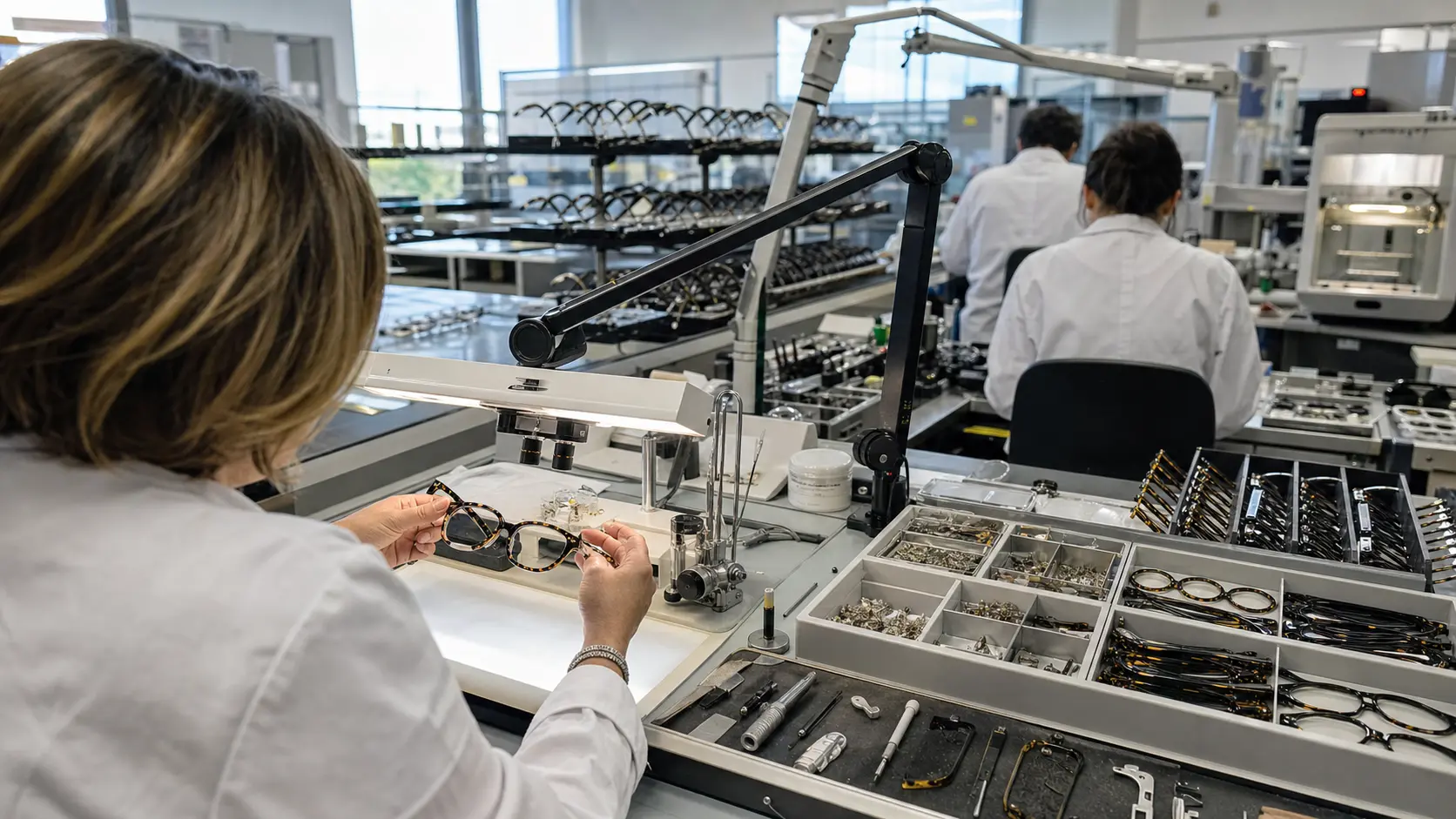
Manufacturing scale is the least glamorous part of Luxottica's story and one of the most important. Frames are physical products with design variety, seasonal cycles, different materials, colorways, sizes, hinges, lenses and packaging. A company that can design, manufacture, inspect, distribute and replenish at scale should be able to lower unit costs, protect quality and respond faster than a fragmented set of suppliers. This is especially valuable when a brand like Ray-Ban or Oakley has global demand and must stay available across stores, opticians and online platforms.
EssilorLuxottica describes a model that combines centralized industrial excellence for mass production of frames, instruments and equipment with decentralized customization in optical lens finishing and vision care services. That fits the economics of a complete pair. A sunglass frame can be produced in larger runs, while a prescription lens often needs local finishing and customization. The group also says its footprint includes manufacturing and logistics facilities, distribution networks and human capital across more than 150 countries.
The manufacturing advantage becomes more complicated as product variety rises. A portfolio with more than 150 brands and many retail banners creates a large matrix of SKUs. Fashion cycles require freshness, but every color and shape carries demand risk. Smart glasses add components, batteries, sensors, speakers, cameras, software-related returns and partner roadmaps. Myopia-management lenses and medical technologies add more clinical and quality requirements. The broader the range, the more the company must prove that scale reduces complexity rather than simply centralizing it.
Inventory is the visible evidence. The 2025 balance-sheet data showed inventories at EUR 3.542 billion, up from EUR 3.152 billion a year earlier. Some increase is natural in a growing business. The issue is whether inventory growth reflects productive support for demand or a creeping cost of variety. In a vertically integrated group, excess inventory is not someone else's problem. It sits inside the group, competes for cash and may have to be discounted through retail channels if demand shifts.
Manufacturing scale therefore earns its return only if it improves availability and margin without making the company slow. Luxottica's historical advantage was not simply that it could make frames; it could make desirable frames, distribute them widely and refresh them. Inside EssilorLuxottica, the manufacturing question has widened to lenses, smart eyewear and medical-adjacent devices. The company has to be both efficient and selective. The biggest danger is not underbuilding capacity; it is building too many variants whose economics look good in a launch plan and weaker on the shelf.
Working Capital Is The Cost Of Owning The Shelf
Owning more of the value chain changes the cash rhythm. A wholesale supplier can sometimes push inventory and receivables into the channel. A retailer and manufacturer cannot escape the physical timing of buying materials, producing frames, shipping goods, stocking stores, collecting from wholesale customers and handling returns. Luxottica's integration is powerful because it owns more of the shelf. It is expensive for the same reason.
The 2025 cash data captures the tension. Free cash flow reached EUR 2.80 billion, up from EUR 2.41 billion in 2024. That is a strong result and indicates the group can convert profit into cash while growing. At the same time, trade working capital increased by EUR 540 million, with the company linking the increase to growth in both Professional Solutions and Direct to Consumer. Trade working capital comprises inventories, trade receivables and trade payables. For a vertically integrated eyewear group, that line is not an accounting footnote. It is the financial expression of the strategy.
Working capital can be good spending when it supports fast-selling products, replenishes stores, carries new categories through launch and keeps wholesale customers supplied. It can be bad spending when it funds slow-moving SKUs, bloated retail assortments, over-optimistic launches or channel stuffing. Investors should not automatically penalize a working-capital increase in a growth year. They should ask whether the cash tied up in the chain is producing higher returns than a simpler model would.
This is where the comparison with unbundled suppliers matters. A focused frame licensor can avoid owning stores. A focused retailer can buy from multiple vendors. A digital-first seller can test demand with fewer physical locations. Luxottica's integrated model has a higher burden because it claims more of the margin pool. If it wants credit for owning more profit points, it must also accept scrutiny for the cash, logistics and inventory sitting between those points.
The 2025 free-cash-flow performance argues that the burden is manageable today. It does not end the debate. Smart glasses, store expansion, acquisitions and new medical or hearing categories can all increase working-capital intensity. The next few reporting periods should be read for whether growth continues to arrive with cash conversion, or whether inventory and receivables begin to tell a less flattering story.
Smart Glasses Add Growth And A New Dependency
AI glasses have changed the story from mature eyewear consolidation to consumer technology optionality. EssilorLuxottica said units of AI glasses, including Ray-Ban Meta and Oakley Meta, were above 7 million in 2025. The company described Ray-Ban Meta as a category-defining success and launched Oakley Meta in 2025, including performance-oriented models. Q1 2026 then said new Ray-Ban optical-first styles were off to a strong start and that AI glasses supported both physical stores and e-commerce.
The growth logic is compelling. Eyewear is one of the few wearable categories consumers already accept on their faces. A frame has social permission that many headsets lack. Ray-Ban brings cultural familiarity; Oakley brings sport credibility; the retail network provides fitting and demonstration; the lens business can connect the device to prescription use. If smart glasses become a mainstream device category, EssilorLuxottica has a better route to the face than most technology companies.
The dependency is just as clear. Meta supplies much of the technology identity, software layer and consumer narrative around Ray-Ban Meta. That can accelerate adoption, but it also means Luxottica's economics depend on a partner with different incentives. Meta may prioritize user engagement, data, platform reach or hardware share. EssilorLuxottica must protect brand trust, optical quality, privacy perception and retail margin. A successful device can still be economically awkward if the most valuable economics accrue to the software platform or if hardware margins are diluted by components and support.
There are also regulatory and social risks. Cameras, microphones, AI assistance and displays raise privacy questions in stores, schools, workplaces and public spaces. A classic sunglass rarely asks bystanders to trust a technology platform. A connected pair does. The company has to ensure that the desirability of Ray-Ban and Oakley is not weakened by concerns about recording, data handling or social discomfort. The more smart eyewear becomes a visible category, the more policy and consumer norms matter.
The near-term evidence is positive but incomplete. Seven million units in 2025 is enough to take the category seriously. It is not enough to conclude that smart glasses will improve group margins after hardware cost, returns, support, partner share and marketing are counted.
The facts that would change the judgment are concrete: stable or improving adjusted operating margin while smart-glasses revenue grows, high repeat purchase, strong prescription adoption, low return rates, wider geographic availability without privacy backlash, and evidence that the category lifts the core optical basket rather than merely adding lower-margin device volume.
Network Evidence Is Real But Narrow
BTW tracks Luxottica Group S.p.A. in part because the RIPE NCC public member record identifies it as a Local Internet Registry record for Italy. The record lists Luxottica Group S.p.A., a Milan address and Italy as the serviced area. That is real network-resource evidence. It should be treated with discipline.
For an eyewear company, the RIPE record does not transform the business into an ISP, cloud provider, registry, data-center operator or managed-network vendor. It indicates that a large corporate group has formal internet-number-resource governance in its operating footprint. That matters because the business is increasingly digital and cross-border. It runs stores, e-commerce sites, wholesale ordering, manufacturing coordination, logistics, customer service, eye-care scheduling, smart-device support and corporate systems.
Network reliability and data locality affect the ability to operate stores and digital channels, especially when the company is integrating retail, wholesale and technology products across regions.
The economics are indirect. A retailer with weak digital infrastructure loses conversion, inventory visibility and customer trust. A manufacturer with poor connectivity loses coordination and resilience. A smart-glasses partner with cross-border data flows faces privacy and service-continuity questions. A corporate LIR footprint can support internal routing, address management and operational control. It does not prove that the company monetizes connectivity directly.
This distinction is important because overreading network records creates bad analysis. The right conclusion is modest: Luxottica's directory evidence supports a view of the company as a large, digitally dependent multinational with Italy-based internet resource governance. It adds to the risk map for cloud service dependency, cross-border connectivity and locality. It is not a separate profit center.
In practical terms, investors and operators should ask whether the company discloses enough about cyber resilience, store uptime, e-commerce continuity, data protection, and smart-device governance. Public financial releases provide the commercial picture. The RIPE record points to an infrastructure layer that public articles should not exaggerate but should not ignore.
Substitutes Are Smaller, Faster And Annoyingly Credible
Luxottica's integration looks strongest when compared with fragmented rivals. It looks less invulnerable when compared with focused substitutes. Warby Parker shows that a digital-first eyewear retailer can build brand trust, store expansion and a simpler consumer proposition without owning the same global manufacturing and wholesale structure. National Vision shows that value retail can compete on affordability and exam access.
Safilo, Marcolin, Kering Eyewear and LVMH's Thelios show that luxury and licensed eyewear production remains strategically contested, especially as fashion houses bring more eyewear capability closer to their own brand systems.
None of these substitutes matches EssilorLuxottica's full breadth. That is exactly why they matter. A substitute does not need to replicate the whole system to pressure one profit pool. A value retailer can challenge price perception. A fashion house's in-house eyewear arm can reduce reliance on external licensees. A digital retailer can make consumers comfortable buying frames online. A focused manufacturer can win a license if a fashion brand wants tighter control. A technology company can influence the smart-glasses roadmap if consumers value software more than frame heritage.
The competitive threat is therefore distributed. Luxottica is not likely to be displaced by one rival. It can be chipped at by many. The frame margin can face private-label alternatives. The lens attachment can face online price comparison. The wholesale relationship can face supplier diversification. The retail store can face lower-cost digital acquisition. The smart-glasses opportunity can face platform bargaining power from Meta and future entrants.
The company's defense is also distributed. Brands create pull. Manufacturing protects quality and availability. Retail stores provide fitting and trust. Lenses raise the complete-pair economics. Wholesale relationships give reach beyond owned stores. The question is whether the combination keeps delivering more value than a set of focused rivals can remove. The 2025 and Q1 2026 growth numbers suggest the defense is still working. The rise of credible substitutes means management cannot rely on history alone.
Unofficial market signals reinforce that tension. Consumer press has long questioned eyewear markups and industry concentration. Fashion coverage points to luxury groups treating eyewear as a strategic category rather than a passive license. Financial press has rewarded smart-glasses growth while also questioning margin mix and partner dependency. These signals are not audited facts, and they should not be treated as proof of misconduct or future failure. They are useful because they show where the market will test the company: price trust, fashion control, technology economics and perceived concentration.
Regulation And Trust Are Part Of The Margin Test
An integrated eyewear group naturally attracts competition scrutiny. The European Commission approved the Essilor and Luxottica combination in 2018 after examining whether the merged group could harm competition in lenses, frames and optical retail. Later, the GrandVision acquisition involved further merger-control scrutiny and remedies. The conclusion is not that the group is prohibited from integrating. The conclusion is that integration creates a public-interest question as well as a shareholder question.
This matters economically because regulatory scrutiny can limit acquisition flexibility, delay transactions, require divestments, increase legal cost or influence commercial behavior. A company that controls brands, lenses, wholesale relationships and stores has to keep proving that the structure benefits customers and professionals, not only shareholders. If independent opticians, consumers or regulators believe the model restricts choice or raises prices unfairly, the margin premium can become politically fragile.
Trust also matters in smart eyewear. Consumers may accept a premium for Ray-Ban or Oakley because they trust the style and quality. They may be more cautious when the product includes cameras, microphones, AI assistance or display functions. Regulators may ask different questions about data, minors, workplaces, accessibility and consent. Retail staff may need to explain not only fit and lenses but also privacy and product behavior. That changes the cost of selling.
Geopolitical and operating risks sit beside regulation. The group sells across North America, EMEA, Asia-Pacific and Latin America. It sources components, manages manufacturing and logistics, and sells through retail and professional channels exposed to currencies, tariffs, local consumer demand and policy changes. Management commentary in 2025 and market coverage both pointed to tariffs and lower-margin smart-glasses mix as issues investors were watching. Currency also mattered: Latin America grew at constant exchange rates in 2025 but declined at current exchange rates.
The company can manage these risks, but it cannot make them disappear. Integration may give more levers: move assortment, use multiple channels, adjust pricing, shift launches, deploy local stores, lean on brand pull. It also gives more exposure. The group owns more points where a regulatory, privacy, tariff, currency or consumer-trust problem can hit.
What would change the judgment:
The current judgment is cautiously positive but demanding. Luxottica's integrated model still has a plausible route to value creation because revenue growth is broad, brands remain strong, wholesale and retail are both growing, free cash flow is healthy, and smart glasses have moved from experiment to meaningful unit volume. The model is not a simple monopoly story, nor is it a frictionless compounding machine. It is a high-control operating design that has to earn its complexity every year.
Several facts would make the case stronger. First, sustained adjusted operating margin improvement while AI glasses continue to grow would show that connected eyewear is not diluting the economics. Second, stable or improving cash conversion with rising revenue would show that inventory and trade working capital are not absorbing too much of the benefit. Third, continued Professional Solutions growth, especially among independents and key accounts, would show that owned retail is not poisoning wholesale trust.
Fourth, evidence that retail expansion raises complete-pair value and lens attachment rather than just adding store count would support the capital allocation. Fifth, low return rates and strong prescription adoption for smart glasses would prove that the category is becoming eyewear, not just consumer electronics in a familiar frame.
Several facts would weaken the case. A rising inventory burden, slower comparable-store sales, wholesale underperformance, visible discounting, privacy backlash against smart eyewear, weak renewal of key licenses, or margin slippage blamed repeatedly on product mix would suggest integration is becoming heavier than management admits. A major regulatory intervention or remedy in a core market would also change the risk premium. So would evidence that Meta or another platform captures most of the smart-glasses value while EssilorLuxottica carries the retail and brand-service burden.
The most important missing metrics are not exotic. Investors need cleaner visibility into smart-eyewear profitability, lens attachment by channel, inventory quality, return rates, wholesale partner health, retail productivity and the economics of acquired store networks. Management does not need to disclose every competitive detail. But the more the company asks the market to value the integrated model, the more the market should ask for proof that each layer earns its capital.
Conclusion: Integration Must Earn Its Complexity
Luxottica's integration thesis remains economically coherent. Owning brands, manufacturing, wholesale reach and retail conversion can create a powerful loop: desire creates traffic, traffic creates fitting moments, fitting moments create lens and service attachment, and direct consumer knowledge informs future products. Essilor's lens and professional assets make that loop broader. Smart glasses give it a new growth vector. The 2025 and Q1 2026 numbers show that the model still has momentum.
But the value is not automatic. The group carries the cost of physical inventory, store networks, acquisitions, partner dependency, regulatory attention and consumer trust. Integration is attractive because it captures more of the profit pool. It is risky because it also captures more of the downside when a channel, product category or region underperforms. The right conclusion is that Luxottica's old strategy still makes sense inside EssilorLuxottica, but only if management keeps proving cash returns, partner balance and margin quality. Revenue growth has earned the company attention.
Durable value creation still has to be earned through the cash account, the wholesale relationship, the store base and the economics of smart eyewear.