
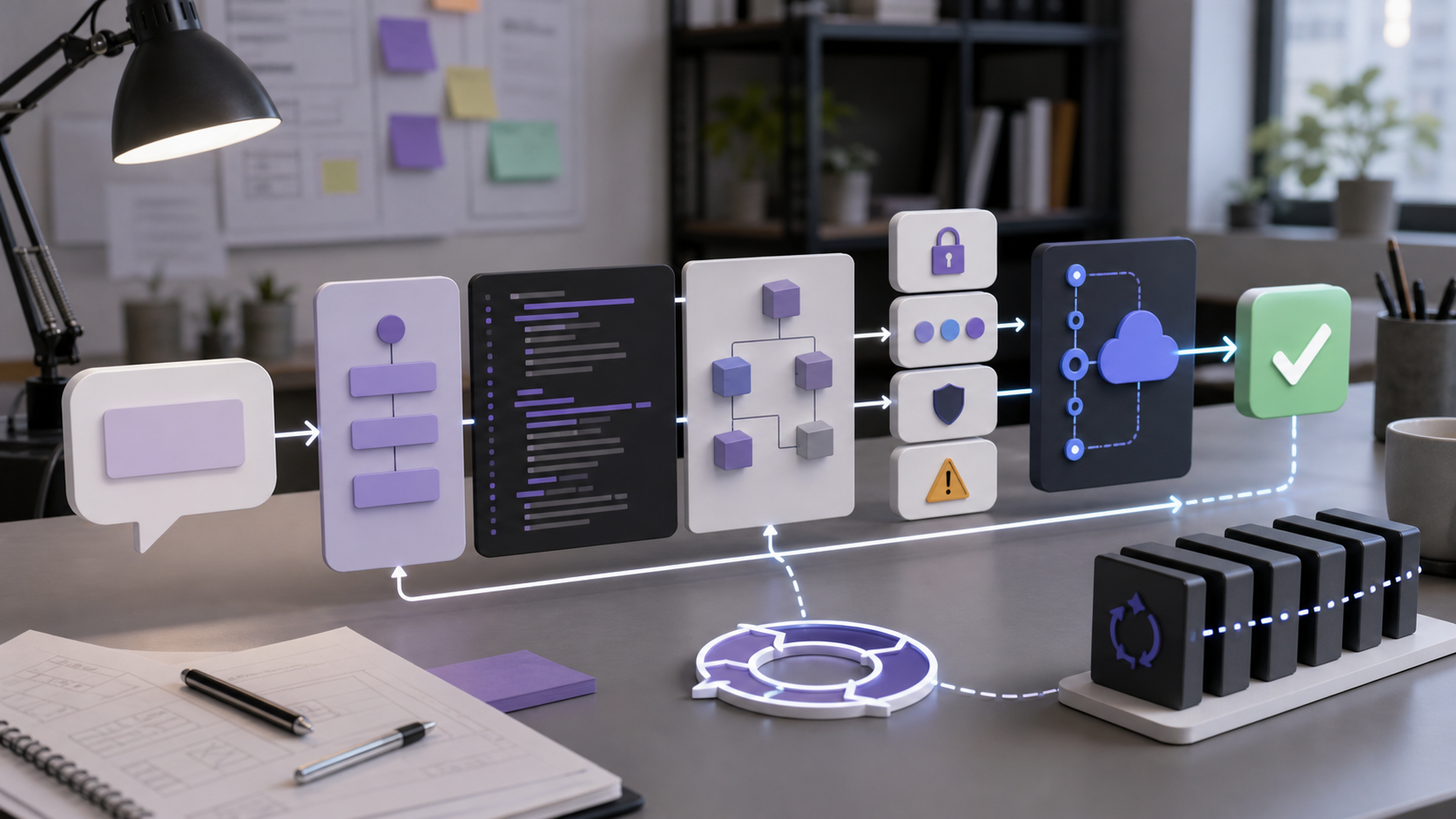
Summary
- Lovable's strongest claim is not that it makes an application appear quickly, but that it can preserve enough structure, code ownership, testing evidence, deployment control and security review for the resulting change to be accepted.
- Public evidence supports a serious product surface: natural-language build and planning modes, editable code, GitHub synchronization, managed back-end options, Supabase integration, browser and frontend testing, security scans, publishing controls, project monitoring, credit-based pricing and enterprise governance features.
- The same evidence also lowers certainty. No live workspace was tested for this article, Lovable's own terms warn that AI output requires independent review and testing, security tools do not guarantee complete safety, migration and self-hosting paths carry manual work, and repeated changes can accumulate review, dependency and data-model debt.
The real unit of value is the accepted change
Lovable is easy to misread because the most memorable moment in the product is the first working screen. A user asks for a dashboard, a booking flow, a landing page, a customer portal, or an internal tool, and the platform produces a web application that can be previewed, edited and published. That first impression matters. It is the reason the company became visible so quickly, attracted venture capital and found an audience beyond trained software developers. But a working first version is not the same thing as accepted software.
An accepted application change has a stricter definition. The user or team must know what changed, why the change was made, which files and data structures were touched, whether authentication and access rules still hold, whether the application can be published safely, whether the live version is the intended version, and whether future maintainers can understand the result. The change must be specific enough to review and stable enough to carry into the next change. If the application breaks after the third, tenth or fiftieth edit, the first version was not a durable productivity gain. It was only a fast start.
That distinction is central to Lovable Labs Sweden AB's operating question. The company sells a product that can convert ordinary-language intent into real web application code, hosted previews, integrations and live deployment. The market often describes this category with excitement about non-specialists building software. The more useful buyer question is less romantic: does the platform remove work, or does it shift the work from initial coding into later supervision, refactoring, security repair, data migration and exception handling?
Lovable's public documentation shows that the company understands at least part of that problem. The platform is not presented only as a toy generator. It includes planning before implementation, direct code inspection, GitHub synchronization, project knowledge, workspace rules, testing tools, browser checks, security scans, publishing permissions, project monitoring, usage metering and enterprise controls. Those are the right surface areas for a product that wants to move from early prototypes toward ongoing application development.
The burden is that every one of those controls creates a second question. A planning mode is useful only if it captures real constraints. Editable code is useful only if the code remains understandable. GitHub synchronization is useful only if the repository becomes part of a review process rather than a passive export. A managed back end is useful only if database rules, authentication and storage are correct. Security scans are useful only if findings are reviewed and fixed. Browser testing is useful only if it exercises the behavior that matters.
Publishing controls are useful only if teams know the difference between a preview, an unpublished edit and a live application.
This is why Lovable should be judged through repeated accepted changes. A single demo asks whether the system can make something plausible. Repeated accepted changes ask whether the system can preserve state, intent and accountability. That is a much higher bar, and it is the only bar that matters when customers use the platform for products, workflows or customer-facing applications.
Lovable's product is a control surface around generated code
Lovable's public product surface combines several layers that are usually separate in a software team. The user interface starts with conversation and planning. The build system modifies an application. The code editor lets users inspect and edit the underlying files. Integrations connect GitHub, Supabase, Stripe and other services. Lovable Cloud supplies a managed hosting and back-end path. Publishing turns a project snapshot into a live URL. Security and testing tools attempt to catch common defects before and after launch.
That bundle makes Lovable more than a design mockup system. The documentation describes applications as standard Vite and React projects built on open-source technologies, with front ends that can be moved to common hosting providers and back ends that may remain on Lovable Cloud, move to managed Supabase, or move to self-hosted Supabase when teams need more control. It also states that code can be synced to GitHub and integrated into existing engineering workflows. The pricing page says users own their code, apps, websites, customer data and AI output, subject to third-party rights in the underlying models.
Those points are important because ownership and portability are core to the commercial case. If a founder, product manager or designer can build only inside Lovable and cannot inspect or move the result, the platform is closer to a locked website builder. If the generated application is a real codebase that can be reviewed, synced, exported and hosted elsewhere, Lovable becomes closer to an AI-assisted development environment. Public documentation supports the second direction, but with conditions.
The conditions matter. GitHub synchronization has stated limits. The documentation says Lovable exports projects to GitHub, but does not currently import existing GitHub repositories into Lovable. It also says reconnecting after disconnection creates a new repository rather than restoring the same linked repository.
External deployment documentation describes meaningful manual steps for moving from Lovable Cloud to a separate Supabase project: environment values must be changed, configuration updated, SQL migrations run in order, database data exported and imported, authentication reconfigured, storage files moved, secrets recreated, and the app verified after the switch. Database exports have stated size and frequency limits.
That is not a reason to dismiss the platform. It is a reason to price the real work correctly. Lovable can lower the cost of starting and iterating on an application. It does not abolish the operational cost of owning an application. The moment a customer wants external hosting, strict compliance, separate environments, custom review, a mature release process or long-lived maintenance, the codebase becomes a normal software asset again. It needs version control, review discipline, dependency management, test coverage, data migration procedures, access control, rollback plans and ownership.
Lovable's useful role is therefore a control surface around generated code. It can create, modify and explain work. It can expose diffs and summaries. It can help plan and test changes. It can maintain context through project and workspace knowledge. It can connect the generated project to cloud services and source repositories. But the buyer's acceptance decision should stay with the application, not with the novelty of the interface. If the change cannot be inspected and accepted in ordinary software terms, the speed of generation is only a temporary advantage.
Planning before building is where ambiguity is either reduced or preserved
The hardest defects in AI-assisted application building often begin before a line of code changes. A user asks for a feature in ordinary language, but ordinary language compresses assumptions. "Add user roles" can mean role-based page visibility, database-level authorization, administrative assignment, billing entitlements, invite flows, audit records, support override rules, or all of them. "Make checkout work" can mean a payment link, a subscription model, tax handling, webhook verification, refund logic, invoice emails, error states and regional compliance.
If the platform turns a vague request into code too quickly, the system may feel productive while preserving ambiguity inside the application.
Lovable's Plan mode is intended to address that problem. The documentation describes it as a way to think, explore, compare approaches, investigate issues and create a structured plan before code is written. It also says Plan mode does not modify code and that users can inspect, edit and refine plans before approving implementation. The latest approved plan is saved in the project, while earlier plans remain available in conversation history. That is a useful design choice because the transition from idea to implementation is where many non-specialist builders need help.
Plan mode creates a practical acceptance point. Before an application is changed, the user can ask what components, data models, APIs, assumptions and sequencing the change requires. That matters more for Lovable than for a conventional code assistant because many of its target users are not experienced engineers. A trained developer may see an under-specified request and ask about database constraints, authentication, state, edge cases and deployment. A product manager or founder may not know which questions to ask. A planning layer can make missing detail visible.
The risk is that a plan can become a comforting artifact rather than a reliable one. A structured plan still needs review by someone who understands the domain and the consequences of failure. If a healthcare staffing platform, finance tool, learning portal or customer operations dashboard is built from a plan that misunderstands access rights or data retention, the clean formatting of the plan does not reduce the risk. Lovable's own terms make the broader point by warning that AI output can contain errors, inaccuracies or other issues and should not be used without independent review and testing.
For repeated changes, planning quality becomes an accumulating asset. A project that has accurate knowledge about its purpose, users, data schema, architecture and constraints gives the AI builder better context. Lovable's knowledge feature is designed for that purpose. Workspace knowledge can define shared coding standards, preferred libraries, naming conventions, testing requirements and things to avoid. Project knowledge can hold application-specific details such as the domain, database schema, architecture decisions and security requirements. The documentation also says instruction files in a connected repository can provide guidance.
That is a credible approach to improving consistency, but it creates maintenance work. Knowledge that is wrong, stale or too vague can mislead future changes. A team that changes its data model, swaps authentication providers, adopts a new component pattern or introduces stricter privacy rules has to update the project context. Otherwise the AI system may follow old assumptions. Lovable therefore reduces one category of repeated explanation while adding a need for context stewardship.
The strongest Lovable implementation will treat planning and knowledge as part of software governance. The weakest will treat them as optional notes. In the strong version, a natural-language request becomes a reviewed change plan with explicit assumptions, affected files, data effects, test needs and publish risk. In the weak version, the user keeps asking for fixes until the screen looks right, while hidden state and security assumptions drift underneath.
Code ownership is real only when review becomes routine
Lovable's code editor and GitHub integration are central to its credibility. A platform that can generate an application but cannot show the code leaves customers dependent on a black box. Lovable's documentation says users can browse the full file structure, search files, inspect and edit code, format and copy file content, download files, preview Markdown, and reference exact lines in conversation. The GitHub documentation describes synchronization into repositories and explains how linked projects can be managed at the workspace level.
Those capabilities support code ownership, but ownership is not the same as governance. A repository full of generated code that no one reviews can become a liability. The fact that a project is synced to GitHub does not prove that a team uses pull requests, branch protection, dependency scanning, secrets review, test checks or release approvals. It only makes those practices possible.
This is one of Lovable's most important customer segmentation questions. For a solo founder trying to test a market, the value may be speed and enough inspectability to fix obvious problems. For a business team building an internal tool, the value may be the ability to move faster while involving engineering only when the tool touches sensitive systems. For an enterprise, the value depends on whether generated changes can enter a normal review path. A senior engineer should be able to inspect the diff, understand the architecture, run tests, check authentication and merge or reject the change.
Without that path, Lovable can generate shadow software faster than the organization can govern it.
The public documentation does not prove that Lovable-generated code is consistently high quality across complex applications. It does not provide independent defect rates, maintainability metrics, security outcomes or long-term refactor evidence. That absence should shape the buyer's confidence. The right conclusion is not that the code is poor; it is that buyers should not infer code quality from generation speed.
Review should focus on several predictable areas. First, application structure: are components, routes, state management and data access patterns understandable, or has repeated editing scattered logic across the project? Second, dependencies: are packages necessary, current and compatible, or has the project accumulated brittle libraries? Third, data access: are Supabase or Lovable Cloud tables, functions, policies and storage buckets aligned with user roles? Fourth, secrets and configuration: are keys stored in the correct environment, and are test and live values separated?
Fifth, error handling: does the user see useful failure states, and does the operator get enough information to diagnose problems without leaking sensitive data? Sixth, tests: do important user journeys and backend rules have durable checks?
Lovable can assist with some of that review. It can inspect files, run verification tools, detect errors and surface security findings. But the acceptance decision should not be delegated entirely to the same system that generated the change. In ordinary software teams, code review works partly because a second person brings different assumptions and accountability. In AI-assisted building, the same principle applies. The more business-critical the app, the more the customer needs independent review, even if the initial builder is not an engineer.
Back-end behavior is where simple apps become operating systems
Many Lovable use cases are front-end heavy: landing pages, simple dashboards, prototypes, campaign sites and internal tools. But the platform's strategic value depends on full-stack behavior. Lovable's documentation describes Lovable Cloud as a managed back-end option covering database, authentication, storage and related services. Its Supabase integration lets users connect front-end work to a hosted PostgreSQL database, authentication, file storage, realtime capabilities and serverless functions.
The quick-start documentation frames full-stack capability through Lovable Cloud or Supabase, plus optional services such as payments and email.
The back end is where the accepted-change lens becomes unforgiving. A generated UI can look correct while saving data to the wrong table, exposing rows to the wrong users, mishandling authentication state, failing on empty data, dropping uploaded files, duplicating records, or calling an external service with the wrong secret. These are not theoretical concerns for any AI app builder. They are the ordinary risks of moving from screen generation to stateful applications.
Lovable has added several relevant controls. The security documentation says basic scans check areas including row-level security policy linting, database schema review and npm dependency vulnerabilities. Deep scans add code-level and access-control review, including overly permissive data-access rules, endpoints without proper authentication or authorization, exposed secrets, unsafe input handling and information leakage through errors or logs. The project security view groups findings by severity and provides remediation guidance.
Publishing settings can block deployment when critical findings remain unresolved, and a security scan can be required before first publish.
Those controls are useful because Supabase-style applications depend heavily on correct row-level security and policy design. A builder who can create a table and a form may not automatically understand the difference between front-end hiding and back-end authorization. The public security material correctly states that users remain responsible for ensuring their app meets its security requirements, especially for sensitive data or critical functionality, and that Lovable's tools cannot guarantee complete security. That caveat is not boilerplate. It is the key operating boundary.
Lovable Cloud also changes the economic and operational shape of the application. The credits documentation says one credit balance can cover building, hosting and AI features in deployed apps, and that cloud usage includes database, network, storage, edge functions and realtime usage. The Cloud documentation describes instance sizes, resource-limit alerts, slow-query investigation, pausing projects, removing Cloud, and export behavior. This makes Lovable a development surface and a runtime dependency.
Customers are not only buying generated code; they may also be relying on Lovable-managed infrastructure and related third-party infrastructure.
That dependency can be acceptable if it saves setup and operations work. For many early projects, managed hosting and a built-in database are exactly the value. But it changes the buyer's diligence. Teams need to know what happens when traffic grows, when database usage crosses limits, when the workspace runs out of credits, when the application needs a custom domain, when data must move to another environment, or when a regulator or customer asks where data is processed.
Lovable's terms and privacy policy state that the services use third-party infrastructure and AI providers, and that the company does not fully control their availability, performance or security. That is normal for a cloud software provider, but it belongs in the acceptance calculus.
Back-end acceptance should therefore include a working data review, not only a visual review. A representative change should be tested by creating, reading, updating and deleting records with the right identities; verifying that unauthorized users cannot access records; checking storage permissions; confirming that payments or email flows handle failure; and confirming that migrations can be reproduced. Without those checks, Lovable may have built a convincing interface over an unaccepted data model.
Testing tools are useful only when they verify the behavior that matters
Lovable's public documentation describes several verification tools. Browser testing lets the system interact with the application in a real browser inside a virtual environment, clicking buttons, filling forms, navigating pages, reading console logs and network requests, capturing screenshots, detecting runtime errors and checking layouts across screen sizes. The testing overview adds frontend tests with Vitest, React Testing Library and jsdom, plus backend verification through direct edge function calls and edge tests.
Project monitoring can later check code and visitor errors in the background, with findings sent by email or shown in the editor.
That is a serious testing surface for a product aimed at non-specialist builders. The right workflows are clear. If a visible user flow is at stake, browser testing can exercise it. If a UI rule should not regress, a frontend test can preserve it. If backend logic is the issue, direct edge function calls and edge tests can isolate it. If a deployed project starts producing visitor errors, project monitoring can alert the owner and provide a path to investigation.
The evidence limit is equally clear. Documentation that a tool can test behavior is not proof that a given project has enough tests. A builder can still publish an application with shallow verification. Browser testing may cover the happy path but miss authorization, concurrency, payment failure, malicious input, mobile edge cases or unusual data. Frontend tests can lock in current behavior without proving that the behavior is correct. Edge tests help only if the important backend rules are identified and written down.
Project monitoring is explicitly described as not replacing testing and as capable of missing issues or producing false positives.
This is where Lovable's customer value depends on workflow maturity. A founder may benefit from asking the system to test a signup flow, checkout flow or dashboard filter after each meaningful change. A product team may need a checklist that requires browser testing for user-facing changes, frontend tests for important components, edge tests for business rules and a human review before publishing. An enterprise may need these checks to feed into existing release evidence.
The strongest buyer will ask for test evidence in the same way it asks for the feature. "Add the feature" is incomplete. "Add the feature, verify the signed-in flow, add a regression test for the rule and show the publish risk" is closer to an accepted change. Lovable's tools can support that behavior, but the user still has to request and evaluate it. Public documentation even recommends separating large building work from browser verification because doing both at once can be less safe if a test step gets stuck. That detail is revealing. Verification is real work, not magic attached to generation.
The commercial question is whether Lovable reduces the cost of this work enough to matter. If the platform makes it easier for a non-specialist to reproduce a bug, inspect logs, run a browser check and request a fix, it can reduce support burden and engineering interruption. If teams skip tests because the generated app appears to work, Lovable can increase risk. The product does not decide that tradeoff by itself. The customer's acceptance process does.
Security controls are necessary, but the warnings are part of the product
Security is one of the most important areas where Lovable's public material is both encouraging and cautionary. The company presents security, privacy and governance as enterprise concerns, with SOC 2 Type II, ISO 27001:2022 and GDPR-related posture described in the documentation and security pages. It offers basic and deep scans, dependency checks, project security views, workspace security centers, scheduled scans on enterprise plans, publish blocking for critical findings and optional integrations with security tools.
Those features fit the risk profile of AI-assisted application building. Non-specialist builders can create software that handles personal data, payments, authentication, customer records and internal operations before they fully understand the attack surface. Built-in scans for row-level security, dependency vulnerabilities, overly permissive access rules, unprotected endpoints, exposed secrets, SQL injection, cross-site scripting and leakage through logs are not decorative. They address the exact areas where generated full-stack applications can fail.
But the warnings matter as much as the controls. Lovable's security documentation says users are responsible for ensuring applications meet the security requirements appropriate to their use case and recommends additional professional security review for sensitive data or critical functionality. The project security view says a "no issues found" state means the latest scan did not surface findings, not that the project has no security risk.
The terms say AI output may contain errors and should not be relied upon without independent review and testing, and that the customer is responsible for applications and projects built, deployed and made available using the services.
Those caveats should be treated as a product boundary, not legal noise. Lovable can identify classes of risk. It cannot know every business rule, every regulatory requirement, every customer promise, every abuse path or every consequence of a data leak. It can suggest or apply fixes. It cannot prove that a fix preserves intended behavior unless the application is tested in context.
Security also intersects with data usage. The privacy policy and training-data documentation distinguish customer data, service data, usage data and personal data, and describe opt-out options for training-related data use. Business and Enterprise workspaces can set workspace-level opt-outs; other users can contact support. The privacy policy also states that Lovable Cloud customer data is stored and processed on Supabase infrastructure and that AI Gateway inputs may be transmitted to third-party AI providers. For some customers this is acceptable. For others, especially regulated or region-bound users, it is a procurement issue.
The right security evaluation is therefore layered. At the project level, users should run scans, review findings, test access rules and treat ignored findings as recorded risk decisions. At the workspace level, admins should manage roles, publishing permissions, SSO, SCIM, audit logs and data policies where available. At the application level, owners should decide whether the app may handle sensitive data at all. At the procurement level, the organization should review trust documentation, processor lists, data-transfer terms and third-party dependencies.
Lovable is strongest when it makes these layers visible to builders who otherwise might not consider them. It is weakest if customers interpret security scans as a substitute for engineering and compliance review. A critical business app built quickly still needs a security owner.
Publishing is not the end of the change; it is another controlled step
Lovable's publish documentation is especially relevant to the accepted-change standard because it separates project editing from live deployment. Publishing deploys a snapshot of the current project to a live URL. Future changes are not automatically pushed; users must publish an update. A visual indicator appears when the project has changes newer than the live version. Free and Pro plans publish externally to anyone with the link, while Business and Enterprise plans can restrict published apps to workspace members or make them publicly available. Enterprise admins can restrict who is allowed to publish externally.
This structure helps prevent one common failure: assuming the preview and live app are the same thing. In an AI-assisted workflow, users may make many small edits, then forget which version is live. Snapshot-based publishing gives the team a concrete acceptance point. The project can be reviewed, tested and scanned before the live version changes. Publishing from the conversation interface also respects workspace settings and permissions, checks required page information and runs the same security checks used by the publish dialog.
Lovable's Test and Live environments feature, though no longer available for new Cloud projects as of March 24, 2026, shows the same design concern. For existing projects with the feature, building occurs in Test, Live is updated only when explicitly published, and database data and cloud configuration are not shared, reset or overwritten after setup. Publishing syncs structure rather than content, and a live database backup is created before each publish.
The feature's limited availability lowers its relevance for new customers, but the concept is useful: safe application change requires separation between experimentation and live data.
The current publishing model still leaves several acceptance questions. Does the project have a separate staging path if Test and Live environments are unavailable? Who is allowed to publish? Are security findings blocking or advisory? Is there a record of who published and why? Can the team unpublish quickly if necessary? Are custom domains and access settings correct? Does the live app use the intended credentials? What happens if a user keeps editing after launch but does not republish? Does the organization have an external review step before customer-facing changes?
Lovable's enterprise audit logs can answer some governance questions. The audit log documentation says logs show who performed an action, when, what changed and which resource was affected, with events covering membership, workspace settings, identity, secrets, integrations, projects, Lovable Cloud and authentication. That is useful for incident review and compliance. It is also plan-limited, so smaller teams may not have the same evidence surface.
Publishing is where Lovable's economic promise can either hold or collapse. If a team can safely move from request to reviewed code to tested preview to controlled publish, the platform may save significant time. If the team publishes because the preview looked good, then discovers security, data or integration problems after users arrive, the apparent speed becomes downstream repair. Accepted change means the publish decision is deliberate.
Lovable's economics are about supervision, not only credits
Lovable's pricing model is credit-based. Public pricing material says credits are used across building, hosting and AI features in deployed apps. Plan mode has a stated one-credit-per-message cost, while other build work varies by task complexity. Workspaces can include unlimited members, share a credit pool and set credit limits for members. Free plans include daily build credits and cloud grants, while paid plans add monthly credits and included grants. Hosting costs for smaller or new apps may be covered by included grants, but apps with significant traffic or size may incur additional usage.
Credit pricing is easy to understand at the point of use. The harder economic question is what Lovable does to total operating cost. The cost of AI app building is not only subscription price or credit consumption. It includes reviewing generated code, correcting misunderstood requirements, maintaining project knowledge, deciding security findings, writing or requesting tests, managing third-party integrations, monitoring live errors, migrating data when needed, handling app-specific support, and bringing engineers in when a generated change touches sensitive systems.
Lovable can reduce some of those costs. It can give non-specialists a faster path to working software. It can let product managers and designers produce realistic applications rather than static mockups. It can help founders test ideas before hiring a full engineering team. It can let engineers start from an existing scaffold rather than an empty repository. It can make routine UI changes cheaper. It can surface security and runtime issues earlier than a purely manual process would.
It can also increase some costs. If many business users create tools without governance, the organization may inherit a portfolio of semi-maintained apps. If generated code is accepted without review, future engineers may spend time unwinding architectural shortcuts. If applications depend on Lovable Cloud but later need external hosting or data residency, migration work appears. If credit limits are loose, teams may spend on repeated generation rather than clarifying requirements. If testing is treated as optional, bugs move into live use.
This does not make Lovable uneconomic. It means the commercial buyer should measure cost per accepted change, not cost per generated screen. A useful metric might compare how long it takes to deliver a reviewed business tool before and after Lovable, including supervision and repair. Another might track how many product experiments reach user testing without engineering interruption. Another might measure how often generated applications require engineer rescue before launch. Another might track security findings per published app and time to resolution.
The strongest economic case is for teams with many small-to-medium application needs, where the alternative is slow manual development, fragile spreadsheets, unsupported no-code tools, or never building the tool at all. The weaker case is for teams that already have mature engineering pipelines and need highly customized, regulated, high-scale software from the start. Lovable can still help those teams prototype and explore, but the handoff into professional software governance becomes central.
Funding and growth evidence make the commercial stakes clear. Public reporting and Lovable's own announcements show a company that moved from early European startup visibility into large venture rounds, with a $330 million Series B announced at a $6.6 billion valuation and investor language focused on enterprise adoption, governance, integrations and infrastructure. That scale raises expectations. Lovable is no longer just being judged as a clever builder for early demos. It is being judged on whether it can support real organizations without creating unmanaged software estates.
Enterprise features shift the question from creation to control
Lovable's enterprise direction is visible in its public materials. The documentation references workspace roles, SSO, SCIM, audit logs, workspace security centers, sensitive-data scanning, publishing permissions, verified domains, data opt-out, private registry support and governance features. The company's Series B announcement explicitly emphasized deeper integrations, collaboration and governance, and infrastructure to take products beyond demos. This is the right direction if Lovable wants to be used inside organizations with existing product and engineering practices.
Enterprise adoption changes the product's risk profile. In a small startup, one founder may both request, review and publish an app. In a large company, the person who wants the workflow may not own security, data, compliance, procurement, brand or operations. Lovable's value becomes less about replacing engineering entirely and more about narrowing the distance between idea owners and engineering controls. A product manager can create a realistic tool. A designer can turn flows into a working interface. An operations team can draft an internal app. Engineers and admins then decide how that app enters the organization's systems.
That is a plausible model. It is also a demanding one. Enterprises need identity integration so departed employees lose access. They need audit logs so actions can be investigated. They need publishing controls so private experiments do not become public websites accidentally. They need data policies so proprietary code and customer data are handled according to company rules. They need security centers to see abandoned or risky projects. They need GitHub integration so generated code can pass through review. They need migration options so applications are not trapped if requirements change.
Lovable's public feature set touches these areas, but public pages do not prove enterprise maturity in a particular deployment. A buyer still needs procurement-grade evidence: current compliance reports, processor lists, support commitments, incident history, data-location terms, role matrices, SSO and SCIM behavior, audit-log retention, export behavior, security-scan accuracy, and integration limits. The trust center was publicly referenced, but the available public crawl did not expose detailed reports. That means article-level confidence should remain moderate rather than high.
The enterprise risk is not only technical. It is organizational. If Lovable makes software creation available to many non-engineers, companies need rules for what may be built, what may be published, what data may be stored, who reviews generated code, when engineering must approve changes, and when an app should be retired or migrated. Without that layer, Lovable can accelerate a form of shadow IT. With it, Lovable can become a useful front door for controlled application creation.
The difference is visible in one practical question: after six months, can the organization list every Lovable-built app, identify its owner, know whether it is live, see whether it has open security findings, understand its data categories, review its access model and know whether it is still used? If yes, the platform is supporting governance. If not, the organization has accumulated software obligations faster than it can manage them.
The main failure modes are ordinary software failures with a faster entry point
Lovable's failure modes are not mysterious. They are the same failures that appear in ordinary application development, compressed by a faster creation process.
Requirement ambiguity is first. A natural-language instruction can under-specify data rules, user roles, edge cases, failure states, accessibility, localization, mobile layout, performance, monitoring and migration. The generated application may satisfy the visible part of the request while missing the operational part.
Security misconfiguration is second. Row-level security, authentication, storage policies, secrets and backend functions require explicit review. Lovable's scanners can help, but the public security material correctly says they cannot guarantee complete safety.
Integration drift is third. Apps often depend on Supabase, GitHub, Stripe, email providers, AI providers, analytics tools and custom APIs. Each integration has credentials, rate limits, permissions and failure modes. A generated app can call a service successfully once and still fail when credentials rotate, data formats change or a plan limit is hit.
Dependency debt is fourth. AI-generated projects can accumulate packages and patterns that work locally but become hard to maintain. Dependency scanning can detect known vulnerabilities, but it does not judge architecture, readability or future migration cost.
Testing gaps are fifth. Browser checks, frontend tests and edge tests are available, but they must be directed at meaningful behavior. A successful visual flow does not prove authorization, payment webhooks, concurrency or data retention.
Publishing confusion is sixth. Users must know which version is live, who can access it, whether unpublished changes exist, whether security scans passed and whether custom domains and metadata are correct.
Data migration is seventh. Lovable's own external deployment guide shows that moving a back end requires manual credential, migration, authentication, storage and verification work. That is manageable, but it is not free.
Cost surprise is eighth. Credits make usage visible, but repeated building, hosting, AI features, monitoring and cloud growth can turn an inexpensive experiment into an operating cost. The relevant measure is not only credits consumed, but review and maintenance avoided or created.
Organizational accountability is ninth. If a non-specialist builds a live app, someone still owns support, security, data rights, user access, uptime expectations and retirement. Lovable can help build and monitor the app; it does not become the business owner of the app.
These failure modes do not undermine Lovable's value. They define the operating conditions under which the value is real.
How a buyer should evaluate Lovable
A serious evaluation should start with one representative application change, not a generic demo. Choose a project that includes real data, authentication, one or two integrations, a user-facing workflow, a publish decision and a future maintenance expectation. Then judge Lovable by whether the change reaches acceptance without manual reconstruction.
The first test is requirement clarity. Ask the platform to reason through the change before implementation. Does the plan identify affected components, data model changes, assumptions, security issues, test needs and publish consequences? Can the user edit the plan before code changes? Does the final implementation match the approved direction?
The second test is code review. Sync to GitHub or inspect the code directly. Can a developer understand the diff? Are files organized coherently? Are dependencies reasonable? Are environment variables and secrets handled correctly? Does the generated code follow the project's stated conventions?
The third test is data control. Create users with different roles, attempt authorized and unauthorized actions, inspect database policies, verify storage access and test edge cases around missing or malformed data. If the app uses Lovable Cloud, understand the instance size, usage limits, backup behavior and export options.
The fourth test is verification. Run browser testing on a full user flow. Add frontend tests for important UI behavior. Add backend tests for business rules. Confirm that failures are visible and reproducible. Rerun tests after a second change to see whether the project remains stable.
The fifth test is security. Run basic and deep scans, review dependency findings, test whether critical findings block publishing if configured, and decide whether a professional review is needed. Do not treat "no issues found" as proof of safety.
The sixth test is publishing. Publish only after review, then confirm that the live application is the intended snapshot. Make a new edit and verify that it does not go live automatically. Check access controls for public and workspace-only publishing. Review unpublish behavior and custom-domain setup if relevant.
The seventh test is monitoring and maintenance. Enable monitoring where available, generate a realistic error, review how findings appear, and decide who owns the response. Change a requirement after launch and see whether Lovable can modify the app without breaking earlier behavior.
The eighth test is exit cost. Move the front end to another host or at least inspect the documented path. Review the Supabase migration procedure, export limits, authentication reconfiguration and secret handling. If the app would be hard to move, price that dependence honestly.
The ninth test is governance. In a team workspace, assign roles, set credit limits, manage publishing permissions, review audit logs if available, and decide who can create, publish and delete projects. The tool's value rises when these controls fit the organization.
This evaluation will not produce a universal answer. Lovable may be excellent for rapid product discovery, internal tools and early customer-facing apps with careful review. It may be inappropriate as the sole path for sensitive, regulated or high-scale systems without additional engineering controls. The point is to know which case applies before a live app depends on it.
Bottom line: Lovable is credible, but acceptance still belongs to the customer
Lovable Labs Sweden AB's public-facing product has moved well beyond the narrow image of a fast prototype generator. The evidence shows a platform with planning, generation, editable code, GitHub synchronization, managed cloud services, Supabase integration, testing tools, browser verification, monitoring, security scans, publishing controls, pricing controls and enterprise governance features. Those are the right components for a company trying to make AI-assisted application building operational rather than merely impressive.
The public evidence also supports caution. No direct workspace test was available for this article. Public pages describe capabilities, not tenant-level outcomes. Funding announcements and customer examples show market belief and adoption, not independent proof of code quality, security, maintainability or economic return. Lovable's own terms and documentation place responsibility for review, validation, sensitive data, third-party dependencies and security suitability on the customer. Migration paths exist, but they include manual work and limits. Monitoring and scanning help, but they do not replace testing or security ownership.
The best conclusion is conditional. Lovable can be a credible way to reduce the distance between software intent and working application change, especially for founders, product teams, designers, early engineering teams and organizations with many small tools to build. Its value is strongest when users combine natural-language creation with planning, code review, tests, security scans, controlled publishing and clear ownership. It is weakest when speed becomes a substitute for acceptance.
The accepted-change standard keeps the judgment honest. After a real Lovable change, the owner should be able to answer: what changed, which code and data structures were affected, how access control was protected, which tests passed, which findings remain, who approved publication, how the live app can be corrected, and what would happen if the app had to move elsewhere. If those answers are clear, Lovable has reduced work. If they are missing, the work has not disappeared. It has only been postponed.