
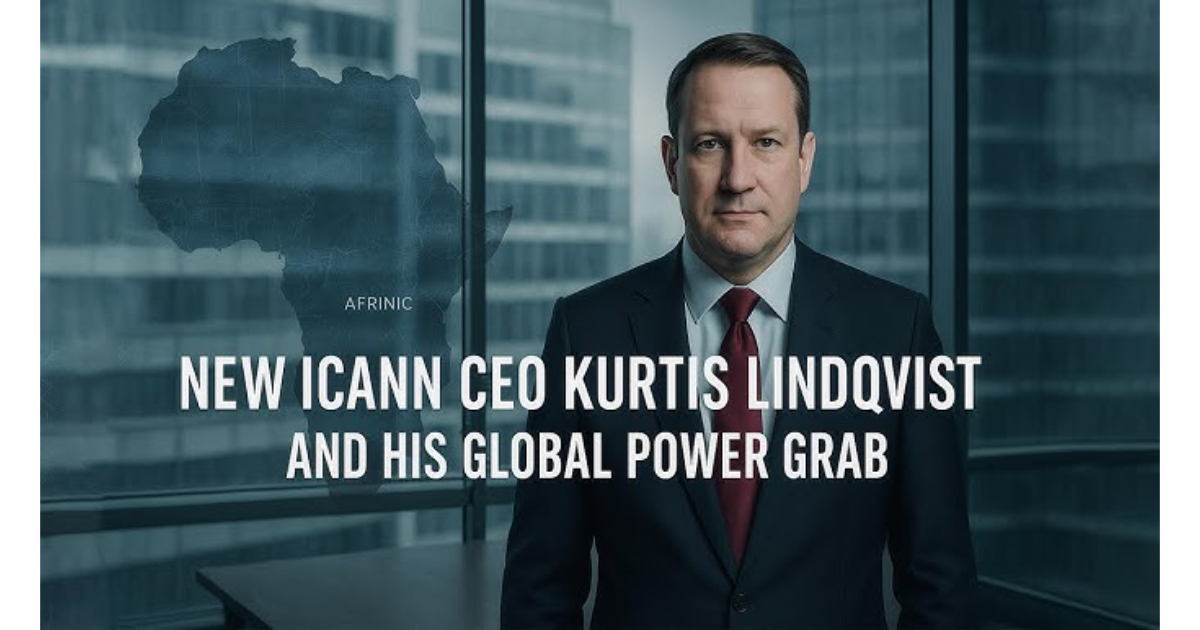
- ICANN’s sudden demand for AFRINIC’s document preservation sparks concern over potential exposure of long-ignored governance failures and complicity.
- Lindqvist’s aggressive stance and later backtracking deepen confusion as Africa’s internet future hangs in legal and political uncertainty.
- Secret January document retrieval by ICANN lawyer raises questions about what sensitive records may already be in ICANN’s possession.
The fallout from AFRINIC’s annulled 2025 board election has taken a sharp turn, shifting from disputes over proxy votes to a high-stakes battle over control of the registry’s historical records. At the centre of this escalating conflict is ICANN CEO Kurtis Lindqvist, whose sudden demand for document preservation has raised eyebrows across the internet governance community.
Also read: New ICANN CEO Kurtis Lindqvist and his global power grab
A suspiciously timed request
On 16 July, ICANN Board Chair Kurtis Lindqvist sent a formal letter to AFRINIC’s court-appointed Official Receiver, Gowtamsingh Dabee. The letter insisted on the urgent preservation of AFRINIC’s critical governance documents.
While framed as routine oversight, the timing is anything but coincidental. The demand comes just weeks after ICANN’s unprecedented threat to derecognise AFRINIC, a move enabled by a controversial compliance document quietly ratified in December 2024 that bypassed ICANN’s own multistakeholder processes.
Critics question why ICANN is only now expressing concern about record-keeping, given AFRINIC’s years-long governance crisis. The registry has operated without a functional board since 2023, endured multiple court battles, and faced allegations of financial mismanagement, all while ICANN remained conspicuously silent.
The ghost of January 11, 2025
The document preservation demand gains darker significance in light of BTW Media’s earlier reporting. On January 11, 2025, a lawyer representing ICANN visited AFRINIC’s Mauritius headquarters to retrieve an undisclosed document while the Official Receiver was abroad.
Security logs and eyewitness accounts confirm the visit occurred, contradicting ICANN’s public statement. The clandestine nature of the retrieval, conducted on a weekend without the Receiver’s knowledge, suggests ICANN may have already accessed sensitive internal materials, potentially including records that shed light on its years-long inaction or indirect involvement in AFRINIC’s decline. This raises a critical question: What might Lindqvist fear is buried in AFRINIC’s archives?
Also read: Did ICANN’s lawyer illegally visit AFRINIC when the Official Receiver was away?
Selective accountability
ICANN’s sudden zeal for transparency rings hollow to longtime observers. For over a decade, AFRINIC’s dysfunction played out before the eyes of the global internet community:
- The former senior management of AFRINIC, Ernest Byaruhanga, oversaw irregular IP address transfers worth tens of millions.
- Expired board members like Benjamin Eshun attempted illegal power grabs while litigation against members like Cloud Innovation drained AFRINIC’s resources.
- The Mauritian Supreme Court froze AFRINIC’s accounts after evidence surfaced that legal fees were funneled through a shell firm.
Throughout this period, ICANN took no substantive action. Only under Lindqvist’s leadership has ICANN adopted an aggressively interventionist stance, coinciding with AFRINIC’s court-sanctioned efforts to reform through elections.
A power grab in plain sight
The July 16 letter marks the latest escalation in ICANN’s campaign to assert control over AFRINIC. By leveraging the disputed ICP-2 compliance procedures, ratified without community input, Lindqvist has positioned ICANN as judge, jury, and executioner of RIR legitimacy.
This power grab carries global implications. If ICANN can unilaterally derecognise AFRINIC, no RIR is safe from political interference. The move also disregards Mauritian courts, which have repeatedly affirmed AFRINIC’s legal standing despite ICANN’s objections.
The stakes for Africa
With AFRINIC’s winding up hearing set for July 24 and new elections mandated by September 30, the continent’s internet future hangs in the balance. Cloud Innovation has petitioned for AFRINIC’s dissolution, arguing the registry is beyond repair. Lindqvist’s recent backtracking, claiming ICANN never endorsed this position, only deepens the confusion.
One thing is clear: After years of neglect, ICANN’s belated intervention reeks of self interest rather than stewardship. The documents it now seeks to control may reveal why Lindqvist is so determined to rewrite history before the truth catches up.