
Summary
- Klasmann-Deilmann GmbH is a German family-controlled growing-media group, not a telecom operator. RIPE NCC membership is useful continuity evidence for its own business network administration, but the economic question is whether a EUR322.2 million substrate producer can lower peat intensity without weakening the product that professional growers buy to protect yield.
- The company's direction is clear. Its 2025 Sustainability Report says alternative raw materials reached 1.15 million cubic metres, or 30.0% of total production, and management is targeting 50% by 2030. That target is commercially meaningful because product carbon footprint fell from 90.7 kg CO2e per cubic metre in 2013 to 60.9 kg in 2025, but it is not a peat exit: the same report says peat retains unmatched physical, chemical, biological and economic properties and that a complete phase-out is not yet visible.
- The transition can create value if Klasmann-Deilmann converts raw-material control into crop security, local availability and credible regulatory preparation that customers will pay for. It destroys value if renewable inputs raise recipe complexity, processing cost, transport cost and complaint risk faster than growers' willingness to pay rises.
Consistency is the product customers buy
The buyer's first incentive is not a pledge. It is avoiding a failed crop. A nursery that sells young vegetable plants, herbs, bedding plants, ornamentals, soft fruit or forestry plants needs a root-zone medium that holds water, air and nutrients in a predictable way. A missed germination window, uneven press pot, weak root system or disease problem can consume labour, energy, biological-control cost and shelf space before any retailer or food customer sees the plant. Substrate is a small share of the final crop value, but it sits early enough in production that a defect can multiply.
That is why Klasmann-Deilmann's own 2025 Sustainability Report frames growing media as an essential input alongside seed and fertiliser. The report says a growing medium stores air, water and nutrients; regulates pH; supports root stability; and is tailored to plant species, cultivation method and climate. It also says the group operates more than 10,000 actively used substrate recipes across roughly 150 peat, alternative raw material, aggregate, fertiliser and additive inputs. The commercial claim behind that complexity is simple: growers buy repeatability for their crop, not just cubic metres of material.
The economics follow from that timing. If a peat-reduced blend works, the customer may accept a higher price because it lowers carbon exposure while preserving yield, retailer access and process stability. If it works only with more irrigation, different fertilisation, shorter shelf life or greater biological-control risk, the grower carries hidden cost. A supplier can charge for sustainability only when the buyer's own economics still work.
Klasmann-Deilmann therefore has to price renewable-input substitution against four things at once. The first is product performance: the blend must hold structure, water and nutrients reliably. The second is operational adaptation at the nursery: growers may need changed irrigation, fertilisation or storage practice. The third is input cost: renewable materials require sourcing, drying, screening, buffering, testing and transport. The fourth is regulatory and customer pressure: peat reduction has strategic value only if food, retail and public-sector buyers reward it, or if regulation makes higher-peat alternatives less attractive.
The conclusion is not that lower peat use is optional. The company's market is moving. Its own sustainability page states that alternative raw materials reached 30.0% in 2025 and that the 2030 goal is 50%. The conclusion is that a substrate producer cannot spend strategy as if it were free. Every cubic metre of new input has to defend either yield, margin, availability, regulatory position or customer retention.
The company is a substrate producer, not a connectivity seller
The legal and operating boundary matters because the public source trail begins with a RIPE NCC directory record. Klasmann-Deilmann's imprint identifies Klasmann-Deilmann GmbH at Georg-Klasmann-Strasse 2-10, 49744 Geeste, Germany, registered at the Osnabrueck commercial register under HRB 120005, with Damian Ikemann and Jan Astrup as managing directors. The company's contact page places the headquarters and management in Geeste and lists product development, communications, legal and human-resources contacts there.
The operating description is agricultural and industrial. Klasmann-Deilmann's about-us page describes the group as active in the international substrate industry, with sales and production companies in Europe, Asia and America and partners on every continent. It says its growing media support fruit, vegetables, edible mushrooms, herbs, ornamental plants, trees and shrubs. The product portfolio includes professional and consumer substrates, white and black peat, wood fibre, green compost, coir, perlite, Growcoon propagation systems, Log & Solve grower software, peat moss for peatland restoration and renewable raw materials for energy use.
The 2025 report gives the financial perimeter. Group revenue was EUR322.2 million in 2025, up from EUR281.9 million in 2023 and EUR160.1 million in 2013. Commercial-horticulture growing-media sales were 3.808 million cubic metres, with a further 383,000 cubic metres in the consumer segment. Full-time-equivalent headcount was 949. The lead company performs strategic and management functions; production and sales are spread across German, Lithuanian, Latvian, Irish, Dutch, Belgian, Australian, US, Japanese and other companies. Shareholders are Deilmann-Montan GmbH with 57.5% and Klasmann Anlage- und Verwaltungs GmbH & Co. KG with 42.5%.
That is a medium-sized, internationally distributed industrial supplier. It is not an internet-access provider. The RIPE NCC member page lists Klasmann-Deilmann GmbH at the same Geeste address and shows Germany as the area serviced. RIPE NCC's resources guide explains that members can request and administer internet number resources such as IPv4 addresses, IPv6 addresses and autonomous-system numbers. For Klasmann-Deilmann, that evidence says the company has an official business need to administer network resources. It does not prove that the company sells connectivity, transit, hosting or managed network services.
That distinction changes the article's economics. Network resources matter as operational continuity evidence: a group coordinating recipes, orders, quality data, partner sites, customer service and global sales needs reliable digital operations. They do not define the business model. The business model is selling technical growing media and related systems into professional horticulture, supported by raw-material control, processing capability, quality assurance, technical advice and logistics.
Scale gives substitution a budget but not unlimited pricing power
Klasmann-Deilmann has enough scale to invest, but not enough to ignore cost discipline. The 2025 report's EUR322.2 million revenue base and 4.191 million cubic metres of total growing-media sales imply a business with material volume, seasonal logistics and meaningful fixed assets. The group can spread product-development work, certification, laboratories and sales support across a large international customer base. It can also use long-term supplier contracts, acquisitions and partner production to reduce raw-material risk.
Scale also gives the company a reputational reason to move early. Klasmann-Deilmann calls itself one of the leading companies in the international growing-media industry. Its sites page says the sales network covers about 100 countries, with own subsidiaries in central markets and independent long-term partners elsewhere. A supplier with that footprint has more to lose from being late on peat reduction than a local mixer serving a narrow crop group. Retailers, food producers, public buyers and organic associations can ask for evidence of lower impact, certified inputs and continuity.
But the same scale creates a harder margin problem. A laboratory success in one crop, one country or one season is not enough. Substrate recipes are crop-specific, climate-specific and method-specific. An input that works in a Dutch herb nursery may not work in a hot-region soft-fruit system or in a forest-tree propagation tray. A formulation that survives a trial may still be hard to source in peak season. A cheaper renewable input can become expensive if it raises screening losses, transport weight, fertiliser adjustment or customer-complaint handling.
The company's own disclosures recognise this. In the June 2026 sustainability-report announcement, management said sustainable development requires a massive financial outlay, careful integration of new business units, refurbishment of production facilities, an ongoing review of the product portfolio and strong team commitment. In the TASPO interview republished by Klasmann-Deilmann, Damian Ikemann said higher prices affect the whole horticultural sector and that substrate raw-material supply must be secured diversely by type and location.
That is the central capital-allocation question. The renewable-input transition is valuable if Klasmann-Deilmann earns it back through stronger customer retention, better price acceptance, lower regulatory risk, more secure inputs, more efficient transport or differentiated products. It is not valuable merely because the alternative input share rises. A business can meet a ratio while surrendering margin if it has to over-process materials, carry excess inventory, subsidise customer adaptation or replace complaints at its own cost.
Peat is hard to replace because it bundles performance
Peat remains commercially powerful because it bundles properties that alternative raw materials usually supply separately. Klasmann-Deilmann's report is unusually direct on this point. It says raised-bog peat has been the most important raw material for growing media since the late 1950s and is the only raw material that possesses all the physical, chemical and biological properties required for commercial horticulture.
The same report lists peat's physical strengths as structural stability, air and water capacity, wettability; chemical strengths as pH, nutrient buffering and low harmful-substance risk; biological strengths as being largely free of weed seeds and pathogens; and economic strengths as availability, consistency and suitability for horticultural requirements.
That is why a 50% target is not a simple procurement switch. Wood fibre can improve air capacity, drainage, root development and weight. Green compost can add biological activity, nutrient buffering and disease-suppression potential. Coir can improve water movement and structural stability. Perlite can reduce weight and improve drainage. Sphagnum has some peat-like properties. Biochar can hold carbon and may add structure. But none of those inputs automatically replaces peat across every crop, pot size, climate and grower practice.
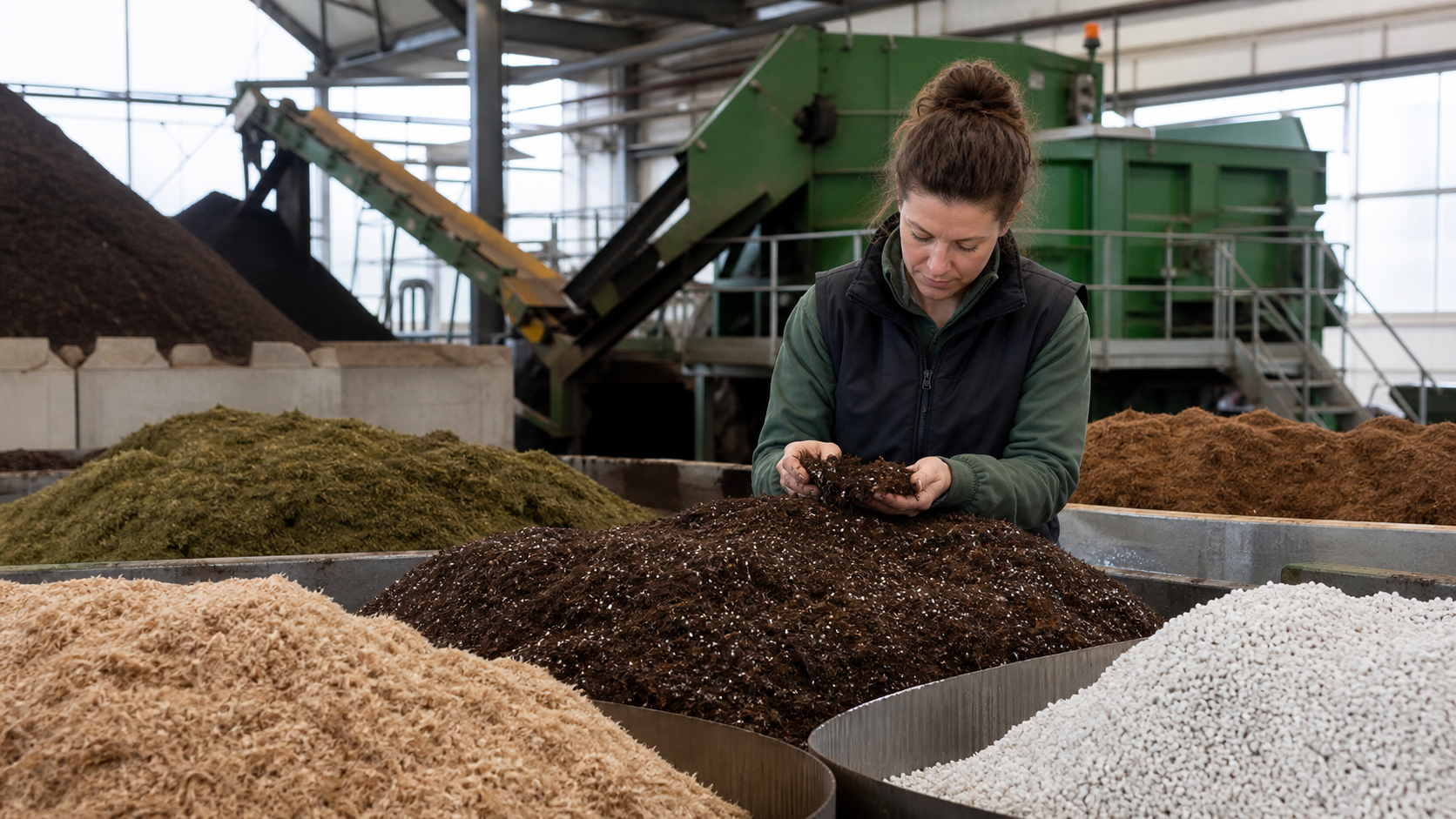
The company's GreenFibre brochure shows the performance logic. GreenFibre is made by thermal and mechanical defibration of softwood chips, can be adjusted for structure, has low fine-particle content, is RHP-certified and can increase air capacity, drainage and root development while reducing transport cost because of lower weight. That is a credible role in a blend. It also implies processing cost, wood-chip sourcing and quality-control discipline.
The TerrAktiv green-compost brochure supports another role. Green compost can be biologically active, buffer nutrients, improve rewettability and support organic fertiliser conversion. But compost's value depends on stable feedstock, maturity, salt level, phytosanitary safety and consistent screening. It cannot be treated as generic green waste. A grower paying for a professional substrate does not want to discover feedstock variability during crop production.
That makes the substitution task more like recipe engineering than commodity buying. Klasmann-Deilmann's ProLine page lists organic blends with specified shares of TerrAktiv, GreenFibre and coir, including products with 20-30% alternative constituents in propagation and up to 50% in potting. It also claims ProLine substrates reduce CO2 emissions by up to 40% and that all ingredients are controlled for organic cultivation by Ecocert. The commercial signal is that higher renewable shares already exist in defined segments. The limit is that each segment has its own acceptable trade-offs.
Renewable inputs change the cost structure
The 2030 target changes the cost base because it shifts the scarce input from peat reserves alone to a portfolio of renewable materials, processing capacity and logistics. The raw-materials page lists GreenFibre, TerrAktiv, TerrAktiv PLUS, coir, perlite and peat as raw-material categories. The raw-materials brochure says Klasmann-Deilmann plans substrate quantities years in advance, invests in new sites and process equipment, produces constituents through its own facilities or raw-material companies and uses RHP membership for quality-tested substrates.
That brochure also reveals the strategic hedge. It says the company operates 12 wood-fibre plants worldwide, has secured wood chips through exclusive long-term contracts, has integrated Olde Bolhaar Eco-Service as a large producer of substrate compost, produces bark humus at AGS, Olde Bolhaar, Lithuania and Ireland sites, has exclusive access through Shakti Cocos to large coir quantities in India and Sri Lanka, and has produced perlite at Silute in Lithuania since 2022. Those are not small claims. They show that the company is trying to own or secure the bottlenecks before growers demand higher renewable shares at scale.
The economic advantage is resilience. If a substrate supplier depends only on spot-market renewable inputs, it can win the sustainability narrative in calm periods and lose delivery credibility in a shortage. Klasmann-Deilmann's own procurement language points the other way: long-term contracts, own facilities, partner companies and decentralised production. That is the correct architecture for a seasonal business where missing spring demand can be more costly than paying for redundant supply options.
The risk is that redundancy costs money before it proves itself. A 12-plant wood-fibre footprint needs feedstock contracts, energy, maintenance, quality control and utilisation. Coir access in India and Sri Lanka brings freight, buffering, moisture, currency and supplier-governance risks. Perlite production in Lithuania improves security and price stability only if volumes justify the capital and the delivered cost competes with external supply. Compost capacity creates value only if collection streams, certification and recipe use keep pace.
Klasmann-Deilmann's own 2025 report sets the hurdle plainly. It says the 50% goal has a massive impact on product development, customer consulting, resource security and investments. It says alternative raw materials must be available in sufficient quantities at any time, secured through supply contracts, located at a reasonable transport distance, competitively priced and compatible with the industry's overall cost and price structure. That is a business test, not a public-relations test.
Decentralised production is the hedge against transport drag
Transport is the place where a low-carbon claim can quietly lose its economics. Peat, wood fibre, compost, coir and perlite differ by density, moisture, compressibility and processing need. A material that lowers product emissions can still raise delivered cost if it moves too far, carries too much water, requires more storage or forces extra handling at the factory. Klasmann-Deilmann's report says the group is adapting production facilities to use locally available raw materials worldwide partly to reduce fossil-fuel and transport emissions.
The company's decentralisation is visible in both owned sites and partner production. Its sites page says Geeste is the nerve centre, but production and sales are distributed across countries. The 2025 report names production companies in Germany, Lithuania, Latvia, Ireland, the Netherlands, Belgium and Australia, and says that, as of August 1, 2024, selected partner production was being used in France, Poland, Latvia, Canada, Japan and China. Partner production is economically attractive when it reduces freight distance, gives access to local renewable materials and keeps customer service close to the grower.
It also changes the control problem. A substrate specification produced by an independent partner on Klasmann-Deilmann's behalf must still meet the company's performance, filling-volume and certification expectations. The more the mix depends on local feedstocks, the more valuable recipe management, laboratory testing and technical advice become. The company's advantage is no longer just that it owns peat reserves. It is that it can translate local input variation into an acceptable crop result.
The deliverability page makes this customer-facing. It says the horticultural sector faces higher demands for resource-conserving production, that high-quality growing-media demand is increasing internationally, and that recent supply disruptions showed the value of agility and substrate expertise. It promises long-term planning, own production of constituents, protection of Baltic peat resources, investment in production capacity and filling systems, use of circular raw materials and development of future solutions such as sphagnum farming and polymer technology.
That is the right promise, but it is expensive. A decentralised model carries more interfaces: partner contracts, raw-material traceability, audit schedules, recipe translation, seasonal stock, quality records and customer support. It creates resilience only if Klasmann-Deilmann can preserve crop security across all those interfaces. Otherwise decentralisation becomes a source of variability rather than a hedge against transport drag.
Certification turns quality risk into commercial permission
Certification is not decoration in this business. It is a way to make invisible material properties commercially acceptable. Klasmann-Deilmann's certificates page lists RPP, RHP, Ecocert, ISO 9001, ISO 14001 and ISO 14064 documents. Its about-us page says RHP monitors raw materials and production, ISO 9001 covers quality management, ISO 14001 covers environmental management, peat extraction follows Responsibly Produced Peat guidelines, former extraction sites are rehabilitated mainly by rewetting, its carbon footprint is verified to ISO 14064 and sustainability reporting follows GRI standards.
For customers, these marks reduce diligence cost. A grower may not have the ability to audit a wood-fibre plant, compost site, peat extraction area or coir supplier. The buyer can, however, require a product that has passed recognised controls. That becomes more important as recipes become more complex and as organic, retailer and public-sector buyers demand evidence. The ProLine page says raw materials and fertilisers are tested for pesticide residues, conventional and organic inputs are separated and labelled, and recipes and customer lists are disclosed to Ecocert.
Certification also protects price. If peat-reduced substrates are sold only as cheaper substitutes, margins will suffer because alternative inputs often need extra processing. If they are sold as higher-assurance products that protect organic access, retailer confidence and regulatory preparedness, Klasmann-Deilmann has a better chance to recover cost. The company appears to understand this. Its ADVANCED Substrates page presents peat-reduced blends as high-performance products using wood fibre, perlite, coir, green compost and peat, with customer comments about better water balance, stronger plants and reliable support.
There is still a danger of overclaiming. A certificate does not guarantee yield, and a lower product carbon footprint does not guarantee lower total crop cost. It gives the buyer more confidence that the inputs were produced and tested under defined standards. The economic outcome still depends on performance in the nursery, the adaptation burden on the grower and the price premium available from downstream buyers.
The strongest certification economics appear in segments where the buyer already values proof: organic propagation, herbs, vegetable young plants, controlled retail specifications and customers facing their own emissions reporting. In low-margin segments with weak end-customer reward, Klasmann-Deilmann may need to absorb more transition cost or keep higher peat content for longer.
Customers pay for crop security before carbon claims
Klasmann-Deilmann's customer promise has to be read in this order: crop security first, lower footprint second. The 2025 report says a successful peat-reduced transition requires consensus between the horticultural business, substrate manufacturer and other suppliers. It says the producer must offer a product it believes in, the grower must adapt operations to the substrate's properties and the grower must achieve reliable cultivation results. That is a practical description of who pays and who carries the downside.
The customer examples on the ADVANCED page are useful but limited. One Belgian Helleborus producer is quoted saying TerrAktiv and GreenFibre made plants stronger, more compact and resistant. A container-plant producer says 20% GreenFibre helped water balance and rewettability in response to customers asking for more ecologically responsible substrates. These are company-hosted testimonials, so they are not independent performance audits. They are nevertheless credible signals of the selling motion: Klasmann-Deilmann has to win on agronomy, not only on emissions.
The value split is uneven. The grower may get fewer emissions in plant production, better retailer access and more resilient water balance. The substrate supplier gets a defended price and customer loyalty if the blend works. Downstream retailers and consumers may get a more sustainable story without directly paying all the transition cost. The downside, however, appears first at the nursery: more irrigation, less shelf life, biological-control cost, rejected plants or complaint risk.
This is why the company's advisory capacity is economically important. The contact page lists product development and market support, corporate communications and sustainability management, and other named functions. The 2025 report says customer consulting is one of the areas heavily affected by the 50% alternative-material goal. In a commodity market, advice is overhead. In a transition market, advice is part of the product because the buyer needs help converting a recipe change into a crop result.
That advice has to be crop-specific rather than generic. A grower producing young vegetable plants in press pots is solving for block stability, germination, rapid rooting and reliable transplanting. A pot-herb grower is also solving for shelf life, sciarid pressure, food-retail rejection risk and a substrate that behaves predictably under organic fertilisation. A soft-fruit grower cares about drainage, pH, long-term structure and irrigation control over a longer crop cycle. A forestry-plant producer may value propagation efficiency and root quality more than the same retail-facing carbon claim.
Klasmann-Deilmann's 10,000-recipe base is valuable only if the company uses it to price these differences instead of selling one uniform transition story.
The pricing problem remains. Ikemann's 2026 interview states that Klasmann-Deilmann can use a calculated proportion of TerraCoal biochar in growing media in connection with official CO2 certificates, but that the higher price generally cannot yet be realised in the market. That is a valuable admission. It means the market is not automatically paying for every climate feature. Klasmann-Deilmann should therefore allocate TerraCoal, Sphaxx, high-renewable blends and fully offset offers to customer groups with real willingness to pay, not treat them as universal replacements before the economics support that.
Regulation raises the option value of being early
Regulation and public policy are pushing the same direction, but not as a single immediate ban. Klasmann-Deilmann's report says Germany, the United Kingdom and Switzerland are pursuing strategies to reduce or phase out peat, while some other countries remain neutral or reject restrictions. It also states that large-scale peat extraction in Ireland has effectively ended nationwide since 2019 because national planning and environmental law conflicted with EU law and there was no new regulation in sight. For a group with operations and sourcing across multiple countries, that asymmetry matters.
The European context is broader restoration and climate policy. The European Commission's Nature Restoration Regulation page describes binding restoration targets as part of the EU biodiversity strategy, while the Official Journal text of Regulation (EU) 2024/1991 is the legal source. The regulation does not make every horticultural substrate decision illegal. It increases the long-term policy value of peatland restoration, wetland recovery and lower emissions from degraded organic soils.
For Klasmann-Deilmann, being early has option value. It gives the company time to test crops before regulation or retailer pressure becomes abrupt. It supports relationships with organic associations and customers that need proof. It lets the group secure wood, compost, coir, perlite and sphagnum inputs before competitors crowd the market. It also gives management a way to shape industry compromise rather than only react to restrictions.
There is a counter-risk. If policy moves slower than expected, customers may resist paying for higher-cost blends. If policy moves faster, the company may be forced to accelerate before recipe performance and input availability are ready. If policy is uneven by country, some competitors can sell higher-peat products into less restrictive markets at lower cost, while Klasmann-Deilmann carries more transition expense. This is why the 50% target is economically cleaner than a full phase-out promise. It leaves room for peat where performance or input availability still matters.
The company also faces social and legal scrutiny around extraction itself. Its own report says peat extraction is allowed only on areas already drained or agriculturally used, that intact peatlands are left untouched, and that subsequent use is usually set by authorities and often involves rewetting. It says 94% of extraction areas and 97% of peat extraction volumes were RPP-certified at the end of 2025, and 5,136 hectares had been rewetted. Those disclosures reduce risk; they do not eliminate it. The more peat remains in the mix after 2030, the more important transparent extraction, certification and after-use evidence become.
The RIPE record is continuity evidence only
The RIPE NCC record matters because it explains why a substrate producer appears in a network-resource context. It should not be over-read, and the boundary is material for readers and customers alike. The RIPE member page identifies Klasmann-Deilmann GmbH as a local internet registry member at the Geeste address. RIPE NCC's own resource guide says members can obtain and manage internet number resources. A company with international sales, production partners, technical support, recipe data, quality documentation and customer communications can have a legitimate need for such resources even when it does not sell telecom services.
The economic value is continuity and governance, not revenue diversification. Klasmann-Deilmann's brochure page shows how much product and technical documentation the company distributes. Its report mentions digital recipe management and customer consulting. Its sites page shows a geographically dispersed sales and production network. A failure in order coordination, recipe documentation, quality records or customer support can damage delivery reliability. Network-resource administration is part of business infrastructure that supports that reliability.
But a RIPE membership record does not reveal bandwidth contracts, application uptime, cybersecurity maturity, cloud dependence, route resilience or cost. It does not convert Klasmann-Deilmann into an ISP, cloud provider or data-centre company. It should be treated as a continuity marker around a globally distributed industrial supplier whose commercial product remains growing media.
The same themes therefore fit only if used carefully. Cloud service dependency, cross-border connectivity, data locality and network-resource evidence matter because Klasmann-Deilmann coordinates industrial and customer-service activity across borders. They are not the operating thesis. The operating thesis is that raw-material transition must protect crop performance and margin.
Competition will test whether the premium is real
Klasmann-Deilmann's strongest competitive advantages are experience, raw-material access, certification, recipe knowledge and customer advice. The about-us page says the company began ready-to-use substrate production in 1959, started composting in 1991, began GreenFibre production in 2010, opened an innovation centre in Geeste in 2018, passed the one-million-cubic-metre mark for alternative raw materials in 2024 and launched Sphaxx and TerraCoal in 2025. That history is relevant because growers are cautious about root-zone changes. The more evidence a supplier has across crops and seasons, the easier it is to sell a higher-value blend.
The competition is not only other substrate producers. It is also the grower's alternative choices: keep using higher-peat blends where legal and accepted; buy cheaper local mixes; source coir or other media from specialist suppliers; change crop systems; delay the switch until retailers demand it; or require the substrate supplier to absorb transition cost. In organic and high-specification segments, Klasmann-Deilmann may hold stronger pricing power. In commodity ornamentals or price-sensitive consumer soil, willingness to pay can be thinner.
The company's own ProLine claim of more than 70% market share in premium organic substrates is significant, though it is company-reported and segment-specific. It suggests pricing power where certification and advisory relationships matter. It should not be applied to the whole growing-media market. A strong organic position helps fund innovation, but the broader 2030 target spans a much wider volume base.
Substitutes also differ by region. In markets near compost, wood fibre or bark sources, local alternatives can be cost-effective. In markets dependent on imported coir, transport and buffering can erase part of the carbon and cost benefit. In peat-rich regions with looser policy, peat remains cheap and technically familiar. Klasmann-Deilmann's decentralised strategy is the correct response, but it must avoid one mistake: selling a global percentage target at the expense of local crop economics.
The unofficial signal is mixed but useful. Company-hosted customer quotes show demand for ecologically responsible substrates and satisfaction in specific uses, while management's own TASPO answers acknowledge that higher prices cannot always be realised and that the whole horticultural sector is feeling painful price increases. Those signals do not prove market-wide willingness to pay. They show that Klasmann-Deilmann has real customer pull in some niches and real price resistance in others.
The facts that would change the judgment
The current judgment is cautiously positive. Klasmann-Deilmann can probably move toward a 50% alternative-material share by 2030 without surrendering the business, because it already reached 30.0% in 2025, has scaled multiple renewable inputs, has global production and partner sites, uses recognised certification, and understands that crop security is the commercial gate. The move should defend long-term relevance in professional horticulture and reduce policy exposure. It should also preserve peat for the applications where no substitute yet matches the full performance bundle.
The judgment is not that every investment will earn its cost. The company's own evidence says the transition requires high financial outlay, production-facility refurbishment, business-unit integration, product-portfolio revision and more consulting. Corporate carbon footprint rose slightly after 2023 because growth increased resource consumption and transport, even as product carbon footprint remained much lower than in 2013. That is exactly the tension: growth, transport and input diversification can consume part of the emissions and margin benefit.
Five facts would improve the judgment. First, crop-level trial data showing equal or better yield, rejection rates and labour use for peat-reduced blends in major crops and climates. Second, realised price premiums or retention gains from customers using higher-renewable formulations. Third, delivered-cost evidence that wood fibre, compost, coir, perlite, sphagnum and biochar can be sourced and processed at scale without higher complaint cost. Fourth, proof that decentralised partner production lowers freight and improves peak-season delivery without quality drift.
Fifth, clearer disclosure separating gross margin, capital spending and return on invested capital for alternative raw materials from the legacy peat business.
Five facts would worsen it. First, evidence that growers accept lower-peat blends only when Klasmann-Deilmann subsidises price or service. Second, repeated crop issues linked to variable compost, coir, wood fibre or fertiliser behaviour. Third, transport cost or emissions rising faster than local-input gains. Fourth, regulatory pressure forcing faster peat reduction before sufficient renewable input quality and volume exist. Fifth, continued dependence on peat purchases at spot-market prices because own extraction access becomes more constrained.
The company's 2030 target is therefore the right kind of ambition: large enough to change the cost base, limited enough to avoid pretending peat is already replaceable everywhere. It will pay if Klasmann-Deilmann sells reliability, proof and agronomic support, not just a lower peat percentage. It will fail if customers are asked to absorb performance risk while the supplier counts only the input ratio. In this market, the grower pays for consistent results first; sustainability earns a premium only after the crop still works.
That makes measurable repeat orders, not headline volume, the most important evidence to watch through 2030.