
Summary

  • Kawasaki Robotics should be judged less by how many robot models it can list and more by whether a customer can get one handling, machine tending, welding, painting or palletizing step into a stable workcell with the right fixture, safety design, tool, program, controller interface, operator routine and maintenance plan.
  • The public evidence supports Kawasaki as a serious industrial robot supplier with broad product coverage, application-specific models, compact controllers, integration aids, service offerings and case-study proof points. It does not by itself prove low total cost, fast changeover or durable uptime for every plant, because those outcomes depend on part variation, cell design, integrator quality, maintenance discipline and the economics of the task being automated.

The real test is the accepted cell

Kawasaki Robotics sits inside the larger Kawasaki Heavy Industries family, but the relevant business here is not motorcycles, aerospace or the other branches that share the Kawasaki name. The relevant business is industrial robot systems: articulated arms, palletizing robots, arc welding robots, spot welding robots, painting robots, controllers, programming tools, safety functions, service support and partner equipment that are used to automate physical work in factories and logistics operations.

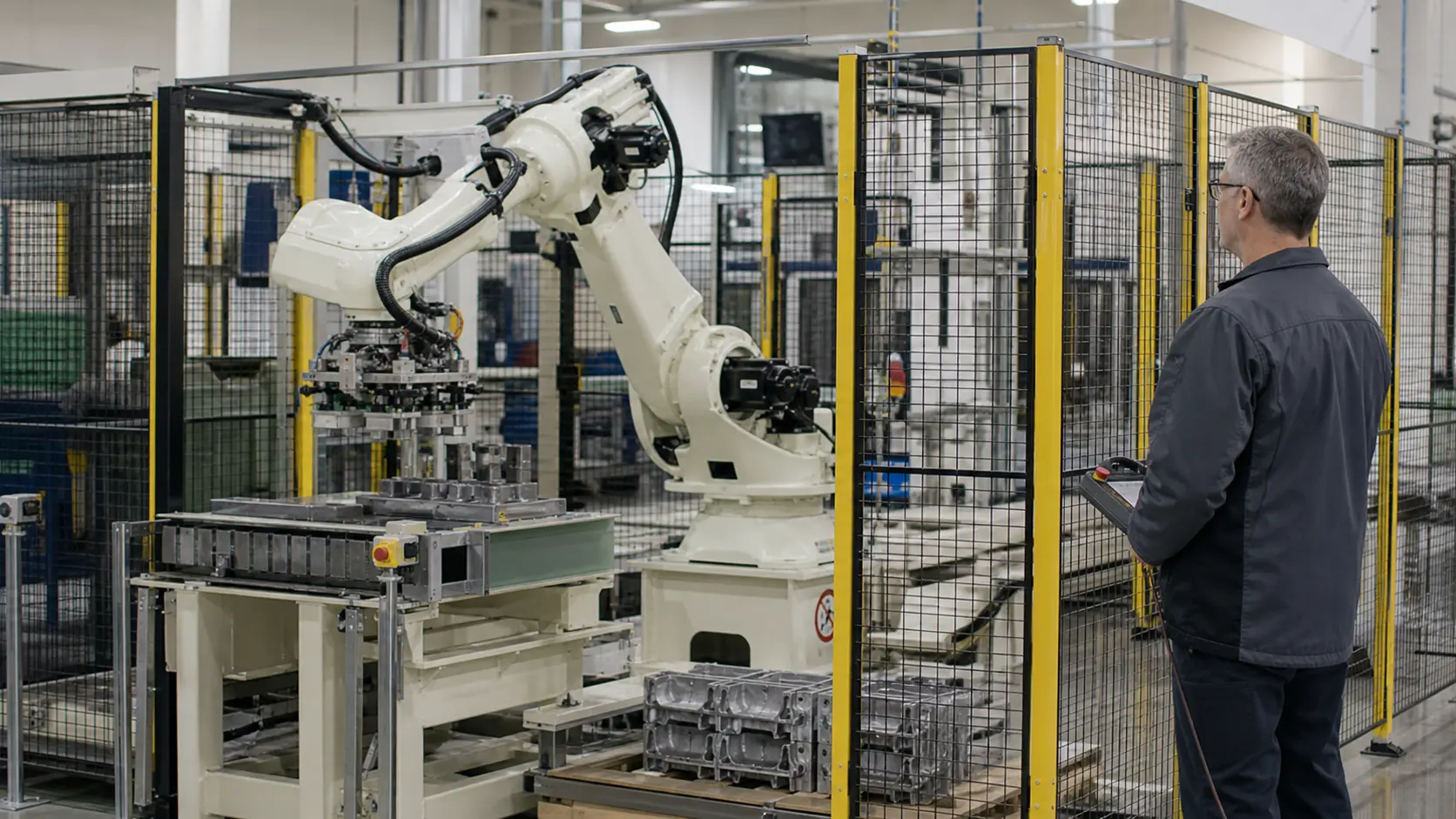
That distinction matters because industrial robotics is not a simple equipment sale. A manufacturer does not buy a robot arm in the same way it buys a freestanding hand tool. It buys a cell outcome. The robot has to pick a part, load a machine, follow a weld seam, stack a pallet, move a panel, spray paint inside a process envelope, or tend a sequence of machines while staying inside a safety system. The accepted state is reached only when the full cell can be released into production with defined cycle time, stable quality, trained operators, documented recovery steps, and maintenance routines that a plant can live with.

Kawasaki's public product pages make the breadth obvious. Small R series robots such as the RS007N target material handling, machine tending, pick-and-place and dispensing work. Heavy BX series robots address material handling, palletizing and spot welding. BA series robots target arc welding. CP series robots focus on palletizing. K series robots such as the KJ155 are built for painting. The F60 controller supports compact installations for smaller robots and Kawasaki describes global safety specification support, remote I/O options, external axis options and energy-saving revisions.

The company also points to support services, training, K-AddOn partner equipment, vision options and lifecycle monitoring.

Those are necessary signals, not sufficient proof. A robot can have the right payload, reach and controller yet still fail as a production asset if the part presentation is unstable, the fixture is imprecise, the end-of-arm tool marks the product, the safety restart sequence is awkward, the program is brittle, the operator cannot diagnose faults, or the integrator leaves behind a cell that only its own engineers understand.

Kawasaki's value is therefore tested in the accepted workcell state: not whether a robot can move, but whether it can keep physical action, safety and production acceptance aligned when parts, operators and fixtures vary.

The industrial robot market also increases the pressure on that test. The International Federation of Robotics reported that global industrial robot installations remained above 500,000 units in 2024 and that the United States remained one of the five largest markets. High installed numbers do not make any individual cell easy. They show that the technology is mainstream enough for buyers to compare suppliers closely.

A Kawasaki proposal competes not only with other robot brands, but also with manual work, simpler conveyors, dedicated fixtures, lower-cost automation, collaborative robots, machine-side automation, outsourcing and process redesign. The workcell has to justify itself against all of those substitutes.

What Kawasaki brings to the cell

The strongest public case for Kawasaki begins with the breadth of the robot line and the application pages around it. In material handling, Kawasaki describes robots that move products between locations with grippers and can interface with conveyors, guided vehicles, storage and retrieval systems and other plant equipment. The company says its material-handling options include conveyor tracking, collision detection and servo-controlled end-of-arm tooling. That language is important because a handling cell is rarely just an arm and a gripper.

It is a timing problem between incoming product, sensor confirmation, robot motion, destination equipment and exception handling.

For machine tending, Kawasaki's own framing is even closer to the economic question. A machine-tending robot loads and unloads CNC machines, lathes, presses, washers or other equipment. Kawasaki describes common one- or two-machine setups, fieldbus communication such as Ethernet/IP, door and chuck signals, fixture cleaning by air blow-off, floor or ceiling mounting, simple block-step programming and the full AS language for more logic-intensive work. The application page also gives a rough public cycle-time estimate for a standard machine-load sequence, while warning that the actual number depends on the setup.

This is exactly the level where automation is won or lost: not in the brochure claim that a robot is fast, but in whether the seconds spent entering a machine, swapping parts, clearing chips and waiting for doors fit the real machining cycle.

Palletizing gives Kawasaki a different kind of acceptance problem. The CP180L product page lists 180 kg payload and 3,255 mm reach, while the CP series is presented as an end-of-line and distribution option with palletizing software. The palletizing application page correctly identifies a central production issue: facilities often handle many SKUs, sizes, weights and package types. A robot that works for one rectangular case can struggle when a plant adds bags, bottles, thin cartons, pails or seasonal packaging.

The value of a CP series cell therefore depends on pattern management, end-of-arm tooling, product damage limits, pallet quality, label orientation, infeed control and the ease with which operators can change recipes.

Arc welding and spot welding add still more constraints. The BA006N product page lists a 6 kg payload, 1,445 mm reach, hollow wrist structure and support for F60, F01 and E01 controllers. Kawasaki's arc welding material emphasizes cable management, welding software, positioners, seam tracking and sensor options. The installation manual for BA series arc welding robots is a reminder that a welding robot is part of a broader system. It discusses installation and connection for arc welding equipment, safety manuals, education and training, safety fences, teach and maintenance responsibilities and welder interfaces.

In welding, a robot path is not enough. The cell has to manage torch angle, wire feed, shielding gas, workholding, heat distortion, fixture wear and inspection expectations.

Painting adds yet another layer. The KJ155 page lists an 8 kg payload, 1,545 mm reach, floor or wall mounting, an explosion-proof painting category, and a hollow wrist intended to accommodate hoses. Paint workcells are not general handling cells with a spray gun attached. They involve hazardous environments, atomization, overspray, booth airflow, coating thickness, cleaning cycles, color changes and regulatory safety design. The KJ155 signals that Kawasaki has an application-specific product boundary, but acceptance still rests on process control and integration detail.

The controller is the production hinge between these applications. Kawasaki's F60 controller page highlights a compact, light design, common global safety specifications, remote I/O expansion, optional Bluetooth interface, external motor amplifiers and Cubic-S safety monitoring capability. These features do not automatically produce value, but they touch several real plant costs: cabinet space, electrical integration, remote signals, operator access, safety monitoring and external axes. The E01 controller page similarly stresses worldwide use, multiple primary power supply voltages and safety standards.

For a global manufacturer, controller standardization can reduce engineering variation across plants. For a single small factory, it can reduce the risk that a robot cell becomes an unusual island that only one technician can understand.

Kawasaki also sells around the arm. K-AddOn presents partner equipment that can be integrated with Kawasaki robots. The 3D vision-guided CV-X480D page describes a Keyence system for assembly, depalletizing and machine tending that uses multiple cameras and projector patterns, automatic robot-camera calibration, CAD data upload and path planning around detected entities. K-COMMIT is presented as a lifecycle support and monitoring package that collects operation data for preventive maintenance. The public claims around such add-ons should be read carefully, but their presence is commercially meaningful.

A robot supplier that treats vision, tooling, safety, programming and maintenance as peripheral details leaves more of the outcome to the integrator and the customer. Kawasaki at least recognizes that the cell is the product.

Repeated tasks and the work Kawasaki can absorb

The best Kawasaki use case is a repeated physical step where the work is constrained enough for a robot to be more reliable than a person, but variable enough that the supplier's programming, sensing, support and partner ecosystem matter. That includes loading machined parts into a CNC cell, moving products between conveyor positions, palletizing mixed but structured SKUs, spot welding automotive assemblies, arc welding repeatable fabrications, spraying predictable parts, deburring a known geometry, or moving heavy components through a process where the position can be defined.

These tasks share a pattern. First, the work has a physical entity that can be presented to a robot in a known or detectable state. Second, the motion can be repeated many times with limited judgment. Third, errors are expensive enough to justify engineering discipline: a dropped part, missed weld, crashed torch, bad pallet or unsafe restart matters. Fourth, the labour involved is costly, scarce, ergonomically difficult or better used elsewhere. Fifth, the process around the robot can be controlled. If incoming parts vary beyond the fixture or vision model, the robot becomes a fault generator.

If upstream equipment starves or floods the cell, the robot does not create throughput by itself.

Kawasaki's public evidence fits this shape. The material-handling page talks about moving products with appropriate end-of-arm tools and interfacing with other equipment. The machine-tending page discusses trays, conveyors, fixtures and vision as ways to feed parts to the robot. The palletizing page highlights SKU, size and weight variation as a core challenge. The arc welding page points to sensors, laser tracking, path modification and positioners. These are not abstract automation categories.

They are the production surfaces where a plant discovers whether the robot can absorb repeated work or merely move the burden from labour to engineering.

For a customer, the first screening question should be brutally concrete: what exact state must the cell accept?

In a machine-tending cell, the state might be "raw part loaded, finished part removed, chips cleared, door closed, chuck confirmed, next cycle started, no operator inside the zone." In palletizing, it might be "case placed in the correct pattern, pallet stable, label orientation acceptable, damaged packages rejected, pattern changed by an operator without engineering support." In arc welding, it might be "part clamped, seam found or path confirmed, weld completed inside quality limits, torch protected, fixture released, exceptions logged." A Kawasaki robot has to be evaluated against that accepted state, not

against a generic payload or reach number.

This matters because robots are very good at repetition and very bad at ambiguity that has not been engineered away. If a worker sees a bent tab, a missing insert or a poorly taped carton, the worker may slow down and adapt. A robot usually needs the abnormal state to be detected, routed and recovered. Kawasaki's robot line can be part of that answer, especially when paired with sensors, fixtures and controllers. But the answer has to be designed. A plant that buys an arm to cover for a messy process often discovers that it has purchased a very precise way to expose the process mess.

Supervision cost is the hidden labour line

Robot automation is often sold as labour saving. That can be true, but only if the buyer counts supervision honestly. A robot can remove an operator from repetitive lifting, loading or welding, yet add new work in programming, teach pendant use, fixture cleaning, recipe changes, fault recovery, preventive maintenance, tooling replacement, quality checks and coordination with upstream and downstream equipment. The labour line moves from direct action to supervision and support.

Kawasaki's own materials implicitly acknowledge this. The getting-started guidance tells first-time buyers to keep projects simple and find a system integrator that understands the application type. The FAQs describe sensors, safety equipment and programming languages. The BA series welding manual recommends education and training before operation, teaching, maintenance or inspection responsibilities. The downtime and maintenance materials urge operator education, preventive maintenance, inspection, parts and service routines. None of that means Kawasaki is weak. It means industrial robots are supervised systems.

For a large automotive manufacturer, supervision cost may be absorbed into an existing automation department. That customer may already have controls engineers, maintenance technicians, spare-parts discipline, safety review processes and integrator management skills. Kawasaki's broad line and support network can fit that environment. For a small or mid-sized shop, the same cell may create a fragile dependence on a few people. If the only employee who can adjust a Kawasaki program leaves, the robot's theoretical productivity is not the same as its usable productivity.

This is where Kawasaki's programming posture matters. The machine-tending page emphasizes simple Block Step programming for some work and Kawasaki AS for more logic-intensive applications. The FAQ describes a programming platform with multiple languages. Open or flexible programming can lower lock-in if a plant trains people and documents work correctly. But flexibility cuts both ways. More power can mean more ways to create custom logic that is hard to maintain.

A buyer should ask who will own the program after acceptance, how backups will be stored, how changes will be approved, and whether normal production staff can recover from common faults without calling the integrator.

Supervision cost also includes quality supervision. A robot repeats what it is told. If a fixture drifts, a gripper pad wears, a torch bends, a paint nozzle clogs, a conveyor stop moves or a camera calibration shifts, the robot may continue performing the wrong action with admirable consistency. Kawasaki's K-COMMIT and maintenance offerings are relevant because they point toward monitoring and lifecycle management. Still, the plant has to decide which variables need inspection. Preventive maintenance is not only a service contract. It is a production routine that ties robot condition to output quality.

The strongest economics appear when the supervision burden is lower than the direct labour burden being replaced. A robot that eliminates two dangerous, fatiguing shifts but requires a trained technician for occasional faults may be a good trade. A robot that replaces one flexible operator but requires constant engineering support may not be. Kawasaki can improve the odds with application fit, support and tooling partners, but it cannot repeal the supervision equation.

Integration is the main commercial risk

Kawasaki's public materials repeatedly point customers toward integrators and partner equipment. That is not a weakness unique to Kawasaki. It is the structure of industrial robotics. The arm supplier rarely controls every piece of the cell: fixtures, end-of-arm tools, conveyors, PLCs, guarding, scanners, welding power sources, paint systems, machine doors, clamps, part presentation, upstream scheduling, quality inspection and plant maintenance practices. The commercial risk lies in the handoff among these parties.

The accepted workcell state is where handoff gaps become visible. Suppose the robot supplier sizes the arm correctly, the integrator designs a gripper, the plant supplies part drawings, and the safety consultant defines guarding. If the parts arrive with burrs that jam the fixture, the cell fails. If the machine tool door signal is unreliable, the robot waits. If the gripper works on dry parts but slips on oily ones, throughput falls. If the safety scanner stops the cell every time a forklift passes nearby, operators lose confidence. If the HMI exposes too little information, every small recovery becomes a call to maintenance.

No single catalogue page resolves these risks.

Kawasaki's K-AddOn platform is useful because it acknowledges the equipment ecosystem. Vision systems, grippers, sensors, safety hardware and peripherals have to be compatible with the robot workflow. The 3D vision example shows how a partner system can extend a Kawasaki cell into bin picking, depalletizing or machine tending where part location is not fixed. But the buyer should not confuse listed compatibility with accepted production performance. Vision that works in a demo still has to handle lighting, reflectivity, occlusion, damaged packaging, mixed parts, cycle-time pressure and plant cleanliness.

Integration risk is especially high when the economic promise depends on flexibility. Palletizing multiple SKUs, tending high-mix machining, welding custom fabrications or using AI-enabled warehouse handling all sound attractive because they promise more than a hard-tooled single-purpose machine. But flexibility is not free. It moves cost into software, sensing, recipes, validation and operator procedure. Kawasaki's current messaging around physical AI and advanced automation may be commercially important, especially in logistics, but a buyer should separate research and showcase momentum from proven cell economics.

A dynamic warehouse cell has a much wider exception space than a fixed palletizing cell.

The practical procurement question is therefore not "Does Kawasaki have a robot for this?" It is "Who accepts responsibility for the whole cell when it misses the target?" The contract should define throughput, uptime assumptions, acceptable product variation, safety validation, training, documentation, spare parts, software access, recovery procedures, changeover targets and post-acceptance support. If Kawasaki, the integrator and the customer each define success differently, the robot can be mechanically correct and commercially disappointing.

Safety is not a bolt-on guard

Industrial robot safety is a core part of the accepted state. OSHA's robot guidance describes robot systems as including the manipulator, end effector, control system, power sources, sensors and communication interfaces. OSHA also points employers, integrators, operators and maintenance workers toward relevant robot safety standards and risk assessment practices. A3 Robotics likewise emphasizes robot safety standards, technical reports, training and risk assessment resources. These references matter because a production robot is not safe simply because it is fenced or because a sensor exists.

Kawasaki's FAQ states the same basic principle in simpler terms: safety is the most important part of an automated robot cell, and methods range from full fencing to sensors. The BA arc welding manual tells installers to consider safety fences not only around robot arm motion but also around other hazards related to the process. That is the right framing. The danger is not only the arm. It can be the tool, the part, the weld, the paint environment, the fixture, the conveyor, stored energy, a restart sequence, or a maintenance state where a person is inside the cell.

Safety also has a production cost. A cell that stops safely but too often may be technically safe and operationally poor. A cell with a confusing restart procedure may encourage operators to work around it. A machine-tending cell that requires awkward access for chip clearing may create maintenance exposure. A palletizing cell that makes it hard to remove a damaged package may push operators toward informal recovery behavior. The accepted state has to include normal stoppages and abnormal recovery, not only ideal running.

Kawasaki's controller features, safety monitoring options and global safety specification language are relevant at this point, but the buyer still needs a task-specific risk assessment. The safety design should know the payload, speed, tool, process, workpiece, fixture, access needs, teaching mode, maintenance tasks and adjacent traffic. It should also be tied to operator training and site acceptance. If a plant treats safety as an afterthought to be solved after the robot is installed, the final cell can become slower, more expensive and less trusted than expected.

The safety issue is also part of the substitute decision. A simple conveyor, lift assist, fixture redesign or semi-automatic machine may reduce risk enough without requiring a full robot cell. Conversely, a hazardous weld, heavy pallet, repetitive lift or paint process may justify the robot precisely because it removes people from difficult work. Kawasaki wins when the safety architecture and production economics reinforce each other. It loses when the robot adds enough guarding, stoppages and recovery complexity to undermine the original labour or throughput case.

Maintenance, uptime and the difference between capability and availability

Robot capability is what the arm can do. Availability is whether it is ready to do it when production needs it. Kawasaki's public lifecycle materials emphasize routine maintenance, service support, analysis, predictive maintenance and K-COMMIT monitoring. The K-COMMIT page describes all-time monitoring and operation-data collection for preventive maintenance and lifecycle support. Maintenance blogs discuss operator education, inspection, parts and service, and shutdown checks for issues such as backlash or harness damage.

These materials support a balanced conclusion. Kawasaki understands that maintenance is part of the product. That is positive. But the presence of a maintenance offering also warns buyers not to treat industrial robots as install-and-forget machines. A robot arm may be highly reliable in general, while a specific cell is limited by cable wear, tool wear, welding consumables, paint hoses, gripper pads, dirty sensors, damaged fixtures, loose fasteners, controller faults, air supply, power quality or upstream equipment.

The most important maintenance boundary is the one between the robot and the application. If a Kawasaki arm repeats within specification but the end-of-arm tool wears out, the cell still fails. If a welding torch bends after a collision, the robot may follow the taught path and produce bad welds. If a palletizing vacuum cup loses grip because packaging changed, the robot may be blamed for a tooling problem. If a vision system drifts, the arm may move accurately to a bad target. In a mature workcell, maintenance data has to cover the whole cell, not only the robot controller.

Uptime claims should therefore be translated into plant routines. What are the inspection intervals? Which spare parts are stocked on site? Which faults can operators clear? Which ones require maintenance? Which ones require Kawasaki or the integrator? How quickly can the plant restore a known good program? Are controller backups and calibration records managed? Does the customer have enough trained staff across shifts? Is there a remote support path? Are critical tools duplicated? These questions decide whether a robot is a resilient production asset or a single point of failure.

Kawasaki's public case-study evidence is useful but selective. The six-station machine-tending case describes a battery-related process with a large robot placed among several stations and refers to improved product quality through the combined automation equipment. The storage tank case describes robots, safety software and tool changing in a finishing process, with customer comments about service and support. These are meaningful examples because they show the robot embedded in a broader production system. They are not universal proof.

Public case studies are chosen because they went well, and they usually omit the full economics, downtime distribution and post-installation learning curve.

Unit economics: where the payback really comes from

The commercial case for a Kawasaki cell starts with direct labour, but it rarely ends there. The gross benefit can include lower labour hours, more consistent output, reduced ergonomic risk, better use of scarce skilled workers, higher machine utilization, lower rework, reduced scrap, longer production hours, safer handling of hazardous tasks and more predictable cycle time. The gross cost includes the robot, controller, tool, fixtures, guarding, sensors, conveyors, PLC work, safety design, programming, installation, commissioning, training, floor space, spare parts, service, maintenance labour, production disruption and future changeovers.

The most common error is to compare robot price with wage cost and stop there. A 7 kg RS007N cell for machine tending is not just a small arm. It may need a drawer, tray, gripper, air supply, machine interface, chip clearing, safety scanner or fence, HMI, program, operator training and service path. A CP180L palletizer is not just a 180 kg payload arm. It needs infeed control, pallet handling, pattern software, end-of-arm tooling, rejected-package handling and coordination with stretch wrapping, conveyors or forklifts.

A BA006N welding cell needs the welding power source, fixture, torch package, gas, wire, fume handling, safety, inspection and a process engineer who understands weld quality. A KJ155 paint robot needs the booth and process environment to be compatible with robotized spraying.

The best unit economics usually appear in high repetition, constrained variation and costly labour environments. Automotive body work, structured palletizing, repetitive welding and stable machine tending can fit that profile. The robot's speed and repeatability create value because the surrounding process is already standardized or can be standardized. In those cases, Kawasaki's broad application coverage and mature controller ecosystem are credible strengths.

The weaker economics appear in high-mix, low-volume work where changeover absorbs the savings, or in messy processes where human judgment is masking upstream defects. Kawasaki's machine-tending page acknowledges this by distinguishing low-mix, high-volume shops from high-mix, low-volume shops and emphasizing interface usability. The more a customer needs flexibility, the more it must pay for programming discipline, recipes, fixtures, sensing and training. A plant may still choose Kawasaki for that flexibility, but the payback should be tested against realistic changeover time, not ideal cycle time.

Opportunity cost is another issue. A robot can increase the uptime of an expensive CNC machine by tending it consistently through breaks or off shifts. In that case the payback is not just labour substitution; it is machine utilization. But if the machine cycle is long and the operator has other productive work between loads, a robot may sit idle while capital is tied up. A palletizer may pay back quickly where end-of-line labour is scarce and injuries are a concern, but less quickly if line speed is low and packages change constantly.

A welding robot may improve consistency in repeatable joints, but it may not beat a skilled welder on varied repair work or one-off fabrication.

Customers should demand a cell-level payback model. It should include expected cycle time, utilization, number of shifts, direct labour change, supervision labour, scrap or rework change, maintenance cost, support cost, consumables, floor-space effects and changeover. It should also include ramp risk. The first month of a robot cell may not resemble the steady-state forecast. If the integrator, Kawasaki and the plant cannot describe the path from commissioning to stable production, the payback is speculative.

Product boundaries and customer-result boundaries

Kawasaki's product boundary is broad but not unlimited. The company can supply robot arms, controllers, software, support, application expertise and ecosystem connections. It can provide application-specific models such as palletizing, welding and painting robots. It can offer controller features and lifecycle services. It can point customers to integrators and add-on partners. It can publish manuals, downloads, CAD files and product specifications.

The customer-result boundary is larger. A finished production result depends on parts, fixtures, tools, upstream controls, downstream equipment, safety validation, operator training, quality standards, plant maintenance, and the discipline of the integrator. Kawasaki can influence many of those things, especially when deeply involved, but it does not own every variable in every deployment. That is why a Kawasaki robot can be excellent in one plant and disappointing in another.

This boundary should make buyers more precise, not more skeptical by default. If the problem is a repetitive heavy lift with stable packaging, Kawasaki's CP series and palletizing software may be a strong fit. If the problem is a CNC tending cell with predictable part presentation and a well-understood machine interface, an R series or other Kawasaki model with the right controller and tool may be sensible. If the problem is complex welding with repeatable fixtures, a BA robot, welding software and positioner can be a credible path.

If the problem is highly variable warehouse manipulation, the buyer should expect more sensing, software and exception-handling work, even when Kawasaki partners with physical AI specialists.

Public customer evidence should be read within this boundary. The case studies show Kawasaki robots solving real production tasks, but they are not benchmark tests across all suppliers. Product pages show payloads, reach and application fit, but they do not prove total delivered cost. Manuals show seriousness around installation and safety, but they do not prove that every integrator documents a cell well. Market statistics show broad robot adoption, but they do not prove that a given plant should automate a given step.

The buyer's best protection is acceptance specificity. Define what the cell must do, what variation it must tolerate, how many seconds are available, what recovery looks like, who changes recipes, who supports faults, what safety state is acceptable, what quality metrics must hold and how long the trial must run before final acceptance. Kawasaki's robot line gives a customer many possible ways to build that cell. The acceptance criteria decide whether the project is a production system or a moving demonstration.

Realistic substitutes

Kawasaki's toughest competition is not always another six-axis robot brand. In many plants, the realistic substitute is a simpler process change. A fixture that reduces handling, a conveyor that buffers work, a lift assist that reduces injury risk, a semi-automatic loader, a better pallet pattern, a machine-side bar feeder, a collaborative arm with a lower safety footprint, an outsourced finishing step, or a dedicated hard automation machine can be the right answer.

Hard automation can beat a robot when the task is extremely stable and speed matters more than flexibility. A dedicated palletizer or transfer mechanism may be faster and easier to maintain for one package type. A custom dial table may outperform a robot for a fixed assembly step. A machine tool accessory may handle loading better than an external arm. Kawasaki is more attractive when the task needs reach, programmability, multiple part paths, future product variation or integration with several process stations.

Manual work can also remain rational. For rare tasks, short runs, ambiguous inspection, frequent engineering changes or operations where the worker performs several different duties, the labour saving may not cover the robot cell. This is not anti-automation. It is the discipline of choosing the right automation. A robot that forces a plant to redesign everything around a low-value step is not a strategic asset.

Collaborative robots are another substitute, especially for smaller payloads and shared spaces. Kawasaki's broader portfolio and recent collaborative messaging show that the company understands this market, but a collaborative robot is not automatically safer or cheaper. Payload, speed, tool hazard, application risk and cycle time still matter. A fenced industrial Kawasaki cell may be the better answer for speed or payload. A collaborative setup may be better for lower-speed, lower-force tasks with frequent human interaction. The accepted state decides.

Software-only promises are a final substitute and risk. Offline programming, automatic path planning, AI vision and remote monitoring can reduce friction, but they cannot remove the physical facts of the cell. A path planner still needs accurate cell models and collision assumptions. A vision system still needs lighting and entity features. Monitoring still needs maintenance action. Kawasaki's partnerships and add-ons are useful when they reduce real integration work. They are less useful if buyers treat them as magic over uncertain parts and poorly controlled processes.

Final judgment

Kawasaki Robotics is a credible industrial robot supplier for customers that understand the cell-level problem they are buying. The public evidence shows a broad application portfolio, robot models sized for handling, palletizing, welding and painting, compact controller options, safety and I/O features, application guidance, integrator emphasis, lifecycle support and selected customer case studies. It also shows the unavoidable truth of industrial automation: the robot is only one part of the accepted production state.

The positive case is strongest where a plant has a repeated physical task, clear part presentation, measurable cycle time, known quality requirements, a competent integrator, trained operators and a maintenance plan. In that environment, Kawasaki's catalogue breadth becomes useful because the buyer can select the right arm and controller for the work rather than forcing the work around a narrow product. The F60 controller, R series handling robots, CP palletizers, BA welding robots, BX heavy-duty models and K series painting robots address different production realities.

The support and add-on ecosystem can reduce integration and lifecycle burden when used deliberately.

The caution is equally important. Kawasaki does not erase fixture mismatch, path program error, tool wear, unsafe restart, payload limits, robot faults, integrator handoff gaps, slow changeover or maintenance dependency. Those are not edge cases. They are ordinary failure modes in robot workcells. A buyer that treats them as procurement details rather than production risks may end up with a cell that looks advanced and behaves fragile.

For manufacturing, logistics and industrial automation teams, the right Kawasaki question is not "Can the robot do the motion?" The right question is "Can this Kawasaki workcell keep producing accepted parts under the variation our plant actually has, with supervision cost lower than the labour and quality cost it replaces?" If the answer is yes, Kawasaki's industrial robotics business has a defensible value proposition. If the answer is unclear, the next dollar should go into cell definition, fixtures, safety review, integrator accountability and maintenance planning before it goes into another robot option.

That is the discipline of the accepted workcell. The robot catalogue opens the door. The accepted state decides whether automation pays.