
Summary
- INSIDE-PC PENARROYA SL is best understood as a local Spanish connectivity and technology operator serving homes and small businesses, not as a pure number-resource identity. Its own materials point to fibre, mobile, fixed voice, TV, security, hosting, ERP-adjacent software, device retail and support around Peñarroya-Pueblonuevo and nearby Guadiato localities.
- The upside is a reliability bundle that national operators often struggle to make personal: local installation, nearby fault handling, practical home and SME support, and a single relationship for access, Wi-Fi, fixed voice, mobile lines, cameras and small-business systems.
- The risk is unit economics. Low advertised monthly prices, short direct-fibre permanence, installation included under conditions, field labour, router and optical equipment refresh, upstream connectivity, mobile resale dependence and regulatory overhead all compete for the same gross margin.
- Public RIPE and routing records support the existence of a real number-resource footprint, including named INSIDE-PC allocations routed through AS34977, whose overview is associated with PROCONO S.A. That evidence matters operationally but does not by itself prove customer count, service quality or full network ownership.
- The judgment turns on density and payment willingness. INSIDE-PC can justify the uptime promise if enough customers in a small service area accept a premium for local accountability and bundled continuity; it becomes fragile if buyers treat broadband as an interchangeable EUR 15-30 commodity.
The customer is buying avoided downtime, not just speed
Start with a shop owner in Peñarroya-Pueblonuevo, a professional office in Fuente Obejuna or a family running a rural property that depends on card payments, WhatsApp bookings, cloud accounting, remote cameras and mobile voice. The immediate question is not whether a national brand can advertise a faster theoretical network. The question is who takes the call when the line drops, who knows the premises, who can explain whether the failure is fibre, Wi-Fi, router, power, device configuration or mobile backup, and whether the cost of that help is lower than the cost of interruption.
That is the economic opening for INSIDE-PC PENARROYA SL. The company presents itself through its own website as a provider of fibre, mobile lines, fixed telephony, television, security, software, hosting, control-horario tools, device plans and support. Its legal notice identifies Inside PC Peñarroya, S.L. as the site owner, gives CIF B14701718, cites a Registro Mercantil de Córdoba entry and places the registered address at C/ Fuente Obejuna, 16, 14200 Peñarroya-Pueblonuevo, Córdoba.
A separate shop information page describes Inside PC Comunicaciones as installers of fibre optic service and an authorised Internet and telephony operator serving companies and individuals in the Valle del Guadiato, with physical shops and its own technical service.
The buyer's decision is therefore a transfer of burden. By paying INSIDE-PC rather than taking only the cheapest available national offer, the buyer asks the company to absorb practical complexity: installation, Wi-Fi diagnosis, fixed voice continuity, mobile line provisioning, television support, camera or alarm connectivity, equipment configuration, local travel time and the administrative work of managing telecom services in Spain. The buyer benefits if the provider solves problems faster than a remote call centre and if the bundle reduces operational friction.
The company benefits only if the monthly recurring revenue and one-off service charges recover the cost of being reachable, nearby and technically competent.
This is why promised uptime is not a slogan in a small market. It is a balance-sheet claim. A local operator that says, in effect, "call us, we will come, we will make the network work," must fund vehicles, tools, spares, trained labour, customer systems, upstream relationships, regulatory compliance and support time. The burden is heavier because the buyer often sees only the tariff card. If fibre is advertised at EUR 15, EUR 20, EUR 25 or EUR 30 per month, the customer may not mentally reserve much for maintenance, after-hours triage or future equipment replacement.
INSIDE-PC's strategic test is whether it can make reliability visible enough that customers see value beyond the access line.
Identity is local and commercial before it is technical
The public identity evidence is unusually clear for a small regional operator. The company legal notice identifies the entity, CIF, registry details, social domicile, telephone and email, and says the site is informational and commercial for products and services in computing, telephony, multimedia, telecommunications and technical support. The commercial home page says the business has spent 21 years connecting people with connectivity and business-management technology. The address and contact details recur across the company's pages, including the footer of service pages and the shop information page.
That matters because there is a temptation in number-resource research to overstate what an ASN, an IP prefix or a route object proves. The RIPE NCC member page for INSIDE-PC PENARROYA SL lists the name, an address at Filipinas s/n in 14200 Peñarroya-Pueblonuevo, Spain, contact details and Spain as the serviced area. RIPE REST records for ORG-IPS18-RIPE name INSIDE-PC PENARROYA SL, give country ES, and show an address at Fuente Obejuna, 16, 14200 Peñarroya-Pueblonuevo. These are strong signals that the company is a RIPE member and resource holder.
They are not the whole business. The customer-facing site shows the operating boundary more completely: fibre access, mobile resale or mobile-service packaging across named network coverages, fixed voice, television, security systems, Wi-Fi, maintenance, hosting, ERP-style software, control-horario products and computer retail. A Páginas Amarillas listing describes the business as Internet and telephony services, fibre optic and television, plus product sales.
Commercial company directories classify the legal form as a sociedad limitada and point to retail of information and communications technology equipment, while some provide non-audited employee or revenue bands that should be treated as indicative rather than definitive.
The boundary is therefore hybrid. INSIDE-PC is not merely a computer shop that happens to resell access; it advertises direct fibre, coverage by specific localities, APN support, remote assistance and service conditions. But it is also not a national carrier with a disclosed nationwide network, audited subscriber base and public financial statements. It sits in the middle: a local technology and communications operator whose advantage depends on proximity, product breadth and credibility with customers who want one accountable supplier.
That position can be valuable. Small markets often reward firms that bridge categories, because the customer problem rarely arrives neatly labelled. A cafe's broadband fault may involve the fibre line, the router, a Wi-Fi mesh, a payment terminal, a camera feed and a mobile line. A remote-only broadband provider may solve the access circuit but leave the rest of the problem with the buyer. INSIDE-PC's identity gives it permission to own the full practical failure. The economic risk is that customers may still compare it against national broadband prices, not against the avoided cost of an outage.
The revenue stack mixes fibre, mobile, television, support and devices
The published tariff architecture shows why the company is trying to build a stack rather than a single-product relationship. Its direct-fibre page advertises general tariffs from 250MB at EUR 15 per month through 1,000MB at EUR 30 per month, with 500MB and 600MB plans in between. The same page includes higher-value combinations, such as 300-megabit or 1,000-megabit fibre offers bundled with two mobile lines. The front page also promotes up to 1Gbps symmetric fibre, mobile lines across Movistar, Vodafone and Orange coverages, television, security, software ERP, hosting and control-horario products.
Mobile is a separate margin opportunity and a defensive necessity. The company's mobile pages show line plans with 60GB, 80GB, 150GB, 200GB, 250GB, 300GB and 400GB allowances, many with unlimited calls, plus additional-line offers. The page also describes network flexibility under a Triple 5G proposition using Yoigo, Orange and Movistar, while other pages and APN instructions refer to Movistar, Orange, Vodafone and an Orange Fusion 5G configuration. These references point to a service model that depends on underlying mobile networks rather than wholly owned radio infrastructure.
That is normal for many local operators, but it changes the economics: margin comes from packaging, support and customer control, not from owning every layer of the mobile network.
Television gives the bundle another retention lever. The TV Fibra page advertises a EUR 5 per month basic TV-fibre service associated with direct fibre and a EUR 15 television-without-Internet option, available in Peñarroya Pueblonuevo, Fuente Obejuna and Argallón. The TV app page advertises more than 160 channels in some packages, device compatibility and last-seven-days viewing. TV is not likely to be the strategic centre of the company, but it can reduce churn if households use INSIDE-PC as the default provider for access and entertainment.
Security and field services add a different economic layer. The camera page advertises camera service from EUR 3.90 per month, with installation and support included in the service, and ownership purchase options. The alarm page advertises 4G alarm kits from EUR 15 per month, with self-managed alerts and no central monitoring-station fee. The fibre-maintenance page offers network analysis, interference review, security and key audits, a first visit for non-customers and free technical service for existing customers. These are not pure telecom access products.
They are labour-heavy, trust-heavy products that can justify a local relationship if priced and scheduled well.
The device-retail and smartphone plan offer fills out the revenue map. The homepage promotes a smartphone-renewal plan in which the customer combines a device with an InsidePC mobile line and pays a clear monthly fee, with renewal after 24 months. The online shop says the company sells technology products and ships across Spain. These lines can support cross-selling, but they also add inventory, financing and after-sales risk. The lesson is that INSIDE-PC's revenue is diversified, yet much of that diversification pulls the company toward more service obligations, not fewer.
The coverage promise is narrow enough to be valuable
The most economically interesting coverage claim is not national ambition. It is locality. The direct-fibre page's embedded coverage list says the company's fibre reaches 13 localities: Argallón, Belmez, El Hoyo, El Porvenir, Espiel, Fuente Obejuna, La Granjuela, Los Blázquez, Ojuelos Altos, Peñarroya Pueblonuevo, Posadilla, Valsequillo and Villanueva del Rey. This is exactly the kind of footprint where a local operator can know premises, streets, poles, walls, wireless dead spots and customer habits better than a remote sales desk.
The narrowness is strategic. If INSIDE-PC tried to behave like a national challenger, it would be forced into national marketing spend, wholesale bargaining against much larger players and service expectations it may not be able to control. In a compact local area, the company can make a different promise: it can answer the phone, send a technician, configure the access point, explain the route to a customer, and sell a bundle that reflects local conditions. The buyer pays because the supplier is not abstract.
But density is the condition. Peñarroya-Pueblonuevo had 10,244 inhabitants at 1 January 2025 in the INE municipal population table, down from 13,844 in 1996. That decline does not make the market unattractive by itself, but it forces discipline. A shrinking or ageing local base limits the number of households and small businesses that can support repeated field visits, subsidised installations and equipment refresh. If the company serves several small localities, route density and scheduling become central to margin. A full day with multiple nearby jobs can be profitable; a day of scattered calls for low-ARPU customers is not.
The company therefore needs the coverage promise to pull customers into the same operational grid. Each additional fibre customer in a covered street can improve the economics of local spares, response time and upgrade work. Each additional mobile-only or camera-only customer outside efficient routing can dilute the economics unless the plan includes enough margin or clear service limits. Local accountability works when the service area is small enough to know and dense enough to support.
The old mail.insidepc.es fibre page contains a revealing detail: the basic installation includes equipment needed to provide Internet and fixed telephony at a defined customer point, while extra installation work, such as running Ethernet cable to another device, carries an hourly labour charge plus materials. That is the correct instinct. The core plan can absorb a standard install, but custom work must be priced. The future of the company depends on consistently applying that principle across fibre, Wi-Fi, cameras and small-business support.
Resource records show operating depth and upstream dependence
RIPE records add technical substance, but they also make the dependency picture more precise. The RIPE NCC member page names INSIDE-PC PENARROYA SL as a member in Spain. The RIPE organisation object ORG-IPS18-RIPE names the company and the Peñarroya-Pueblonuevo address. RIPE inetnum records show, among other entries, 185.252.172.0 - 185.252.175.255 as ES-INSIDE-PC-20180328, country ES, org ORG-IPS18-RIPE, status ALLOCATED PA, maintained by RIPE-NCC-HM-MNT and es-inside-pc-1-mnt. Another record for 176.126.196.0/23 appears as ES-INSIDE-PC-20120914 with the same organisation and allocated status.
A third named record for 188.208.28.0/23 appears as ES-INSIDE-PC-20090508.
Those allocations are meaningful. Address space is not proof of revenue, but it is an operating input. A local provider that holds or manages RIPE-registered resources has more direct operational obligations than a pure affiliate selling somebody else's package. It must keep registry objects accurate, manage routing and assignment practices, maintain abuse and contact channels, and coordinate with upstream or transit providers. That administrative capability supports the view that INSIDE-PC is more than a storefront.
The route evidence also shows limits. RIPE route objects for 185.252.172.0/22 and 176.126.196.0/23 list origin AS34977. RIPEstat's AS overview identifies AS34977 as PROCONO-AS PROCONO S.A. and marks it announced. Third-party routing pages likewise associate AS34977 with PROCONO S.A. while showing INSIDE-PC-named prefixes in the routing table. The prudent conclusion is that INSIDE-PC has a resource-holder footprint and routes at least some named resources through an upstream or related network context associated with PROCONO S.A. It should not be described as owning AS34977 on that evidence.
Economically, this distinction matters. If INSIDE-PC depends on upstream routing through another operator, then part of the reliability promise is bought, not built. The company can still differentiate through local access, support, design and customer handling, but it cannot fully control every upstream event. The more it sells uptime-sensitive services to SMEs, the more it needs redundancy, monitoring, clear incident processes and commercial terms that align the customer promise with the network reality.
The resource records therefore sharpen the investment case. They raise confidence that the company has genuine network-resource involvement. They also warn against romanticising local control. Local support can reduce mean time to identify and repair customer-premises faults; it cannot eliminate dependence on upstream connectivity, national mobile networks, RIPE policy compliance, power, equipment supply and wholesale terms.
Pricing only works if installation and support are disciplined
The advertised fibre prices are competitive for households: EUR 15 for 250MB, EUR 20 for 500MB, EUR 25 for 600MB and EUR 30 for 1,000MB on the direct-fibre page, with prices VAT included. The page also says direct-fibre plans have a three-month permanence period, an early-cancellation penalty of EUR 50, free installation when the permanence condition is met and an EUR 80 penalty if equipment is not returned at contract end. The monthly prices are easy to sell. The hard question is whether they leave enough room for field support.
Installation is the first margin test. Fibre access requires customer-premises equipment, an optical network terminal or router, cabling, connectors, splicing or patching, quality testing, customer education and future troubleshooting. Some customers will be simple. Others will need extra Wi-Fi coverage, awkward cable runs, legacy fixed-phone compatibility, TV setup, camera connections, or advice about mobile backup. If the company treats every install as "included" regardless of complexity, the EUR 15-30 monthly plan can be consumed before it has funded upstream and overhead.
The better approach is visible in the old fibre page's extra-work charge and in the product stack. Standard access should be simple and bounded. Additional cable work, mesh Wi-Fi, security, camera, business continuity, remote assistance and device maintenance should either be sold as separate products or embedded in higher-ARPU bundles. Otherwise, the company subsidises the most demanding customers with the margin from the easiest ones.
Mobile pricing adds another constraint. The Orange/Triple mobile pages show plans as low as EUR 7.90 or EUR 8.90 per month for substantial data allowances, with VAT included. The page says some no-permanence terms apply to residents registered in the Valle del Guadiato, while others face a three-month commitment; cancellation of a managed portability can cost EUR 25 plus VAT per line. This is sensible friction, because mobile provisioning creates administrative work and can be churn-heavy. But the gross margin on low-cost mobile lines is unlikely to fund much bespoke service by itself.
Mobile becomes more attractive when attached to fibre, alarms, cameras, devices or SME support.
Television and security have similar economics. A EUR 5 TV add-on may be profitable if it uses a scalable platform and reduces churn, but a support-heavy TV service can become a nuisance if customers need device-by-device help. A EUR 3.90 camera plan or a EUR 15 alarm kit can work if installation is standardised, device failure rates are controlled and support expectations are clear. The revenue stack is useful only if each product has a defined service envelope.
The cost base is more physical than a tariff page suggests
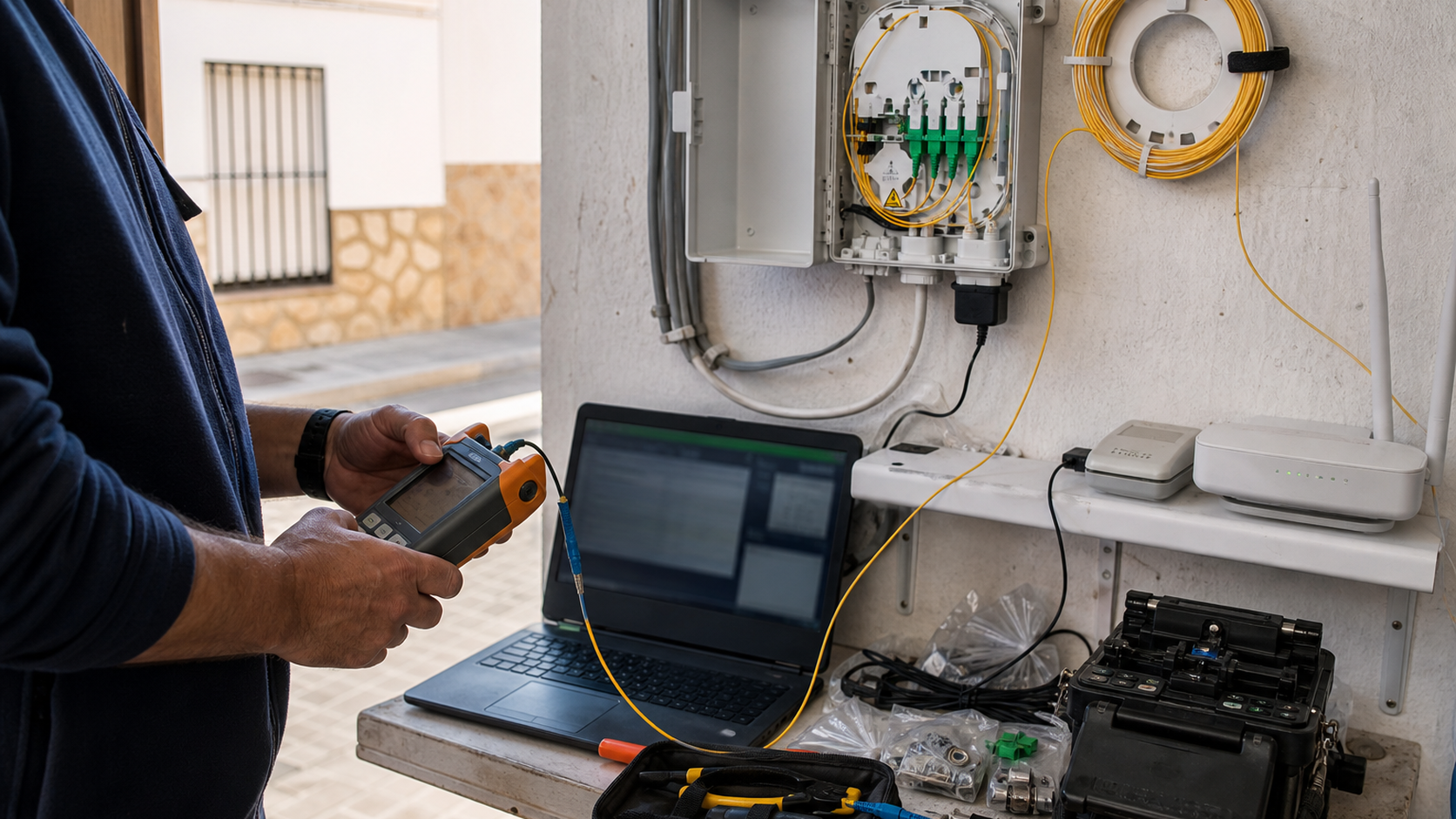
The company's strongest differentiation is physical presence. It also creates the heaviest cost base. A local telecom provider needs technicians, tools, transport, stock, routers, optical components, fibre materials, wall boxes, connectors, splitters, power supplies, replacement devices, ladders, test equipment and customer-service systems. It also needs administrative time for invoices, portability, privacy obligations, telecom compliance, registry maintenance and supplier coordination.
This makes cost recovery more demanding than in a pure software or affiliate model. If an access product fails, the customer may expect a technician. If a router ages, the customer may expect a replacement. If a camera stops recording, the customer may not distinguish the camera, Wi-Fi, power supply and Internet line. If a mobile line has an APN problem, the customer sees INSIDE-PC as the accountable party, even when the underlying network belongs to someone else. The company's own pages reinforce this expectation by offering APN configuration, remote assistance, contact by WhatsApp, a call-back flow and technical support language.
Capital needs are not only network build. Even when a local operator relies partly on third-party infrastructure or upstream routing, it still funds customer-premises equipment and service inventory. The direct-fibre terms' EUR 80 equipment-return penalty acknowledges that installed devices have value. Security and camera services add another pool of deployed assets. Smartphone monthly plans introduce device financing and renewal risk. Hosting and business software introduce infrastructure or vendor obligations. None of these costs appears in a simple fibre tariff headline.
Labour is the central scarce asset. The company can buy routers and cables from suppliers, but it cannot scale local trust instantly. The technician who knows the villages, can explain a fault in plain language, and can decide whether a problem is Wi-Fi, fibre, camera, phone or customer equipment is the company's real differentiator. That labour must be scheduled tightly and sold at a price that recognises its value. If customers get unlimited field support for a low monthly fee, the company is selling insurance without pricing the risk.
The operational challenge is to divide support into tiers without damaging the local promise. Basic fibre customers can receive standard fault handling and remote diagnosis. Higher-value households can buy mesh, security, TV and mobile bundles. Businesses can pay for service continuity, fast response, backup connectivity and device maintenance. The article's core question is answered here: customers can pay enough only if the company persuades them that reliability is a product, not a courtesy.
Supplier dependence is the hidden side of local accountability
INSIDE-PC's local face does not remove supplier dependence. The mobile pages explicitly rely on named national network coverages or partner configurations. The APN instructions refer to Movistar, Orange, Vodafone and Orange Fusion profiles. The route evidence points to INSIDE-PC-named address blocks originated by AS34977, whose overview is associated with PROCONO S.A. Television app services likely rely on platform and content arrangements. Equipment comes from router, camera, alarm and device vendors. Hosting and software products may involve additional infrastructure or application suppliers.
This dependence is not a flaw. It is how many local operators serve small markets. The key question is whether the company can convert dependence into a coherent customer experience. If the mobile network is down, can INSIDE-PC identify the issue quickly and avoid wasting a field visit? If an upstream routing provider has an incident, can the company communicate honestly and provide realistic restoration expectations? If a camera vendor changes cloud terms, can the company protect customers or migrate them? If equipment supply tightens, can the company standardise on models it can support?
Supplier bargaining power also affects margin. National mobile networks, upstream providers, TV platforms, device wholesalers and software suppliers may not give a small local operator the same terms a national brand receives. INSIDE-PC must therefore earn margin through bundling, service and retention, not by winning a pure wholesale cost contest. The company has to make the customer believe that the local relationship is worth more than the cheapest national package.
The Spanish regulatory context makes supplier economics more dynamic. CNMC approved the definitive deregulation of fixed broadband wholesale markets in August 2025, ending Telefónica's obligation to offer NEBA Local and NEBA Fibra under regulated conditions after a transition, while maintaining regulated access to physical infrastructure such as ducts and poles during the review of that market. For small operators, this matters because access economics can move from regulated terms toward commercial bargaining in some layers, while civil-infrastructure access remains a central competitive tool.
Even if INSIDE-PC's exact use of these mechanisms is not public, the market context shapes the cost of expansion and the alternatives available to competitors.
Supplier dependence therefore turns local accountability into a managerial problem. The customer wants one accountable company. INSIDE-PC can provide that interface only if it maintains supplier redundancy, clear escalation routes and pricing that covers the coordination burden.
Customer density decides whether reliability earns its premium
The Guadiato opportunity is real but finite. The company says its fibre reaches 13 localities. The anchor town, Peñarroya-Pueblonuevo, had just over 10,000 inhabitants in the latest INE municipal figures. Some surrounding localities are smaller. That means the economic question cannot be answered by national broadband penetration alone. It depends on local take-up, household size, business density, churn, and how many customers buy more than one product.
Density is not merely population. A cluster of customers in the same village can justify a nearby cabinet, a stock of spares and a predictable support route. A handful of customers spread across several localities can be expensive even if each pays on time. The direct-fibre price ladder suggests the company wants broad adoption, but the support and security products suggest it also needs higher-value accounts. A household buying EUR 15 fibre alone is different from a business buying fibre, fixed voice, mobile lines, Wi-Fi maintenance, cameras and continuity support.
Customer concentration has two sides. If the company depends heavily on a small set of SME customers, it can face revenue volatility if a few leave, close or move to national providers. If it depends mostly on households, it may struggle to monetise high-touch support. The most resilient mix is probably a dense household base that funds local network presence, plus a layer of SMEs that pay for accountability, multi-service support and faster restoration. That mix lets the company treat household products as scale and SME services as margin.
The local demographic trend creates pressure. A town declining from 13,844 inhabitants in 1996 to 10,244 in 2025 offers fewer organic growth customers than a fast-growing suburb. However, the same trend can strengthen the value of a trusted local provider if remaining households and businesses care about service continuity and do not want remote-only support. In a smaller community, reputation compounds. Good response earns referrals; bad response travels quickly.
The density threshold is the fact investors would want most. Public sources do not disclose INSIDE-PC's subscriber count, churn, ARPU, customer acquisition cost, service tickets, route density or SME share. Without those numbers, the judgment must remain conditional. The strategy is coherent if the company has enough multi-product customers in its covered localities. It is less attractive if the base is mostly low-price fibre customers expecting premium service without paying for it.
Competition comes from national bundles and local substitutes
INSIDE-PC does not compete in an empty rural market. Spain's national telecom market is intensely fibre-based and concentrated. CNMC reported that in May 2026 fixed broadband lines reached 19.83 million, FTTH reached 18.1 million, and Movistar, Vodafone and MASORANGE held 80% of fixed broadband lines; including DIGI raised the share to 94.4%. For mobile, CNMC reported 62.96 million lines in May 2026, with Movistar, Vodafone and MASORANGE holding 85.6%, and 98.1% when DIGI is included.
The annual CNMC sector report for 2025 said more than 90% of active fixed broadband lines were fibre and that retail telecom and audiovisual revenue grew 2.2% while wholesale revenue grew 5.6%.
Those numbers create two pressures. First, national operators can sell bundles at scale, advertise heavily and subsidise acquisition. Second, consumers are trained to compare telecom service by monthly price, included gigabytes and promotional discounts. A local provider that sells accountability must make that value visible, otherwise it is dragged into a commodity price table.
The competitive set also includes local and regional alternatives. Search and directory results around Peñarroya-Pueblonuevo surface names such as Avatel in proximity, while the government broadband methodology lists many regional fibre and wireless operators in Spain, including INSIDE-PC and other Andalusian names. The Ministry's 2026 coverage release says Spain reached 95.92% fibre coverage, almost 95% fixed gigabit household coverage and 86.01% rural gigabit coverage, with 5G global coverage at 99.27%.
Even if local service conditions vary street by street, the macro trend is clear: rural connectivity gaps are narrowing, and local operators cannot rely only on being the first available provider.
Substitutes are not limited to fibre. For some households, mobile broadband can be enough. For some SMEs, a national fibre line plus a separate IT contractor can replace a local bundle. For security, national alarm brands and self-install cameras compete. For devices, online retail competes with the local shop. For TV, streaming services compete with operator TV. INSIDE-PC's answer is integration: one provider, one bill or relationship, one local technical team, one accountable interface.
That answer has value when the customer has real operational complexity. A retired household that only wants cheap Internet may not pay much for it. A clinic, accountant, workshop, agricultural business, hospitality venue, municipal supplier or shop may pay because downtime creates measurable losses. The company should therefore avoid treating every buyer as equal. The high-value customer is the one for whom failure is expensive.
Regulation helps demand but raises the standard of proof
Spanish broadband policy supports demand for local connectivity. The Ministry's broadband page states that broadband services are persistent high-capacity data connections often sold with fixed voice, mobile and television; it also says basic 1Mbps broadband has been guaranteed as a universal service since 2012, with Telefónica designated for that function. The same page points to public programmes such as ÚNICO-Banda Ancha and PEBA-NGA to extend broadband infrastructure. The 2026 coverage release highlights rural 5G SA gains and continued fixed-gigabit expansion.
For INSIDE-PC, this policy environment is double-edged. Public programmes and national connectivity goals normalise high-speed service in small places, increasing customer expectations and enabling more digital activity. That helps a local provider sell uptime as a necessity. But it also raises the baseline. If rural customers increasingly have gigabit and 5G alternatives, a local operator must prove service quality, not merely availability.
Regulatory overhead is part of the cost burden. A telecom provider that handles customer data, numbering, portability, APN support, resource records, privacy notices, website forms, contracts and service terms must operate within Spanish and EU legal frameworks. The company's privacy and legal pages refer to GDPR, Spain's data-protection law and information-society obligations. Those obligations are normal, but they are not free. They require documentation, systems, process discipline and incident handling.
Resource governance adds another layer. RIPE membership and number-resource management bring database accuracy and operational responsibilities. Abuse contacts, route objects, organisation records and allocations must be maintained. A small operator that neglects these areas risks operational and reputational harm. Conversely, keeping them current helps counterparties and customers take the operator seriously.
The geopolitical risk is limited but not absent. INSIDE-PC operates in Spain within EU telecom and data-protection rules, so it is not exposed to the same cross-border licensing risk as a provider operating in contested jurisdictions. The main external risks are supplier consolidation, wholesale terms, energy and equipment costs, cybersecurity, rural-demographic weakness and the economics of national competition. Regulation supports the connectivity agenda, but it does not guarantee local margins.
Unofficial signals point to presence, not audited performance
Unofficial market signals are useful only if kept in their place. The company's Facebook and Instagram presence, directory listings, European Youth Card discount listing and Páginas Amarillas profile all reinforce that Inside PC is visible locally as a connectivity, telephony, fibre, television and technology-service brand. AbuseIPDB and IP geolocation pages identify IP addresses associated with Inside-PC Penarroya SL or insidepc.es, but those pages are third-party operational or reputation signals, not official service-quality reports.
Commercial directories provide company classifications, employee or revenue bands and BORME summaries, but much of that information is extractive, paywalled or non-audited.
The market-signal conclusion is modest. INSIDE-PC appears to have genuine local presence, customer-facing service pages, physical contact details, social visibility, technology retail, telecom packaging and resource records. There is no public evidence in the reviewed sources of audited churn, SLA performance, customer satisfaction, fault-repair intervals, net promoter score, exact subscriber base, upstream contracts or profitability. The absence of those facts should not be read as a negative finding; it is simply the normal opacity of a small private operator.
The social signal that matters most is not follower count. It is product specificity. The website contains concrete tariffs, codes, localities, conditions, APN settings and support flows. That specificity is harder to fake than generic marketing language. It suggests an operator that is actively selling and supporting a real product set. The company should still be judged by the quality of its execution, not by the breadth of the catalogue.
For an Elias Ward lens, the unofficial signals say the company has a plausible commercial position, but they do not prove value creation. Value creation would require evidence that customers pay enough, stay long enough and buy enough adjacent services to fund the cost of reliability. A busy local brand can still be low-margin if support is underpriced. A smaller, disciplined base can be more valuable if it pays for continuity.
What would change the judgment
The current judgment is cautiously constructive. INSIDE-PC has a coherent local-operator thesis: a small-region provider with fibre, mobile, TV, security, devices, support and number-resource evidence can sell reliability and local accountability where national scale feels impersonal. The thesis is strongest for customers whose downtime is expensive and whose technical stack is messy enough to make local support valuable. It is weakest for price-only households and for products where the company depends heavily on suppliers but cannot charge for coordination.
Several facts would strengthen the case. The first is subscriber density by locality: homes passed, active fibre lines, take-up rate, churn and average products per customer in the 13 listed coverage areas. The second is SME penetration: how many customers buy business continuity, fixed voice, cameras, alarms, hosting, software or support rather than only low-price access. The third is service evidence: repair times, repeat-fault rates, install backlog, remote-resolution rates and customer satisfaction. The fourth is supplier architecture: upstream redundancy, mobile wholesale structure, TV platform terms and equipment-vendor concentration.
The fifth is financial evidence: gross margin by product, field-labour utilisation, capex per new connection and bad-debt rates.
Several facts would weaken the case. High churn among fibre customers would suggest the local relationship is not sticky. A large share of support time consumed by EUR 15-20 plans would indicate underpriced service obligations. A lack of upstream redundancy would make uptime promises fragile for SMEs. Heavy device-financing exposure without credit controls would add balance-sheet risk. Weak registry maintenance or stale resource records would damage the number-resource credibility.
A competitor's dense build in the same villages, combined with aggressive national bundle pricing, would force INSIDE-PC to prove why local support deserves a premium.
The core question is therefore not whether INSIDE-PC can advertise reliable connectivity. It can. The harder question is whether it can make reliability a paid product. The company must keep saying no to free complexity, charge for custom work, convert support into retention, bundle products that reduce churn, and reserve its highest service promises for customers who value uptime enough to fund the burden. If it does that, local accountability can be more than marketing. It can be the reason customers pay enough for the company to keep the network, the tools and the people ready when failure would cost more.