
What is the Internet Engineering Task Force (IETF)? is tracked as a internet infrastructure institution within the internet infrastructure ecosystem.
What is the Internet Engineering Task Force (IETF)? has public-source relevance to network operations, governance, dependency mapping, or market structure.
What is the Internet Engineering Task Force (IETF)? has public-source relevance to network operations, governance, dependency mapping, or market structure.
What is the Internet Engineering Task Force (IETF)? is tracked as a internet infrastructure institution within the internet infrastructure ecosystem.
Public-source signals support medium-impact monitoring for infrastructure visibility and dependency analysis.
Public-source signals support medium-impact monitoring for infrastructure visibility and dependency analysis.
| 0.90–1.00 | A | High — direct sources |
| 0.75–0.89 | A/B | Strong |
| 0.55–0.74 | B/C | Medium |
| 0.35–0.54 | C/D | Weak–medium |
| 0.10–0.34 | D | Weak signal |
| 0.00–0.09 | D | Internal monitoring |
Several public sources
- Established in 1986, the Internet Engineering Task Force (IETF) is the Internet’s premier Standards development organisation (SDO).
- The IETF wants the Internet to work for communities that share our commitment to openness and fairness.
- When the IETF takes ownership of a protocol or function, it accepts the responsibility for all aspects of the protocol, even though some aspects may rarely or never be seen on the Internet.
OUR TAKE:
Many people compare IETF and W3C together. It can be said that IETF and W3C are the two major standards organizations in the Internet industry. There is no denying that the IETF and W3C are excellent organisations, and they are open standards. The IETF has a broader scope of responsibility than the W3C, defining and managing all aspects of Internet technology degrees.
—-Fei Wang, BTW Reporter Related intelligence: Tim Zuidema trading as TiZu.
Established in 1986, the Internet Engineering Task Force (IETF) is the premier Standards Development Organisation (SDO) for the Internet. The IETF develops voluntary standards that are commonly adopted by Internet users, network operators, and equipment vendors, thus shaping the trajectory of the Internet. However, the IETF cannot control or patrol the Internet in any way.
“The overall goal of the IETF is to make the Internet work better.”
RFC 3935: A Mission Statement for the IETF
“Its mission is to produce high quality, relevant technical and engineering documents that influence the way people design, use, and manage the Internet in such a way as to make the Internet work better. These documents include protocol standards, best current practices, and informational documents of various kinds.” Related intelligence: RIPE NCC and CTU turn Czech IPv6 cooperation into an internet-resilience signal.
As we can see from the statement, the Internet is not value-neutral, and neither is the IETF. The IETF wants the Internet to work for communities that share our commitment to openness and fairness. The concepts promoted by the IETF are rich and include technical concepts such as decentralised control, edge user authorisation, and resource sharing because they resonate with the core values of the IETF community. Interestingly, these “superstructures” seem to have little to do with our “tech world.” Related intelligence: RIPE NCC defends neutrality in Kosovo IP address dispute.
How to be a part of the IETF
The IETF is not a walled treasure, and anyone can participate in organisational meetings if they wish. You can register your account on the website. All IETF participants are considered volunteers and are expected to participate in their personal capacity, including those who pay to participate. In most cases, your participation in the discussion of Internet drafts is free, and you can express your views freely. Apart from attending the IETF conference, the only charge is the registration fee for the conference. However, the IETF also offers options to prevent this cost from becoming a barrier to participation.
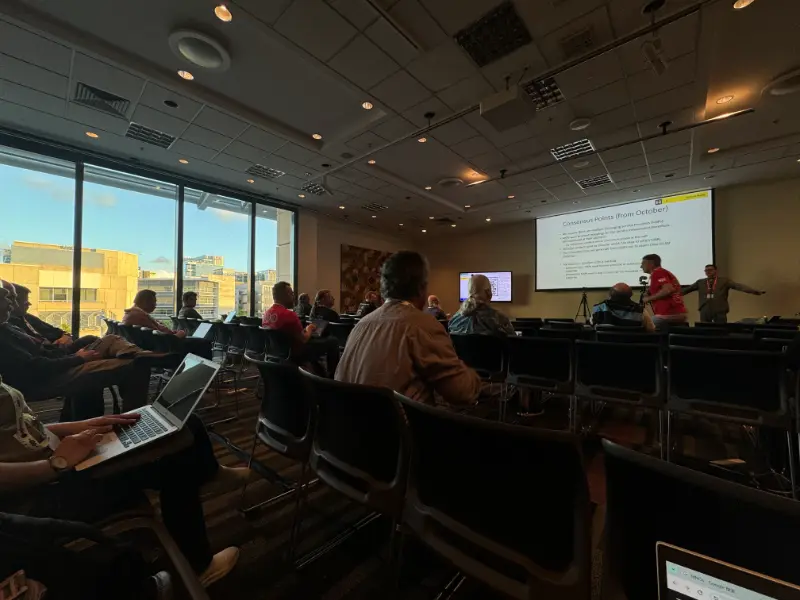
The IETF welcomes individuals and participants from all over the world and from various departments within the Internet industry. In any given year, more than 7,000 people are actively involved in the IETF by writing documentation, participating in mailing list discussions, or attending conferences. Participants are regularly reminded of the policies and processes they should adhere to through Note Well reminders. To ensure that people of different backgrounds are treated with dignity, decency, and respect, these policies include a code of conduct and an anti-harassment policy.
Additionally, the IETF has an ombudsman who handles any conduct issues.
What happens at the IETF meeting
The most notable is the IETF conference, where many new ideas that will help advance the Internet are generated.The IETF holds week-long meetings three times a year, the primary goal of which is to help the working groups accomplish their tasks and to foster discussion across the working groups. The average number of people attending IETF meetings in person is now between 1,000 and 1,500, with hundreds more attending remotely.The conference was held in turn around the world.
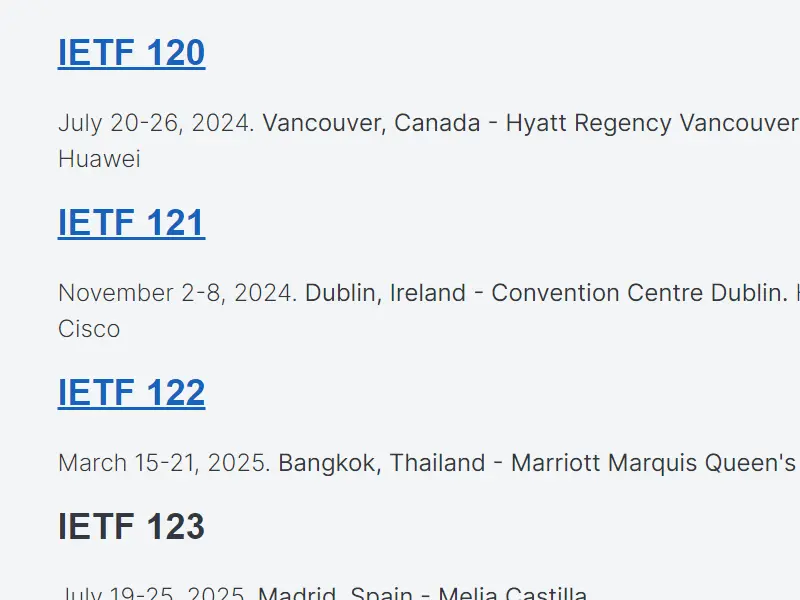
IETF meetings are very different from standard computer industry meetings in that there are no showrooms, no salespeople, and meetings are mostly meetings of existing or proposed working groups discussing their ongoing work. It is important to know that a working group meeting at an IETF meeting is not decision-making, and any consensus reached during the meeting must be submitted to the working group mailing list to see if it is unanimously supported by all working group participants, not just those attending the meeting.
At the same time, it is a newcomer-friendly conference: to help new participants, there are tutorials and webinars, and often several social events open to all participants.
Also read: IETF 119 officially kicks off in Brisbane
All sessions are supported by live remote participation and recordings of the sessions are posted on YouTube shortly after they are recorded. The full record of all IETF meetings (agenda, meeting materials, audio recordings, chat logs, etc.) is archived and permanently available online after the meeting. So you can go to the IETF website to follow the track record, learn from it, and have your say.
Groups in IETF
Internet Engineering Steering Group
The Internet Engineering Steering Group (IESG) is responsible for technical management of IETF activities and the Internet standards process.
Internet Architecture Board
The Internet Architecture Board provides long-range technical direction for Internet standards, ensuring the Internet continues to grow and evolve as a platform for global communication and innovation.
The Internet Architecture Board (IAB) is a committee of the Internet Engineering Task Force. Its responsibilities include: IESG Confirmation, Architectural Oversight, Standards Process Oversight and Appeal, IANA, External Liaison, Advice to ISOC, IRTF Chair
Internet Research Task Force
The Internet Research Task Force (IRTF) focuses on longer term research issues related to the Internet while the parallel organization, IETF focuses on the shorter term issues of engineering and standards making.
Directorates
IETF Directorates, comprised of experienced IETF participants, often serve as advisory groups for IETF work.
Nominating Committee
The Nominating Committee or, as it is typically known, the NomCom, exists to review open IAB, IESG, IETF Trust, and IETF LLC positions and to nominate a candidate for each.
IETF Trust
The IETF Trust was created to acquire, hold, and maintain intellectual property and other property used in connection with Internet standards.
Tools Team
The IETF community works largely online and Tools Team volunteers from the IETF community develop tools to support all aspects of the work of the IETF. The team investigates open source software tools to help IETF participants work together more efficiently.
IETF Systers
The IETF Systers Program offers women and nonbinary IETF participants the opportunity to meet and exchange knowledge and experience with other colleagues from across all areas of the Internet Engineering Task Force and the Internet Research Task Force.
Affiliate Groups
Affiliate Groups (AG) are not official IETF groups, they are a way for IETF participants to self-organize around a shared, non-IETF activity (like hobbies, outside interests, etc).
POP QUIZ
Which IETF subsidiary organization has the goal of promoting science and technology related to the Internet and related technologies?
A. Internet Architecture Board
B. Internet Research Task Force
C. IETF Trust
D. IETF Systers
The correct answer is at the bottom of the article.
How they work on a draft
IETF is dedicated to advancing the development of Internet technology. They do this by developing technical documents (RFCs) that define in detail how Internet technologies operate and ensure that these technologies can be operated and managed at scale.
Work in the IETF typically begins with a discussion document generated by one or more participants, called an Internet-Draft (I-D), and then efforts are made to have that I-D adopted for further work. Anyone can write an Internet draft on any topic they feel is relevant to the IETF. These drafts go through a series of processes and may eventually become RFCs (Request for Comments).
The IETF also has a policy on intellectual property rights (IPR), which aims to ensure that participants have as much information as possible about any intellectual property restrictions on technical proposals during the development process.
Most of the IETF’s work is done in working groups. The Working Group (WG) has its own mailing list, where most interactions and all official work take place. The workgroup’s daily activities revolve around Internet-Drafts, which, over time, the workgroup forms into RFCs. Decisions within the working group, as with the broader IETF, are made by “rough consensus” rather than by vote. When a working group completes an I-D, it goes through a process to ensure that it is approved by the designated technical lead and unanimously supported by the entire IETF.
Once an I-D has overcome all the hurdles to becoming an RFC, it goes through a professional editing process and is then assigned a number and published in a range of formats.
Also read: RIPE NCC General Meeting 2024 scheduled for May 22
The correct answer is C.
Domain of operation
What is the Internet Engineering Task Force (IETF)? is profiled by BTW Media because published evidence links it to internet infrastructure, governance, operational dependencies, or market visibility.
- Public role: What is the Internet Engineering Task Force (IETF)? is framed by what is the internet engineering task force (ietf)? is tracked as a internet infrastructure institution within the internet infrastructure ecosystem. and public governance context. Evidence basis: What is the Internet Engineering Task Force (IETF)? article record; What is the Internet Engineering Task Force (IETF)? article record
- Operating surface: Internet infrastructure institution and Europe and Middle East provide the public context for this institution profile. Evidence basis: What is the Internet Engineering Task Force (IETF)? article record; What is the Internet Engineering Task Force (IETF)? article record
Timeline
- What is the Internet Engineering Task Force (IETF)? public profile updated
Public coverage records What is the Internet Engineering Task Force (IETF)? as a subject for role, operating context, and evidence review.
At A Glance
- Name: What is the Internet Engineering Task Force (IETF)?
- Type: Internet infrastructure institution
- Base: Europe and Middle East
- Profile focus: Institution
What It Does
- Public records support monitoring of its role, services, and key relationships.
Why It Matters
- Public-source signals support medium-impact monitoring for infrastructure visibility and dependency analysis.
- Operational criticality: Medium
- Time horizon: Next quarter
What To Watch
- Monitoring focuses on verified service continuity, governance changes, and relationship signals.
Track verified source updates, role changes, and current public evidence.
Public-source signals support medium-impact monitoring for infrastructure visibility and dependency analysis.
Longer-term relevance depends on verified operating, policy, and relationship changes.
Member Briefing
Deeper Profile Context
Login is required to unlock the full profile briefing and source notes.
Only for Strategy Circle
Strategic Circle Access
Open to all readers. Unlock profile briefings after joining and logging in.
Join Strategic CircleOnly for Leadership Alliance
Leadership Alliance Access
For owners and management of IP-holding companies. Login required to unlock.
Join Leadership AlliancePublic View
The public read of What is the Internet Engineering Task Force (IETF)? is limited to visible role, operating context, and relationship evidence.
Watchpoints
- New public role, affiliation, product, policy, or market disclosures.
- Verified relationship changes involving named organizations or people.
Caveats
- Private or unverified claims are excluded from this public view.
FAQ
Why is What is the Internet Engineering Task Force (IETF)? included?
What is the Internet Engineering Task Force (IETF)? has public evidence that makes the institution relevant to BTW's coverage of digital infrastructure, governance, or markets.
What is public about this profile?
The public layer covers visible role, operating context, linked organizations, and evidence-backed watchpoints.
What should readers watch next?
Readers should watch for source-backed role changes, new partnerships, regulatory exposure, operating expansion, or evidence that changes the public assessment.