
Summary
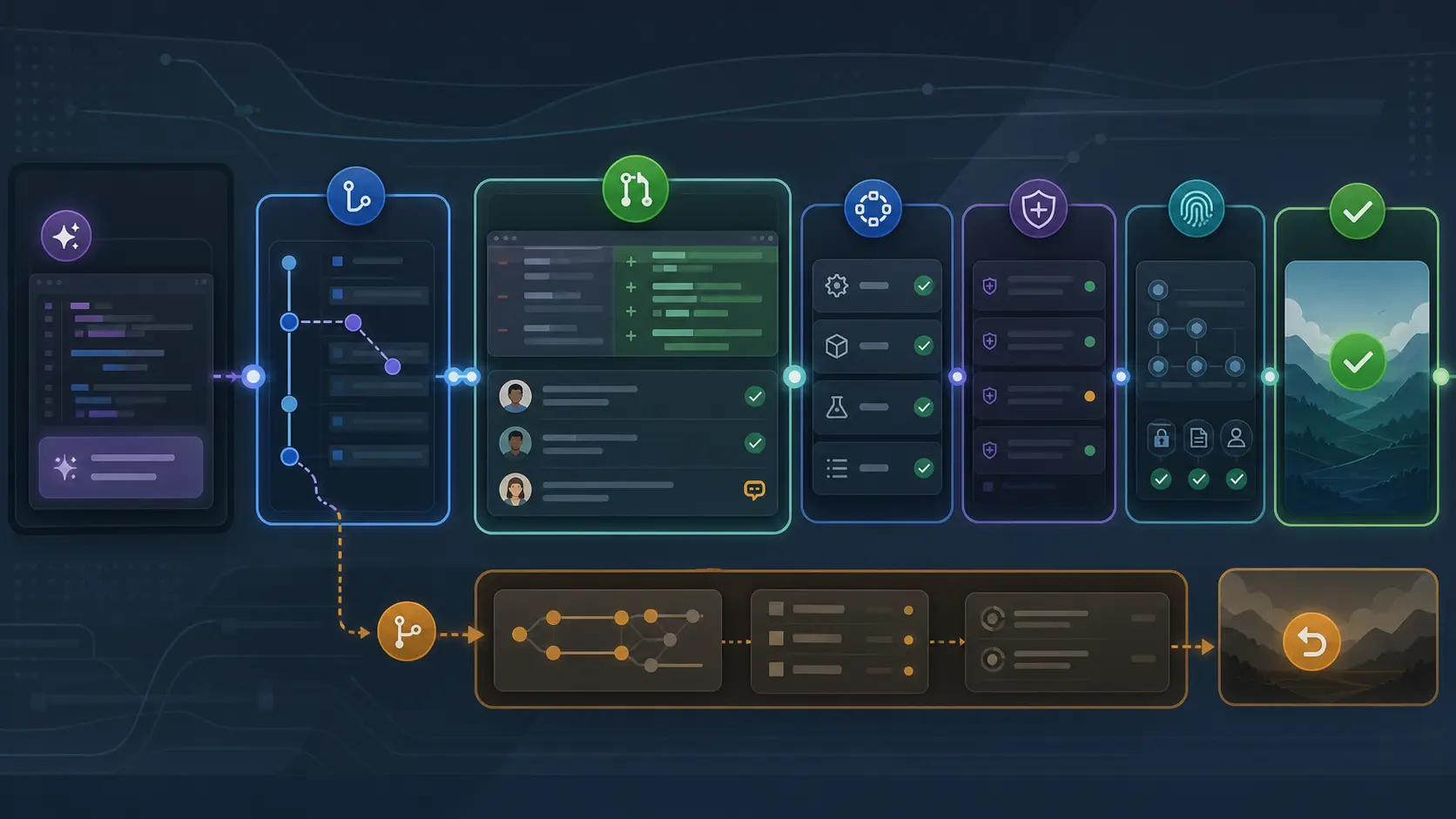
- GitHub, Inc. is best evaluated by the accepted code change: a pull request or release candidate that carries review, CI, dependency and security evidence through to merge or rollback. Copilot speed matters only after that denominator includes human review, required checks, runner cost, alert triage, permission design and recovery.
- GitHub has an unusually strong position because Copilot, pull requests, Actions, merge queues, Advanced Security, audit logs and repository APIs sit in the same software delivery control plane. The same integration also creates lock-in and reliability exposure: when Actions or Copilot review degrades, the cost appears in delayed merges, repeated reviews and interrupted release evidence.
- Buyers should separate model capability from product reliability and from their own production outcome. A faster suggestion or first-pass review is not the same thing as a lower change-failure rate, shorter lead time or cheaper engineering organization. The economic case depends on local measurement and on how much supervision the platform still demands.
The real unit is not a suggestion
The repeated task inside a software organization is smaller and more stubborn than the public AI story suggests. A developer needs a bug fix, dependency update, configuration change or small feature to move from idea to accepted change. The change must be understandable enough for review, tested enough for the team to trust it, safe enough not to leak secrets or introduce a vulnerable dependency, and traceable enough that someone can explain what happened after it ships. For GitHub, Inc., the company behind GitHub.com and GitHub Copilot, that accepted change is the cleanest denominator.
That denominator matters because GitHub is not just selling autocomplete. It operates the repository, pull request, issue, automation, security and audit surfaces where software work is negotiated. A Copilot suggestion in an editor may save keystrokes. A background coding session may prepare a branch. A code-review assistant may produce useful comments. But the business value is still realized only when the pull request becomes something the organization can accept. The accepted output is not "code was generated." It is "this change can be merged or promoted with the evidence we require."
This article centers the existing directory entity GitHub, Inc., not Microsoft's whole cloud and productivity strategy, not individual open-source repositories, and not customer projects that happen to be hosted on GitHub. Microsoft acquired GitHub for $7.5 billion in stock, and Microsoft's 2025 annual report says GitHub Copilot had more than 20 million users. That parent context matters for capital, distribution and enterprise procurement. It does not make every Microsoft AI claim a GitHub production outcome.
The narrower question is sharper: can GitHub preserve code context, permissions, test evidence, dependency risk and review state when AI and automation accelerate ordinary software changes? If the answer is yes, GitHub turns the repository into a more valuable control plane. If the answer is only partially yes, the saved typing time may be paid back through extra review, brittle automation, cloud-runner minutes, policy work, switching cost and recovery labor.
Why GitHub starts from an advantaged place
GitHub's advantage is that the review room, the build room and the archive are already close together. Pull requests know the branch, diff, comments, review state and checks. Actions can run tests and release tasks. Branch protection and rulesets can require approvals or passing checks before merge. Merge queues can retest a change against the current target branch and other queued pull requests. Advanced Security surfaces code scanning, secret scanning and dependency review around the same repository. Enterprise audit logs can record user, organization and repository events for debugging and compliance.
That combination gives GitHub something many AI coding tools must reconstruct from outside: the working memory of a software change. An external coding assistant can read files, write patches and comment on a diff, but it often needs extra integration to know which checks are required, which status source is trusted, which dependency alert blocks a release, which reviewer approval counts, which branch rule applies, and which audit event a regulated customer needs to retain. GitHub can make these surfaces part of the same operating loop because it owns the platform where many teams already make the decision.
The company is pushing Copilot into that loop. GitHub documentation says Copilot can review pull requests and provide suggestions that developers may apply, and that Copilot can also work in the background on a branch, run tests and linters in a GitHub Actions-powered environment, and open a pull request. GitHub's own product engineering blog says Copilot code review grew 10x since initial launch and accounted for more than one in five code reviews on GitHub by March 2026. It also says more than 12,000 organizations ran automatic Copilot code review on every pull request.
Those adoption signals are meaningful, but they are not the whole economic case. A first-pass review is useful only if it reduces the total cost of getting to a trustworthy change. GitHub's code-review docs make the boundary explicit: Copilot leaves a "Comment" review, not an "Approve" review or "Request changes" review, and its review does not count toward required approvals or block merging. That is the right product posture for many teams. It also means the customer is still paying for accountable human approval.
The important shift is therefore not replacement. It is compression and redistribution of work. GitHub can shift some effort from writing boilerplate toward reviewing a diff, from manually checking a lockfile toward reading dependency evidence, from waiting on a failed build without context toward inspecting logs and artifacts, and from scattered compliance work toward audit-log retention. Whether that is cheaper depends on what the team measures.
Three layers that must stay separate
The first layer is model capability. Can the model infer the next line, propose a fix, summarize a diff, identify a missing edge case or turn a clear task description into a coherent patch? Public research gives a reason to take this seriously. A Microsoft Research landing page for a GitHub Copilot study says recruited developers implementing a JavaScript HTTP server completed the task 55.8% faster with Copilot than the control group. GitHub's older survey work also reported benefits around flow, mental effort and satisfaction.
The second layer is product reliability. Can GitHub deliver the assistant, review service, runner, status check, merge queue and security surface when the team needs them? This is where the platform story becomes less simple. GitHub's own availability reports show that Actions, Copilot and code-review services have had material degradations. In December 2025, GitHub reported a Copilot Code Review degradation that caused 46.97% of pull request review requests to fail. In January 2026, GitHub reported a Copilot outage with average 18% and peak 100% error rates across chat features.
In May 2026, an Actions degradation peaked at 42% of Actions runs failing and also affected GitHub Pages and Copilot cloud services.
The third layer is the customer production outcome. Did accepted changes reach users faster? Did change failure fall? Did recovery improve? Did the team spend less time in review, or did it trade writing time for supervision time? Did automated comments catch consequential issues or add noise? Did security triage become easier or merely busier? These are not questions GitHub can answer from a vendor benchmark alone. They require a buyer to compare accepted changes before and after adoption, in the buyer's own repositories, with the buyer's own branch rules, tests, dependency graph, release cadence and review culture.
Keeping the layers separate prevents a common mistake. A coding-speed result does not prove lower total engineering cost. A product feature does not prove reliable service. A customer quote does not prove an audited return on investment. GitHub's opportunity is large because the layers can reinforce each other inside the same platform. GitHub's risk is also large because a failure in one layer can make the others look more expensive.
What an accepted pull request actually costs
The visible cost of a pull request is the time someone spends writing and reviewing code. The hidden cost is the control surface around it. Someone has to scope the work so an AI-assisted change does not sprawl. Someone has to decide which files may be read or changed. Someone has to configure content exclusions, repository permissions, branch protections, rulesets, status-check sources and required reviewers. Someone has to keep Actions workflows fast enough that more generated changes do not simply create a longer CI line.
GitHub's own merge-queue documentation shows why this matters. A merge queue is useful when many pull requests target the same branch because it checks that a queued change still passes required status checks against the latest target and earlier queued changes. But it also requires integration work. If a repository uses Actions for required checks, workflows need the merge_group event. Without it, the required check may not be reported and the merge can fail. The tool reduces one kind of risk by creating a different operational requirement.
Rulesets and required status checks have similar tradeoffs. GitHub documents that required status checks can be strict or loose. Strict checks require the topic branch to be up to date before merging, which can require more builds after other collaborators change the target branch. Loose checks reduce build churn but accept the risk that a status check may fail after merge because of incompatible base-branch changes. The choice is not an abstract policy preference. It is a cost decision about how much CI, latency and merge risk the organization will carry.
Actions adds a second cost meter. GitHub-hosted runners give teams a maintained execution environment, but additional use above quota is billed, and storage for artifacts and caches accrues over time. AI-assisted development can increase the number of candidate changes, review requests and test runs. If accepted output rises with quality intact, that may be good leverage. If generated changes are noisy, the team may pay more for runner minutes, artifact retention and reviewer attention without increasing useful throughput.
Security checks add another denominator. Code scanning can find vulnerabilities and coding errors; secret scanning can scan Git history for hardcoded credentials; dependency review can show dependency changes, release dates, dependent projects and vulnerability data in a pull request. These tools are valuable precisely because generated code can be plausible while still wrong, stale or unsafe. But every alert has to be triaged. A security suggestion that lands in a pull request is still an input to judgment, not a guarantee of safe code.
The cost also includes exception handling. A branch rule can block the background coding service if the rule is incompatible. GitHub's documentation says the service can work on one branch at a time, open exactly one pull request for each assigned task, and has a 59-minute maximum execution time. It also says some repository rules may block it, and content exclusions are not accounted for in that mode. For an enterprise, those details are not footnotes. They define which tasks can be delegated, which repositories require policy exceptions, and which changes still need a human to break the work down.
Code review is where the economics turn
Code review is GitHub's most important test because it is where fluent output meets organizational accountability. A model can produce code that looks consistent with nearby files. A reviewer has to decide whether the code should exist. That decision involves business intent, edge cases, maintainability, security posture, performance, rollback and who will own the result six months later.
GitHub appears to understand that the review denominator is not comment volume. In its March 2026 code-review blog, the company said it evaluates Copilot code review through developer feedback and whether flagged issues are resolved before merge. It also said 71% of reviews surface actionable feedback, while 29% say nothing, and that a more advanced reasoning model improved positive feedback rates by 6% while increasing review latency by 16%. That is a revealing tradeoff. GitHub is not claiming that the fastest review is always the best review. It is saying signal can be worth latency.
For buyers, that framing is more useful than a headline about AI reviewing code. The right question is not how many comments the assistant leaves. It is whether the comments reduce time to accepted change without lowering scrutiny. A good automated first pass can catch missing checks, suspicious dependencies, incomplete error handling, inconsistent tests or confusing logic before a human reviewer spends attention. A bad first pass can generate review theater: comments that look diligent but miss the actual risk, or suggestions that force the developer to explain why no change is needed.
GitHub's product boundary is important here. Because Copilot's review does not count as approval, the organization can use it as a filter without pretending it is accountable. That keeps the human reviewer in the loop, but it also preserves review labor. If the AI first pass catches defects early, the reviewer spends less time on mechanical problems and more time on intent. If it misses context, the reviewer spends extra time checking the AI and the code. The same feature can be leverage in one repository and drag in another.
The risk rises with generated changes. If Copilot or another assistant helps developers open more pull requests, reviewers may face more diffs even if each diff is smaller. If teams respond by lowering review standards, the cost can reappear as incidents, rework, dependency problems or maintainability debt. If teams keep standards steady, they need better batching, clearer ownership and stronger evidence surfaces. GitHub's platform is well placed for that, but it cannot remove the need for judgment.
Actions makes the claim operational
GitHub Actions is the place where a proposed change becomes more than an argument in a pull request. Tests run. Linters fail. Build logs identify a broken step. Artifacts preserve outputs. Checks become merge gates. The same system can produce the evidence a release manager needs to decide whether a candidate is promotable or must be rolled back.
That is why Actions reliability is part of Copilot economics. If AI-assisted development increases the pace of candidate changes, CI becomes the throttle. GitHub documentation says workflow runs expose whether a result is success, failure, canceled or neutral, and that logs and artifacts can be downloaded. The public REST API also exposes workflow-run metadata for public repositories. In a mature engineering organization, those are not conveniences. They are the audit trail behind the accepted change.
Actions can also become the bottleneck. GitHub's May and March 2026 availability reports show Actions degradations with material customer impact. On March 5, 2026, GitHub reported that 95% of workflow runs failed to start within five minutes during an incident, with an average delay of 30 minutes, and that 10% failed with an infrastructure error. On May 15, GitHub reported a peak 42% Actions run failure during a planned failover problem. On May 26, newly queued Actions runs failed to start for a period, affecting Pages, Copilot code review and the Copilot coding service because of their dependency on Actions.
These incidents do not mean Actions is unsuitable. They mean GitHub's accepted-change product is a distributed system, not a magic layer on top of code. When Actions is healthy, it gives AI-assisted work a controlled path to evidence. When Actions is degraded, the cost of automation shows up as blocked checks, delayed review, repeated runs, stale queues and manual coordination. A buyer who counts only model-seat price misses the more important operational exposure.
The practical response is not to avoid GitHub automation. It is to design for degraded states. Teams need to know which checks are truly required, which can be retried, which artifacts must be retained, which releases can proceed with manual evidence, and when to freeze merges. They need workflows that do not create ambiguous check names. They need runner choices that match their workload and security posture. They need logs that a human can use when an automated change fails for an environmental reason rather than a code reason.
That is where GitHub's integrated position can help. The same pull request can hold discussion, check results, security findings, dependency evidence and review comments. The same branch rules can enforce policy. The same API can expose run state. The buyer's job is to ensure the integration does not become a black box.
Security and supply-chain evidence are not optional
AI coding changes the security denominator because it can increase both speed and uncertainty. A human developer may write an insecure change. A model-backed assistant may also write an insecure change, and it may do so with high confidence and familiar style. The important question is not whether AI-generated code is uniquely dangerous. It is whether the platform preserves enough evidence to catch ordinary mistakes at higher throughput.
GitHub's security surfaces are relevant because they attach risk evidence to the place where code changes are accepted. Code scanning can analyze a repository for vulnerabilities and coding errors and show alerts. Dependency review can show dependencies added, removed or updated in a pull request, along with release dates and vulnerability data. Secret scanning can scan Git history for hardcoded credentials and known secret types. GitHub Advanced Security packages these surfaces into Code Security and Secret Protection.
Copilot Autofix adds another layer. GitHub documentation says Autofix can generate suggested fixes for CodeQL alerts, including a code change and natural-language explanation. That can reduce the expertise required to begin remediation, but it does not eliminate the need to check the fix. A vulnerability fix can break behavior, change assumptions or cover only one path. A dependency update can solve a CVE and introduce compatibility risk. A generated regex for secret detection can be too broad or too narrow. The accepted output remains the reviewed, tested and auditable change.
For enterprises, the governance question is also data access. Copilot Business and Enterprise are sold with centralized management and policy control. GitHub documentation says Business and Enterprise customer data is protected under GitHub's Data Protection Agreement and that the individual training opt-out setting is not displayed for those plans. For individual Free, Pro, Pro+ and Max users, GitHub says interactions may be used to train and improve models starting April 24, 2026 unless users opt out. That distinction matters inside companies where employees may use personal tools next to managed accounts.
The buyer's security policy therefore has to cover both code and tool access. Which repositories may use AI assistance? Which users can enable it? Which models or third-party extensions are allowed? Which branches can receive generated commits? Which secrets, dependencies and files are excluded from casual exposure? Which logs prove that the accepted change was reviewed? GitHub can supply many controls, but the customer still has to decide the operating policy.
Measurement should start from delivery, not enthusiasm
The cleanest buyer scorecard starts with accepted changes and works backward. DORA's software delivery metrics are useful here because they frame performance around lead time, deployment frequency, failed deployment recovery time, change fail rate and rework. They are not perfect, and they should not be used to punish individual developers, but they keep the discussion anchored in delivery rather than novelty.
For GitHub adoption, a practical scorecard would compare four periods: before Copilot or expanded automation, early adoption, mature adoption and degraded-service periods. For each period, the team can measure time from first commit to merge, time from merge to deployment, number of review cycles, percentage of pull requests requiring rework, CI minutes per accepted change, flaky-run retries, security alerts introduced or prevented at pull-request time, time spent by reviewers, and recovery time after a bad change. The unit is not "number of AI suggestions accepted." It is "accepted changes with acceptable evidence."
GitHub's Copilot usage metrics API can help enterprises understand usage, but usage is not outcome. A high number of completions, chats, review comments or background sessions may indicate adoption. It may also indicate thrashing. The usage signal needs to be joined with repository outcomes. Did branches close faster? Did review queues shrink? Did comments become more substantive? Did incident review show fewer escaped defects? Did runner costs rise faster than accepted output? Did maintainers of critical repositories feel less interruption or more?
The hardest part is measuring supervision. A developer who accepts a generated change may spend less time typing but more time checking assumptions. A reviewer may spend less time finding obvious mistakes but more time verifying that the AI did not miss a deeper invariant. A platform team may spend more time maintaining rulesets, merge queues and runner capacity. A security team may spend more time tuning alerts. If those costs are not counted, Copilot can look cheaper than it is.
None of this means the tool has weak value. It means the value is operational rather than magical. The strongest case for GitHub is that it can move AI help into the evidence path. A buyer can require the same branch protections, status checks, audit logs and security scans whether a human wrote every line or received assistance. That makes GitHub's platform more defensible than a standalone coding toy. But the buyer must still prove that the accepted-change system improves.
Alternatives set the commercial floor
GitHub does not compete only with manual work. It competes with doing less, with internal automation, with open-source tooling, with cloud-provider assistants, with GitLab, Bitbucket, Sourcegraph-style code search and many smaller code-review products. The realistic alternative depends on where the buyer already keeps repositories, CI, tickets and security evidence.
GitLab Duo can automatically review merge requests, and GitLab documents limits around large merge requests, context windows and AI Gateway timeouts. Amazon Q Developer can review GitHub pull requests and provide code-quality and critical findings when users have the right repository permissions. Atlassian's Bitbucket documentation says its beta AI feature can put assistance inside CI/CD steps, but also states that AI-completed tasks are not a replacement for existing build or test steps and require human verification for release-gate decisions.
These sources show that the category is converging on the same basic truth: AI can assist the change process, but it cannot be the release authority.
GitHub's commercial edge is integration density. If a company already uses GitHub Enterprise, Actions, Advanced Security and Copilot, the marginal value of deeper AI review can be high because the assistant sits next to the review, check and security surfaces. If a company standardizes on GitLab or Bitbucket, GitHub's advantage is weaker. If a regulated company uses self-hosted runners, custom CI, separate security scanners and a heavily customized release system, GitHub may be only one piece of the evidence chain.
Switching cost is therefore both a moat and a buyer risk. A team that builds branch policies, Actions workflows, marketplace integrations, audit-log exports, dependency review policies, security campaigns and Copilot usage reporting around GitHub may become more efficient. It also becomes more exposed to GitHub pricing, availability, product packaging and policy changes.
If Actions minutes rise, plan packaging changes or a required feature moves tier, the buyer's alternative is not simply "turn off Copilot." The alternative may be migrating repositories, retraining developers, rebuilding CI, revalidating compliance evidence and teaching reviewers a new interface.
The right procurement question is not whether GitHub is cheaper than a competitor on seat price. It is whether the total cost per accepted change falls after lock-in, runner spend, review time, security triage, policy maintenance, incident handling and migration risk are included. GitHub can win that test, but only if the customer measures the whole loop.
The reliability watchpoints are visible
GitHub's public reliability disclosures give buyers concrete watchpoints. First, Copilot and Actions are coupled. GitHub's May 2026 incidents show that Actions failures can affect Copilot code review and the asynchronous coding service. That matters because a buyer may think of Copilot as an AI seat product while the product's operational path depends on CI infrastructure.
Second, model-backed services can fail in ways that look different from classic web availability. A model-update configuration error can create elevated chat errors. A model-backed dependency can increase review latency and fail review requests. A reasoning-model change can improve feedback quality while increasing latency. Buyers need to monitor not only whether GitHub.com is up, but whether review latency, completion quality, queue depth and retry rates are acceptable for their own merge process.
Third, evidence paths require retention and export. Enterprise audit logs can support debugging and compliance, and GitHub documents audit-log streaming to external destinations. But streamed logs use at-least-once delivery, so events may be duplicated, and health checks need attention. That is normal distributed-systems behavior, not a scandal. It means compliance evidence has its own maintenance burden.
Fourth, policy exceptions can erode control. If an AI-assisted service cannot operate under a branch rule, teams may be tempted to add bypasses. Some bypasses are reasonable. Too many bypasses turn governance into decoration. The safe approach is to make exceptions explicit, reviewed and measurable. If a repository is too sensitive for broad automation, that should be a policy decision rather than an accidental limitation discovered after a failed session.
Fifth, public-source evidence is thinner than buyer decision-making requires. GitHub publishes docs, incident reports, engineering blogs and customer stories, but it does not publish every customer's change failure rate, review time or ROI. A buyer should treat vendor data as a starting hypothesis and run its own controlled rollout. The acceptance denominator is local.
What GitHub must prove next
GitHub's next proof point is not more impressive code generation in isolation. The stronger proof would show that AI-assisted changes travel through the whole GitHub delivery path with less net friction. That means fewer low-value review comments, faster meaningful reviews, fewer flaky retries per accepted change, lower escaped-defect rates, clearer security remediation, better rollback evidence and stable cost per merge.
The company has already exposed some of the right internal measures. Tracking whether flagged review issues are resolved before merge is better than counting comments. Treating review signal as more important than speed is better than promising instant feedback. Admitting outages and publishing monthly availability reports is better than pretending the platform is always invisible. The commercial question is whether those practices scale as more teams make AI assistance default.
GitHub also needs to keep the legal and brand boundary clear. GitHub, Inc. can benefit from Microsoft's model access, distribution and enterprise reach, but customers buy GitHub to operate a developer platform. They will judge it by repository reliability, review quality, CI cost, security evidence and governance controls. If Copilot becomes a generic Microsoft AI bundle in buyer perception, GitHub risks losing the specific value of being the software delivery control plane.
For open-source maintainers, the stakes are different. Public repositories often face asymmetric review burdens. More AI-assisted contributions can mean more low-quality diffs to inspect. GitHub's product design has to help maintainers preserve scarce attention, not merely increase contribution volume. A first-pass review that catches obvious issues before a maintainer reads a pull request is useful. A tool that makes it easier to submit plausible but context-free changes is harmful. The accepted-change denominator is even more important where reviewer time is donated or thinly staffed.
For enterprise teams, the stakes are budget and accountability. Copilot licenses, Actions minutes, Advanced Security, GitHub Enterprise, audit exports and integration work are all part of the same business case. The platform can be worth more than the sum of its parts if it reduces the effort required to move safe changes. It can be expensive if teams buy every surface and still rely on manual reconciliation outside GitHub.
The commercial answer is conditional
GitHub is tested by the accepted code change because that is where all the competing claims meet. A model can be fluent. A product can be popular. A status page can be green. A customer can feel faster. None of that is enough unless the organization can accept the change with confidence and recover when it is wrong.
The optimistic case is straightforward. GitHub already holds the repository context, review state, CI evidence, dependency view, security alerts and audit trails for many software teams. Copilot can reduce the cost of drafting and first-pass review. Actions can turn changes into measurable build results. Branch protections, rulesets and merge queues can enforce policy. Advanced Security can surface risk before merge. Audit logs and APIs can preserve provenance. If these pieces work together, GitHub becomes a stronger operating surface for software delivery.
The skeptical case is also straightforward. AI assistance may create more code than organizations can responsibly review. Review comments may add noise. CI may become more expensive. Actions or Copilot outages may block accepted changes. Security alerts may increase triage load. Pricing and packaging may shift. Migration away from an integrated GitHub stack may become harder the more deeply teams embed it.
The best answer is conditional measurement. A buyer should not ask whether GitHub Copilot makes developers "more productive" in the abstract. It should ask whether GitHub, Inc.'s combined platform reduces the total cost of an accepted change in its own environment. That cost includes writing, reviewing, testing, security triage, CI, audit evidence, exception handling, rollback, platform maintenance and switching risk.
The same question should be asked by maintainers, not only by enterprise procurement teams. A public repository may not care about seat utilization or pooled AI credits, but it still cares about reviewer attention, contributor trust, reproducible checks and whether a change can be understood after the original author disappears. In that setting, the value of GitHub's AI layer is not how much code it helps strangers submit.
It is whether the platform helps maintainers reject weak changes quickly, improve promising changes without taking ownership of them, and preserve enough context that a later maintainer can understand why a change was accepted. That is still an accepted-output test, just with a different budget line.
If the total cost falls while quality and recovery improve, GitHub's AI expansion is more than a feature cycle. It is a stronger claim on the software delivery control plane. If the cost merely moves from typing to checking, or from individual developers to reviewers and platform teams, the fluent suggestion was never the unit of value. The accepted pull request was.