
Summary
- The confirmed physical defect was an ignition switch whose torque performance could fall below General Motors' specification. Added key-ring weight, road conditions or contact with the key could rotate it out of Run. The engine could shut off and power assistance could be lost; if rotation occurred before crash sensing completed, frontal airbags might not deploy. That mechanism created risk. It does not establish that the switch caused every crash involving a recalled vehicle.
- Control began inside GM. The company owned the vehicle specification, design release, validation, part-number discipline, field analysis, defect-determination process, regulator notice and recall scope even though Delphi manufactured the switch. A design engineer had unusually concentrated component authority, but the larger failure was institutional: independent validation, supplier challenge, traceability and cross-functional escalation did not reliably constrain that authority.
- The timeline is documented through corporate admissions, regulatory records and a board-commissioned investigation. Low torque appeared during development; stalls were reported in production vehicles; the switch was redesigned in 2006 without a new part number; crash and airbag evidence accumulated; and by 2012 some GM personnel understood the safety connection. The formal recall process still did not deliver a filing until February 2014.
- NHTSA was a failed second detection layer, not the primary owner of GM's controls. The agency possessed complaints, crash investigations and a state trooper's analysis but did not connect them into an investigation. The Department of Transportation Inspector General later found weaknesses in complaint screening, data quality, analysis, training and documentation. Those failures do not transfer GM's design and reporting duties to the regulator.
- Later resolutions answer different questions. GM admitted facts in a federal deferred prosecution agreement and forfeited $900 million; NHTSA imposed civil penalties; the SEC settled accounting-control charges without an admission or denial; states settled consumer-protection allegations; civil cases addressed bankruptcy notice and economic loss; and a voluntary compensation facility made offers on eligible claims. None of those records is a judicial finding that fixes one complete causal death or injury total.
- Repair and reform evidence is substantial but bounded. Replacement switches, end-of-line checks, owner notices, historical remedy counts, a reorganized safety function, a speak-up program, federal monitoring and changes at NHTSA show real response. Public records do not establish the current number of unrepaired affected vehicles, reproduce an equivalent weak-signal case under controlled observation, or prove that every information boundary identified in 2014 remains closed.
- Durable accountability requires more than a policy statement. It requires a traceable design baseline, independent approval of safety-relevant deviations, one case record linking field, crash, warranty and litigation evidence, time-limited escalation triggers, documented reasons for not opening a defect investigation, owner-level repair verification and periodic independent testing of whether employees can move ambiguous evidence to people with recall authority.
The recall began after the decisive controls had already failed
General Motors filed the first ignition-switch recall report with the National Highway Traffic Safety Administration on 7 February 2014. The original Part 573 report described a switch whose torque performance might not meet GM's specification. It said added weight on the key ring, road conditions or another jarring event could move the switch out of Run. Engine power, power steering assistance and power braking assistance could be lost. If the switch moved before the crash-sensing algorithm completed its work, the airbags might not deploy.
That filing is the formal start of recall 14V-047, not the beginning of the defect history. Development tests had identified low torque more than a decade earlier. Customers reported stalls. Engineers considered design responses. A revised switch entered production. Fatal crash evidence and airbag nondeployment analysis followed. Litigation later enabled an external comparison of switch components. By the time the formal defect decision arrived, multiple opportunities to contain, identify or escalate the risk had passed.
This distinction defines the accountability problem. Recall timeliness is often measured from the moment a manufacturer decides that a safety-related defect exists. Federal law then requires notification within five working days. But a company can delay the start of that clock if evidence never reaches the people or committee empowered to make the determination. A process can therefore appear formally compliant at its final step while the institution spends months or years keeping the issue below that step.
NHTSA's later consent order closed that escape route for this case: GM admitted that it had not notified the agency within five business days and agreed to the then-maximum $35 million civil penalty.
The visible trigger was a switch rotating from Run. The direct design root was insufficient detent torque in affected switches. Contributing conditions included a low-cost remedy that was not adopted across the population, classification of stalls as a customer-convenience issue, and approval practices that gave one component engineer broad discretion. The detection failure was broader: signals held by engineering, warranty, crash investigators, outside counsel and regulators were not combined. The escalation failure was that work continued outside the normal safety-decision path even after the airbag consequence was understood.
The response challenge then became manufacturing enough replacement parts, identifying the full population, warning owners and proving repair.
Those layers should not be collapsed into one claim about motive. The public record supports findings about decisions, information flows and missed controls. It does not prove what every employee privately believed, or that every delay reflected an intention to conceal a lethal hazard. Institutional accountability does not require that inference. A company can be responsible for a dangerous outcome because its allocation of authority, evidence and deadlines repeatedly prevented an answer that its own records made increasingly necessary.
A small switch created a coupled safety consequence
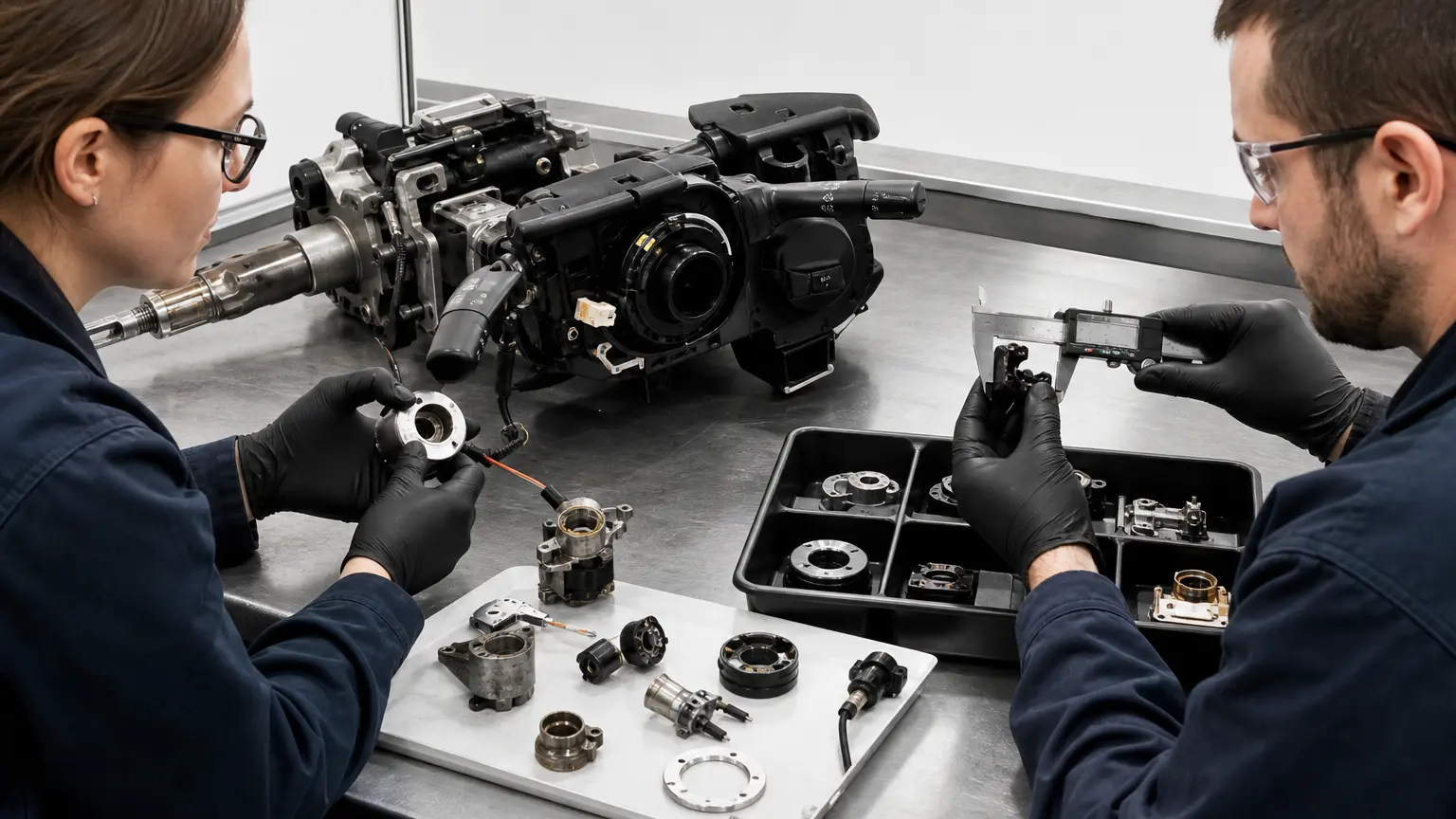
The ignition switch performed more than a convenience function. In the affected vehicles, its detent mechanism was supposed to keep the key in the selected position against ordinary forces. If torque was too low, a heavy key ring, rough road or knee contact could rotate the key from Run toward Accessory or Off. The resulting engine shutdown could remove power assistance. More critically, vehicle electrical state could affect the sensing and deployment path for frontal airbags.
The safety consequence was conditional. Airbag nondeployment depended on the timing of switch movement relative to crash sensing and on the crash being of a type in which deployment otherwise would have occurred. A vehicle stall did not automatically produce a crash. A crash in an affected vehicle did not automatically prove switch rotation. An airbag that did not deploy was not by itself proof of this defect because deployment algorithms consider direction, severity and other inputs.
The case therefore required investigators to combine physical switch evidence, key position, event-data-recorder information, crash geometry, electrical state and vehicle history.
That conditional chain helps explain why early signals were easier to classify narrowly. An owner complaint about a stall could be routed as drivability or customer satisfaction. A crash investigator could observe nondeployment without knowing that the switch had moved. A lawyer could see an expert report in one case without treating it as fleet evidence. A component engineer could focus on detent feel while an airbag engineer focused on sensing data. Each local interpretation could be defensible in isolation while the combined pattern was unsafe.
The condition also made specification control decisive. The question was not whether every switch rotated under every test. It was whether production switches consistently met the approved torque envelope over vehicle life and foreseeable use. GM's own board investigation, described in Anton Valukas's congressional statement, concluded that the original switch was far below GM specifications and that one engineer had approved it. That is stronger evidence than a retrospective claim that the design simply behaved differently from customer expectations.
The mechanism also bounds the counterfactual. A switch that met specification or a key system less susceptible to contact would have reduced inadvertent rotation. It cannot be inferred that every later crash would have been avoided, because drivers, road conditions and crash dynamics still mattered. Conversely, the absence of certainty about each crash did not justify waiting for perfect causal proof before treating recurrent stalls plus airbag nondeployment as a safety signal. Safety governance exists precisely because population action often must precede case-by-case adjudication.
Practical control was distributed, but it was not evenly distributed
Delphi manufactured the ignition switch. That supplier role mattered: it produced components, communicated test results and implemented the later design change. It did not own the whole-vehicle safety case. GM set the performance specification, released the design, integrated the switch with vehicle electrical and restraint systems, controlled the part number, received warranty and field information, decided whether a defect existed, selected recall scope and reported to NHTSA. Supplier accountability is therefore real but subordinate to the vehicle manufacturer's system authority.
Within GM, the design release engineer had direct control over the component drawing, acceptance decisions and proposed fixes. The Valukas investigation portrayed that role as unusually consequential in this history. Yet attributing the case to one engineer would understate the control design. A mature system should not allow one person's approval to make a safety-relevant deviation durable without independent verification, supplier-quality challenge, change control and fleet monitoring. Concentrated authority became hazardous because the surrounding controls did not reliably detect or reverse it.
Product investigation and safety committees controlled later escalation. They could open formal investigations, require cross-functional analysis, present matters to decision bodies and initiate a defect determination. Engineers, field personnel and lawyers controlled pieces of evidence that those committees needed. Warranty systems held repeat-repair and complaint information. Crash investigators held event data. Litigation teams received expert analyses and discovery. Finance personnel controlled recognition of probable recall costs.
The failure was not that no one had any control; it was that no one owned the obligation to aggregate these sources on a clock and explain a decision not to escalate.
Senior leadership and the board controlled governance, resources and accountability after escalation. They could ask whether safety committees received adverse litigation evidence, whether part changes were traceable, whether unresolved cases aged visibly, and whether recall recommendations were independent of cost and reputational concern. They were not expected to inspect every switch. Their responsibility was to make the control system capable of surfacing a switch that local teams had failed to resolve.
NHTSA controlled regulatory investigation, information demands, civil enforcement and oversight of the recall. It did not approve GM's internal component release or see every litigation file in real time. Dealers controlled repair scheduling, parts installation and direct customer contact within the campaign; they did not set the national population or produce the replacement supply. Owners could respond to notices and present vehicles for repair, but they had the least information and could not validate the manufacturer's fleet analysis. Accountability has to follow those boundaries.
The party with the most consequence is not always the party with the most control.
2001 to 2006: low torque was accepted, then the design changed without traceability
The Department of Justice's Statement of Facts, which GM admitted as part of its 2015 deferred prosecution agreement, reconstructs the development period. During preproduction work in 2001 and 2002, engineers observed that a prototype switch could move out of Run. Testing showed torque below the company's minimum specification. The design was nevertheless approved for production. This was not a hidden aging effect discovered only after years in service; the performance gap existed at the approval stage.
Production complaints followed. In 2004, GM personnel encountered a Chevrolet Cobalt that stalled after the driver's knee contacted the key ring. Similar reports appeared in 2005. Engineers considered changing the key head from a slot to a smaller hole, reducing the leverage and movement of the key ring. The DOJ record says the change would have cost less than one dollar per vehicle, but it was not adopted as a population remedy. GM instead issued dealer information and later made an insert available to reduce key-ring movement for complaining customers.
The exact historical cost estimate is less important than the decision structure. A remedy was evaluated against warranty cost and customer inconvenience while the issue was still classified as non-safety. Once that classification was set, each subsequent complaint could be treated as another instance of an already bounded problem. There was no effective rule requiring the classification to be reopened when stalls appeared in real-world driving or when restraint-system consequences became plausible.
In April 2006, the switch design changed. A longer detent plunger and related internal changes increased torque. The House Energy and Commerce Committee's investigative memorandum describes an engineering change form authorizing the redesigned plunger. The work order did not clearly record the torque change, and the revised switch retained the old part number. That conflicted with the accepted practice of assigning a new number when fit, form or function changed.
The missing part number was not clerical trivia. Part numbers are evidence infrastructure. They allow engineers to determine which design is in which vehicle, compare failure rates, isolate production windows, define recall scope and prevent old and new components from being treated as interchangeable. When a safety-relevant internal change shares an identifier with the prior design, databases and investigators lose a reliable join key. The physical object changes while the enterprise record says it did not.
The change appears to have improved torque, but it did not repair the installed population. Nor did it create a clear retrospective investigation into vehicles already carrying the earlier switch. The supported inference is that proper change identification would have made later comparisons faster and recall boundaries clearer. It is not possible to prove that a new number alone would have caused an earlier recall. A traceable identifier creates the opportunity for detection; accountable people and escalation rules still have to use it.
2006 to 2011: crash evidence accumulated without one accountable case
In October 2006, a Chevrolet Cobalt crashed in Wisconsin and its frontal airbags did not deploy. A state trooper's reconstruction, later available to NHTSA and GM, noted that the ignition was in Accessory and identified the switch position as relevant to the nondeployment. NHTSA conducted a special crash investigation. The agency had a concrete event linking ignition state, a frontal crash and restraint performance, but did not open a defect investigation.
GM also investigated airbag nondeployments. By 2007, personnel were examining crashes in which the ignition had moved from Run. By 2009, according to the DOJ facts and Valukas record, the ignition switch was understood as one likely explanation in at least some cases. The challenge was no longer merely whether customers disliked a stall. It was whether electrical state caused by a low-torque switch could disable a principal crash-protection system.
The evidence remained divided by function and case. A crash group might resolve why airbags did not deploy in one vehicle. A switch engineer might know that a revised component had higher torque. Warranty staff might see intermittent stalls. Lawyers might receive claims alleging a product defect. No authoritative case record required those facts to be reconciled against the original specification, the unnumbered design change and the fleet population. Without that common object, each team could close or carry its portion while the enterprise question remained ownerless.
The 2009 bankruptcy added a legal boundary but did not erase the engineering history. The sale of Old GM assets to the new General Motors entity affected which entity could be held liable for particular pre-sale conduct and claims. The DOJ Statement of Facts expressly distinguishes acts before 10 July 2009 and says its admissions do not, by themselves, impute legal responsibility for Old GM conduct to New GM or alter the bankruptcy sale order. A careful analysis therefore separates continuity of technical evidence from allocation of legal liability.
The same vehicles and switches continued to exist even as corporate liabilities were reorganized.
In 2010, Brooke Melton died after her Cobalt lost power and crashed. Her family pursued a product-liability case. The House's first 2014 oversight hearing preserved testimony about the vehicle's service history and the family's investigation. That testimony is important evidence of what outside parties brought to light, but it is not a substitute for a technical finding in every other crash.
By 2011, GM personnel had recognized a pattern involving switch position and airbag nondeployment, and outside counsel had raised potential punitive-damages exposure in litigation. Still, the safety issue did not move cleanly into a formal defect determination. This period shows why litigation evidence needs a defined safety route. Lawyers can protect privilege and defend claims while still ensuring that technical allegations, expert tests and component comparisons reach engineers and safety decision-makers.
Treating those goals as mutually exclusive can make the legal department a repository for risk evidence that the product system never evaluates.
2012 to January 2014: a known safety connection stayed outside the normal recall path
The DOJ admitted that by the spring of 2012 some GM personnel understood both the safety defect and the connection between switch movement and airbag nondeployment. Knowledge had moved beyond an isolated component concern to supervisors and attorneys. Yet the company did not notify NHTSA until February 2014. The twenty-month interval is central because it cannot be explained only by the difficulty of discovering the mechanism.
Work continued, but much of it remained outside the normal safety process. The DOJ record describes an investigation kept "offline" rather than promptly placed before the formal committees that could make a recall decision. Presentations to NHTSA did not disclose the full state of the internal understanding. That matters because activity is not the same as escalation. A company may hold meetings, request parts, consult lawyers and analyze crashes while still preventing the question from reaching the body accountable for a yes-or-no defect determination.
The breakthrough came partly from outside. During the Melton litigation, an expert used X-rays and physical comparison to show that switches carrying the same part number had different internal components. A 29 April 2013 deposition confronted the responsible engineer with that difference. Delphi documentation later confirmed the 2006 change. The official June 2014 House hearing record traces how plaintiff-side discovery resolved a fact that GM's own part-control system had obscured.
This was an external reconstruction of an internal control failure. It did not create the defect. It supplied a missing comparison and forced the organization to reconcile two apparently identical part records. The event demonstrates why litigation, warranty returns and supplier records should be searchable within a common safety case even when legal materials remain access-controlled. A safety team does not need every privileged communication; it needs a mandatory alert when an expert demonstrates an unrecorded physical change in a part implicated in crashes.
GM's formal committees received a field-performance presentation in December 2013. On 31 January 2014, the executive field action decision committee decided to recall certain vehicles. The initial 7 February filing covered a narrower population, including model-year 2005 to 2007 Chevrolet Cobalts and 2007 Pontiac G5s. GM expanded the recall later in February to include additional models and years, and by March described a global population of roughly 2.6 million vehicles.
The sequence raises two separate timing questions. Once the January committee formally decided, filing followed promptly. But the NHTSA consent order established that the legal notification obligation had arisen earlier than GM's filing. More fundamentally, the governance system allowed evidence sufficient for a safety determination to remain below the determining committee. A durable timeliness metric must therefore start before the committee vote.
It should measure age from defined trigger events: a safety-specification failure, a crash allegation involving loss of protection, repeat field incidents, a supplier-confirmed unrecorded design change, or an expert finding that materially changes the causal picture.
Recall scope expanded while owners and dealers waited for parts
The first recall was not the final scope. GM added Saturn Ion, Chevrolet HHR, Pontiac Solstice and Saturn Sky vehicles and extended model years after further review. NHTSA's 4 March 2014 Special Order demanded documents about specifications, modifications, part-number changes, incidents, committee decisions and the effectiveness of the remedy. The order shows that the regulator was testing not only whether a defect existed, but whether GM's population and chronology were complete.
Owners were initially told to remove nonessential items from key rings and use only the ignition key until repair. That interim measure could reduce leverage and accidental contact. It did not make an out-of-spec switch compliant, and it transferred part of the risk response to customers who could not inspect the component. Interim instructions are appropriate when parts are scarce, but they need a clear expiration condition, repeated communication and transport alternatives for owners who cannot safely rely on behavioral mitigation.
Replacement supply was a major constraint. GM and Delphi had to produce switches at scale, distribute them to dealers and ensure that the replacement matched the corrected design. NHTSA's dealer repair bulletin specified replacement of the ignition switch and, where necessary, ignition keys. It also documented end-of-line verification parameters for the new component. This is tangible remediation evidence: a defined part, an installation procedure and production checks.
Parts and procedures do not prove fleet completion. A recall population includes sold, resold, scrapped, exported, stolen and unreachable vehicles. Dealer claims show that a reimbursed repair occurred, but completion rates depend on a reliable denominator and correct vehicle identification. A vehicle can also change hands after notices were mailed. Repair accountability therefore requires VIN-level reconciliation among manufacturer, dealer and registration records while protecting owner data.
NHTSA's public quarterly campaign report for the second quarter of 2016 listed a United States recall population of 2,190,934, 1,571,075 vehicles remedied and 43,613 categorized as unreachable at that reporting point. Those figures are historical. They do not establish the current number still operating without repair, and they should not be combined mechanically with the global 2.6 million figure because the geography and reporting basis differ.
The distinction between campaign launch and risk retirement is essential. A recall can be announced once. Repair requires years of owner identification, parts availability, dealer capacity and follow-up. NHTSA states in its current recall guidance that safety recalls do not expire and directs owners to check by VIN. That continuing right is useful, but public accountability would be stronger if legacy campaigns published current cohort data: unrepaired registered vehicles, recent completion rate, unreachable reasons, geographic concentration and independent sample checks that installed parts match the remedy.
NHTSA was a second detection layer, and it also failed
Manufacturers have earlier and richer access to design, warranty, supplier and litigation evidence. NHTSA provides an independent layer through consumer complaints, early-warning reports, special crash investigations, defect investigations, information orders and penalties. In this case that second layer had relevant evidence but did not aggregate it effectively.
The House committee's staff report on NHTSA failures said the agency had the Wisconsin trooper's report, three special crash investigations and evidence of airbag nondeployment, yet failed to identify the switch defect. The agency considered opening investigations into Cobalt airbag nondeployments but did not proceed. The problem resembled GM's internal fragmentation: records existed in separate systems and were interpreted case by case rather than as a growing control hypothesis.
The Department of Transportation Inspector General's 2015 audit found broader weaknesses in NHTSA's Office of Defects Investigation. Complaint screeners lacked adequate training and supervision; data quality controls were weak; potential defects were not always thoroughly screened; statistical methods were limited; and decisions about investigations were insufficiently documented. The audit made seventeen recommendations. The OIG page now marks them closed, meaning the department accepted responsive action. Closure is evidence of administrative completion, not proof that no similar detection failure can recur.
The regulatory failure does not cancel the manufacturer's failure. NHTSA did not select the switch torque, approve production, omit the part-number change or hold GM's full litigation record. GM also had a legal duty to disclose a known safety defect rather than wait for the regulator to infer it from sparse public data. The two layers are meant to be redundant. When both fail, responsibility is cumulative, not transferable.
NHTSA's enforcement response addressed timing and cooperation. In addition to the $35 million untimely-recall penalty, the agency's civil-penalty summary records $441,000 related to GM's failure to respond fully and on time to the Special Order. The consent order required improved access to safety information, employee reporting mechanisms, enhanced committee procedures, faster regulator communication and additional oversight. Penalties mark a breach; the operational commitments are the more relevant test of whether the information path changed.
Later audits show that regulator reform remained a work in progress. The OIG's 2018 recall oversight report found that NHTSA did not adequately verify manufacturer-reported completion rates and lacked a risk-based process for monitoring recalls. Its 2023 review of defect investigation processes credited restructuring and modernization but found missed timeliness goals, inconsistent documentation and escalation, and the absence of a fully integrated information system. Recommendations on both pages are now shown as closed.
That record supports improvement, while also showing why closed actions should not be treated as a substitute for performance evidence under a new high-consequence case.
The board investigation explained process failure, but it was not a criminal trial
GM's board retained Anton Valukas and Jenner & Block to conduct an internal investigation. Valukas told Congress that the team interviewed more than 230 people, reviewed approximately 41 million documents and had access to relevant company personnel and materials. The resulting report is unusually detailed about decisions, culture and information flow. NHTSA preserves the report through its electronic reading room, alongside timeliness-query and early-warning materials.
The investigation found no single moment when one senior executive received a complete file and rejected a recall. Instead it described a pattern of fragmented responsibility, avoidance of individual ownership, slow committees and the normalization of unresolved issues. The phrase often associated with the report, the "GM nod," described agreement without effective action. Another cultural description, the "GM salute," captured responsibility being pointed elsewhere.
Those labels are memorable, but the accountability value lies in the underlying records: missing change control, failed handoffs, no deadline for a safety answer and no common evidence file.
The report also attributed serious failures to identifiable employees. GM said that fifteen people were no longer employed as a result and five others were disciplined. The company's 2014 Form 10-K disclosed those actions and a set of reforms. Employment action is not a finding of criminal guilt. The Valukas report was commissioned by GM, not produced through adversarial discovery and trial. Its access and scale make it important primary evidence; its institutional origin and legal purpose remain relevant when assessing independence.
Individual accountability is also limited by the allocation of proof in corporate cases. A person may make a poor technical judgment without possessing the knowledge required for fraud. A lawyer may mishandle escalation without intending to conceal a federal offense. A manager may inherit a flawed classification. Conversely, the absence of an individual conviction does not make the control architecture adequate. Corporate systems exist to prevent a single ambiguous mental state from determining whether a hazard reaches the right authority.
The supported institutional inference is stronger than an unsupported motive claim. GM's structure allowed evidence to be localized, delayed and reframed until an external lawsuit resolved the part discrepancy. Cost and liability considerations were present in the record, but public materials do not prove that every actor chose delay to save money. Accountability should focus on observable duties: who received each signal, what they were required to do, whether they did it, who reviewed the exception and how long it remained open.
The federal criminal resolution established admissions, not every contested fact
In September 2015, the United States charged General Motors with concealing a safety defect from NHTSA and with wire fraud. Under the deferred prosecution agreement announced by the Justice Department, GM admitted the detailed Statement of Facts, accepted a three-year agreement, agreed to an independent federal monitor and forfeited $900 million. The charges were to be dismissed if the company met the agreement's terms.
The admissions are powerful because they came from the company in a federal criminal resolution. They establish that GM failed to disclose a known safety defect in a timely manner and made misleading representations about vehicle safety. They also establish the sequence of low-torque approval, failed field responses, unnumbered redesign, delayed safety recognition and incomplete regulator disclosure described in the agreement.
The procedural form still matters. A deferred prosecution agreement is not a jury verdict after a contested trial. It resolves corporate charges under negotiated conditions. It does not adjudicate the guilt of every employee mentioned in underlying records, decide causation for every crash or replace the bankruptcy court's allocation of Old GM and New GM liabilities. The Statement of Facts itself reserves that corporate-history distinction.
The independent monitor's mandate focused on information paths that the defect exposed. The Justice Department's GM case page describes review of safety representations, recall compliance, sharing of engineering analysis developed in litigation, and treatment of known defects in certified pre-owned vehicles. Those topics are not peripheral compliance items. They correspond directly to failure points in the chronology.
Public evidence about a monitorship is inevitably partial. The existence of a monitor, management meetings and completed recommendations shows that a formal assurance layer operated. It does not let outsiders reconstruct every test, exception or disagreement. The most defensible conclusion is that the resolution required targeted remediation and external scrutiny. A stronger claim, that monitoring proved the culture permanently repaired, would need published outcomes showing how an ambiguous new defect moved across the same boundaries under real pressure.
Securities, state and civil resolutions answer narrower questions
The ignition-switch history also reached financial reporting. In 2017, the Securities and Exchange Commission issued an administrative order finding that GM's accounting controls did not ensure that safety information reached the accounting personnel responsible for loss contingencies. According to the order, some personnel understood the safety issue by spring 2012, while accounting staff were not informed until November 2013. GM paid $1 million and settled without admitting or denying the findings.
That order matters because it reveals a second consequence of fragmented escalation. When safety evidence does not reach recall decision-makers, it may also fail to reach financial controllers who must evaluate probable and estimable losses. The same organizational boundary can delay owner protection and distort the timing of financial recognition. The settlement does not prove securities fraud, and its no-admit-or-deny form should be stated. It does show that safety information architecture is part of disclosure control, not solely an engineering concern.
Forty-nine states and the District of Columbia reached a $120 million consumer-protection settlement with GM in 2017. The California attorney general's official announcement describes requirements concerning safety representations and the sale of recalled vehicles, including repair obligations for vehicles designated as certified pre-owned. These were negotiated remedies to allegations, not trial findings assigning causation in individual crashes.
Bankruptcy litigation addressed another boundary. In 2016, the Second Circuit held in In re Motors Liquidation Company that known or knowable ignition-switch claimants had not received constitutionally adequate notice before the 2009 sale order was applied against them. The court concluded that Old GM knew or should have known about a defect and that direct mailed notice was required for certain claimants. It did not decide the merits or value of every underlying product claim.
Economic-loss class actions later ended in a settlement receiving final approval in December 2020. The federal approval order covered multiple recall classes, releases and payments from New GM and the GUC Trust. It also contained no-admission provisions. A settlement can deliver compensation and finality while leaving contested liability unresolved. It should not be converted into a finding that every class vehicle suffered the same defect, diminution or causal history.
The case therefore has several accountability records, each with its own standard. NHTSA addressed recall timing and cooperation. DOJ addressed corporate criminal conduct. The SEC addressed accounting controls. States addressed consumer protection. Bankruptcy courts addressed notice and sale-order effects. Civil settlements allocated money and releases. Combining all dollar amounts into a single "cost of the switch" would be misleading because periods, claim types, entities and broader recall charges overlap.
Harm cannot be reduced to one unqualified death count
The human consequences were severe. Families lost relatives; occupants suffered catastrophic and less severe injuries; owners faced uncertainty and loss of use; dealers handled parts shortages and repeated contact; employees worked under public and legal scrutiny; and investors absorbed recall, litigation and compliance costs. Accountability requires measurable impact, but a headline number must preserve how it was produced.
GM created the Ignition Switch Compensation Claims Resolution Facility, administered by Kenneth Feinberg, to evaluate death and physical-injury claims. The facility's final report says it reviewed 4,343 claims and found 399 eligible, comprising 124 death claims, 18 Category One injury claims and 257 Category Two injury claims. It reported aggregate offers of $594,535,752.
Those are confirmed program outcomes. They are not equivalent to adjudicated causal findings. The facility's published methodology allowed a streamlined eligibility process and did not conduct the same exhaustive scientific and engineering causation analysis that contested litigation might require. Claimants who accepted offers released claims. The program excluded pure economic loss and was designed as a voluntary alternative to litigation. Its eligible death count is therefore neither a universal minimum nor a scientifically final total of deaths caused by the switch.
Other sources used different filters. GM's early recall filings listed incidents known to the company at the time. Litigation records included alleged injuries and economic loss. Regulators described crashes associated with affected vehicles. Media counts often changed as claims were submitted and reviewed. These datasets should not be merged without deduplicating people, vehicles, legal status, causal standard and reporting date.
Counterfactual harm is even harder. For a crash with a nondeploying airbag, one would need to estimate whether deployment would have occurred absent switch movement and whether it would have changed death or injury outcome. Restraints reduce risk; they do not guarantee survival. For a stalled vehicle, one would need to separate loss of assistance from driver response and road conditions. The defensible statement is that the defect created a foreseeable pathway to loss of control and loss of airbag protection, and that the compensation program recognized hundreds of eligible claims under its rules.
Exact claims about lives that certainly would have been saved exceed the public evidence.
Financial impact also needs boundaries. GM's filings recorded billions of dollars in 2014 recall and courtesy-transportation charges, but that year included many campaigns beyond the ignition switch. The company's 2015 Form 10-K separately disclosed the $900 million federal resolution, ignition-related legal charges and civil-settlement provisions. These are accounting categories, not a clean social-cost estimate. They exclude some family harm, consumer time and regulator resources while including legal and program costs that may overlap with broader recall activity.
Repair evidence exists, but the final denominator is not public
The strongest remediation evidence is physical. GM replaced the affected switches and keys, specified corrected components, increased manufacturing capacity and introduced multiple end-of-line tests. Dealer claim records created a transaction trail for completed repairs. Owner letters and VIN lookup made the campaign actionable. The quarterly report shows that more than 1.5 million vehicles in the reported United States population had been remedied by mid-2016.
The evidence remains incomplete in three ways. First, the public quarterly file is a historical snapshot. It does not identify how many unrepaired vehicles remain registered and operable in 2026. Second, an aggregate completion count does not show whether remaining vehicles are concentrated among hard-to-reach owners, rural areas, low-income households, used-car channels or jurisdictions with weaker registration matching. Third, dealer reimbursement data verifies an installation claim, not necessarily the long-term field performance of each part.
An accountable closure record would preserve the denominator by cohort. For each model year and region it would show the original eligible population, exclusions with reasons, repairs by quarter, vehicles newly identified through title changes, returned mail, scrappage, exports and current unresolved VINs. Independent sampling could compare claimed repairs against installed part identifiers and test torque performance. Privacy constraints would limit publication of owner-level data, but they do not prevent audited aggregate evidence.
The campaign also illustrates why owner warning must be treated as a control, not a mailing task. A letter needs to state the hazard plainly, distinguish interim behavior from the permanent fix, explain transport or loaner options, survive ownership transfer and be repeated until repair or verified disposal. Communication effectiveness should be measured by completed repairs and comprehension sampling, not the number of envelopes sent.
Used-vehicle channels create a continuing risk. A recalled car can be sold several times, and buyers may not know its campaign status. The federal monitor and state settlement both addressed known open recalls in certified pre-owned sales. A more durable rule would prevent any manufacturer-backed certification of a vehicle with an open safety recall and require visible disclosure before other dealer sales, while preserving free repair for subsequent owners.
Because safety recalls do not expire, an owner can still obtain the remedy. That is a meaningful protection. The unknown is not whether the campaign legally remains open; it is whether every affected vehicle still capable of carrying occupants has either been repaired or removed from service. Public campaign closure should require evidence about that residual population rather than allowing declining annual repair volume to fade from view.
GM changed governance, but self-reported reform is not durability proof
GM reported substantial changes after 2014. Its Form 10-K said it created a Global Vehicle Safety organization led by a vice president reporting directly to the chief executive, added more than one hundred safety investigators and specialists in North America, restructured the safety decision process and introduced the Speak Up for Safety program. It also described additional product-integrity resources and more direct escalation.
These changes address identifiable weaknesses. More investigators can reduce backlog. A senior safety leader can give issues access to executive authority. A protected reporting channel can bypass a stalled hierarchy. A reorganized committee can reduce the distance between technical evidence and a defect determination. End-of-line switch checks address the original production-control failure. The DOJ monitor and NHTSA consent order added outside review and enforceable obligations.
The source and measurement limits matter. Much of the public account comes from GM's own securities filings. Headcount demonstrates capacity, not judgment quality. A speak-up channel demonstrates availability, not whether employees trust it or whether substantiated reports produce timely action. A committee redesign demonstrates a changed chart, not whether ambiguous evidence receives an owner and deadline. Terminations demonstrate consequences, not a system that would prevent recurrence.
Durability evidence should test the route, not only the policy. An independent reviewer could introduce or sample real cases containing weak but converging evidence: a specification deviation, intermittent field failures, a crash allegation, a supplier inconsistency and litigation analysis. The test would ask whether systems create one case identifier, whether required functions join, whether uncertainty is labeled, whether deadlines escalate automatically, whether dissent is retained and whether the final decision cites the evidence considered.
Outcome measures should also be published in bounded form. Useful measures include median and tail age of safety investigations, number of cases escalated because of litigation or warranty correlation, overdue decisions, reopened classifications, supplier changes lacking new identifiers, substantiated employee reports, time from probable safety connection to NHTSA notice, and repair completion by cohort. Raw counts need denominators and trend explanations so that an increase in reporting is not misread as deterioration when it may show greater trust.
The right conclusion is that GM implemented reforms targeted at known failure points and operated under external obligations. The public record does not support the stronger conclusion that escalation risk has been permanently eliminated. Institutional controls remain accountable only when their performance can be observed over time and when failures or near misses cause the design to change again.
Regulatory reform improved tools while preserving familiar risks
NHTSA also changed after the case. OIG recommendation closure, revised investigation procedures, expanded data work and later modernization efforts are evidence of response. Congress and the agency examined early-warning reporting, special crash investigations and manufacturer timeliness. NHTSA's 2023 report to Congress on Early Warning Reporting improvements describes proposed data, technology and analytical changes intended to improve defect identification.
Early-warning data are useful only if definitions, quality and analytical thresholds are reliable. Manufacturer reports can show deaths, injuries, warranty claims and field reports, but coding differences and incomplete narratives can hide a cross-system pattern. Automated screening can rank anomalies, yet models will reproduce weak source data and may miss a rare failure with severe consequences. Human investigators still need authority to connect complaint language, crash records, component history and external litigation evidence.
Documentation is a safety control. If an agency considers and declines an investigation, the record should state the hypothesis, data reviewed, uncertainty, comparison group and condition that would reopen the question. That allows later reviewers to distinguish a reasonable decision on limited evidence from an issue that disappeared between offices. It also lets new evidence update an earlier judgment instead of beginning from zero.
Escalation clocks are equally important. A complaint queue can meet average processing targets while a small set of high-severity cases ages. The OIG's later findings on timeliness and inconsistent escalation show that organizational improvements did not automatically solve case flow. Risk-weighted measures should expose the oldest unresolved cases involving loss of propulsion, loss of restraint protection or multiple deaths, even if the statistical count is small.
Regulatory transparency has limits because investigations contain confidential business and personal information. NHTSA can still publish aggregate reasons, milestone dates and closure logic. It can state when a manufacturer first disclosed a theory, when the agency obtained critical evidence, what independent tests were performed and why scope changed. The ignition-switch case shows that oversight loses force when the regulator must reconstruct a manufacturer's chronology only after public crisis.
The regulator's durable role is independent challenge. It should never depend on a company having already aggregated its evidence correctly. At the same time, no amount of agency modernization can replace manufacturer traceability and timely reporting. Redundancy means both layers should be capable of finding the hazard, not that each can assume the other will do so.
Confirmed facts, supported inferences and unknowns must remain separate
Several facts are confirmed across corporate admissions and official records. Affected switches could perform below GM's torque specification. The design changed in 2006 without a new part number. GM received stall and crash information over years. The switch-airbag connection was understood by some personnel by spring 2012. The company did not begin the recall until February 2014 and admitted untimely notification. NHTSA had relevant crash evidence but did not open an effective investigation. Replacement parts were produced and millions of vehicles were called back.
Federal, state and civil resolutions imposed money, monitoring, process obligations or compensation.
The supported inference is that no single technical mystery explains the delay. The physical mechanism was conditional, but the institution repeatedly weakened its ability to see it: a below-spec approval, narrow classification, incomplete design-change record, separated crash and legal evidence, offline investigation and delayed committee access. The same pattern appeared at NHTSA, where data and investigations remained insufficiently connected. This inference follows from documented control gaps without requiring an allegation that all participants shared a concealment plan.
Another supported inference is that correct part numbering would have materially improved traceability. It would have exposed two component populations and enabled more reliable field comparison. It cannot be said with confidence that numbering alone would have produced an earlier recall. Organizations can ignore well-labeled evidence too. Traceability is necessary infrastructure, not an automatic decision.
Important facts remain unknown or unresolved in public records. There is no complete, adjudicated count of deaths and injuries caused by switch movement. The current number of affected vehicles still operating without repair is not established by the cited historical campaign report. Public sources do not reveal every monitor test or every post-reform safety case. They do not establish the private knowledge or motive of every individual. They cannot show which specific crashes would have had different outcomes if airbags had deployed.
Some counterfactuals are plausible but not provable. Meeting the original torque specification likely would have reduced accidental rotation. Adopting the key-head redesign or replacing early switches could have reduced exposure. A new part number probably would have accelerated technical comparison. A NHTSA investigation after the Wisconsin crash might have forced testing and disclosure sooner. A mandatory litigation-to-safety referral in 2012 could have moved the issue to the recall committee. Each intervention removes a documented barrier, but none guarantees the timing or outcome of every later event.
Uncertainty should change the strength of a claim, not suspend action. A manufacturer need not know the final injury total before correcting a component that fails its safety specification and can disable airbag protection. A regulator need not prove every crash before opening an investigation. The decision threshold for protective action is appropriately lower than the evidentiary threshold for assigning legal causation or individual criminal guilt.
A durable accountability model starts before the recall clock
The first control should be a traceable safety baseline. Every safety-relevant component needs an approved specification, named owner, independent validator, supplier signoff and versioned identifier. A deviation should record who accepted it, the evidence, duration and compensating controls. Any change affecting fit, form, function, material or performance should create a new revision that remains linked to vehicle identification and supplier lots.
The second control should be one enterprise safety case. Warranty claims, customer complaints, field reports, event-data analyses, supplier deviations, engineering investigations, lawsuits and outside expert findings should attach to a common hazard hypothesis when they share component, symptom or consequence. Access can remain role-based, but the system must reveal that relevant evidence exists. A legal privilege boundary should protect advice, not prevent a safety alert stating the technical allegation and required review.
The third control should be explicit escalation logic. Defined events should start a clock: failure to meet a safety specification, a crash involving loss of protective systems, repeated unexplained stalls, an unrecorded part change, a supplier contradiction or a credible external test. The owner should either escalate, document a reasoned closure or request a short, visible extension. Aging should reach independent safety leadership automatically. Cost should be separated from the initial safety determination.
The fourth control should preserve decision quality. Committee records need the evidence considered, dissent, unknowns, affected population, legal deadline and conditions that would change scope. An incomplete root cause should not prevent interim warning or a staged recall when a credible hazard and bounded population are known. Conversely, a broad recall decision should explain the inclusion logic so that expansion is not mistaken for arbitrary reaction.
The fifth control should treat regulator notice as an information flow, not a ceremonial filing. NHTSA should receive material chronology, competing theories, unrecorded part changes, crash evidence and scope uncertainty as they evolve. Special Orders should not be required to extract the history that the manufacturer already used. Regulators should maintain their own integrated case and document reasons for opening, declining or expanding an investigation.
The sixth control should keep the case open through repair. Owner notice, parts capacity, dealer installation, title changes, scrappage and residual vehicles belong to the same accountability chain. Closure should require independently testable repair counts and evidence that the corrected part performs as specified. A falling repair rate should trigger targeted outreach rather than administrative quiet.
Finally, boards and regulators need recurring assurance. They should sample near misses, not only major recalls, and publish enough aggregated evidence to show whether weak signals crossed boundaries on time. The ignition-switch case is not adequately answered by saying that a defective part was replaced. It is answered when the system can demonstrate that no engineer, lawyer, supplier, committee or regulator can again hold a critical fragment for years without a visible owner, a running clock and an auditable decision.
The accountability finding
General Motors had practical control over the decisive early safeguards: torque specification, production approval, component traceability, field aggregation and formal defect escalation. It did not exercise those controls adequately. A switch was approved below specification, a meaningful redesign was hidden by an unchanged part number, and evidence of stalls, crashes and airbag nondeployment remained fragmented. By the time outside litigation helped expose the physical difference, the organization had spent years treating connected evidence as separate problems.
NHTSA independently failed to turn available crash and complaint information into a timely investigation. That failure increased the duration of public exposure, but it did not relieve GM of its earlier knowledge, richer data or statutory reporting duty. Dealers and owners carried the operational burden of repair without controlling design or scope. Courts, prosecutors, regulators and compensation administrators later imposed different forms of accountability, none of which supplies one universal causal ledger.
The response produced real evidence: corrected parts, repair procedures, historical completion data, penalties, admitted facts, monitoring and reorganized safety functions. The remaining evidence gap concerns durability and final risk retirement. Public records do not show the present unrepaired population or provide a repeatable independent test proving that a similarly ambiguous hazard would now move rapidly from local evidence to recall authority.
The lasting lesson is procedural and measurable. Safety accountability begins when evidence first challenges a specification, not when a committee finally votes. It continues through version control, cross-functional case ownership, regulator notice, owner communication and verified repair. A company that can show those links under uncertainty has more than a recall program. It has a control system capable of learning before scattered warnings become a retrospective timeline of preventable delay.