
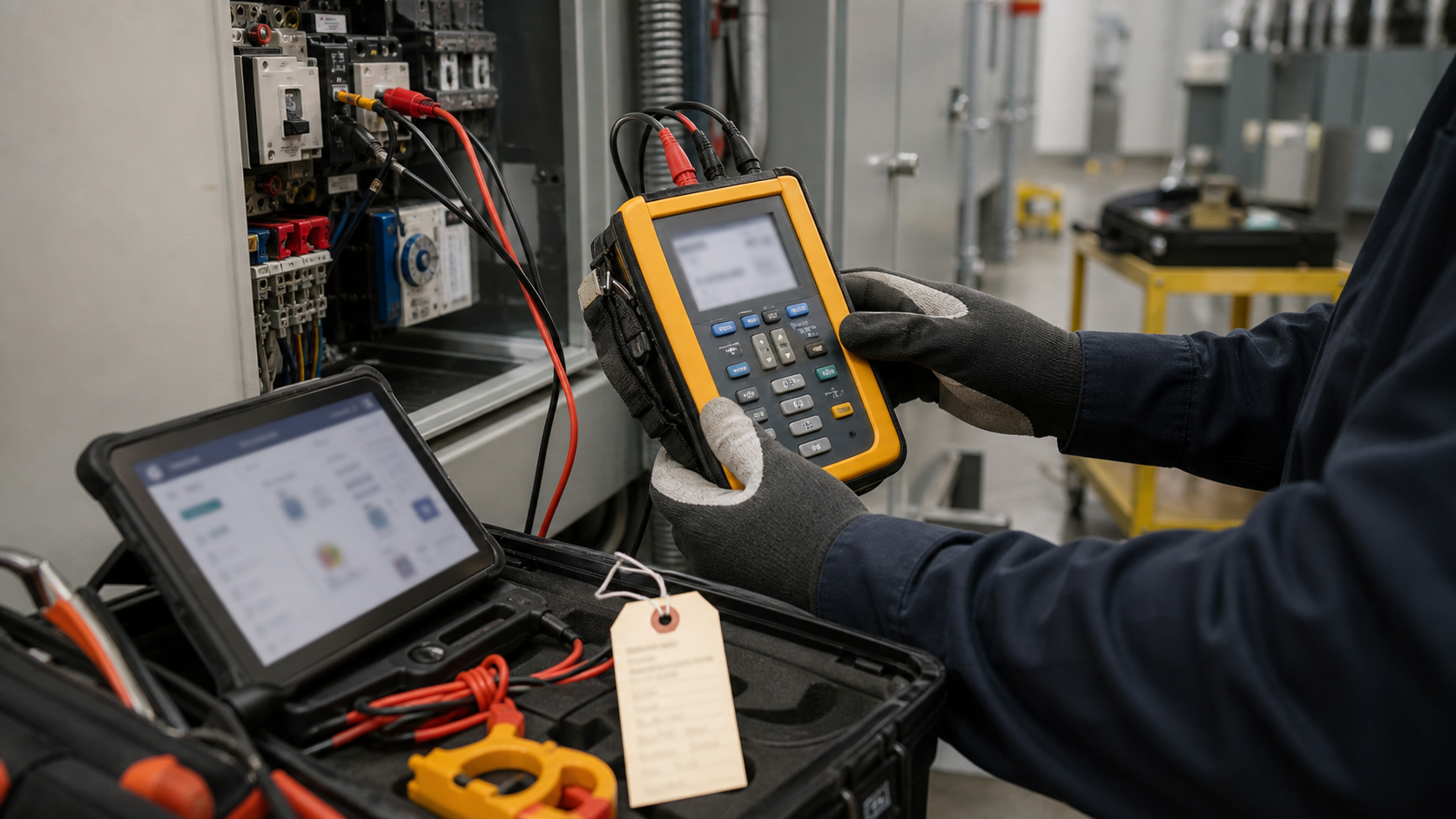
Summary
- Fluke Electronics is not priced only as yellow plastic, probes and a screen. It is priced as a measurement assurance system: safety-rated instruments, calibration traceability, repair access, warranty rules, software records and a trusted distribution boundary.
- The most durable part of Fluke's account is the technician's need to defend a reading in environments where a bad measurement can create downtime, failed audits, damaged equipment or electrical injury. That is why calibration labs, service centers and authorized channels matter as much as the meter.
- The risk to watch is not a single cheap competitor. It is the combined pressure from lower-cost testers, grey-market listings, counterfeit accessories, stretched maintenance budgets and software dependence. Fluke keeps its premium if customers keep seeing lifecycle proof, not just brand familiarity.
Public reference links
This profile draws on public company, service, standards and market materials that show how Fluke presents the business around instruments, calibration, repair, authorized distribution, software records and maintenance reliability. Key public references include https://www.fluke.com/en-us https://www.fluke.com/en-us/support/calibration-services https://www.fluke.com/en-us/support/repair https://www.fluke.com/en-us/support/service-center-locations https://www.fluke.com/en-us/support/customer-services/quality-and-accreditations https://www.fluke.com/en-us/support/warranties https://www.fluke.com/en-us/where-to-buy https://www.fluke.com/en-us/where-to-buy/counterfeit-awareness https://www.fluke.com/en-us/where-to-buy/grey-market https://www.fluke.com/en-us/products/fluke-software/connect https://www.fluke.com/en-us/products/fluke-software/emaint-cmms https://fortive.com/companies https://fortive.com/work https://pressroom.fluke.com/fluke-survey-finds-predictive-maintenance-adoption-doubles-as-manufacturers-boost-digital-investment/ https://pressroom.fluke.com/ai-boom-exposes-data-centre-confidence-crisis-fluke--research-warns/ https://www.iso.org/standard/66912.html
The fault is never only electrical
The purchase case for Fluke becomes visible when the fault is inconvenient. A conveyor line stops before a shift change. A variable-speed drive reports an intermittent warning. A data center power path is being commissioned under time pressure. An HVAC contractor is standing in front of a panel where a wrong voltage assumption could become a safety incident. In each case the technician reaches for an instrument and asks a simple question: can this reading be trusted enough to act on now?
That question is why Fluke Electronics, known publicly through Fluke Corporation, remains more than an instrument brand. The company sells compact professional electronic test tools, software for measurement and condition monitoring, and calibration capabilities used by technicians, electricians, maintenance managers, engineers and metrologists. Fortive's current business directory lists Fluke among its operating companies and describes it as an industry-leading test and measurement business within Intelligent Operating Solutions.
Fortive's own site also says its companies focus on safer, more efficient operations, real-time data, analytics and lower downtime across mission-critical physical assets. That group context matters because it places Fluke in the market for operational confidence, not only in the market for handheld meters.
The difference sounds abstract until a reading is challenged. A plant can buy a low-cost meter for a toolbox. It can also buy a higher-priced instrument that arrives with safety category markings, documented specifications, a calibration path, repair options, warranty terms and a recognized brand that auditors, supervisors and other technicians accept without a long explanation. The second purchase is a risk transfer. The customer is buying less argument around the reading.
Fluke's product spread reinforces that position. The public catalog covers digital multimeters, basic electrical testers, clamp meters, power quality instruments, earth ground and installation testers, battery analyzers, insulation testers, portable oscilloscopes, thermal cameras, acoustic imagers, thermometers, network cable testers, process calibrators, electrical standards, temperature and pressure calibration tools, condition monitoring systems and software. That range gives Fluke a way into routine field service, plant reliability, lab calibration and connected maintenance.
It also gives procurement teams a reason to standardize around a familiar tool family rather than assemble a drawer of unrelated devices.
The commercial unit is therefore not a meter by itself. It is a bundle of equipment, confidence, repeat buying and proof. The strongest customer may own older Fluke units, new wireless instruments, calibration standards, thermal cameras, network testers and software records in the same maintenance estate. The account expands when the technician's reading is converted into a service ticket, a trend line, an asset history or a calibration certificate. It contracts when the buyer decides that a cheaper device can produce enough confidence for the task, or that a software system from another vendor owns the maintenance record.
For small and midsize industrial customers, the stakes are practical. They may not have a large metrology staff, a spare instrument pool or a specialist reliability team. A broken meter can delay a service visit. A missed calibration date can disrupt an audit. A counterfeit lead set can make a cheap purchase expensive. A disconnected reading can leave a fault unresolved because the next technician cannot see what happened last time. Fluke's advantage is strongest when those customers believe the company reduces that hidden burden.
Why the premium starts before the first measurement
Fluke has long benefited from a reputation among professional users that its instruments survive field conditions and produce readings people accept. Reputation alone is not a moat, but in test and measurement it lowers friction. A maintenance supervisor who sees a Fluke meter on a job is less likely to ask whether the tool is appropriate. A technician who has used one for years is less likely to hesitate under pressure. A purchasing team may still compare prices, but the premium can be defended when the cost of an incorrect diagnosis is higher than the price gap between meters.
The low-cost substitute pressure is real. Consumer and trade review markets routinely place Fluke beside much cheaper devices. A home-improvement review can call a Fluke 117 a professional-quality choice while also recommending budget multimeters for basic work. That comparison is not a threat in the same way across every use case. A homeowner checking a battery or outlet has a different risk profile from an electrician opening an industrial panel, a commissioning engineer signing off a data center installation or a calibration lab maintaining traceable standards. But the comparison does reveal the boundary Fluke must defend.
Customers will not pay a professional premium if the job is ordinary, the risk is low and proof is not needed.
The premium begins with design intent. Industrial test tools are used near transient voltages, energized systems, variable drives, distribution panels, motors, control circuits and harsh work sites. Safety categories, insulation, test leads, fuses and clear markings are not decoration. They are part of the reason a technician can use the tool where the available fault energy is high. Fluke's own grey-market guidance emphasizes that electrical safety depends on tools performing to a high standard and warns that authorized purchases preserve the safety standard and warranty boundary.
Its counterfeit guidance is even more direct: fake test leads and clips can use poor materials, fail early, generate intermittent readings, overheat, or increase shock and arc-flash risk. The company also warns that dissimilar metals in knock-off leads can create errors in low-voltage or low-resistance measurements.
That warning is commercially vital because accessories are often treated as simple add-ons. In the field, probes and leads are part of the measurement chain. A trusted meter with a weak lead set can still produce a bad or dangerous outcome. Fluke's brand therefore has to defend the whole contact path between the circuit and the record, not only the main instrument.
The same logic applies to durability. Fluke's warranty page frames its industrial products around a limited lifetime policy, with lifetime defined as seven years after manufacturing stops and with at least ten years from purchase for covered industrial products made after October 1996. The exclusions are also telling: misuse, contamination, abnormal operation, fuses, batteries and normal wear are outside the promise. In other words, the warranty is not magic protection against every field problem. It is a confidence signal around workmanship, support and long-lived product expectations.
That matters in installed-base economics. A maintenance team that keeps instruments for a decade is not buying only new features. It is buying continuity: compatible habits, known menus, available manuals, service paths and a common tool vocabulary. The technician who has used one Fluke device can often move faster on another. A supervisor can standardize training. A procurement manager can replace a lost or damaged unit without re-teaching a crew. Those advantages are hard to price on a purchase order, but they show up when a fault must be cleared before production restarts.
The result is a premium that is strongest in tasks where three things coincide: the electrical environment is unforgiving, the customer needs an auditable or defensible reading, and the tool will be used often enough that downtime and service support matter. Where those conditions are absent, the premium is more exposed.
Calibration is the after-sale product
The assignment's central thesis is clearest in calibration. A meter can be accurate when it leaves the factory and still become commercially weak if the owner cannot prove its condition later. Production, laboratory and maintenance environments often need traceable calibration records, not merely a technician's belief that a tool seems right. Fluke's own calibration services page describes measuring instruments as the "heartbeat" of a company because they check and measure production processes, control quality and affect profitability.
The page ties regular traceable calibration to ISO 9001 expectations, consistent output, lower operating cost and access to international markets.
That is the heart of Fluke's lifecycle economics. The first sale places an instrument in the field. The calibration schedule keeps the instrument eligible for controlled work. The service certificate turns the instrument into acceptable evidence. The customer is not only renewing an instrument; it is renewing permission to rely on that instrument.
ISO/IEC 17025 helps explain why this proof is valuable. The current ISO page describes the standard as the international framework for the competence, impartiality and consistent operation of testing and calibration laboratories. It is used by accreditation bodies to assess labs. For a customer, the practical implication is that calibration work is not all the same. A stamped sticker without credible traceability may be enough for casual use, but not for environments where compliance, customer audits or safety cases matter.
Fluke has a direct incentive to keep that ladder visible. Its quality and accreditation pages list ISO 9001 certificates for North American sites and other locations, including Everett service locations and Fluke Park. Its service-center page lists North American service locations, including Fluke Corporation customer support services in Everett, Washington, Fluke Calibration in American Fork, Utah, and Fluke Park Laboratory in Everett. Those addresses are more than logistics. They are anchors for the promise that a product can return to a known support system.
The warranty page adds another layer. Fluke says extended warranty services can include routine calibration, repair, upgrades and other support, and that extended warranty repair can include recalibration, performance testing, a service report and a certificate. A customer buying such a plan is paying to reduce the surprise around instrument downtime. It is also converting a maintenance task into a budgetable line item. For a small plant or contractor, that can be more valuable than a modest discount on the purchase price.
Calibration also disciplines the product line. A company that sells into metrology and industrial reliability cannot easily compete only on visual branding. It must maintain specification credibility, service documentation, calibration procedures and support channels. A public paper comparing the Fluke 8588A digital multimeter with the Keysight 3458A for sampling performance illustrates that Fluke appears not only in contractor tool conversations but also in serious metrology discussions. That does not make every Fluke product a lab instrument, and the paper should not be stretched beyond its technical focus.
It does show that the brand's reach includes high-end measurement environments where performance details matter.
The after-sale product is therefore a repeated trust renewal. If Fluke's calibration turnaround becomes slow, if certificates are hard to retrieve, if local support weakens, or if customers cannot justify service-plan cost, the moat narrows. If the service path remains predictable, Fluke's installed base becomes harder for rivals to dislodge. A cheaper meter must then compete not only with a device but with the certificate, the known service route and the technician's confidence that a reading will survive review.
A calibration deadline prices the tool differently
A purchase order often treats meters as equipment. A calibration deadline treats them as permissions. The difference is subtle but decisive. When a quality manager asks whether a tool is still within its calibration interval, the question is not whether the technician likes the device. It is whether the company can use the reading in a controlled process, a customer audit, a safety review or a maintenance decision that might be questioned later. At that moment the asset is not the plastic shell. The asset is the combination of specification, certificate, date, procedure and confidence in the organization that performed the work.
That is why Fluke's service language matters even when it reads like routine support copy. It tells the customer that calibration eligibility can be checked, a quote requested, a service order submitted and repair or calibration routed through a defined account process. It also tells the customer that repair plans can include performance testing and a certificate. The commercial value is predictability. A plant manager can budget for annual calibration. A contractor can schedule downtime around a tool's service window. A lab can keep a record that links an instrument to a traceable service event.
None of that makes the first purchase cheaper, but it can make the total risk of ownership easier to explain.
The deadline also changes the competitive set. A low-cost tester may be perfectly useful for rough diagnostics, training benches or noncritical checks. It becomes less attractive when the customer needs a documented calibration path, service continuity and a record accepted by another party. In that setting, the cheapest device can create downstream work: finding a capable lab, confirming the scope, tracking certificates, managing failures and explaining deviations. Fluke's opportunity is to collapse that work into a brand-backed route.
This is especially visible in mixed fleets. Many organizations own old instruments, new instruments, specialty calibrators, thermal cameras and borrowed or rented devices. The maintenance office may have a spreadsheet of due dates, a cabinet of stickers, a few missing probes and a recurring argument about which tool should be used for which job. A supplier that can help impose order on that fleet has more value than a supplier that only ships a new box. The more instruments that share a service route and documentation style, the less time the customer spends reconciling exceptions.
There is also a behavioral effect. Technicians often develop a hierarchy of trust among tools. One meter is used for quick checks. Another is used when the reading will drive a shutdown decision. A calibrated instrument may be reserved for acceptance work. A power quality analyzer may be borrowed only when the fault is hard to reproduce. Fluke's brand works when it owns the top of that hierarchy: the tool people reach for when the consequence of being wrong is high.
The risk is complacency. If a brand assumes that trust is permanent, cheaper or more nimble rivals can occupy the lower tiers and slowly move upward. A plant might begin by buying a low-cost backup. The backup might prove acceptable for routine checks. A distributor might bundle it with other supplies. A service contractor might equip apprentices with it. Over time, the premium tool remains only for the most formal tasks. That may still be profitable, but it narrows the account. Fluke has to keep showing that its tools reduce everyday friction, not just formal audit risk.
Calibration is one way to do that because it touches both formal and practical needs. A calibration certificate is formal proof. A fast return is practical relief. A clear service report is both. If Fluke can make that experience easy, it reminds customers why the premium is attached to a system. If the experience is slow, opaque or hard to schedule, it teaches customers to separate the tool from the service promise. Once those are separated, the next hardware purchase becomes easier to contest.
Local support labor is part of the meter
Industrial buyers do not experience service in the abstract. They experience it as an RMA number, a shipping label, a phone call, a loaner decision, a missed job, a calibration due date, a repair estimate and the skill of the technician who keeps instruments in service. Fluke's repair page says its customer support services provide repair services and replacement parts through certified service centers worldwide and tells customers to get a Return Material Authorization before sending an instrument in. The service-center page says an RMA is required and asks customers to contact Fluke before shipping equipment to avoid delays.
That procedural language can feel ordinary, but it points to a real commercial asset. A maintenance organisation wants less uncertainty around the tools that diagnose uncertainty. If an instrument fails in a region where support is slow, the brand suffers even if the product was good. If the repair channel is clear, the brand's premium can be defended because the customer is not stranded.
This is where local support labor becomes a product feature. A global industrial group can list a wide product catalog, but the account is won locally when distributors, service centers, technicians and support desks solve small problems. Fluke's where-to-buy page provides purchasing routes in the United States and contact points for technical support, repairs and distributor questions. Its counterfeit and grey-market pages direct customers toward authorized distributors or direct Fluke purchases.
The message is consistent: the purchase channel determines whether the customer receives not just hardware but warranty, support, training and confidence in authenticity.
Authorized distribution is especially vital in test equipment because the buyer may not discover a problem at purchase. A grey-market product may be genuine but outside normal support rights. A counterfeit accessory may pass a quick visual inspection but fail under electrical or mechanical stress. A discounted listing may be attractive until it lacks the service path needed for a calibration deadline. Fluke's warning that grey-market sellers may lack aftersales support and product training is not only a brand-protection claim; it reflects a structural problem in industrial procurement.
The cheapest visible price can hide a missing service obligation.
The service labor story also affects small businesses. A small electrical contractor or regional manufacturer may not have redundant tools in every category. A single thermal camera, power quality analyzer or calibrator can be a shared resource. If that device is away for calibration or repair, the team may rent, borrow, delay work or fall back to a less capable instrument. Fluke's support plans, service reports and calibration certificates help reduce that operational drag, but they also create dependence on Fluke's own ability to deliver.
This dependence is not necessarily negative. Many industrial accounts prefer a single accountable supplier for tools, calibration and support. The risk is that the customer pays a premium and still feels exposed when capacity is tight, when parts are unavailable, or when support queues grow. That is why turnaround time, certificate accessibility and service communication may matter as much as new product features.
For Fluke, the installed base is valuable only if the installed base feels looked after. A long warranty promise, a known service center, authorized distributor coverage and repair documentation are all ways to keep the buyer from viewing the next purchase as a fresh open competition. When support slips, every replacement cycle becomes a chance for a lower-cost brand, a distributor private label or a rental option to enter the account.
Software moves the reading from a screen to an asset history
Fluke's software and connected reliability products shift the account from isolated measurements to recorded maintenance evidence. Fluke Connect is the clearest bridge. The product page says the software can capture measurements, photos and notes in the field, sync data to the cloud, share information in CSV, JPEG or text formats, and aggregate data from more than 100 compatible Fluke tools and sensors. It also says teams can take measurements from more than 20 meters away, set up traceable asset histories and view data from anywhere at any time.
Later on the same page, Fluke describes secure cloud backup and offline access as part of the value.
That changes what a meter does in the customer's operation. A reading on a screen is perishable. A reading attached to an asset history can be compared, shared, reviewed and used to decide which work should happen next. That is useful for small teams because it reduces knowledge loss between technicians. It is useful for managers because it links field observations to maintenance planning. It is useful for compliance and reliability work because the same reading can be tied to a date, asset and follow-up decision.
It also introduces cloud service dependency. A customer using connected tools is relying on the software experience, account access, mobile and desktop support, data export, security posture and service continuity. The more valuable the historical record becomes, the more costly it is to lose access or move it. Fluke can deepen customer retention through software, but it also accepts responsibility for a different kind of trust. The instrument must be safe and accurate; the data system must be available, understandable and portable enough that the customer does not feel trapped.
eMaint extends the same logic into maintenance management. Fluke presents eMaint as CMMS and Enterprise Asset Management software from Fluke Reliability. The product page says maintenance and reliability teams, from single-plant industrial facilities to global Fortune 500 companies, use it to plan, track and streamline maintenance programs. It says eMaint has more than 150,000 users worldwide and covers asset management, work orders, preventive maintenance, audit trails, e-signatures, condition monitoring, smartphone field use and integrations with systems such as ERP, SCADA, PLC and building management systems.
It also describes a cloud-based ecosystem of hardware and software.
In account terms, eMaint can pull Fluke closer to the operating nerve center. A meter identifies a condition. A sensor monitors a trend. A CMMS creates or tracks work. A manager sees whether the work was completed. A connected reliability account can therefore be larger and stickier than a tool purchase. It also competes in a more crowded software market where customers compare implementation help, integrations, subscription cost, reporting, mobile usability and data ownership.
Fluke's current press releases show why the company is pushing here. A May 2026 survey released by Fluke reported that predictive maintenance adoption among surveyed manufacturing respondents doubled from 9 percent to 18 percent over a year, while 72 percent of organizations allocated 16 to 30 percent of maintenance budgets to new technologies. The same release said skills-related issues represented most reported obstacles. Another 2026 release said eMaint launched a first global partner network to help customers with implementation, adoption, local expertise and asset reliability.
A separate Maintec release highlighted AI-assisted eMaint capabilities such as natural language access to maintenance data, automated procedure generation from technical documentation and voice-enabled work order creation.
Those claims are Fluke's own, so they should be treated as company positioning rather than independent market proof. Still, they reveal the direction of travel: Fluke wants the account to include connected tools, maintenance software, partner services and practical help for labor-constrained teams. The judgement question is whether customers see that bundle as an efficiency gain or as another subscription layer around work they already struggle to staff.
The distributor boundary protects price and legitimacy
Distribution is a quiet control surface in Fluke's business. The brand can only defend premium pricing if customers believe the product is genuine, covered and supported. That belief depends on authorized distributors, direct sales and clear warnings against grey-market or counterfeit purchases.
Fluke's where-to-buy page tells customers where they can purchase Fluke tools in the United States and provides contacts for technical support, repairs and distributor questions. The counterfeit page tells buyers to purchase only from authorized distributors or directly from Fluke.com. The grey-market page warns that tools, parts or accessories sold outside authorized channels may be genuine but may lack aftersales support, product training or original manufacturer warranty coverage. In electrical work, that boundary is not merely commercial. It affects whether the customer can rely on the safety and service promise attached to the tool.
This matters because industrial distribution has changed. Buyers can compare online listings, marketplace sellers, distributor stock, used equipment, refurbished tools and offshore alternatives in minutes. A field technician might ask for Fluke because of trust. A procurement system might surface a cheaper seller. A finance team might challenge the premium if it sees only a part number and price. Fluke's channel strategy has to make the authorized path feel worth the difference.
The company has several levers. First, it can keep distributor coverage broad enough that customers do not have to choose between authenticity and availability. Second, it can make warranty, calibration and repair rights visibly easier through authorized channels. Third, it can educate buyers that a cheap accessory can undermine both safety and measurement integrity. Fourth, it can keep direct support responsive so the customer does not feel abandoned after paying the premium.
Channel strength is also a defense against low-cost substitutes. A cheap meter sold through a trusted local distributor can be more threatening than an unknown online listing because it enters the customer's normal buying process. Conversely, a Fluke product available through established distributors and backed by service can be easier to approve even when it costs more. The buyer is not only comparing features; the buyer is comparing the support burden.
The market signal from review guides is useful here. When a consumer-oriented guide names a Fluke device as a professional-quality pick and places it next to a very low-cost basic multimeter, it demonstrates how wide the price ladder is. It also shows that Fluke's challenge is not to prove that every buyer needs a premium instrument. The challenge is to keep professional users clear about when the premium matters. The stronger the distinction between basic checks and safety-critical, audit-sensitive work, the easier it is for Fluke to defend margins.
Counterfeit pressure sharpens that distinction. If a fake test lead produces intermittent readings or unsafe insulation, the resulting failure can damage trust in the visual brand even if Fluke did not make the item. That is why brand policing, education and authorized-channel clarity are part of the product. A test tool company cannot assume customers will understand the difference between genuine, grey-market and counterfeit devices without repeated reminders.
The best commercial outcome for Fluke is a buyer who thinks of authorized channel, warranty, calibration, service center and tool performance as one package. The worst outcome is a buyer who thinks a meter is a commodity and treats the rest as unnecessary sales language. Fluke's public material is designed to keep the first interpretation alive.
The substitute is usually a budget meeting, not one rival
It is tempting to describe Fluke's competition as a list of rival instrument makers. That misses the way industrial substitution actually happens. A maintenance manager may not replace Fluke with one new brand across the entire tool room. The manager may approve a cheaper clamp meter for apprentices, rent a specialty analyzer instead of buying one, use a distributor's available alternative during a stockout, delay replacing an old instrument, or buy a lower-cost backup for noncritical checks. The share loss can arrive as small decisions that do not look strategic at the time.
This is why maintenance budgets are central to the thesis. In a tight year, a plant does not ask only which meter is best. It asks which risks must be funded now. A failed production line, a compliance deadline, an insurance recommendation, a customer audit or a safety incident can protect spending on trusted measurement. Routine replacement, spare capacity and convenience purchases are easier to defer. Fluke benefits when its product is tied to the first group and is exposed when customers push it into the second.
The review market shows how easy the low end is to rationalize. A low-priced tester can be described as good enough for basic household diagnostics. That does not make it appropriate for industrial panels, but it creates a mental anchor. Once procurement sees a basic meter for a tiny fraction of a professional tool's price, the burden shifts to the requester. The technician has to explain why the job requires a safety rating, True RMS accuracy, rugged probes, calibration records, software compatibility or a support plan.
Fluke's public education helps that explanation, but the explanation still has to happen repeatedly inside customer organizations.
Rental and service outsourcing create a different form of substitution. A customer may decide that it does not need to own every high-end instrument. It can rent a power quality analyzer for a short investigation, outsource a periodic test, or call a specialist contractor for commissioning. That does not remove Fluke from the market; rental fleets and contractors may use Fluke equipment. But it changes who makes the purchase decision. Fluke then has to convince fleet owners, distributors and service firms, not only end customers. The trusted brand can help, but price, durability, utilization and repair cost become even more visible.
Distributor availability is another pressure point. When a maintenance crew needs a tool immediately, the available product may win. If Fluke is in stock through the customer's normal distributor, the premium is easier to approve. If the authorized route is slow and an alternative is on the shelf, urgency can override standardization. The best channel strategy therefore protects both legitimacy and speed. Authenticity without availability is frustrating. Availability without authenticity is risky. Fluke's public channel guidance addresses the first half; distributor execution determines the second.
Software can also substitute for hardware in a more indirect way. If a CMMS, building management system or industrial platform becomes the place where maintenance decisions are made, the hardware reading is only one input. A software vendor that owns the asset record can recommend sensors, handheld tools and service providers. Fluke's eMaint and connected reliability push is a response to that risk. It keeps Fluke closer to the decision layer rather than leaving the company as a tool vendor feeding someone else's record.
The most dangerous substitute is not necessarily cheaper. It is a simpler total experience. If another supplier makes procurement, calibration, data capture, fleet management and support easier, customers may tolerate a similar or even higher price. Fluke's brand gives it a strong starting point, but the service journey has to remain coherent. The company sells trust, and trust is experienced in many small administrative moments after the sale.
Maintenance budgets are moving toward proof, but labor is tight
Fluke's opportunity sits inside a broader maintenance budget shift. Industrial customers are under pressure to reduce unplanned downtime, document compliance, improve energy performance, keep aging assets working and make fewer skilled technicians cover more equipment. In that environment, better measurement tools and connected maintenance systems can look like sensible investment. They can also look like extra cost if the customer lacks labor to use them well.
Fluke's 2026 manufacturing survey speaks directly to that tension. The company reported that predictive maintenance adoption doubled among the surveyed group, that organizations were allocating meaningful maintenance budget shares to new technologies, and that skills shortages, knowledge gaps and lack of expertise were major obstacles. The takeaway is not simply "more software." It is that tools must reduce the burden on technicians rather than add a new administrative layer.
That is why Fluke's value proposition is strongest when it connects measurement to action. A thermal image that identifies a failing connection is useful. A trended record that shows temperature worsening across inspections is more useful. A work order created from that finding, with the asset history attached, is stronger still. Calibration records, service certificates and audit trails all fit the same pattern: measurement becomes operational evidence.
Data center work illustrates the stakes. A 2026 Fluke data center survey reported that only 22 percent of surveyed professionals fully trusted that test and measurement data reflected real-world operating conditions, and that confidence fell further during peak load or failure conditions. The same release said half of respondents experienced unplanned outages or major disruptions at least annually, and that many saw legacy tools as increasing downtime and compliance risk. Those are company-released survey results and should be read as market signals, not neutral census data.
Even so, they match a visible industry problem: infrastructure growth is making measurement confidence more valuable.
For SMEs, the proof burden can be just as severe even if the assets are smaller. A regional food plant, machine shop, facilities contractor or electrical service company may not run hyperscale infrastructure, but it still faces downtime, safety incidents, customer audits and thin staffing. Such customers may choose Fluke because it compresses decisions. A known instrument with a calibration certificate and a support path reduces the number of explanations required inside the business.
The budget risk is that customers delay replacement. If cash is tight, a team may keep older instruments longer, share tools across crews, buy lower-cost backups, rent specialty equipment or outsource tests that require expensive instruments. Fluke's own warranty and support language recognizes the long life of its tools. That can be both strength and constraint. Durable products support brand trust, but long replacement cycles can slow hardware revenue unless software, service, calibration and new categories expand the account.
This is why the after-sale relationship is central. A company that owns ten Fluke meters and pays for periodic calibration may remain a customer even without buying new meters each year. A company using Fluke Connect or eMaint may create recurring software and service exposure. A company that depends on service-center turnaround may keep returning to the same brand because switching would disrupt procedures. Fluke's market power is therefore measured less by one purchase order and more by how much of the customer's maintenance proof system it touches.
There is a human reason this matters. Maintenance work is often judged only when something goes wrong. The technician who prevents a fault may receive little attention; the technician who acts on a bad reading receives plenty. Tools that make the work defensible help reduce that personal risk. A logged measurement, a saved thermal image, a calibrated instrument and a clear service record give the technician a way to show that the decision was reasonable at the time. This is part of Fluke's brand equity, even if it never appears as a separate line on the invoice.
For SMEs, that defensibility can be more useful than complex analytics. A small plant may not have a reliability engineer studying every trend. It may simply need a consistent way to record that a motor was checked, a panel was safe, a breaker was tested, a temperature anomaly was found, or a tool was in calibration. Fluke's connected tools and service documents should be judged by whether they make those basic records easier. If they do, the company can sell software without losing the field simplicity that made the hardware trusted. If they do not, customers may see digital features as something for larger enterprises only.
This balance is delicate. A technician wants a fast reading, not a data-entry chore. A manager wants visibility, not a pile of disconnected files. A finance team wants a budget case, not a vague promise of modernization. Fluke's strongest offer connects those needs: instrument, record, certificate, service and action. The connected account fails if any link is too cumbersome. The meter can be rugged and the software can be capable, but if the technician avoids using the app, the promised asset history never forms.
The best evidence of future strength would be ordinary usage. Are measurements being saved without extra friction? Are calibration certificates easy to retrieve before audits? Are service cases resolved without repeated calls? Are distributors stocking the right accessories? Are younger technicians learning on Fluke tools because crews standardize around them? These are mundane questions, but they determine whether the premium survives the next budget cycle.
Facts that would change the judgement
The bullish view of Fluke is that industrial measurement confidence is becoming more valuable. Electrical systems are more complex, maintenance labor is scarcer, uptime expectations are higher, and customers need defensible records. Fortive's current pages describe Fluke as part of a portfolio built around mission-critical operations, safety and productivity. Fluke's own current releases emphasize predictive maintenance, eMaint partnerships, AI-assisted maintenance functions and data-center measurement confidence. Those signals point toward a company trying to sell a connected reliability system around its tool heritage.
The skeptical view is that the meter premium can be squeezed from multiple directions at once. Low-cost instruments continue to improve. Review markets normalize comparisons between professional tools and budget alternatives. Distributor private labels can meet basic needs. Rental markets can reduce the need to own specialty instruments. Maintenance teams can delay replacements. Software vendors without Fluke hardware can own the maintenance record. Counterfeit and grey-market channels can confuse price expectations. If customers see Fluke's after-sale proof as complicated or expensive, the premium weakens.
Several facts would change the judgement materially.
First, calibration turnaround and certificate quality would matter. If Fluke can maintain fast service, clear documentation and broad accreditation coverage, its after-sale moat strengthens. If customers report delays, confusing records or weak local availability, the service promise becomes less persuasive.
Second, software adoption and retention would matter. Fluke Connect and eMaint deepen the account only if customers use them repeatedly and integrate them into daily work. A large user count is useful, but the stronger evidence would be renewal behavior, expansion across sites, successful integrations and lower technician burden.
Third, authorized-channel discipline would matter. If customers can easily identify genuine products and obtain support through distributors, Fluke can defend price. If marketplace confusion grows, counterfeit accessories spread, or grey-market listings become the reference price, the brand absorbs risk it did not create.
Fourth, the labor market matters. Fluke benefits when skilled technicians are scarce and tools that reduce uncertainty are worth more. It also suffers if the same shortage prevents customers from deploying connected systems fully. A software feature that looks strong in a demonstration has to work for a tired technician standing in front of a machine after hours.
Fifth, parent-company focus matters. Fortive now presents itself with two strategic segments and a 10,000-strong global team, and its site lists total 2024 revenue of $6.23 billion. Fluke is one operating company inside that structure. The question is whether Fortive continues to invest behind Fluke's combined hardware, software and service promise with enough patience to protect the long-cycle industrial account.
Finally, product trust has to remain visible. Fluke's brand cannot rely only on history. Each new connected tool, service plan, software release, support interaction and calibration certificate must reinforce the same idea: the reading is worth acting on. If that idea fades, customers will compare screens, functions and prices. If it stays strong, they will compare risk.
The account Fluke really sells
Fluke Electronics matters because industrial work often pauses at the point of measurement. A technician can suspect a fault, but action starts when the reading is trusted. A plant can schedule preventive work, but the work is prioritized when evidence shows risk. A compliance review can ask for records, but confidence depends on traceable calibration and recognizable procedures. A maintenance manager can buy lower-cost tools, but must also manage the consequences when a reading is challenged.
The company has built a public position around that gap between seeing a number and trusting it. The visible tool is vital, but the surrounding system explains the premium: service centers in named locations, calibration services, ISO-linked quality documentation, warranty and repair terms, authorized distributors, counterfeit warnings, connected measurement software, CMMS/EAM reach and a Fortive portfolio that frames Fluke as part of mission-critical operations.
That system is not invulnerable. It requires service execution, clear channel control, credible software, useful records and product quality that continues to justify technician loyalty. It also requires humility about use cases. Not every measurement needs a premium meter, not every small business wants a connected platform, and not every customer has the labor to absorb a new software layer. Fluke wins when it knows where the proof burden is real and where the customer simply needs a cheap basic check.
The best reading of Fluke's current position is therefore balanced. The brand's strength is not nostalgia for a yellow meter. It is the conversion of measurement into trusted action across safety, calibration, uptime and support. The pressure is that cheaper tools and software substitutes can peel away tasks where that trust is less critical. The facts to watch are not only new product launches, but calibration performance, service responsiveness, authorized-channel clarity, connected-software adoption and whether technicians keep treating Fluke readings as the ones they can defend.
If those conditions hold, Fluke continues to sell something customers need after the hardware ships: the right to believe the reading, act on it, and prove later why the decision was reasonable.