
Summary
- Fitel Network S.L. has enough public evidence to be treated as a regional ISP whose paid unit is the Lloret de Mar access account. Public pages and listings describe fibre optic internet, Wi-Fi, mobile, television, streaming and maintenance services for individuals and companies in Lloret de Mar, while official and indexed product pages point to fibre, mobile and Fitel TV offers. Sources: https://www.lloretcb.org/en/recursos/fitel-network/, https://fitelnetwork.com/fibra/ and https://fitelnetwork.com/fitel-tv/
- The routing evidence is stronger than a simple local-business listing. RIPE records AS205715 as AS-FitelNetwork for Fitel Network S.L.; RIPEstat showed the AS announced on 2026-07-09 and visible for 5 IPv4 prefixes, 2,048 IPv4 addresses and no IPv6 originated space; PeeringDB lists Fitel Network as a Cable/DSL/ISP network with 5-10Gbps traffic and an operational facility entry in the Barcelona area. Sources: https://stat.ripe.net/data/as-overview/data.json?resource=AS205715, https://stat.ripe.net/data/routing-status/data.json?resource=AS205715 and https://www.peeringdb.com/net/19904
- The business model is not only a speed tariff. The public record points to FTTH/FTTB GPON, own local fibre, mobile resale or bundled mobile service, Fitel TV, business telephony and event streaming. The economic question is whether installation density, local support labour and tourist-town seasonality let a small operator protect margin against Movistar, Orange/MasOrange, Vodafone/Lowi, Finetwork, fixed wireless and mobile broadband substitutes.
- The main caveat is that several service and price claims are company-published or visible through indexed snippets rather than fully crawlable current pages. The safest judgement is therefore specific: Fitel has current customer-facing access proof and live routing evidence, but public sources do not disclose subscriber count, churn, gross margin, exact wholesale mobile terms, IPTV content-rights economics, installation backlog, outage history or measured service quality.
The decision starts at the first visit
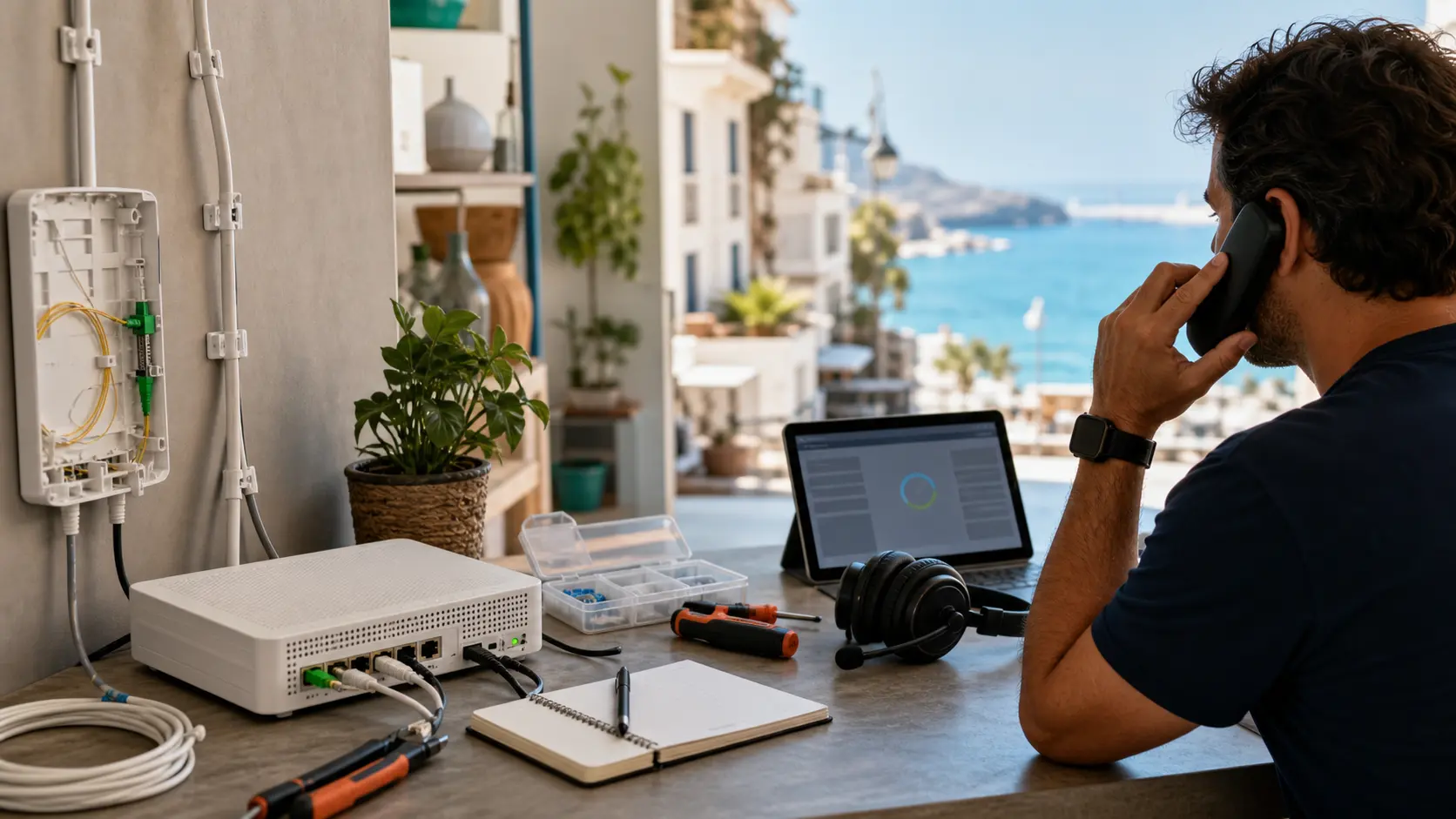
The most useful way to understand Fitel Network is to start with a first installation visit in Lloret de Mar, not with a national price comparison table. A household or small business on the coast can see large Spanish telecom brands advertising fibre, mobile and television across the country. But the purchase is not made in the abstract.
It is made at a door, in a building, with a router location, a fibre path, a landlord or community rule, a patch point, a WhatsApp message from the previous tenant, a reception desk that needs card terminals online, and a family that wants video calls, television, mobile data and summer guests connected at the same time.
That is the context in which a local operator can have an economic role. Fitel Network is publicly presented as a Lloret de Mar telecom operator specializing in fibre optic and Wi-Fi internet services, with engineering projects, installations, marketing and maintenance for both individuals and companies. The Lloret Convention Bureau listing describes Fitel as the leading local telecom operator in Lloret de Mar and says that Fitel Television covers live events through streaming and recording, using local fibre infrastructure. Source: https://www.lloretcb.org/en/recursos/fitel-network/
The local-office signal is not a trivial detail. The same listing gives a Lloret de Mar address, telephone number and email contact. RIPE records for AS205715 also place the organisation in Lloret de Mar and identify Fitel Network S.L. as the organisation behind AS-FitelNetwork. Source: https://rdap.db.ripe.net/autnum/205715 The public record therefore ties the operating claim, the address claim and the network-resource claim to the same small geographic market.
The title of this article is intentionally about installation. In a dense national fibre market, a local ISP rarely wins because it can buy electronics cheaper than a national operator or because it can outspend a listed carrier on advertising. It wins when it converts a local visit into a paying account, when the customer believes the installer will solve the real building problem, and when local support reduces the perceived risk of switching. The moat is not an exclusive technology. GPON, routers, OLTs and transit can be bought by many operators.
The moat is knowledge of the local housing stock, tourist accommodation rhythm, urbanisation edges, customer language mix, building access and support expectations.
That also means the moat is labour-intensive. A small fibre operator has to send people into the field, answer calls, manage seasonal peaks, coordinate with building administrators, repair drops, swap routers and explain why the internet is slow when the problem may be Wi-Fi, distance, interference, a device, a streaming server or the operator path. If those costs run ahead of monthly revenue, local proximity becomes a margin problem. If the operator can resolve problems faster than the national substitute and sell enough bundled services, local proximity becomes an economic asset.
What the public record proves
The public record proves several things clearly. Fitel Network S.L. is a Spanish limited company associated with Lloret de Mar and NIF/CIF B55171680. Public business listings and the indexed legal-notice snippet from the company site report the same tax identifier, telephone contact and website. DatosCif reports the company as constituted in 2013, with the earlier name Northprojects 2013 S.L., and records an activity expansion into installation and maintenance of telecom networks. Source: https://www.datoscif.es/empresa/fitel-network-sl
The company record alone would not be enough for a regional ISP article. A registered company can be dormant, shifted to another activity or only administratively linked to telecom work. The stronger evidence is customer-facing and network-facing. Public pages and indexed snippets for Fitel's own website show fibre, fibre-and-mobile, mobile and Fitel TV pages, with a Lloret de Mar coverage check and a free-call contact number. The indexed fibre page shows a 300 Mb fibre offer at 24.90 EUR per month and tells readers to check coverage in Lloret de Mar. Source: https://fitelnetwork.com/fibra/
The Fitel TV page snippet says the product includes a local channel, generalist channels, series, documentaries and more than 164 channels in one package. Source: https://fitelnetwork.com/fitel-tv/ Girona Noticies, a local media source, also describes Fitel offers including fibre, mobile, a business switchboard service and Fitel TV with more than 164 channels, with pause, recording and rewind functions. Source: https://gironanoticies.com/noticia/242899-fitel-network-a-la-vanguardia-de-las-telecomunicaciones-en-lloret-de-mar.htm
Those TV claims should be read narrowly. They prove a public television-bundle offer and a local audiovisual positioning. They do not prove the economics of content rights, wholesale channel contracts, margin per package, active TV subscribers or the competitive strength of the channel lineup against Movistar Plus+, Orange TV, streaming apps or illegal IPTV substitutes. The safe point is that Fitel is not presenting itself as a bare access line only. It presents a local bundle.
The network-resource record is more precise. RIPE's database identifies AS205715, as-name AS-FitelNetwork, organisation ORG-FNS15-RIPE, Fitel Network S.L., country ES, and an assigned status. The aut-num record lists import from AS35699 and export to AS35699 announcing AS-FITEL-SET, with administrative and technical contact handle ECB47-RIPE. Source: https://rest.db.ripe.net/search.json?query-string=AS205715&source=ripe RIPEstat's AS overview showed AS205715 as announced on 2026-07-09, with holder AS-FitelNetwork Fitel Network S.L. Source: https://stat.ripe.net/data/as-overview/data.json?resource=AS205715
RIPEstat's announced-prefixes result for the recent window listed five prefixes: 5.59.171.0/24, 5.59.174.0/23, 94.125.96.0/23, 188.95.148.0/23 and 109.205.247.0/24. RIPEstat's routing-status result for the same AS showed five IPv4 prefixes, 2,048 IPv4 addresses, zero IPv6 originated space and full visibility from the v4 RIS peers reported in that response at the checked time. Sources: https://stat.ripe.net/data/announced-prefixes/data.json?resource=AS205715 and https://stat.ripe.net/data/routing-status/data.json?resource=AS205715
The routing record still needs caveats. Public routing data proves a current global routing surface. It does not prove that every address is used for retail broadband, that all routes are originated from Fitel-owned last-mile infrastructure, that performance is good, that peering is diverse, or that a particular household receives a particular capacity. But for the purpose of classifying Fitel as a regional access operator rather than a shell listing, the combination of retail fibre claims, local installation and maintenance claims, AS205715, visible prefixes and PeeringDB presence is substantial.
A small ISP with a visible core
The Splynx case study is important because it gives historical technical detail that ordinary marketing pages rarely disclose. It describes Fitel Network as a telecommunications operator specializing in fibre optic and Wi-Fi internet services, carrying out engineering projects, installations, marketing and maintenance in Lloret de Mar. It says Fitel started deploying fibre optics at the end of 2017 in main urban locations of Lloret de Mar, using FTTH and FTTB topology with GPON technology. It also says the network was designed to connect more than 10,000 fibre ONT devices and that end-user services included VOIP and mobile connections. Source: https://splynx.com/success-stories/fitel-network/
The same case study describes a network redesign problem that is economically useful. Fitel had Huawei MA5608 OLT equipment in bridge mode, terminating PPPoE connections on a MikroTik CCR1036 router that also performed NAT. The vendor describes early wireless traffic around 800 Mbps, first GPON customers pushing traffic to 1.4 Gbps, PPPoE reconnection problems, NAT connection tracking and CPU spikes. The redesign moved load across more than one router, added switching and aimed at a core prepared for 10G traffic, BGP, OSPF, PPPoE servers and security policies. Source: https://splynx.com/success-stories/fitel-network/
Because this is a vendor case study, it should not be treated as neutral proof of today's performance. It is still valuable because it explains the operational transition from a small wireless and fibre access operator toward a routed fibre network. It also explains why local fibre economics are not just trenching and sales. When the first few hundred GPON customers create core-router stress, the operator has to redesign before the bottleneck becomes the brand.
Growth requires back-office billing, access authentication, routing policy, NAT architecture, public address resources, customer support and field installation to mature at the same time.
PeeringDB now lists Fitel Network with ASN 205715, network type Cable/DSL/ISP, 5-10Gbps traffic levels, mostly inbound traffic, three IPv4 prefixes in that profile, zero IPv6 prefixes, open general peering policy and an operational interconnection facility entry at Templus DC Barcelona BCN01 in L'Hospitalet de Llobregat. Source: https://www.peeringdb.com/net/19904 That reinforces the idea that Fitel has a visible network core, but it also surfaces a dependence: no public exchange point entries are shown, and the public facility entry is in the Barcelona metro area rather than in Lloret itself.
RIPEstat's asn-neighbours result reported one observed neighbour for AS205715 at the checked time: AS35699, Adamo Telecom Iberia S.A. Source: https://stat.ripe.net/data/asn-neighbours/data.json?resource=AS205715 BGP.tools and Hurricane Electric's BGP toolkit also identify Adamo Telecom Iberia as the visible upstream or peer, with Fitel originating five IPv4 prefixes and no IPv6 prefixes. Sources: https://bgp.tools/as/205715 and https://bgp.he.net/AS205715
This is neither a condemnation nor a guarantee. A regional ISP can run a credible service with one main upstream if the commercial arrangement, capacity, failover and local access network are well managed. But public sources do not show multiple live transit providers, route diversity, an IX route-server presence or IPv6 retail readiness. That means upstream concentration and IPv6 absence are watchpoints. If a national operator can offer a broader network stack, lower transit cost, richer CDN integration and deeper support resources, Fitel has to answer with local responsiveness and customer intimacy.
The paid unit is a coastal account
Fitel's economic unit is the monthly access account in a coastal town. That sounds simple, but it differs from a standard urban fibre account in Barcelona or Madrid. Lloret de Mar has a resident population of 41,944 in 2025, according to Idescat, across 48.71 square kilometres. Source: https://www.idescat.cat/emex/?id=170950&lang=en The tourism body says Lloret is the fifth-ranked sun-and-sand destination in Spain by hotel bed spaces, with more than 29,000 hotel bed spaces, more than 120 hotel establishments, more than 1 million visits per year and more than 5 million overnight stays per year. Source: https://professionals.lloretdemar.org/en/statistics/lloret-in-figures/
That gap between resident population and visitor load matters for broadband. A residential apartment may have a normal winter usage pattern and a crowded summer pattern. A bar or restaurant may be quiet in January and dependent on payments, guest Wi-Fi, streaming music and booking platforms in August. A holiday flat may need service that works for short-stay visitors who do not know the router, the password, the operator or the building. A hotel-adjacent business may need fast repair because an outage affects reviews and card acceptance.
The local operator's challenge is to turn that seasonality into revenue rather than cost. A pure monthly fibre price may not capture the summer value of reliable Wi-Fi in a tourist accommodation unit. But a support-heavy summer can consume labour exactly when field teams are most stretched. Prepaid or seasonal use was visible in the Splynx case study, which said Fitel connected companies and residential customers paying monthly and had customers who came to Lloret de Mar for vacation and paid in prepaid mode. Source: https://splynx.com/success-stories/fitel-network/
Prepaid tourist-town broadband is attractive because it can monetise temporary demand, but it is operationally awkward. The customer may arrive for a week, expect immediate service, speak another language, use many devices and leave before the operator can recover a long contract contribution. If the activation requires a technician, the account has to cover that labour somehow. If it does not require a technician because the unit is already wired, the operator's investment in prior installation becomes the moat.
The more buildings and tourist units Fitel has already touched, the easier it is to sell the next connection without rebuilding the physical path.
This is why installation density matters. A fibre operator with a cluster of served buildings can reuse local knowledge, schedule visits more efficiently, carry spare equipment that matches the installed base, and recognise recurring faults. A national operator may have the larger network but can still be slower at the last five metres, especially where building access, tourist turnover and local street knowledge matter. For Fitel, the valuable account is not only the household paying 24.90 EUR or a bundled promotional rate.
It is an address whose future service calls become predictable and whose neighbours can be sold through the same local network.
Pricing against a national fibre market
Spain is a difficult country in which to sell fibre only on speed. CNMC reported that fixed broadband reached 19.63 million lines in February 2026, with FTTH at 17.9 million lines after adding 74,205 in the month. Movistar, Vodafone and MasOrange together held 81.7 percent of fixed broadband lines, and the share rose to 95.3 percent when Digi was included. Source: https://www.cnmc.es/prensa/datos-febrero-telecos-20260413 That is a market where national brands, low-cost challengers and wholesale access models discipline price.
Movistar's public fibre page advertises 300 Mb, 600 Mb and 1 Gb symmetric fibre, no permanence, free installation in 24-48 hours, a Smart WiFi router and a 5G home alternative where fibre is not available. Source: https://www.movistar.es/fibra-optica/ Lowi, Vodafone's low-cost brand, advertises 600 Mb fibre with Vodafone coverage, WiFi 6 router, 5G mobile, installation in 24-48 hours and a fibre-plus-mobile price of 30.00 EUR per month for 600 Mb with a 50GB mobile line in the indexed page view. Source: https://www.lowi.es/ofertas-fibra-y-movil/ Orange advertises fibre and mobile offers with 600 Mb to 1 Gb speeds, and up to 10 Gb depending on coverage. Source: https://www.orange.es/tarifas/fibra-y-movil/
Business buyers are also exposed to national pricing. Telefonica Empresas' public page for companies showed promotional business fibre at 24.90 EUR excluding tax for 300 Mb or 600 Mb for the first 12 months, with higher non-promotional prices and promotion validity through 31 July 2026. Source: https://www.telefonicaempresas.es/internet-empresas Finetwork's public tariffs advertise low-cost fibre-and-mobile bundles, including 600 Mb and 1 Gb combinations. Source: https://www.finetwork.com/tarifas-fibra-movil/
Against that background, Fitel cannot rely on being the cheapest visible brand in Spain. Its indexed fibre page shows 300 Mb at 24.90 EUR per month and coverage checking in Lloret de Mar. Girona Noticies also reported Fitel offers such as 300 Mb symmetric fibre at 24.90 EUR per month, mobile 5G with 30GB at 8.90 EUR per month, a business switchboard at 59 EUR per month and a promotional fibre-plus-mobile offer. Source: https://gironanoticies.com/noticia/242899-fitel-network-a-la-vanguardia-de-las-telecomunicaciones-en-lloret-de-mar.htm
The exact price comparison should not be frozen because promotions change. The economic point is more durable. Fitel's price has to cover a much smaller address base than Movistar, Orange, Vodafone or MasOrange. It has less national advertising leverage, less equipment purchasing power, less mobile-network ownership, less content-rights scale and probably less bargaining power on upstream and wholesale inputs.
To compensate, it has to extract value from attributes the national operators find harder to personalise: local installation, practical support, community identity, event streaming, business phone service, building familiarity and trust among customers who prefer a local contact.
That is a more demanding margin story than a simple "small operator undercuts the incumbent" story. Discounting can win the first account, but it can also worsen the payback period on drops, routers, ONTs and technician time. A local operator's best account is one where installation cost is amortised over a long relationship, the customer buys more than bare internet, and support is good enough to reduce churn without creating repeated expensive visits.
Television and mobile make the bill stickier
Fitel TV matters because it makes the account more than a broadband commodity. The public Fitel TV page snippet advertises a local channel, generalist channels, series and documentaries, and more than 164 channels in one package. Girona Noticies describes the service as part of a bundle with internet and telephony and says it offers recording, pause and rewind functions. Sources: https://fitelnetwork.com/fitel-tv/ and https://gironanoticies.com/noticia/242899-fitel-network-a-la-vanguardia-de-las-telecomunicaciones-en-lloret-de-mar.htm
For a local ISP, television can be defensive even if it is not high-margin. It gives customers one more reason not to compare only megabits. It gives older households a familiar bundle, small hospitality businesses a content and local-channel option, and the operator another support touchpoint. The risk is that television can also import content-cost pressure, set-top-box support, channel disputes and piracy comparison. The public sources do not disclose Fitel's channel contracts or margin. The article can safely treat TV as a bundling and retention signal, not as proof of media-rights strength.
Mobile service is similar. Fitel's pages and local media coverage advertise mobile offers and fibre-plus-mobile combinations. The Splynx case study said end-user services included mobile connections. Source: https://splynx.com/success-stories/fitel-network/ That likely means the customer account can include mobile lines even though Fitel does not own a national mobile radio access network. The public sources reviewed here do not disclose the wholesale mobile partner, contract economics or churn impact.
The mobile bundle still matters commercially. In Spain, households are trained to compare convergent packages, not only fixed broadband. Lowi, Orange, Movistar, Finetwork, Digi and O2 all push bundles that combine fibre and mobile. If Fitel lacked mobile entirely, a customer could use it for fibre but still leave the main family bill with a national operator. By offering mobile, Fitel can fight for the household bill, not only the router.
The business switchboard offer reported by Girona Noticies adds a small-business angle. A 59 EUR monthly centralita product with welcome locution, waiting music, interactive menu and call transfer is not the same as ordinary residential fibre. Source: https://gironanoticies.com/noticia/242899-fitel-network-a-la-vanguardia-de-las-telecomunicaciones-en-lloret-de-mar.htm For restaurants, real-estate offices, booking businesses, clinics or local services, voice presentation and call handling can matter. But again the public record does not show the number of business accounts or profitability of that service.
The economics of the bundle are therefore asymmetric. Every extra service can reduce churn and lift average revenue per account. Every extra service can also create another failure mode. A customer with internet only calls when the line or Wi-Fi fails. A customer with internet, mobile, TV and business telephony can call about SIM activation, porting, router placement, channel function, voice menus and invoice confusion. A local operator's advantage depends on whether it can handle those calls with less friction than a national call centre.
Local support labour is not a soft factor
The local support labour topic is supported because Fitel's public identity is built around local service, installation and maintenance. The Lloret Convention Bureau says Fitel carries out engineering projects, installations, marketing and all kinds of maintenance for both individuals and companies. Source: https://www.lloretcb.org/en/recursos/fitel-network/ Fitel's Instagram and Facebook snippets repeatedly emphasise local fibre in Lloret de Mar, fast attention, human attention and coverage consultation. Sources: https://www.instagram.com/fitelnetwork/?hl=en and https://www.facebook.com/FitelNetwork/
Social-media snippets are low-grade evidence for quality. They are useful, however, because they show how the company sells itself: local, human, nearby. That language is economically important. A regional ISP can turn labour into a product feature only if customers believe the labour is reachable. If local presence is just marketing and support is slow, the customer will compare price and churn. If local presence is real, the customer may tolerate a slightly less aggressive price because the alternative is a national queue.
Field support is also where the installation moat is defended. The first visit sets the customer's memory of the operator. Does the installer arrive on time? Does the router location make sense? Does the Wi-Fi reach the terrace or back room? Does the technician explain the ONT, TV device, mobile port or business phone setup? Does the customer know whom to call? The answer may matter more than a small difference between 300 Mb and 600 Mb in advertised speed.
In a tourist town, local support is also seasonal risk management. Summer brings more devices, more short-stay users, more restaurants processing payments, more security cameras, more streamers and more impatient guests. A network that is good enough in February may feel stressed in August. A support team that is adequate in winter may be overloaded when visitors arrive. The economic moat exists if Fitel's installed base is dense enough, its fault patterns are known enough and its labour scheduling is flexible enough to protect customer experience during peak demand.
The public record does not disclose technician headcount. LinkedIn's public page for Fitel Network S.L. shows a company-size range of 11-50 employees and lists roles including technical direction and installer profiles visible in the employee preview. Source: https://gh.linkedin.com/company/fitel-network-sl That supports the idea of an operating team rather than a paper reseller, but it does not prove staffing sufficiency, training, repair times or service quality.
The better way to frame local support is as a variable-cost moat. Fitel can defend accounts through local labour, but the labour must be productive. The company needs enough accounts per served cluster to keep technicians efficient, enough revenue per account to pay for visits, enough diagnostic discipline to avoid unnecessary truck rolls, and enough bundle depth to make customers worth retaining. If large operators raise promotional pressure and Fitel responds with price cuts, support labour can quickly become the margin squeeze.
Competition is large, local and technological
The first substitute is Movistar. It has the national brand, deep fibre history, fixed-mobile-TV bundling and a public offer that emphasises no permanence, installation, smart router and a 5G fixed alternative if fibre is unavailable. Source: https://www.movistar.es/fibra-optica/ Movistar's advantage is trust at national scale. Its disadvantage, from a local operator's point of view, is that it may feel less personal at the moment a customer needs building-specific support.
The second substitute is Orange/MasOrange. Orange's public bundles cover fibre, mobile and TV, and MasOrange's consolidation gives it scale in Spain's fixed and mobile markets. Source: https://www.orange.es/tarifas/fibra-y-movil/ Scale can fund discounts and richer bundles. It can also make small local operators look expensive if the customer values only speed and mobile data.
The third substitute is Vodafone/Lowi and related low-cost brands. Lowi's offer is especially relevant because it makes national infrastructure feel simple and cheap: Vodafone coverage, fibre, mobile data, WiFi 6 router, 5G and a clean monthly price. Source: https://www.lowi.es/ofertas-fibra-y-movil/ Finetwork adds another price anchor in Spain's low-cost segment. Source: https://www.finetwork.com/tarifas-fibra-movil/ These offers make it hard for Fitel to sell a pure price story.
The fourth substitute is fixed wireless and mobile broadband. Movistar's fibre page itself points to Radio 5G where fibre is not available. Source: https://www.movistar.es/fibra-optica/ For some Lloret addresses, especially temporary accommodation or edge locations, a wireless solution may be good enough. Wireless can avoid installation friction, but it may struggle with indoor signal, congestion, latency, fair-use limits or seasonal cell loading. Fitel's opportunity is to prove that installed fibre is more reliable for dense use.
The fifth substitute is another Catalan or regional fibre operator. Spain has many regional and local fibre providers, and consolidation has changed ownership of local networks over time. The public record reviewed here does not identify a specific Lloret rival with stronger evidence than the national brands, but the risk is clear: if another local operator builds nearby or buys into the area, Fitel's local moat becomes contested. In that case the installed base, customer goodwill and support quality matter more than generic local identity.
The sixth substitute is customer inertia. Many households do not switch unless the current service is bad, the price rises, the installation is easy or the promotion is dramatic. That favours incumbents at each address. Fitel's marketing has to overcome not only national competitors but also the customer's dislike of appointments, uncertainty, number porting, TV changes and router disruption. A successful first installation can turn that inertia into Fitel's own retention advantage.
Upstream dependence and the cost of small scale
Fitel's public routing record points to AS35699 Adamo Telecom Iberia as the visible upstream or neighbour. RIPE's aut-num record lists import from AS35699 and export to AS35699 announcing AS-FITEL-SET. RIPEstat reported one observed neighbour. IP2Location similarly lists AS35699 as upstream and no downstreams, while showing five IPv4 ranges and no known IPv6 addresses for AS205715. Sources: https://stat.ripe.net/data/asn-neighbours/data.json?resource=AS205715 and https://www.ip2location.com/as205715
For a small ISP, upstream dependence is both normal and strategic. The operator can own or operate last-mile fibre while buying upstream reachability from a larger network. The customer's experience depends on both. A local drop can be perfect and the upstream path still matter for latency, routing resilience and content reachability. Conversely, upstream quality cannot fix a poor in-building installation.
The public record does not show transit price, committed information rate, backup agreements, CDN caching, DDoS protection, RPKI operations beyond what third-party tools show, or contractual service levels. BGP.tools shows one prefix with a valid RPKI certificate marker and several prefixes matching trusted IRR sources, while Hurricane Electric reports one RPKI-originated valid route in its summary. Sources: https://bgp.tools/as/205715 and https://bgp.he.net/AS205715 That is useful routing hygiene evidence, but it does not prove a complete route-security posture.
The IPv6 absence is a notable watchpoint. RIPEstat, BGP.tools, Hurricane Electric and IP2Location all show no originated IPv6 space for AS205715 in the reviewed public view. Sources: https://stat.ripe.net/data/routing-status/data.json?resource=AS205715 and https://bgp.tools/as/205715 In the short run, many residential customers may not notice if IPv4 service is stable. In the long run, IPv6 absence can indicate technical debt, dependence on NAT and a weaker position for customers that need modern network reachability.
This does not mean Fitel's service is poor. It means the public evidence supports a local ISP with live IPv4 routing, not a richly multi-homed, IPv6-forward public network. A stronger future case would show additional upstreams, IX participation, IPv6 announcements, more detailed route-security records, published network-status information or independent measurements from within the network.
Regulation and wholesale fibre shape the backdrop
Spain's regulatory backdrop matters because the national fibre market is already highly developed. CNMC's February 2026 data shows FTTH close to 18 million lines and strong concentration among the largest operators plus Digi. Source: https://www.cnmc.es/prensa/datos-febrero-telecos-20260413 A small operator in that environment is not bringing fibre to a country that lacks fibre. It is trying to own enough local trust and enough address-specific installation advantage in a country where fibre is mainstream.
That changes the logic of investment. Early fibre builders could win by being first. Late or small builders must win by being better at specific addresses, by bundling local services, by serving overlooked buildings, by responding faster or by pricing a local relationship. If every rival can advertise hundreds of megabits, the differentiator shifts from nominal speed to installation confidence, support, bundle shape and the probability that the account will work during the customer's busiest hours.
Wholesale and infrastructure sharing also affect the competitive field. Large operators can sell over their own networks, shared networks or wholesale arrangements. Low-cost brands can package national coverage without owning every local fibre strand. That makes the customer-facing brand less tied to local plant ownership. Fitel's challenge is to make local plant and local service visible enough that customers do not see it as just another reseller.
The public source base suggests Fitel has some own local infrastructure. The LinkedIn company page says the company has more than 30 km of own fibre optic infrastructure. Source: https://gh.linkedin.com/company/fitel-network-sl The Lloret Convention Bureau says Fitel Television uses local own fibre infrastructure for event streaming. Source: https://www.lloretcb.org/en/recursos/fitel-network/ These are company-adjacent claims, not independent engineering audits, but they fit the technical history from the Splynx case study and the current AS evidence.
The difference between owning local fibre and renting access is central to the article's thesis. If Fitel owns and understands enough local fibre, installation density can become a moat. If much of the customer experience depends on third-party access or wholesale inputs, the moat weakens and the brand has to compete harder on service. Public sources support the presence of local fibre infrastructure, but not a complete map of owned plant.
What would change the judgement
Several facts would materially change the judgement. The most positive would be a current, company-published network map or coverage tool showing served buildings or neighbourhoods, combined with transparent installation terms and support response targets. That would turn the local installation moat from an inferred economic mechanism into a documented operating surface.
Subscriber count would also matter. A network designed for more than 10,000 ONTs is not the same as a network with 10,000 active accounts. The Splynx case study says the design could connect more than 10,000 fibre ONT devices, not that it had that many active customers. Source: https://splynx.com/success-stories/fitel-network/ Public articles sometimes say Fitel provides services to thousands of homes, but without a current audited subscriber figure, the safer approach is to treat scale as unknown.
Margin data would matter. A local ISP can look attractive from the outside if the fibre is installed and customers are loyal. It can look fragile if installation subsidies, promotional prices, upstream costs, support calls, TV costs and mobile wholesale charges consume the bill. Public sources do not disclose revenue by product, gross margin, capital expenditure, debt, churn or customer-acquisition cost.
Network diversity would matter. Additional upstreams, public IX ports, IPv6 announcements, RPKI coverage across all originated prefixes and public network-status transparency would strengthen the view that Fitel's network layer is maturing beyond a small single-upstream access network. Current public evidence shows a live AS and prefixes, but also visible dependence on Adamo and no originated IPv6.
Customer sentiment would matter, but it needs better evidence than scattered social snippets. Downdetector pages indexed for Fitel show no current user-reported problems at the time of search, while GoWork presents a small, unverified review base. Sources: https://downdetector.es/en/status/fitel-network/ and https://es.gowork.com/fitel-network-girona Those are weak signals. They are not enough to claim high customer satisfaction or poor quality. A larger independent review set, complaint statistics or regulator complaint data would be more useful.
Finally, the company's mobile and TV wholesale terms would matter. If Fitel can buy mobile and TV inputs at sustainable costs while keeping support local, the bundle can lift retention. If wholesale terms are thin and content/support issues rise, bundles can become low-margin complexity. The public record proves bundle availability, not bundle profitability.
The investment read is operational, not heroic
Fitel Network is not an infrastructure story about a small company replacing Spain's national carriers. It is a disciplined local-operator story. Spain already has extensive FTTH, aggressive convergent bundles and national brands that can discount. In that environment, Fitel's addressable advantage is not grand scale. It is the repeated local transaction: consult coverage, schedule installation, solve the building, connect the household or business, add mobile or TV where useful, answer the call, and keep the account through the next summer season.
That is why the company is worth monitoring in the regional ISP category. The public evidence shows a real local telecom provider with customer-facing fibre and Wi-Fi services, a television and mobile bundle, installation and maintenance claims, a visible AS, current IPv4 routing, Barcelona-area interconnection presence and a Lloret de Mar operating identity. Those facts support the thesis that Fitel's value is priced through installation density, service labour and local account retention.
The same facts also limit the thesis. Public sources do not show a large multi-upstream network, IPv6 origination, audited customer numbers, measured uptime, published SLA performance, content-rights economics or financial statements. Fitel's moat is therefore narrower than the word "fibre" suggests. It is not fibre alone. It is fibre already installed, in the right buildings, with support that customers trust enough not to switch.
For a Lloret de Mar household or small business, the practical question remains simple. If a national operator offers a cheaper headline bundle but the first appointment is uncertain, a local installer has value. If Fitel can install quickly, answer locally, keep TV and mobile simple, and survive seasonal peaks, it can defend accounts in a market where speed is commoditised. If it cannot, the same customer can return to Movistar, Orange, Vodafone/Lowi, Finetwork, mobile broadband or another fibre operator with little loyalty to the local story.
That is the economic centre of Fitel Network. The company prices coastal fibre where installation is the moat, and the moat has to be rebuilt every time a customer opens the door.