
Summary
- Fasttelekom Ltd. is best read as a Fastiv access-account business, not as a national carrier. Its public offer is local: GPON and XGS-PON broadband, cable TV, Sweet.tv, business connectivity, office support, 24/7 technical phone support and a subscriber app for Fastiv and Fastiv Raion.
- The headline 10 Gbit/s tier is real as an advertised tariff: Fasttelekom's official price page lists a TITAN 10G XGS-PON plan at UAH 1,799 per month with a UAH 4,999 connection charge and a premium XGS terminal included. That should be treated as an upper service tier, not as evidence that ordinary users routinely experience 10 Gbit/s throughput.
- The strongest network evidence is current and meaningful. RIPE, RIPEstat, PeeringDB and UA-IX records show AS51597, current IPv4 and IPv6 announcements, RIPE-visible routing, upstreams, public peering and 10G exchange connections. That proves an operating network surface; it does not prove customer speed, uptime, fault response, profitability or service quality.
- The margin test is local labour. Fasttelekom says it has its own crew in Fastiv, same-day or next-day connection windows, an office on Soborna Street, 24/7 technical support and network backup power. Those claims make the article's topic of Local support labour defensible, but the true standard is whether field repair and power continuity hold when fibre, electricity and customer routers fail.
- Competition is not theoretical. Kyivstar markets home internet in Fastiv with free installation, 24/7 support and optical backup power; Lanet markets 2,000 Mbit/s PON in Fastiv; FastNET and other local fixed providers, Vodafone GPON offers, Ukrtelecom's national fixed network, mobile broadband and Starlink-style backup all pressure Fasttelekom's premium pricing.
A 10-gigabit order starts as a repair promise
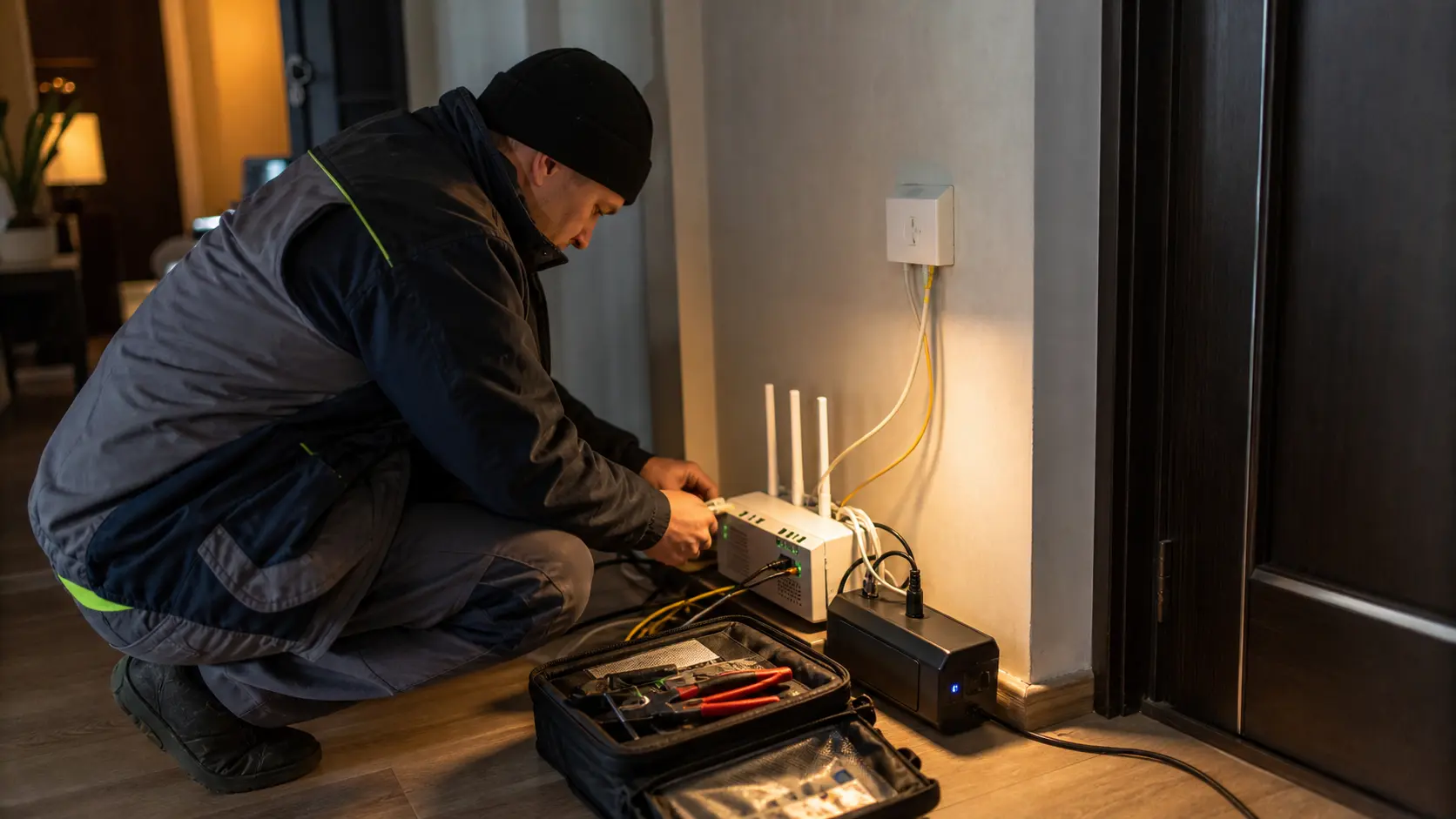
Imagine a Fastiv customer choosing the expensive plan on Fasttelekom's price page. The buyer sees a local provider that says it can deliver internet up to 10 Gbit/s, television, a premium XGS terminal and service that keeps working during power cuts if the customer powers the router and optical terminal. The first emotional sale is speed.
The second sale, the one that decides whether the account stays, is much less glamorous: whether a technician arrives, whether the fibre drop is clean, whether the optical levels are stable, whether the home router and customer devices can use the service, whether evening contention stays tolerable, whether upstream routes avoid avoidable pain, and whether the network remains useful when the city loses power.
That is why Fasttelekom is a more interesting company than a simple "small ISP offers big speed" headline suggests. The company is not trying to beat Kyivstar or Ukrtelecom by being bigger. It is trying to make a local Fastiv account feel closer, faster to install, more repairable and more bundled than the substitutes around it. Its own pages lean into that position. The home page describes internet and TV in Fastiv, XGS-PON operation during outages, 88 cable TV channels, Sweet.tv and a local support brigade.
The about page presents the company as a Fastiv operator with fifteen years of work in the city and an in-house team rather than outsourced callouts. The contact page gives a Fastiv office at Soborna 33, office hours and multiple support numbers. The Google Play listing for the official "My Fasttelekom" app says it is for subscribers in Fastiv and Fastiv Raion and lets them view balance, pay, manage tariffs, handle Sweet TV and receive provider notifications.
The article's economic unit is therefore a Fastiv broadband and television account. That account can be an apartment Ethernet account, a private-sector GPON account, a higher-speed XGS-PON account, a television bundle or a business line. The same customer relationship is being sold through several prices and performance promises. The 10G plan is the visible flag. The real business is the account around it: monthly access revenue, connection fees, device handling, TV upsell, support labour, repair scheduling, electricity resilience and the cost of carrying traffic out of Fastiv through Kyiv and wider internet routes.
The public evidence supports a strong but bounded conclusion. Fasttelekom has a current operating surface as a Ukrainian access provider. It has an official service site, official tariff pages, regulator listing, company registration, active RIPE records, current route visibility, public exchange presence and local support surfaces. It does not publish audited subscriber numbers, churn, capex, network utilisation, fault statistics or service-level results for ordinary households. The argument must therefore stay disciplined. Fasttelekom has built a credible local access proposition around GPON and XGS-PON.
Whether that proposition becomes a durable premium business depends on repair and density economics that are only partly visible from public records.
The tariff stack reveals the commercial ladder
Fasttelekom's official price page is the anchor for the 10G claim. It lists ordinary apartment services at 100, 500 and 1,000 Mbit/s, with monthly prices of UAH 229, UAH 279 and UAH 329. It lists private-sector GPON tiers at 200, 500 and 1,000 Mbit/s, with monthly prices of UAH 299, UAH 349 and UAH 369. It lists internet plus TV bundles at 100, 500 and 1,000 Mbit/s with 88 analog and digital cable channels, priced at UAH 299, UAH 359 and UAH 399.
Then it separates the "Ultra Speeds" offer: 2.5G at UAH 599 per month with a UAH 2,499 connection charge, 5G at UAH 999 per month with a UAH 3,499 connection charge, and TITAN 10G at UAH 1,799 per month with a UAH 4,999 connection charge and a premium XGS terminal included.
That ladder matters because it shows that 10G is not a casual throwaway number. It is priced as a premium tier. The monthly price is roughly five times the private-sector 1G GPON tier and more than four times the 1G internet-plus-TV tier. The connection charge is also higher. The plan has to carry more than bandwidth. It has to justify special installation handling, a more expensive optical terminal, customer education, support expectations, likely router questions and the risk that the subscriber will test every weakness in the service.
A buyer who pays UAH 1,799 per month for a small-city broadband plan will not judge the provider only against a basic 100 Mbit/s line. The buyer will compare the promise against gaming latency, upload capacity, Wi-Fi limits, wired Ethernet limits, evening congestion and the ability to get help when the speed test disappoints.
The existence of lower-price GPON and internet-plus-TV plans is just as important. A local ISP usually cannot fill a town with premium 10G accounts. It needs a broad base of ordinary accounts that cover local plant, field labour and office support. The cheap apartment 100 Mbit/s plan keeps price-sensitive households from leaving. The 500 Mbit/s and 1G plans create an upgrade ladder. The private-sector PON tiers monetise houses where fibre drops and field work are more expensive than apartment Ethernet. The TV bundles lift average monthly revenue by attaching entertainment to access.
The XGS-PON tiers pull the brand upward and give the provider a reason to talk about future-proof capacity.
This is not the same as proving that the network is uncongested or that the 10G tier can be delivered everywhere. A tariff page shows what is offered, not what every address can receive or what throughput a household gets at peak time. The practical interpretation is narrower: Fasttelekom is using XGS-PON as a premium upgrade on top of a conventional local ISP tariff base.
The 10G number opens the door, but the economics depend on how many customers buy higher tiers, how many stay on cheaper plans, how much capital sits in optical equipment, how many truck rolls are needed per install, and whether the provider can avoid turning every premium account into a support-heavy account.
The same ladder also reveals a tension. If the 10G tier is too rare, it may be mostly a brand signal. If it is popular, it can stress backhaul, customer equipment, installation time and fault handling. The ideal middle ground is a small number of high-value customers who understand the limits of home networking and are willing to pay for local support. That is why the word "promise" in the headline is not a claim of guaranteed performance. It is a promise that the operator must keep in the field, one home at a time.
XGS-PON changes capacity, not the laws of density
XGS-PON is a real step up from older access technologies. ITU-T Recommendation G.9807.1 describes 10-gigabit-capable symmetric passive optical network technology for residential, business, mobile-backhaul and other access uses, with nominal 10 Gbit/s rates in both downstream and upstream directions. Broadband Forum material has also described XGS-PON as a technology that can coexist with existing GPON deployments and meet gigabit-plus demand on shared fibre infrastructure.
For a small operator, this matters because an upgrade to XGS-PON can reuse parts of the optical distribution network rather than requiring a complete rebuild of every street.
But XGS-PON does not repeal access-network economics. Passive optical networks are shared systems. The capacity at the optical line terminal, split ratio, optical budget, customer terminal, home router, in-home cabling, Wi-Fi environment, upstream aggregation, peering and transit all affect the experience. A nominal 10G access tier is not the same thing as a dedicated uncontended 10 Gbit/s circuit to every global destination. Fasttelekom's own business page distinguishes dedicated symmetric channels and custom business connectivity from residential tariff language. That distinction should remain visible.
A premium home XGS-PON account can be very fast and valuable without being a private leased line.
The commercial question is where Fasttelekom deploys scarce high-speed resources. In a town network, density is the friend and enemy of the operator. Dense apartment blocks can reduce drop cost per subscriber, shorten installation time and support efficient maintenance. They can also create evening congestion if too many high-usage households sit behind the same shared access and aggregation segments. Private-sector houses can create sticky accounts because fewer operators may be willing to do the fibre drop, but they add truck time, cable work and repair distance.
XGS-PON works best when the operator can place high-speed demand where the optical plant, splitter design and backhaul can support it without expensive overbuild.
Fasttelekom's tariff page gives hints about that segmentation. Apartment tariffs are labelled as Ethernet connection, with an option to connect PON so the service works without power for 72 hours. Private-sector tariffs are explicitly "GPON to the home." The Ultra Speeds block is framed as XGS-PON in Fastiv, not as a universal national offer. The article should not infer exact coverage from the page. The better inference is that Fasttelekom is trying to manage several access layers at once: legacy apartment Ethernet or FTTB-style service, GPON private-sector fibre and higher-speed XGS-PON for selected demand.
This creates a support burden. Customers do not buy "optical distribution network design"; they buy a monthly line and expect the advertised tier to feel real. If a 10G customer uses an old laptop, a 1G router, poor Wi-Fi, a damaged patch cord or an overloaded home switch, the customer may experience the problem as an ISP failure. The operator therefore has to spend labour explaining equipment limits and, in some cases, selling or configuring appropriate routers and terminals. Fasttelekom's price page says the 10G tier includes a premium XGS terminal and mentions turnkey connection, router, cable and speed-test setup.
That detail is economically important. It is the provider acknowledging that the access line alone is not enough; the last metre inside the home can turn a premium plan into a complaint.
Local support labour is the moat, if it stays fast
Fasttelekom has unusually direct public support evidence for a small provider. Its contact page lists a city phone line, a 24/7 technical support number, Kyivstar, Vodafone and Lifecell mobile numbers, a main office in Fastiv and Telegram messaging. Its about page says the company has its own staff crew that goes to customers rather than handing calls to contractors. The price page promises turnkey connection and setup. The home page says most connections can happen the same evening if the request is made before noon, otherwise the next business day.
The Google Play app adds another support surface by giving subscribers balance, payment, tariff and notification control.
That is enough to justify Local support labour as a controlled topic. It is not enough to declare support quality solved. The right conclusion is that field labour is visible and central to the offer. A local provider can beat a national brand when the customer believes the technician knows the street, the building, the pole route, the basement cabinet and the normal failure modes. It can also lose that advantage quickly if calls pile up, if a small crew is stretched across too many installs, or if a power or fibre incident affects several neighbourhoods at once.
The labour economics are unforgiving. A cheap 100 Mbit/s account can become unprofitable if it needs multiple visits. A 10G account can become reputationally expensive if it attracts customers who test the line constantly and expect business-class reaction at residential prices. A TV bundle can reduce churn, but it also adds service calls when channels, set-up, cabling or account rights fail. A subscriber app can reduce payment friction, but it creates another surface that must keep working.
The best local ISP accounts are boring: one clean installation, one router that can handle the purchased tier, automated monthly payment, few support calls and a customer who values local repair enough not to switch for a short promotion.
Unofficial market signals show both sides. Reviews on 2IP.ua for AS51597 include positive Fastiv comments about fast installation, gigabit performance and service, including reported tests above 700 Mbit/s and 800 Mbit/s on some user entries. They also include negative comments about poor ping, low speed and evening degradation. Anonymous review sites are not audited records and should not be treated as a statistically clean sample. They are useful because they show the exact battleground: real users judge the service by speed at home, repair, support, ping and whether the experience matches the tariff.
Those are the variables Fasttelekom must keep under control.
The company cannot automate its way out of this. Software can handle billing, notifications and tariff changes. It cannot splice damaged fibre, fix a poor optical connector, replace a failed power unit, calm a customer whose router cannot pass 10G, or decide when a support call should become a truck roll. If Fasttelekom's 10G promise works commercially, it will be because the operator uses automation to keep routine account work cheap while reserving human labour for the faults that matter. If it fails, it will likely fail through labour saturation before it fails through the headline tariff itself.
Power continuity is not a slogan in Ukraine
Fasttelekom's pages repeatedly tie PON and XGS-PON to operation during power cuts. The tariff page says PON service works without city power for 72 hours and that Ultra Speeds include UPS-backed nodes for up to 72 hours. The home page says the customer can power the router and optical terminal with a power bank while the optical network remains available through node backup. The corporate page goes further for business customers, saying base nodes have batteries and generators and that office internet can keep working during long outages.
Those claims fit the Ukrainian market. Power resilience is no longer a technical appendix. It is a selling point for households, remote workers, schools, shops and small offices. A Centre for Economic Strategy interview on Ukraine's blackout readiness described operators investing in generators, batteries and energy-efficient sites, and noted that PON technology can keep networks running for up to 72 hours without electricity. Cloudflare's Q1 2026 disruption review recorded traffic drops tied to Ukrainian power and energy events, including regional disruptions after attacks and a January grid event affecting Kyiv and Kharkiv.
These are not Fasttelekom-specific outages, but they explain why a Fastiv provider would make backup power part of the tariff conversation.
The economic point is subtle. Backup power costs money whether or not a customer notices it every day. Batteries age. Generators require fuel and maintenance. Staff need procedures for outages. Nodes need monitoring. If many households lose power at once, the network side may stay alive while customer routers and devices run out of power. The operator then faces a communication problem: explaining that the optical line can work if the customer powers the home equipment. That is why Fasttelekom's pages mention the router and ONU terminal directly. They are not just selling a resilient network.
They are asking the customer to participate in resilience by powering the last equipment in the chain.
This affects churn. In a town where power cuts are remembered, a provider that actually stays online during outages can become trusted. A provider that advertises backup but fails during a prolonged cut can lose trust faster than one that never promised it. The 72-hour number is especially sensitive. It should be treated as a network-design claim, not a guaranteed experience for every home in every outage. Real duration depends on the affected node, battery condition, generator logistics, load, damage and customer-side power.
The commercial standard is not perfection; it is whether the service is predictably better than alternatives when electricity becomes scarce.
Power continuity also changes competition. Kyivstar markets home internet in Fastiv with optical backup power up to 12 hours. Lanet markets 100 percent reserved network power in Fastiv. Vodafone markets GPON home internet with up to 100 hours of autonomous network operation in its home-internet footprint. These rival claims create a resilience race. Fasttelekom cannot simply say "works without light" and own the theme. It has to show, through customer experience, that the local crew and network design make the claim believable in Fastiv specifically.
The network footprint is small, current and real
Fasttelekom's network-resource evidence is unusually strong for a local provider. RIPE records show AS51597, FASTTELECOM-AS, assigned in 2010 and linked to Fasttelekom Ltd. The RIPE organisation record names Fasttelekom Ltd., country Ukraine, registration number 37583301 and a Fastiv address. RIPE routing policy records list external uplinks to AS35320, AS3326 and AS199995, and exchange imports and exports involving UA-IX, UBNIX or Giganet-style exchange routing, and DTEL-IX.
RIPEstat data on July 10, 2026 showed the AS announced, visible to 326 of 326 IPv4 full-feed RIS peers and 321 of 321 IPv6 peers, with 12 IPv4 prefixes, 3,072 IPv4 addresses and one IPv6 /48-equivalent announced. PeeringDB lists FASTTELECOM LTD as AS51597, with AS-FASTTELECOM, two public exchange connections and two facilities.
UA-IX gives an independent exchange-specific view: it lists Fasttelekom Ltd. LLC, AS51597, a Kyiv VEGA site and IPv4/IPv6 exchange addresses. PeeringDB's exchange data shows operational 10G public peering at UA-IX and Giganet IXN, with IPv4 and IPv6 addresses. PeeringDB's facility data places the network at NewTelco Kiev and Giganet in Kyiv. APNIC Labs' population estimate for July 6, 2026 puts AS51597 at roughly 5,541 estimated users in Ukraine, about 0.02 percent of the country. That is a measurement estimate, not a subscriber count, but it reinforces the local scale: this is not a national mass-market network.
This footprint supports the "Peering and transit" topic because upstream and exchange choices shape performance and cost. A Fastiv access line ultimately needs paths to Ukrainian content, international cloud services, game servers, video platforms, social networks, DNS resolvers and business services. The closer and cheaper the operator can reach common destinations through Kyiv exchanges and upstreams, the better its cost and latency position. Public peering also gives a small provider a way to look less isolated than its local footprint might suggest.
The caveat is just as important. ASN, prefix and exchange evidence does not prove retail quality. It does not prove low contention in the access network. It does not prove that the 10G plan is widely available. It does not prove that routes are always optimal, that support answers quickly, or that the company is financially strong. It proves that Fasttelekom has a live routing footprint and interconnection surface consistent with a real ISP. For a local access company, that is meaningful but not sufficient.
The upstream mix is also a strategic exposure. If one upstream has trouble, others may help. If a local exchange has congestion or operational trouble, transit may still carry traffic at higher cost or latency. If international routes are expensive, a small provider's margins can be squeezed by heavy users on flat-rate plans. If gaming and streaming traffic grows faster than revenue, the operator can face a choice between buying more capacity, tolerating congestion or raising prices. This is where peering becomes economics rather than engineering trivia. The route surface tells us Fasttelekom has options.
It does not tell us whether those options are enough at peak time.
Television bundling protects the account
Fasttelekom is not selling only broadband. Its TV page offers Sweet.tv packages and cable television. It describes Sweet.tv with up to 392 channels, seven-day archive and multi-device viewing, while cable TV offers 88 channels, including analog and DVB-C digital channels, with a standalone cable TV tariff at UAH 149 per month. The internet-plus-TV bundle on the price page attaches 88 cable channels to 100, 500 and 1,000 Mbit/s access tiers. The home page promotes internet, cable television and Sweet.tv together.
This bundle matters because local ISP churn is rarely about speed alone. If a household gets internet, TV and payment convenience from one provider, switching becomes a household decision rather than a simple speed comparison. If cable TV works without extra boxes on older televisions, that may matter for families that do not want every screen to depend on an app. If Sweet.tv brings archive and multi-device viewing, Fasttelekom can present itself as an entertainment account rather than a bare pipe. The operator is using television to make the broadband bill stickier.
The television bundle also changes support. A pure internet account fails in a relatively narrow set of ways: line down, slow speed, router issue, billing issue, Wi-Fi issue, account suspension. A TV bundle adds channel-list questions, customer expectations around sports and family programming, rights changes, app/device issues, coax or DVB-C problems and confusion between cable TV and OTT. The bundle can lift revenue but also increases support variety. That is why local support labour stays central.
The pricing suggests a rational upsell. The 100 Mbit/s internet-plus-TV bundle at UAH 299 is only UAH 70 more than the standalone 100 Mbit/s apartment internet tariff. The 1G internet-plus-TV bundle at UAH 399 is UAH 70 more than the standalone 1G apartment tariff and only UAH 30 more than the private-sector 1G PON tier. For a household that wants TV, the bundle is easy to justify. For Fasttelekom, the extra revenue may help fund local network operations if support load stays under control.
The risk is that entertainment substitutes are strong. Kyivstar TV, Vodafone TV, Megogo, Sweet.tv direct, YouTube, Netflix-style streaming, satellite TV and mobile apps all compete for attention. A local cable bundle is valuable when it is simple, stable and included in one relationship. It becomes less valuable if younger households no longer care about linear channels, or if a national operator bundles mobile, home internet and TV at a discount. Fasttelekom's TV offer therefore supports the broadband account but cannot be the only moat.
Business connectivity is a premium flank, not the whole story
Fasttelekom's corporate page markets a more demanding product than ordinary home internet. It describes guaranteed symmetric channels, 24/7 priority support, a 99.9 percent SLA, full autonomy with batteries and generators, static public IPv4 addresses, routed subnets, BGP and protected L2VPN tunnels between branches. It also says a personal manager will call back for technical terms. These claims support the idea that the company can sell more than household access where a local business needs predictable connectivity.
The business opportunity is obvious in Fastiv. Shops, offices, clinics, small factories, warehouses, education sites and local public-facing services all need internet that survives power problems and gets repaired quickly. A national carrier can provide scale, but a local operator can sometimes provide faster field familiarity. If Fasttelekom can combine local fibre, static IPs, backup power and real support, a business account can carry better margins than a residential line.
The article should not overstate this. Public pages do not show named business customers, contract values, actual SLA performance, enterprise churn or response metrics. The corporate page is an offer, not proof that the company has a large business customer base. The defensible point is that Fasttelekom has a business-connectivity surface that can raise average revenue and justify stronger network practices. The weaker point, which should not be asserted, is that it reliably delivers business-grade uptime in all cases.
The business flank also creates technical and reputational obligations. Once a provider sells static IPs, BGP or L2VPN, it is no longer only a household ISP. It is supporting customer operations that may involve cameras, point-of-sale systems, cloud services, office telephony, servers, branch connectivity and remote work. Those customers will judge outages differently. A gaming household may complain about ping. A shop may lose payments. A clinic may lose scheduling. A warehouse may lose dispatch visibility. The same local repair crew now supports higher-consequence accounts.
This is where Fasttelekom's small scale can cut both ways. A small local team may know customers personally and move fast. It may also have limited depth if multiple business customers have trouble at the same time. Hiring, training and retaining field and network staff is therefore not a back-office issue; it is part of the product. The 10G home plan advertises ambition, but the business page shows why the underlying competence matters.
Competition tests every part of the claim
Fasttelekom's substitutes are specific. Kyivstar has a Fastiv page for home internet that markets free installation, 24/7 support, introductory gigabit access, optical energy-resistant internet and up to 12 hours of equipment power backup. Lanet has a Fastiv page marketing 2,000 Mbit/s PON, promotional prices, free connection, TV options and fully reserved network power. FastNET, another local-style provider, markets Fastiv internet from 100 to 1,000 Mbit/s, quick connection, private-sector and apartment tariffs, business tariffs, paid technician calls, router setup, static IP and Sweet.tv.
Other local fixed providers may overlap address by address. Vodafone's home internet page markets GPON up to 1 Gbit/s with TV bundles and up to 100 hours of autonomous operation where service is available. Ukrtelecom markets a national fixed-network footprint and resilient optical network investment. Starlink appears in APNIC's Ukraine estimates as a visible network and remains a backup substitute, though Starlink's own Ukraine support material says terminals require government whitelist approval to operate in Ukraine.
These substitutes attack different parts of Fasttelekom's proposition. Kyivstar attacks with brand, scale, mobile bundle and free installation. Lanet attacks with a 2G local fixed offer and TV. FastNET and other local rivals attack with proximity and lower-price gigabit-style tariffs. Vodafone attacks with mobile plus fixed bundles where available. Ukrtelecom attacks with incumbent footprint and fixed-line history. Mobile broadband attacks as an emergency or low-commitment substitute.
Starlink attacks as backup connectivity when terrestrial infrastructure or electricity is damaged, but cost, equipment and Ukraine-specific authorisation make it a different kind of product.
The result is a multi-front margin test. Fasttelekom cannot win only by being cheapest, because national and local rivals can discount. It cannot win only by advertising the biggest number, because most households do not need 10G and may not own devices that can use it. It cannot win only by being local, because local rivals can say the same. Its defensible position is a bundle of factors: local repair, GPON/XGS-PON power resilience, TV, app convenience, a current routed network, Kyiv exchange reach and enough pricing tiers to catch several household types.
The 10G plan can help that position even if few customers buy it. It signals that Fasttelekom is not stuck at 100 Mbit/s copper-era economics. It gives high-end households and small businesses a reason to call. It lets the provider frame lower tiers as part of a modern optical network rather than as basic commodity internet. But the plan can also expose weaknesses. A frustrated 10G buyer can become a loud critic if installation is delayed, if speeds are constrained by home hardware, if latency varies, or if a support call feels ordinary after paying a premium.
The best outcome is that the 10G tier operates as an upgrade path, a brand proof point and a selective premium product. The worst outcome is that it becomes a promise that raises expectations faster than the local repair and upstream economics can follow. Fasttelekom's public pages suggest it understands this, because they put power, local technicians and setup next to speed. The market will test whether those supporting pieces are as real as the headline number.
Legal identity and public scale are modest
Fasttelekom's legal and registration trail is coherent. Its documents page gives the company name as TOV FASTTELEKOM LTD and EDRPOU code 37583301, with a legal address in Fastiv on Semena Paliia Street. Opendatabot's July 10, 2026 extract lists the full Ukrainian company name, the English name LIMITED LIABILITY COMPANY FASTTELECOM LTD, the same code, the same Fastiv address, a founding date of August 17, 2011, director Vladyslav Khodakivskyi, charter capital of UAH 180,000, 2025 revenue of UAH 2.156 million, net profit of UAH 26,200 and assets of UAH 1.3037 million.
YouControl's public page identifies the same authorised person as founder and ultimate beneficial owner. The NCEC provider list attached to its June 17, 2026 decision includes Fasttelekom Ltd. under code 37583301.
These facts support a local-company reading. The company is not a shell with only stale domain traces. It appears in corporate registries, telecom provider records and RIPE records with matching identity. The revenue figure, if accepted from the public open-data presentation, is modest. It should not be used as a precise financial model without filings, but it suggests that Fasttelekom's public financial footprint is small compared with national operators. That fits the APNIC estimate and the local Fastiv positioning.
Small scale is not automatically a weakness. In local access, small operators can earn trust through proximity, faster physical repair and knowledge of street-level infrastructure. They can invest where national operators see limited strategic upside. They can tailor tariffs to apartment blocks, private-sector houses and local TV habits. They can also carry concentration risk. One town, one local labour pool, one operating brand and a limited balance sheet make mistakes more visible.
The company was founded in 2011 according to open company data, and Fasttelekom's own about page frames 2026 as fifteen years beside the city. That continuity matters because local access networks are cumulative. Fibre routes, ducts, building permissions, customer habits, support reputation and office presence are built over years. A new entrant can discount, but it cannot instantly recreate trust in a technician who knows the building. At the same time, legacy can become a burden if older plant and customer equipment remain in the network while the brand advertises XGS-PON.
The cleanest judgement is that Fasttelekom looks like a real, small, local infrastructure business with a current network and a high-speed upgrade narrative. It is not transparent enough to judge profitability, debt, capex, detailed ownership relationships beyond public beneficial-owner data, or account-level economics. Readers should treat the public financial numbers as scale indicators, not as a complete investment view.
What would change the judgement
Several facts would materially change this analysis. The first is address-level XGS-PON availability. If the 10G tier is available only in a few buildings or streets, it remains a brand and niche premium product. If it covers much of Fastiv, the capex and backhaul implications are larger. The official tariff page proves the offer exists; it does not map coverage.
The second is take-up by tier. A network with many 100 and 500 Mbit/s accounts has different economics from a network with meaningful 1G, 2.5G, 5G and 10G adoption. The higher the premium-tier take-up, the more important upstream capacity, router support and contention management become. The lower the take-up, the more important it is that the ordinary tariffs cover the cost of maintaining the optical plant.
The third is fault and repair performance. Fasttelekom's local support evidence is strong enough to make repair central to the thesis, but public pages do not show median repair time, first-visit completion, repeat truck rolls, outage frequency, support wait time or power-backup test results. Those numbers would determine whether local labour is a moat or a cost.
The fourth is backhaul cost. RIPE and PeeringDB evidence shows route and exchange presence; it does not show traffic volume, committed capacity, transit pricing or peak utilisation. A small ISP can look healthy in routing records while struggling with evening capacity economics. Conversely, it can look small and still perform well if it has enough local peering and disciplined capacity planning.
The fifth is competition at the street level. Kyivstar, Lanet, FastNET, other local fixed providers, mobile and satellite substitutes do not compete equally at every address. One apartment building may have several options; a private-sector street may have fewer. Fasttelekom's customer retention depends on the precise overlap between its fibre, rivals' fibre, mobile coverage, power resilience and household willingness to pay for TV bundles.
The sixth is labour depth. A local crew is valuable only if it can scale. Installations, storm damage, wartime power problems, fibre cuts and premium customer expectations can arrive together. If the team is thin, good local reputation can turn into delay. If the team is well staffed and trained, Fasttelekom can turn repair speed into the strongest defence against national brands.
The seventh is customer equipment. A 10G access line forces the provider to confront the fact that many homes are still built around 1G Ethernet, cheap routers and noisy Wi-Fi. If Fasttelekom controls the terminal and helps customers build the right in-home setup, the premium tier can feel real. If customers are left to discover hardware limits alone, support calls rise and the 10G brand may disappoint.
The bottom line
Fasttelekom's 10G claim is not empty. It is tied to a current official tariff page, a named TITAN 10G plan, XGS-PON language, a connection charge, a monthly price and included terminal hardware. The company also has live network-resource evidence, public peering evidence, a regulator listing, company identity records, local support pages, an office, a subscriber app, TV bundles and business connectivity offers. That is a serious public record for a local ISP.
The claim should still be read as a premium service promise rather than a proof of typical throughput. A local XGS-PON tier becomes valuable only when the supporting system is credible: fibre construction, optical design, CPE, router setup, support calls, batteries, generators, upstreams, IX routes, TV account handling and repair labour. Fasttelekom's public pages put those supporting pieces in view. The market will decide whether they hold under pressure.
For a Fastiv household, the choice is practical. A national brand may offer stronger scale and bundle discounts. A local rival may offer cheaper gigabit. Mobile broadband may be enough as a backup. Starlink may be useful in harder outages but brings equipment, authorisation and cost questions. Fasttelekom's answer is locality plus modern fibre: a provider close enough to install and fix the line, ambitious enough to sell XGS-PON, and connected enough through Kyiv peering and upstreams to make the town account feel larger than the town.
That is the economic test. The 10-gigabit promise is not won on a speed card. It is won when Fastiv customers find that the line is installable, the account is easy to pay, the TV bundle is useful, the router works, the technician arrives, the node has power, the route holds, and the provider can explain honestly what the tariff can and cannot do. If Fasttelekom keeps that chain repairable, the 10G tier can lift the whole brand. If it cannot, the biggest number on the price page will only make ordinary access failures louder.