
Summary
- Fastly's main product advantage is not the raw scale of its CDN. It is the accepted edge change: a VCL configuration, a Compute package, a purge plan, a security rule, or a logging adjustment that goes into production traffic with enough review, evidence, and reversibility to be trusted.
- The product has credible primitives for that job. Fastly documents locked service versions, cloning, explicit activation, rollback to prior versions, local testing of Compute, Fiddle instrumentation, Terraform management, CLI deployment, event logs, real-time log streaming, purge options, WAF rules, and rate-limiting policies.
- The risk is that developer control shifts responsibility rather than eliminating it. Cache keys, surrogate keys, origin behaviour, customer code, API tokens, account roles, CI/CD state, log destinations, WAF false positives, and POP regional behaviour remain the customer's operational problems.
- The business case is strongest when teams measure cost per accepted edge change, not cost per terabyte or feature list. Fastly reported 634 large customers and $173.0 million revenue in Q1 2026, but buyers still need evidence that changes can be reviewed, observed, rolled back, and migrated away from Fastly when necessary.
The change request that shows what Fastly really is
Start with a small production request. A media site wants to change how breaking-news assets are cached. A commerce team wants to add a header rule ahead of a promotion. A SaaS platform wants a Compute function to validate a token closer to the user. A security team wants to rate-limit a costly API route without blocking the rest of the application. None of these requests sounds like a platform strategy decision. Each is an ordinary edge change.
That's exactly why it's the right way to evaluate Fastly, Inc. The company is easy to describe as a CDN or edge cloud platform. Its public website positions Fastly as a programmable edge cloud for building, securing, and delivering sites and applications, with product groups in network services, security, Compute, and observability (Fastly). But a buyer doesn't experience that platform as an abstraction. They experience it as changes: cloning a service version, editing VCL, updating a Compute package, creating a purge strategy, adding a logging endpoint, tweaking a WAF rule, validating a rate-limiting policy, activating the change, watching live traffic, and deciding whether to keep or revert it.
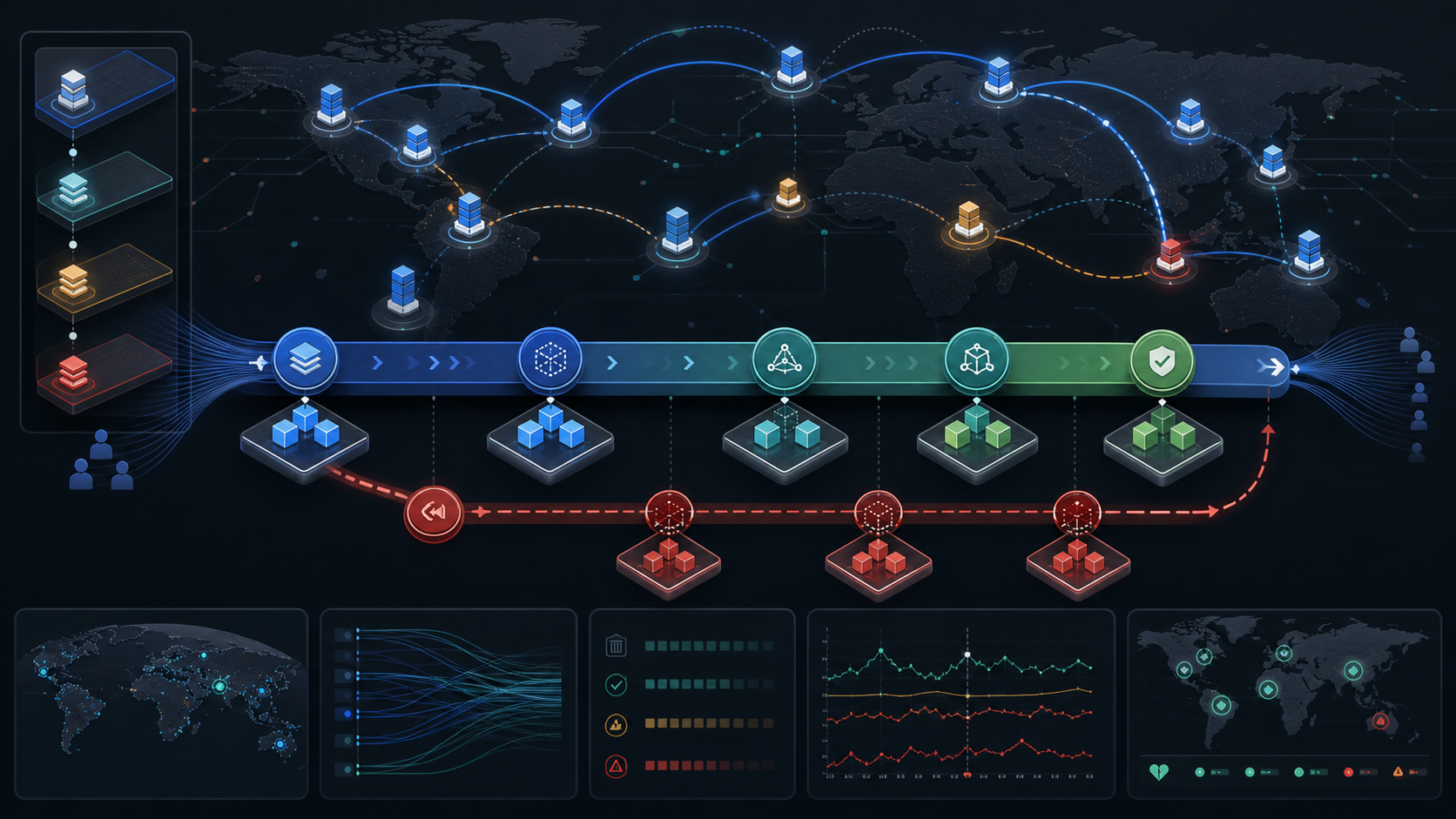
The accepted outcome is therefore not "CDN enabled". It's an edge change in production that must be bounded, explainable, observable, and reversible. If the request is accepted, intended users should get the desired behaviour. The origin shouldn't be overloaded by a careless purge. The wrong entities shouldn't stay stale. A rollback should restore the edge to a known previous service version, not an improvised guess. Logs should show enough version information, request path, cache status, error rate, and actor so the team understands what happened. If the change involves security, it must have a false-positive path and a rollback plan.
If it involves Compute, it must separate code behaviour from Fastly platform behaviour and from the customer's origin behaviour.
This framework matters because Fastly's value sits between two types of work. On one side, there's work customers would rather not do: operating a global delivery network, building a purge system, managing edge POPs, creating a programmable cache layer, streaming edge logs, running a WebAssembly runtime at the edge, and exposing deployment APIs. On the other side, there's work Fastly cannot do for them: deciding the right cache key, knowing whether a customer origin can handle revalidation traffic, writing safe business logic, governing API tokens, testing customer-specific rollbacks, or deciding what a broken checkout looks like.
Fastly is valuable when it shrinks the first category without hiding the second. It's dangerous to overvalue the story when a team treats programmable edge control as if it were automatic correctness. The question isn't whether Fastly can activate a change quickly. The question is whether the organisation can know the change was the right one, that it created no hidden side effects, and that rollback will restore the user-facing and origin-facing state the business needs.
The legal and product boundary
The subject here is Fastly, Inc., the US public company that operates the Fastly edge delivery, Compute, security, observability, and deployment tooling. The boundary matters. Fastly isn't the customer's origin application, DNS team, JavaScript bundle, release automation, or business logic. A Fastly service can sit in the path of those systems and can strongly influence their performance and failure modes, but it doesn't own every component in the user journey.
Fastly's own public disclosures make the product surface broad. In its 2025 fiscal year Form 10-K, Fastly described a platform that includes network services, Compute, observability, and security products. It described Compute as a WebAssembly-based edge environment for use cases such as search-engine optimisation, data pipelines, authentication and token handling, and ad personalisation. It also described observability features like real-time logging, metrics, alerting, log tailing, and tracing (2025 Form 10-K). These aren't mere delivery features. They make Fastly part of the software release surface.
The same report also lists risks that matter for this article: defects, interruptions, outages, performance delays, and similar issues with the platform. That's not unusual for a cloud infrastructure company. It remains central to procurement. A buyer who shifts logic and cache decisions to Fastly is buying a control surface and accepting a dependency. The point isn't to reject that dependency. The point is to price it correctly.
Fastly's Q1 2026 results show why this surface is commercially important. The company reported $173.0 million revenue for the quarter ended 31 March 2026, a 20% increase year-over-year. Network Services revenue was $126.2 million, Security revenue $38.8 million, and Other revenue, which includes Compute and Observability solutions, was $8.0 million. Fastly also reported 634 large customers, the top ten customers representing 34% of revenue, remaining performance obligations of $369 million, and trailing twelve-month net retention of 113% (Q1 2026 results).
These figures support the view that Fastly isn't a small developer tool. It's a material edge platform with enterprise concentration. But financial scale isn't proof that a given customer's edge changes are going to be safe. A platform can be large and still require careful local governance. A large customer base can signal market acceptance while leaving unanswered the operational questions that decide whether a buyer should put checkout, authentication, media delivery, software downloads, public APIs, or security controls through the edge.
Fastly's current marketing metrics need the same separation. The company reports serving more than 5 trillion daily requests as of 31 March 2026, 578 Tbps of edge network capacity as of 31 March 2026, and an average regional purge time below 150 milliseconds as of 31 December 2025 (Fastly). These are useful scale signals. They are not a guarantee that a customer has chosen the right surrogate keys, configured appropriate backend health checks, or rehearsed rollback for a faulty Compute package.
Versioning is the first rollback mechanism
Fastly's strongest documented primitive for accepted edge changes is service versioning. The CDN service documentation says that Fastly locks versions that have already been activated, allows users to clone an existing version, requires new versions to be activated before their configuration is deployed, and does not automatically activate configuration changes. It also describes immediate activation and rollback when the user has the right permissions (working with CDN services).
The Compute service documentation follows the same pattern. Activated service versions are locked. A user can clone a version, edit the clone, activate it in production, and see the activation appear in the event log (working with Compute services). That's the right shape for a developer-controlled edge platform. It gives a team a deployable unit, a previous version, and a way to go back to that previous version.
This doesn't mean rollback is automatic recovery. A prior service version restores the configuration, not time. If the faulty change purged important cache entities, caused origin overload, leaked a header, blocked legitimate users, allowed abusive traffic, changed the security posture, or wrote incorrect data through an origin path, reactivating an earlier version can stop the ongoing edge behaviour without undoing all side effects. A good rollback plan must state what is restored and what isn't.
This distinction is especially important for teams attracted to Fastly because changes can move quickly. The product makes activation easy; governance decides whether easy activation is a virtue. A small publishing team might benefit from fast configuration changes during live news events. A commerce team might need more staged review ahead of a promotion. A security team might want a WAF change to start in log mode before blocking. A platform team might require all edge changes to go through a pull request and a Terraform plan. The same Fastly versioning model can support each pattern, but it doesn't choose the pattern.
The practical test is simple. For the last ten edge changes a team accepted, can they answer four questions without heroic log archaeology? What version or package changed? Who approved and activated it? What production signal showed that the intended behaviour was happening? What exact prior state would be restored if the change had to be rolled back? If those answers aren't available, the team is using Fastly as a quick control panel rather than a governed release surface.
The Fastly CLI supports the same operational shape. Thefastly compute publishreference describes a command that wraps build and deploy operations, supports non-interactive use, and includes service availability check options like path, expected status code, and timeout (compute publish). Thefastly compute updatereference shows updating a package on the active version using--version activeand--autoclone(compute update). These controls make it plausible to wire Fastly changes into CI/CD. They also raise the bar for credential management, code review, and automated checks.
Fast activation isn't enough. A production edge change must have pre-activation tests, post-activation checks, an event log, a rollback command or procedure, and a decision rule about when to roll back. If a team can't define those items, the economic benefit of speed is ambiguous. It may be replacing slow manual work with faster uncertainty.
Compute changes are software releases, not just CDN configurations
Fastly Compute changes the evaluation because it allows customers to run code at the edge. Fastly describes Compute as an edge platform that runs code on its global network using WebAssembly and Wasmtime, with access to data stores, dynamic configuration, and real-time messaging (getting started with Compute). That's more than CDN configuration. It makes edge behaviour part of the application architecture.
This can be economically powerful. Authentication checks, personalisation, redirects, API routing, bot-handling logic, image or video decisions, and cache control decisions can all move closer to the user. A customer can reduce trips to origin, hide origin complexity, respond to traffic spikes more gracefully, or iterate on user experience without waiting for a core application release. The product promise is developer control over a strategic location in the request path.
But Compute also imports the normal economics of software lifecycle management. Code has dependencies. Dependencies have versions. Runtime behaviour differs by language. Tests can miss live traffic cases. A change that works on a local server can fail against a production origin. Error handling matters because Fastly's error documentation says that unhandled Compute errors, panics, or exceptions can produce a blank HTTP 500 if the programme terminates before generating a response, while stderr can be caught via log tailing (errors generated by Fastly).
That means the accepted output for Compute isn't "package deployed". It's "package deployed and demonstrated to produce intended production behaviour under the relevant request classes". A token validation function must have positive and negative tests. A personalisation function must define fallback behaviour when the data store fails or the origin is slow. A redirect function must prove it doesn't create loops. A bot-handling function must define how false positives are reviewed. A media function must show how it behaves when the origin returns unusual headers.
Fastly does provide test surfaces. The CLI can run Compute locally viafastly compute serve, and the command supports watch mode to rebuild and restart the local server when files change (compute serve). Fastly's testing documentation describes using that local development server with backends (testing Compute). Fastly Fiddle can create ephemeral Fastly services without account login and return instrumentation for requests and responses (Fiddle).
These tools reduce the iteration cost. They don't eliminate production uncertainty. Local testing cannot fully reproduce POP routing, regional cache state, real traffic bursts, customer origin limits, or every security control interaction. Fiddle is useful for a reduced case, but public or shareable test artefacts aren't where a team should put private business logic or secrets. The sensible operating model is layered: unit and local tests for code behaviour, Fiddle or staging-like reduced cases for edge mechanics, service version activation for controlled production release, and live logs/metrics for confirmation.
The alternative isn't always worse. Some customers might keep logic in their main application and use simpler CDN configuration. Others might use a cloud provider's native edge function product if they already concentrate identity, logging, and deployment controls in that cloud. Some might use open-source Varnish or a self-managed reverse proxy for a narrower case. Fastly's advantage is strongest when edge placement and developer control meaningfully reduce origin load, latency, operational complexity, or security exposure. It's weakest when the edge logic becomes a second application platform only a few specialists understand.
Cache state is part of the accepted output
The cache is where a small edge change can be technically correct and commercially wrong. A service version can activate cleanly, code can run, and the user can still see stale content, the origin can be flooded by cache misses, or the wrong variants can stay cached. Fastly's purge documentation makes clear why this isn't a trivial afterthought.
Fastly documents URL purges, full purges, surrogate-key purges, and bulk surrogate-key purges. It also documents soft purge for URL and surrogate-key cases using theFastly-Soft-Purge: 1header, while full purge cannot be soft (purge API). The conceptual guide explains that surrogate-key purges target entities by the surrogate key, not the cache key, and that multiple variants of an entity don't necessarily all share the requested key. It also says that full purge invalidates all content on the service and that full purge operations are automatically logged in the event log, while URL and surrogate-key purges aren't logged by default unless the edge code emits log events (Purging).
That's a dense operational lesson. Cache state isn't just a button. It's a model. If a team uses surrogate keys, it has to know which variants carry which keys. If it uses versioned asset URLs, it has to know which HTML or API responses point to those assets. If it uses soft purge, it has to understand revalidation and origin behaviour. If it uses full purge, it has to expect a broader miss wave and have origin capacity or shielding plans. If it needs evidence, it has to log the right purge actions because not all purge types are logged by default.
The accepted edge change must therefore include a cache paragraph. What content should change? Which cached entities must stay valid? What purge method is used? Are variants covered? Is origin revalidation acceptable? Is the purge action observable? What's the fallback plan if origin traffic spikes? Those questions sound mundane because cache correctness is mundane. It's also where much edge reliability lives.
Fastly's reported average regional purge time below 150 milliseconds is relevant, but it shouldn't become the buyer's entire purge model. A fast purge mechanism can still target the wrong entities. A fast global invalidation can still expose an origin that was sized for cache hits. A cache rule that saves money most days can create a customer support event if it makes prices, product availability, public safety notices, account pages, or breaking-news headlines stale. The business risk isn't just "can Fastly purge?". It's "can the customer describe what should change and demonstrate that it changed?".
This is also where developer control can create a hidden maintenance cost. VCL and Compute make sophisticated cache decisions possible. They can also produce configurations that newer engineers can't confidently read. Fastly's own Khan Academy customer story excerpt is helpful because it notes that VCL was used for complex authentication, fine-grained cache control, and routing logic, while the complexity grew and fewer engineers understood the mechanics over time (Khan Academy). That's not an argument against VCL. It's an argument for treating edge logic as code with ownership, documentation, testing, and succession planning.
Observability decides whether a rollback is real
Rollback without evidence is a ritual. A team can reactivate an earlier Fastly version and still not know whether the user impact stopped, whether the origin recovered, whether a security rule is still blocking legitimate traffic, or whether only one geography remains affected. Fastly's observability surface isn't, therefore, secondary to the product; it's part of the accepted change denominator.
Fastly documents real-time log streaming for data passing through services, with supported destinations including syslog-compatible systems, object storage, FTP, third-party observability services, data streaming systems, and analytics platforms (real-time log streaming). Its logging endpoints guide separates destinations by operational need: real-time pipelines, data stores, observability platforms, object storage, and protocol/self-hosted endpoints (logging endpoints).
The importance isn't that Fastly can emit logs. The importance is that customers must decide which logs matter before the change. A platform team deploying an edge redirect needs the request path, response status, backend name, service version, and cache status. A security team deploying a rule needs matching signals, action, false-positive review, and customer impact path. A publishing team changing cache policy needs purge events, hit/miss behaviour, origin fetches, and freshness. An API team needs latency, errors, and backend failure signals.
If the logs aren't routed to a place where engineers can query them during the change window, the edge platform is observable only in theory.
Fastly's event log documentation also matters. Event logs can show which service-level changes were made and by whom, including who activated the most recent version, and the documentation indicates that service event log data is retained for 365 days (event log). The account events API exposes fields like event type, description, user ID, token ID, service ID, IP address, and timestamps (event logs API). That gives customers an audit trail for control plane action.
But audit trails and traffic logs answer different questions. The event log can show that an actor activated a version. Traffic logs show whether the requests behaved correctly. Origin logs show whether the customer's application survived the change. Synthetic monitoring shows whether users from important regions saw the intended state. A real accepted change process joins these views. It doesn't ask Fastly to be the sole system of record.
Vendor-hosted customer stories give examples of this pattern, with the usual caution that they are seller-selected. Fastly says The Guardian uses log streaming as an early warning system after site changes, sending logs to S3 and analysing search and social bot effects (The Guardian). A Foursquare excerpt says it streams all edge logs to Observe for request, error, and latency visibility (Foursquare). These stories don't prove broad ROI. They show the right kind of operational question: when an edge change lands, what evidence will tell the team it's safe to continue?
The watchpoint is cost. High-volume edge logs can be expensive to store, index, and query. Sampling can reduce cost while hiding rare failures. Retention can satisfy daily debugging while failing audit needs. Data residency can matter if logs include sensitive fields. Fastly can stream logs, but the buyer still owns the log, redaction, routing, retention, alert thresholds, and incident practice. The cost of those choices belongs in the economic model.
Security changes must use the same denominator
Fastly's platform is no longer just a delivery surface. Its public materials and financial reports make security a big part of the company. Q1 2026 Security revenue was $38.8 million, up 47% year-over-year, per Fastly's investor release (Q1 2026 results). The product surface includes Next-Gen WAF, bot management, DDoS protection, API security, and rate limiting.
Security controls strengthen the case for edge placement. Blocking abusive traffic before it reaches the origin can protect infrastructure and reduce downstream cost. Rate-limiting a costly API route at the edge can prevent a single customer or bot pattern from consuming capacity. A WAF rule can observe or block request classes across applications that would otherwise require per-application changes. But the accepted output is still a change, not a feature flag.
Fastly's Next-Gen WAF rules documentation says that rules define how the WAF handles requests that match condition sets and can exist at the account/corporate level or at the site/workspace level (Next-Gen WAF Rules). Its WAF API reference says that the APIs manage workspaces, requests, events, redactions, tags, and rules for customers with product access (Next-Gen WAF API). The rate-limiting documentation describes policies attached via the security surface or service configuration and conceptually frames rate limiting as a way to limit abusive traffic or costly/billable resources (rate-limiting policies).
Those are useful controls. They aren't the same as a security outcome. A rule that blocks a real attack is valuable. A rule that blocks checkout, mobile clients, partner API calls, or search crawlers is costly. A rate limit that protects the origin from a bot can also punish legitimate bursts if the grouping key is wrong. A WAF in log mode might be safer at first but might not reduce attack load. A WAF in block mode might reduce attack load but increase false-positive risk.
A security change needs the same acceptance criteria as a delivery change: condition set, intended action, scope, logging, alert owner, false-positive path, rollback step, and post-change review.
The distinction is especially important because Fastly's edge controls can sit close to revenue. A commerce bot rule, a media token check, an API rate limit, or a login protection rule can affect users before the application sees them. That placement is why customers buy the product. It's also why change control matters. The closer a rule is to the first mile of user traffic, the less time the organisation has to discover that the rule is wrong.
Fastly can make security actions easier to deploy consistently. The customer still has to decide who can create the rule, who reviews exceptions, how rules are tested against representative traffic, whether logs show blocked and allowed cases, and how quickly a rollback can be activated. If security and platform teams own different parts of this process, the accepted change must explicitly name both owners. Otherwise, the edge becomes a place where urgent security action and production reliability collide without a shared release model.
The control plane is a dependency
Fastly's architecture can reduce origin dependency for users, but it doesn't eliminate dependency on Fastly's own control plane and account systems. Activating service versions, changing Compute packages, editing security configurations, issuing purges, using APIs, setting up logs, and reading event history all depend on Fastly account access and control plane capabilities.
Fastly documents status pages for that reason. The company says it continuously monitors the performance and status of its global network and related services, publishes public updates at fastlystatus.com, offers private status details to authenticated customers for sensitive components, and provides incident history and subscription controls (Fastly's service status). Public status is useful, but it isn't a customer-specific source of truth. A customer could have a faulty origin, an incorrect service version, a DNS error, a faulty WAF rule, or a regional routing problem while the public status page looks normal.
During the evidence step for this article, direct requests to the public status API from the research environment returned HTTP 403 after the legacy status domain redirected to Fastly's current status domain. Search snippets still showed the public status page reporting normal operations on 11 July 2026 and exposing recent public incident records for API Services, Compute in Palo Alto, and elevated errors or latency in London POPs. That isn't enough to compute incident frequency or availability. It's enough to reinforce the procurement point: status evidence has to be part of the customer's own monitoring plan, not a substitute for it.
Account governance is the other control plane dependency. Fastly's API token documentation describes user tokens tied to human users and automation tokens for non-human clients. Token scopes include global, purge-all, purge-select, and read-only. Automation tokens require a sudo-mode superuser and aren't tied to a human user (API tokens). This is exactly where CI/CD convenience and blast radius meet.
A token that can activate service versions, update Compute packages, or purge the whole cache is a production credential. It needs the same treatment as a cloud deployment key: least privilege, expiry, storage, rotation, ownership, emergency revocation, and audit. A purge-select token might be enough for a pipeline. A read-only token might be enough for dashboards. A global token might be convenient until it shows up in a build log or a developer's laptop gets compromised.
User roles and account permissions also shape the economics of change. Fastly documents that user roles determine what a person can see and manage, while users can manage personal MFA and API tokens regardless of role (roles and permissions). A mature buyer will map those roles to their release process. Who can clone a service version? Who can activate into production? Who can purge all cache? Who can create automation tokens? Who can change WAF rules? Who can disable a logging endpoint? If those answers aren't clear, Fastly's developer-friendly surface can become a governance gap.
Terraform and CI make changes repeatable, with their own costs
Fastly's Terraform guide is valuable because it states clearly the quiet part of edge operations. Fastly has a provider for configuring, managing, and deploying services; service versions can be created without activation; and some resources are versionless, including ACLs, dictionaries, and dynamic VCL snippets. The guide also warns that Terraform state is sensitive, that state locking helps avoid data races, and that Terraform is meant for configuration rather than data (Terraform guide).
That's a mature distinction. Infrastructure as code can make Fastly changes reviewable and repeatable. It can also create a new class of drift and state risk. Versionless resources are particularly important because they can change outside the normal service version lifecycle. That might be exactly what a customer wants for fast updates. It can also make the accepted change boundary harder to see if data, dynamic snippets, or ACL entries are populated by scripts outside Terraform.
The economic benefit of Terraform is strongest when the organisation already reviews infrastructure changes in code. Fastly then becomes another provider in a known process: plan, review, apply, observe, revert. The cost appears when the edge service becomes too dynamic for the review system. A dictionary entry could control routing. A dynamic snippet could change behaviour quickly. An ACL could affect security. If those entities are updated via separate APIs without the same review and logging, the team can have versioned services and still have unreviewed production behaviour.
The same is true for CI. The Fastly CLI and public repos show active tooling surfaces. Public GitHub API metadata forfastly/clidescribed it as a terminal tool for building, deploying, and configuring Fastly services, andfastly/compute-actionsas GitHub Actions for building on Fastly Compute. Repo metadata isn't a quality audit, but recent push timestamps in July 2026 show active public tooling surfaces.
CI can reduce manual mistakes, enforce tests, and create repeatable deployment records. It can also shift risk onto scripts. Automation can activate too broadly, use the wrong service ID, suppress an interactive confirmation with--auto-yes, use an overprivileged token, or skip a health check because it's inconvenient. The buyer must count the work needed to make automation safe: release reviews, environment separation, token management, service ID controls, dry-run or plan output, approval gates, rollback commands, and post-deployment monitoring.
That work isn't a Fastly failure. It's the cost of treating edge behaviour as software. The more valuable the edge becomes, the more it deserves the release discipline of core application code.
Customer stories show the upside and the maintenance warning
Vendor customer stories shouldn't be read as neutral benchmarks. They're seller-selected and generally omit raw configs, traffic volumes, support cost, failed experiments, incident logs, and counterfactuals. Used carefully, they still help identify real usage patterns.
The Fastly customer story index and excerpts show several patterns relevant to accepted edge changes. USA TODAY Co. engineers are described building a custom load-balancing solution using edge dictionaries, VCL snippets, and backend health checks, while the broader story reports bot traffic reduction across many sites (USA TODAY Co.). GIPHY is described using VCL flexibility to optimise cache hit rates and save compute resources (GIPHY). Dunelm is described using Fastly as part of digital transformation, faster site updates, and infrastructure-as-code strategy, with the page reporting big improvements in deployment speed and performance (Dunelm).
These examples support the positive case. Fastly can become a programmable operational surface for teams that want more than basic caching. Edge dictionaries, snippets, backend health checks, VCL logic, Compute, and log streaming can let customers solve problems in the request path where latency, origin load, and security exposure are highest. A developer-friendly edge can be materially better than waiting for a core application release or over-provisioning origin systems.
The same examples imply the cost. Custom load balancing is custom logic. Cache-rate optimisation depends on expertise. Infrastructure-as-code speed only helps if the code stays reviewable. VCL complexity, as the Khan Academy excerpt notes, can grow until fewer engineers understand it (Khan Academy). That's the maintenance line buyers mustn't ignore.
The procurement question isn't whether Fastly can produce impressive results for selected customers. It's whether a given organisation has the operating model to keep those results healthy after the first enthusiastic implementation. Who owns the VCL? Who owns the Compute dependencies? Who reviews the dictionaries? Who reviews the WAF rules? What happens when the edge specialist leaves? How are new engineers trained to understand cache and purge behaviour? Does the team have a readable architecture document for each service? Are edge changes included in incident reviews?
Fastly's business promise is developer control. Developer control creates value when many engineers can use it safely. It creates fragility when only one or two engineers can explain why production works.
Comparing realistic alternatives
The fair comparison isn't Fastly against a blank sheet. Customers have alternatives. They can leave behaviour in the origin application and use a simpler CDN. They can use another CDN or cloud edge platform. They can build with a cloud provider's native load balancer, CDN, WAF, and edge function products. They can run open-source Varnish or a reverse proxy for a narrower deployment. They can use multi-CDN routing. They can also choose to do less at the edge.
Fastly is appealing when the accepted edge change is frequent, important, and better located at the edge than at the origin. Breaking-news sites, software distribution, public package registries, media, high-traffic commerce, latency-sensitive APIs, and high-security workloads can have this property. In those environments, a cache or security change that takes hours can be too slow, and a core application release can be the wrong place to express delivery behaviour.
The established SaaS or cloud provider alternative can be better when the organisation values a single control plane over edge specialisation. If a company already runs identity, deployment, WAF, logging, and monitoring in one cloud, adding another edge platform might increase integration work. If a team has simple static assets and low traffic, Fastly's richer controls might be unnecessary. If a company can't hire edge expertise, a managed CDN with fewer controls might be safer than a programmable platform.
Open-source and in-house options look attractive when control matters more than global network operation. A company can self-manage Varnish, write its own reverse proxy logic, or use cloud-native functions. But the buyer then owns the global reach, operations, DDoS posture, peering, monitoring, purge semantics, support, and staffing. The cost shifts from the vendor bill to the engineering payroll and operational risk. That can make sense for a company with unusual requirements. It's generally a heavier lift than the initial architecture diagram suggests.
Multi-CDN strategies are the most nuanced alternative. They can reduce vendor concentration and improve resilience, but they increase the configuration, testing, and observability work. A service must decide which entities and routes are portable, how cache keys align, how purge semantics differ, how logs are normalised, how security rules are rendered, and which provider is authoritative during an incident. Multi-CDN isn't free redundancy. It's another accepted change system.
Fastly's case is strongest when a team wants high-control edge behaviour and is willing to operate that control as software. It's weakest when a buyer wants the edge to remove operational responsibility.
What buyers should measure
The useful metric is cost per accepted edge change. That includes the licence and usage cost, but it's broader than the bill. It includes the time to specify the change, build it, test it, review it, activate it, observe it, handle exceptions, roll it back if needed, and maintain the resulting configuration over time. It also includes the switching cost if the organisation later wants to move the behaviour to another CDN, a cloud provider, open-source infrastructure, or back to the origin application.
A buyer can make this concrete before signing or expanding. Pick recent or expected changes and run them through a checklist. For a cache change: define the entities, variants, keys, purge method, origin impact, and evidence. For a Compute change: define local tests, runtime errors, dependency versions, staging behaviour, production checks, and rollback. For a security rule: define condition set, action, logging, false positives, and rollback. For a logging change: define destination,, retention, cost, and alert owner. For a Terraform change: define state, locking, drift, dynamic resources, and activation policy.
Then compare alternatives using the same denominator. How would the same change work with the current CDN? With a cloud edge platform? In the origin application? With open-source Varnish? With a manual ticket? Without doing anything? The answer will vary by organisation. The important thing is that Fastly is evaluated against real work, not generic CDN slogans.
There are watchpoints. If edge changes require too many specialists, the maintenance cost rises. If the purge strategy is poorly understood, the cache risk rises. If logging is expensive or incomplete, rollback confidence drops. If API tokens are overprivileged, automation risk rises. If security rules aren't tested against representative traffic, false positives become a business risk. If customer origin behaviour isn't included in the plan, a successful Fastly activation can still create an application incident.
There are also positive signals. If a team can express edge changes as versioned, reviewed, and testable units; if it can tie activation events to traffic logs and origin metrics; if it can roll back without guessing; if it can teach more than one engineer how the services work; if it can scope tokens and roles; and if it can run live checks in the regions that matter, Fastly's developer-control economics become much more compelling.
The verdict
Fastly, Inc. must be judged by the accepted edge change. Its platform has serious ingredients for that standard: versioned services, explicit activation, rollback to prior versions, Compute tools, local testing, Fiddle, purge APIs, soft purge, real-time logs, event logs, Terraform integration, API automation, WAF rules, and rate limiting. Those are the right primitives for a company that wants to let developers shape traffic at the edge.
The buyer's burden is to turn the primitives into an operating system. Fastly cannot know the right cache key, the appropriate security exception, the origin's revalidation capacity, the acceptable false-positive rate, the retention rule for edge logs, or the staffing plan for VCL. It can give teams a powerful place to make changes. It cannot make every change correct.
That's why the business question isn't whether Fastly is fast, programmable, or large. The public evidence supports that it is a substantial programmable edge platform with significant enterprise use. The question is whether the customer's ordinary production changes get cheaper and safer after counting the full cost of oversight, testing, integration, logging, incident response, rollback, and future switching.
When the answer is yes, Fastly can move important work from slow origin releases to a responsive, observable edge layer. When the answer is no, the same control can turn into another production system with its own specialists, credentials, hidden state, and failure modes. The product is best understood as a force multiplier for disciplined teams, not a replacement for discipline.