
Summary
- Exide Technologies SAS has a real French corporate and industrial base, and its official materials show a business built around automotive batteries, motion systems and energy solutions for telecom, UPS, data centers and BESS. That makes network control operationally relevant, but it does not by itself prove a customer-facing ISP or telecom-services business.
- The public RIPE NCC membership evidence should be read as a control option: it can support address management, continuity and technical autonomy for a distributed industrial supplier. The capital-recovery case remains unproven until Exide shows that the control lowers outages, improves service margins, protects regulated customer relationships or opens a measurable revenue line that carriers and cloud substitutes cannot compress.
The French Boundary Turns Network Control Into A Cost Test
The first economic constraint is geography. Exide Technologies SAS is a French simplified joint-stock company headquartered in Gennevilliers, near Paris, with French registration number 682 030 895, a stated share capital of EUR 38.5 million and an official activity in the manufacture of batteries and electric accumulators. Public company records list the head office at 5 allee des Pierres Mayettes in Gennevilliers, active secondary establishments including Herblay-sur-Seine, Cesson-Sevigne and Lille, and an employee band of 250 to 499 in France for the 2022 record.
The company's own legal notice confirms the same French legal identity, Nanterre registration and head-office address.
That local boundary matters because the network-control question is not abstract. A France-anchored operating company pays for technical control through French staff, French facilities, European compliance obligations, procurement processes, cyber-risk controls, energy costs and the opportunity cost of capital that could otherwise go into production modernization, battery chemistry, service teams or working capital. If the company has address resources, membership obligations, routing arrangements or private connectivity capabilities, those assets sit inside a broader industrial cost base rather than a stand-alone telecom platform.
The alternative available to many of Exide's customers is simpler. A mobile operator, tower company, data-center operator, logistics site, manufacturer or public-sector buyer can buy backup-power equipment from Exide while taking connectivity from Orange Business, a systems integrator, a cloud provider, a colocation operator or another managed-service substitute. In that world Exide may benefit from controlling its own resources for resilience, but it must show that this control produces value beyond what outsourced connectivity already provides. Local control is not free optionality. It is a fixed-cost position that has to earn its keep.
The core capital-recovery test is therefore narrow: does Exide's local network footprint support revenue that would be lost without it, or does it materially lower the cost and risk of serving critical infrastructure customers? If the answer is only that network control is technically useful, the value accrues mostly to internal reliability. That can still be economically rational, but it should be judged like plant maintenance, certification or environmental compliance: necessary for some contracts, hard to monetize, and exposed to constant pressure from larger suppliers that can spread the same capability across more customers.
The Company Is A Battery Manufacturer Before It Is A Network Actor
The public identity of Exide Technologies SAS is industrial. The company describes itself as a global battery-storage business serving automotive and industrial sectors through lead-acid and lithium-ion technologies. Its 2025 ESG report places the portfolio across 12V automotive batteries, traction batteries for material handling and robotics, stationary batteries for UPS and telecommunications, utility-scale energy storage, behind-the-meter systems and specialist propulsion batteries. The same report frames three commercial divisions: Automotive, Motion and Energy Solutions.
That mix is important for telecom economics because Exide is not approaching connectivity from the normal starting point of an access provider. It is not primarily selling broadband lines, mobile service, IP transit, cloud hosting or managed WANs. It sells stored-energy products and related service capability to customers for whom power continuity is part of operational risk.
Its telecom page is explicit that mobile networks rely on base transceiver stations and telecom towers, that these sites require robust battery systems during grid outages, and that Exide supplies batteries and UPS solutions to mobile network operators, tower companies and BTS equipment manufacturers. Its data-center and UPS pages make the same point for servers, critical systems, hospitals, factories, financial services and telecommunications.
In economic terms, Exide sits adjacent to connectivity rather than inside the connectivity revenue pool. Its product may keep a network alive when the grid fails, but the company does not automatically control the customer relationship for the network service itself. This is a valuable but contested position. Critical-power vendors can be deeply embedded in infrastructure procurement, yet the highest-margin recurring control points may sit with the operator, cloud platform, facility manager or systems integrator that bundles monitoring, connectivity, software and lifecycle management.
The company's history reinforces the industrial reading. Exide says the EMEA and Asia-Pacific business became a standalone company in October 2020 after separating from the US group and transferring to new ownership under Energy Technologies Holdings LLC. At that point Exide described itself as headquartered near Paris, serving global markets with more than 5,000 employees across Europe, the Middle East, Asia and Australia, operating two R&D facilities and eleven production plants in Europe, and generating EUR 1.4 billion of turnover in fiscal 2020.
That is the scale of a manufacturing and energy-storage platform, not a local telecom challenger.
The distinction is not semantic. If a battery company carries network resources, the reason may be internal autonomy, customer support, monitoring, secure remote access, operational separation or continuity for field systems. Those can be serious reasons. But the strategic value depends on the company's ability to convert technical control into lower failure rates, faster service recovery, better warranty economics, stronger contract renewal, or credible differentiation in critical-power tenders.
Otherwise the footprint is a support function sitting inside a business that is judged by battery reliability, cost, compliance and service reach.
RIPE Membership Shows Control Capacity, Not A Retail ISP Proposition
The RIPE NCC public member evidence is the main network-resource signal attached to Exide Technologies SAS in public infrastructure records. It links the entity to RIPE's French member directory under the CEAC label, reflecting the legacy Compagnie Europeenne d'Accumulateurs lineage visible in Exide's French corporate history and establishment records. Pappers still shows a closed Saint-Ouen-l'Aumone establishment with the CEAC trade sign, and the Exide history records expansion into Europe and the consolidation of established regional battery brands.
That signal matters because RIPE NCC membership is not a casual marketing badge. In ordinary network economics, membership and number-resource administration can indicate that an organisation wants direct control over Internet number resources, administrative contacts, registry records and routing-related governance. For a distributed industrial company, such control can support stable addressing for internal systems, plant connectivity, customer portals, remote monitoring, supplier integration, security segmentation and continuity planning. It can also reduce dependency on a single connectivity provider for identity and renumbering.
But RIPE evidence must be kept in its lane. A member listing is not proof that Exide sells ISP service, operates public access networks, provides IP transit, runs a cloud platform or competes directly with carriers. The evidence records a RIR member or resource-holder footprint and official service-area context, not proof of a managed-network services business. That caution is especially important for a company whose official pages sell batteries for telecom infrastructure rather than connectivity itself.
The positive interpretation is that Exide may have preserved network autonomy because its customers and sites make downtime expensive. Battery systems for mobile towers, data centers, UPS rooms and industrial facilities are often tied to monitoring, field support, warranty response and equipment performance data. If Exide can maintain stable addressing and secure access across countries and service partners, it can reduce the friction of supporting those systems.
For some customers, especially where critical-power assets are linked to service-level obligations, a vendor with stronger operational control may be more credible than a vendor fully dependent on third-party connectivity arrangements.
The negative interpretation is that the footprint is a historical or administrative residue. CEAC, Fulmen, Tudor and other legacy battery brands sit inside a long acquisition history. It is possible for number-resource and membership records to persist because they are useful but not central, because renumbering is inconvenient, or because an old industrial network still supports email, websites, monitoring or internal applications. The market does not reward resource ownership by itself. It rewards service outcomes.
That is why the correct capital-recovery question is not whether RIPE membership is real. The question is whether the cost of maintaining that control is smaller than the avoided cost of outages, vendor lock-in, cyber exposure and contract friction. If the footprint is small and efficiently run, the hurdle may be easy to clear. If it requires specialist staff, audits, security work, equipment refreshes and provider coordination across several countries, the hurdle rises sharply.
The Business Model Pays For Reliability When Outages Are Expensive
Exide's business model gives the strongest reason to care about local control: its products are bought when failure is costly. The company's telecom materials say base transceiver stations and telecom towers need batteries to maintain continuous operation during grid outages, voltage fluctuations and peak-demand periods. Its UPS materials make the same continuity argument for data centers, healthcare, IT, financial services, emergency response, manufacturing and telecom networks. The product is not discretionary comfort. It is insurance against downtime.
That creates a natural bridge between power continuity and network continuity. A battery system that cannot be monitored, diagnosed, serviced or integrated reliably loses part of its economic promise. In the customer's eyes, the value proposition is not just lead-acid or lithium chemistry. It is uptime, predictable maintenance, warranty confidence, response speed, thermal management, safety and total cost of ownership. Exide's Motion division explicitly speaks in total-cost-of-ownership terms for material-handling customers, while the Energy Solutions division emphasizes resilient infrastructure and energy management.
Network control can support that model in several ways. First, it can make service data more portable and less dependent on the customer's chosen carrier. Second, it can support secure remote access to installed systems, especially where field dispatch is expensive. Third, it can reduce the friction of supporting multi-country accounts that operate in different carrier environments. Fourth, it can help Exide maintain separation between corporate traffic, customer equipment monitoring and supplier systems. Fifth, it can give the company more bargaining leverage when buying connectivity for its own sites or service platform.
The economic upside is clearest where customers buy outcomes rather than boxes. If an operator or data-center customer pays for availability, lifecycle support or monitored energy performance, Exide can capture more margin from service continuity. If the sale is mainly product shipment through distributors, local network control is less valuable. A battery placed into a simple replacement channel does not need the same network architecture as a managed fleet of critical-power assets.
The company's official product expansion suggests it wants to move further into systems rather than remain only a conventional battery supplier. The ESG report says Exide introduced Solition Mega Three in fiscal 2025, launched Solition Telecom, expanded EV charging infrastructure with Powerbooster Mobile and strengthened advanced lithium-ion capability through the BE-Power acquisition. Its website continues to market BESS, telecom, data-center and UPS solutions. Those are more integrated markets than basic aftermarket batteries. They make network control more plausible as an operating capability.
The problem is that integrated markets also attract larger and better-capitalized substitutes. Cloud platforms, carriers, electrical contractors, data-center integrators and battery giants all want pieces of the same continuity budget. Exide can win when its battery expertise, European service network and customer trust are decisive. It cannot assume that network control gives pricing power unless customers experience it as lower risk or lower lifetime cost.
Pricing Power Comes From Continuity, Certification And Switching Friction
Pricing power in this market is not created by having technical assets. It comes from making the buyer uncomfortable with switching. Exide has several plausible sources of switching friction: installed batteries, brand history, application know-how, product certification, service coverage, recycling arrangements, warranty obligations, OEM approvals and compatibility with customer equipment. The company's 2020 standalone announcement says Exide serves automotive and industrial markets under several well-known brands and acts as an original-equipment manufacturer to leading automotive and industrial equipment manufacturers.
Its ESG report names brands such as Tudor, Fulmen, Centra, Sonnak, Deta, Sonnenschein, Marathon, Sprinter, Tensor and Solition.
Those brands are economically useful because they reduce customer uncertainty. A data-center operator does not want to discover a battery-quality problem during an outage. A telecom operator does not want a tower-backup issue across hundreds of sites. A warehouse operator does not want poor traction-battery performance to lower forklift utilization. Exide's brand portfolio, installed base and application history can support a premium if the customer believes the product and service reduce failure risk.
Network control can add to that premium only if it reinforces those switching costs. A customer may pay more if Exide's monitoring, diagnostics, service history and technical support reduce operating risk. A customer may accept a long-term contract if Exide can show that its systems integrate predictably with the customer's infrastructure. A customer may prefer Exide if the vendor can demonstrate better incident response because it controls part of the technical path instead of waiting on a carrier or integrator.
The danger is that buyers may not see or reward the hidden layer. Procurement teams often compare batteries by specification, expected life, warranty, installation cost and supplier track record. Network architecture can be invisible until failure. If Exide cannot translate control into measurable service-level outcomes, the buyer may treat it as vendor overhead. In that case the company bears the cost while the price is set by product competition.
This is where larger carriers and cloud platforms become serious substitutes. They do not need to manufacture batteries to capture the customer's operational-control budget. They can bundle private connectivity, managed security, cloud monitoring, incident management and service desks around equipment supplied by others. If the customer buys a managed infrastructure wrapper, Exide's local control may become a supplier input inside someone else's margin stack. The company would still sell batteries, but it would not own the most valuable recurring relationship.
The proof of pricing power would be evidence of multi-year service contracts, attach rates for monitoring and maintenance, lower churn in telecom and data-center accounts, or margins that improve as Exide sells more integrated energy solutions. Public materials show the strategic direction, but they do not provide enough segment economics to conclude that network control is already earning a premium.
The Cost Base Is Heavy Before A Single Router Is Counted
Exide's cost base starts with manufacturing. Public French records classify the company under battery and accumulator manufacturing. The official location page lists European headquarters in Gennevilliers, automotive manufacturing in Spain, Germany, Poland and Italy, industrial-energy manufacturing in Germany, Portugal, Spain, France and Poland, distribution centers across Europe, and recycling facilities in Portugal and Spain. The French records show the Lille manufacturing establishment under the L'Accumulateur Tudor sign and Herblay as a wholesale electrical-materials site.
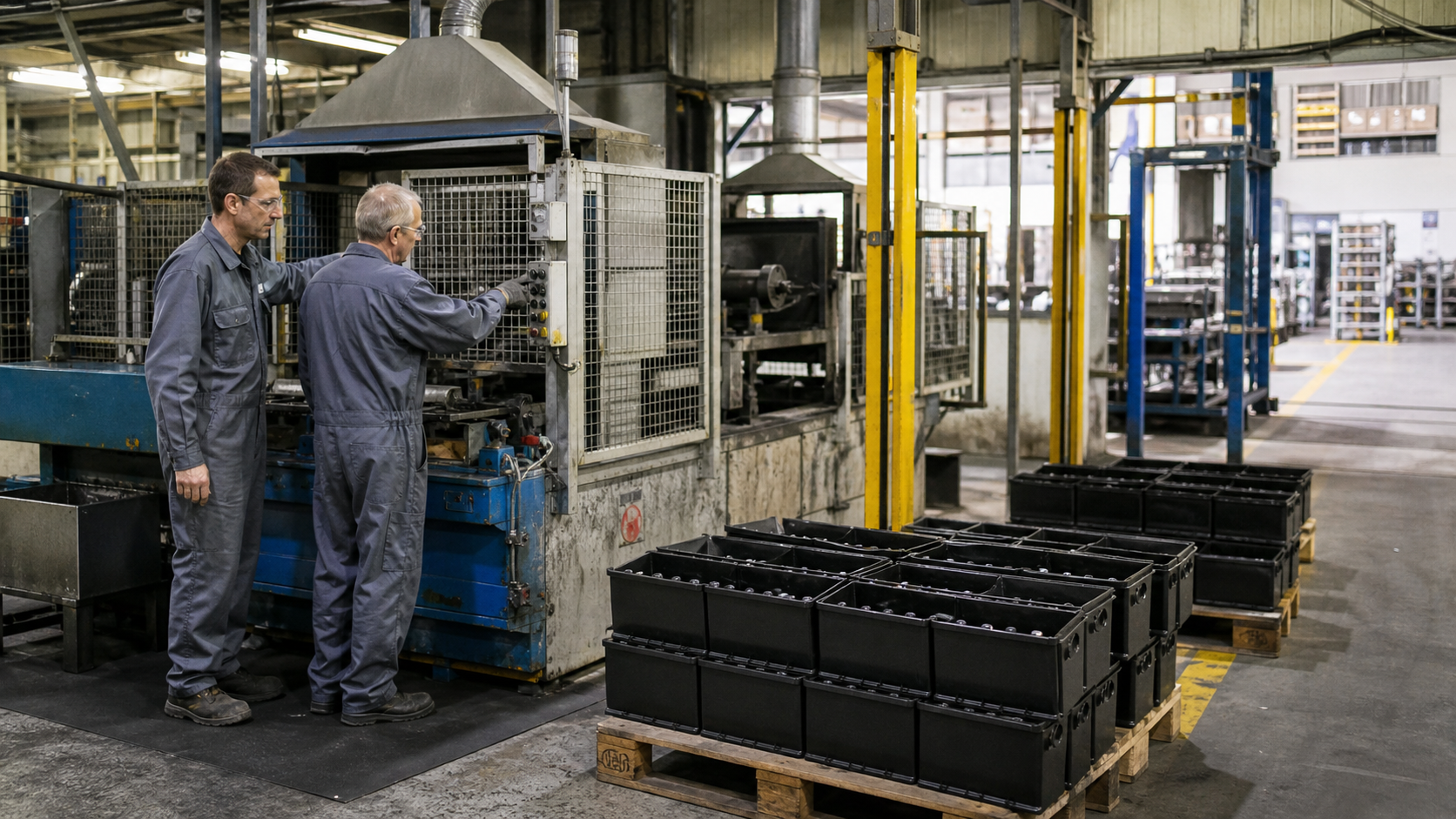
The economics of such a footprint are capital intensive. Battery manufacturing requires plant, equipment, materials, environmental controls, quality systems, safety programs, product engineering, inventory and working capital. Industrial-energy systems add service and engineering demands. Recycling adds environmental and regulatory complexity even when it improves material circularity. Exide's own sustainability materials emphasize pollution management, waste and hazardous-material controls, water use, emissions reduction and supplier due diligence.
This matters because network control competes for capital inside the same envelope. Every euro spent on internal network architecture, address management, routing resilience, security tooling or specialist staff has to beat alternatives: plant modernization, automation, energy efficiency, lithium-ion capability, BESS product development, customer-service capacity or compliance systems. In a pure ISP, network investment is the product. In Exide's case, network investment is a support layer unless it directly enables monetized service.
The Lille situation shows how quickly industrial fixed costs can dominate strategy. Public reporting in 2025 said Exide Technologies planned to close its historic Lille lead-battery site, threatening 211 jobs, with the company citing declining demand for lead batteries and competition from lithium batteries produced in China and emerging gigafactories in Hauts-de-France. The same reporting noted environmental pressure around lead contamination.
Even if a buyer treats that article cautiously, it illustrates the real economic problem: industrial assets can become hard to recover when technology mix, demand and compliance costs move against them.
Exide's 2025 ESG report also shows that the company is investing in sustainability and compliance: a 2024-2030 sustainability strategy, a double-materiality assessment, progress on Scope 1 and Scope 2 emissions, pollution-management policy work, supplier risk screening and supply-chain intelligence. These are not optional for a European battery company. They are part of the cost of staying eligible for customers, regulators and investors.
Against that backdrop, the local network footprint has to be right-sized. If it is a modest governance and addressing layer that prevents lock-in and supports monitoring, it can be a rational cost. If it grows into a quasi-telecom platform without external revenue, it risks becoming strategy theatre: visible technical sophistication without capital recovery.
Supplier Dependence Limits How Much Local Control Can Capture
Exide's supplier dependence is visible in its own sourcing materials. The supplier-information page says suppliers play a central role in a sustainable, ethical and resilient value chain. It requires compliance with a supplier code of conduct covering ethical business practices, human rights, labor conditions and health and safety. It expects environmental controls, conflict-minerals and due-diligence alignment for battery materials, transparency on material origin and recycled content where applicable.
The ESG report adds that direct material suppliers undergo continuous risk screening by a third-party provider across sanctions, financial risk, reputational risk, political exposure, ESG factors and cybersecurity.
This supplier structure limits the profit that any local network-control footprint can capture. Batteries are exposed to raw materials, recycled lead flows, lithium-ion cell supply, electronics, chargers, enclosures, energy prices, logistics and manufacturing yields. A company can own its IP resources and still be price-taken on critical inputs. It can control remote monitoring and still depend on third-party software, telecom carriers, cloud infrastructure, transport providers and industrial suppliers.
The point is not that supplier dependence makes Exide weak. All industrial companies have suppliers. The point is that the bargaining game is multi-layered. If lead, lithium, electronics, transport or energy costs rise, network control does not necessarily protect gross margin. If a customer can buy a complete managed-energy package from another supplier, Exide must prove that its own integration gives a lower total cost or lower risk. If a cloud or carrier can host the customer-facing monitoring layer, the economic rent may shift away from Exide even if Exide's batteries remain in the cabinet.
The EU Batteries Regulation increases this pressure by moving compliance deeper into the product lifecycle. It introduces sustainability, safety, labelling, collection, recycling, recycled-content and due-diligence requirements across battery categories. For European suppliers, that regulation can be a barrier to low-quality entrants, but it also raises documentation and systems costs. Firms with better compliance infrastructure may gain trust; firms with weak systems lose eligibility.
Network control can help manage supplier and compliance data, but it does not remove the obligation. The economically attractive case is where Exide uses technical control to reduce compliance friction: traceability, product data, service records, remote diagnostics, and secure customer reporting. The unattractive case is where the company pays for local control while compliance, supplier risk and product certification remain separate cost centers that customers do not reward.
Customers Can Buy Simpler Alternatives From Carriers, Clouds And Managed Providers
The most direct competitive threat is simplicity. Exide sells into customers that already buy from large communications and cloud providers. A telecom operator has network vendors, tower-service firms, managed-security providers and energy suppliers. A data center has colocation providers, cloud interconnects, UPS vendors, facilities-management contractors and software platforms. A manufacturer has carriers, systems integrators, cloud services and industrial automation vendors. In each setting, the buyer may prefer fewer suppliers and clearer accountability.
Orange Business, AWS Direct Connect, Microsoft Azure ExpressRoute, Google Cloud Interconnect, OVHcloud and other providers illustrate the substitute logic. They can sell connectivity, private network access, cloud adjacency, monitoring, security and managed operations without owning the customer's battery chemistry. Their proposition is not that they replace Exide's physical product. It is that they can own the digital control plane around equipment, sites and applications. If a customer values operational simplicity, the managed provider can become the primary interface while specialist hardware vendors become components.
That is why Exide's capital-recovery test must include buyer behavior. A customer may admire Exide's European service network and still choose a cloud-native monitoring platform. A tower company may buy Exide batteries while standardizing connectivity through its carrier relationships. A data-center customer may care about UPS performance but place network observability under its existing provider. A public-sector or regulated buyer may prefer a larger prime contractor that can handle liability across domains.
Exide has counterarguments. It knows battery behavior, degradation, charging, thermal constraints, site-level operating conditions and warranty failure modes better than a generic managed-network provider. Its official materials emphasize energy consultation, service all over Europe and MEA, R&D in Europe and designed-and-assembled-in-Europe energy solutions. In critical-power applications, domain expertise matters. A cloud platform can monitor data, but it cannot always interpret battery-specific degradation or field-service tradeoffs as well as the manufacturer.
The strategic question is whether Exide can keep enough of the digital interface to defend margin. If it merely ships batteries into a managed provider's stack, its pricing will be pressured by product comparison. If it owns the lifecycle data and service relationship, its local network control can support recurring revenue and customer retention. The difference is not marketing language. It is contract structure, renewal behavior and margin disclosure.
Visible Growth In Batteries Is Not The Same As Value Creation In Network Control
Exide's end markets have visible growth signals. Telecom sites need backup power. Data centers are expanding. Industrial energy flexibility is becoming more valuable as power prices, grid constraints and renewable integration shape operating decisions. Battery energy storage systems are moving from demonstration to commercial procurement. Exide's own 2026 website highlights data-center backup, telecom batteries, Solition BESS products and energy flexibility messaging. Its ESG report presents the Energy Solutions division as supporting telecom, utilities, data centers and BESS.
But visible market growth can mislead investors and customers if it is confused with value creation. A battery supplier can grow sales while margins compress because lithium-ion competitors scale faster, lead-acid demand declines in some applications, raw-material costs move against it, or customers demand integrated service at product-only prices. Growth in data centers or telecom does not automatically mean Exide captures the economics of digital infrastructure. It may capture the hardware, while carriers and cloud platforms capture the recurring service layer.
This is the Elias Ward distinction between revenue growth and value creation. Revenue growth asks whether more batteries, systems or services are sold. Value creation asks whether returns exceed the capital and operating cost required to produce them. For Exide's local network control, value creation would require evidence that the footprint protects or expands returns. It is not enough that telecom and data centers are growing markets. It is not enough that Exide sells into them. The question is whether the network-control layer makes Exide more profitable, more resilient or more strategically indispensable.
The company's 2020 standalone press release provides a useful baseline. A EUR 1.4 billion turnover business with more than 5,000 employees and eleven European production plants can absorb some shared technical overhead. A small resource-control capability may be economical precisely because it rides on a large industrial platform. The danger appears if the company or outside observers overstate that capability as a telecom business. The value of the footprint should be judged in proportion to its function.
The best interpretation is therefore pragmatic. Exide's network-resource evidence supports an operational-control thesis, not a hidden ISP-growth thesis. It may help Exide serve customers whose energy assets must stay visible and supportable during disruption. It may reduce carrier lock-in and protect continuity. It may make European service operations more robust. These are real benefits if they show up in uptime, contract renewal and service margin. They are not the same as proof that the company can price like a connectivity provider.
Regulation And Site Risk Raise The Hurdle Rate
Regulation cuts both ways for Exide. On one side, strict battery regulation, environmental compliance and supplier due diligence can protect established European suppliers from weaker competitors. Customers in telecom, data centers, public infrastructure and industrial sites often prefer suppliers that can document safety, recycling, product quality and continuity. Exide's sustainability materials show an effort to build that credibility through ESG reporting, a 2024-2030 strategy, supplier screening, Scope 1 and Scope 2 emissions targets and recycling operations.
On the other side, regulation raises fixed cost and reduces tolerance for operational mistakes. The EU Batteries Regulation imposes lifecycle obligations around sustainability, safety, labelling, producer responsibility, due diligence and recycling. Exide's own ESG report identifies pollution, resource usage, climate, workforce, safety and supply-chain topics as material. The company says it is developing pollution-management policies, improving data collection and working toward emissions and renewable-energy targets. These are necessary but costly.
Site risk is not theoretical. Public reporting around the Lille plant has focused on lead contamination, health concerns, closure plans and the difficult future of a historic French lead-battery site. The company's ESG materials also recognize that batteries can affect the environment and people around operations. For a business selling reliability into critical infrastructure, environmental and health controversies matter economically. They can affect permitting, labor relations, customer trust, public procurement, insurance, remediation costs and the company's ability to argue that its local footprint is a strategic advantage.
Network control sits inside this broader risk profile. If Exide's technical infrastructure supports compliance, traceability and incident response, it can help lower the hurdle rate. If it is unrelated to the company's main regulatory burdens, it remains secondary. A buyer considering Exide for critical infrastructure will ask about product safety, environmental record, service continuity, cybersecurity and supplier resilience. Network-resource control can contribute to that answer, but it cannot compensate for weak performance in the core industrial obligations.
The geopolitical angle is also relevant. Battery supply chains are exposed to China's scale in lithium-ion manufacturing, European efforts to localize battery capacity, raw-material dependencies and trade-policy uncertainty. Public news and market reporting continue to emphasize China's dominance in EV and battery manufacturing and Europe's attempt to build local capacity. A France-based Exide platform may benefit from customers seeking European supply and service. But the same customers will compare price, technology road maps and financing capacity against global battery leaders.
Local network control helps only if it strengthens a broader European reliability proposition.
Unofficial Signals Point To Scarcity Of Proof, Not Hidden Telecom Momentum
Unofficial market signals are useful only if they are handled as signals. Public chatter and secondary coverage around Exide concentrates on batteries, restructuring, legacy environmental issues, product launches, energy storage, telecom backup power and the Lille plant. The visible market story is not that Exide has emerged as a connectivity provider. It is that a long-running battery group is trying to defend and modernize its role in automotive, industrial, critical-power and energy-storage markets while navigating technology change and compliance pressure.
That scarcity of telecom-service proof should not be exaggerated into a negative claim. Many industrial companies maintain network resources without advertising them. The absence of consumer-facing ISP marketing does not mean the resources are unused. It simply means the public case for monetization is not visible. For a research judgment, that creates a burden of proof: the network-control footprint should be valued conservatively until evidence shows it drives customer economics.
The strongest informal signal in Exide's favor is the product adjacency. Telecom backup batteries, data-center UPS systems, BESS products and energy-consultation services all benefit from reliable monitoring and field coordination. A company that sells into those environments has rational reasons to maintain more technical autonomy than an ordinary manufacturer. The weakest signal is the lack of public segment data tying that autonomy to revenue, margin or retention.
This is where rumors would be dangerous. It would be easy to infer that RIPE membership means Exide has a telecom strategy, or that telecom-product pages mean it competes with carriers. The public evidence does not support that leap. The defensible statement is narrower: Exide has a network-resource governance signal and sells power-continuity products into telecom and digital-infrastructure environments. That combination makes local network control economically relevant, but not proven as a stand-alone growth engine.
The practical implication for buyers is to ask for evidence, not labels. If Exide claims superior continuity, buyers should ask for uptime records, monitoring architecture, incident-response processes, cybersecurity certifications, spare-parts coverage, field-service commitments and examples of avoided downtime. If Exide claims lower total cost of ownership, buyers should ask for lifecycle cost models and realized service data. If Exide claims European resilience, buyers should ask how much of the product, software, service and supply chain is actually under European control.
The Evidence That Would Change The Judgment
Several facts would materially improve the case that Exide's local network control earns its cost. The first would be contract evidence: telecom, tower, data-center or industrial customers buying monitored energy solutions where Exide owns a recurring service obligation, not just a product sale. The second would be attach-rate evidence showing that a meaningful share of Energy Solutions revenue includes monitoring, maintenance, remote diagnostics or lifecycle service. The third would be margin evidence showing that integrated service contracts outperform product-only contracts after support costs.
The fourth would be operational evidence. Exide could show that local control reduces mean time to repair, avoids renumbering risk, improves incident response, lowers customer downtime, strengthens cyber segmentation or supports multi-country service standardization. For a battery supplier, a modest reduction in failure cost can be valuable if the installed base is large and contracts are demanding. But the evidence must be specific. General claims about reliability are not enough.
The fifth would be capital-discipline evidence. If Exide can run the network-control footprint with limited incremental cost because it is embedded in existing IT, security and service operations, the hurdle is lower. If the footprint requires dedicated specialists, external consultants, hardware refreshes, audits and complex routing operations, the company needs a clearer revenue or risk-reduction case. In industrial economics, the same technical asset can be attractive at one cost level and unattractive at another.
The sixth would be competitive evidence. Exide would strengthen its case by showing that carrier, cloud or managed-service substitutes cannot easily match its battery-specific service performance. That could include proprietary diagnostics, better degradation models, faster spare deployment, field-service density, European manufacturing proximity, recycling integration or warranties linked to monitored usage. Without such differentiation, larger providers can wrap the customer relationship around Exide's product.
The seventh would be regulatory evidence. If Exide's systems help customers comply with battery documentation, recycling, safety, traceability and due-diligence requirements under the EU Batteries Regulation, the network-control layer could become part of compliance value. Buyers may pay for reduced compliance friction. The reverse is also true: if compliance is handled through ordinary documentation and supplier portals, network control has less direct economic value.
The eighth would be site-footprint evidence after the Lille decision. If Exide demonstrates that French operations remain commercially central through Gennevilliers headquarters, Herblay distribution, service coverage, customer relationships and European R&D or production links, then the France-bound operating constraint remains a platform. If French industrial presence shrinks while the company's technical and manufacturing center of gravity moves elsewhere, the local-control story needs to be reassessed.
The Economic Verdict
The most defensible judgment is cautious but not dismissive. Exide Technologies SAS has enough operating substance to make network control relevant. It is a real French company with a battery-manufacturing identity, European headquarters, official energy-solutions products for telecom and data centers, a public RIPE NCC member signal and a broader group platform that sells into uptime-sensitive markets. That is a legitimate basis for tracking the company in network-resource and regional infrastructure contexts.
The same evidence does not prove pricing power in connectivity. Exide's public business is batteries and energy systems. Its buyers can obtain connectivity, managed networking, cloud interconnect, monitoring platforms and cybersecurity from larger providers that have more scale in those domains. If those substitutes own the customer interface, Exide's local network control remains operationally useful but financially subordinate. It supports the sale rather than commanding the margin.
The capital-recovery answer therefore depends on whether the footprint is a quiet enabler or an unfunded ambition. As a quiet enabler, it can be rational: preserve address control, support remote diagnostics, avoid lock-in, improve incident response and strengthen service credibility for critical-power customers. As an ambition to create telecom-like economics, the public case is weak. There is no visible evidence that Exide can price local network control as a separate service against carriers, cloud platforms and managed-service substitutes.
For now, the burden of proof sits with the value-creation case. Exide can point to credible adjacencies: telecom towers, UPS rooms, data centers, BESS, European service and battery expertise. But it must show that those adjacencies produce returns, not just activity. The facts that would change the judgment are concrete: recurring monitored-service revenue, higher margins from integrated contracts, documented downtime reduction, customer renewals tied to Exide-controlled service data, and compliance value that buyers cannot get as cheaply from a managed provider.
Until those facts are visible, Exide Technologies SAS should be read as a battery and energy-storage company with a useful local-control option. The option may protect service continuity and reduce dependency. It may even be essential for some customer commitments. But the economic test remains open: who pays for the control, who benefits from it, and whether Exide captures enough of that benefit to recover the capital and operating cost before simpler substitutes take the margin.